Market Snapshot
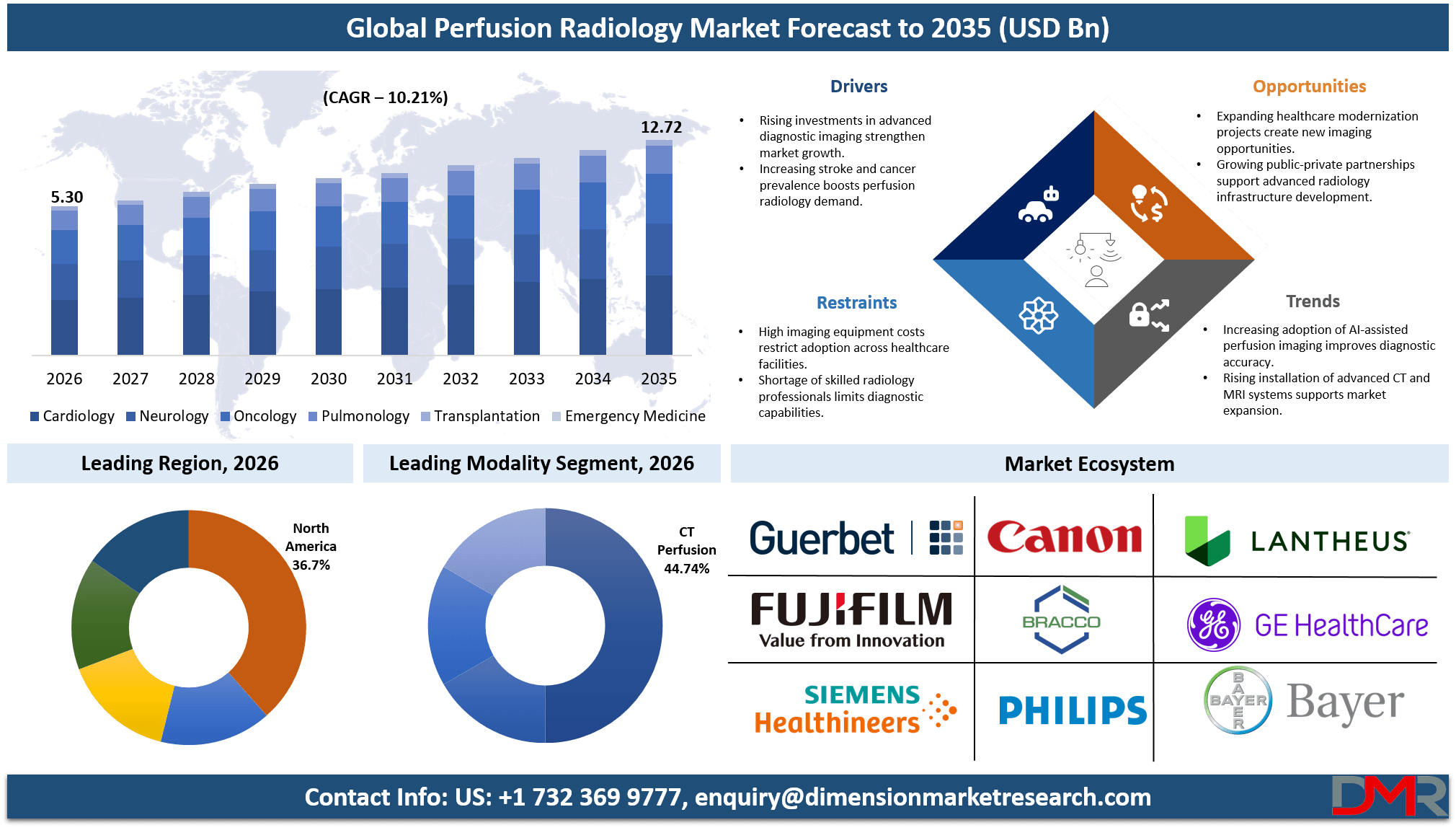
- Global Perfusion Radiology Market valued at USD 4.81 Billion in 2025, projected to reach USD 12.72 Billion by 2035 at a CAGR of 10.21%.
- CT Perfusion leads By Modality with a 44.74% revenue share in 2026.
- Cardiology leads By Application with a 47.95% revenue share in 2026.
- Hospitals lead By End User with a 60.24% revenue share in 2026.
- North America holds the dominant regional position, anchored by the U.S. market at USD 1.46 Billion in 2026.
Market Overview
The perfusion radiology market covers imaging modalities, processing software, and contrast agents used to measure blood flow at the tissue level across clinical specialties. The market excludes structural imaging without hemodynamic analysis and standalone contrast agent formulations sold outside perfusion protocols. Cardiology, neurology, and oncology each drive distinct procurement patterns, making this a multi-vertical market rather than a single-application segment.
ℹ
To learn more about this report –
Download Your Free Sample Report Here
Perfusion radiology sits at the intersection of diagnostic imaging hardware and clinical decision software, a position that makes it unusually sensitive to both device refresh cycles and evidence-based protocol adoption. As reported by Radiopaedia, normal gray-matter cerebral blood flow runs at approximately 60 mL/100g/min, cerebral blood volume at 4 mL/100g, and mean transit time around 4 seconds. These clinical baselines are embedded directly into commercial perfusion software, meaning vendors who control the algorithm also shape clinical thresholds at scale.
AI integration is repositioning perfusion radiology from a pure imaging function into a care-coordination tool. Automated platforms now generate quantitative perfusion maps that feed directly into treatment-routing decisions, shifting vendor competition from hardware specifications toward software accuracy and workflow integration speed.
Market Size and Forecast
The Global Perfusion Radiology Market size is estimated at USD 5.30 Billion in 2026 from USD 4.81 Billion in 2025, and is projected to reach USD 12.72 Billion by 2035, exhibiting a CAGR of 10.21% during the forecast period.
Dose-reduction technology has removed a structural barrier to wider perfusion protocol adoption. A PubMed-documented iterative reconstruction protocol for cerebral CT perfusion enabled a 50% reduction in radiation dose while preserving diagnostic image quality. Separately, data published via Radiology Business shows ASIR and low-kV cranial CT protocols reducing dose-length product by more than 34% in one protocol group and more than 64% in another. Hospitals that previously limited perfusion to high-acuity cases can now extend protocols to a broader patient population without exceeding dose budgets, pulling forward demand volume.
Canon Medical Systems' global commercial launch of the Alphenix 4D CT with Aquilion ONE / INSIGHT Edition in November 2025 illustrates how hybrid Angio-CT platforms are compressing the perfusion workflow into a single interventional suite. Vendors that bundle perfusion assessment, treatment planning, and post-procedure verification into one system shorten procurement conversations and increase switching costs, which supports the long-term revenue trajectory underlying the 2035 forecast.
Modality Analysis
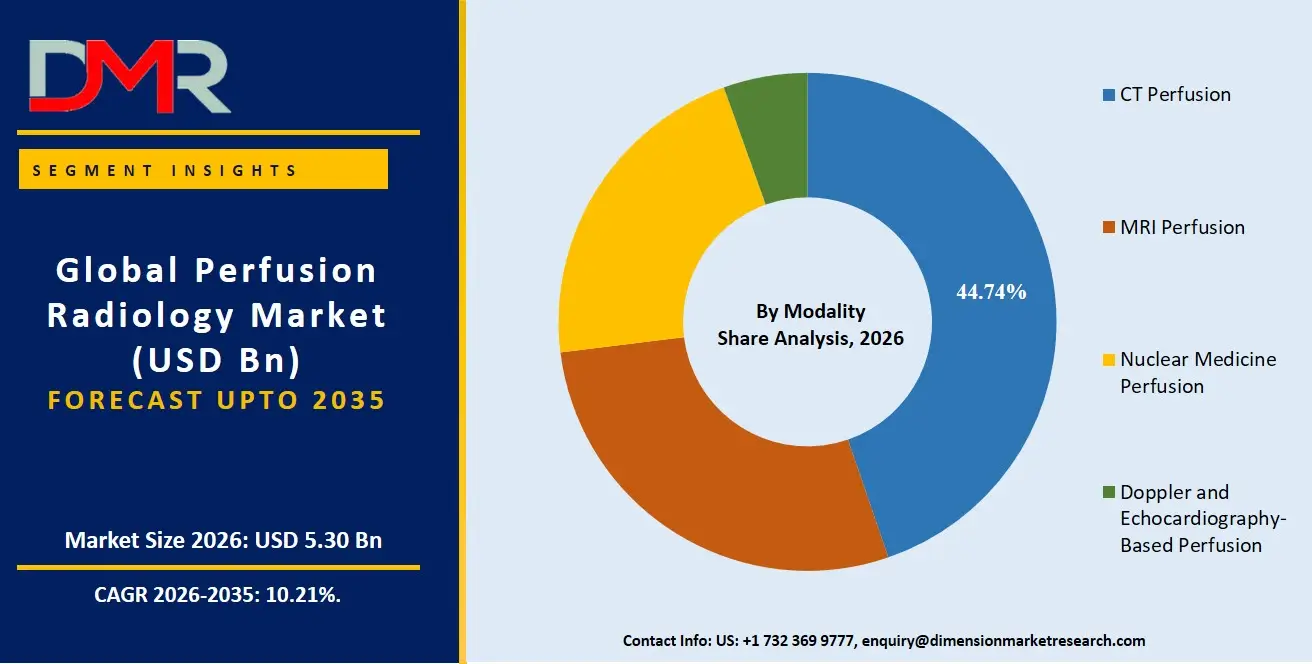
CT Perfusion led the modality segment with a 44.74% share in 2026.
CT Perfusion's revenue dominance reflects installed-base momentum across both primary and comprehensive stroke centers. Stroke protocols built around CT Perfusion are embedded in clinical guidelines validated by landmark trials including DEFUSE 3 and DAWN, creating procurement inertia that competing modalities cannot easily disrupt in the near term. Facilities that already own CT scanners face no incremental hardware cost to activate perfusion protocols, which makes CT Perfusion the default entry point for centers expanding into advanced neuroimaging.
ℹ
To learn more about this report –
Download Your Free Sample Report Here
The hypoperfusion intensity ratio, a quantitative metric defined as the volume of tissue with Tmax greater than 10 seconds divided by the volume with Tmax greater than 6 seconds, is now embedded in CT Perfusion software to characterize collateral status, as documented in Stroke Manual data. MRI Perfusion serves oncology and functional brain imaging where non-ionizing acquisition matters, while Nuclear Medicine Perfusion retains a cardiology-specific role that GE HealthCare is actively expanding. Doppler and Echocardiography-Based Perfusion addresses point-of-care settings where CT or MRI access is limited. Automated perfusion platforms flag ischemic regions when time-to-peak or MTT parameters exceed 145% of contralateral normal tissue, as confirmed by a 2025 Stroke Manual review, giving CT Perfusion software a quantitative rules layer that vendors in other modalities have yet to replicate at comparable scale.
Application Analysis
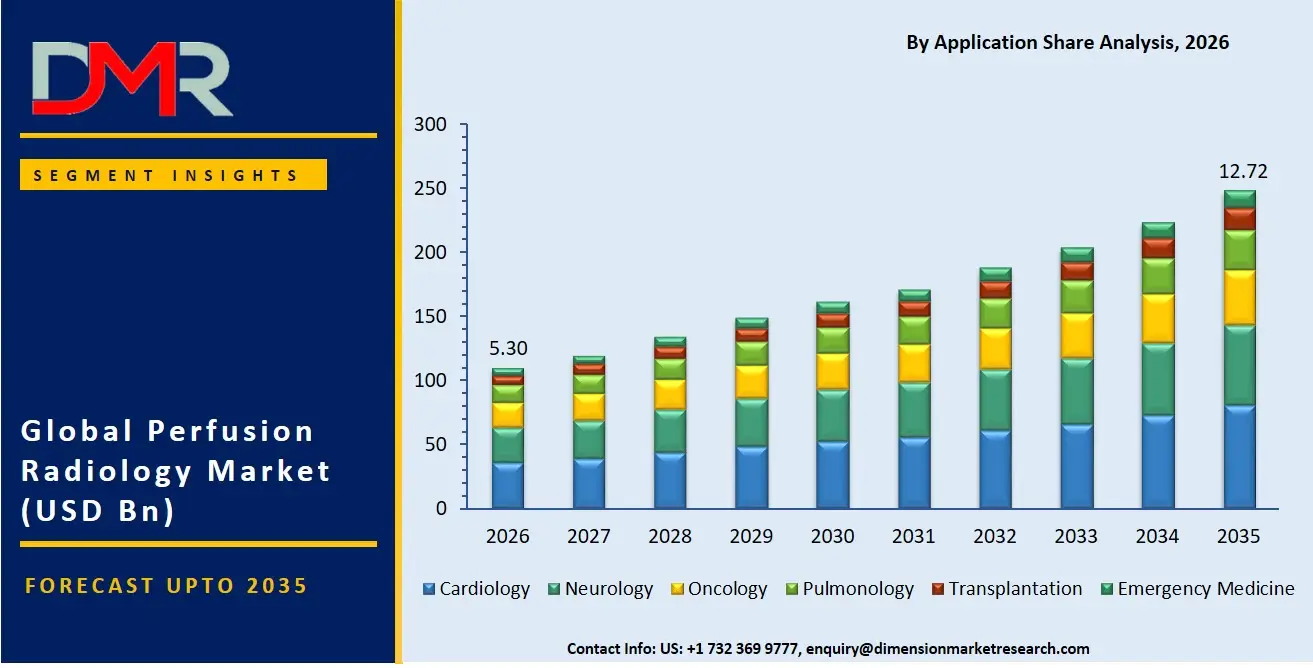
With a 47.95% share in 2026, Cardiology outpaced all other application categories.
Cardiology's application dominance is structural. Myocardial perfusion imaging is a high-volume, repeat-use clinical workflow tied to coronary artery disease management, one of the highest-prevalence conditions across every major geography. Cardiac perfusion studies generate recurring protocol revenue rather than episodic demand, making cardiology accounts disproportionately valuable to vendors. Imaging providers who locked in cardiac perfusion contracts during the post-pandemic device refresh cycle now benefit from multi-year consumable and software maintenance revenue streams.
ℹ
To learn more about this report –
Download Your Free Sample Report Here
Neurology holds the second position, anchored by stroke triage protocols where perfusion determines treatment eligibility in time-critical windows. Oncology is accelerating as MRI Perfusion opens non-ionizing assessment pathways for tumor vascularity without the radiation burden of CT. Pulmonology, Transplantation, and Emergency Medicine represent smaller but strategically distinct niches where perfusion adoption is earlier-stage and less contested, giving focused vendors an opportunity to establish category leadership before protocols become standardized.
End User Analysis
Hospitals accounted for 60.24% of end-user demand in 2026, the highest of any category.
Hospitals dominate because CT and MRI Perfusion require scanner infrastructure, skilled radiologists, and software licensing that only high-volume institutions can support economically at present. Comprehensive stroke centers drive the most intensive perfusion use, combining emergency triage, intervention, and post-procedure assessment within a single facility. The hospital channel is also where enterprise imaging procurement occurs, allowing major vendors to bundle perfusion software into broader radiology platform contracts.
Diagnostic Imaging Centers represent the fastest-growing end-user category as cloud-deployed perfusion software reduces the dependency on on-premise processing hardware. Ambulatory Surgical Centers are beginning to integrate perfusion assessment into interventional suites, a trend Canon Medical's hybrid Angio-CT platform directly targets. Academic and Research Institutes drive protocol development and clinical validation, acting as early adopters whose published outcomes propagate into hospital procurement decisions downstream. Pharmaceutical and Biotechnology companies are a distinct but growing end-user segment, applying perfusion imaging as a biomarker tool in oncology and cardiovascular drug trials.
Key Market Segments
By Modality
- CT Perfusion
- MRI Perfusion
- Nuclear Medicine Perfusion
- Doppler and Echocardiography-Based Perfusion
By Application
- Cardiology
- Neurology
- Oncology
- Pulmonology
- Transplantation
- Emergency Medicine
By End User
- Hospitals
- Diagnostic Imaging Centers
- Ambulatory Surgical Centers
- Academic and Research Institutes
- Pharmaceuticals & Biotechnology
Regional Analysis
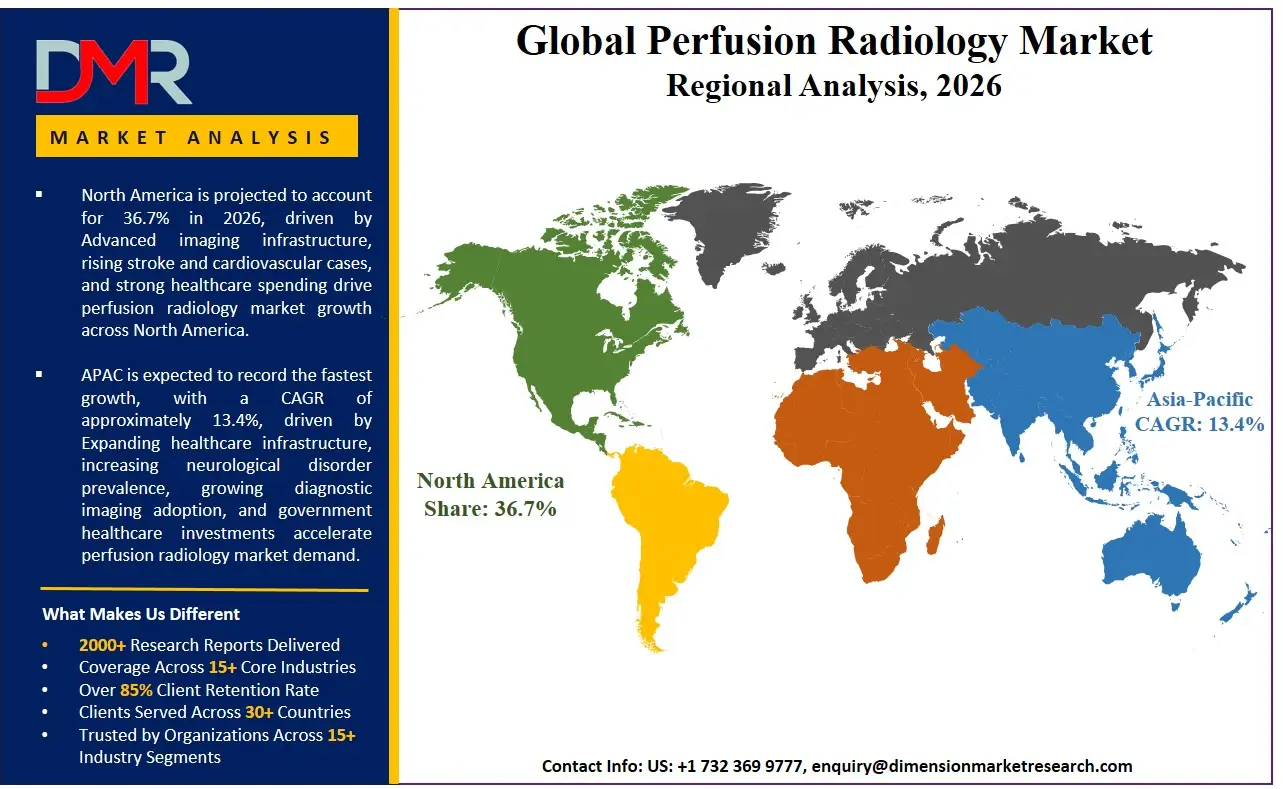
North America led the regional segment, with the U.S. alone generating USD 1.46 Billion in 2026, as it holds 36.7% of the total market share in 2026 positioning the region as the single largest national perfusion radiology market globally.
North America's position reflects concentrated infrastructure advantages: the highest density of comprehensive stroke centers, Medicare reimbursement frameworks that cover CT and MRI Perfusion for acute stroke and cardiac indications, and a regulatory environment where FDA-cleared AI perfusion platforms reach commercial deployment faster than in most other regions. Major vendors including GE HealthCare, Siemens Healthineers, and RapidAI are headquartered or have primary commercial operations in the U.S., further concentrating product launches and clinical trial activity in this geography.
ℹ
To learn more about this report –
Download Your Free Sample Report Here
Europe holds the second regional position, with Germany and the UK driving volume through national stroke network programs that mandate perfusion-capable imaging at designated centers. Asia Pacific carries the fastest growth trajectory, led by China and Japan where hospital construction programs and government-backed diagnostic modernization initiatives are creating net-new demand for perfusion infrastructure. Latin America and the Middle East & Africa remain earlier-stage markets where procurement is concentrated in urban academic centers, but both regions are starting to benefit from cloud-deployed perfusion software that bypasses the hardware acquisition barrier.
Key Regions and Countries
North America
Europe
- Germany
- France
- The UK
- Spain
- Italy
- Rest of Europe
Asia Pacific
- China
- Japan
- South Korea
- India
- Australia
- Rest of APAC
Latin America
- Brazil
- Mexico
- Rest of Latin America
Middle East & Africa
- GCC
- South Africa
- Rest of MEA
Market Dynamics
Stroke Protocol Mandates Embed Perfusion Into Standard Treatment Pathways
Landmark trial evidence from DEFUSE 3, SWIFT PRIME, EXTEND-IA, and DAWN established perfusion core-penumbra mapping as the clinical basis for mechanical thrombectomy patient selection. Regulatory clearance of FDA-indicated perfusion software for stroke triage translated that evidence into operational mandates at certified stroke centers. Hospitals cannot meet comprehensive stroke center accreditation requirements without perfusion-capable imaging, converting protocol compliance into a procurement driver that bypasses budget discretion.
A 2025 randomized multicenter acute-stroke trial across 48 centers with 1:1 allocation, documented by Critical Care Reviews and SAGE Journals, showed that perfusion-supported multimodal CT pathways measurably altered treatment-decision times and thrombolysis use compared with non-perfusion protocols. GE HealthCare's U.S. launch of Flyrcado™ in March 2025 brought an FDA-cleared PET myocardial perfusion agent to the cardiac segment, extending the evidence-based mandate logic from neuro into cardiology. Vendors whose platforms are embedded in approved clinical pathways face far lower churn than those competing on image quality alone.
Separately, automated platforms define infarct core as regions with CBF below 30% of the contralateral side and penumbra as tissue with Tmax exceeding 6 seconds, as per Stroke Manual documentation, embedding vendor-specific thresholds into clinical workflow and creating de facto algorithmic lock-in at the software layer.
Platform Divergence and Contrast Nephrotoxicity Constrain Protocol Eligibility
Statistically significant divergence in core-penumbra output between RapidAI and Viz.ai platforms forces clinicians to exercise caution when switching or comparing systems. Cross-platform decision-making inconsistency creates friction in multi-site health systems that operate mixed vendor environments, slowing enterprise-wide protocol standardization. Radiologists who flag treatment-grade discrepancies between automated tools create institutional hesitancy that delays procurement decisions.
Gadolinium and iodinated contrast agents remain prerequisites for MRI and CT Perfusion respectively, and both carry nephrotoxicity risk profiles that exclude patients with compromised renal function. As reported by PubMed, half-dose iterative reconstruction protocols rated lower in 26–31% of examinations on subjective image quality metrics, quantifying the current trade-off between dose reduction and perceived diagnostic confidence. Patients ineligible for full-dose protocols represent a structural ceiling on perfusion volume that vendors have not yet resolved through contrast-free alternatives at clinical scale.
MRI Perfusion and AI Outcome Forecasting Open Non-Ionizing Growth Pathways
MRI Perfusion is advancing at a 7.25% CAGR, creating a non-ionizing, contrast-light white space in oncology and functional brain imaging where CT Perfusion's radiation burden is a disqualifier. Tumor vascularity assessment and blood-brain barrier permeability mapping are MRI-specific applications that CT cannot replicate, placing MRI Perfusion vendors outside direct competition with the CT-dominant installed base. A hepatic CT protocol study published in Radiology confirmed that low tube voltage plus hybrid iterative reconstruction achieves substantial dose reduction with non-inferior diagnostic scores, demonstrating the direction of travel for vendors who choose to pursue lower-burden CT alternatives in parallel.
Siemens Healthineers received FDA clearance for six new Artis interventional imaging systems featuring the Optiq AI imaging chain in May 2026, signaling that AI-powered image quality enhancement is entering the interventional radiology workflow where perfusion assessment is increasingly standard. Deep-learning final-infarct-volume prediction from baseline CTP source images extends perfusion beyond diagnosis into outcome forecasting, opening a new product category that no vendor currently owns at scale. Medium-vessel-occlusion detection expansion and myocardial application diversification each address previously underserved patient cohorts, reducing the market's single-indication dependence on large-vessel acute stroke triage.
Market Trends
AI Accuracy Benchmarking and Cloud Deployment Shift Competitive Dynamics
Head-to-head accuracy benchmarking is becoming a primary competitive differentiator. Trending data shows RapidAI achieving 93% accuracy in medium-vessel-occlusion detection on CT Perfusion alone versus Viz.ai at 70%, a gap that procurement teams at stroke centers can now quantify directly. Penumbra characterization protocols that define affected tissue as CBF below 65% of normal minus CBV below 30% of the contralateral side, per Stroke Manual data, are embedding numeric rule sets that make platform accuracy claims testable and auditable. GE HealthCare introduced the Revolution Vibe CT system with AI-powered cardiac imaging tools in March 2025, reinforcing the migration of vendor value from image acquisition toward algorithmic output. Cloud-deployed perfusion software is pulling primary stroke centers into the advanced imaging segment without requiring hardware upgrades, compressing a market diffusion cycle that hardware-only vendors had relied on to protect pricing.
Market Competition Overview
The perfusion radiology market is moderately consolidated at the hardware and enterprise software layer, with four major diagnostics groups controlling the majority of installed-base placements across CT and MRI Perfusion. These players compete primarily on platform integration depth, bundling perfusion software into broader enterprise imaging contracts that include PACS, AI analytics, and contrast agent supply agreements. Scale procurement by large hospital networks has accelerated this bundling dynamic, making it increasingly difficult for single-point vendors to compete on image quality alone.
AI software providers represent a structurally distinct competitive tier. Specialized platforms win on algorithmic accuracy and stroke-workflow integration speed rather than hardware margin. Consolidation activity at the enterprise software level is intensifying: acquisitions of cloud imaging and radiology workflow businesses signal that hardware-dominant players are buying software capabilities rather than building them organically. Contrast agent suppliers occupy a recurring-revenue position that is relatively protected from platform shifts, as protocol-approved agents become embedded in clinical pathway documentation and switching requires re-validation rather than simple substitution.
Company Profiles
GE HealthCare Technologies Inc. operates across the full perfusion value chain, combining CT and MRI hardware, nuclear cardiology agents, and enterprise imaging software. The November 2025 Flyrcado expansion to the Cardiovascular Associates of America network demonstrated GE HealthCare's ability to scale a newly launched perfusion agent through an organized provider network rather than through individual hospital negotiations, a commercialization model that compresses time-to-volume for new products. The agreed acquisition of Intelerad for approximately USD 2.3 Billion in November 2025 adds cloud-based radiology workflow infrastructure, positioning GE HealthCare to capture software revenue from perfusion cases processed outside its own hardware installed base.
Key Players
- GE HealthCare Technologies Inc.
- Koninklijke Philips N.V.
- Siemens Healthineers AG
- Canon Medical Systems Corporation
- Bracco Imaging S.p.A.
- Bayer AG
- Guerbet S.A.
- Lantheus Holdings, Inc.
- Cercare Medical A/S
- FUJIFILM Holdings Corporation
- HeartFlow, Inc.
- Olea Medical S.A.
- Profound Medical Corp.
- RadNet, Inc.
- RamSoft, Inc.
- RapidAI, Inc.
- Shimadzu Corporation
- TeraRecon, Inc.
- United Imaging Healthcare Co., Ltd.
- Viz.ai, Inc.
- Sonic Healthcare
Supply Chain and Value Chain Analysis
The perfusion radiology value chain runs from raw material suppliers of detector components and contrast agent precursors through imaging hardware manufacturers, software platform developers, contrast agent producers, and clinical service providers to the end-user hospital or imaging center. Maximum value creation concentrates at two nodes: the imaging system manufacturer, which captures hardware margin and ongoing service contracts, and the AI software layer, where algorithmic accuracy commands premium licensing fees with near-zero marginal cost per additional scan processed.
The most significant supply chain risk sits in contrast agent logistics. Gadolinium and iodinated contrast agents are chemically specialized products manufactured by a limited number of producers globally. A disruption at a single major contrast manufacturing facility, as occurred during COVID-19, constrains perfusion protocol execution across entire hospital networks regardless of hardware availability. Vendors building contrast-light or contrast-free MRI Perfusion protocols are addressing this bottleneck structurally rather than reactively.
Regulatory Landscape
FDA clearance is the primary market-access gate in North America, and perfusion software platforms require separate clearance from the imaging hardware they process. AI-based perfusion decision-support tools have faced increasing FDA scrutiny under the Software as a Medical Device framework, requiring pre-market submission for any algorithm that directly influences treatment selection. Siemens Healthineers' May 2026 clearance of six Artis systems demonstrates that the FDA pathway for AI-enhanced interventional imaging remains open, but timelines are extending as the agency builds technical review capacity for machine learning models.
Europe's MDR framework imposes post-market surveillance requirements that affect both hardware and software perfusion products, increasing compliance costs for vendors selling across multiple EU member states. Japan's PMDA and China's NMPA each require domestic clinical data submissions for AI perfusion platforms, creating parallel approval processes that extend time-to-market for non-domestic vendors entering Asia Pacific. These regulatory asymmetries across geographies represent a structural advantage for players with dedicated regional regulatory affairs teams.
Investment and White Space Analysis
Investment is currently concentrating at two points in the perfusion value chain: AI software platforms with stroke-workflow integration capabilities, and enterprise imaging infrastructure that can host and distribute perfusion analytics across multi-site health systems. GE HealthCare's USD 2.3 Billion Intelerad acquisition and Canon Medical's Alphenix 4D CT platform launch both reflect this pattern, with established players deploying capital to capture software and workflow revenue rather than competing solely on scanner specifications.
The clearest white space sits in MRI Perfusion for oncology and functional brain imaging, where vendor presence is thin relative to the clinical demand pipeline. Primary stroke centers outside major metropolitan areas represent a second underserved cohort: cloud-deployed perfusion software makes them accessible without requiring hardware upgrades, but few vendors have built commercial infrastructure to serve this distributed segment at scale. Medium-vessel-occlusion detection and myocardial perfusion diversification each represent product categories where category-defining market share is still available to first movers with validated accuracy
Report Details
| Report Characteristics |
| Market Value (2025) |
USD 4.81 Billion |
| Market Value (2026) |
USD 5.30 Billion |
| Forecast Revenue (2035) |
USD 12.72 Billion |
| CAGR (2026–2035) |
10.21% |
| Historical Data |
2020 – 2024 |
| Forecast Data |
2026 – 2035 |
| Base Year |
2025 |
| Estimate Year |
2026 |
| Report Coverage |
Revenue Forecast, Market Dynamics, Competitive Landscape, Recent Developments |
| Segments Covered |
By Modality (CT Perfusion, MRI Perfusion, Nuclear Medicine Perfusion, Doppler and Echocardiography-Based Perfusion), By Application (Cardiology, Neurology, Oncology, Pulmonology, Transplantation, Emergency Medicine), By End User (Hospitals, Diagnostic Imaging Centers, Ambulatory Surgical Centers, Academic and Research Institutes, Pharmaceuticals & Biotechnology) |
| Regional Coverage |
North America – US, Canada; Europe – Germany, France, UK, Spain, Italy, Rest of Europe; Asia-Pacific – China, Japan, South Korea, India, Australia, Rest of APAC; Latin America – Brazil, Mexico, Rest of Latin America; Middle East & Africa – GCC, South Africa, Rest of MEA |
| Prominent Players |
GE HealthCare Technologies Inc., Koninklijke Philips N.V., Siemens Healthineers AG, Canon Medical Systems Corporation, Bracco Imaging S.p.A., Bayer AG, Guerbet S.A., Lantheus Holdings Inc., Cercare Medical A/S, FUJIFILM Holdings Corporation, HeartFlow Inc., Olea Medical S.A., Profound Medical Corp., RadNet Inc., RamSoft Inc., RapidAI Inc., Shimadzu Corporation, TeraRecon Inc., United Imaging Healthcare Co. Ltd., Viz.ai Inc., Sonic Healthcare, and Other Key Players |
| Customization Scope |
Customization for segments and region or country level will be provided. Additional customization can be done based on requirements. |
| Purchase Options |
We have three licenses to opt for: Single User License (Limited to 1 User), Multi-User License (Up to 5 Users), and Corporate Use License (Unlimited Users & Printable PDF). |
Frequently Asked Questions
What is the biggest investment opportunity in Perfusion Radiology Market?
▾ MRI Perfusion for oncology and functional brain imaging represents the clearest underserved white space, with MRI Perfusion advancing at a 7.25% CAGR in a segment where vendor presence remains thin relative to clinical demand. Cloud-deployed perfusion software targeting primary stroke centers outside major metropolitan hubs is a second high-return entry point, accessible without requiring new hardware infrastructure investment from hospital buyers.
Which segment is growing fastest in Perfusion Radiology Market and why?
▾ MRI Perfusion is the fastest-growing modality segment, advancing at a 7.25% CAGR, driven by oncology demand for non-ionizing tumor vascularity assessment and functional brain imaging protocols that CT Perfusion cannot serve. Among applications, Oncology is accelerating as MRI-based perfusion biomarkers enter pharmaceutical drug trials, generating repeat-use protocol revenue beyond the acute clinical setting.
Who are the top companies in Perfusion Radiology Market?
▾ GE HealthCare Technologies Inc, Siemens Healthineers AG, Koninklijke Philips N.V., and Canon Medical Systems Corporation hold the largest enterprise positions across hardware, software, and contrast agent channels. AI-specialist platforms RapidAI and Viz.ai are the most active competitors at the clinical decision-support software layer, where accuracy benchmarking is intensifying competitive pressure on the larger hardware incumbents.
Which region is growing fastest and why ?
▾ Asia Pacific is the fastest-growing region, led by China and Japan, where government-funded hospital construction and diagnostic modernization programs are creating net-new perfusion infrastructure demand. Unlike North America, where growth reflects protocol deepening within an established installed base, Asia Pacific growth reflects first-install volume that carries higher long-term vendor stickiness.
What is the biggest challenge holding Perfusion Radiology Market back?
▾ Output divergence between competing AI perfusion platforms is the most immediate structural restraint. Documented discrepancies in core-penumbra measurements between RapidAI and Viz.ai force clinical teams to treat automated outputs with caution, slowing enterprise-wide protocol standardization and creating friction in procurement decisions at multi-site health systems. Contrast agent nephrotoxicity adds a second eligibility ceiling that limits perfusion protocol volume among renally compromised patient populations.