Market Overview
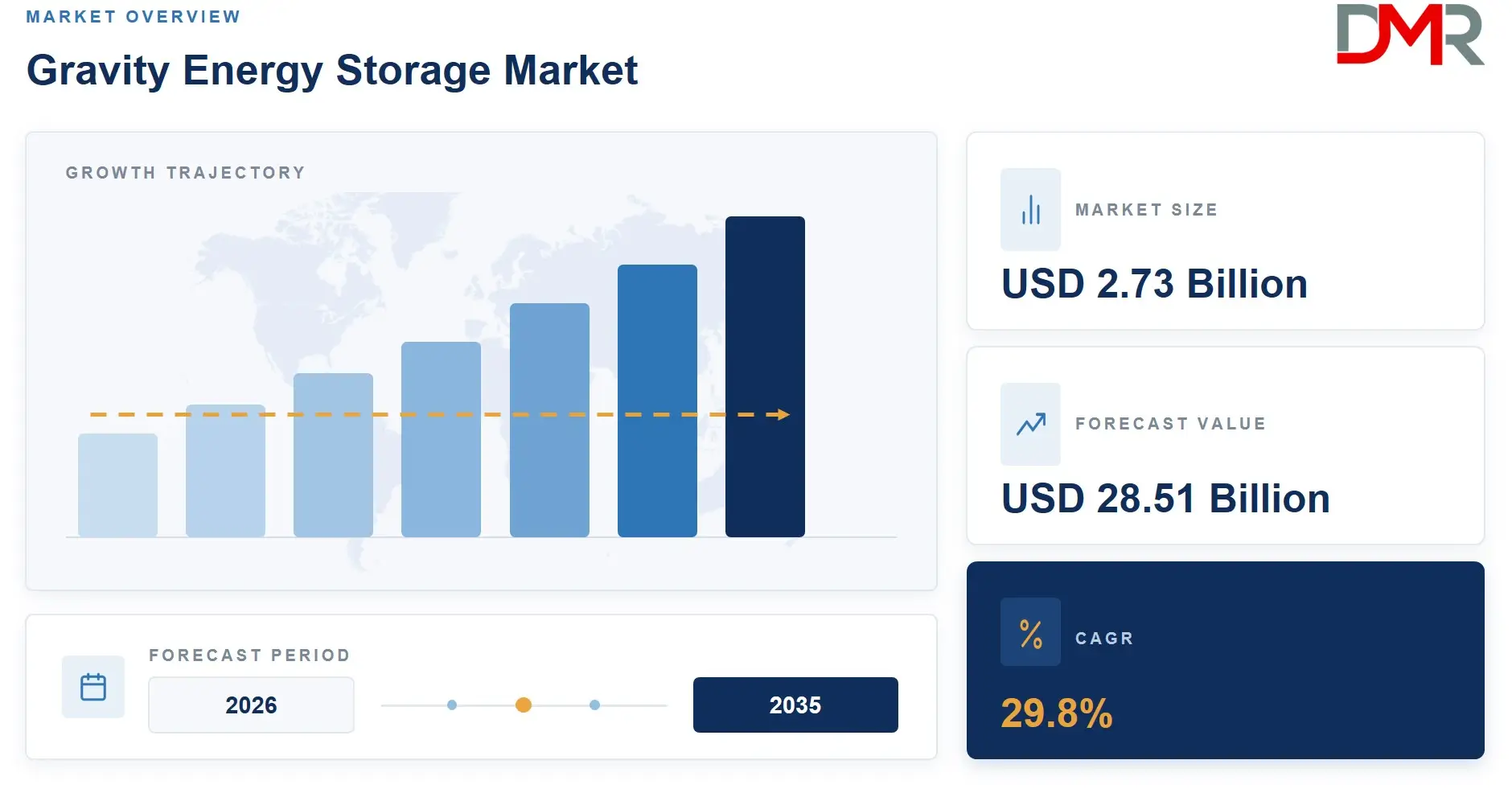
The Global Gravity Energy Storage Market size is estimated at USD 2.73 Billion in 2026, and is projected to reach USD 28.51 Billion by 2035, exhibiting a CAGR of 29.8% during the forecast period.
A 29.8% CAGR reflects buyer conviction that Long Duration Energy Storage gaps created by grid decarbonization cannot be filled by lithium-ion or pumped hydro alone. Gravity systems attract capital because they operate without electrochemical degradation, offering 30 to 50 year asset lifespans that reframe total cost comparisons at multi-hour discharge durations. In January 2026, RheEnergise's Devon High-Density Hydro facility achieved full rated power, providing the first commercially verified performance benchmark for the sector.
Gravity energy storage converts potential energy from elevated mass into electricity on demand. The market covers tower-based, mine-shaft, hydraulic, and rail-based gravity concepts, but excludes pumped hydro reservoirs, compressed-air storage, and battery chemistries. As reported by RheEnergise, the Cornwood demonstrator reached its designed peak output of 500 kW in January 2026, representing the first gravity storage system to consistently achieve its rated output in public field conditions.
Gravity storage connects directly to long-duration grid infrastructure, capacity markets, and renewable integration programs across North America, Europe, and Asia Pacific. Abandoned industrial sites and former mine networks in these regions provide deployable physical infrastructure at near-zero greenfield cost. That structural advantage separates gravity storage from every other long-duration technology competing for the same grid slots.
ℹ
To learn more about this report –
Download Your Free Sample Report Here
Key Takeaways
- The market size is USD 2.73 Billion in 2026, and is projected to hit USD 28.51 Billion by 2035 at a CAGR of 29.8%.
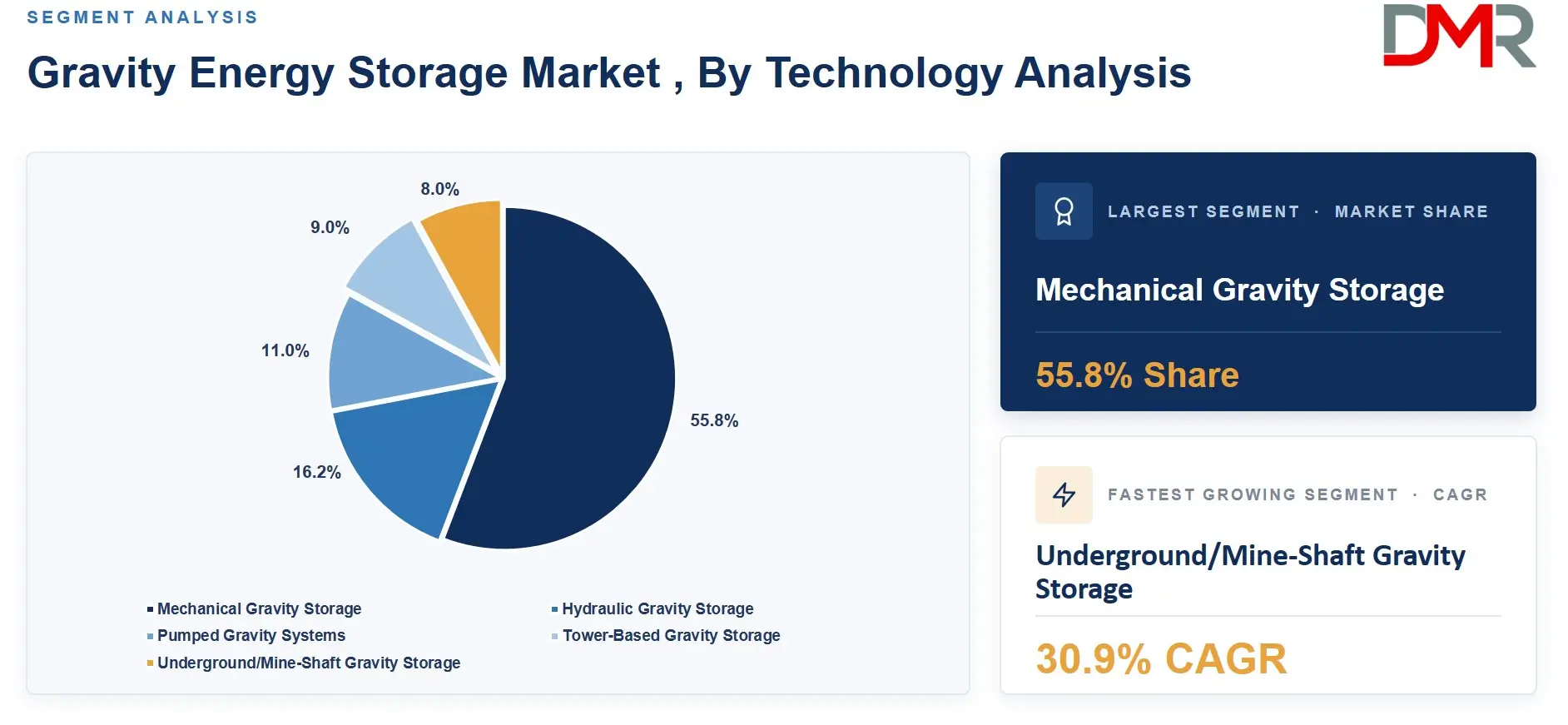
- By Technology: Mechanical Gravity Storage led as the largest category with a 55.8% share in 2026.
- By Energy Capacity: Above 1 MWh led as the largest and fastest-growing category with a 60.4% share in 2026.
- By Storage Duration: Above 4 Hours led as the largest category with a 54.4% share in 2026.
- By Component: Mechanical Systems led as the largest category with a 38.2% share in 2026.
- By Installation Method: Above-Ground led as the largest category with a 60.1% share in 2026.
- By Application: Grid Energy Storage led as the largest category with a 50.2% share in 2026.
- By End User: Utilities led as the largest category with a 64.2% share in 2026.
- By Region: North America led with a 37.2% share in 2026.
- Top key players: Energy Vault Holdings, Inc., Gravitricity, Green Gravity Pty Ltd., RheEnergise Limited, Gravity Power.
Technology Analysis
Mechanical Gravity Storage accounted for 55.8% of technology demand in 2026, the highest of any category.
Mechanical gravity storage leads because tower-based and rail-based weighted systems have the most mature engineering specifications among gravity storage concepts. Energy Vault's EVx tower platform has completed multiple pilot installations, giving project finance teams a physical reference point that hydraulic and mine-shaft systems still lack at scale. Buyers in grid-scale applications default to mechanical systems precisely because bankable technical documentation exists for them and not for competing concepts.
Hydraulic Gravity Storage and Pumped Gravity Systems attract attention from buyers seeking higher energy density per site footprint. RheEnergise's commercial-scale design targets 10 to 100 MW per project with storage durations of 6 to 20 hours, positioning hydraulic gravity ahead of mechanical tower systems on duration per MW. Underground and Mine-Shaft Gravity Storage carries the fastest growth trajectory, driven by zero-greenfield-cost access to abandoned shaft infrastructure across former coal regions in the UK, Germany, Poland, and Australia. Grid-side voltage and current in vertical-shaft gravity systems stabilized within 0.15 seconds in a 2025 simulation, with three-phase total harmonic distortion measuring 4.72%, a performance characteristic that utilities weigh heavily against competing technologies.
ℹ
To learn more about this report –
Download Your Free Sample Report Here
Energy Capacity Analysis
With a 60.4% share in 2026, Above 1 MWh outpaced all other energy capacity categories.
Above 1 MWh systems dominate because grid operators and utilities procure gravity storage for multi-hour discharge applications where large capacity blocks deliver the greatest dispatch value. Green Gravity's mine-shaft design uses individual weights of 60 to 80 tonnes in shafts approximately 500 metres deep, a physical configuration that inherently produces megawatt-hour-scale output rather than sub-megawatt-hour capacity. Grid Scale Energy Storage procurement programs in the U.S. and EU explicitly require minimum capacity thresholds that lock sub-megawatt systems out of the most valuable tenders.
Below 500 kWh systems address commercial and industrial behind-the-meter demand, where modular tower gravity units compete as zero-fire-risk substitutes for lithium-ion. The 500 kWh to 1 MWh band serves community microgrids and isolated industrial facilities. Green Gravity's commercial specification confirms up to 10 MW per mine shaft with 8 to 20 hour discharge durations, pushing the Above 1 MWh segment's growth further as operators stack multiple shafts to hit project-scale capacity targets.
Storage Duration Analysis
Above 4 Hours led the storage duration segment with a 54.4% share in 2026.
Above 4 Hours dominates because gravity storage's commercial value proposition lives entirely in the long-duration window where lithium-ion faces prohibitive cost scaling. Grid operators procuring for overnight storage, multi-hour renewable firming, and morning peak ramp events require four-plus-hour assets. Gravity systems compete directly for these slots and rarely enter short-cycle arbitrage markets where round-trip efficiency advantages favor electrochemical technologies.
Below 1 Hour applications represent a small and contested segment. Gravity systems face structural efficiency disadvantages against flywheels and batteries for frequency regulation at sub-one-hour durations. The 1 to 4 Hour band serves peaking applications and some renewable smoothing contracts, but buyers in this window typically prefer lithium-ion on procurement timelines and financing familiarity. Gravity storage grows fastest at the Above 4 Hours end, where bankable alternatives are fewest.
Component Analysis
A 38.2% share made Mechanical Systems the clear leader across component categories in 2026.
Mechanical systems capture the largest component share because hoisting assemblies, cable systems, and counterweight structures form the primary capital expenditure in every gravity storage configuration. Suppliers with crane, mining, and industrial lifting heritage hold natural cost and engineering advantages in this segment. Civil and structural infrastructure costs rank second by total project spend, reflecting the site preparation requirements for tower foundations and shaft reinforcement work.
Motor-Generator Systems and Power Conversion Systems carry higher per-unit margins than civil or mechanical components. Control and Automation Systems represent the fastest-evolving sub-category, as operators require real-time dispatch optimization and grid-synchronization software that commodity vendors cannot supply. Buyers who control the control and automation layer hold structural pricing power in service contracts and future upgrade cycles.
Installation Method Analysis
Above-Ground captured 60.1% of the installation method segment in 2026, ahead of all rivals.
Above-ground installations lead because tower-based gravity systems can be sited on flat terrain without mining permits, shaft rehabilitation costs, or underground geotechnical assessments. Energy Vault's EVx platform epitomizes this advantage. Vendors can deliver above-ground systems on brownfield industrial sites within standard construction timelines, making them financeable under conventional project development schedules.
Underground and Mine Shaft installations are growing fastest from a smaller base. Former collieries in the UK, Pennsylvania, and New South Wales provide ready shaft infrastructure that eliminates the civil construction cost that above-ground systems require for their foundations and tower structures. Hillside and Terrain-Based systems occupy a niche applicable to rail-network-adjacent terrain and mountainous renewable generation sites. Each installation method targets a distinct buyer profile, limiting direct competition between the three sub-categories within a single project.
Application Analysis
Grid Energy Storage led the application segment with a 50.2% share in 2026.
Utilities and grid operators account for half of all gravity storage deployments because multi-hour grid firming contracts represent the highest-value and most creditworthy revenue stream available to project developers. Renewable Energy Integration captures the next largest application block, driven by wind and solar curtailment reduction targets embedded in national grid decarbonization plans. Peak Shaving and Load Shifting and Frequency Regulation follow, both constrained by gravity systems' efficiency characteristics at shorter durations.
Backup and Resilience applications carry the fastest growth trajectory across the application segment. Remote mining sites, island grids, and critical infrastructure operators face diesel fuel logistics costs that make gravity storage economically compelling without requiring grid interconnection revenue. A 29.8% sector CAGR masks material divergence across applications. Backup and Resilience could outpace the broader market rate as industrial operators in diesel-dependent geographies convert to in-situ gravity storage with zero ongoing fuel exposure.
End User Analysis
Utilities led the end user segment with a 64.2% share in 2026.
Utilities dominate because regulated procurement frameworks and capacity market structures create the most reliable revenue visibility for long-duration gravity storage assets. Independent Power Producers and Renewable Energy Developers compete for the second tier of deployments, typically in merchant or offtake-backed project structures. Commercial and Industrial buyers are the fastest-growing end user category, pulled by modular tower gravity systems that offer C&I operators a non-chemical, zero-fire-risk alternative to rooftop or on-site lithium-ion storage.
Mining Companies occupy a strategically important but currently small end-user position. A dual-purpose economic model, using mine shaft infrastructure simultaneously for extraction operations and energy storage, creates a compelling capital efficiency argument. Mining's sustainability mandates and diesel cost exposure make it one of the most commercially logical early adopter segments outside utilities.
Key Market Segments
By Technology
- Mechanical Gravity Storage
- Hydraulic Gravity Storage
- Pumped Gravity Systems
- Tower-Based Gravity Storage
- Underground/Mine-Shaft Gravity Storage
By Energy Capacity
- Above 1 MWh
- Below 500 kWh
- 500 kWh–1 MWh
By Storage Duration
- Above 4 Hours
- Below 1 Hour
- 1–4 Hours
By Component
- Mechanical Systems
- Motor-Generator Systems
- Power Conversion Systems
- Control & Automation Systems
- Civil & Structural Infrastructure
By Installation Method
- Above-Ground
- Underground/Mine Shaft
- Hillside & Terrain-Based
By Application
- Grid Energy Storage
- Renewable Energy Integration
- Peak Shaving & Load Shifting
- Frequency Regulation
- Backup & Resilience
By End User
- Utilities
- Independent Power Producers
- Renewable Energy Developers
- Commercial & Industrial
- Mining Companies
Regional Analysis
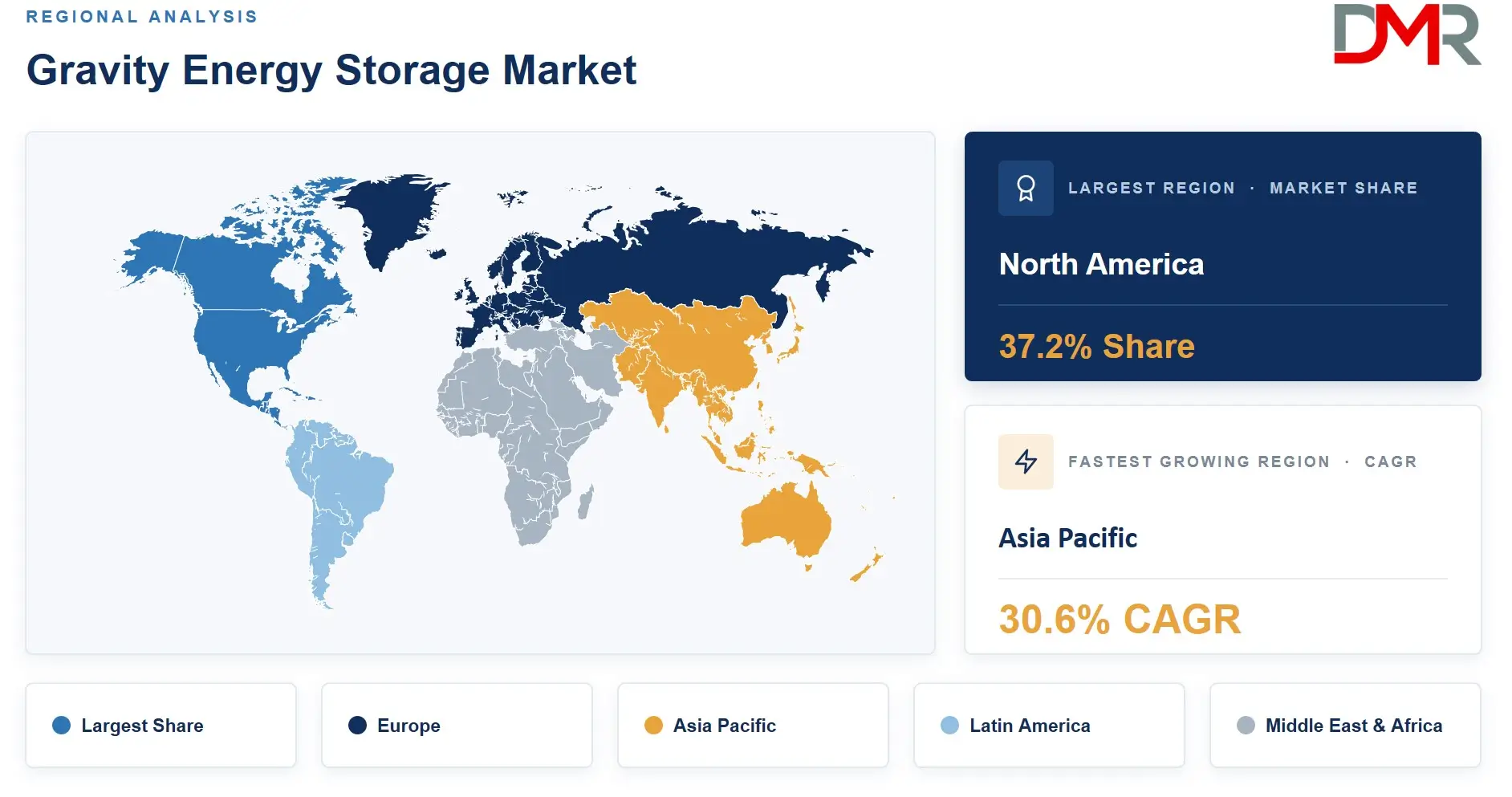
North America led the gravity energy storage market with a 37.2% share in 2026.
North America
North America holds the largest regional share because U.S. federal energy policy, including the Inflation Reduction Act's investment tax credit provisions and the Department of Energy's Long-Duration Storage Shot program, created procurement signals that pulled gravity storage into competitive RFPs alongside battery and pumped hydro bids. US Energy Storage policy frameworks explicitly target technology-agnostic procurement, giving gravity systems access to tendering processes that earlier grid procurement cycles excluded. During modeled grid-connection tests, the simulated 40 MW to 20 MW power command change showed that a gravity storage system maintained a DC bus near 8,000 V with grid-side total harmonic distortion of 4.93%, a performance level that satisfies IEEE interconnection standards in North American grid codes.
Asia Pacific
Asia Pacific carries the fastest regional growth rate, driven by China's aggressive grid storage procurement targets, Australia's abundant abandoned mine infrastructure, and India's accelerating renewable capacity additions. China's grid operators face multi-hour storage gaps that pumped hydro permitting timelines cannot address within national carbon neutrality schedules. Australia provides the most developed mine-shaft gravity pipeline outside the UK, with New South Wales government programs actively co-funding demonstration projects at former colliery sites.
ℹ
To learn more about this report –
Download Your Free Sample Report Here
Europe
European deployment centers on the UK, Germany, and Poland, where former coal mining regions provide both abandoned shaft infrastructure and government remediation funding that de-risks project capital costs. The UK leads European activity through Gravitricity's Edinburgh operations and RheEnergise's Devon field site. EU industrial policy under the Net-Zero Industry Act designates long-duration storage as a strategic technology, opening state-aid exemptions that accelerate project timelines for gravity system developers operating in member states.
Latin America
Latin America represents an emerging opportunity for terrain-based and mine-shaft gravity systems, particularly in Chile and Peru where copper and lithium mining operations generate both diesel cost exposure and available shaft infrastructure. Hydropower dependence across Brazil and Colombia creates vulnerability during drought cycles that gravity storage in terrain-abundant Andean regions could partially offset. No utility-scale gravity project has reached financial close in Latin America as of 2026, making the region a second-wave market.
Middle East & Africa
The Energy Vault and Eskom partnership in South Africa marks the first utility-scale gravity storage commitment on the African continent. South Africa's Hendrina project targets a population center with chronic load-shedding exposure, creating a replicable project template for other Sub-Saharan utilities facing similar grid reliability deficits. GCC nations hold no current gravity storage pipeline, given the absence of suitable terrain or abandoned mine infrastructure in flat desert geographies.
Key Regions and Countries
North America
Europe
- Germany
- France
- The UK
- Spain
- Italy
- Rest of Europe
Asia Pacific
- China
- Japan
- South Korea
- India
- Australia
- Rest of APAC
Latin America
- Brazil
- Mexico
- Rest of Latin America
Middle East & Africa
- GCC
- South Africa
- Rest of MEA
Macroeconomic Impact
Rising real interest rates between 2022 and 2025 compressed project finance availability for early-stage gravity storage developers, whose technologies lacked operational track records required by senior lenders. Rate normalization in 2025 and 2026 partially restored debt market access, but project finance structures still require government loan guarantees or co-investment for most gravity storage deals outside the U.S. Inflation Reduction Act framework. A 2025 IEEE simulation confirmed that at 50% renewable energy penetration, the optimal gravity storage allocation reached 104 MW, with a minimum modeled daily operating cost of CNY 2,309,879, a figure that grid planners use to benchmark procurement economics against competing dispatchable assets.
Currency movements affect gravity storage's supply chain economics because most mechanical and civil components are sourced locally, while power electronics and control systems carry more global supply chain exposure. Euro and pound sterling weakness against the U.S. dollar raised imported component costs for European developers in 2024 and early 2025, a headwind that partially offset EU remediation grant benefits. GDP growth in India and Southeast Asia expands the addressable market for gravity storage at remote mining and industrial sites where diesel dependence makes storage economics self-justifying without grid revenue.
Market Dynamics
Driver: Long-Duration Policy and Grid Decarbonization Pull Forward Demand
Policy frameworks in the U.S., EU, and UK explicitly designate long-duration storage as a grid infrastructure priority, creating technology-agnostic procurement channels that gravity systems enter on equal terms with batteries and pumped hydro. Energy Storage Systems policy in the U.S. under the Long-Duration Storage Shot program targets cost reductions to USD 0.05/kWh for systems delivering 10 to 100 hours of storage, a target range where gravity systems are structurally competitive. RheEnergise's working fluid operates at approximately 2.5 times the density of water, a physical characteristic that multiplies extractable energy from a given elevation difference and widens the technology's cost competitiveness against conventional pumped hydro at constrained sites.
A 2025 IEEE 30-node grid simulation found that optimized gravity storage reduced the grid's peak-to-valley load difference by 36.1%, a performance outcome that directly addresses the grid stability problem driving multi-hour storage procurement globally. Gravity storage systems demonstrated a response speed of reaching a new stable operating point within 0.4 seconds following a 40 MW to 20 MW power command step-change, satisfying grid frequency response specifications that long-duration technologies historically struggled to meet.
Restraint: Absence of Bankable Operational History Limits Project Finance Access
Gravity storage systems lack the utility-scale operational history that project finance lenders require to apply standard debt-to-equity structures. No gravity storage installation has completed a full annual operating cycle at commercial scale as of 2026, leaving lenders without the performance data needed to underwrite senior debt without government guarantees. A 2025 peer-reviewed optimization study of a 20 MWh piston-hydraulic system achieved a modeled round-trip efficiency of 76.67%, an improvement over initial designs but still below the 80 to 90% round-trip efficiency that lithium-ion systems routinely deliver in bankable technical reports.
Dispatch cost penalties accumulate in short-cycle arbitrage markets where gravity systems' efficiency gap against lithium-ion generates higher effective cost per MWh dispatched. Lenders and offtake buyers in markets with hourly price spreads penalize gravity storage relative to batteries in revenue models. Developers who cannot demonstrate multi-year operational data face a financing gap that government grants partially bridge but do not eliminate.
Opportunity: Mine Remediation Programs and Industrial Site Repurposing
EU and U.S. Rust Belt mine remediation programs fund site cleanup at former coal and industrial facilities, creating a dual-purpose economic argument for gravity storage deployment. Developers who co-locate storage with remediation work access grants that eliminate a large portion of civil construction cost. Two Green Gravity mine shafts operating in parallel deliver between 10 and 15 MW for 8 hours, equivalent to roughly 80 to 120 MWh and sufficient power for approximately 3,000 homes, a capacity output achieved without any new greenfield land disturbance.
Modular tower-based systems add a parallel opportunity channel by targeting C&I behind-the-meter markets as a non-chemical, zero-fire-risk lithium-ion alternative. Remote mining and extraction sites face diesel fuel logistics costs that make gravity storage economically compelling even without grid interconnection revenue. Rail-network-adjacent terrain provides another zero-cost infrastructure base for regenerative weighted-car gravity concepts in North America and Europe.
Porter's Five Forces
Competitive rivalry in gravity energy storage remains low in absolute terms but will intensify as demonstration projects generate bankable performance data. A 2025 vertical-shaft simulation reduced output power fluctuation from 137% to 8% after optimization at 40 MW output, and a short-circuit test showed DC-bus voltage declining from 8,000 V to approximately 6,500 V while active power fell from 40 MW to roughly 33 MW. These technical performance parameters define the engineering benchmarks that new entrants must meet to compete for utility RFPs. Barriers to entry are high because the capital requirements for demonstration projects, the engineering complexity of multi-hundred-tonne hoisting systems, and the absence of standardized components exclude most underfunded start-ups. Supplier power concentrates in motor-generator and power electronics supply chains, where a small number of industrial electrical manufacturers control critical specifications. Thermal Energy Storage and compressed-air systems represent the closest technology substitutes, competing for the same long-duration grid slots with partially overlapping site requirements. Buyer power is rising as utilities gain experience evaluating gravity storage tenders alongside competing technologies, pushing vendors toward more transparent performance disclosures and firmer output guarantees. The overall competitive structure favors early-mover vendors with operational project data over technologically capable but unproven entrants.
AI and Gen AI Impact
Artificial intelligence reshapes gravity energy storage primarily at the dispatch optimization and predictive maintenance layers of the value chain. Real-time machine learning algorithms manage weight dispatch sequences, anticipate grid frequency deviations, and optimize charge-discharge scheduling against spot market price signals faster than conventional SCADA systems. Optimized power fluctuation in modeled gravity storage systems remained below 9% across outputs of 30 to 44 MW, with a minimum of 6.7% recorded at 30 MW and 32 MW output levels, a performance envelope that AI-driven dispatch controllers actively maintain and continuously narrow.
Generative AI tools accelerate engineering design cycles for gravity system configurations. Vendors use generative models to simulate thousands of shaft depth, weight mass, and hoisting speed combinations before physical prototyping. Early movers who deploy AI design and dispatch stacks simultaneously hold a compounding advantage: lower capital costs from optimized engineering and higher revenue from smarter grid dispatch. Laggards who rely on manual dispatch and conventional structural engineering face both higher project costs and lower operational revenues.
Market Trends
Renewable Curtailment Reduction and Revenue Stacking Drive Gravity Storage Positioning
A 2025 IEEE simulation found that gravity storage reduced wind energy curtailment by 42.3% and photovoltaic curtailment by 18.7%, quantifying the grid value that renewable developers can monetize through storage co-location offtake agreements. DC bus voltage stabilized at approximately 8,000 V within 1 second in vertical-shaft simulations, with a steady-state error of only ±50 V or 0.63% of the setpoint, establishing the grid-quality output standard that capacity market revenue stacking models now require. Emerging carbon credit and capacity market revenue stacking frameworks, developed specifically for non-electrochemical long-duration assets, allow gravity storage projects to stack multiple income streams that improve project-level returns and reduce dependence on single-contract revenue.
Market Competition Overview
The gravity energy storage market is highly fragmented, with no single vendor holding more than a single-digit share of a pre-commercial sector where project counts remain in the dozens globally. Energy Vault holds the widest commercial footprint, having signed agreements across South Africa, the U.S., and Europe, and its EVx 2.0 platform at the Eskom Hendrina project specifies a 25 MW/100 MWh output at 4 hours of discharge. Gravitricity and RheEnergise compete on mine-shaft and hydraulic gravity concepts respectively, targeting project specifications where Energy Vault's tower-based platform has no technical advantage. Green Gravity occupies the mine-shaft niche in the Southern Hemisphere with an established pipeline in Australian and Indian markets.
Competitive strategy currently differentiates on technology type rather than price. Vendors cannot yet compete on cost-per-MWh track record because insufficient operational data exists to support reliable levelized cost comparisons across platforms. Long-Duration Energy Storage Consortium standards development now creates common technical benchmarks, and the first vendors to demonstrate consistent performance against those benchmarks will gain bankability advantages that translate directly into project finance cost-of-capital advantages over rivals still in demonstration phase.
Pricing Analysis
Gravity energy storage pricing sits at the early-commercial stage where technology demonstration costs dominate over steady-state production economics. A 2025 peer-reviewed optimization study reduced modeled levelized energy cost for a 20 MWh piston-hydraulic system from CNY 0.6921/kWh to CNY 0.6258/kWh, a 9.6% reduction achieved through parametric optimization of system design without hardware changes. A separate 2025 simulation found that modeled gravity storage carried a levelized storage cost 15% lower than compressed-air energy storage under equivalent grid assumptions, establishing an initial cost positioning benchmark against the closest technology competitor.
Above-ground tower systems carry higher civil construction costs per MWh than mine-shaft configurations, where existing infrastructure eliminates foundation and structural expenditure. Regional pricing diverges significantly. U.S. projects benefit from ITC credits and federal loan guarantees that effectively reduce developer capital costs by 30 to 50%. Australian and UK mine-shaft projects access government remediation grants that compress civil cost exposure further. Price convergence across gravity storage concepts will depend on accumulated project experience reducing engineering uncertainty premiums that currently inflate early-stage capital budgets.
Company Profiles
Energy Vault Holdings, Inc. holds the broadest commercial pipeline among gravity storage vendors, with tower-based EVx systems contracted across three continents. The company's strategic positioning rests on converting its first-mover demonstration advantage into bankable performance records that unlock project finance at commercial scale. Energy Vault's decision to use recycled waste coal ash blocks weighing 25 to 30 tonnes in the Hendrina EVx 2.0 design reduces both block material costs and positions the company within waste remediation funding frameworks that add non-revenue project economics.
Green Gravity Pty Ltd. concentrates entirely on mine-shaft gravity systems, a deliberate narrowing of focus that gives it engineering depth in underground hoisting mechanics that broader energy storage developers cannot match. The Russell Vale mine-shaft trial in New South Wales was specified at 150 kW with a project cost of AUD 10 million, establishing a replicable per-shaft capital benchmark for the Australian pipeline. Green Gravity's MoU with TEXMiN for Indian mine storage and its February 2026 innovation grant for gripper subsystem scaling confirm a dual-market development track across two of the world's largest abandoned mine inventories.
Key Players
- Energy Vault Holdings, Inc.
- Gravitricity
- Green Gravity Pty Ltd.
- RheEnergise Limited
- Gravity Power
- Renewell Energy
- Advanced Rail Energy Storage
- EDF
- ANDRITZ AG
- Voith Group
- GE Vernova
- Toshiba Corporation
- Quidnet Energy, Inc.
- Terrament, Inc.
- Sink Float Solutions, Inc.
- Baud Resources
- Mine Storage
- Gravitas Energy
- Heindl Energy GmbH
- IIASA-affiliated UGES developers
Supply Chain and Value Chain Analysis
Gravity energy storage supply chains divide into three distinct tiers. Upstream, raw material suppliers provide structural steel, concrete, and high-density aggregate or recycled industrial waste for counterweight blocks. Energy Vault's EVx 2.0 uses recycled blocks containing waste coal ash, with each block weighing approximately 25 to 30 tonnes, converting a remediation liability into a supply chain input that reduces block material procurement costs and supports circular economy credentials for ESG-focused investors.
Midstream, mechanical hoisting systems, motor-generator assemblies, and power conversion equipment represent the highest-margin supply chain tier. Industrial crane and mining equipment manufacturers hold engineering and certification advantages in this layer. Downstream, civil and structural contractors, grid interconnection engineers, and software control system vendors complete the value chain. Maximum value creation concentrates in power conversion and control software, where proprietary algorithms command service contract margins unavailable to commodity civil or mechanical suppliers.
Regulatory Landscape
US Grid Energy Storage Equipment regulations under FERC Order 841 and subsequent state-level implementation rules require storage resources to participate in wholesale markets on equal terms with generation assets. Gravity storage qualifies under these frameworks as a non-generation storage resource, but project developers must navigate interconnection queue processes designed originally for thermal generators. The EU Net-Zero Industry Act designates long-duration storage as a strategic technology, enabling member states to fast-track permitting and apply state-aid exemptions for qualifying projects. UK planning rules for energy storage were updated in 2023 to classify storage above 50 MW as Nationally Significant Infrastructure Projects, streamlining consenting for large gravity storage installations.
Mine rehabilitation regulations in Australia, the UK, Germany, and Poland create a parallel regulatory framework. Projects that combine mine remediation with gravity storage access both energy storage licensing and mine closure regulatory pathways simultaneously, reducing single-project regulatory exposure. Environmental permitting for underground shaft modifications remains the longest-lead regulatory step for mine-shaft gravity developers across all jurisdictions.
Investment and White Space Analysis
Investment currently flows toward demonstration and early commercial-scale projects in the U.S., UK, and Australia, where policy co-funding and mine remediation grants reduce private capital requirements to bankable levels. Offshore Energy Storage and floating gravity concepts represent a distinct white space that no vendor has commercially addressed as of 2026. Terrain-based gravity storage in mountainous renewable generation zones of Latin America and South and Southeast Asia represents an underserved segment where high renewable penetration targets and challenging grid extension economics create a natural market entry case.
Commercial and industrial behind-the-meter gravity storage carries the widest unaddressed market gap in mature economies. No modular gravity storage product had achieved certified commercial availability for C&I buyers in North America or Europe as of mid-2026. The first vendor to certify and finance a modular below-1 MWh gravity product for C&I on-site installation will access a market segment currently served entirely by lithium-ion, capturing both first-mover pricing power and long-term service contract revenue.
Recent Developments
- May 2026: Energy Vault and Eskom signed a strategic development agreement to deploy a 25 MW/100 MWh EVx 2.0 gravity storage plant at Hendrina Power Station in South Africa, providing 4 hours of discharge at rated output.
- February 2026: Energy Vault and Peak Energy entered a partnership to design sodium-ion grid storage systems, extending Energy Vault's storage technology portfolio beyond gravity-based configurations.
- January 2026: Energy Vault began construction of the 150 MW SOSA Energy Center, advancing its largest North American gravity storage project toward commissioning.
- September 2026: Energy Vault acquired land for the 1 GW Stoney Creek gravity storage project, the largest single gravity storage site commitment announced globally as of that date.
- October 2025: Green Gravity signed a memorandum of understanding with TEXMiN to develop mine-shaft gravity storage projects across Indian coal mine sites, opening a pipeline in one of the world's largest concentrations of abandoned mine infrastructure.
- February 2026: Green Gravity secured an innovation grant specifically for scaling gripper subsystem components, addressing one of the critical mechanical engineering bottlenecks in mine-shaft gravity storage deployment.
Report Scope
| Report Characteristics |
| Market Value (2026) |
USD 2.73 Billion |
| Forecast Revenue (2035) |
USD 28.51 Billion |
| CAGR (2026 to 2035) |
29.8% |
| Base Year for Estimation |
2025 |
| Historic Period |
2020 to 2024 |
| Forecast Period |
2026 to 2035 |
| Report Coverage |
Revenue Forecast, Market Dynamics, Competitive Landscape, Recent Developments |
| Segments Covered |
By Technology (Mechanical Gravity Storage, Hydraulic Gravity Storage, Pumped Gravity Systems, Tower-Based Gravity Storage, Underground/Mine-Shaft Gravity Storage), By Energy Capacity (Above 1 MWh, Below 500 kWh, 500 kWh–1 MWh), By Storage Duration (Above 4 Hours, Below 1 Hour, 1–4 Hours), By Component (Mechanical Systems, Motor-Generator Systems, Power Conversion Systems, Control & Automation Systems, Civil & Structural Infrastructure), By Installation Method (Above-Ground, Underground/Mine Shaft, Hillside & Terrain-Based), By Application (Grid Energy Storage, Renewable Energy Integration, Peak Shaving & Load Shifting, Frequency Regulation, Backup & Resilience), By End User (Utilities, Independent Power Producers, Renewable Energy Developers, Commercial & Industrial, Mining Companies) |
| Regional Analysis |
North America (US and Canada), Europe (Germany, France, The UK, Spain, Italy, and Rest of Europe), Asia Pacific (China, Japan, South Korea, India, Australia, and Rest of APAC), Latin America (Brazil, Mexico, and Rest of Latin America), Middle East & Africa (GCC, South Africa, and Rest of MEA) |
| Competitive Landscape |
Energy Vault Holdings, Inc., Gravitricity, Green Gravity Pty Ltd., RheEnergise Limited, Gravity Power, Renewell Energy, Advanced Rail Energy Storage, EDF, ANDRITZ AG, Voith Group, GE Vernova, Toshiba Corporation, Quidnet Energy, Inc., Terrament, Inc., Sink Float Solutions, Inc., Baud Resources, Mine Storage, Gravitas Energy, Heindl Energy GmbH, IIASA-affiliated UGES developers |
| Customization Scope |
Customization for segments and region or country level will be provided. Additional customization can be done based on requirements. |
| Purchase Options |
Three license options: Single User License, Multi-User License (Up to 5 Users), Corporate Use License (Unlimited Users and Printable PDF) |
Frequently Asked Questions
What is the biggest investment opportunity in the Gravity Energy Storage market?
▾ The most capital-efficient investment opportunity lies in mine-shaft gravity storage projects co-located with EU and U.S. mine remediation programs. Government remediation grants cover civil construction costs that would otherwise make early-stage projects unbankable. The market is projected to reach USD 28.51 Billion by 2035, and mine-shaft projects that qualify for dual remediation and energy storage funding carry the most favorable risk-adjusted returns in the current pipeline.
Who are the top companies in the Gravity Energy Storage market?
▾ Energy Vault Holdings, Gravitricity, Green Gravity Pty Ltd., RheEnergise Limited, and Gravity Power are the five most active vendors as of 2026. Energy Vault holds the largest commercial project pipeline across three continents. Green Gravity and RheEnergise lead in mine-shaft and hydraulic gravity configurations respectively.
Which segment is growing fastest and why?
▾ Underground and Mine-Shaft Gravity Storage is the fastest-growing technology sub-segment, and Backup and Resilience is the fastest-growing application sub-segment. Mine-shaft systems grow because existing shaft infrastructure eliminates greenfield civil construction costs. Backup and Resilience applications grow because remote mining and island grid operators face diesel logistics costs that make gravity storage economically self-justifying without grid revenue dependence.
Which region is growing fastest and why?
▾ Asia Pacific carries the fastest regional growth rate. China's multi-hour grid storage procurement targets, Australia's mine-shaft infrastructure pipeline, and India's expanding renewable capacity additions collectively pull gravity storage investment into the region ahead of Latin America and Middle East and Africa. Green Gravity's MoU with TEXMiN in India and New South Wales government co-funding of Australian mine-shaft projects reflect this acceleration.
What is the biggest challenge holding this market back?
▾ The absence of utility-scale bankable operational history is the single largest commercial constraint. Project finance lenders require full annual operating cycle data before applying standard debt-to-equity structures, and no gravity storage installation had completed that cycle at commercial scale as of 2026. Modeled round-trip efficiency of 76.67% for leading hydraulic gravity concepts remains below the 80 to 90% threshold that lithium-ion delivers in bankable technical assessments, compounding lender caution.