What is the Green Ammonia Production Market Size?
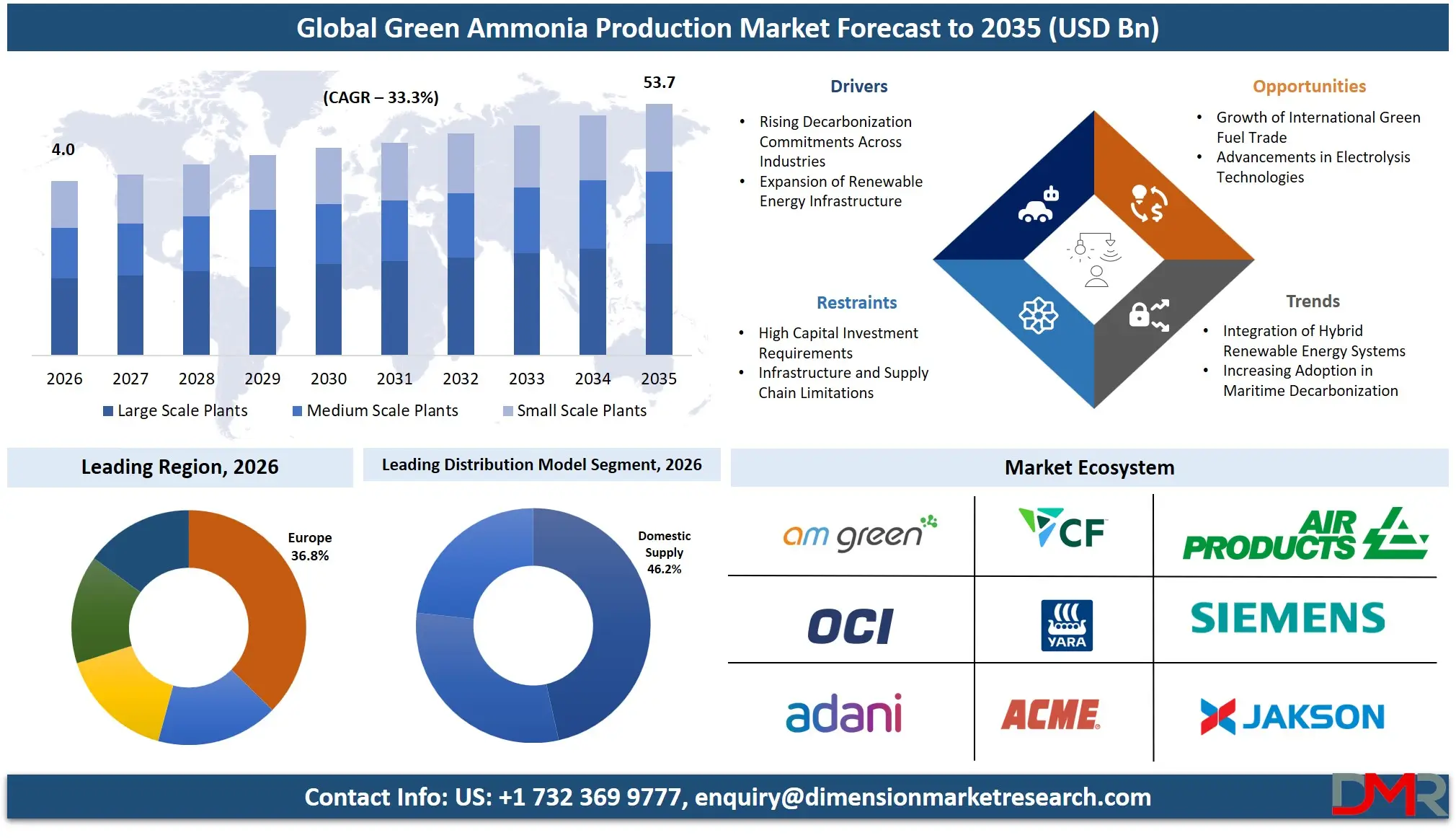
The Green Ammonia Production Market size is expected to be USD 4.0 billion in 2026 and increase at a compound annual growth rate of 33.3% to USD 53.7 billion in 2035 due to growing number of gastrointestinal, metabolic, autoimmune, and neurological diseases is propelling the market forward.
ℹ
To learn more about this report –
Download Your Free Sample Report Here
The Green Ammonia Production Market focuses on the advancements, industrial applications, and deployment of ammonia production technologies in which green hydrogen is produced through electrolysis using renewable energy sources, after which green hydrogen is combined with nitrogen through the Haber-Bosch process without using any fossil fuels. This market includes electrolysis systems, renewable energy systems, ammonia production plants, storage, transportation, and export facilities involved in the manufacturing and exportation of low-carbon ammonia.
The market is growing at a rapid pace due to increasing efforts toward reducing carbon footprint in the ammonia production sector within fertilizer, maritime, power generation, and hydrogen carriers industries. Growing investments in hydrogen value chains using renewable energy sources, government energy policies, and corporate commitments towards net-zero emission goals are expected to support continued market growth across all geographies. Major market trends in the Green Ammonia Production Market include large scale green ammonia exports, hybrid renewable energy systems, state-of-the-art electrolysis systems, and maritime ammonia utilization.
ℹ
To learn more about this report –
Download Your Free Sample Report Here
The US Green Ammonia Production Market
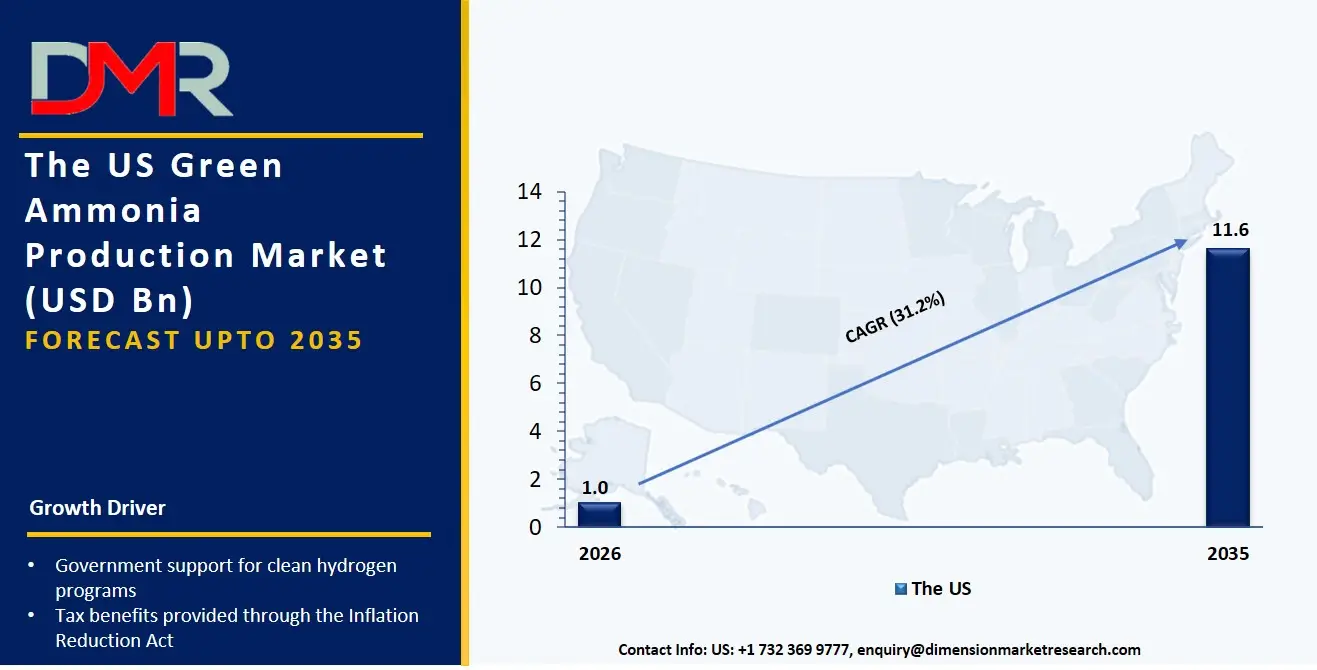
The US Green Ammonia Production Market size is estimated to be USD 1.0 billion in 2026 and is expected to increase at a CAGR of 31.2% over the forecast period.
There has been growth in the US Green Ammonia Production Market owing to government support for clean hydrogen programs, tax benefits provided through the Inflation Reduction Act, and investments in renewable energy projects. There is active involvement of energy producers, fertilizer makers, and technology companies in promoting the commercial use of this technology. The market is supported by an abundance of solar and wind energy sources in Texas and the Midwest. Collaborations between industrial producers and renewable energy developers have boosted the use of such technologies at pilot and commercial scales.
ℹ
To learn more about this report –
Download Your Free Sample Report Here
Europe Green Ammonia Production Market
The Europe Green Ammonia Production Market size is estimated to be USD 1.5 billion in 2026 and is expected to increase at a CAGR of 31.0% over the forecast period.
Production of green ammonia also remains highly promising in Europe because of high ambition climate change targets and policies such as the European Green Deal and REPowerEU program. Countries like Germany, The Netherlands, and Spain are investing heavily in infrastructure for importing renewable hydrogen and ammonia. There is also increased innovation in electrolysis and international green energy infrastructure initiatives. The introduction of carbon pricing and strict greenhouse gas emission reduction targets are driving demand for green ammonia use cases in sectors.
Japan Green Ammonia Production Market
The market size of Japan Green Ammonia Production will be USD 200 million in 2026 and at a CAGR of 32.9% in the forecast period.
Market Growth in Green Ammonia Production in Japan will continue steadily because of government-sponsored projects on carbon neutrality and increasing demand for green alternatives to conventional fuels. Japan is promoting the use of ammonia co-firing in its thermal power plants. Collaboration with international ammonia producers and development of its importation facilities have contributed positively to the market's growth. Japan's technological know-how in hydrogen and fuel systems has been instrumental in boosting developments in ammonia applications. Although challenges exist in terms of costly production processes and reliance on imports, government policies are still pushing the market forward.
Key Takeaways
- Market Size & Forecast: The Green Ammonia Production Market size is projected to reach USD 4.0 billion in 2026 and is anticipated to have a value of USD 53.7 billion in 2035.
- Growth Rate & Outlook: The Green Ammonia Production Market size is set to grow at a compound annual growth rate of 33.3% during the forecast period of 2026 to 2035.
- Primary Growth Drivers: Some of the major growth drivers in the market include Setting of Higher Carbon Neutral Goals in Diverse Industries, and more.
- Key Market Trends: Some of the major trends in the market are Hybrid Renewable Energy Systems Integration, and more.
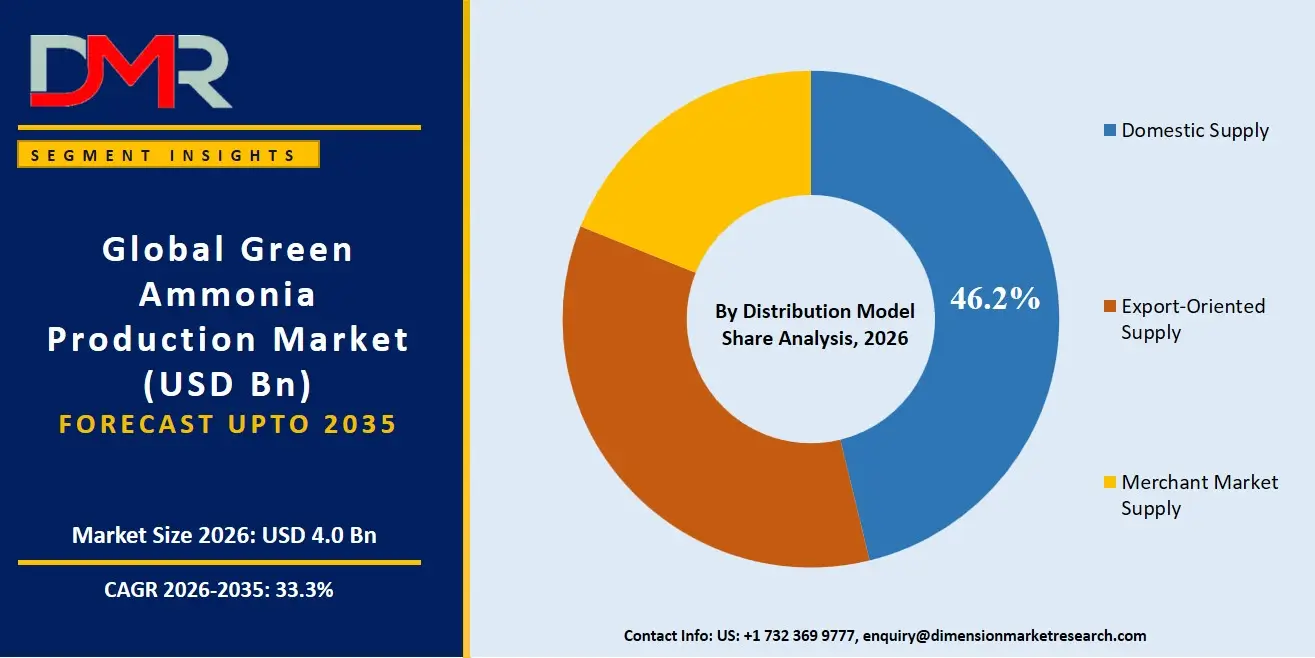
- By Distribution Model: The Domestic Supply segment is anticipated to get the majority share of the Green Ammonia Production market in 2026.
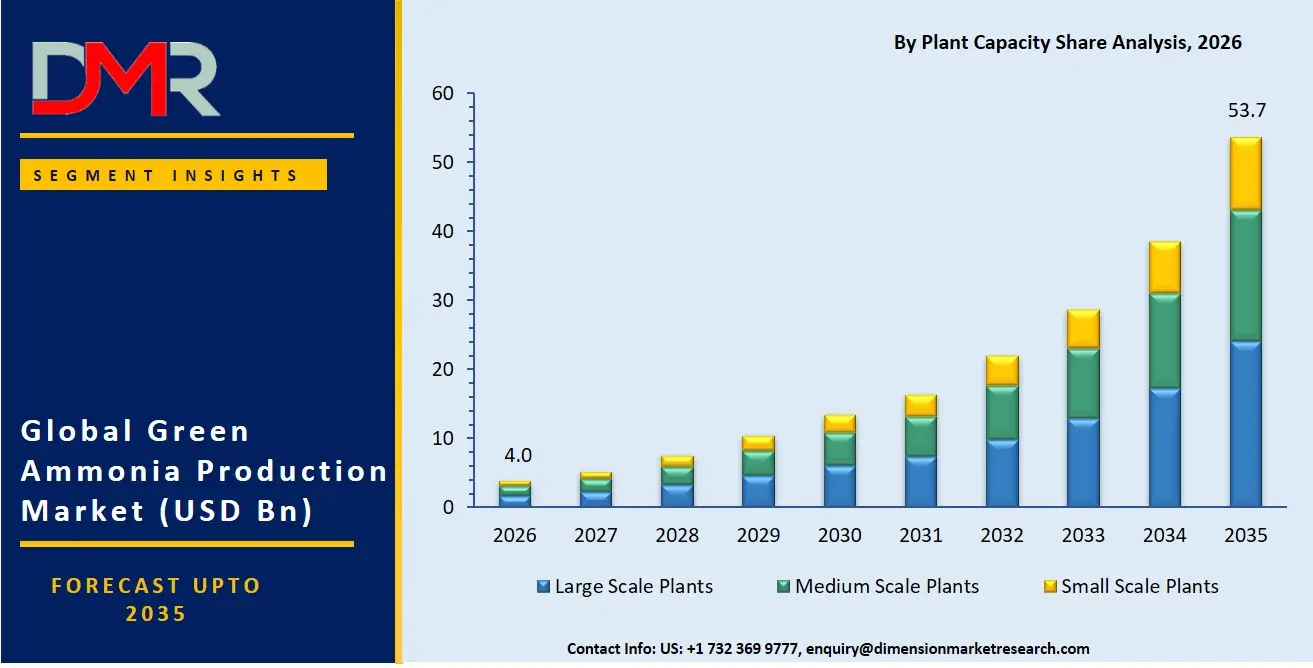
- By Plant Capacity: The large scale plants segment is expected to get the largest revenue share in 2026 in the Green Ammonia Production market.
- By End Use: The agriculture segment is expected to get the largest revenue share in 2026 in the Green Ammonia Production market.
- Regional Leadership: Europe is set to lead the Green Ammonia Production market with an estimated 36.8% share in 2026.
What is the Green Ammonia Production?
The Green Ammonia Production refers to the process of manufacturing ammonia through the use of energy from renewable energy sources in the electrolysis process to produce green hydrogen which will further undergo the Haber-Bosch reaction with nitrogen gas without the use of fossil fuels. This industry comprises electrolyzer machines, renewable energy installations, storage systems, and ammonia logistics management systems. The green ammonia production industry has gained greater relevance owing to the decarbonization initiatives being taken by various industries such as fertilizer production, shipping, energy generation, and hydrogen storage industries. The increasing investment in hydrogen economies and carbon neutrality policies has further spurred technology innovation within this industry.
Use Cases
- Ammonia Production: There has been an increase in the use of green ammonia for fertilizer production as a method of cutting carbon emissions linked with ammonia manufacturing. Fertilizer manufacturers are making use of renewable ammonia in the production of urea and nitrogen fertilizers in order to adhere to environmental policies and to cater to the rising demand for food in the world.
- Maritime Fuel: Shipping companies are looking into the potential of utilizing green ammonia as a zero-carbon fuel source for ammonia-powered ships as part of their maritime bunker fuel options. Ammonia acts as a high-density fuel for the marine industry as it helps meet International Maritime Organization's emission reduction targets.
- Power Generation: Green ammonia is being used by utility companies in coal co-firing as well as gas turbine operations in order to cut down on greenhouse gas emissions. Ammonia makes it easier to transition from carbon-based fuels to cleaner fuel alternatives without any compromise to reliability.
- Hydrogen Storage & Transport: Renewable ammonia can be used as a medium for hydrogen transport and energy storage due to its higher efficiency compared to other mediums.
How AI Is Transforming the Green Ammonia Production Market
The role of AI technology in making green ammonia production processes more effective is evident in the improved use of renewable energy sources, increased efficiency of electrolysers and enhanced monitoring capabilities of plant operations. Predictive analytics through AI technology makes it easier for manufacturers to limit production downtimes and manage their energy consumption and processes involved in ammonia production.
In addition, AI is contributing to better supply chain management and logistics planning in the green ammonia ecosystem. Automation technology ensures high levels of safety, reduced energy waste and the implementation of predictive maintenance practices that help ensure the longevity of plant infrastructure. Lastly, digital twin technology allows developers to design plants that produce ammonia efficiently at reduced development costs.
Market Dynamic
Driving Factors in the Green Ammonia Production Market
Setting of Higher Carbon Neutral Goals in Diverse Industries
There is an ever-growing interest on the part of diverse industries in setting higher goals to become carbon neutral, thus stimulating a greater demand for ammonia production methods that are environmentally friendly. Fertilizer manufacturers, transport service firms, and power generation companies are switching to low-carbon fuels, driven by the necessity to comply with emissions limits and sustainability practices. The role played by governments in supporting decarbonization initiatives in industries includes offering financial incentives in the form of grants and resorting to hydrogen production through renewable resources. Moreover, international companies are implementing ESG principles into their business.
Restraints in the Green Ammonia Production Market
Large Amounts of Capital Required
The plants that produce green ammonia have a high amount of capital required due to their need for electrolysis, renewable energy, storage, and transport infrastructure. The high cost of development is one of the obstacles for the adoption of green ammonia by small market players and developing nations. Another factor to consider is the long duration of projects coupled with uncertainties concerning the future price of ammonia. Lack of financing and underdeveloped hydrogen infrastructure are additional limitations.
Opportunities in the Green Ammonia Production Market
International Growth in Green Fuel Trade
The formation of international green fuel trading corridors opens up various opportunities for green ammonia producers. Nations having plenty of renewable energy sources are setting up ammonia production facilities for export to nations that rely on imports for their energy needs like Japan and South Korea. Commercial viability of ammonia projects is being ensured through long-term sales agreements with end-users. Increased attention towards carbon-free fuels and hydrogen carrier ships will contribute to growing demand in international markets.
Trends in the Green Ammonia Production Market
Hybrid Renewable Energy Systems Integration
One of the emerging trends impacting the market is the development of hybrid renewable energy systems incorporating solar power, wind power, and energy storage solutions. Hybrid systems increase the reliability of plants, provide optimal use of electricity and minimize disturbances in operations owing to intermittency in renewable sources. Large-scale green ammonia projects are being designed by developers that utilize hybrid renewable sources in order to maintain consistent production of hydrogen. Advanced energy management systems have also been adopted in green ammonia facilities.
Research Scope and Analysis
The Green Ammonia Production Market report analyzes the prevailing trends, technological developments, production processes, use of renewable energy, and applications in the industry. The study also highlights the dynamics of the market, competitive landscape, distribution channels, and investment avenues that impact industry growth. Additionally, the report segments the market based on production process, production capacity, application, end-user industries, and sources of renewable energy to forecast future growth.
ℹ
To learn more about this report –
Download Your Free Sample Report Here
By Product Technology Analysis
In terms of production technologies, the Proton Exchange Membrane (PEM) Electrolysis is estimated to be the market leader with a 38.7% market share in 2026 based on its efficient operations, adaptability, and ability to integrate with renewable energy sources. PEM Electrolysis is gaining popularity in green ammonia production owing to its quick response capability and small plant size. Integrated renewable PEM Electrolysis systems are gaining popularity in recent times due to the initiatives taken by the government to develop low-carbon hydrogen economies. On the other hand, the Solid Oxide Electrolysis will emerge as the most rapidly growing segment driven by the benefits offered by high-temperature efficiency and applications of waste heat generated from industries. The development of advanced electrolysis materials, reductions in equipment prices, and investments in hydrogen infrastructure will fuel the growth of green ammonia production technology.
By Renewable Energy Source Analysis
The Solar Energy category is expected to hold a dominant position in the market with a projected market share of 36.4% in 2026 owing to decreasing costs in photovoltaic installations as well as increasing installations of utility-scale solar projects globally. Utility-scale solar PV plants have been extensively employed to produce green hydrogen in regions where there is high solar radiation along with availability of ample land. Moreover, solar plus battery storage systems are enhancing energy security for ammonia manufacturing plants. Nonetheless, Hybrid Renewable Systems are likely to witness the fastest growth during the forecast period since these employ solar, wind and storage technology to provide uninterrupted power from renewables.
By Plant Capacity Analysis
Large Scale Plants are estimated to hold a market share of around 44.9% in 2026 because of the growing investment in export-driven mega projects and carbon-neutral industrial complexes. Large Scale Plants are able to leverage economies of scale and renewable energy sources, along with having secure supply contracts with international customers. Government and private stakeholders are focusing on developing large-scale plants in order to satisfy the growing demand from fertilizer, shipping, and energy industries. In addition, the Medium Scale Plants market is anticipated to exhibit the highest growth rate because of increasing regional production projects and applications in integrated fertilizer manufacture.
By Application Analysis
Fertilizer Production application segment is expected to capture the lion's share of the market with a forecasted market share of 41.3% by 2026 due to ammonia being an important ingredient for producing nitrogen-based fertilizers around the globe. Decarbonization and sustainability goals in agriculture are driving fertilizer producers to opt for sustainable ammonia production techniques. Urea production is the largest sub-segment within this category. Furthermore, Maritime Fuel applications are expected to witness the fastest growth rate due to investment in ammonia-powered ships and maritime decarbonization strategies. Environmental regulations regarding emissions from marine vessels along with technological progressions in ammonia fuel technology will accelerate its usage in the global shipping industry.
By End Use Industry Analysis
It is expected that the Agriculture segment will account for about 34.8% of the market share in 2026 due to the extensive utilization of ammonia in the creation of nitrogen fertilizers. The growing consumption of food products, sustainable agricultural practices, and reduction of greenhouse gases in the manufacturing of fertilizers have driven the adoption of green ammonia in agriculture. Fertilizer producers are now adopting renewable sources of ammonia in line with international emission standards and the rising demand for eco-friendly products among consumers. Conversely, the Marine & Shipping segment is forecasted to record the highest growth rate since maritime transportation companies seek zero-emissions energy sources in order to comply with international carbon emissions standards.
By Distribution Model Analysis
The Domestic Supply segment is expected to lead the distribution model segment with a projected market share of 46.2% in 2026, driven by increasing demand within the region for sustainable fertilizer, chemical feedstock, and fuel for power generation. Nations are increasingly focusing on their domestic energy security by developing localized green ammonia supply systems. The domestic supply network helps cut down on transportation costs and improves energy resilience. Nevertheless, the Export-Oriented Supply segment is expected to witness significant growth in the coming years due to international trade in renewable energy and increased demand from energy-importing nations.
The Green Ammonia Production Market Report is segmented on the basis of the following:
By Production Technology
- Alkaline Water Electrolysis (AWE)
- Conventional Alkaline Electrolysis
- Pressurized Alkaline Electrolysis
- Proton Exchange Membrane (PEM) Electrolysis
- High-Efficiency PEM Systems
- Renewable-Integrated PEM Systems
- Solid Oxide Electrolysis (SOE)
- Other Emerging Technologies
- Anion Exchange Membrane (AEM)
- Plasma-Assisted Ammonia Synthesis
By Renewable Energy Source
- Solar Energy
- Utility-Scale Solar PV
- Solar + Battery Storage Systems
- Wind Energy
- Onshore Wind
- Offshore Wind
- Hydropower
- Hybrid Renewable Systems
- Solar + Wind
- Solar/Wind + Energy Storage
By Plant Capacity
- Small-Scale Plants
- Pilot Plants
- Decentralized Production Units
- Medium-Scale Plants
- Regional Production Facilities
- Integrated Fertilizer Plants
- Large-Scale Plants
- Export-Oriented Mega Projects
- Industrial Decarbonization Hubs
By Application
- Fertilizer Production
- Urea Production
- Ammonium Nitrate Production
- Nitrogen Fertilizer Blending
- Power Generation
- Coal Co-Firing
- Gas Turbine Fuel
- Maritime Fuel
- Marine Bunker Fuel
- Ammonia-Powered Vessels
- Hydrogen Carrier & Storage
- Hydrogen Transport
- Long-Duration Energy Storage
- Industrial Feedstock
- Chemicals & Petrochemicals
- Refining Applications
By End-Use Industry
- Agriculture
- Energy & Utilities
- Marine & Shipping
- Chemicals & Petrochemicals
- Transportation
By Distribution Model
- Domestic Supply
- Export-Oriented Supply
- Long-Term Offtake Agreements
- Cross-Border Ammonia Trade
- Merchant Market Supply
Regional Analysis
Leading Region in the Green Ammonia Production Market
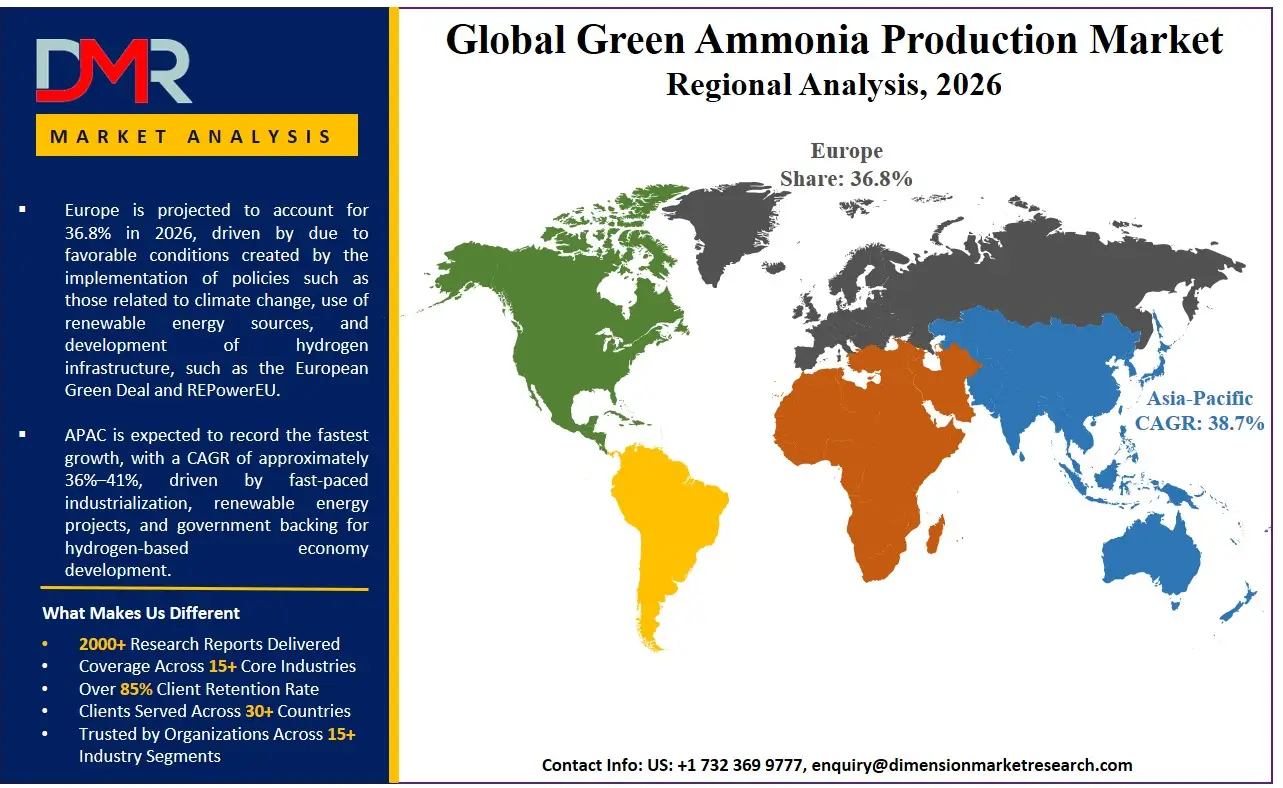
It is projected that Europe will be leading the market with a 36.8% market share of the green ammonia production market in 2026. This happens due to favorable conditions created by the implementation of policies such as those related to climate change, use of renewable energy sources, and development of hydrogen infrastructure, such as the European Green Deal and REPowerEU. Countries that have been involved in creating these conditions include Germany, the Netherlands, Norway, and Spain. These countries have been aggressively working towards establishing facilities for importation of ammonia along with the creation of renewable hydrogen.
ℹ
To learn more about this report –
Download Your Free Sample Report Here
Fastest Growing Region in the Green Ammonia Production Market
The Asia-Pacific region is anticipated to witness the highest rate of growth in the green ammonia production market owing to fast-paced industrialization, renewable energy projects, and government backing for hydrogen-based economy development. Nations like Japan, South Korea, China, and Australia are enhancing their ammonia production and import facilities to meet their energy transformation objectives. The growing need for green marine fuels and carbon-neutral energy production is driving their market adoption rates. Australia is poised to become one of the largest exporters owing to its rich renewable energy sources. Meanwhile, Japan and South Korea are entering into sustainable long-term ammonia sourcing agreements.
By Region
North America
Europe
- Germany
- The U.K.
- France
- Italy
- Russia
- Spain
- Benelux
- Nordic
- Rest of Europe
Asia-Pacific
- China
- Japan
- South Korea
- India
- ANZ
- ASEAN
- Rest of Asia-Pacific
Latin America
- Brazil
- Mexico
- Argentina
- Colombia
- Rest of Latin America
Middle East & Africa
- Saudi Arabia
- UAE
- South Africa
- Israel
- Egypt
- Rest of MEA
Competitive Landscape
In the Green Ammonia Production Market, competition has been growing due to technology developments, the ability to integrate with renewable energy sources, and long-term supply contracts. Players in this market have been concentrating on partnering efforts, pilot project implementation, and investments in electrolysis systems to increase their competitive edge. The capital-intensive nature and difficult compliance regulations represent major entry barriers into the market. Efforts towards Research and Development initiatives aimed at improving electrolyzer efficiency, lowering production expenses, and integrating with renewable energy sources have been gaining importance among companies operating in this market space.
Some of the prominent players in the global Green Ammonia Production are:
- Yara International
- CF Industries
- OCI N.V.
- Air Products and Chemicals
- Siemens Energy
- thyssenkrupp Uhde
- Nel ASA
- ENGIE
- Iberdrola
- ACME Group
- Reliance Industries
- NTPC Green Energy
- Adani New Industries
- AM Green
- Jakson Green
- Oriana Power
- Fortescue Future Industries
- Woodside Energy
- Envision Energy
- Mitsubishi Heavy Industries
- Other Key Players
Recent Developments
- In May 2026, Jordan entered into an agreement worth USD 1 billion for the construction of the first ever green ammonia plant at a utility scale with Jordan Green Ammonia Co. The agreement was signed under the auspices of Jordan's Prime Minister Jaafar Hassan. This endeavor comes on the back of the aspirations that Jordan aims to emerge as a regional green hydrogen and renewable energy hub.
- In November 2025, Air Liquide unveiled the first pilot plant in the world for ammonia cracking with industrial capacity, which will allow 30 tons of ammonia to be turned into hydrogen each day. This development shows that there is significant progress in ammonia-to-hydrogen technology, facilitating the transportation of hydrogen over long distances and making low-carbon hydrogen available. Using the already established infrastructure for ammonia worldwide, this technology enhances the transition towards a hydrogen economy globally.
- In June 2025, Envision Energy entered into an important agreement with Marubeni Corporation for the off-take of green ammonia, to promote and speed up the commercialization and trade of green ammonia. This will be achieved through Envision Energy's green hydrogen-ammonia technology solutions combined with Marubeni's worldwide energy trading capabilities. This will allow the large-scale production and use of ammonia in various sectors like chemicals, fertilizer production, transportation, and energy generation. This also facilitates the movement towards clean energy in Japan.
Report Details
| Report Characteristics |
| Market Size (2026) |
USD 4.0 Bn |
| Forecast Value (2035) |
USD 53.7 Bn |
| CAGR (2026–2035) |
33.3% |
| Historical Period |
2021 – 2025 |
| Forecast Period |
2027 – 2035 |
| Base Year |
2025 |
| Estimate Year |
2026 |
| Segments Covered |
By Production Technology, By Renewable Energy Source, By Plant Capacity, By Application, By End-Use Industry, By Distribution Model |
| Regional Coverage |
North America – The US and Canada; Europe – Germany, The UK, France, Russia, Spain, Italy, Benelux, Nordic, & Rest of Europe; Asia-Pacific – China, Japan, South Korea, India, ANZ, ASEAN, Rest of APAC; Latin America – Brazil, Mexico, Argentina, Colombia, Rest of Latin America; Middle East & Africa – Saudi Arabia, UAE, South Africa, Turkey, Egypt, Israel, & Rest of MEA |
Frequently Asked Questions
How big is the Global Behind the Meter Energy Storage Market?
▾ The Global Behind the Meter Energy Storage Market size is estimated to have a value of USD 9.6 billion in 2026 and is expected to reach USD 52.7 billion by the end of 2035.
What is the CAGR of the Global Behind the Meter Energy Storage Market from 2026 to 2035?
▾ The market is growing at a CAGR of 20.8% over the forecasted period.
What factors are driving the growth of the Global Behind the Meter Energy Storage Market?
▾ The market is driven by advances in runtime peak load detection and automated demand response, regulatory pressure to speed up energy compliance results and reduce grid exposure mistakes, and increased government investment in a national secure distributed energy digital infrastructure.
What are the major trends in the Global Behind the Meter Energy Storage Market?
▾ The key market trends include the adoption of real-time battery degradation tracking and encrypted energy payload analysis, along with a growing shift toward cloud-native BTM management platforms and data-enabled asset management systems.
Which region held the largest share of the Global Behind the Meter Energy Storage Market in 2026?
▾ North America is expected to account for the largest market share in 2026, with a share of about 38.1%.
Which region is expected to grow the fastest in the Global Behind the Meter Energy Storage Market?
▾ Asia Pacific is the fastest-growing region in the market during the forecast period.
Who are the key players in the Global Behind the Meter Energy Storage Market?
▾ Some of the major key players in the Global Behind the Meter Energy Storage Market are Tesla, Inc., Enphase Energy, SolarEdge Technologies, Inc., Generac Holdings Inc., LG Energy Solution, Ltd., BYD Company, and many others.
How is the Global Behind the Meter Energy Storage Market segmented?
▾ The market is segmented by battery type, system capacity, connection type, application, and end user.