What is the Global Green Ammonia Synthesis Catalyst Market Size?
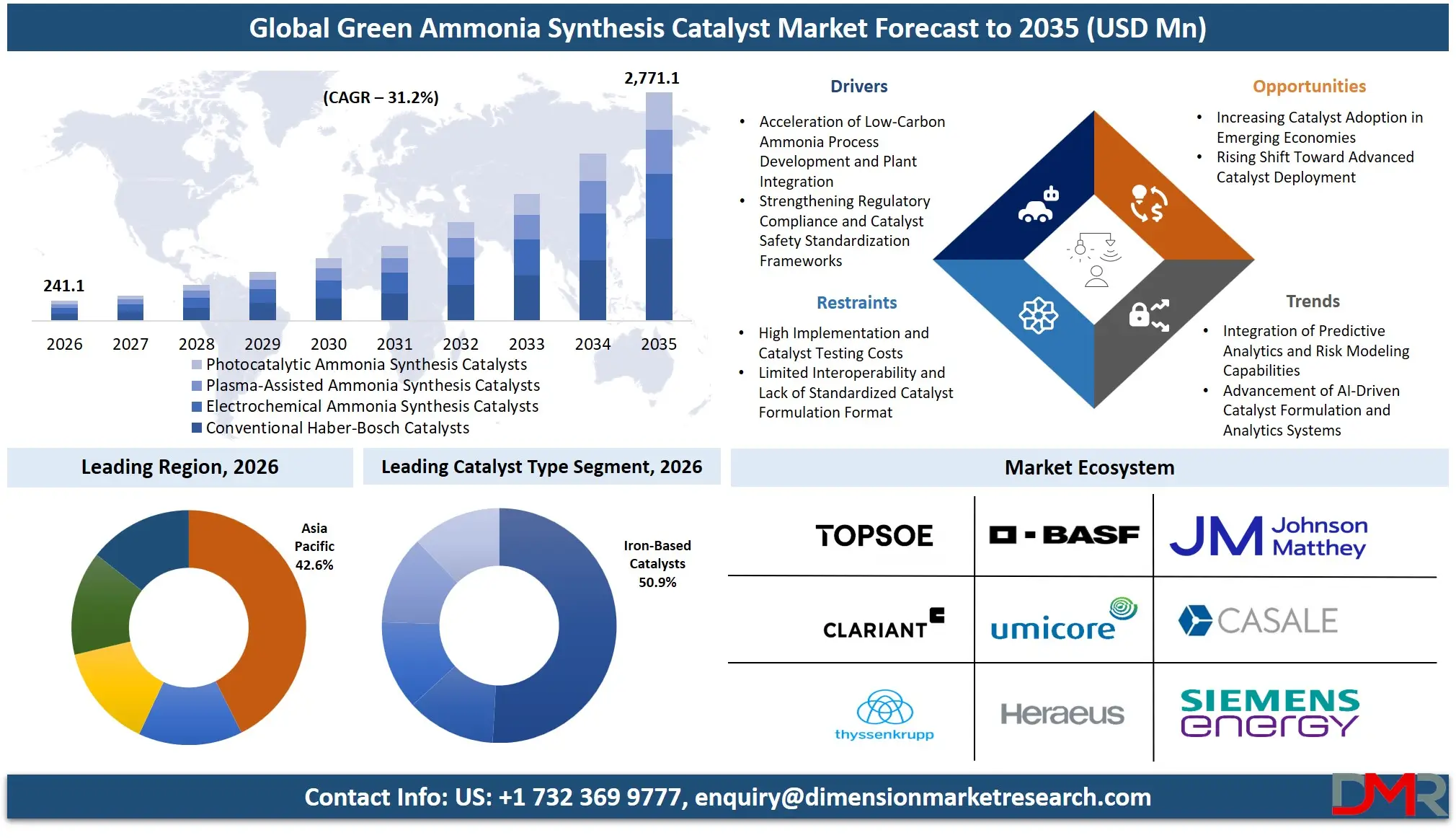
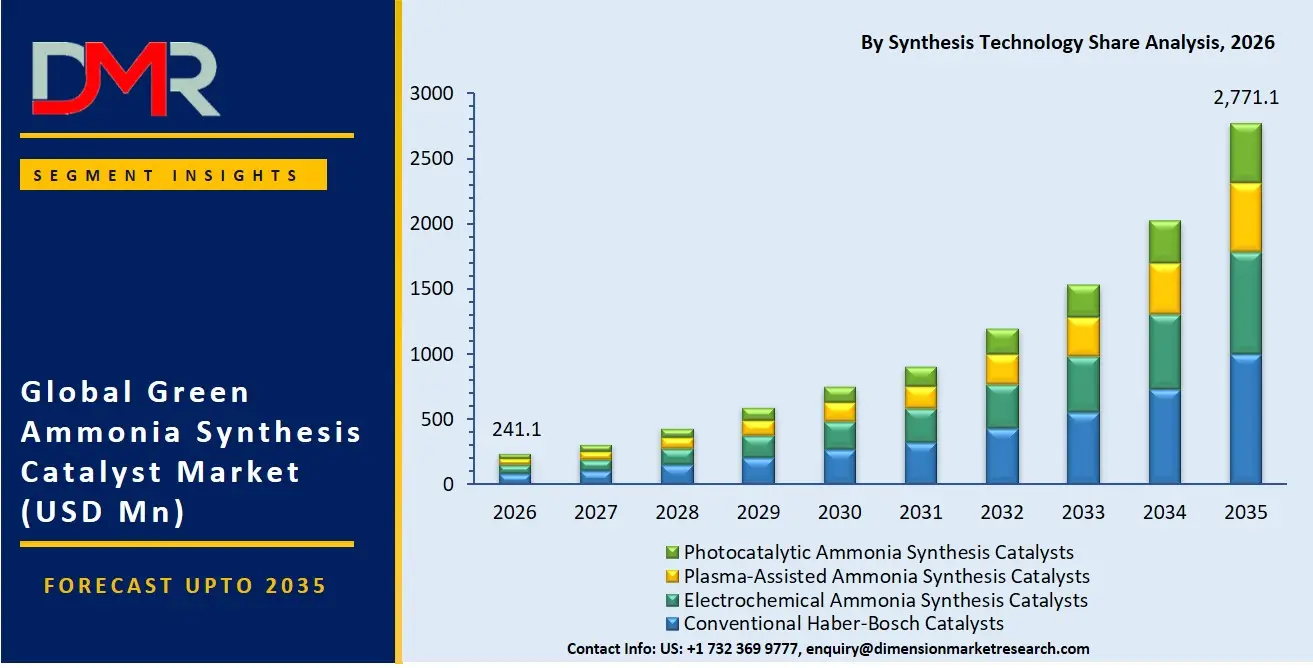
The Global Green Ammonia Synthesis Catalyst Market size is estimated at USD 241.1 million in 2026 and is projected to reach USD 2,771.1 million by 2035, exhibiting a CAGR of 31.2% during the forecast period, driven by the rising use of renewable hydrogen integration, decentralized ammonia production patterns in modular energy architectures, and connected digital governance and emissions compliance management systems.
ℹ
To learn more about this report –
Download Your Free Sample Report Here
The global green ammonia synthesis catalyst market is expanding because of increasing use of high-activity catalyst stability testing and impurity profiling in detecting and analyzing anomalous catalytic deactivation patterns, increasing regulatory mandates, which reduce the risk of thermal runaway during ammonia synthesis and speed up environmental compliance audits for new production plants, and more funding in automated catalyst formulation logging.
Some other reasons for expansion in this market include new technologies in low-pressure synthesis loop management, catalyst fouling prediction through behavior analytics, automated hydrogen carrier lifecycle handling, high-volume process data platforms, and improved cross-supplier formulation-sharing rules. The green shift in fertilizer production and distributed ammonia synthesis has been helpful in speeding up clean energy development and making sensitive catalyst transaction management easier. This includes ruthenium-promoter interaction analytics research. In addition, government plans focusing on preventing industrial emissions and the secure green hydrogen economy have ensured steady research in catalyst synthesis systems.
ℹ
To learn more about this report –
Download Your Free Sample Report Here
The US Green Ammonia Synthesis Catalyst Market
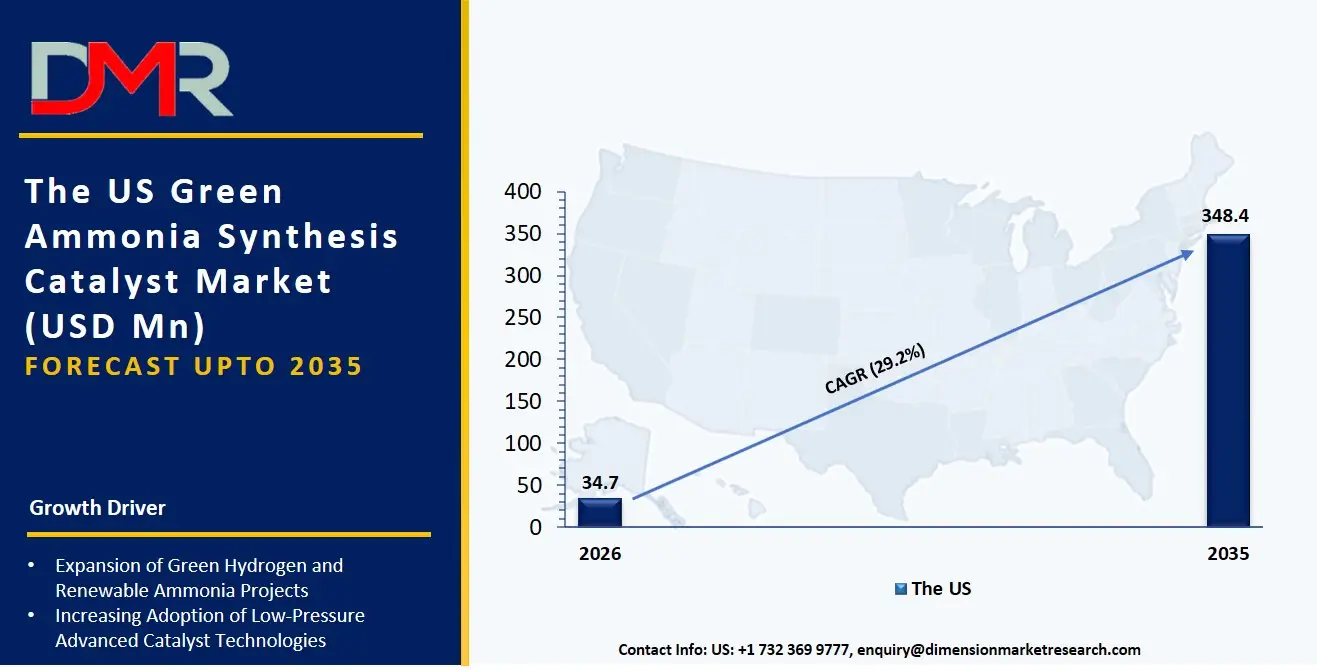
The US Green Ammonia Synthesis Catalyst Market is estimated to grow to USD 34.7 million in 2026 with a compound annual growth rate of 29.2% during the forecast period.
The US market is shaped by major federal and state-level programs promoting low-carbon process architectures, secure catalyst adoption supported by DOE and NIST, and DOD-led energy modernization initiatives. These programs encourage the use of high-purity hydrogen processing, real-time impurity-in-solution protection, and predictive compliance software for catalyst blending. Automated process safety platforms are being rapidly adopted, and the US continues to invest in better data sharing between R&D labs, encrypted catalyst audit systems, and reliable thermal runaway detection tools for green ammonia synthesis platforms. Service providers are also influenced by laws like EPA's Clean Air Act, DOE hydrogen shot targets, and national digital chemical strategies to offer services that ensure process safety, rule-following, and smooth integration across modular and distributed plant environments.
ℹ
To learn more about this report –
Download Your Free Sample Report Here
Europe Green Ammonia Synthesis Catalyst Market
The European Green Ammonia Synthesis Catalyst Market is estimated to be valued at USD 75.2 million in 2026, witnessing growth at a CAGR of 34.1%, during the forecast period.
Europe's green ammonia synthesis catalyst market is well-established, shaped by EU-wide policies such as the Renewable Energy Directive, REPowerEU, and national policies to support sustainable hydrogen markets (e.g., Germany's H2Global initiative and France's national ammonia import strategy). Countries are also making catalyst performance management more flexible to align plant operator and customer demands and enable the sharing of anonymized catalyst data across borders. The market grows due to new tools like software for real-time ionic conductivity validation and risk scoring systems for catalyst thermal stability. Use is made easier by teamwork between public and private groups and shared digital safety rules. Manufacturers have access to technologies such as promoted ruthenium catalyst fine-tuning, catalyst-hydrogen interaction modeling, and secure process audit logging, and Europe is at the forefront of the digitisation of safe and efficient green ammonia production operations. The region's exceptional CAGR of 34.1% is driven by aggressive EU decarbonization targets, rapid scale-up of renewable hydrogen projects, and substantial government funding for green ammonia demonstration plants across the continent.
Japan Green Ammonia Synthesis Catalyst Market
The Japan Green Ammonia Synthesis Catalyst Market is projected to be valued at USD 21.4 million in 2026, progressing at a CAGR of 33.2%, during the period spanning from 2026 to 2035.
Japan's green ammonia synthesis catalyst market is well developed, with high-purity hydrogen carrier data platforms, connected secure catalyst blending management systems, and a wide array of catalyst aging simulation software tools. National focus on automation, efficiency, and process integrity is delivered via catalytic activity models and smart process protection. Growth opportunities are helped by government measures under the Green Growth Strategy by Japan's Ministry of Economy, Trade and Industry (METI), and continued investment in hydrogen cloud modernization. AI-driven catalyst research, multi-party analytics for application-specific process data sharing, and virtualized synthesis safe environments all need effective catalyst management software to keep pace with high-pressure ammonia synthesis. Higher costs for validating new catalyst systems and connecting them with older infrastructure are significant, but there are opportunities for the export of Japanese catalyst technologies to the Asian and Pacific markets.
Key Takeaways
- Market Size & Forecast: The Global Green Ammonia Synthesis Catalyst Market is estimated to be valued at USD 241.1 million in 2026 and is expected to grow to USD 2,771.1 million by 2035.
- Growth Rate & Outlook: The market is expected to witness growth at a compound annual growth rate of 31.2% in the forecast period.
- Primary Growth Drivers: The availability of new catalyst synthesis technologies that use real-time degradation detection, the need to speed up compliance results and improve success rates of process data sharing, and more government investment in a national secure green hydrogen infrastructure are key growth drivers.
- Key Market Trends: The real-time profiling of catalyst thermal stability risks, advanced promoter interactions, and the shift to AI-driven catalyst formulation platforms and automated digital asset inventory management are key market trends.
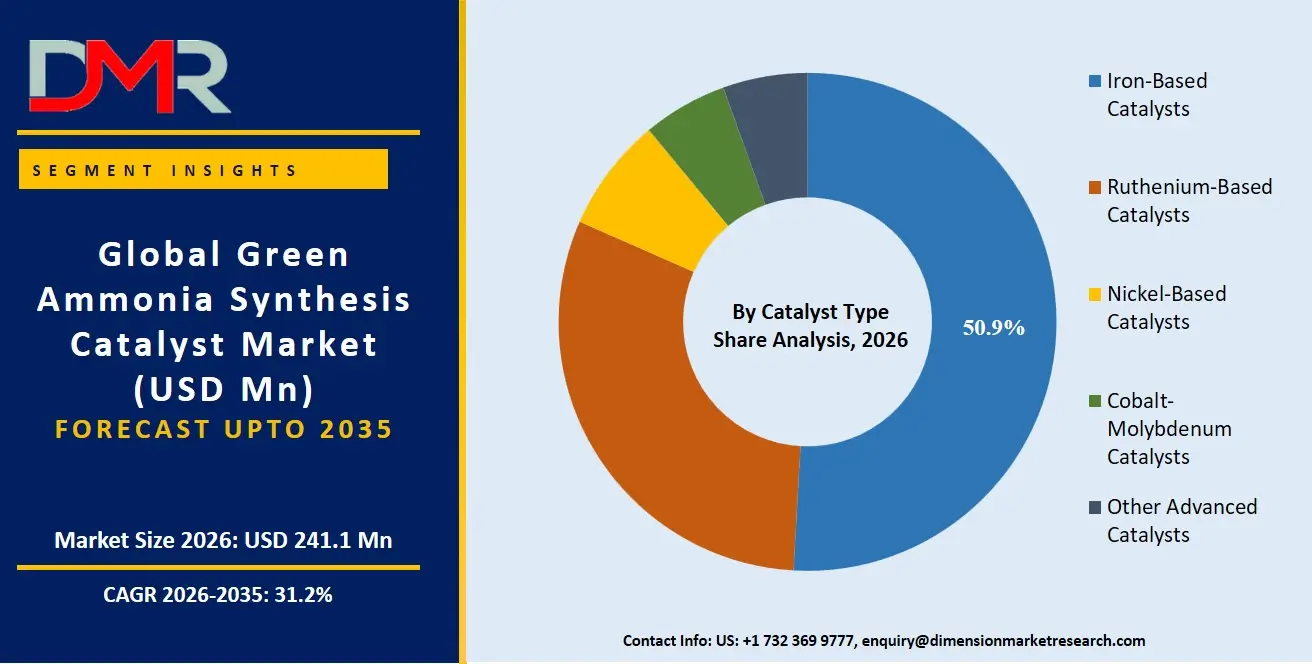
- By Catalyst Type: The Iron-Based Catalysts segment is expected to take the largest revenue share in the global green ammonia synthesis catalyst market in 2026.
- By Synthesis Technology: Conventional Haber-Bosch Catalysts is expected to take the largest revenue share in 2026 in the green ammonia synthesis catalyst market.
- By Application: The Fertilizer Production segment is estimated to take the lead in 2026 with the largest share in the green ammonia synthesis catalyst market.
- Regional Leadership: Asia-Pacific is estimated to take the lead in 2026 with 42.6% share in the green ammonia synthesis catalyst market.
What is Green Ammonia Synthesis Catalyst?
Green Ammonia Synthesis Catalyst refers to a combination of advanced catalytic materials and real-time monitoring technologies that provide ammonia manufacturers, plant operators, and compliance entities with enhanced capabilities beyond basic process control, including helping to protect catalyst formulations during production, preventing thermal runaway via hydrogen carrier engineering, and enabling secure multi-party catalyst analytics. They include magnetite-based catalysts, wüstite-based catalysts, supported ruthenium catalysts, promoted ruthenium catalysts, nickel-based catalysts, and cobalt-molybdenum systems. These platforms use modern systems such as real-time activity validation, digital catalyst inventory management software, and remote process advisory to manage, verify, and track sensitive catalytic events and results. To improve ammonia synthesis safety outcomes, manage process variability and application-specific programs, and expand protection into customized digital coverage to support individual plant designs and promote the development of green chemical products.
Use Cases
- Market Stability for Daily Operations: Green ammonia synthesis catalyst platforms can provide market-balancing benefits through software (encrypted catalyst analytics, attestation) and control systems to reduce thermal runaway risk and support settlement of safe catalyst transactions in minutes, compared to days that it would take with only manual process handling.
- Long-Term Sensitive Catalyst Asset Management: Long-term data on ongoing catalyst stability issues, including catalytic activity intermittency, green hydrogen feedstock price spikes, or catalyst degradation, are studied to better understand market performance and to help plan long-term software-based catalyst care.
- Workload Load Balancing: Process safety is handled through catalyst management platforms and smart software in modular plant and corporate settings to support market capacity balance for high-pressure ammonia synthesis workloads.
- Government & Regulated Programs: Faster catalyst software development helps data innovation and development of targeted green ammonia programs; government programs, through smart monitoring of national hydrogen material data, advance national clean energy protection strategies, and help the adoption of operational standards.
How AI Is Transforming the Global Green Ammonia Synthesis Catalyst Market?
Artificial intelligence (AI) is being used progressively more often in green ammonia synthesis catalyst platforms to improve catalyst demand forecasting, find safety quality trends in catalytic activity patterns, and automatically spot unusual degradation patterns in catalyst cycling data. It also allows faster catalyst thermal verification because it can handle digital catalyst submissions on a large scale. Encrypted catalyst audit logs are easier to study and help registries find integration issues, reduce mistakes, and improve the overall accuracy of catalyst certification. This has resulted in operations being cost-effective, quicker, and more efficient than the old manual review method.
AI is also strengthening research and development by improving catalyst risk assessment and enabling more accurate capacity planning for catalyst blending. It helps ammonia manufacturers predict how many safe catalyst batches will be needed, find possible catalytic activity delays, and monitor the performance of catalyst safety networks more effectively. In addition, automation of routine catalyst compliance checks and performance tracking is reducing operational workload, lowering administrative costs, and improving overall efficiency. This is leading to better financial results and more stable operations across the green ammonia synthesis catalyst production chain.
Market Dynamics
Key Drivers of the Global Green Ammonia Synthesis Catalyst Market
Acceleration of Low-Carbon Ammonia Process Development and Plant Integration
The market is growing with the rise of advanced catalyst formulations for green ammonia plants, better management of sensitive catalyst processes, and a closer connection between catalyst performance monitoring and secure plant integration. Green ammonia synthesis catalyst platforms provide real-time data that allows monitoring of catalytic activity, helping to spot degradation early, and checking process safety performance much faster. This has improved operational efficiency and reduced human errors and production costs. At the same time, demand for more automated research and development is being helped by more activity in predictive analytics for the assessment of individual catalyst risks, as catalyst science further digitizes formulation and material processing tasks.
Strengthening Regulatory Compliance and Catalyst Safety Standardization Frameworks
There is increasing emphasis on ammonia synthesis safety, process purity, and rule-following within the green ammonia synthesis catalyst system. Rules and frameworks such as the EU Renewable Energy Directive, U.S. Inflation Reduction Act, and green hydrogen modernization efforts in key markets are encouraging better catalyst handling practices and more structured ammonia safety processes. These advances are supporting the need for systems that can offer steady monitoring of sensitive catalytic materials and standardized reporting. At the same time, active work to improve the sharing of catalyst performance data and reduce verification issues is strengthening the need for more effective management systems in both government and private market participants.
Restraints in the Global Green Ammonia Synthesis Catalyst Market
High Implementation and Catalyst Testing Costs
The rollout of green ammonia synthesis catalyst systems remains costly, requiring significant investment in advanced catalytic materials, activity validation technologies, system integration, testing, and alignment with existing ammonia plant workflows. In addition, following environmental regulations such as REACH and other regional laws adds to setup complexity. These factors increase upfront costs and can limit adoption, especially among smaller ammonia manufacturers and new companies entering the market.
Limited Interoperability and Lack of Standardized Catalyst Formulation Format
There is still fragmentation in the market in terms of catalyst formulation formats and data handling procedures. Although some areas have put in place organized digital management systems, many ammonia plants continue to work with both legacy process control and modern automated simulation systems. Lack of standardized catalyst thermal stability protocols limits the ability to share catalyst performance data between ammonia manufacturers and catalyst suppliers and results in inefficiencies in production, deployment, and system integration.
Growth Opportunities in the Global Green Ammonia Synthesis Catalyst Market
Increasing Catalyst Adoption in Emerging Economies
Newly developing economies such as Brazil, Indonesia, Nigeria, the UAE, and Vietnam are slowly building their green hydrogen and catalyst systems. These regions have long-term growth possibilities, with more people adopting green fertilizers and energy storage, and with more companies becoming aware of ammonia safety programs and slowly modernizing digital production infrastructure. These markets have few older ammonia systems and can be used with new, technology-driven catalyst platforms that can grow over time.
Rising Shift Toward Advanced Catalyst Deployment
The move to safer ammonia synthesis systems, decentralized production networks, and real-time catalyst performance checks is creating the adoption of advanced catalyst systems. These systems allow centralized process data access, better coordination between ammonia manufacturers and market participants, and faster digital catalyst inventory management. Advanced digital setups are increasingly becoming a trend among modern ammonia process providers as operational efficiency becomes one of the competitive factors.
Global Green Ammonia Synthesis Catalyst Market Trends
Integration of Predictive Analytics and Risk Modeling Capabilities
Green ammonia synthesis catalyst platforms are gradually adding data-driven technology to find catalyst degradation trends and improve accuracy in digital catalyst inventory management. These systems allow ammonia manufacturers and plant operators to study their catalytic activity behavior better, simplify the management of their digital portfolios, and improve their overall process performance. This move is slowly turning the industry more proactive and data-driven in ammonia safety instead of being purely reactive in market operations.
Advancement of AI-Driven Catalyst Formulation and Analytics Systems
The use of AI-based catalyst formulation systems is currently becoming a basic part of today's green ammonia development operations. These systems allow real-time catalyst stability monitoring, centralized digital asset administration, and better network coordination among market participants. Advanced catalyst platforms are improving the efficiency and responsiveness of platform providers that operate in different regions by reducing dependence on manual formulation processes and allowing operations to grow more easily.
Research Scope and Analysis
The global green ammonia synthesis catalyst market is witnessing strong growth driven by rising adoption of green fertilizers, distributed ammonia synthesis, and increasing demand for high-safety and high-efficiency ammonia processes. The market is segmented based on catalyst type, synthesis technology, production scale, and application.
ℹ
To learn more about this report –
Download Your Free Sample Report Here
By Catalyst Type Analysis
The Iron-Based Catalysts segment is likely to continue dominating the market in 2026, accounting for approximately 50.9% of the global green ammonia synthesis catalyst market share. This is due to its key role in enabling high-activity synthesis, a wide operating parameter range, and long-term process stability, and its usefulness in various ammonia settings where operational efficiency is needed. Within Iron-Based Catalysts, the Magnetite-Based Catalysts sub-segment holds the largest share, driven by high deployment volumes, automated demand for stable ammonia chemistry, and compliance requirements. The Ruthenium-Based Catalysts segment is the fastest-growing, driven by its superior activity at lower temperatures and pressures, with Supported Ruthenium Catalysts leading in modular and distributed plant applications.
By Synthesis Technology Analysis
The Conventional Haber-Bosch Catalysts segment is likely to continue holding the lead in 2026, accounting for approximately 62.8% of the global green ammonia synthesis catalyst market share, driven by strong demand for proven reliability, large-scale industrial application, and lower catalyst costs, as well as flexible integration with renewable hydrogen. This segment reflects the continued shift toward decarbonized but conventional ammonia loops. The Electrochemical Ammonia Synthesis Catalysts segment is the second-largest and fastest-growing, supported by direct renewable electricity integration, ambient condition operation, and rapid R&D advances. Plasma-Assisted and Photocatalytic Catalysts remain emerging but high-potential segments focused on decentralized and ultra-low-carbon applications.
By Production Scale Analysis
The Large-Scale Industrial Plants segment is expected to dominate with around 68.4% market share in 2026, driven by the need for consistent ammonia output, economies of scale, and integration with existing fertilizer complexes. These plants support customized catalyst loading plans because they can offer multiple levels of performance tuning, capacity amounts, and multi-year stability plans, delivering fast results while keeping catalyst data within secure registry systems. The Modular & Distributed Plants segment is the second-largest, driven by demand for on-site ammonia generation for energy storage and maritime fuel. The Pilot & Demonstration Plants segment is the fastest-growing within Production Scale, witnessing strong growth with increasing needs for technology validation, catalyst screening, and scale-up data generation.
By Application Analysis
The Fertilizer Production segment is the largest application in 2026, accounting for approximately 48.5% share, driven by the need for consistent crop yield improvement, reduced carbon footprint, and quality consistency. Agribusinesses are adopting green ammonia catalyst platforms for visibility and control over their fertilizer production parameters. The Energy Storage & Hydrogen Carrier segment is the second-largest, supported by renewable energy mandates and hydrogen economy commitments. Maritime Fuel remains a strong segment driven by IMO decarbonization targets and shipowner trials, while Power Generation and Industrial Feedstock are the fastest-growing due to coal co-firing phase-outs and green steel initiatives.
The Global Green Ammonia Synthesis Catalyst Market Report is segmented based on the following:
By Catalyst Type
- Iron-Based Catalysts
- Magnetite-Based Catalysts
- Wüstite-Based Catalysts
- Ruthenium-Based Catalysts
- Supported Ruthenium Catalysts
- Promoted Ruthenium Catalysts
- Nickel-Based Catalysts
- Cobalt-Molybdenum Catalysts
- Other Advanced Catalysts
By Synthesis Technology
- Conventional Haber-Bosch Catalysts
- Electrochemical Ammonia Synthesis Catalysts
- Plasma-Assisted Ammonia Synthesis Catalysts
- Photocatalytic Ammonia Synthesis Catalysts
By Production Scale
- Large-Scale Industrial Plants
- Modular & Distributed Plants
- Pilot & Demonstration Plants
By Application
- Fertilizer Production
- Energy Storage & Hydrogen Carrier
- Maritime Fuel
- Power Generation
- Industrial Feedstock
- Others
Regional Analysis
Largest Region in the Green Ammonia Synthesis Catalyst Market
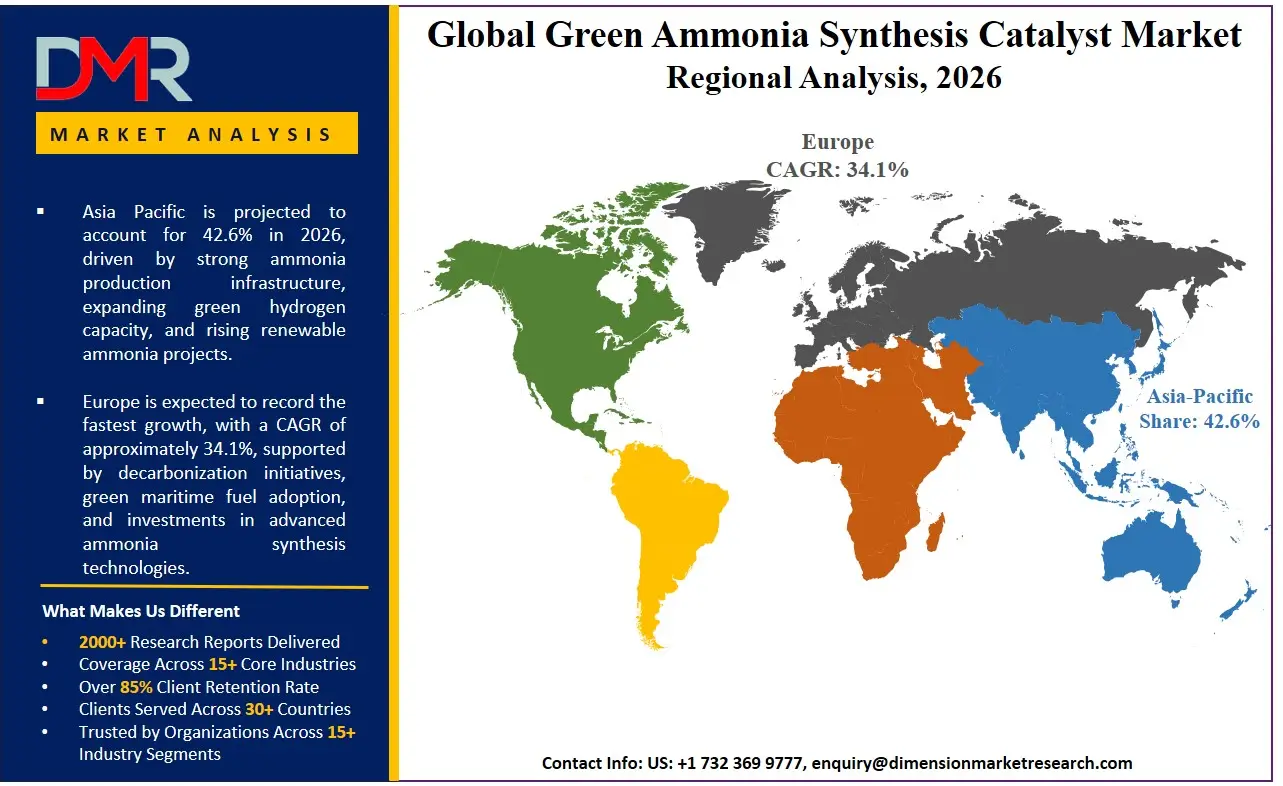
It is projected that the Asia-Pacific will take the lead in the global green ammonia synthesis catalyst market, covering a market share of about 42.6% in the year 2026. The region's dominance is driven by the presence of major ammonia producers and catalyst manufacturers in China, India, Japan, and South Korea, strong government mandates for green ammonia as a hydrogen carrier, and aggressive domestic renewable energy targets. Asia-Pacific benefits from significant investment in greenfield ammonia complexes, the highest concentration of new-build renewable ammonia projects across Australia, China, and India, and strong government support through METI in Japan, NITI Aayog in India, and provincial subsidies in China. The region is also home to the world's largest fertilizer consumers and is rapidly scaling up modular ammonia production for maritime fuel and power generation. Additionally, ongoing investments in low-pressure catalyst R&D and electrochemical synthesis technologies further strengthen Asia-Pacific's leading position. The widespread adoption of advanced catalysts for renewable ammonia synthesis in Australia's hydrogen export hubs, Japan's co-firing power plants, and India's green fertilizer corridors continues to reinforce the region's market leadership.
ℹ
To learn more about this report –
Download Your Free Sample Report Here
Fastest-Growing Region in the Green Ammonia Synthesis Catalyst Market
Europe is the fastest-growing region in the global green ammonia synthesis catalyst market during the forecast period. Europe's rapid growth is supported by aggressive EU decarbonization targets under the European Green Deal, the REPowerEU plan, which aims to produce 10 million tonnes of domestic green hydrogen by 2030, and substantial government funding for green ammonia demonstration plants across Germany, the Netherlands, Norway, and Spain. Europe is also at the forefront of developing standardized catalyst testing protocols and digital catalyst management platforms, with strong public-private partnerships such as the European Clean Hydrogen Alliance. Moreover, major catalyst manufacturers like Clariant, BASF, and Haldor Topsoe are expanding their European R&D and production capacities, and the presence of world-leading electrolyzer manufacturers is expected to keep Europe's growth momentum as the highest CAGR region during the forecast period.
By Region
North America
Europe
- Germany
- The U.K.
- France
- Italy
- Russia
- Spain
- Benelux
- Nordic
- Rest of Europe
Asia-Pacific
- China
- Japan
- South Korea
- India
- ANZ
- ASEAN
- Rest of Asia-Pacific
Latin America
- Brazil
- Mexico
- Argentina
- Colombia
- Rest of Latin America
Middle East & Africa
- Saudi Arabia
- UAE
- South Africa
- Israel
- Egypt
- Rest of MEA
Competitive Landscape
The green ammonia synthesis catalyst market is highly competitive, with new ideas and strategic partnerships shaping the competitive environment. To gain an advantage, companies and providers are focused on developing better catalyst platforms (such as AI-powered activity simulation, automated thermal stability detection systems, and software development kits for ammonia safety management), smart catalytic activity analytics, and cloud-based catalyst degradation monitoring. There are high barriers to entering the market due to the large amount of money needed for regulatory approval, specialized catalyst chemistry knowledge, and the need for mature manufacturing systems and rule-following.
Strategic approaches to increase market presence include partnerships with green hydrogen research groups and digital registries, mergers between catalyst providers and ammonia plant manufacturers, and long-term support contracts with customers and government institutions. Additionally, research and development in digital catalyst formulation, sharing rules, and flexible simulation designs are important for staying competitive and meeting the changing needs of the green ammonia synthesis catalyst community.
Some of the prominent players in the Global Green Ammonia Synthesis Catalyst Market are:
- Topsoe A/S
- BASF SE
- Johnson Matthey Public Limited Company
- Clariant AG
- Umicore SA
- Casale SA
- thyssenkrupp Uhde GmbH
- KBR, Inc.
- Stamicarbon B.V.
- Axens SA
- Heraeus Holding GmbH
- Dorf Ketal Chemicals (India) Private Limited
- TANAKA Kikinzoku Kogyo K.K.
- QuantumSphere, Inc.
- Sichuan Shutai Chemical Technology Co., Ltd.
- Linqu Taifeng Chemical Co., Ltd.
- Starfire Energy, Inc.
- Siemens Energy AG
- Nel ASA
- Acta S.p.A.
- Other Key Players
Recent Developments
- May 2026: Nel ASA launched its next-generation pressurized alkaline electrolyzer platform under the Calluna Project, supported by approximately USD 156.9 million EU Innovation Fund grant. The platform is designed to reduce green hydrogen production costs and support large-scale green ammonia and e-fuel projects through modular electrolyzer deployment.
- April 2026: Siemens Energy AG partnered with Shomax Energy to expand zero-carbon green ammonia fertilizer production facilities in the US. The collaboration integrates Siemens’ automation, digital twin, and process infrastructure technologies to support scalable green ammonia manufacturing and sustainable fertilizer supply chains.
- March 2026: Topsoe A/S signed a front-end engineering and design (FEED) agreement with Hynfra for a green ammonia project in Aqaba, Jordan. The project will utilize Topsoe’s ModuLite ammonia synthesis technology and catalyst-integrated ammonia loop solutions to convert green hydrogen into ammonia for large-scale sustainable production.
- February 2026: Johnson Matthey Public Limited Company revised the sale agreement of its Catalyst Technologies business to Honeywell International Inc. amid changing catalyst market conditions. The division develops catalysts used in fertilizers, hydrogen, and sustainable fuels, highlighting ongoing strategic restructuring within advanced catalyst markets.
Report Details
| Report Characteristics |
| Market Size (2026) |
USD 1.9 Bn |
| Forecast Value (2035) |
USD 8.1 Bn |
| CAGR (2026–2035) |
17.4% |
| The US Market Size (2026) |
USD 334.0 Mn |
| Historical Period |
2021 – 2025 |
| Forecast Period |
2027 – 2035 |
| Base Year |
2025 |
| Estimated Year |
2026 |
| Segments Covered |
By Material Type, By Fuel Cell Type, By Application, By End-Use Industry |
| Regional Coverage |
North America – The US and Canada; Europe – Germany, The UK, France, Russia, Spain, Italy, Benelux, Nordic, & Rest of Europe; Asia-Pacific – China, Japan, South Korea, India, ANZ, ASEAN, Rest of APAC; Latin America – Brazil, Mexico, Argentina, Colombia, Rest of Latin America; Middle East & Africa – Saudi Arabia, UAE, South Africa, Turkey, Egypt, Israel, & Rest of MEA |
Frequently Asked Questions
How big is the Global Green Ammonia Synthesis Catalyst Market?
▾ The Global Green Ammonia Synthesis Catalyst Market is estimated to be valued at USD 241.1 million in 2026 and is expected to reach USD 2,771.1 million by the end of 2035.
What is the CAGR of the Global Green Ammonia Synthesis Catalyst Market from 2026 to 2035?
▾ The market is growing at a CAGR of 31.2% over the forecasted period.
What factors are driving the growth of the Global Green Ammonia Synthesis Catalyst Market?
▾ The market is driven by advances in real-time catalyst degradation detection and automated safety enforcement, regulatory pressure to speed up green ammonia compliance results and reduce thermal runaway mistakes, and increased government investment in national green hydrogen infrastructure.
What are the major trends in the Global Green Ammonia Synthesis Catalyst Market?
▾ The key market trends include the adoption of real-time catalyst thermal stability tracking and ruthenium-promoter interaction analysis, along with a growing shift toward AI-driven catalyst formulation platforms and data-enabled digital catalyst inventory management systems.
Which region held the largest share of the Global Green Ammonia Synthesis Catalyst Market in 2026?
▾ Asia-Pacific is expected to account for the largest market share in 2026, with a share of about 42.6%.
Which region is expected to grow the fastest in the Global Green Ammonia Synthesis Catalyst Market?
▾ Europe is the fastest-growing region in the market during the forecast period.
Who are the key players in the Global Green Ammonia Synthesis Catalyst Market?
▾ Some of the major key players in the Global Green Ammonia Synthesis Catalyst Market are Clariant AG, Umicore SA, Johnson Matthey Public Limited Company, Topsoe A/S, Siemens Energy, and many others.
How is the Global Green Ammonia Synthesis Catalyst Market segmented?
▾ The market is segmented by catalyst type, synthesis technology, production scale, and application.