Market Overview

The Global Healthcare Information Software Market is expected to reach a value of USD 218.6 billion in 2023, and it is further anticipated to reach a market value of USD 1,036.1 billion by 2032 at a CAGR of 18.9%. 
 
Healthcare Information Software encompasses a diverse range of technological solutions designed to manage, analyze, and streamline the flow of medical information within healthcare settings. These software systems encompass electronic health records (EHR), telehealth platforms, patient management systems, and more, aiming to enhance the efficiency of healthcare services and patient outcomes.
 
The market for Healthcare Information Software is a dynamic and rapidly expanding sector, driven by the increasing demand for integrated healthcare solutions, the push for regulatory compliance, and the need to reduce healthcare delivery costs while improving treatment outcomes.
 
As we look into 2024, the Healthcare Information Software market presents significant growth opportunities for both established players and new entrants. Innovations such as cloud-based platforms and AI-driven diagnostics are key drivers. For new businesses, the market is ripe for the introduction of innovative solutions that address niche areas like remote patient monitoring and personalized medicine.

Healthcare Information Software Market Growth Analysis

ℹ To learn more about this report – Download Your Free Sample Report Here

 
Existing industry giants can leverage their infrastructure to scale up new technologies rapidly, enhancing their offerings and expanding into new geographic markets. Partnerships between tech companies and healthcare providers are also anticipated to increase, as these collaborations can expedite the integration of advanced tech solutions in healthcare systems.
 
Several pivotal trends are shaping the future of the Healthcare Information Software market. Telepharmacy systems are transforming patient care by integrating cloud-based formularies and digital dispensing systems. This integration significantly reduces prescription errors, with innovations reported to lower error rates by over 40%.
 
Additionally, the surge in health app usage is noteworthy. In the United States alone, 43% of the population used health apps in 2024, with over 300 million global users in 2023. The demographic breakdown reveals a keen interest in health apps among Millennials (45%) and Gen Z (30%), highlighting the potential for targeted software development that caters to the preferences and needs of these key user groups.
 
The transformative impact of telepharmacy systems cannot be overstated, as these innovations have significantly reduced prescription errors by more than 40%, according to Tateeda. This patient safety and efficiency improvement underscores the value of integrating advanced technologies in healthcare settings.
 
Further, the extensive adoption of health apps, as indicated by Statista, with 43% of the U.S. population engaging with these apps in 2024, and the Business of Apps reporting over 300 million users in 2023, emphasizes the deepening penetration and reliance on digital health solutions.
 
These statistics not only highlight the growing trend but also point towards areas where developers can focus their efforts to meet the evolving demands of healthcare consumers, particularly in catering to the tech-savvy Millennial and Gen Z demographics.

Key Takeaways

  • The Global Healthcare Information Software Market is projected to grow from USD 218.6 billion in 2023 to USD 1,036.1 billion by 2032, with a CAGR of 18.9%.
  • On-premise deployment models lead the market in 2023, preferred for their data security and customization capabilities.
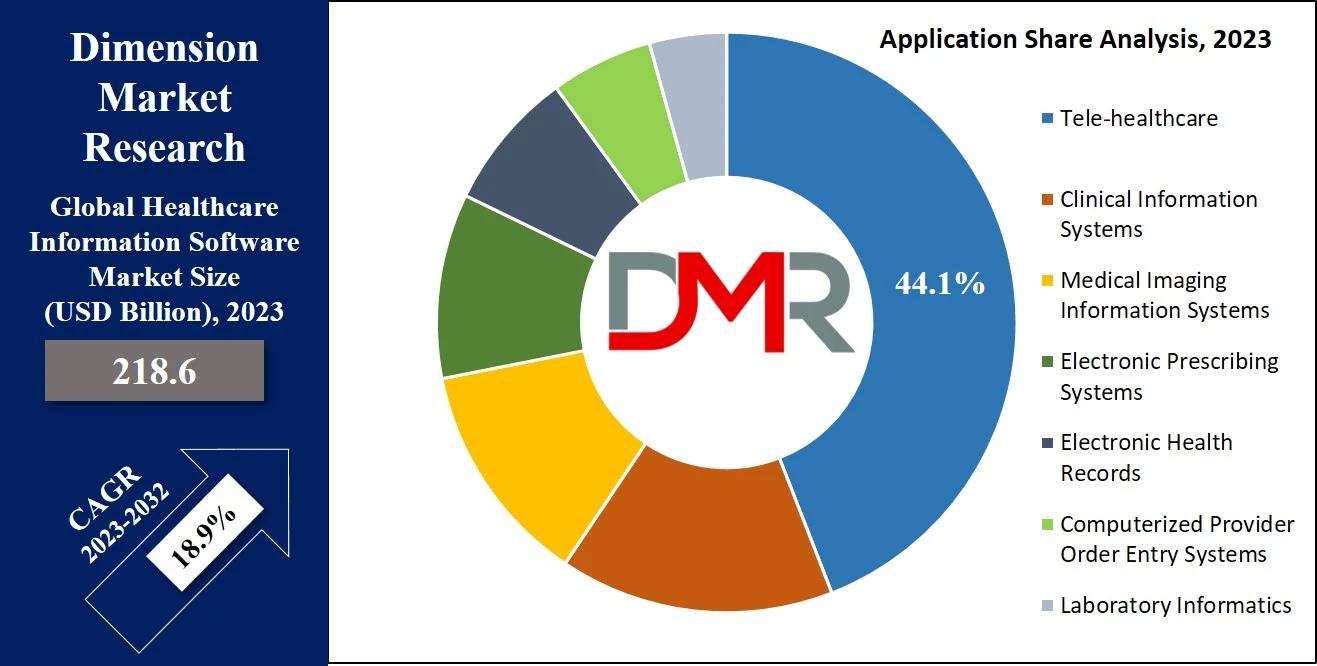
  • Tele-healthcare is the leading application in 2023, driven by the increasing demand for effective electronic healthcare systems and technological advancements.
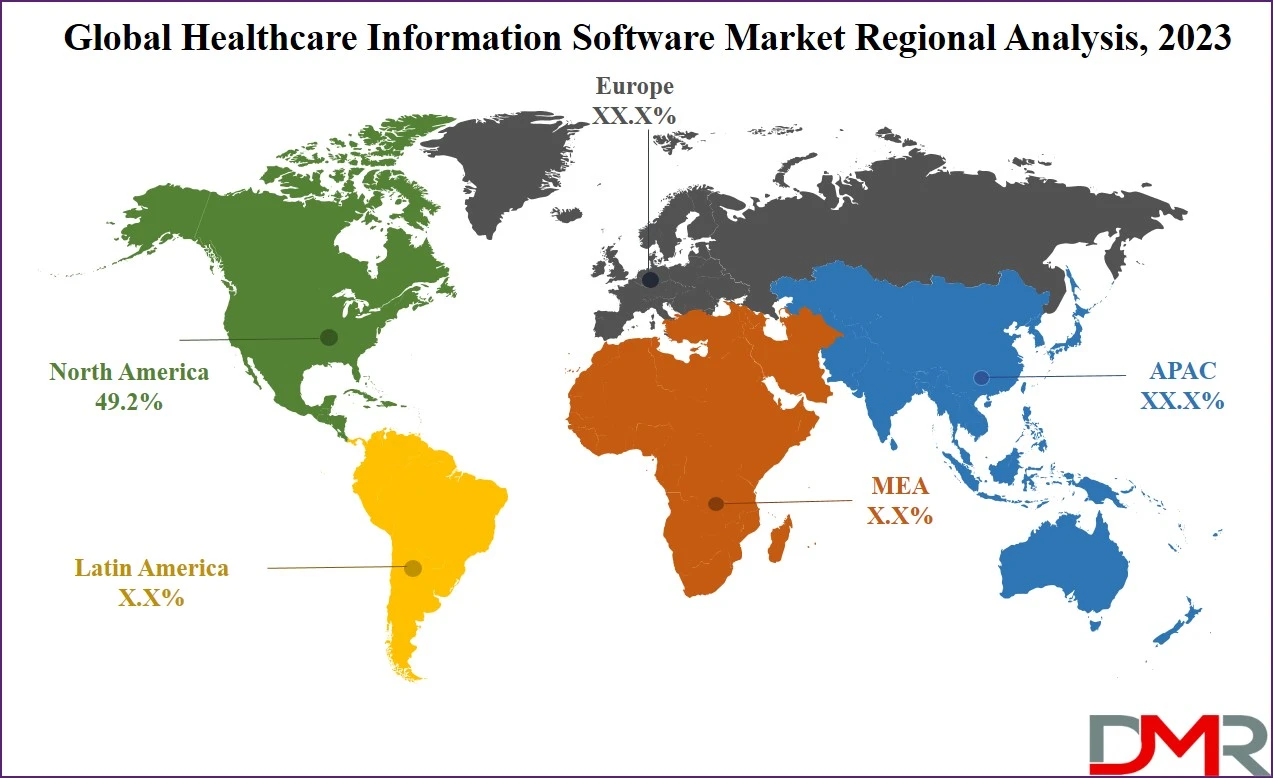
  • North America holds the largest market share at 49.2% in 2023, driven by the robust adoption of healthcare IT solutions, especially in the U.S., aimed at improving patient care and reducing costs.

Use Cases

  • Electronic Health Records (EHR): Digitizes and centralizes patient medical histories, allowing for quick access and better coordination among healthcare providers.
  • Clinical Decision Support: Provides healthcare professionals with evidence-based recommendations and alerts to support diagnosis and treatment decisions.
  • Telemedicine Platforms: Enables remote patient consultations, monitoring, and care delivery, expanding healthcare access regardless of location.
  • Healthcare Analytics: Processes large volumes of health data to identify trends, optimize operations, and predict patient outcomes.
  • Revenue Cycle Management: Streamlines billing processes, insurance claims processing, and financial workflows to improve healthcare organization profitability.

Market Dynamic

The increase in the number of chronic diseases like cancer, diabetes, and cardiovascular disorders, due to the aging population's rapid growth, has increased the demand for advanced healthcare solutions & diagnostic devices, which in turn, expanded the market for healthcare information software, providing efficient management of diagnostic data for optimal disease diagnosis & treatment.
 
Moreover, the expanding target market is fueled by the rise in global deadly diseases, influenced by stress-inducing lifestyles & the increase in consumption of fast food, contributing to the prevalence of lifestyle disorders worldwide.

However, despite these growth factors, challenges like security issues & interoperability problems create constraints on the healthcare information software market. In addition, a shortage of qualified professionals is anticipated to impede market expansion during the forecast period, emphasizing the importance of addressing workforce limitations in the evolving healthcare landscape.

Driving Factors

Rising Demand for Digital Health Solutions
 
As the healthcare sector increasingly embraces digital transformation, the demand for healthcare information software is rising. This software helps streamline patient data management, improves operational efficiency, and enhances decision-making by integrating clinical, financial, and administrative functions. The growing reliance on electronic health records (EHRs), telemedicine, and health management systems further accelerates the adoption of such solutions.
 

Government Initiatives and Regulations 

Governments worldwide are promoting the use of healthcare information systems to enhance the quality of care and improve operational efficiencies. Regulations such as the Health Information Technology for Economic and Clinical Health (HITECH) Act and the Affordable Care Act in the U.S. mandate the adoption of EHRs, creating an environment that drives the demand for healthcare information software.
 
Increasing Focus on Patient-Centric Care 

There is a growing emphasis on patient-centric care, where healthcare information software plays a critical role in improving care delivery. With better access to patient records, healthcare providers can offer personalized treatment, reduce errors, and enhance patient outcomes. The shift towards value-based care models further necessitates the integration of comprehensive healthcare information systems.

Restraining Factors

High Implementation and Maintenance Costs 

Healthcare information software systems can involve significant initial investments in terms of software licensing, hardware, and ongoing maintenance. Smaller healthcare organizations or those with limited budgets may find these costs prohibitive, preventing widespread adoption. The need for training staff to use these systems also adds to the overall cost, potentially limiting growth in certain markets.

 
Data Security and Privacy Concerns 

As healthcare information software deals with sensitive patient data, concerns over data security and privacy are major barriers. The increasing frequency of cyberattacks targeting healthcare systems and the complexity of complying with regulations such as the Health Insurance Portability and Accountability Act (HIPAA) make healthcare providers wary of adopting new systems. Ensuring the protection of patient data is crucial to mitigating these risks and encouraging software adoption.

Growth Opportunities

Emergence of Artificial Intelligence (AI) and Machine Learning (ML)

The integration of AI and ML into healthcare information software is creating significant growth opportunities. AI-powered tools can analyze large volumes of healthcare data to offer predictive insights, enhance decision-making, and improve patient outcomes. The growing demand for smart solutions in diagnostics, personalized medicine, and workflow automation provides a rich avenue for expanding AI-based software offerings.

Telemedicine Integration 

The rise of telemedicine, accelerated by the COVID-19 pandemic, presents a substantial growth opportunity for healthcare information software. By integrating telemedicine platforms with electronic health records (EHRs) and other healthcare management systems, healthcare providers can enhance patient engagement, improve remote care, and streamline workflows, all contributing to the increased adoption of healthcare software solutions.

Expansion in Emerging Markets 

The healthcare information software market holds considerable growth potential in emerging economies, where there is increasing demand for digital solutions. As healthcare infrastructure improves and digital literacy rises, countries in regions like Asia-Pacific, Latin America, and Africa are likely to see increased adoption of healthcare information software. Localizing solutions to fit regional needs could open new avenues for software providers.

Trends

Cloud-Based Solutions 

There is a noticeable shift towards cloud-based healthcare information software solutions. Cloud computing offers scalability, reduced infrastructure costs, and remote access to critical data, making it an attractive option for healthcare organizations. This trend is particularly beneficial for small and medium-sized healthcare providers, enabling them to access state-of-the-art software solutions without large capital investments.

 
Interoperability and Data Exchange 

Interoperability is becoming a key trend in healthcare information software. The ability for systems to seamlessly share and exchange data across different healthcare providers and platforms is crucial for delivering coordinated and efficient patient care. With the rising focus on integrated healthcare systems and connected ecosystems, software solutions that prioritize interoperability are increasingly in demand.

Research Scope and Analysis

By Deployment

The market is divided by deployment model into on-premise and cloud, where the on-premise deployment takes the lead in 2023, capturing the largest market share, which is indicative of the major use of traditional on-site deployment methods across different sectors, as organizations favor on-premise models for their control over data security and customization, aligning with established practices.

Also, cloud deployment is expected to significantly growth over the forecasted period. The flexibility, scalability, & cost-effectiveness of cloud models appeal to many enterprises, encouraging a shift towards cloud-based healthcare IT solutions
 
As technological landscapes evolve and the advantages of cloud deployment become more apparent, the market may experience a shift in dominance from on-premise to cloud solutions in the coming future.

By Application

The laboratory informatics is categorized by application into Computerized Provider Order Entry Systems (CPOE), Electronic Health Records (EHR), medical imaging information systems, electronic prescribing systems, laboratory informatics, clinical information systems, & tele-healthcare.
 
As of 2023, tele-healthcare stands out as the dominant segment in terms of revenue share, which can be attributed to the growth in demand for effective electronic healthcare systems, constant advancements in healthcare IT, & the essential need for technology-integrated tools.
 
In addition, factors like an increase in health consciousness, a growth in preference for affordable care, & the growing geriatric population contribute significantly to the thriving tele-healthcare sector.

Also, the electronic prescribing system segment is expected to have the fastest growth during the forecast period, driven by increasing awareness of the benefits associated with e-prescribing. 
 
Further, the medical imaging information systems segment, comprising radiology information systems, monitoring analysis software, & picture archiving and communication systems (PACS), is also witnessing substantial growth due to the vital need for streamlined healthcare operations, growing awareness about these systems in tracking billing information & radiology imaging orders, and the global prevalence of chronic diseases.
Healthcare Information Software Market Application Analysis

ℹ To learn more about this report – Download Your Free Sample Report Here


The Healthcare Information Software Market Report is segmented on the basis of the following:

By Deployment

  • On-Premise
  • Cloud

By Application

  • Tele-healthcare
  • Clinical Information Systems
  • Medical Imaging Information Systems
  • Electronic Prescribing Systems
  • Electronic Health Records
  • Computerized Provider Order Entry Systems
  • Laboratory Informatics

Regional Analysis

In 2023, North America emerged as the market leader, securing the largest revenue share of 49.2%, driven by the widespread adoption of healthcare IT solutions & services, particularly in the US, which is fueled by a collective effort among healthcare providers to enhance patient care standards while simultaneously reducing costs. 
 
Further, the adoption of healthcare IT solutions showcases variability among providers, exemplified by the major use of Electronic Health Records (EHR) in Oregon, where digital divisions influence adoption rates.

Further, Asia Pacific is expected to show rapid growth in the forecast period, attributed to growth in demand for healthcare IT services., which is driven by increased government investments in healthcare, along with a rising need for efficient management of clinical, financial, & administrative aspects in hospitals. Government initiatives & supportive programs are major in fostering the adoption of these technologies across the region.
Healthcare Information Software Market Regional Analysis

ℹ To learn more about this report – Download Your Free Sample Report Here

By Region

North America
  • The U.S.
  • Canada
Europe
  • Germany
  • The U.K.
  • France
  • Italy
  • Russia
  • Spain
  • Benelux
  • Nordic
  • Rest of Europe
Asia-Pacific
  • China
  • Japan
  • South Korea
  • India
  • ANZ
  • ASEAN
  • Rest of Asia-Pacific
Latin America
  • Brazil
  • Mexico
  • Argentina
  • Colombia
  • Rest of Latin America
Middle East & Africa
  • Saudi Arabia
  • UAE
  • South Africa
  • Israel
  • Egypt
  • Rest of MEA

Competitive Landscape

The Healthcare Information Software market is highly competitive, led by a handful of key players holding significant market share. Yet, technological progress &"innovative product offerings are allowing midsize & smaller companies to expand their influence. 
 
These companies are leveraging advancements to introduce affordable services, challenging the dominance of larger players, which encourages healthy competition that fosters innovation &affordability in the rapidly evolving healthcare information software market.

For instance, in September 2022, Sharecare unveiled Smart Omix, an advanced digital clinical research tool, that facilitates the collection of real-world data & the creation of digital biomarkers via mobile research studies.
 
Smart Omix highly contributes to the progress of relevance, equity, & data integrity in clinical research within the healthcare landscape. Its advanced capabilities mark a crucial step forward in improving the efficiency & inclusivity of research efforts across the entire healthcare range.

Some of the prominent players in the global Healthcare Information Software Market are:
  • GE Healthcare
  • eMDs Inc
  • Novarad
  • eClinicalWorks
  • McKesson Corp
  • Carestream Health
  • Siemens Healthcare
  • Philips Healthcare
  • Cerner Corp
  • Meditech
  • Other Key Players

Recent Development

  • In March 2023, Vital raised $24.7 million in Series B funding to enhance its AI-driven software, designed to optimize operations and patient care in hospitals and health systems.
  • In December 2023, Ketryx secured $14 million during its Series A funding round, led by Lightspeed Venture Partners, with E14 Fund and Ubiquity Ventures also contributing, aiming to expand its technological offerings.
  • In March 2023, HealthPlix, an Indian EMR startup, garnered $22 million in Series C funding to continue its development and expansion of electronic medical record systems across India.
  • In January 2023, Volta Medical obtained €36 million in Series B funding to promote the adoption of its innovative AI software for cardiac ablation, coinciding with the introduction of a new CFO to bolster its management team.
 
 
                                  Report Characteristics
Market Size (2023) USD 218.6 Bn
Forecast Value (2032) USD 1,036.1 Bn
CAGR (2023-2032) 18.9%
Historical Data 2017 - 2022
Forecast Data 2023 - 2032
Base Year 2022
Estimate Year 2023
Report Coverage Market Revenue Estimation, Market Dynamics, Competitive Landscape, Growth Factors and etc.
Segments Covered By Deployment (On-Premise and Cloud), By Application (Tele-healthcare, Clinical Information Systems, Medical Imaging Information Systems, Electronic Prescribing Systems, Electronic Health Records, Computerized Provider Order Entry Systems, and Laboratory Informatics)
Regional Coverage North America – The US and Canada; Europe – Germany, The UK, France, Russia, Spain, Italy, Benelux, Nordic, & Rest of Europe; Asia- Pacific– China, Japan, South Korea, India, ANZ, ASEAN, Rest of APAC; Latin America – Brazil, Mexico, Argentina, Colombia, Rest of Latin America; Middle East & Africa – Saudi Arabia, UAE, South Africa, Turkey, Egypt, Israel, & Rest of MEA
Prominent Players GE Healthcare, eMDs Inc, Novarad, eClinicalWorks, McKesson Corp, Carestream Health, Siemens Healthcare, Philips Healthcare, Cerner Corp, Meditech, and Other Key Players
Purchase Options We have three licenses to opt for: Single User License (Limited to 1 user), Multi-User License (Up to 5 Users), and Corporate Use License (Unlimited User) along with free report customization equivalent to 0 analyst working days, 3 analysts working days and 5 analysts working days respectively.
 

Frequently Asked Questions

How big is the Global Healthcare Information Software Market?

The Global Healthcare Information Software Market size is estimated to have a value of USD 218.6 billion in 2023 and is expected to reach USD 1,036.1 billion by the end of 2032.

Which region accounted for the largest Global Healthcare Information Software Market?

North America has the largest market share for the Global Healthcare Information Software Market with a share of about 49.2% in 2023.

Who are the key players in the Global Healthcare Information Software Market?

Some of the major key players in the Global Healthcare Information Software Market are GE Healthcare, eMDs Inc, Novarad, and many others.

What is the growth rate in the Global Healthcare Information Software Market?

The market is growing at a CAGR of 18.9 percent over the forecasted period.