India 5G Network Slicing Market Snapshot
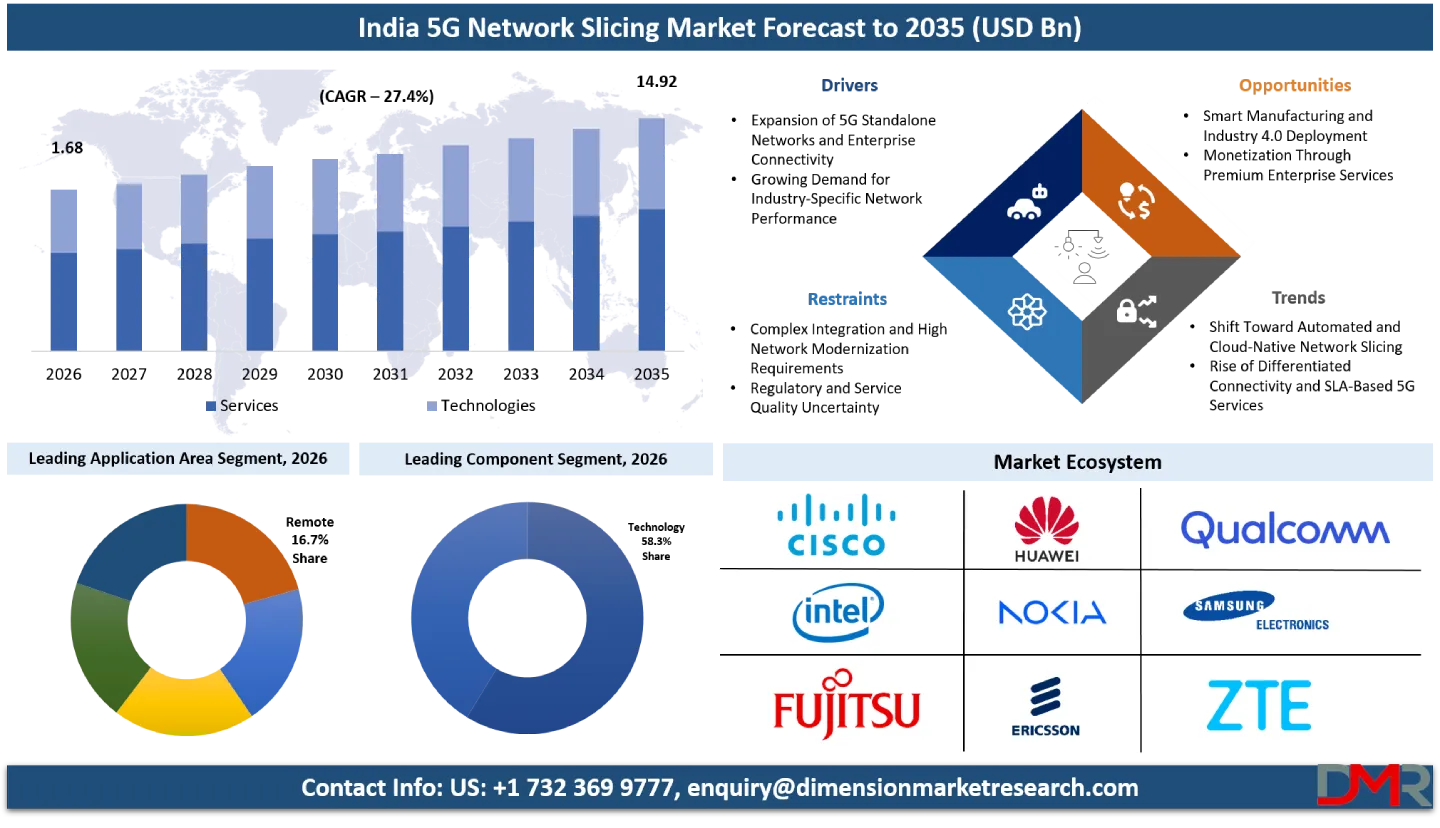
- Market Value: The India 5G Network Slicing Market is projected to reach USD 14.92 billion by 2035 from USD 1.68 billion in 2026, at a CAGR of 27.4%.
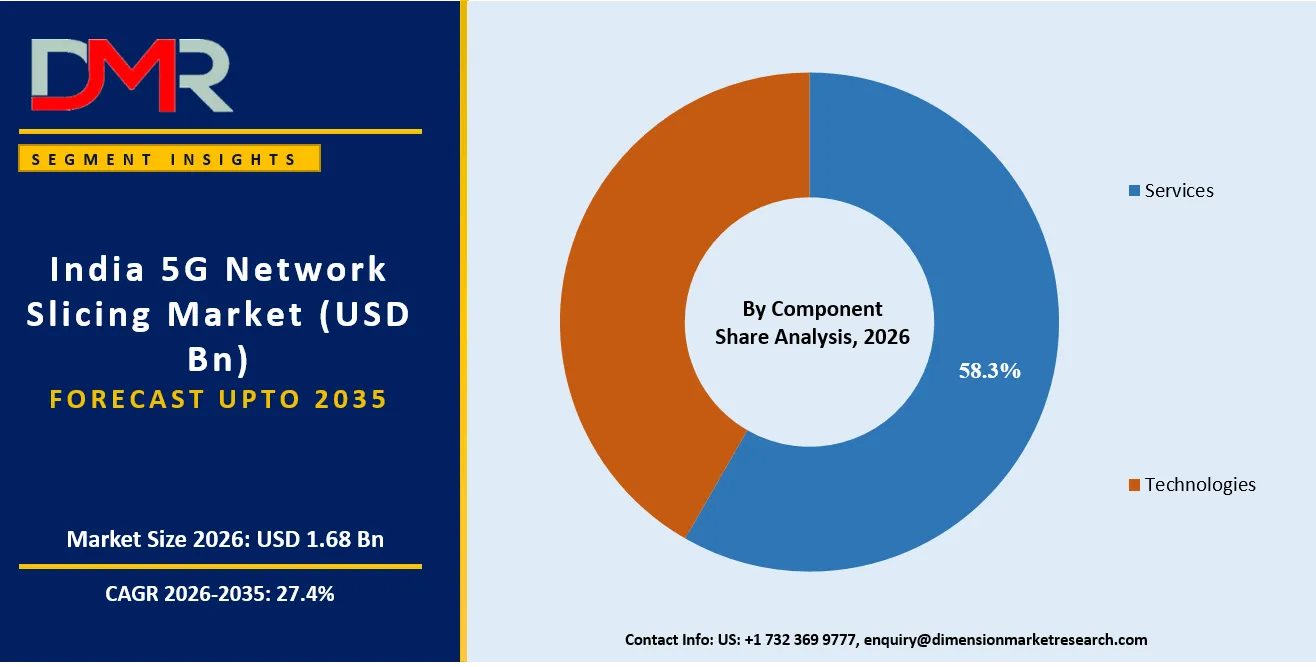
- By Component Segment Analysis: Technologies segment dominated with 58.3% share in 2026.
- By Application Area Segment Analysis: Remote Monitoring led application areas with 16.7% share in 2026.
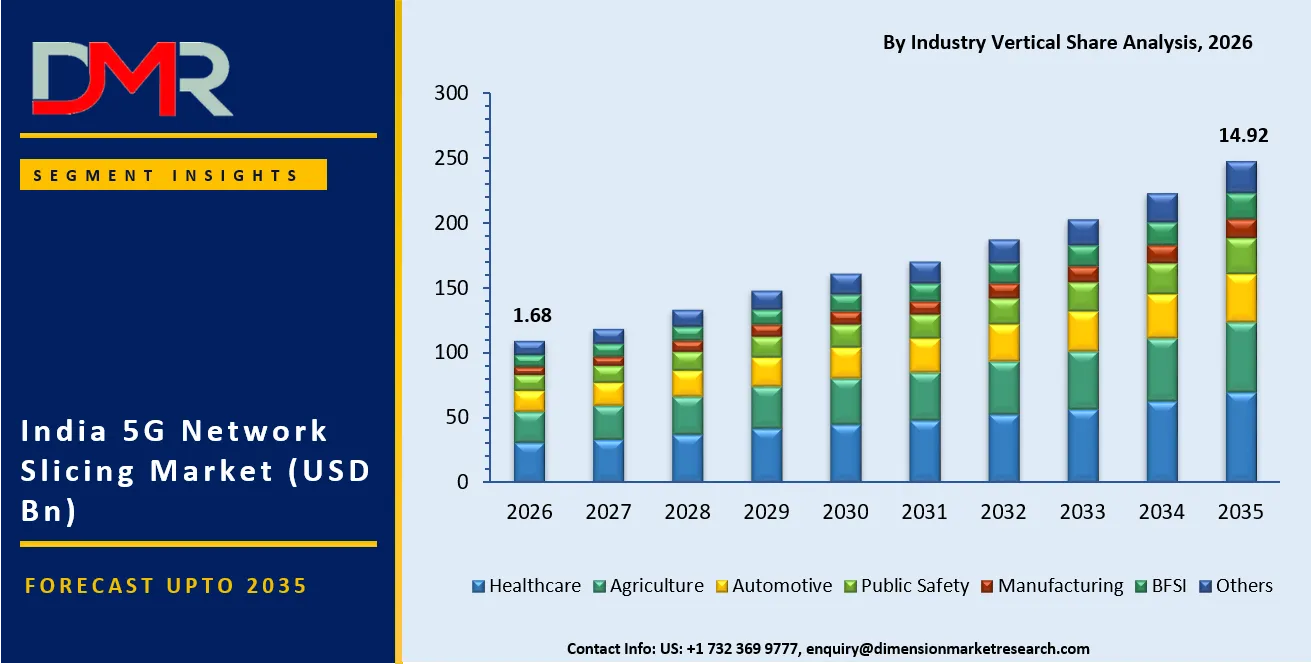
- By Industry Vertical Segment Analysis: Manufacturing held 18.9% share in 2026.
- Major Players: Ericsson, Nokia, Huawei, Cisco Systems, Samsung Electronics, ZTE Corporation, Qualcomm, and Others
What is the India 5G Network Slicing Market and its Market Size?
The India 5G Network Slicing Market size is projected to be valued at USD 1.68 billion in 2026 and is projected to reach USD 14.92 billion by 2035, expanding at a CAGR of 27.4% during the forecast period. Network slicing allows telecom operators and enterprises to create multiple virtual networks over shared 5G infrastructure, with each slice configured for specific bandwidth, latency, reliability, security, and service requirements. The model is becoming relevant across manufacturing, healthcare, logistics, utilities, financial services, media, and public infrastructure as organizations move from basic 5G connectivity toward performance-based enterprise services.
ℹ
To learn more about this report –
Download Your Free Sample Report Here
The growth pf the market is primarily driven by the expansion of 5G Standalone infrastructure, cloud-native 5G core platforms, edge computing, software-defined networking, network function virtualization, and automated orchestration. Reliance Jio has already implemented end-to-end network slicing for its fixed wireless access services and is exploring enterprise applications across manufacturing, healthcare, education, retail, security, and surveillance. Ericsson identifies network slicing and 5G Standalone architecture as important enablers for differentiated consumer and enterprise connectivity in India.
The commercial environment is also moving toward differentiated quality-of-service models. In August 2026, the Telecom Regulatory Authority of India proposed service-quality provisions related to 5G network slicing, reflecting growing regulatory attention as operators explore specialized connectivity services. The framework could influence how telecom companies design enterprise slices, premium service tiers, guaranteed network performance, and future monetization strategies while maintaining consumer service standards.
Use Cases
- Remote Monitoring: Network slicing can assign dedicated network resources to cameras, industrial sensors, connected assets, environmental monitoring systems, and remote facilities. With Remote Monitoring holding 16.7% of application-area share in 2026, the use case benefits from predictable data transmission, stronger device connectivity, controlled latency, and service continuity across factories, energy facilities, warehouses, transport networks, and infrastructure sites.
- Smart Manufacturing: Manufacturers can use dedicated 5G slices to connect industrial robots, automated guided vehicles, machine-vision systems, programmable controllers, and Industrial IoT devices. Slicing allows production applications with different performance needs to operate on shared infrastructure while receiving defined service levels. Manufacturing accounted for 18.9% of the India 5G network slicing market in 2026, supported by automation, connected production, predictive maintenance, and smart-factory investment.
- Enterprise Connectivity: Businesses can use 5G network slices for secure branch connectivity, cloud access, collaboration platforms, field operations, and mission-critical applications. Unlike conventional mobile broadband, a dedicated slice can be configured around enterprise requirements such as availability, throughput, device density, or latency. This creates opportunities for telecom operators to develop premium enterprise 5G services and service-level agreement-based connectivity models.
- Healthcare Services: Hospitals and healthcare networks can apply dedicated slices to connected medical devices, remote diagnostics, ambulance connectivity, high-resolution medical imaging, and telemedicine services. Separating critical healthcare traffic from general mobile traffic can support more predictable network performance. As India's digital healthcare infrastructure expands, network slicing could become an important connectivity layer for applications where reliability, security, and consistent service quality are essential.
- Logistics and Mobility: Dedicated 5G slices can support fleet tracking, connected vehicles, warehouse automation, port operations, asset monitoring, and real-time logistics platforms. Different slices can be assigned to video feeds, tracking sensors, autonomous equipment, or operational communications based on their performance requirements. This flexibility can help logistics companies improve visibility, automate workflows, reduce communication delays, and manage increasingly connected transport and distribution environments.
How AI/Gen AI is Transforming the India 5G Network Slicing Market?
AI-based automation is strengthening the commercial value of 5G network slicing by helping telecom operators analyze traffic patterns, predict capacity requirements, detect anomalies, and allocate network resources more dynamically. Machine-learning models can support closed-loop orchestration by monitoring latency, bandwidth, congestion, and service-quality indicators and adjusting slices as demand changes. This is particularly useful in environments such as manufacturing, remote monitoring, enterprise connectivity, and logistics, where network requirements can vary by application, location, device, and time. Jio's deployment already uses automated service management and orchestration to deploy and operationalize slicing-based services more efficiently.
Generative AI can further improve network operations by assisting engineers with configuration workflows, troubleshooting, service design, operational documentation, and analysis of complex network telemetry. When integrated with 5G core, edge computing, cloud platforms, and orchestration tools, these capabilities may shorten the process of designing enterprise-specific slices and identifying service degradation. Vendors such as Ericsson, Nokia, Huawei, Cisco Systems, Samsung Electronics, ZTE, VMware, Mavenir, and Juniper Networks are positioned within this broader shift toward programmable and automated telecom infrastructure. For Indian operators and enterprises, the combination of intelligent automation and network slicing can support faster service creation, better resource utilization, lower operational complexity, and new revenue models based on differentiated connectivity performance.
Key Drivers in the India 5G Network Slicing Market
Expansion of 5G Standalone Networks and Enterprise Connectivity
The expansion of 5G Standalone infrastructure is a major driver of India 5G network slicing market growth because slicing depends on cloud-native core networks, programmable resources, and service-based architecture. India is moving toward wider 5G adoption, with Ericsson projecting more than 1.1 billion 5G subscriptions in the country by 2031. Operators are also exploring differentiated enterprise connectivity, fixed wireless access, and dedicated service levels. Jio has implemented end-to-end network slicing for fixed wireless access, creating a practical foundation for wider enterprise applications across manufacturing, healthcare, education, retail, and security services.
Growing Demand for Industry-Specific Network Performance
Enterprise demand for predictable latency, reliability, security, and bandwidth is accelerating the India 5G network slicing market. Traditional mobile networks provide shared connectivity, while slicing enables operators to allocate dedicated logical resources according to application requirements. This model is attractive for smart factories, remote monitoring, automated warehouses, connected healthcare, utilities, surveillance, and mission-critical communications. Jio Platforms already promotes network slicing for massive machine-type communications, ultra-reliable low-latency communications, and enhanced mobile broadband services, showing how telecom infrastructure can evolve toward application-specific service delivery and SLA-based enterprise offerings.
Restraints in the India 5G Network Slicing Market
Complex Integration and High Network Modernization Requirements
Network slicing requires coordinated upgrades across the 5G core, radio access network, transport layer, orchestration platforms, cloud infrastructure, edge systems, and enterprise applications. Operators must also integrate service assurance, policy control, cybersecurity, billing, and lifecycle management before offering reliable commercial slices. These requirements increase deployment complexity and may extend implementation cycles, particularly for enterprises using legacy networks. Smaller organizations may also find dedicated 5G services difficult to justify until measurable productivity gains, lower downtime, or automation benefits offset integration and operational costs.
Regulatory and Service Quality Uncertainty
Regulation remains an important restraint as India determines how differentiated 5G services should operate alongside consumer protection and net neutrality principles. In August 2026, TRAI proposed quality-of-service provisions for network slicing, including safeguards intended to prevent resource allocation to specialized slices from reducing service quality for general users. Such rules are important for market maturity but can add compliance requirements for telecom operators designing premium connectivity models. Pricing, transparency, performance commitments, and network resource management are therefore likely to remain important considerations during commercial expansion.
Growth Opportunities in the India 5G Network Slicing Market
Smart Manufacturing and Industry 4.0 Deployment
Manufacturing represents a strong growth opportunity for the India 5G network slicing market, supported by connected machinery, robotics, industrial IoT, machine vision, predictive maintenance, and automated material handling. The manufacturing vertical held 18.9% market share in 2026, reflecting demand for reliable industrial connectivity. Dedicated slices can separate critical production traffic from ordinary enterprise communications and assign different service levels to robots, sensors, cameras, and control systems. As Indian manufacturers increase investment in digital factories and automation, telecom operators and technology vendors can develop sector-specific private and hybrid 5G solutions.
Monetization Through Premium Enterprise Services
Network slicing creates an opportunity for Indian telecom operators to move beyond traditional data plans and monetize connectivity according to service quality, application requirements, or enterprise outcomes. Operators can potentially offer guaranteed bandwidth, lower latency, higher reliability, secure enterprise access, and dedicated resource allocation through subscription or SLA-based models. Jio's network slicing platform specifically supports service differentiation and SLA management across shared infrastructure. These capabilities could support new revenue streams in logistics, healthcare, financial services, manufacturing, media, public safety, and large-scale enterprise connectivity as commercial 5G business models mature.
Trends in the India 5G Network Slicing Market
Shift Toward Automated and Cloud-Native Network Slicing
A key India 5G network slicing market trend is the transition from manually configured telecom networks toward automated, cloud-native orchestration. Operators increasingly need platforms that can create, modify, monitor, and terminate slices according to real-time service conditions. Jio has deployed automated service management and orchestration capabilities designed to accelerate the testing and production of network-slicing services. This trend is increasing demand for network automation, software-defined networking, cloud-native 5G core functions, policy engines, analytics, and service assurance technologies offered by telecom equipment, networking, software, and cloud infrastructure companies.
Rise of Differentiated Connectivity and SLA-Based 5G Services
The India 5G network slicing market is gradually moving toward differentiated connectivity in which network performance can be tailored to specific users, applications, and industries. Instead of selling only data capacity, telecom providers can use slicing to package services around latency, reliability, device density, security, or guaranteed throughput. Global growth in commercial differentiated connectivity offerings based on 5G Standalone slicing indicates that this model is moving closer to mainstream deployment. In India, regulatory discussion, enterprise trials, expanding 5G coverage, and demand for specialized connectivity are creating a foundation for premium consumer and enterprise service models.
Research Scope and Analysis
The India 5G Network Slicing Market is segmented based on Component, Application Area, Industry Vertical, and other relevant categories. The study provides an in-depth analysis of key segments and sub-segments, covering their applications, enterprise adoption, deployment trends, demand patterns, investment priorities, and contribution to overall market growth.
ℹ
To learn more about this report –
Download Your Free Sample Report Here
By Component
The Technologies segment accounted for the largest share of 58.3% in 2026, making it the dominant component category in the India 5G Network Slicing Market. The leadership of this segment is supported by increasing investments in cloud-native 5G core infrastructure, software-defined networking, network function virtualization, orchestration platforms, edge computing, and artificial intelligence-driven network management. Telecom operators are prioritizing technology modernization to enable programmable and scalable network slicing services for enterprise customers. Vendors continue to introduce advanced automation platforms capable of managing multiple virtual network slices while maintaining service quality and operational efficiency. As demand for customized enterprise connectivity increases across manufacturing, healthcare, logistics, financial services, and smart infrastructure, technology investments are expected to remain the primary contributor to market revenue throughout the forecast period.
By Application Area
Remote Monitoring emerged as the leading application area with a market share of 16.7% in 2026. The widespread deployment of connected sensors, industrial equipment, surveillance systems, utilities infrastructure, environmental monitoring solutions, and intelligent transportation networks is creating sustained demand for reliable and secure communication services. Network slicing enables operators to dedicate network resources according to application requirements, ensuring consistent connectivity for mission-critical monitoring applications. Enterprises increasingly require uninterrupted data transmission, low latency, and predictable network performance for operational visibility and asset management. As industrial digitalization accelerates across India, remote monitoring is expected to remain one of the fastest-growing commercial applications for network slicing services.
By Industry Vertical
The Manufacturing segment held the largest market share of 18.9% in 2026 due to rising investments in smart factories, industrial automation, robotics, machine vision, predictive maintenance, and Industrial Internet of Things deployments. Manufacturers are adopting dedicated network slices to separate production traffic from general enterprise communications while maintaining secure and reliable connectivity for critical industrial applications. This approach improves production efficiency, reduces operational downtime, and supports real-time decision-making across connected facilities. Government initiatives promoting advanced manufacturing and digital industrial transformation are further encouraging enterprises to modernize communication infrastructure, strengthening manufacturing's position as the leading industry vertical within the India 5G Network Slicing Market.
ℹ
To learn more about this report –
Download Your Free Sample Report Here
The India 5G Network Slicing Market Report is segmented on the basis of the following:
By Component
By Application Area
- Network Monitoring
- Asset Management
- Multimedia
- Real-Time Streaming
- Remote Monitoring
- Network Function Virtualization
- Real-Time Surveillance
- Supply Chain Management
By Industry Vertical
- Healthcare
- Agriculture
- Automotive
- Public Safety
- Manufacturing
- Others
- BFSI
- Media and Entertainment
- Energy and Utilities
Competitive Landscape
The competitive landscape of the India 5G Network Slicing Market is characterized by strategic collaborations between telecom equipment manufacturers, cloud technology providers, chipset companies, software vendors, and mobile network operators. Market participants are investing heavily in cloud-native 5G core platforms, network orchestration, edge computing, software-defined networking (SDN), network function virtualization (NFV), and artificial intelligence-based automation to strengthen their enterprise offerings. As organizations across manufacturing, healthcare, logistics, financial services, utilities, and smart city projects seek application-specific connectivity, vendors are focusing on delivering scalable network slicing platforms that provide differentiated quality of service, enhanced security, and low-latency performance. Product innovation, interoperability, open architecture, and managed service capabilities remain important competitive factors influencing long-term market positioning.
Some of the prominent players in the India 5G Network Slicing Industry are:
- Ericsson
- Nokia
- Huawei
- Cisco Systems
- Samsung Electronics
- ZTE Corporation
- Qualcomm
- Intel Corporation
- Fujitsu
- NEC Corporation
- Juniper Networks
- Dell Technologies
- VMware
- Mavenir
- Others
Recent Developments:
- May 2026: Bharti Airtel launched Priority Postpaid, using 5G network slicing to reserve capacity for eligible users during congestion—the first major retail use in India.
- May 2026: Ericsson and Nokia said Airtel’s commercial slicing rollout could accelerate AI-enabled devices and applications while supporting more intelligent, service-focused networks.
- August 2026: TRAI proposed India’s first formal slicing-QoS framework, requiring capacity checks, advance disclosures, PRB monitoring and separate performance commitments for each slice.
Report Details
| Report Characteristics |
| Market Size (2026) |
USD 1.68 Billion |
| Forecast Value (2035) |
USD 14.92 Billion |
| CAGR (2026–2035) |
27.4% |
| The India Market Size (2026) |
USD 1.68 Billion |
| Historical Data |
2021 – 2025 |
| Forecast Data |
2027 – 2035 |
| Base Year |
2025 |
| Estimate Year |
2026 |
| Segments Covered |
By Component, By Application Area, By Industry Vertical |
| Major Players |
Ericsson, Nokia, Huawei, Cisco Systems, Samsung Electronics, ZTE Corporation, Qualcomm, Intel Corporation, Fujitsu, NEC Corporation, Juniper Networks, Dell Technologies, VMware, and Mavenir, and Others |
Frequently Asked Questions
What is the current size of the India 5G Network Slicing Market?
▾ The India 5G Network Slicing Market is valued at USD 1.68 billion in 2026 and is forecast to reach USD 14.92 billion by 2035.
What is the growth rate of the India 5G Network Slicing Market during the forecast period?
▾ The India 5G Network Slicing Market is expected to grow at a CAGR of 27.4% during the forecast period from 2026 to 2035.
What factors are driving the growth of the India 5G Network Slicing Market?
▾ Expansion of 5G Standalone networks, Industry 4.0 adoption, cloud-native infrastructure, and enterprise digital transformation drive market growth.
What are the major challenges restraining the India 5G Network Slicing Market?
▾ High deployment costs, complex network integration, legacy infrastructure, and evolving regulatory requirements restrain market expansion.
Which segment holds the largest share of the India 5G Network Slicing Market?
▾ The Technologies component segment held the largest share of the India 5G Network Slicing Market with 58.3% revenue share in 2026.
Who are the leading companies in the India 5G Network Slicing Market?
▾ Ericsson, Nokia, Huawei, Cisco Systems, Samsung Electronics, ZTE Corporation, Qualcomm, Intel Corporation, Fujitsu, NEC Corporation, Juniper Networks, Dell Technologies, VMware, Mavenir, and other leading technology providers.
How is AI influencing the India 5G Network Slicing Market?
▾ AI improves network automation, traffic optimization, predictive analytics, intelligent orchestration, and service assurance across 5G network slicing deployments.
What are the future opportunities and trends in the India 5G Network Slicing Market?
▾ Growing private 5G, edge computing, AI-driven orchestration, Industry 4.0, and premium enterprise connectivity create strong future market opportunities.