South America 5G Core Network Market Snapshot
-
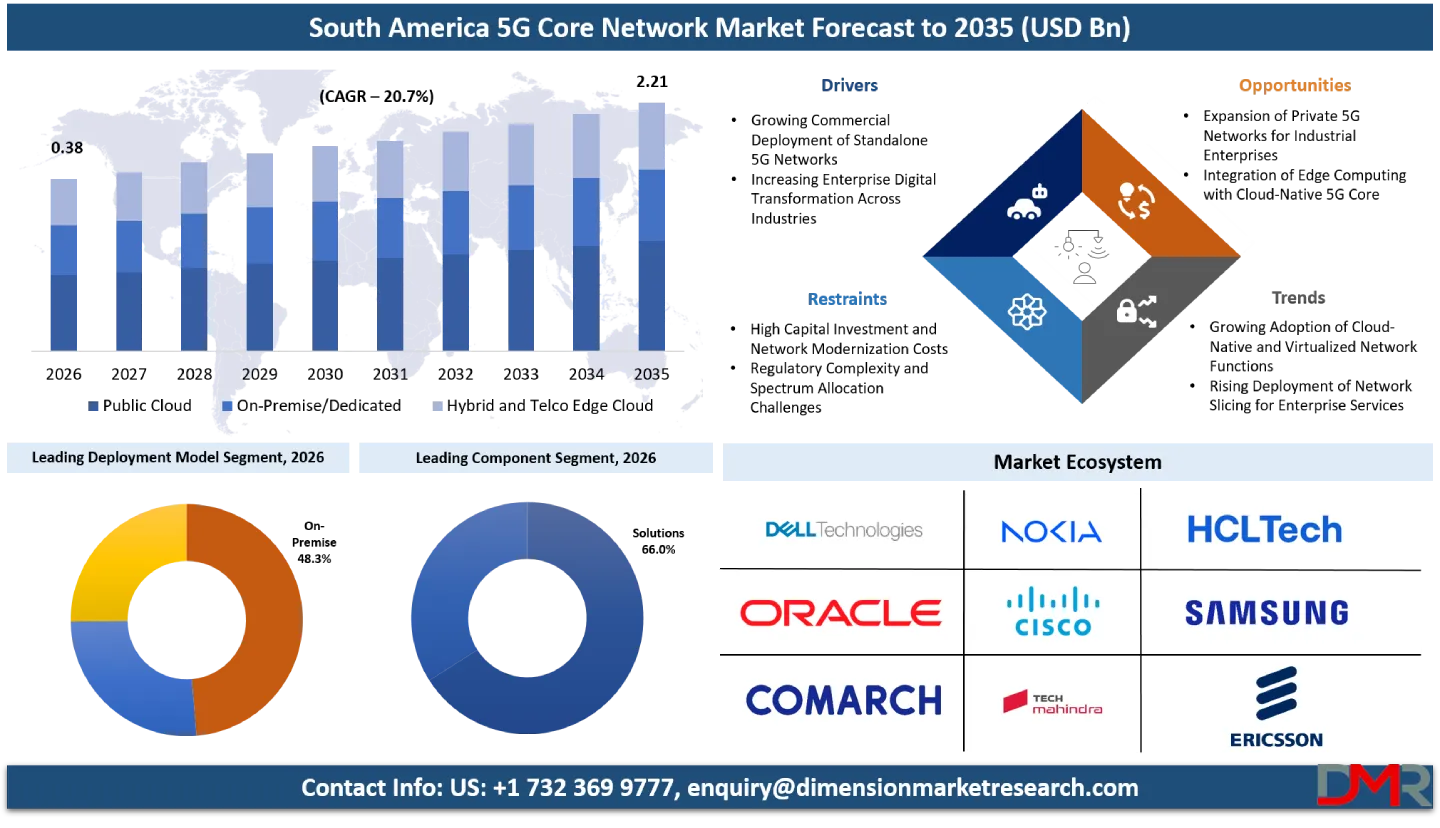
Market Value: The South America 5G Core Network market is expected to reach USD 2.21 billion by 2035 from USD 382.4 million in 2026, at a CAGR of 20.7%.
-
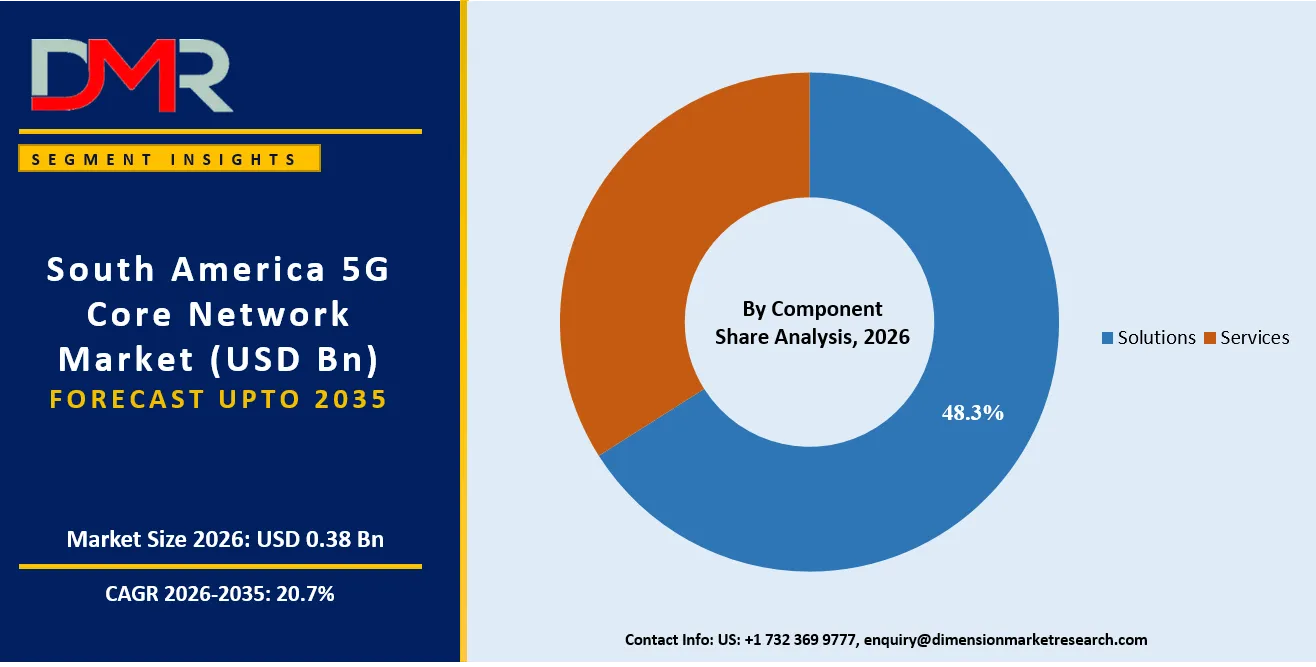
By Component Segment Analysis: Solutions segment dominated with 66.0% share in 2026.
-
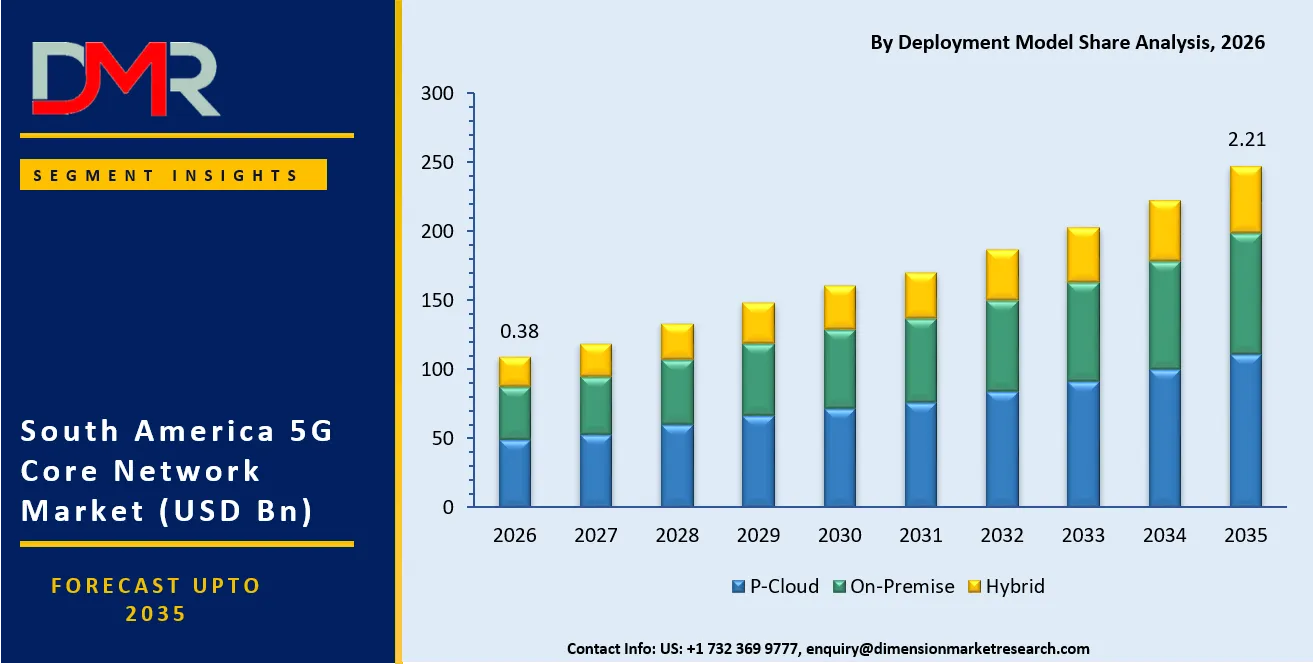
By Deployment Model Segment Analysis: On-Premise/Dedicated led deployment models with 48.3% share in 2026.
-
By End-User Segment Analysis: Telecom Operators held 74.6% share in 2026.
-
By Network Function Segment Analysis: User Plane Function (UPF) led network functions with 18.4% share in 2026.
-
Regional Analysis: Brazil led South America 5G Core Network market with 62.8% revenue share in 2026.
-
Major Players: HCLTech, Nokia, Oracle Corporation, Samsung Electronics Co., Ltd., Comarch SA and others.
What is the South America 5G Core Network Market and its Market Size?
The South America 5G Core Network market size is projected to reach USD 382.4 million in 2026 and USD 2.21 billion by 2035, expanding at a CAGR of 20.7% during the forecast period. A 5G core network is the central software-based infrastructure that manages subscriber access, mobility, data sessions, security, policy control, service delivery, and communication between devices and external data networks. It supports standalone 5G services and enables telecom operators to deliver faster data speeds, lower latency, improved network reliability, and customized connectivity for consumer and enterprise applications.
ℹ
To learn more about this report –
Download Your Free Sample Report Here
The South America 5G Core Network market growth is closely linked to the transition from non-standalone 5G systems, which depend partly on existing 4G infrastructure, toward standalone 5G architecture. Standalone networks use a dedicated 5G core and allow operators to introduce network slicing, edge computing, massive machine-type communication, and ultra-reliable low-latency services. These capabilities are becoming more important as telecom providers seek new revenue streams from industrial connectivity, private networks, smart infrastructure, cloud gaming, connected healthcare, and automated business operations.
Use Cases
- Industrial Automation and Smart Manufacturing: Manufacturers can use 5G core networks to connect robots, sensors, cameras, production equipment, and autonomous vehicles through secure, low-latency services. Dedicated network slices and edge processing support real-time quality inspection, predictive maintenance, worker safety, and production monitoring. These applications can raise demand for private 5G core solutions across automotive, food processing, metals, and consumer goods facilities.
- Mining and Energy Operations: Mining companies, oil and gas producers, and utilities can deploy dedicated 5G core infrastructure to connect remote assets, autonomous machinery, drones, environmental sensors, and field workers. Reliable local connectivity supports equipment tracking, video analytics, predictive maintenance, and remote control in locations where public coverage may be limited. This use case is especially relevant to South America's resource-based economies and large industrial sites.
- Connected Healthcare Services: Hospitals and healthcare networks can use 5G core platforms to support telemedicine, connected diagnostic equipment, mobile clinical systems, remote patient monitoring, and rapid transfer of medical images. Network slicing can separate critical healthcare traffic from general data services, while edge computing reduces the distance traveled by sensitive information. These capabilities can improve service availability in major cities and underserved communities.
- Smart Ports, Logistics, and Transportation: Ports, airports, warehouses, and logistics companies can use 5G connectivity for automated guided vehicles, asset tracking, connected cranes, fleet monitoring, surveillance, and real-time inventory management. A programmable 5G core allows each application to receive suitable bandwidth, latency, and security. Growing trade activity and logistics modernization are expected to support demand for private networks and edge-enabled core infrastructure.
- Smart Cities and Public Safety: Municipal bodies can apply 5G core capabilities to intelligent traffic systems, connected lighting, utility monitoring, emergency communications, public surveillance, and environmental sensors. Network slicing can provide protected capacity for first responders and other essential services during periods of congestion. Broader adoption will depend on public investment, data governance, cybersecurity controls, and cooperation between governments and telecom operators.
How AI/Gen AI is Transforming the South America 5G Core Network Market?
Artificial intelligence is changing how South American telecom operators plan, operate, and secure 5G core networks. AI-based systems can study traffic patterns, device behavior, service quality, and network alarms to predict congestion, identify faults, allocate resources, and recommend corrective action. When combined with Network Data Analytics Function capabilities, automation can improve performance assurance and resource utilization. AI also supports dynamic slice management, energy optimization, fraud detection, and threat monitoring, helping operators manage the greater complexity created by distributed cloud-native network functions and rising data traffic.
Generative AI expands this value by allowing network teams to interact with operational systems through natural-language instructions. Engineers can use AI assistants to summarize incidents, search technical records, generate configuration guidance, explain performance changes, and support root-cause analysis. Emerging AI agents can complete defined operational tasks, such as detecting likely service-level violations and coordinating responses across network domains. Adoption will require accurate data, human oversight, secure model access, and clear governance because incorrect recommendations may affect critical services. Over time, GenAI-supported orchestration can shorten resolution cycles and help operators move toward intent-based, increasingly autonomous 5G operations.
Key Drivers in the South America 5G Core Network Market
Growing Commercial Deployment of Standalone 5G Networks
The expansion of standalone 5G infrastructure is one of the primary factors accelerating the South America 5G Core Network market growth. Mobile operators are investing in cloud-native core platforms to reduce network latency, improve service flexibility, and support advanced capabilities such as network slicing and edge computing. As subscriber demand for high-speed connectivity continues to increase, operators are modernizing legacy packet core infrastructure with software-defined architectures that enable faster service deployment, improved scalability, and efficient network resource utilization. These investments are creating sustained demand for advanced 5G core solutions across the region.
Increasing Enterprise Digital Transformation Across Industries
Rapid digital transformation across manufacturing, mining, healthcare, transportation, logistics, utilities, and financial services is driving adoption of advanced 5G core infrastructure. Enterprises require reliable, secure, and low-latency communication networks to support industrial automation, connected devices, cloud applications, artificial intelligence, and real-time analytics. Private 5G deployments and dedicated enterprise networks are becoming strategic investments for organizations seeking operational efficiency and business continuity. This growing enterprise demand is encouraging telecom operators to expand their 5G core capabilities and introduce new connectivity services.
Restraints in the South America 5G Core Network Market
High Capital Investment and Network Modernization Costs
Deploying a cloud-native 5G core requires substantial investment in virtualization software, container platforms, data centers, transport networks, cybersecurity systems, orchestration tools, and skilled technical resources. Many regional telecom operators continue balancing investments between existing LTE infrastructure and new standalone 5G deployments. The significant capital expenditure associated with network modernization may slow implementation schedules, particularly among smaller operators with limited financial resources and lower revenue generation capacity.
Regulatory Complexity and Spectrum Allocation Challenges
Different regulatory frameworks, licensing procedures, and spectrum allocation policies across South American countries continue creating implementation challenges for telecom operators. Delays in spectrum auctions, compliance approvals, and infrastructure permits can postpone commercial deployment timelines and increase operational uncertainty. In addition, evolving cybersecurity regulations and data protection requirements require operators to maintain high compliance standards, increasing implementation costs while extending project execution across multiple markets.
Growth Opportunities in the South America 5G Core Network Market
Expansion of Private 5G Networks for Industrial Enterprises
Private 5G networks are creating significant growth opportunities across mining, manufacturing, energy, ports, airports, and logistics facilities. Enterprises increasingly seek dedicated communication infrastructure that delivers secure connectivity, predictable performance, and low latency for mission-critical operations. Advanced 5G core platforms enable customized network management, industrial IoT integration, autonomous equipment, and real-time operational monitoring. As enterprise digitalization accelerates, demand for private 5G core deployments is expected to increase steadily across South America.
Integration of Edge Computing with Cloud-Native 5G Core
Edge computing is emerging as a major opportunity for 5G core network vendors as enterprises require localized data processing for latency-sensitive applications. Combining distributed edge infrastructure with cloud-native core architecture improves application responsiveness while reducing network congestion. Industries including healthcare, manufacturing, transportation, media, and smart cities increasingly require edge-enabled connectivity to support artificial intelligence, video analytics, autonomous systems, and immersive digital experiences. This trend is expected to strengthen long-term market expansion.
Trends in the South America 5G Core Network Market
Growing Adoption of Cloud-Native and Virtualized Network Functions
Telecom operators are increasingly replacing hardware-based network infrastructure with virtualized and cloud-native 5G core platforms that improve scalability, operational flexibility, and service innovation. Containerized network functions simplify software deployment, reduce maintenance requirements, and support continuous service upgrades. This architectural transition also enables faster integration with artificial intelligence, automation platforms, and multi-cloud environments, making cloud-native technology one of the most significant trends shaping the regional market.
Rising Deployment of Network Slicing for Enterprise Services
Network slicing is becoming a key technology for delivering customized connectivity to industries with different performance requirements. Telecom operators are creating dedicated virtual network environments that provide tailored bandwidth, latency, security, and reliability for healthcare, manufacturing, transportation, public safety, and industrial automation. As standalone 5G adoption expands throughout South America, network slicing is expected to become an important commercial strategy supporting enterprise digital transformation and new revenue generation opportunities.
Research Scope and Analysis
The South America 5G Core Network market is segmented based on Component, Deployment Model, End User, Network Function, and other relevant categories. The study provides an in-depth assessment of each segment by examining technology adoption, deployment patterns, application areas, customer demand, investment activities, and revenue contribution. It further evaluates how different market segments support overall industry development while identifying emerging opportunities that are expected to influence future market growth.
ℹ
To learn more about this report –
Download Your Free Sample Report Here
By Component
The Solutions segment accounted for the largest share of the South America 5G Core Network market, representing 66.0% of total revenue in 2026. The segment includes cloud-native core platforms, subscriber data management, policy control, network orchestration, service-based architecture, security solutions, charging systems, and analytics software that enable telecom operators to manage next-generation mobile networks efficiently. Growing migration toward virtualized infrastructure, increasing adoption of standalone 5G architecture, and rising demand for software-defined networking continue strengthening the position of this segment.
Telecom operators are prioritizing scalable software solutions that simplify network management, accelerate service deployment, improve operational efficiency, and support advanced capabilities such as network slicing, edge computing, and automated lifecycle management. Continuous software upgrades and increasing investments in intelligent network automation are expected to sustain the dominance of the solutions segment throughout the forecast period.
By Deployment Model
The On-Premise/Dedicated deployment model held the leading market share of 48.3% in 2026 owing to its ability to provide enhanced security, regulatory compliance, operational control, and predictable network performance. Telecom operators, government agencies, financial institutions, healthcare organizations, manufacturers, mining companies, and energy providers continue investing in dedicated infrastructure to support mission-critical communication and private 5G services.
On-premise deployments enable organizations to maintain complete ownership of network resources while ensuring low latency, data sovereignty, and greater resilience for business-critical applications. Growing adoption of industrial automation, enterprise digital transformation, and private wireless networks is expected to further strengthen demand for dedicated deployment models across South America as organizations seek secure and reliable communication infrastructure.
ℹ
To learn more about this report –
Download Your Free Sample Report Here
The South America 5G Core Network Market Report is segmented on the basis of the following:
By Component
-
Solutions
- NFV Infrastructure
- Orchestration and Management
- Packet-Core Software
- Services
- Consulting and Advisory
- Integration and Deployment
- Support and Maintenance
By Deployment Model
-
Public Cloud
- On-Premise/Dedicated
- Hybrid and Telco Edge Cloud
By End-User
-
Telecom Operators
- Enterprises
- Energy and Utilities
- Smart Cities and Municipalities
- Transportation and Logistics
- Manufacturing
- Public Safety and Emergency
By Network Function
Competitive Landscape
The South America 5G Core Network market is characterized by intense competition among global telecommunications equipment manufacturers, software providers, cloud technology companies, and network infrastructure vendors. Market participants compete by investing in cloud-native architecture, network function virtualization, artificial intelligence, edge computing, automation platforms, cybersecurity capabilities, and open network technologies. Strategic collaborations with telecom operators, technology partnerships, product innovation, and managed service offerings remain key competitive strategies as vendors seek to strengthen their regional presence. Companies are also expanding research and development activities to improve network performance, reduce operational costs, simplify deployment, and support the growing adoption of standalone 5G infrastructure across South America.
Some of the prominent players in the South America 5G Core Network Industry are:
- HCLTech
- Nokia
- Oracle Corporation
- Samsung Electronics Co., Ltd.
- Comarch SA
- Cisco Systems, Inc.
- Tech Mahindra Limited
- Dell Technologies Inc.
- Ericsson
- Amdocs Limited
- NEC Corporation
- Huawei Technologies Co., Ltd.
- Hewlett Packard Enterprise Development LP
- IBM Corporation
- Juniper Networks, Inc.
- ZTE Corporation
- Red Hat, Inc.
- Mavenir Systems, Inc.
- Others
Recent Developments:
- February 2026: Nokia expanded its TIM Brasil partnership across 14 additional states, strengthening AI-ready 5G services and widening demand for standalone-core modernization.
- March 2026: Brazil’s target of 80% 5G population coverage across more than 2,220 municipalities is accelerating operator investment in cloud-native cores, edge capacity and automation.
- January 2026: Dell’Oro raised its global 5G mobile-core forecast to 12% CAGR through 2030, supporting investment momentum for standalone 5G, RedCap, network slicing and enterprise services.
Report Details
| Report Characteristics |
| Market Size (2026) |
USD 382.4 Million |
| Forecast Value (2035) |
USD 2.21 Billion |
| CAGR (2026–2035) |
20.7% |
| Regional Market Size (2026) |
USD 382.4 Million |
| Historical Data |
2021 – 2025 |
| Forecast Data |
2027 – 2035 |
| Base Year |
2025 |
| Estimate Year |
2026 |
| Segments Covered |
By Component, By Deployment Model, By End-User, By Network Function |
| Major Players |
HCLTech, Nokia, Oracle Corporation, Samsung Electronics Co., Ltd., Comarch SA, Cisco Systems, Inc., Tech Mahindra Limited, Dell Technologies Inc., Ericsson, Amdocs Limited, NEC Corporation, Huawei Technologies Co., Ltd., Hewlett Packard Enterprise Development LP, IBM Corporation, Juniper Networks, Inc., ZTE Corporation, Red Hat, Inc., Mavenir Systems, Inc., and other |
Frequently Asked Questions
What is the current size of the South America 5G Core Network Market?
▾ The South America 5G Core Network market was valued at USD 382.4 million in 2026 and is forecast to reach USD 2.21 billion by 2035, driven by expanding standalone 5G deployments, enterprise digitalization, and increasing investments in cloud-native telecom infrastructure.
What is the growth rate of the South America 5G Core Network Market?
▾ The South America 5G Core Network market is expected to grow at a CAGR of 20.7% during the forecast period from 2026 to 2035.
What factors are driving the growth of the South America 5G Core Network Market?
▾ The South America 5G Core Network market is driven by standalone 5G deployment, cloud-native network adoption, enterprise digital transformation, industrial IoT expansion, edge computing, and increasing investments in next-generation telecom infrastructure
What are the major challenges restraining the South America 5G Core Network Market?
▾ Major challenges affecting the South America 5G Core Network market include high infrastructure investment requirements, spectrum allocation delays, regulatory complexity, cybersecurity concerns, and the shortage of skilled telecom professionals.
Which segment holds the largest share of the South America 5G Core Network Market?
▾ The Solutions segment held the largest share of the South America 5G Core Network market with 66.0% of total revenue in 2026.
Who are the leading companies in the South America 5G Core Network Market?
▾ Leading companies operating in the South America 5G Core Network market include HCLTech, Nokia, Oracle Corporation, Samsung Electronics Co., Ltd., Comarch SA, Cisco Systems, Inc., Tech Mahindra Limited, Dell Technologies Inc., Ericsson, Amdocs Limited, NEC Corporation, Huawei Technologies Co., Ltd., Hewlett Packard Enterprise Development LP, IBM Corporation, Juniper Networks, Inc., ZTE Corporation, Red Hat, Inc., Mavenir Systems, Inc., and other regional market participants.
How is AI influencing the South America 5G Core Network Market?
▾ Artificial intelligence is transforming the South America 5G Core Network market by enabling intelligent network automation, predictive maintenance, traffic optimization, cybersecurity enhancement, network slicing management, and faster service delivery through AI-powered operations.
What are the future opportunities and trends in the South America 5G Core Network Market?
▾ Future opportunities in the South America 5G Core Network market include private 5G expansion, edge computing integration, Open RAN adoption, cloud-native core deployment, AI-enabled network management, and increasing enterprise demand for low-latency digital connectivity.