India Ashwagandha Supplements Market Snapshot
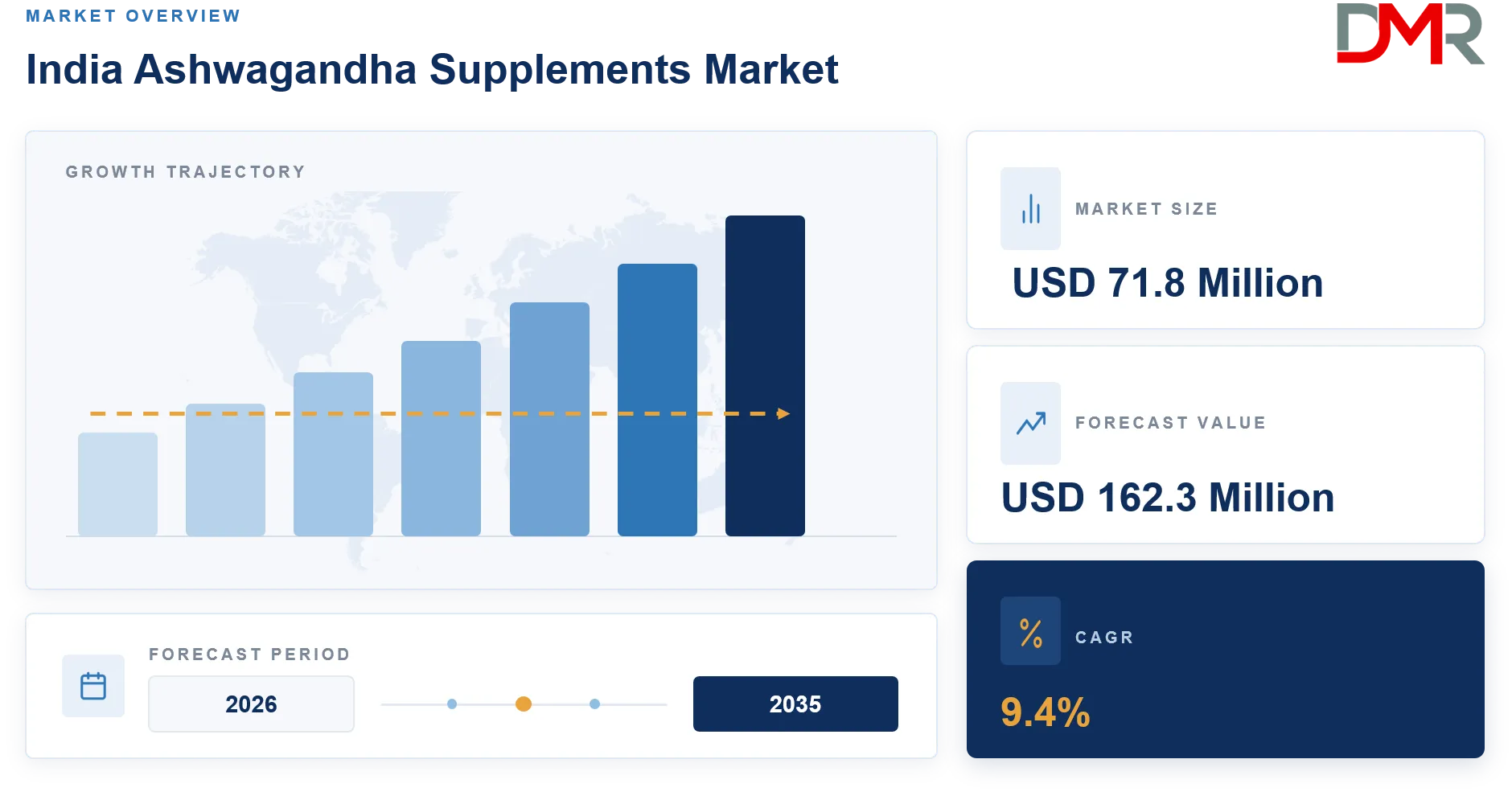
- Market Value: India Ashwagandha Supplements Market is valued at USD 71.8 million in 2026 and is expected to reach USD 162.3 million by 2035.
- CAGR: India Ashwagandha Supplements Market is expected to grow at a CAGR of 9.4% from 2026 to 2035.
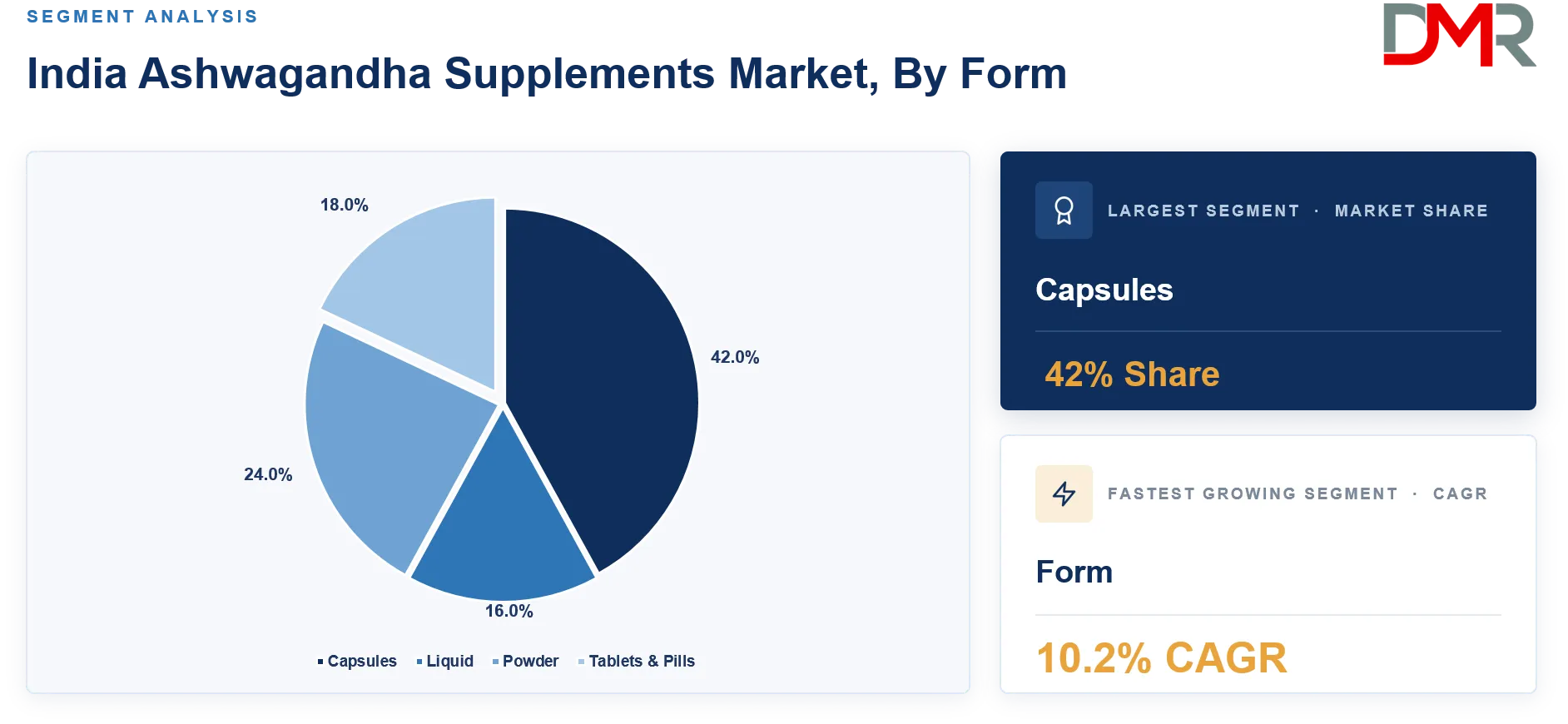
- By Form Analysis: Capsules led the form segment with a 42.0% share in 2026.
- By Distribution Channel Analysis: Retail Pharmacy led distribution channels with a 44.0% share in 2026.
- Major Players: Dabur India, Otsuka Pharmaceutical, Swanson Group, NOW Foods, Himalaya Wellness, and Others.
What is the India Ashwagandha Supplements Market and its Market Size?
The India Ashwagandha Supplements Market size is projected to be valued at USD 71.8 million in 2026 and is projected to reach USD 162.3 million by 2035, expanding at a CAGR of 9.4% during the forecast period. Ashwagandha supplements include capsules, tablets and pills, powders, and liquid formulations containing Withania somnifera as a principal botanical ingredient. Demand spans traditional Ayurveda users as well as consumers seeking standardized, convenient wellness supplements positioned around stress management, vitality, stamina, sleep support, and general well-being.
ℹ
To learn more about this report –
Download Your Free Sample Report Here
India occupies a distinctive position in the ashwagandha supplements industry because the plant has an established role in Ayurveda and is supported by a domestic medicinal-plant ecosystem, herbal product manufacturers, pharmacies, online health platforms, and consumer wellness brands. The commercial market is moving beyond conventional powders toward branded capsules, tablets, standardized extracts, and convenient formulations. Current market competition also combines established Indian Ayurveda companies with international supplement brands, creating opportunities across mass-market, premium, clinically positioned, and digital-first product categories.
Use Cases
- Stress and Daily Wellness: Ashwagandha supplements are increasingly positioned as daily wellness products for adults managing demanding work schedules and lifestyle-related stress. Capsules and tablets provide measured doses and convenient consumption, allowing brands to address consumers who want traditional botanical ingredients in a format that fits established supplement routines.
- Sleep and Relaxation Support: Sleep-focused formulations create an important product-development opportunity. Ashwagandha is commonly marketed internationally for stress, anxiety, and sleep-related wellness applications, while standardized extracts allow manufacturers to formulate single-ingredient products or combine the botanical with complementary wellness ingredients.
- Energy and Stamina Products: Manufacturers use ashwagandha in products positioned around endurance, vitality, fatigue management, and physical performance. This use case expands the addressable market from traditional Ayurvedic users toward active adults, fitness consumers, professionals, and customers seeking botanical alternatives within everyday energy and performance routines.
- Preventive Wellness: Ashwagandha is being integrated into broader preventive-health portfolios sold through pharmacies, health stores, brand websites, and online pharmacies. Established brands such as Dabur and Himalaya position their products around stress management, energy, stamina, and general wellness, illustrating how traditional herbal positioning is being adapted for modern packaged supplements.
- Premium Standardized Supplements: Standardized botanical products give manufacturers an opportunity to compete on extract specification, ingredient traceability, plant-part disclosure, testing, dosage convenience, packaging, and product quality rather than price alone. This supports premiumization and creates potential for differentiated capsules and tablets aimed at knowledgeable urban wellness consumers.
How AI/Gen AI is Transforming the India Ashwagandha Supplements Market?
Data-driven technologies are changing how ashwagandha supplement companies identify demand, plan inventory, develop formulations, and manage digital commerce. Manufacturers can combine pharmacy sales, online search behavior, marketplace activity, customer reviews, geographic demand, and product-level performance data to identify which formats and wellness propositions are gaining attention. Predictive systems can support procurement planning for roots and extracts, flag unusual quality-test results, improve production scheduling, and estimate reorder requirements across retail and online channels. These capabilities are particularly relevant in a market where capsules, tablets, powder, and liquid products require different manufacturing processes, packaging systems, inventory cycles, and distribution strategies.
Generative technologies are also influencing product discovery and commercial operations. Brands can organize large volumes of consumer questions, identify recurring concerns about dosage formats or ingredients, and produce more consistent product information for sales teams and digital storefronts. Research and development teams can use computational tools to screen formulation concepts and structure existing scientific information, while commercial teams can analyze reviews and channel feedback more rapidly. Human validation remains essential because supplement claims, labeling, product classification, safety communication, and scientific interpretation require regulatory and technical review. In India, companies operating across Ayurvedic medicine and food or nutraceutical categories must align products with the regulatory framework applicable to the specific formulation and claims.
Key Drivers in the India Ashwagandha Supplements Market
Shift Toward Convenient Herbal Wellness Formats
India's long-standing familiarity with Ayurveda gives ashwagandha substantial consumer recognition, while packaged supplements make the ingredient easier to incorporate into modern routines. Capsules and tablets eliminate preparation associated with traditional powders and provide portable, pre-measured formats. This shift supports repeat purchasing through pharmacies and digital channels. The 42.0% capsule share in 2026 reflects the commercial importance of convenience, standardized presentation, controlled serving sizes, and compatibility with established supplement-consumption habits.
Growing Focus on Stress Management and Preventive Wellness
Consumer interest in stress management, sleep quality, energy, and general wellness is expanding the commercial role of ashwagandha beyond traditional Ayurvedic usage. Established suppliers now market packaged products directly around stress, stamina, vitality, and overall well-being, making the herb understandable to consumers who may have limited knowledge of classical formulations. This broader positioning increases addressable demand across working adults, fitness-oriented users, wellness shoppers, and consumers seeking plant-based additions to preventive-health routines.
Restraints in the India Ashwagandha Supplements Market
Quality Standardization and Raw Material Consistency
Product quality can vary according to plant material, cultivation conditions, processing, extraction method, concentration, storage, and testing practices. This creates procurement and quality-control challenges for manufacturers seeking consistent finished products at scale. Commercial buyers increasingly require clarity around botanical identity, plant part, extract specification, contaminant testing, and manufacturing controls. Suppliers unable to demonstrate consistent quality may face pressure from organized brands, while stronger traceability and analytical testing can increase operating costs for smaller manufacturers.
Regulatory and Claims Compliance Complexity
Ashwagandha products may enter the Indian market under different product frameworks depending on formulation, intended use, composition, and claims. Companies therefore need careful review of licensing, ingredient requirements, labeling, advertising language, manufacturing practices, and supporting evidence. FSSAI maintains the regulatory framework for foods and related categories, while the Ministry of Ayush oversees India's traditional systems of medicine. Compliance complexity can lengthen commercialization timelines and raises the importance of regulatory expertise when brands expand portfolios or introduce new combinations.
Growth Opportunities in the India Ashwagandha Supplements Market
Expansion of Standardized and Premium Formulations
Premiumization offers manufacturers an opportunity to move beyond undifferentiated herbal products. Companies can compete through standardized extracts, transparent ingredient sourcing, disclosed extract ratios or constituent specifications where appropriate, laboratory testing, vegetarian capsule formats, and focused wellness propositions. Such differentiation is relevant for urban consumers comparing formulations online before purchase. Premium products can also improve value realization for brands because competition moves toward formulation quality, evidence, traceability, and convenience instead of being determined mainly by pack price.
Digital Pharmacy and Direct-to-Consumer Expansion
Online pharmacies and brand-owned commerce channels are widening access to ashwagandha products and creating a measurable route for new-product testing. Digital retail enables consumers to compare format, quantity, ingredient details, reviews, and price without relying solely on local pharmacy inventory. Himalaya products, for example, are available through its own online platform as well as pharmacy commerce channels such as PharmEasy. This omnichannel environment gives established manufacturers and newer wellness brands opportunities to reach customers beyond their strongest physical distribution territories.
Trends in the India Ashwagandha Supplements Market
Movement from Traditional Powder Toward Dose-Convenient Products
A significant product trend is the coexistence of traditional powder with capsules, tablets, pills, and liquid preparations designed for convenience. Capsules held 42.0% of the India Ashwagandha Supplements Market in 2026, indicating that measured oral dosage is central to category growth. Industry research covering the Indian market also identifies capsules, powder, liquid, and other oral formats as core competitive segments. Product development is consequently shifting toward dosage simplicity, compact packaging, standardized presentation, and formulations that can be incorporated into daily wellness routines.
Omnichannel Purchasing and Pharmacy-Led Trust
Retail pharmacies retained a 44.0% distribution-channel share in 2026, showing that physical pharmacy access remains important even as e-commerce expands. Pharmacies provide product visibility and an established health-oriented purchase environment, while online channels improve assortment, comparison, replenishment, and geographic reach. The emerging model is therefore not purely digital. Leading brands are increasingly supported by combinations of retail pharmacy presence, online pharmacy listings, marketplaces, and direct brand stores, creating multiple consumer touchpoints and reducing dependence on a single route to market.
Research Scope and Analysis
The India Ashwagandha Supplements Market study evaluates market size, share, growth, demand, competitive positioning, distribution patterns, product development, and forecast opportunities from 2026 to 2035. The analysis considers changes in consumer wellness behavior, herbal supplement adoption, format preferences, pharmacy distribution, online commerce, regulatory conditions, supplier dynamics, and competitive strategies affecting market revenue.
The India Ashwagandha Supplements Market is segmented based on Form and Distribution Channel. The study provides an in-depth assessment of key segments and sub-segments, covering their commercial applications, consumer adoption, demand patterns, competitive relevance, and contribution to overall India Ashwagandha Supplements Market growth.
By Form
Capsules dominated the India Ashwagandha Supplements Market by form with a 42.0% share in 2026. Their leadership reflects several commercial advantages: accurate pre-measured consumption, portability, limited preparation, easier integration into supplement routines, and compatibility with standardized extracts. Capsules also allow manufacturers to communicate ingredient quantity and extract specifications in a familiar dosage format. The segment competes with tablets and pills, traditional powders, and liquid products, each addressing different price points and consumer preferences. Market research covering India similarly identifies capsules as a major revenue-producing form, while powder remains an important category with growth potential.
Powder remains relevant because it is closely associated with traditional modes of consumption and provides flexibility in serving quantity and preparation. Tablets and pills benefit from established pharmaceutical-style manufacturing and broad consumer familiarity, while liquid products can address users seeking alternatives to solid dosage. Future competition across forms is expected to depend increasingly on standardized ingredient quality, dosage convenience, sensory experience, packaging, product positioning, and channel strategy rather than format alone.
ℹ
To learn more about this report –
Download Your Free Sample Report Here
By Distribution Channel
Retail Pharmacy led the India Ashwagandha Supplements Market distribution landscape with a 44.0% share in 2026. The channel benefits from broad offline accessibility and its association with health-related purchasing. Consumers can encounter ashwagandha alongside Ayurvedic products, vitamins, nutritional supplements, and other wellness categories, creating opportunities for both planned and recommendation-influenced purchases. Hospital pharmacies serve a narrower healthcare-linked demand base, while online pharmacies are increasing competitive intensity by offering wider assortment, price visibility, home delivery, search-based discovery, and convenient replenishment.
Channel strategies are becoming more integrated as major brands combine traditional retail networks with e-commerce. This allows suppliers to maintain physical availability while using online channels for product education, promotions, assortment expansion, and direct demand capture. For new entrants, online distribution can provide a faster way to test product positioning, although sustained scale still depends on brand credibility, consumer retention, supply availability, pricing discipline, and reliable fulfillment.
The India Ashwagandha Supplements Market Report is segmented on the basis of the following:
By Distribution Channel
- Retail Pharmacy
- Hospital Pharmacy
- Online Pharmacy
By Form
- Liquid
- Capsules
- Powder
- Tablets & Pills
Competitive Landscape
The India Ashwagandha Supplements Market features competition between established Indian Ayurvedic companies, wellness brands, international supplement suppliers, pharmacy channels, and emerging digital-first businesses. Dabur India and Himalaya Wellness benefit from established herbal-product portfolios and consumer familiarity in India, while international participants such as NOW Foods and Swanson Group contribute broader supplement-industry expertise and standardized product positioning. Competitive differentiation increasingly centers on extract quality, botanical sourcing, dosage format, ingredient transparency, quality testing, brand trust, pricing, pharmacy availability, and digital distribution.
Some of the prominent players in the India Ashwagandha Supplements Industry are:
- Dabur India
- Otsuka Pharmaceutical
- Swanson Group
- NOW Foods
- Himalaya Wellness
- Others
Regulatory Landscape
India's regulatory landscape for ashwagandha supplements depends on product composition, intended use, claims, and the regulatory category under which the product is marketed. Ayurvedic medicines fall within the framework administered through the Ministry of Ayush and the Drugs and Cosmetics Act and Rules, while products classified as health supplements or nutraceuticals must comply with applicable Food Safety and Standards Authority of India requirements. Manufacturers must address licensing, permitted ingredients, manufacturing standards, labeling, quality controls, and advertising claims before commercialization. This makes regulatory classification an important strategic decision for companies entering the India Ashwagandha Supplements Market. Greater scrutiny of unsupported therapeutic claims also raises the value of documented quality, ingredient traceability, testing, and compliant communication. Companies with established regulatory teams and controlled manufacturing systems are better positioned to launch capsules, powders, liquids, and tablets while maintaining consumer confidence and reducing compliance-related market risks.
Investment and White Space Analysis
The India Ashwagandha Supplements Market offers investment white space in standardized extracts, premium formulations, traceable sourcing, digital distribution, and differentiated wellness applications as the market expands from USD 71.8 million in 2026 to USD 162.3 million by 2035. Capsules, which account for 42.0% of the market in 2026, provide an attractive area for investment in standardized dosage, premium packaging, combination formulations, and quality-led positioning. Online pharmacy expansion also creates room for digital-first brands that can build demand without initially matching the physical distribution scale of established Ayurvedic companies. Additional opportunities exist in contract manufacturing, cultivation partnerships, extract processing, laboratory testing, and supply-chain traceability. Investors can also target gaps between low-cost traditional products and premium standardized supplements by offering clear ingredient specifications and credible quality controls. Retail Pharmacy's 44.0% share indicates that successful entrants should combine digital customer acquisition with pharmacy access rather than relying on a single distribution channel.
Recent Developments
Report Details
| Report Characteristics |
| Market Size (2026) |
USD 71.8 Million |
| Forecast Value (2035) |
USD 162.3 Million |
| CAGR (2026–2035) |
9.4% |
| Historical Data |
2021 – 2025 |
| Forecast Data |
2027 – 2035 |
| Base Year |
2025 |
| Estimate Year |
2026 |
| Segments Covered |
By Distribution Channel (Retail Pharmacy, Hospital Pharmacy, and Online Pharmacy), By Form (Liquid, Capsules, Powder, and Tablets & Pills) |
| Regional Coverage |
India |
Frequently Asked Questions
What is the current size of the India Ashwagandha Supplements Market?
▾ The India Ashwagandha Supplements Market is valued at USD 71.8 million in 2026 and is forecast to reach USD 162.3 million by 2035.
What is the growth rate of the India Ashwagandha Supplements Market?
▾ The India Ashwagandha Supplements Market is expected to grow at a CAGR of 9.4% during the forecast period from 2026 to 2035.
What factors are driving the growth of the India Ashwagandha Supplements Market?
▾ The India Ashwagandha Supplements Market is driven by preventive wellness demand, Ayurveda adoption, convenient formats, and pharmacy access.
What are the major challenges restraining the India Ashwagandha Supplements Market?
▾ The India Ashwagandha Supplements Market faces challenges from quality standardization, raw material consistency, and regulatory compliance.
Which segment holds the largest share of the India Ashwagandha Supplements Market?
▾ Capsules dominate the India Ashwagandha Supplements Market by form, accounting for a leading 42.0% market share in 2026.
Who are the leading companies in the India Ashwagandha Supplements Market?
▾ Dabur India, Otsuka Pharmaceutical, Swanson Group, NOW Foods, and Himalaya Wellness are leading companies in the India Ashwagandha Supplements Market.
How is AI influencing the India Ashwagandha Supplements Market?
▾ AI is supporting the India Ashwagandha Supplements Market through demand forecasting, quality analysis, inventory planning, and consumer insights.
What are the future opportunities and trends in the India Ashwagandha Supplements Market?
▾ The India Ashwagandha Supplements Market offers opportunities in standardized extracts, premium capsules, online pharmacies, and traceable sourcing.