India Cold Chain Logistics Market Snapshot
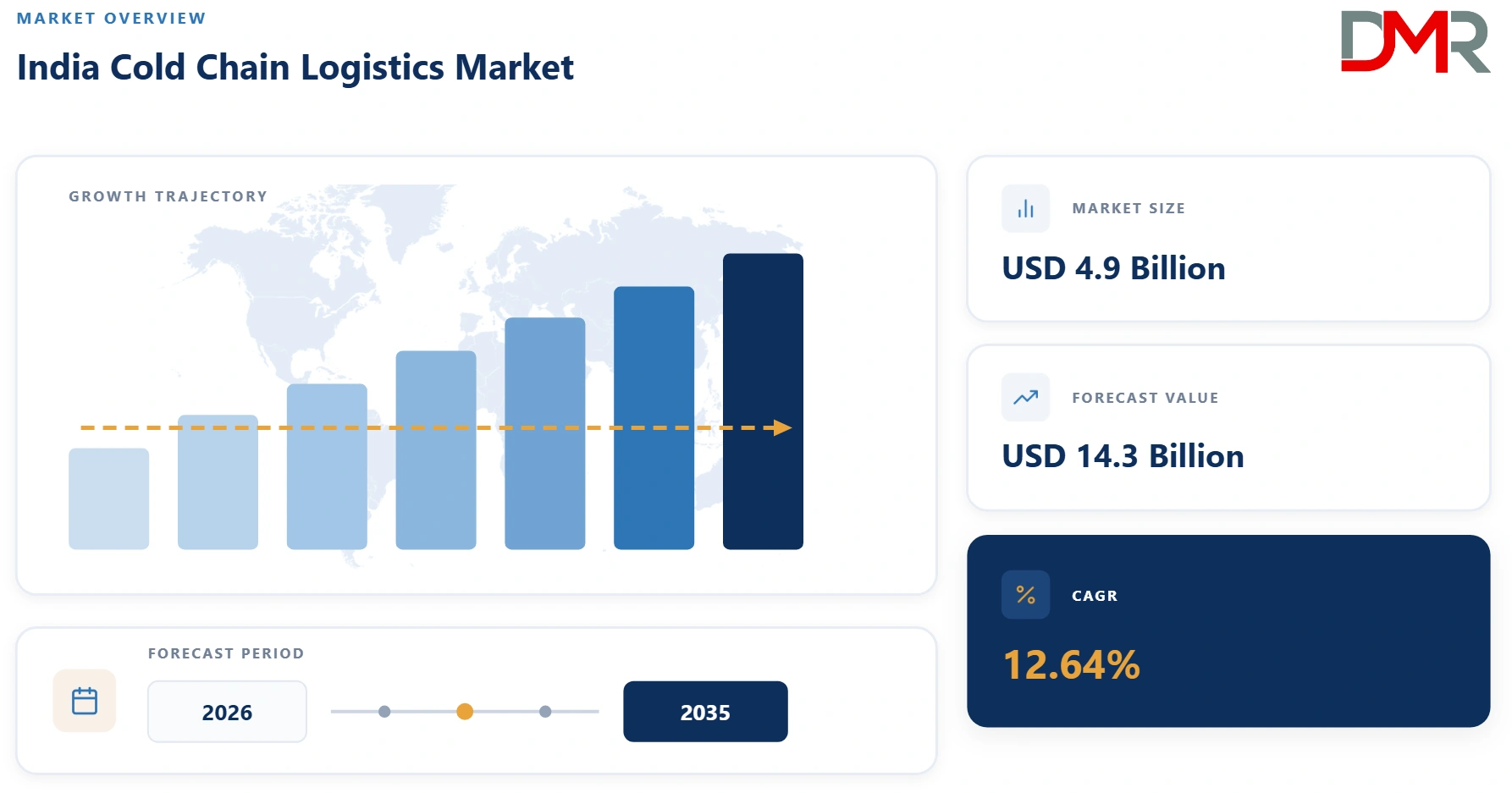
- India Cold Chain Logistics Market Size in 2026: USD 4.9 Billion
- India Cold Chain Logistics Market Size in 2035: USD 14.3 Billion
- CAGR from 2026 to 2035: 12.64%
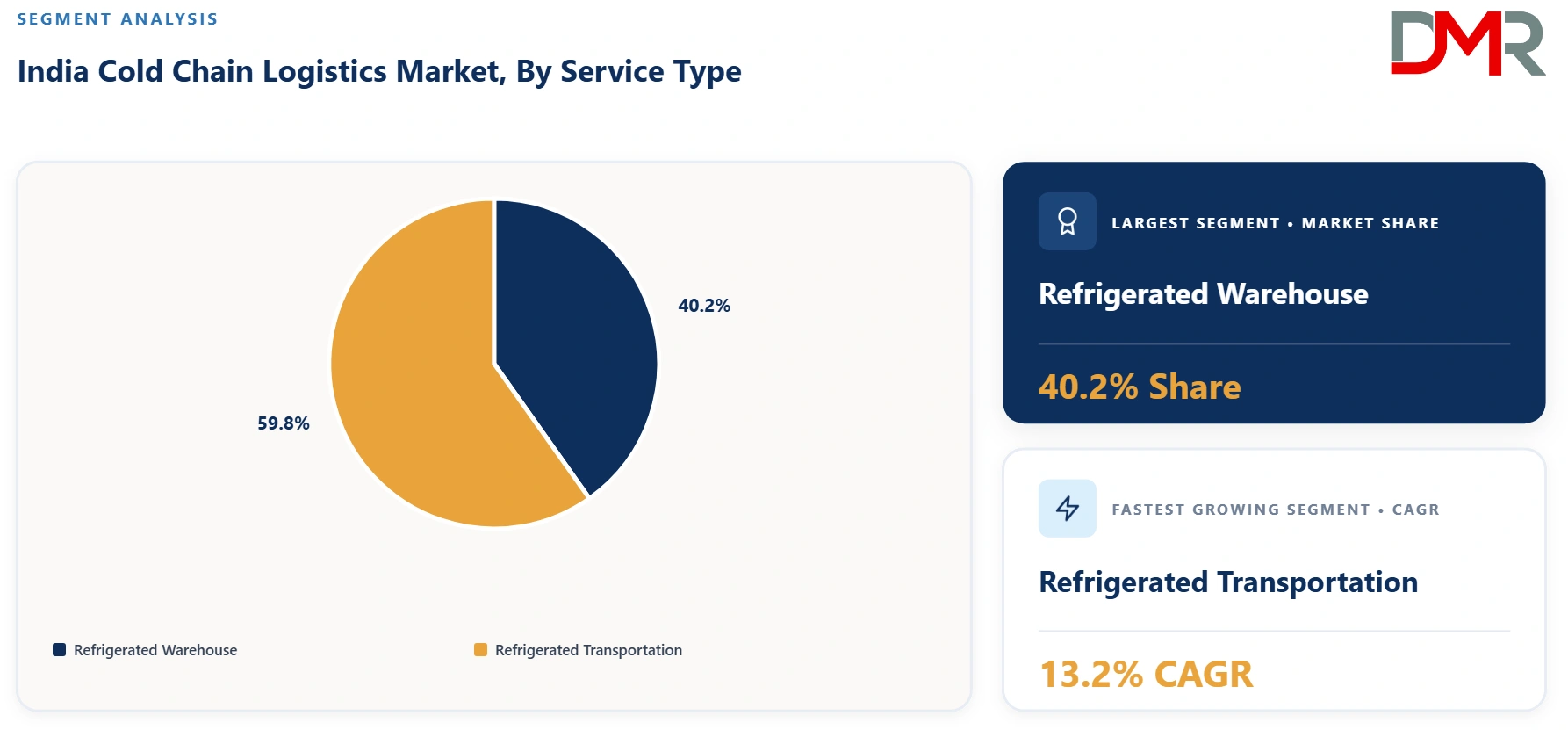
- Refrigerated Warehouse is the leading Service Type segment in 2026: 40.2%
- Fruit & Vegetable is the leading Application segment in 2026: 32.3%
- Frozen is the leading Temperature Type segment in 2026: 31.8%
- Dry Ice is the leading Technology segment in 2026: 42.1%%
What is the India Cold Chain Logistics and its Market Size?
The India Cold Chain Logistics Market encompasses temperature-controlled storage, transportation, and distribution solutions designed to preserve perishable products throughout the supply chain. The market is projected to reach USD 4.9 billion in 2026 and grow at a CAGR of 12.64% through 2035, reaching USD 14.3 billion. Growth is supported by rising demand for fresh food, dairy, seafood, pharmaceuticals, organized retail, food processing, and e-commerce, alongside expanding refrigerated infrastructure and increasing emphasis on reducing post-harvest losses.
ℹ
To learn more about this report –
Download Your Free Sample Report Here
Use Cases
- Fresh Fruit & Vegetable Preservation: Cold chain logistics maintains controlled temperatures for fruits and vegetables from farms to distribution centers, reducing spoilage, extending shelf life, maintaining freshness, and supporting reliable supply across domestic markets.
- Dairy Product Distribution: Refrigerated warehouses and transportation protect milk, cheese, yogurt, butter, and other dairy products from temperature fluctuations, enabling processors and retailers to maintain product quality and food safety throughout distribution.
- Meat & Seafood Logistics: Frozen and chilled logistics enable safe movement of meat, poultry, fish, and seafood by maintaining required temperature ranges, limiting microbial growth, reducing deterioration, and supporting organized retail and export supply chains.
- Quick Commerce & Organized Retail: Cold chain networks support supermarkets, grocery platforms, restaurants, and quick-commerce operators by enabling efficient storage and last-mile distribution of frozen, chilled, fresh, and other temperature-sensitive food products.
Key Takeaways
- Market Size: The India Cold Chain Logistics Market is anticipated to be valued at USD 4.9 billion in 2026 and is forecast to reach USD 14.3 billion by 2035, expanding at a CAGR of 12.64%.
- Growth Rate and Outlook: Market expansion is supported by rising consumption of fresh and frozen foods, rapid growth of organized retail and e-commerce, increasing food processing activities, expanding pharmaceutical distribution, government support for cold chain infrastructure, higher export volumes, and growing investments in temperature-controlled warehousing and transportation across India.
- Primary Growth Drivers: Increasing demand for perishable food products, rising urbanization, growth of quick commerce, expansion of modern grocery retail, increasing seafood and meat consumption, pharmaceutical logistics requirements, reduction of post-harvest losses, food safety awareness, and investments in refrigerated transportation and energy-efficient cold storage facilities are accelerating market development.
- By Service Type Analysis: Refrigerated Warehouse is projected to lead the Service Type segment with a 40.2% share in 2026, supported by increasing requirements for temperature-controlled storage of fruits, vegetables, dairy, seafood, meat, and processed foods. Expansion of food processing facilities, organized retail networks, and modern cold storage infrastructure is further strengthening demand.
- By Application Analysis: Fruit & Vegetable is expected to lead the Application segment with a 32.3% share in 2026, driven by India's substantial horticultural production and the need to minimize post-harvest losses. Increasing demand for fresh produce, organized retail penetration, food processing, exports, and improved farm-to-market cold chain connectivity are supporting segment growth.
- By Temperature Type Analysis: Frozen is anticipated to lead the Temperature Type segment with a 31.8% share in 2026, supported by growing consumption of frozen foods, meat, seafood, ready-to-eat products, and processed foods. Increasing urbanization, changing consumer preferences, expanding foodservice networks, and greater availability of frozen products through supermarkets and online grocery platforms are strengthening demand.
How AI/Gen AI is Transforming the India Cold Chain Logistics Market?
AI and Generative AI are transforming India’s cold chain logistics market by improving temperature monitoring, demand forecasting, route optimization, warehouse management, and predictive maintenance. AI-enabled IoT systems analyze real-time temperature, humidity, vehicle, and storage data to identify deviations before product quality deteriorates. Machine learning helps operators forecast demand, optimize inventory, reduce food wastage, and improve refrigerated fleet utilization. GenAI can automate operational reporting, compliance documentation, shipment analysis, and customer support while generating actionable recommendations from supply chain data. These technologies also support energy optimization in refrigerated warehouses, helping companies reduce operating costs, improve traceability, strengthen reliability, and enhance overall cold chain efficiency.
Key Drivers in the India Cold Chain Logistics Market
Rising Demand for Perishable and Temperature-Sensitive Food Products
India’s growing urban population, rising disposable incomes, changing dietary preferences, and increasing consumption of dairy, seafood, meat, fruits, vegetables, frozen foods, and ready-to-eat products are accelerating cold chain requirements. Consumers increasingly expect fresh, safe, and high-quality products throughout the year, encouraging producers and retailers to strengthen temperature-controlled distribution. Expansion of organized grocery retail, supermarkets, quick-commerce platforms, and foodservice businesses is further increasing refrigerated storage and transportation requirements. Cold chain infrastructure also helps reduce post-harvest losses and extend product shelf life, making it increasingly important for India’s agricultural and food processing ecosystem.
Expansion of Food Processing, Organized Retail, and E-Commerce
Rapid expansion of India’s food processing industry, organized retail sector, online grocery platforms, and quick-commerce networks is driving investment in cold chain logistics. Food processors require reliable refrigerated warehousing and transportation to maintain consistent quality from sourcing through final distribution. Meanwhile, supermarkets and digital grocery companies are expanding assortments of frozen, chilled, dairy, meat, seafood, and fresh products, increasing requirements for temperature-controlled fulfillment. Growing penetration of these businesses beyond major metropolitan areas is encouraging development of regional cold storage facilities and refrigerated transportation networks. Investments in logistics infrastructure and supply chain modernization are consequently supporting broader cold chain adoption.
Restraints in the India Cold Chain Logistics Market
High Capital Investment and Operating Costs
Developing and operating modern cold chain infrastructure requires substantial investment in refrigerated warehouses, temperature-controlled vehicles, cooling equipment, backup power systems, monitoring technologies, and specialized handling facilities. Electricity represents a significant operating expense, particularly in regions experiencing high temperatures or inconsistent power supply. Refrigerated transportation also involves higher fuel consumption, maintenance expenses, and equipment costs compared with conventional logistics. These financial requirements can limit adoption among smaller farmers, processors, distributors, and logistics companies. Long payback periods and fluctuating utilization rates further increase investment risks, making economically sustainable cold chain expansion challenging across lower-volume and geographically dispersed markets.
Fragmented Infrastructure and Last-Mile Connectivity Challenges
India’s cold chain ecosystem remains fragmented across agricultural production centers, processing facilities, warehouses, wholesale markets, and consumption hubs. Inadequate refrigerated transportation availability and uneven cold storage distribution can create breaks in temperature control, particularly across rural and remote areas. Poor last-mile connectivity, inconsistent handling practices, limited consolidation infrastructure, and dependence on multiple intermediaries further complicate efficient movement of perishable products. Smaller producers may also lack access to integrated cold chain services capable of maintaining temperature throughout the journey. These infrastructure gaps increase spoilage risks, logistics costs, and delivery times while restricting the development of seamless farm-to-consumer cold chains.
Growth Opportunities in the India Cold Chain Logistics Market
Expansion into Tier II, Tier III, and Agricultural Production Regions
Significant opportunities exist for cold chain providers to expand beyond major metropolitan areas into Tier II and Tier III cities and agricultural production clusters. Rising incomes, organized retail penetration, food delivery adoption, and changing consumption patterns are increasing demand for fresh, frozen, and chilled products in smaller urban markets. Establishing decentralized cold storage facilities, aggregation centers, reefer transportation networks, and temperature-controlled distribution hubs closer to production areas can reduce spoilage and improve market access for farmers. Companies capable of developing cost-efficient regional networks can address underserved locations while supporting India's growing food processing, retail, export, and agricultural value chains.
Technology-Enabled and Energy-Efficient Cold Chain Infrastructure
Adoption of IoT sensors, artificial intelligence, automation, telematics, cloud platforms, and advanced warehouse management systems creates substantial opportunities for cold chain operators. Real-time temperature and humidity monitoring can reduce spoilage while improving traceability and regulatory compliance. AI-powered demand forecasting and route optimization can increase warehouse utilization and refrigerated fleet efficiency. Simultaneously, solar-powered refrigeration, energy-efficient compressors, advanced insulation, and natural refrigerants can lower electricity consumption and operating expenses. Providers integrating digital monitoring with energy-efficient infrastructure can offer more reliable and cost-effective services, differentiate their operations, and address growing customer expectations for visibility, sustainability, and product integrity.
Trends in the India Cold Chain Logistics Market
Growing Adoption of IoT-Based Real-Time Monitoring and Automation
Indian cold chain operators are increasingly adopting IoT-enabled sensors, GPS tracking, telematics, automated warehouse systems, and cloud-based platforms to improve shipment visibility and operational control. Connected sensors continuously monitor temperature, humidity, location, equipment performance, and other critical parameters across warehouses and refrigerated vehicles. Automated alerts enable operators to respond rapidly when conditions move outside required thresholds, reducing product losses. Digital platforms also improve inventory visibility, fleet management, compliance reporting, and shipment traceability. As customers demand greater transparency and reliability, technology-enabled monitoring is becoming an important differentiator across food, retail, pharmaceutical, and temperature-sensitive logistics operations.
Shift Toward Integrated End-to-End Cold Chain Solutions
The market is increasingly shifting from standalone cold storage and refrigerated transportation toward integrated end-to-end cold chain services. Food manufacturers, retailers, exporters, and other customers increasingly prefer logistics partners capable of managing procurement, temperature-controlled storage, transportation, inventory management, distribution, and last-mile delivery through unified networks. Integrated services reduce handoffs between multiple providers, helping minimize temperature excursions, delays, and product losses. Cold chain companies are consequently expanding multimodal capabilities, distribution centers, reefer fleets, and technology platforms. This transition is encouraging consolidation and strategic partnerships while creating stronger demand for scalable third-party logistics solutions capable of maintaining product integrity throughout the supply chain.
Research Scope and Analysis
The India Cold Chain Logistics Market is analyzed by service type covering refrigerated warehouse and refrigerated transportation, by application covering seafood, meat, fruit and vegetable, dairy products, alternative protein and others, by temperature type covering frozen and chilled, and by technology covering dry ice, gel packs, eutectic plates, liquid nitrogen and quilts across India.
ℹ
To learn more about this report –
Download Your Free Sample Report Here
By Service Type Analysis
Refrigerated Warehouse is projected to dominate the Service Type segment with a 40.2% market share in 2026, supported by expanding temperature-controlled storage infrastructure. Refrigerated Transportation is expected to register the highest CAGR of approximately 13.2% during 2026-2035, driven by rising movement of perishable products across India.
By Application Analysis
Fruit & Vegetable is anticipated to lead the Application segment with a 32.3% market share in 2026, supported by India's large horticultural production base. Alternative Protein is expected to record the highest CAGR of approximately 13.1% during 2026-2035, driven by growing demand for temperature-sensitive plant-based and alternative protein products.
By Temperature Type Analysis
Frozen is projected to dominate the Temperature Type segment with a 31.8% market share in 2026, supported by growing consumption of frozen and processed foods. Chilled is expected to register the highest CAGR of approximately 12.9% during 2026-2035, driven by increasing distribution of dairy, fresh produce, meat, and seafood.
By Technology Analysis
Dry Ice is expected to lead the Technology segment with a 42.1% market share in 2026, supported by its widespread use in temperature-controlled logistics. Gel Packs are projected to record the highest CAGR of approximately 13.0% during 2026-2035, driven by growing adoption in last-mile delivery and temperature-sensitive product transportation.
The India Cold Chain Logistics Market Report is segmented based on the following:
By Service Type
- Refrigerated Warehouse
- Refrigerated Transportation
By Application
- Seafood
- Meat
- Fruit & Vegetable
- Dairy Products
- Alternative Protein
- Others
By Temperature Type
By Technology
- Dry Ice
- Gel Packs
- Eutectic Plates
- Liquid Nitrogen
- Quilts
Technology Analysis
Technology Analysis is highly relevant to the India Cold Chain Logistics Market as operators increasingly deploy IoT sensors, telematics, GPS tracking, AI-based forecasting, warehouse automation, and cloud-based monitoring to improve temperature integrity and operational efficiency. Real-time monitoring enables early detection of temperature deviations, reducing spoilage and strengthening traceability across refrigerated warehouses and transportation networks. Opportunities are expanding around energy-efficient refrigeration, solar-powered cold storage, automated handling, and predictive maintenance. However, high implementation costs, limited digital capabilities among smaller operators, cybersecurity concerns, and integration challenges remain key risks. Continued technology adoption is expected to reduce operating costs, improve asset utilization, strengthen regulatory compliance, and accelerate development of integrated cold chain networks.
Investment and White Space Analysis
Investment and White Space Analysis is particularly important as India’s cold chain infrastructure continues expanding beyond major metropolitan and established food-processing clusters. Significant opportunities exist in Tier II and Tier III cities, agricultural production regions, reefer transportation, multimodal logistics, decentralized cold rooms, and integrated farm-to-retail networks. Rising demand from fruits and vegetables, dairy, seafood, meat, frozen foods, quick commerce, and pharmaceutical distribution is attracting infrastructure investment. White spaces remain in first-mile aggregation, last-mile refrigerated delivery, renewable-powered facilities, and technology-enabled shared cold storage. Key risks include high capital requirements, electricity expenses, fragmented utilization, seasonal demand, and long payback periods. Targeted investment can reduce post-harvest losses and strengthen nationwide temperature-controlled distribution.
Competitive Landscape
The India Cold Chain Logistics Market is fragmented, with organized national providers competing alongside numerous regional cold storages and refrigerated transportation operators. Competition is increasingly shifting toward integrated, technology-enabled services covering warehousing, reefer transportation, inventory management, and last-mile distribution. Major participants include Snowman Logistics, ColdEx Logistics, Mahindra Logistics, TCI Express, DHL Supply Chain India, Gubba Cold Storage, and Crystal Logistic Cool Chain. Companies are expanding multi-temperature facilities, reefer fleets, automation, IoT monitoring, and digital traceability to differentiate their offerings. Rising demand from food processing, organized retail, quick commerce, agriculture, and pharmaceuticals is encouraging capacity expansion. However, regional fragmentation, high infrastructure costs, energy expenses, pricing pressure, and inconsistent asset utilization continue influencing competition and profitability across the market.
Some of the prominent players in the India Cold Chain Logistics Market are:
- Snowman Logistics Ltd.
- ColdEx Logistics Pvt. Ltd.
- Allcargo Gati Ltd.
- Mahindra Logistics Ltd.
- DHL Supply Chain
- Transport Corporation of India Ltd.
- Gubba Cold Storage Ltd.
- Cold Star Logistics Pvt. Ltd.
- Container Corporation of India Ltd.
- Crystal Logistic Cool Chain Ltd.
- R.K. Foodland Pvt. Ltd.
- Indicold Pvt. Ltd.
- Coldman Logistics Pvt. Ltd.
- Coldrush Logistics Pvt. Ltd.
- Godamwale
- Siddhi Cold Chain
- GK Cold Chain Solutions
- Transworld Group
- CEVA Logistics
- Celcius Logistics
- M.J. Logistics Services Ltd.
- Dev Bhumi Cold Chain Ltd.
- Kelvin Cold Chain Logistics Pvt. Ltd.
- Schedulers Logistics India Pvt. Ltd.
- Kool-ex Cold Chain Ltd.
- AWL India Pvt. Ltd.
- Reefer Express
- Ark Supply Chain Solutions
- Indraprastha Cold Storage
- Arihant Cold Storage
- Kailash Agro Cold Storage
- Deccan Cold Storage Pvt. Ltd.
- Blue Dart Express Ltd.
- Delhivery Ltd.
- XpressBees
- Rhenus Logistics India
- Kuehne+Nagel
- APL Logistics
- Fresh and Healthy Enterprises Ltd.
- Stockarea
- Other Key Players
Recent Developments
- In May 2026, Celcius Logistics partnered with Ottobock India to establish a dedicated 3,000 sq. ft. warehouse and distribution hub in Thane. Celcius will manage warehousing and transportation under a five-year exclusive contract, supporting distribution to 24 clinics and more than 200 partners.
- In May 2026, Snowman Logistics reported FY2026 operating income of approximately ₹604.38 crore, compared with ₹552.53 crore in FY2025, indicating continued expansion in its temperature-controlled logistics operations despite lower full-year net profit.
- In April 2026, Celcius Logistics reported that it was approaching its first profitable quarter, supported by increasing cold-chain demand from quick commerce, dairy products, and perishables. Its expanding network across roughly 700 cities highlights the growing role of technology-enabled cold-chain platforms in India.
Report Details
| Report Characteristics |
| Market Size (2026) |
USD 4.9 Bn |
| Forecast Value (2035) |
USD 14.3 Bn |
| CAGR (2026–2035) |
12.63% |
| Historical Data |
2021 – 2025 |
| Forecast Data |
2026 – 2035 |
| Base Year |
2025 |
| Segments Covered |
By Service Type, By Application, By Temperature Type, By Technology |
Frequently Asked Questions
How big is the India Cold Chain Logistics Market?
▾ The India Cold Chain Logistics Market is projected to reach USD 4.9 billion in 2026 and increase to USD 14.3 billion by 2035.
What is the CAGR of the India Cold Chain Logistics Market from 2026 to 2035?
▾ The India Cold Chain Logistics Market is expected to expand at a CAGR of 12.64% from 2026 to 2035.
What factors are driving the growth of the India Cold Chain Logistics Market?
▾ Growth is driven by rising demand for fresh and frozen foods, increasing dairy, meat, seafood, and fruit consumption, expansion of organized retail and quick commerce, growth of food processing and pharmaceutical distribution, reduction of post-harvest losses, and increasing investment in refrigerated warehousing and transportation infrastructure.
What are the major trends in the India Cold Chain Logistics Market?
▾ Major trends include growing adoption of IoT-based real-time monitoring, GPS tracking, telematics, AI-enabled forecasting, warehouse automation, digital traceability, energy-efficient refrigeration, and integrated end-to-end cold chain solutions. Expansion into Tier II and Tier III cities is also shaping market development.
Who are the key players in the India Cold Chain Logistics Market?
▾ Key players include Snowman Logistics Ltd., ColdEx Logistics Pvt. Ltd., Mahindra Logistics Ltd., DHL Supply Chain, Transport Corporation of India Ltd., Gubba Cold Storage Ltd., Crystal Logistic Cool Chain Ltd., Indicold Pvt. Ltd., Coldman Logistics Pvt. Ltd., Celcius Logistics, Kool-ex Cold Chain Ltd., CEVA Logistics, Kuehne+Nagel, Rhenus Logistics India, and Allcargo Gati Ltd.
How is the India Cold Chain Logistics Market segmented?
▾ The market is segmented by Service Type into Refrigerated Warehouse and Refrigerated Transportation, by Application into Seafood, Meat, Fruit & Vegetable, Dairy Products, Alternative Protein, and Others, by Temperature Type into Frozen and Chilled, and by Technology into Dry Ice, Gel Packs, Eutectic Plates, Liquid Nitrogen, and Quilts.