India CRO Market Snapshot
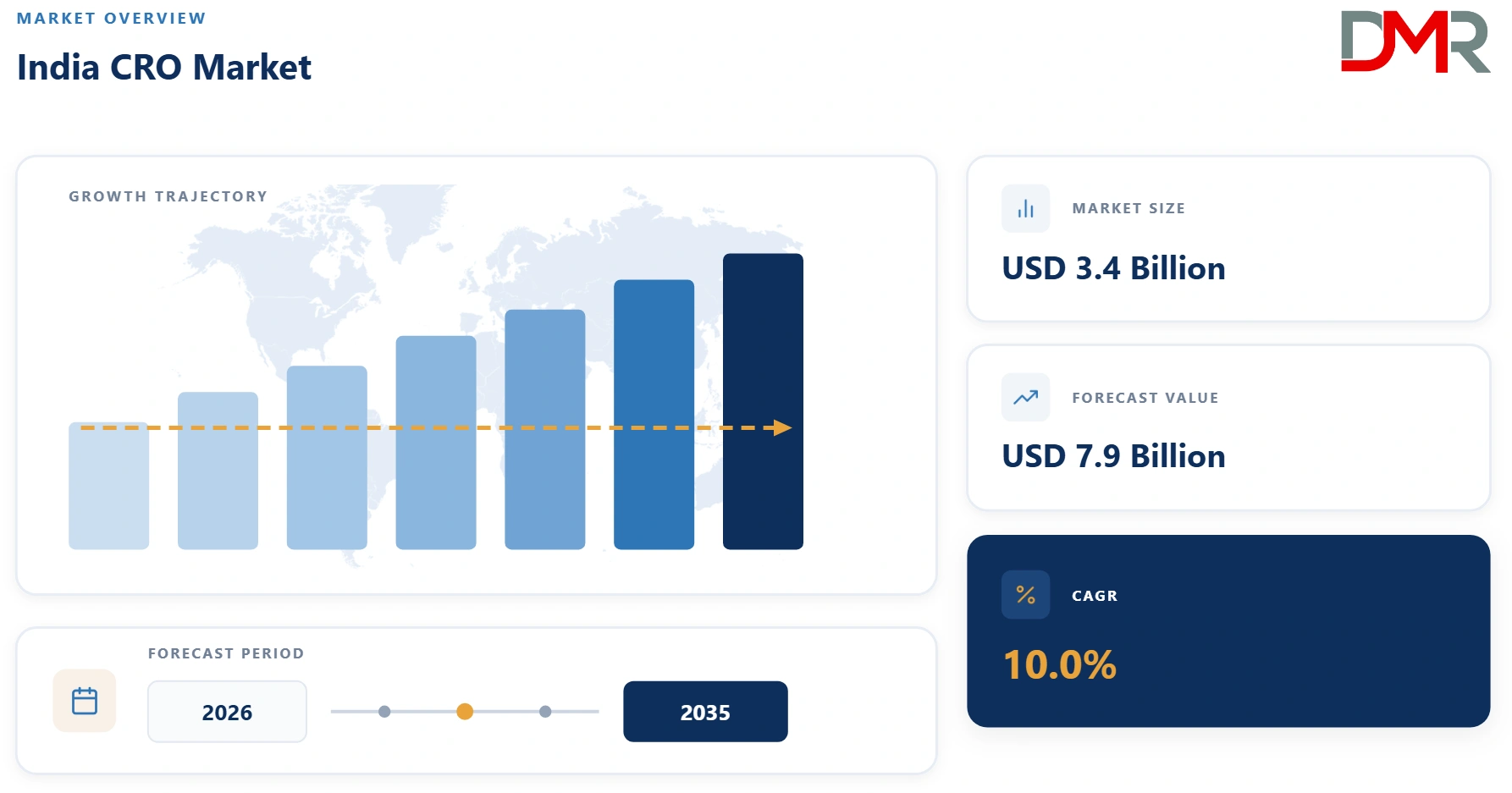
- Market Size, 2026: USD 3.4 billion
- Market Size, 2035: USD 7.9 billion
- CAGR, 2026–2035: 9.82%
- Leading Service Type, 2026: Clinical Research Services, 47%
- Leading Therapeutic Area, 2026: Oncology, 29%
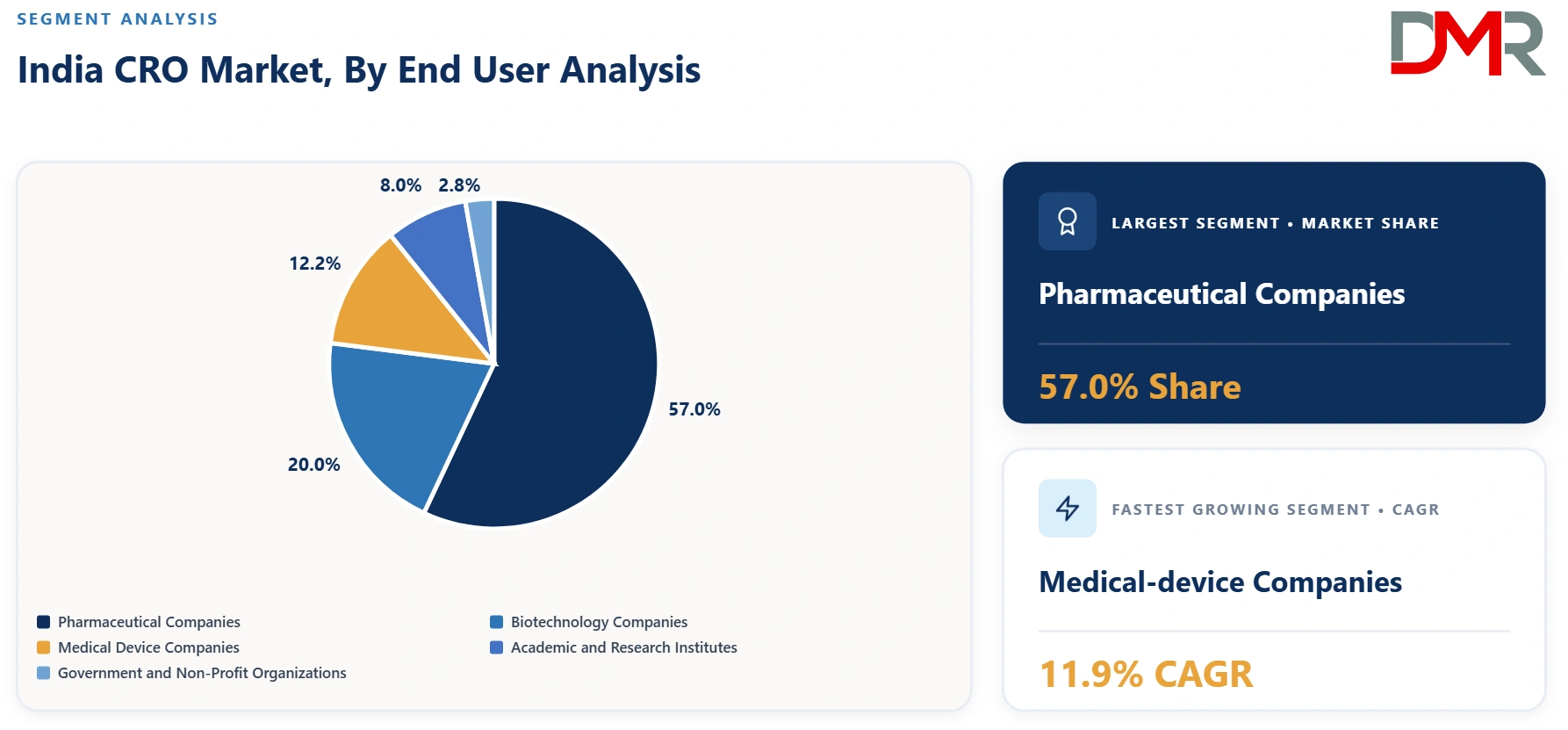
- Leading End User, 2026: Pharmaceutical Companies, 57%
- Fastest-Growing Segment: Medical Device Companies, 11.9% CAGR
What is the India CRO and its Market Size?
The India CRO market is estimated at USD 3.4 billion in 2026 and is projected to reach approximately USD 7.9 billion by 2035, representing a modeled 9.82% CAGR.
ℹ
To learn more about this report –
Download Your Free Sample Report Here
The India Contract Research Organization (CRO) market comprises third-party organizations that provide outsourced research, development, clinical, laboratory, regulatory, safety, data-management, and related services to pharmaceutical, biotechnology, medical-device, academic, and government customers. CROs can support individual activities—such as bioanalytical testing or pharmacovigilance—or manage integrated programs spanning discovery, preclinical research, clinical development, regulatory submission, and post-marketing evidence generation. Their core value proposition is enabling sponsors to access specialized scientific talent, infrastructure, patient populations, technology, and regulatory expertise without building all capabilities internally. India's CRO ecosystem includes domestic providers as well as large multinational organizations operating Indian delivery and clinical-research centers.
Use Cases
- Clinical Trial Management: Designing, initiating, monitoring, and closing clinical studies for pharmaceutical and biotechnology sponsors.
- Bioanalytical Testing: Measuring drug concentrations, biomarkers, immunogenicity, and other laboratory parameters supporting development programs.
- Preclinical Development: Conducting pharmacology, toxicology, pharmacokinetic, and safety studies before human testing.
- Regulatory Affairs: Preparing submissions, managing interactions with regulators, and supporting approvals across Indian and international markets.
- Pharmacovigilance: Detecting, assessing, documenting, and reporting adverse events throughout clinical and post-marketing product lifecycles.
- Data and Evidence Services: Providing biostatistics, clinical data management, real-world evidence, medical writing, and technology-enabled analytics.
Key Takeaways
- Market Size and Growth: The India CRO market is estimated at USD 3.4 billion in 2026, reaching approximately USD 7.9 billion by 2035 at a modeled 9.82% CAGR.
- Growth Drivers: Pharmaceutical outsourcing, biotech innovation, clinical-trial localization, cost advantages, scientific talent, and India's growing role in global drug development.
- Segment Dominance: Clinical research services remain the largest service category, while pharmaceutical companies constitute the largest customer group.
- Therapeutic Leadership: Oncology leads therapeutic-area demand because of India's substantial cancer burden and increasing availability of specialized trial infrastructure.
- Fastest Growth: Medical-device CRO activity is expected to grow faster than the overall market as domestic medtech innovation and clinical-evidence requirements increase.
- Strategic Shift: India's CRO sector is transitioning from predominantly cost-driven outsourcing toward higher-value clinical, regulatory, data, AI, and specialized scientific services.
How AI, Cloud and Digital Technologies Are Transforming India's CRO Market?
AI, cloud computing, advanced analytics, electronic clinical systems, remote monitoring, and automation are increasingly embedded across India's CRO value chain. Applications include protocol feasibility, patient identification, clinical-site selection, risk-based monitoring, automated data cleaning, medical coding, pharmacovigilance case processing, regulatory-document generation, and real-world-data analytics. IQVIA reports that its India operations already span clinical research, data management, lifecycle safety, medical writing, biostatistics, centralized monitoring, and real-world insights, illustrating the breadth of technology-enabled CRO delivery.
Technology improves CRO economics by reducing manual processing, shortening study timelines, improving data consistency, and enabling centralized oversight across geographically dispersed sites. Cloud platforms allow sponsors and CROs to collaborate in real time, while AI can prioritize higher-risk patients, sites, and data anomalies.
Key Drivers in the India CRO Market
Increasing Pharmaceutical R&D and Outsourcing
The India Contract Research Organization (CRO) Market is benefiting from increasing pharmaceutical and biotechnology R&D activity and the growing preference among sponsors to outsource specialized research functions. Pharmaceutical companies are increasingly using CROs for clinical operations, preclinical research, laboratory testing, biostatistics, data management, regulatory affairs, and pharmacovigilance. Outsourcing enables sponsors to access specialized expertise and infrastructure while reducing the need for extensive internal capabilities. India's established pharmaceutical ecosystem, expanding biotechnology sector, skilled scientific workforce, and cost-competitive research environment further support this trend. The increasing complexity of drug development is also encouraging sponsors to work with CROs that can provide integrated services across multiple stages of the development lifecycle.
Growing Clinical Trial Activity and Patient Pool
Increasing clinical-trial activity is another major growth driver for the India Contract Research Organization (CRO) Market. India offers a large and diverse patient population, a substantial burden of chronic and infectious diseases, experienced healthcare professionals, and an expanding network of hospitals and research centers. These characteristics support patient recruitment across oncology, cardiovascular diseases, metabolic disorders, infectious diseases, and other therapeutic areas. International sponsors are increasingly evaluating India for global and multinational clinical-development programs because of its scientific capabilities and cost competitiveness. Regulatory improvements and greater institutional experience with clinical research are also strengthening India's position as a clinical-trial destination.
Restraints in the India CRO Market
Regulatory Complexity and Approval Challenges
Regulatory requirements remain an important restraint for the India Contract Research Organization (CRO) Market. Although India's clinical-research framework has become more structured, CROs and sponsors must comply with requirements covering clinical-trial approvals, ethics committees, informed consent, safety reporting, data management, documentation, and quality standards. Differences in implementation and interpretation across institutions can create operational complexity and affect study timelines. CROs must maintain robust compliance systems, trained personnel, documentation processes, and audit capabilities to meet increasingly stringent expectations. Regulatory delays or uncertainty can make project planning more difficult, particularly for complex multinational trials. Smaller CROs may face greater challenges because maintaining advanced quality and compliance infrastructure requires substantial organizational resources.
Patient Recruitment, Retention and Data Security Challenges
Patient recruitment and retention remain significant operational challenges for the India Contract Research Organization (CRO) Market. Although India has a large patient population, geographic dispersion, limited awareness of clinical trials, eligibility restrictions, transportation difficulties, and concerns about trial participation can complicate enrollment. Long-duration studies may also experience participant dropouts, increasing monitoring requirements and potentially extending study timelines. In addition, the increasing volume of sensitive clinical and patient information creates cybersecurity and data-privacy risks. CROs must implement strong data-governance, cybersecurity, access-control, and confidentiality systems to protect research information. These requirements increase operational complexity and can raise costs, particularly for smaller organizations seeking to compete for international sponsor contracts.
Growth Opportunities in the India CRO Market
Expansion of Specialized and Complex Clinical Research
The India Contract Research Organization (CRO) Market has significant opportunities in specialized clinical research, particularly oncology, rare diseases, precision medicine, biologics, and advanced therapies. Increasingly complex drug-development programs require specialized patient recruitment, biomarker testing, clinical data management, pharmacovigilance, and regulatory expertise. CROs that develop therapeutic-area specialization and integrated capabilities can move beyond traditional cost-based outsourcing toward higher-value strategic partnerships. Oncology is particularly attractive because India's disease burden provides access to substantial patient populations and growing clinical infrastructure. The increasing participation of Indian institutions in sophisticated multinational trials should further create opportunities for CROs capable of managing complex protocols and international quality requirements.
Adoption of AI, Digital Platforms and Technology-Enabled Services
Technology adoption provides another major opportunity for the India Contract Research Organization (CRO) Market. CROs can use artificial intelligence, advanced analytics, cloud platforms, electronic clinical systems, and automation to improve patient identification, site selection, clinical-data management, safety processing, monitoring, and regulatory documentation. India's large technology workforce creates favorable conditions for developing technology-enabled research services and integrating digital capabilities with scientific expertise. CROs that successfully combine clinical knowledge with AI and data analytics can improve operational efficiency, shorten study timelines, enhance data quality, and offer differentiated services. Increasing demand for real-world evidence and decentralized or hybrid clinical research models is expected to further expand the role of digital technologies across the CRO value chain.
Trends in the India CRO Market
Shift Toward Higher-Value CRO Services
The India Contract Research Organization (CRO) Market is shifting from traditional cost-focused outsourcing toward higher-value research partnerships. Sponsors increasingly expect Indian CROs to manage complex clinical development, specialized laboratory activities, regulatory strategy, pharmacovigilance, biostatistics, and integrated data services. This transition is encouraging CROs to invest in scientific capabilities, specialized talent, quality systems, and end-to-end service portfolios. The trend is strengthening India's position as a strategic research destination rather than simply a lower-cost delivery location.
Increasing Technology Integration in Clinical Research
Digital transformation is becoming a defining trend in the India Contract Research Organization (CRO) Market. CROs are increasingly adopting AI, automation, cloud-based platforms, centralized monitoring, electronic data systems, and advanced analytics to improve trial execution. Technology is helping CROs manage geographically distributed studies, identify operational risks, improve data quality, and accelerate repetitive research processes. The growing importance of real-world evidence and technology-enabled clinical trials is expected to further increase demand for CROs combining scientific expertise with digital capabilities.
Research Scope and Analysis
The India CRO market is analyzed across Service Type, Therapeutic Area, and End User. The analysis evaluates market leadership, estimated 2026 share, growth prospects, outsourcing intensity, technology adoption, regulatory requirements, and the evolving demand profile of pharmaceutical, biotechnology, medical-device, academic, and government customers.
ℹ
To learn more about this report –
Download Your Free Sample Report Here
By Service Type Analysis
Clinical Research Services are estimated to represent approximately 47% of the India CRO market in 2026, making them the dominant service category. Clinical research benefits from increasing participation of Indian sites in multinational studies, growing domestic drug-development pipelines, and sponsors' preference for outsourcing operationally complex trial activities. Within this category, Phase III services are estimated to hold the largest share at approximately 42% of clinical research revenue because confirmatory studies require large patient populations, multi-site management, extensive monitoring, and substantial data-management resources. Phase I services are projected to be the fastest-growing clinical phase at approximately 11.2% CAGR, supported by India's ambition to attract earlier-stage global trials and increasing demand for rapid first-in-human development. Parexel has specifically identified India as a potential early-stage clinical-trial hub. Phase II remains the second-largest phase at an estimated 31% of clinical research revenue, benefiting from increasing proof-of-concept and dose-optimization studies. Laboratory, regulatory, pharmacovigilance, discovery, and preclinical services collectively represent the remaining market and are increasingly integrated into full-service contracts.
By Therapeutic Area Analysis
Oncology is estimated to lead the India CRO market by therapeutic area with approximately 29% share in 2026. The segment benefits from high disease prevalence, increased oncology drug pipelines, complex clinical-trial requirements, and greater adoption of biomarker-driven research. India is developing stronger capabilities for lung cancer and other oncology trials, with trial-ready centers and specialized networks increasingly important to sponsors. Rare diseases are expected to be the fastest-growing therapeutic-area segment, with a modeled 12.3% CAGR, reflecting rising genomic research, orphan-drug development, precision medicine, and increasing sponsor interest in India as a source of specialized patient populations. Cardiovascular diseases are estimated to be the second-largest category at approximately 17% share, supported by India's large cardiovascular disease burden and extensive clinical infrastructure. Infectious diseases remain strategically important because of India's epidemiological diversity and vaccine-development capabilities, while metabolic disorders are gaining momentum because of diabetes and obesity research.
By End User Analysis
Pharmaceutical companies are estimated to account for approximately 57% of India CRO revenues in 2026, making them the dominant customer group. Their leadership reflects India's large pharmaceutical industry, growing R&D spending, complex generic and biosimilar programs, and increasing adoption of outsourced clinical and regulatory services. Published market estimates similarly place pharmaceutical and biopharmaceutical companies at roughly 77% of the combined pharmaceutical/biopharma, medical-device, and academic CRO-services market, with pharmaceutical/biopharma services estimated at USD 2.58 billion in 2026. Medical-device companies are expected to be the fastest-growing end-user category at approximately 11.9% CAGR, driven by India's medtech innovation pipeline, evidence-generation requirements, and increasing regulatory sophistication. Biotechnology companies represent an increasingly important high-growth customer base, particularly for biologics, cell and gene therapies, precision medicine, and early-stage development. Academic and government/non-profit organizations contribute a smaller but strategically important portion of demand, especially for infectious diseases, public-health studies, and investigator-initiated research.
The India CRO Market Report is segmented on the basis of the following:
By Service Type
- Discovery Services
- Preclinical Services
- Clinical Research Services
- Phase I
- Phase II
- Phase III
- Phase IV
- Laboratory Services
- Bioanalytical Testing
- Central Laboratory Services
- Biomarker Testing
- Regulatory Affairs Services
- Pharmacovigilance Services
- Others
By Therapeutic Area
- Oncology
- Cardiovascular Diseases
- Infectious Diseases
- Neurology
- Immunology and Autoimmune Diseases
- Respiratory Disorders
- Metabolic Disorders
- Rare Diseases
- Other Therapeutic Areas
By End User
- Pharmaceutical Companies
- Biotechnology Companies
- Medical Device Companies
- Academic and Research Institutes
- Government and Non-Profit Organizations
Regulatory Landscape
India's CRO regulatory environment is becoming more formalized and digitally enabled. CDSCO remains the principal authority overseeing clinical trials, while the New Drugs and Clinical Trials Rules, 2019 and subsequent amendments establish requirements for trial authorization, ethics oversight, CRO responsibilities, and reporting. CRO registration requirements introduced through recent amendments increase accountability and may favor providers with mature quality systems. The May 2026 advisory concerning parallel processing of CDSCO and ethics-committee submissions could improve study-startup efficiency. The principal opportunity is the professionalization of India's CRO sector, while the main risk is that smaller providers may find compliance investments difficult to absorb. Overall, regulatory modernization should support international sponsor confidence and encourage higher-value clinical work.
Technology Analysis
Technology is becoming a core competitive variable rather than a supporting function. AI can assist patient recruitment, feasibility analysis, safety-case processing, data cleaning, medical coding, site-risk identification, and trial forecasting, while cloud systems facilitate global sponsor collaboration. India's combination of life-science expertise and large technology talent pool is particularly favorable for building technology-enabled CRO delivery models. IQVIA already combines clinical research, data management, safety, biostatistics, centralized monitoring, real-world insights, and technology services through its Indian organization. Syngene has also been upgrading ELNs, LIMS, and clinical applications as part of its digital roadmap. Annual Report The opportunity is higher productivity and differentiated service quality; risks include cybersecurity, data privacy, validation, algorithmic bias, and regulatory acceptance of AI-generated outputs.
Competitive Landscape
The India CRO market is moderately fragmented but increasingly consolidating around large multinational and sophisticated domestic providers. Competition occurs among full-service CROs, functional-service providers, specialized laboratory organizations, preclinical specialists, and integrated CRDMOs. Major players compete through geographic expansion, strategic partnerships, technology investment, therapeutic specialization, site networks, regulatory expertise, and bundled services. The principal differentiators are scientific quality, regulatory compliance, patient access, delivery speed, data quality, technology capabilities, and cost. Large global providers benefit from multinational sponsor relationships and integrated delivery networks, while Indian companies compete through scientific depth, flexibility, local market knowledge, and increasingly sophisticated end-to-end capabilities. India's growing strategic importance is encouraging both domestic investment and multinational expansion.
Some of the prominent players in the India CRO Market are:
- IQVIA
- ICON
- Syngene International
- Parexel
- Labcorp Drug Development
- Charles River Laboratories
- Fortrea
- Thermo Fisher Scientific
- Syneos Health
- Medpace
- Aragen Life Sciences
- Jubilant Biosys
- Veeda Clinical Research
- Vimta Labs
- Lambda Therapeutic Research
- Siro Clinpharm
- JSS Medical Research
- Cliantha Research
- Novotech
- Eurofins Advinus
- Aizant Drug Research Solutions
- Piramal Pharma Solutions
- Sai Life Sciences
- Navitas Life Sciences
- AXIS Clinicals
- Bioneeds
- Accutest Global
- Synchron Research Services
- Abiogenesis Clinpharm
- Ethicare Clinical Services
- CliniRx
- GVK BIO
- Anthem Biosciences
- Suven Pharma
- Aurigene Pharmaceutical Services
- Laxai Life Sciences
- Lotus Labs
- TCG Lifesciences
- Jai Research Foundation
- Dabur Research Foundation
- Other Key Players
Recent Developments
- January 2026 : Syngene extended its strategic research collaboration with Bristol Myers Squibb through 2035, expanding integrated services spanning discovery, translational sciences, development, manufacturing, clinical trials, data, and IT.
- December 2025: Thermo Fisher announced a new Bioprocess Design Center in Hyderabad, strengthening India's capabilities in process design, simulation, optimization, and advanced bioprocessing for biologics.
- October 2025: Medpace opened a second Indian office in Hyderabad, adding to its Navi Mumbai location and expanding its presence across clinical research and related functions.
Report Details
| Report Characteristics |
| Market Size (2026) |
USD 3.4 Bn |
| Forecast Value (2035) |
USD 7.9 Bn |
| CAGR (2026–2035) |
9.82% |
| Historical Data |
2021 – 2025 |
| Forecast Data |
2026 – 2035 |
| Base Year |
2025 |
| Segments Covered |
By Service Type, By Therapeutic Area, By End User |
| Country Coverage |
Inmdia |
Frequently Asked Questions
What is the size of the India Contract Research Organization (CRO) Market in 2026?
▾ The India Contract Research Organization (CRO) Market is estimated at approximately USD 3.4 billion in 2026.
What will be the size of the India Contract Research Organization (CRO) Market by 2035?
▾ The India Contract Research Organization (CRO) Market is projected to reach approximately USD 7.9 billion by 2035.
What is the CAGR of the India Contract Research Organization (CRO) Market?
▾ The India Contract Research Organization (CRO) Market is expected to expand at a 10.0% CAGR from 2026 to 2035.
What are the key drivers of the India Contract Research Organization (CRO) Market?
▾ The India Contract Research Organization (CRO) Market is driven by pharmaceutical outsourcing, clinical-trial expansion, skilled talent, cost advantages, and regulatory modernization.
Which segment dominates the India Contract Research Organization (CRO) Market?
▾ Clinical Research Services dominate the India Contract Research Organization (CRO) Market, accounting for an estimated 47% share in 2026.
Which therapeutic area leads the India Contract Research Organization (CRO) Market?
▾ Oncology leads the India Contract Research Organization (CRO) Market, accounting for approximately 29% of the market in 2026.
Which end-user segment is growing fastest in the India Contract Research Organization (CRO) Market?
▾ Medical Device Companies are expected to be the fastest-growing end-user segment in the India Contract Research Organization (CRO) Market.
Who are the major players in the India Contract Research Organization (CRO) Market?
▾ Major players in the India Contract Research Organization (CRO) Market include IQVIA, ICON, Parexel, Syngene International, Thermo Fisher Scientific, and Medpace.