India Mobile EV Charging Market Snapshot
- India Mobile EV Charging Market Size in 2026: USD 24.0 Million
- India Mobile EV Charging Market Size in 2035: USD 180.0 Million
- Global CAGR from 2026 to 2035: 25.2%
- Leading Charging Type: DC Fast Charging, 68% share
- Leading Vehicle Type: Passenger Cars, 52% share
- Leading Application: Fleet Charging, 38% share
- Leading Power Source: Battery-Powered, 55% share
- Leading End User: Fleet Operators, 35% share
- Fastest-Growing Segment: Remote & Off-Grid Charging, 30% CAGR
What is the India Mobile EV Charging and its Market Size?
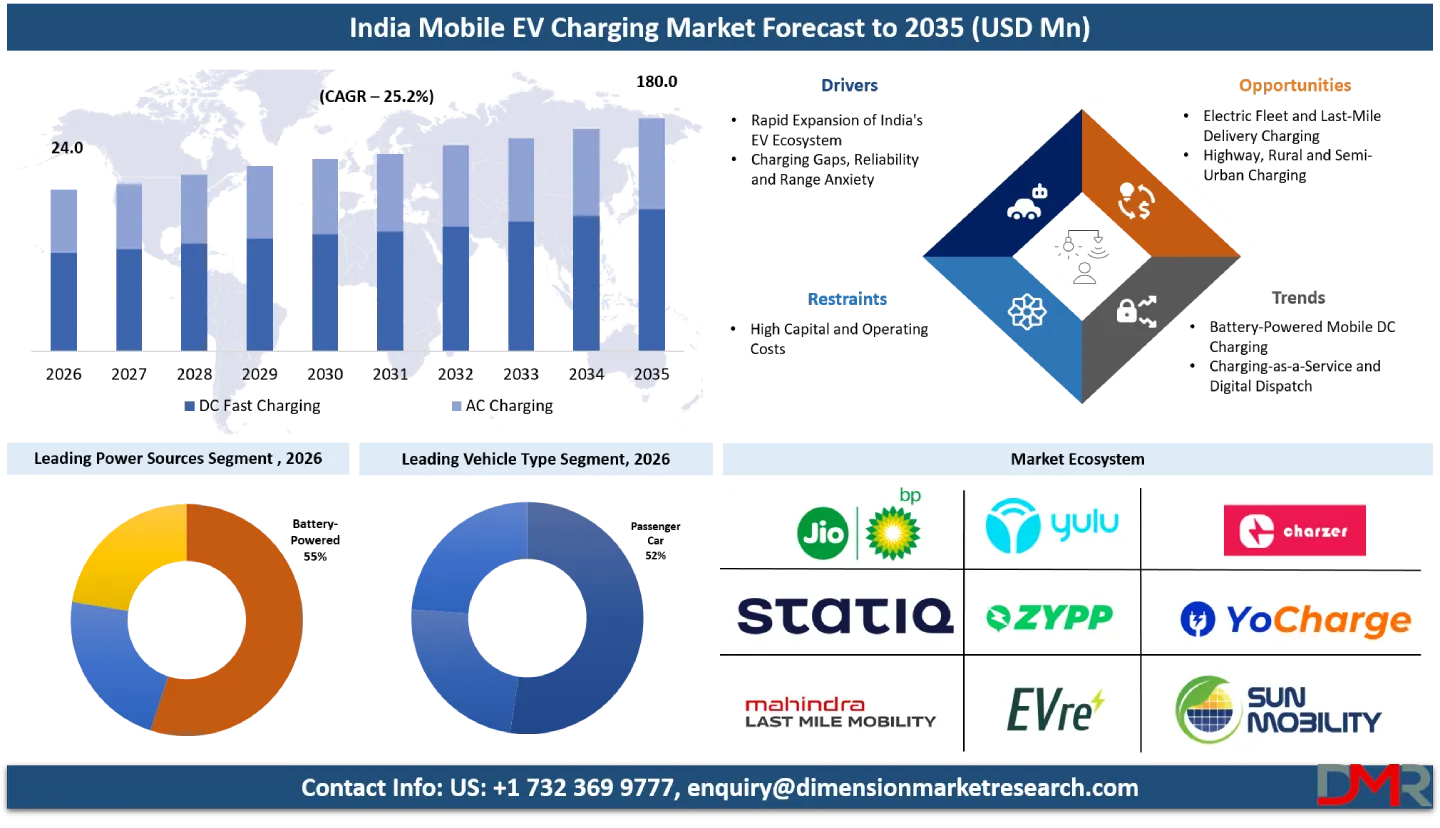
The India Mobile EV Charging Market is projected to reach USD 24.0 million in 2026 and grow at a compound annual growth rate of 25.2 % from there until 2035 to reach a value of USD 180.0 million. The market comprises charging solutions that can be transported or dispatched to an electric vehicle rather than requiring the vehicle to travel to a permanently installed charging station. The market includes mobile charging vans, trucks, battery-powered charging units, portable EV chargers, grid-independent charging systems, emergency roadside charging, temporary charging infrastructure, fleet-support charging, and associated digital dispatch platforms.
ℹ
To learn more about this report –
Download Your Free Sample Report Here
The central value proposition is charging flexibility: operators can move energy capacity toward vehicles and locations where fixed infrastructure is unavailable, congested, uneconomic, or temporarily insufficient. Indian companies are already developing doorstep, off-grid and on-demand models.
The market is expected to remain niche relative to fixed charging infrastructure through the early forecast period. Its strategic importance, however, is likely to exceed its revenue share because mobile charging can complement fixed infrastructure rather than compete with it directly.
Use Cases
- Emergency Roadside Charging: Rapid energy top-ups for EVs unable to reach the nearest functioning charging station.
- Fleet Charging: Mobile charging support for delivery, logistics, taxi and commercial EV fleets.
- Residential Charging: Doorstep charging where apartment residents lack dedicated parking or charging infrastructure.
- Remote & Off-Grid Charging: Energy delivery to rural, semi-urban, construction, tourism and highway locations.
- Temporary Charging: Flexible charging for events, dealerships, vehicle launches, demonstrations and temporary operating sites.
- OEM & Roadside Assistance: Mobile energy support integrated into vehicle warranties, service programs and roadside-assistance packages.
Key Takeaways
- Market Growth: Estimated to rise from USD 24 million in 2026 to approximately USD 180 million by 2035.
- Primary Driver: Rapid EV adoption is increasing the number of vehicles requiring reliable backup and flexible charging.
- Infrastructure Gap: Fixed charging networks are expanding rapidly, but coverage, uptime, parking and grid-capacity constraints create opportunities for mobile solutions.
- Dominant Segment: DC fast charging is expected to represent approximately 68% of 2026 mobile-charging revenue.
- Largest Application: Fleet charging is estimated to account for 38% of 2026 revenue because commercial vehicles have high utilization and downtime costs.
- Fastest Opportunity: Remote/off-grid applications could grow at approximately 30% CAGR as operators expand beyond major metropolitan areas.
- Business Model: Energy-as-a-Service, subscription charging and B2B contracts are likely to become more important than one-off consumer transactions.
How AI/Gen AI is Transforming the INDIA MOBILE EV CHARGING Market?
Mobile EV charging is increasingly becoming a software-orchestrated energy service rather than simply a charger mounted on a vehicle. GPS, IoT sensors, cloud platforms and telematics can monitor charger location, battery state of charge, vehicle requirements, energy availability and customer requests. Operators can then dispatch the nearest suitable charging unit. Current Indian offerings already emphasize app-based booking, real-time tracking and digital dispatch.
Advanced battery-management systems allow operators to optimize charging and discharging cycles, monitor temperature and state of health, and improve asset utilization. AI can forecast charging demand, position mobile units before demand peaks and reduce empty travel between jobs.
The competitive landscape consequently shifts toward response time, reliability, software quality, fleet utilization and geographic coverage. Companies with relatively similar hardware can command different economics based on dispatch algorithms, customer density, fleet contracts and utilization rates. Battery-powered mobile systems also allow operators to avoid expensive grid upgrades at every customer location.
Key Drivers in the India Mobile EV Charging Market
Rapid Expansion of India's EV Ecosystem
The strongest structural driver is the expanding population of electric vehicles. India's EV market is increasingly broad-based, encompassing two-wheelers, three-wheelers, passenger cars, buses and commercial vehicles. In July 2026, EV registrations reached approximately 3.3 lakh units, demonstrating the scale of recent adoption momentum.
As the installed EV base grows, charging demand becomes more heterogeneous. Urban owners may require emergency or doorstep charging, while commercial fleets need predictable energy availability and minimum vehicle downtime. Fixed public infrastructure will satisfy the majority of routine charging requirements, but mobile systems can address the residual demand that is difficult to serve economically with permanent chargers.
Charging Gaps, Reliability and Range Anxiety
India's fixed charging infrastructure is expanding rapidly, but the geographical and operational distribution of chargers remains uneven. The Ministry of Power reported 25,202 public charging stations as of November 30, 2024, while PM E-DRIVE has subsequently created a framework for additional charging deployment. The government's scheme envisages support for 72,300 public charging stations and selected inter-city/inter-state highways. Even a large fixed network cannot economically provide dense coverage everywhere. Mobile charging can therefore act as a flexible layer that responds to temporary demand, emergencies and low-density locations.
Restraints in the India Mobile EV Charging Market
High Capital and Operating Costs
Mobile charging economics are constrained by the cost of the charging equipment, energy-storage system, host vehicle, battery replacement, insurance, maintenance, software, personnel and energy procurement. A mobile DC system must carry enough stored energy to provide meaningful charging while remaining operationally practical. Unlike a fixed charger, a mobile unit also consumes energy and time while travelling between customers. Low utilization can therefore produce poor asset economics.
Growth Opportunities in the India Mobile EV Charging Market
Electric Fleet and Last-Mile Delivery Charging
Fleet electrification offers the most commercially attractive opportunity because charging downtime has a measurable economic cost. E-commerce, grocery delivery, logistics, ride-hailing, employee transportation and urban distribution fleets increasingly depend on predictable vehicle availability. Mobile charging can provide top-ups at temporary parking locations, satellite depots, loading zones and peak-demand clusters without requiring every site to receive permanent high-capacity grid infrastructure.
Highway, Rural and Semi-Urban Charging
Mobile charging has an attractive role between today's fixed infrastructure and future nationwide charging density. Operators can use demand data to identify highway sections, tourist destinations, rural markets and developing urban centers where permanent charging demand is not yet sufficient. This is particularly relevant as government programs expand EV-ready corridors and public charging infrastructure.
Trends in the India Mobile EV Charging Market
Battery-Powered Mobile DC Charging
Battery-powered mobile charging is emerging as one of the most strategically important technologies. Instead of requiring a high-capacity grid connection at every customer location, a mobile unit can charge its own storage at a suitable location and deliver that stored energy elsewhere. This creates a flexible form of distributed energy infrastructure.
Charging-as-a-Service and Digital Dispatch
The industry is moving toward digital booking, automated dispatch, subscription plans and B2B service-level agreements. Hopcharge describes a zero-grid, doorstep model, while newer players are positioning mobile energy as an Energy-as-a-Service offering.
Research Scope and Analysis
The India Mobile EV Charging Market is analyzed across five dimensions: charging type, vehicle type, application, power source, and end user. The analysis evaluates market shares, growth rates, dominant and fastest-growing segments, adoption patterns, technology trends, customer requirements, infrastructure gaps, regulatory factors, and investment opportunities shaping market development through 2035.
ℹ
To learn more about this report –
Download Your Free Sample Report Here
By Charging Type Analysis
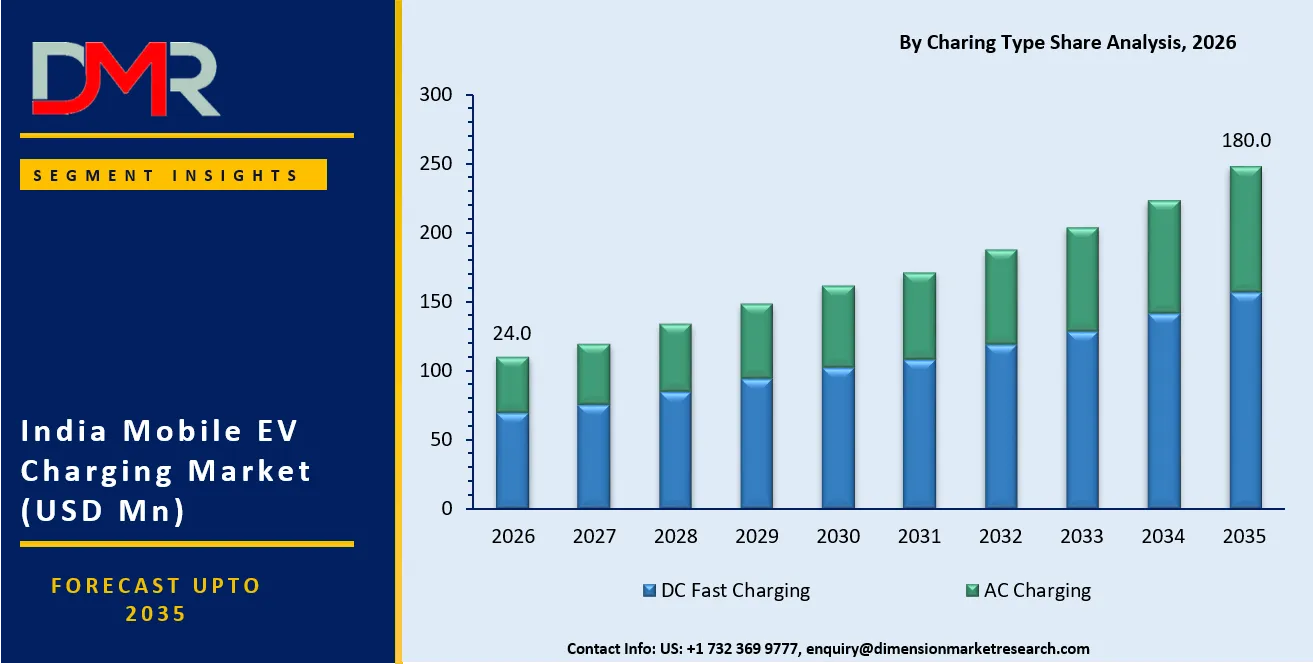
DC Fast Charging is estimated to dominate the India Mobile EV Charging Market in 2026 with approximately 68% share, while AC Charging accounts for roughly 32%. DC's leadership reflects the primary reason customers seek mobile charging: speed and rapid recovery of driving range. Commercial fleets, roadside emergencies and highway users generally place a higher value on minimizing charging time, making DC particularly suitable for mobile applications. AC charging remains important for low-cost portable solutions, residential top-ups, two-wheelers and longer dwell-time use cases. DC Fast Charging is estimated to be the faster-growing category at approximately 27% CAGR, supported by higher-power battery-based mobile units and commercial fleet requirements. AC charging is likely to retain a significant installed base because of lower equipment costs and simpler applications. The increasing availability of high-power mobile systems, including the 200 kW-class systems being promoted by newer Indian entrants, indicates a move toward commercially meaningful mobile DC charging.
By Vehicle Type Analysis
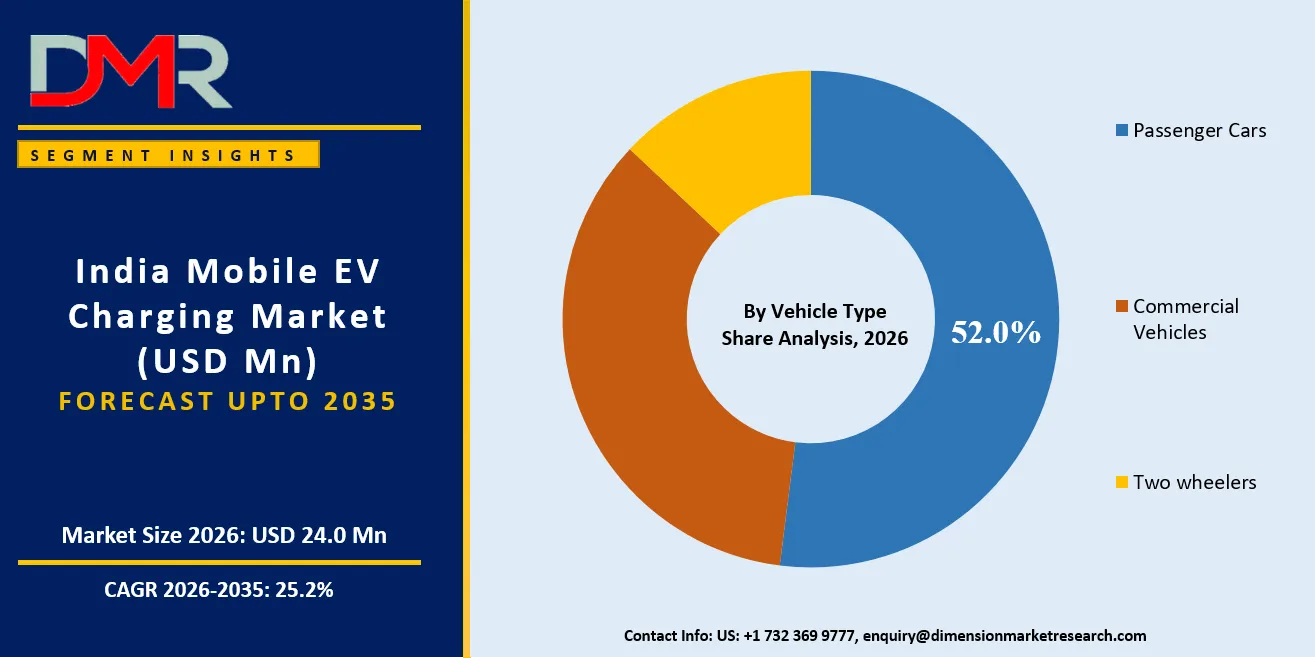
Passenger Cars are estimated to represent approximately 52% of 2026 mobile-charging revenue, followed by Commercial Vehicles at 35% and Two-Wheelers at 13%. Passenger cars currently generate a large share of emergency and doorstep charging demand because consumers value convenience and roadside assistance. However, commercial vehicles are expected to be the fastest-growing category at approximately 29% CAGR, as delivery, logistics and other high-utilization fleets increasingly require charging availability. Within commercial vehicles, light commercial vehicles are expected to account for the majority of demand initially, while heavy commercial vehicles represent a longer-term high-value opportunity because of their larger battery requirements. Two-wheelers have a large installed EV population but generally have lower-value charging sessions and are increasingly served by home charging and battery-swapping models. Mobile charging will therefore be particularly attractive for premium two-wheelers, rental fleets, dealerships and areas with limited electrical access.
By Application Analysis
Fleet Charging is estimated to lead with approximately 38% share in 2026, followed by Emergency Roadside Charging at 31%, Residential & Workplace Charging at 16%, Remote & Off-Grid Charging at 9%, and Event & Temporary Charging at 6%. Fleet charging has the strongest commercial economics because operators can provide recurring contracts, predictable demand and high utilization of mobile assets. Remote & Off-Grid Charging is expected to be the fastest-growing application at roughly 30% CAGR, driven by charging gaps outside metropolitan areas, highway expansion, tourism and commercial operations. Emergency charging remains a crucial early-market use case because customers are willing to pay a premium for convenience when an EV cannot reach a fixed charger. The existing Indian ecosystem already demonstrates doorstep and emergency-oriented business models. Hopcharge, for example, operates an on-demand doorstep model, while Charger on Wheels focuses on mobile DC charging.
By Power Source Analysis
Battery-Powered mobile charging is estimated to account for 55% of the market in 2026, compared with Grid-Powered at approximately 30% and Renewable Energy-Powered at 15%. Battery-powered systems are structurally attractive because the mobile unit can be charged at a location with adequate electrical capacity and subsequently transported to the customer. This avoids installing high-capacity grid infrastructure at every destination. Renewable Energy-Powered mobile charging is expected to grow fastest, at approximately 29% CAGR, albeit from a smaller base, as solar-assisted battery systems and hybrid energy-storage architectures become more commercially viable. Grid-powered mobile units remain relevant where the vehicle can connect to temporary electrical infrastructure. Battery-powered systems are likely to remain dominant through most of the forecast because of their flexibility and ability to support off-grid applications.
ℹ
To learn more about this report –
Download Your Free Sample Report Here
By End User Analysis
Fleet Operators are estimated to represent approximately 35% of 2026 market revenue, followed by Individual EV Owners at 30%, EV Charging Service Providers at 20%, Automotive OEMs & Dealerships at 10%, and Government & Municipalities at 5%. Fleet operators are expected to become increasingly dominant because mobile charging can directly reduce vehicle downtime. EV Charging Service Providers are projected to be the fastest-growing end-user category at approximately 28% CAGR, as conventional CPOs add mobile capacity to their fixed networks. Automotive OEMs are also likely to use mobile charging as a customer-retention and roadside-assistance tool. Government and municipal applications remain smaller but could expand around large events, public-service fleets, highways and underserved areas. The government's current charging-infrastructure programs create a broader ecosystem within which mobile charging can act as a supplementary service.
The India Mobile EV Charging Market Report is segmented on the basis of the following:
By Charging Type
- AC Charging
- DC Fast Charging
By Vehicle Type
- Passenger Cars
- Commercial Vehicles
- Light Commercial Vehicles
- Heavy Commercial Vehicles
- Two-Wheelers
By Application
- Emergency Roadside Charging
- Fleet Charging
- Event & Temporary Charging
- Residential & Workplace Charging
- Remote & Off-Grid Charging
By Power Source
- Grid-Powered
- Battery-Powered
- Renewable Energy-Powered
By End User
- Individual EV Owners
- Fleet Operators
- EV Charging Service Providers
- Automotive OEMs & Dealerships
- Government & Municipalities
Regulatory Landscape
India's EV charging environment is supported by central-government policies that permit both public and private entities to establish charging infrastructure. The Ministry of Power has encouraged open communication protocols such as OCPP, OCPI and UEI, supporting interoperability. PM E-DRIVE provides a significant policy push for public charging infrastructure; its EVPCS guidelines were issued in September 2025. Government documentation states that the scheme supports charging infrastructure through capital subsidies, with assistance varying by location category.
For mobile charging, the regulatory environment is more complex because operators combine EV charging equipment with road-going vehicles and, in some cases, substantial battery storage. Compliance may therefore involve electrical safety, battery safety, vehicle requirements, fire safety, insurance and local operating permissions. Operators should validate applicable requirements with the relevant state electricity authorities, transport authorities and safety bodies before deployment.
Investment and White Space Analysis
The strongest investment white spaces are commercial fleet charging, highway emergency charging, residential doorstep charging, rural/semi-urban coverage and battery-powered high-output mobile DC systems. Bengaluru, Delhi-NCR, Mumbai-Pune, Hyderabad, Chennai, Ahmedabad and major logistics corridors provide attractive early-stage markets because demand density can improve utilization.
The opportunity also extends to highway corridors where fixed stations are being developed but where temporary or emergency demand can exceed local capacity. New models such as MyFuel's 200 kW mobile units and Charger on Wheels' urban mobile-fleet model demonstrate the industry's movement toward higher-power, software-enabled charging-as-a-service.
Competitive Landscape
The India Mobile EV Charging Market remains highly fragmented and early-stage, with startups currently playing a disproportionate role in developing business models. The market includes pure-play mobile charging companies, fixed charging operators adding mobile capabilities, charger manufacturers, automotive OEMs and roadside-assistance companies. Competitive differentiation is increasingly shifting from hardware alone toward dispatch software, charger availability, response time, fleet contracts, geographic density, energy economics and customer experience.
The existence of established charging networks is not necessarily a direct threat: mobile charging can function as a complementary layer for locations where permanent infrastructure is unavailable or where peak demand temporarily exceeds capacity. Major fixed charging operators are expanding rapidly, creating both competitive pressure and partnership opportunities. Tata Power, for example, currently reports more than 5,500 EV charging stations, while Statiq and ChargeZone report large nationwide charging networks.
Some of the prominent players in the India Mobile EV Charging Market are:
- Mahindra Last Mile Mobility
- Sun Mobility
- ChargeZone
- Statiq
- Earth
- Battery Smart
- ChargeMOD
- PlugNgo
- Charzer
- Kazam
- Charge+Zone
- Servotech Power Systems
- Exicom Tele-Systems
- Delta Electronics India
- Tata Power EV Charging
- Fortum Charge & Drive India
- Jio-bp
- EESL
- Ather Energy
- Euler Motors
- Alt Mobility
- Mooving
- ReadyAssist
- RoadGrid
- Zeon Charging
- ElectricPe
- YoCharge
- EVRE
- Statiq Technologies
- PlugNgo Energy
- Kazam EV Tech
- Charzer Technologies
- Numocity Technologies
- ChargeMyGaadi
- EV Plugs
- Earth Technologies
- Yulu
- Zypp Electric
- OSM (Omega Seiki Mobility)
- FAME Mobility
- Other Key Players
Recent Developments
- May 2026: Tata Power expanded ultra-fast EV charging infrastructure along the Delhi-Mumbai Expressway, including 240 kW chargers, strengthening India's fixed charging network and creating complementary opportunities for mobile charging services.
- March 2026: MyFuel EV advanced its 200 kW mobile charging model in Bengaluru, targeting commercial fleets through a zero-capex Energy-as-a-Service proposition designed to provide flexible, high-power charging without permanent infrastructure.
- September 2025: Exicom announced technology support for Charger on Wheels, helping the startup develop and scale mobile EV charging solutions for urban and semi-urban applications across India.
- June 2025: VinFast partnered with Global Assure to strengthen its Indian after-sales ecosystem, including mobile charging and roadside assistance, integrating flexible charging into EV ownership and support services.
- April 2025: Hopcharge expanded its zero-grid, doorstep EV charging model through partnerships and franchise-led growth, positioning mobile charging as an infrastructure-light alternative for customers and fleet operators.
Report Details
| Report Characteristics |
| Market Size (2026) |
USD 24.0 Mn |
| Forecast Value (2035) |
USD 180.0 Mn |
| CAGR (2026–2035) |
25.2% |
| Historical Data |
2021 - 2025 |
| Forecast Data |
2027 - 2035 |
| Base Year |
2025 |
| Estimate Year |
2026 |
| Segments Covered |
By Charging Type, By Vehicle Type, By Application, By Power Source, By End User |
| Country Coverage |
India |
Frequently Asked Questions
What is the India Mobile EV Charging Market size in 2026?
▾ The market is estimated at approximately USD 24 million in 2026, based on an analyst bottom-up estimate rather than an officially reported market series.
What will the market be worth by 2035?
▾ The India Mobile EV Charging Market is projected to reach approximately USD 180 million by 2035, assuming sustained EV adoption and mobile-charging deployment.
What is the expected CAGR?
▾ The market is estimated to expand at approximately 25.2% CAGR between 2026 and 2035, reflecting its low current base and rapidly increasing addressable demand.
What is driving market growth?
▾ EV adoption, charging-access gaps, fleet electrification, range anxiety, highway travel, apartment charging constraints and demand for emergency roadside services are the principal growth drivers.
Which segment is growing fastest?
▾ Remote and off-grid charging is expected to be among the fastest-growing applications, at approximately 30% CAGR, as mobile operators expand beyond major metropolitan charging clusters.
What are the major industry trends?
▾ Battery-powered DC charging, Energy-as-a-Service, app-based dispatch, fleet contracts, AI-driven demand forecasting and renewable-energy-assisted mobile charging are major emerging trends.
Who are the major market participants?
▾ The ecosystem includes Hopcharge, Charger on Wheels, MyFuel EV, Charzo, Setrans and SparXcharge, alongside larger charging companies and technology providers.
How is the India Mobile EV Charging Market segmented?
▾ The market is segmented by charging type, vehicle type, application, power source and end user, covering both consumer and commercial charging requirements.