India SME Robotics-as-a-Service Market Snapshot
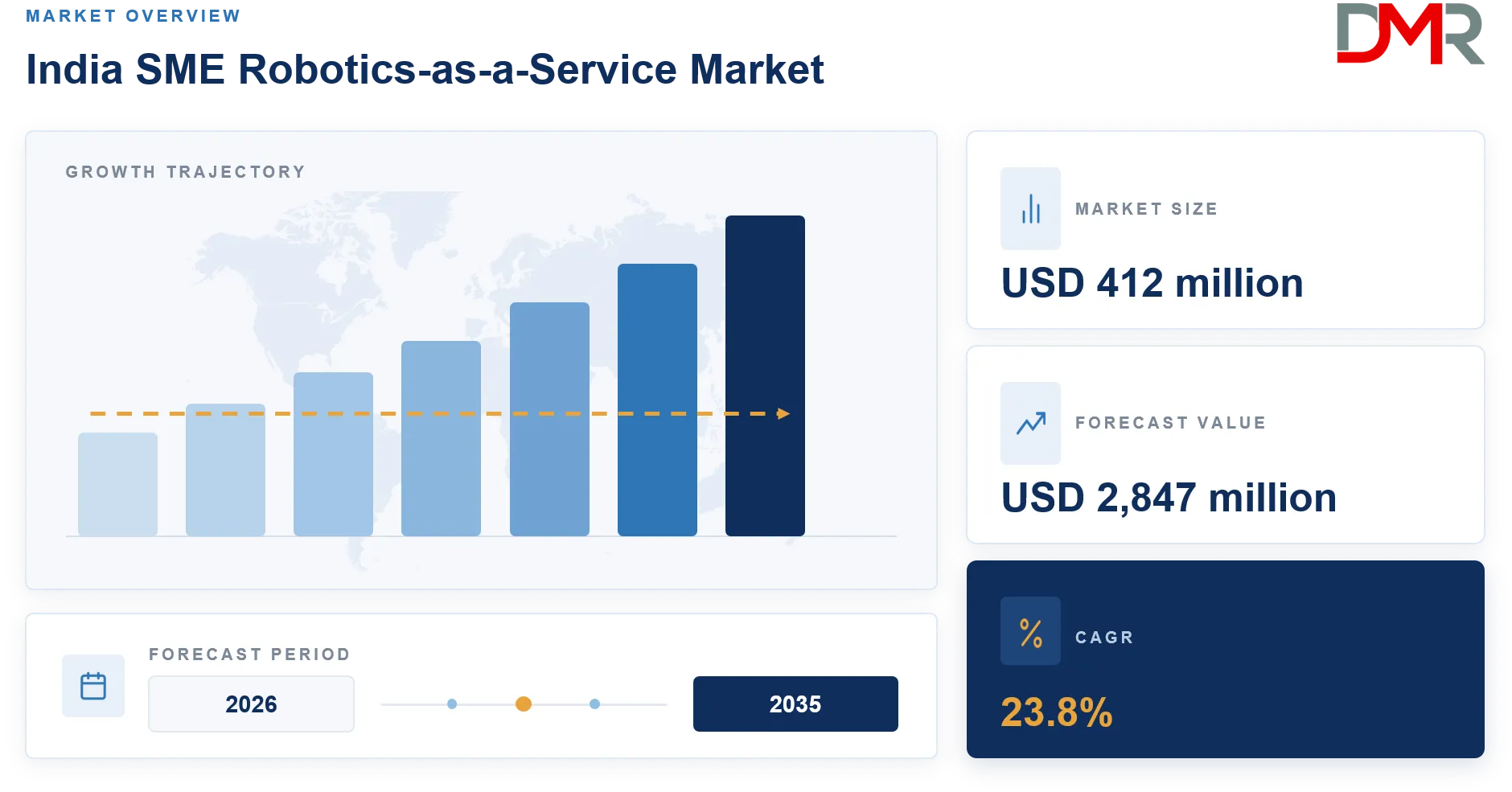
- Market Value: India SME Robotics-as-a-Service market is valued at USD 412 million in 2026 and is projected to reach USD 2,847 million by 2035.
- CAGR: India SME Robotics-as-a-Service market is expected to grow at a CAGR of 23.8% from 2026 to 2035.
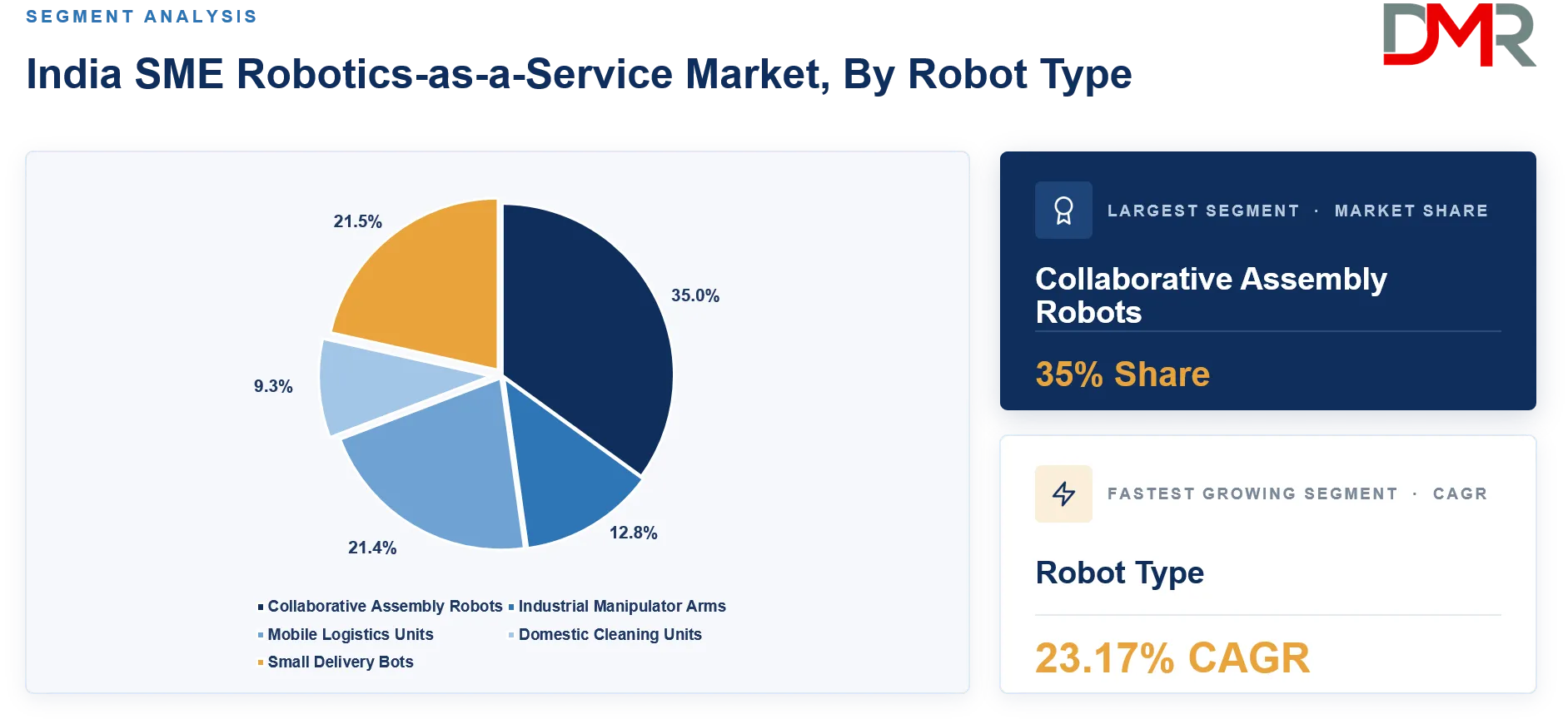
- By Robot Type Segment Analysis: Collaborative Assembly Robots led the robot type segment with a 35.0% share in 2026.
- By Application Segment Analysis: Material Handling Operations led applications with a 32.0% share in 2026.
- By End-User Industry Segment Analysis: Automotive Component Manufacturing held a 24.0% share in 2026.
- Major Players: Addverb Technologies, DiFACTO Robotics and Automation, Systemantics India, GreyOrange, and Others.
What is the India SME Robotics-as-a-Service Market and its Market Size?
The India SME Robotics-as-a-Service Market size is projected to be valued at USD 412 million in 2026 and reach USD 2,847 million by 2035, expanding at a CAGR of 23.8% during the forecast period. Robotics-as-a-Service allows small and medium-sized enterprises to deploy robots through subscriptions, usage-based contracts, leases, or managed automation agreements instead of purchasing and maintaining complete robotic systems upfront.
ℹ
To learn more about this report –
Download Your Free Sample Report Here
The India SME Robotics-as-a-Service market is emerging at the intersection of industrial automation, collaborative robotics, flexible manufacturing, warehouse modernization, and operating expenditure-based technology adoption. The commercial model is particularly relevant for Indian SMEs that need automation but face capital constraints, variable production volumes, short product cycles, or limited in-house robotics expertise. RaaS providers can combine robotic hardware, software, installation, preventive maintenance, remote monitoring, upgrades, and technical support under a recurring payment structure.
Demand is becoming more closely tied to measurable production outcomes. Automotive component suppliers need repeatable assembly and handling, electronics manufacturers require precision, warehouses need faster movement of goods, and food processors seek safer handling and packaging. For these users, the value proposition is moving from robot ownership toward access to productive robotic capacity. This shift is expanding the addressable India SME robotics market beyond large factories that traditionally had the capital and engineering resources required for automation.
Use Cases
- Flexible Assembly: SME manufacturers can deploy collaborative robots beside operators for repetitive fastening, component positioning, machine tending, and light assembly. Subscription-based access helps plants add automation for a production contract or specific line without committing capital to equipment that may be underutilized when product volumes change.
- Material Movement: Mobile logistics robots and autonomous units can move bins, components, pallets, and work-in-progress between storage areas and production stations. The model is useful for warehouses and factories where material routes change frequently and management wants to increase throughput without continuously adding manual transport labor.
- Quality Inspection: Robot-mounted cameras and sensors can support dimensional checks, surface inspection, part verification, and process monitoring. RaaS contracts allow smaller manufacturers to access integrated robotics and machine-vision capabilities while shifting system maintenance, software updates, and technical support responsibilities toward the service provider.
- Machine Tending: Collaborative and industrial manipulator arms can load and unload CNC machines, presses, molding equipment, and other production assets. SMEs can use robotic tending during long shifts or repetitive production runs to improve machine utilization, reduce operator exposure to monotonous tasks, and maintain more consistent cycle times.
- Warehouse Fulfilment: Logistics SMEs, distributors, and growing manufacturers can use mobile robots for transport, sorting, picking support, and replenishment. RaaS enables capacity to be added progressively as order volumes rise, making automation more compatible with businesses that face seasonal peaks or uncertain demand.
How AI/Gen AI is Transforming the India SME Robotics-as-a-Service Market?
Intelligent software is making Robotics-as-a-Service more practical for Indian SMEs by reducing the engineering effort needed to configure, monitor, and optimize robotic fleets. Computer vision can help robots identify parts, detect obstacles, inspect products, and adapt to variable environments, while machine learning can analyze cycle times, error patterns, battery use, equipment health, and operating conditions. These functions support predictive maintenance and remote diagnostics, which are important in a service model because providers must maintain uptime across multiple customer locations. Data gathered from deployed robots can also help vendors refine workflows and identify where customers can increase utilization.
Generative interfaces can further lower the skills barrier by helping operators create work instructions, troubleshoot alarms, interpret maintenance data, and interact with automation systems through more natural commands. The near-term commercial value for SMEs is likely to come from easier programming, faster commissioning, remote assistance, documentation, and workflow optimization rather than fully autonomous factories. As RaaS suppliers integrate intelligent software with cobots, mobile robots, fleet management systems, and vision platforms, competition will increasingly depend on uptime, deployment speed, ease of use, and measurable productivity instead of robot hardware specifications alone.
Key Drivers in the India SME Robotics-as-a-Service Market
Lower Upfront Automation Investment
Capital intensity has historically limited robotics adoption among Indian SMEs because a conventional automation project can require hardware purchases, engineering, integration, safety equipment, maintenance resources, and specialized personnel. RaaS changes the spending profile by spreading costs through subscriptions, leases, or usage-linked payments. This gives smaller manufacturers access to automation while preserving capital for inventory, plant expansion, tooling, and working capital, widening the potential customer base for robotics providers.
Need for Higher Productivity and Consistent Quality
Indian SMEs supplying automotive, electronics, engineering, consumer goods, and export markets face growing pressure to improve throughput, repeatability, traceability, and quality. Repetitive processes such as handling, assembly, machine loading, welding, and inspection are suitable for robotic deployment. RaaS gives businesses a path to automate individual bottlenecks first and expand after results are proven. This incremental model reduces implementation risk and helps management connect robotics spending to output, labor productivity, defect reduction, and asset utilization.
Restraints in the India SME Robotics-as-a-Service Market
Integration with Brownfield SME Factories
Many Indian SMEs operate mixed-generation machinery, compact production layouts, manual material flows, and limited digital infrastructure. Installing a robot is therefore only one part of a deployment. Providers may also need to modify fixtures, machine interfaces, safety systems, workflows, software connections, and material presentation. These integration requirements can weaken the economics of standardized RaaS packages, especially for small installations, and can extend commissioning periods before customers achieve expected productivity gains.
Uncertain Utilization and Contract Economics
RaaS works best when robotic assets remain productively utilized over the contract period. SMEs with seasonal orders, frequent product changes, short production runs, or irregular capacity requirements may find it difficult to forecast robot utilization. Providers also carry risks related to maintenance, relocation, support, and asset redeployment. Contracts therefore need clear service levels, minimum usage terms, maintenance responsibilities, and performance metrics. Poor alignment between production demand and subscription commitments can slow adoption among cost-sensitive companies.
Growth Opportunities in the India SME Robotics-as-a-Service Market
Automation of Tier 2 and Tier 3 Manufacturing Suppliers
A significant opportunity exists in extending robotics beyond large OEM plants into smaller component manufacturers and engineering suppliers. These businesses increasingly need standardized production, faster changeovers, process traceability, and competitive unit costs while often lacking dedicated automation teams. Modular cobot and machine-tending packages can give RaaS providers a repeatable entry point. Vendors that combine financing, application engineering, training, maintenance, and rapid redeployment can address a larger group of first-time robotics users.
Expansion into Warehousing and Intralogistics
Material movement offers strong RaaS potential because mobile robots can be deployed in stages and scaled with warehouse throughput. Indian manufacturers, third-party logistics operators, distributors, and fulfillment centers need flexible systems for transporting goods between receiving, storage, picking, production, and dispatch areas. Fleet-based subscriptions can allow customers to add or remove capacity as demand changes. This creates opportunities for vendors offering mobile robots, fleet orchestration, warehouse software integration, uptime support, and analytics as one service package.
Trends in the India SME Robotics-as-a-Service Market
Shift Toward Collaborative and Flexible Robotics
Collaborative robots are becoming central to the SME automation proposition because they can support smaller work cells and applications where people and robots operate in closely coordinated workflows. Their programmability and ability to be reassigned to different tasks can improve utilization for businesses with changing production requirements. This flexibility is reflected in the market structure, with Collaborative Assembly Robots accounting for 35.0% of India SME RaaS revenue by robot type in 2026, making them the leading segment.
Outcome-Based Automation Contracts
The RaaS market is gradually moving beyond simple equipment rental toward service contracts linked to availability, production capacity, robot hours, throughput, or specific operational tasks. Customers increasingly evaluate automation through total operating economics rather than purchase price alone. This creates room for providers to package robots with software, integration, maintenance, remote diagnostics, replacement support, and performance monitoring. The trend favors suppliers capable of maintaining equipment performance throughout the service period and demonstrating measurable business value.
Research Scope and Analysis
The India SME Robotics-as-a-Service Market is segmented based on Robot Type, Application, End-User Industry, and other relevant commercial and operational categories. The study evaluates adoption patterns, deployment economics, industry demand, robotic applications, service models, competitive positioning, and the contribution of individual segments to overall India SME Robotics-as-a-Service market growth.
ℹ
To learn more about this report –
Download Your Free Sample Report Here
By Robot Type
Collaborative Assembly Robots dominated the India SME Robotics-as-a-Service market with a 35.0% share in 2026. Their leadership reflects the need for flexible automation in SME production environments where floor space, production volume, product mix, and engineering resources can differ sharply from large automated plants. Cobots can support assembly, machine tending, handling, fastening, packaging, inspection, and related repetitive processes. Their ability to be reprogrammed and reassigned improves the commercial case for service-based deployment because one robotic asset can support changing workloads. Industrial manipulator arms remain important for higher payload and established manufacturing processes, while Mobile Logistics Units are gaining relevance as factories and warehouses seek automated internal material flow.
By Application
Material Handling Operations led the India SME RaaS market by application with a 32.0% share in 2026. Handling is a broad automation opportunity because nearly every manufacturing and warehousing facility must move raw materials, components, work-in-progress, containers, finished products, or pallets between process stages. Robots can reduce repetitive manual movement and maintain more predictable workflows between production cells. Mobile robots can serve dynamic routes, while robotic arms can transfer products between machines or conveyors. The application is also suitable for phased RaaS adoption because businesses can begin with a limited number of robots on high-frequency routes and expand fleets as utilization, throughput, and operating savings become measurable.
By End-User Industry
Automotive Component Manufacturing accounted for 24.0% of the India SME Robotics-as-a-Service market in 2026. The sector contains extensive supplier networks performing machining, assembly, welding, handling, inspection, and component processing, creating multiple repeatable automation opportunities. Suppliers must meet stringent specifications, production schedules, and quality requirements while controlling manufacturing costs. Flexible robotic services can help smaller vendors improve process consistency without requiring the same capital commitment as a large automation project. Electronics and semiconductor assembly, logistics and warehousing, food processing, pharmaceutical laboratories, metal fabrication, and machinery production provide additional growth avenues as service providers develop industry-specific automation packages.
The India SME Robotics-as-a-Service Market Report is Segmented on the Basis of the Following:
By Robot Type
- Industrial Manipulator Arms
- Collaborative Assembly Robots
- Mobile Logistics Units
- Domestic Cleaning Units
- Small Delivery Bots
By Application
- Material Handling Operations
- Assembly and Disassembly
- Welding and Soldering Tasks
- Dispensing and Processing
- Inspection and Quality Control
By End-User Industry
- Automotive Component Manufacturing
- Electronics and Semiconductor Assembly
- Food and Beverage Processing
- Logistics and Warehousing Operations
- Healthcare and Pharmaceutical Labs
- Retail and Hospitality Services
- Metal and Machinery Fabrication
Competitive Landscape
The India SME Robotics-as-a-Service competitive landscape includes established automation companies, warehouse robotics specialists, industrial robotics integrators, collaborative robot developers, autonomous mobile robot companies, and emerging robotics startups. Competition is moving toward complete solutions rather than standalone robot hardware. Providers increasingly need application engineering, fleet software, machine vision, remote monitoring, integration, preventive maintenance, financing flexibility, and field support to win SME customers.
Addverb Technologies has developed a broad warehouse and intralogistics automation portfolio, while GreyOrange is associated with robotics-led fulfillment and warehouse operations. DiFACTO Robotics and Automation, Systemantics India, Falcon Autotech, Gridbots Technologies, Hi-Tech Robotic Systemz, PARC Robotic Systems, and other domestic specialists compete across industrial automation, material handling, robotic integration, logistics, and customized applications. Smaller emerging companies can differentiate through modular systems, shorter deployment cycles, industry-specific solutions, and flexible commercial models. Over the forecast period, competitive advantage is expected to depend increasingly on total cost of automation, uptime guarantees, service coverage, integration capability, software quality, deployment speed, and the ability to demonstrate measurable customer productivity.
Some of the prominent players in the India SME Robotics-as-a-Service Industry are:
- Addverb Technologies
- DiFACTO Robotics and Automation
- Systemantics India
- GreyOrange
- Falcon Autotech
- MIVA Robotics
- Alphadroid
- GOAT Robotics
- Peer Robotics
- RobotoAI Technologies
- Aether Dynamics
- xBoom
- Thennai
- ATSN Ventures
- Invento Robotics
- Gridbots Technologies
- Hi-Tech Robotic Systemz
- PARC Robotic Systems
- Kadence Automation & Robotic Systems
- Cyborg Industries
- Others
Pricing Analysis
Pricing in the India SME Robotics-as-a-Service market is shifting from large upfront equipment purchases toward subscription, leasing, pay-per-use, and managed automation contracts that align spending with production needs. The commercial cost varies by robot type, payload, application complexity, operating hours, sensors, vision systems, software, integration, safety requirements, and service-level commitments. Collaborative Assembly Robots can suit SMEs seeking flexible assembly and machine-tending automation, while Mobile Logistics Units may be priced according to fleet size, operating area, workflow complexity, and software integration. For Indian SMEs, total cost of ownership remains more important than the robot fee alone because commissioning, tooling, maintenance, training, uptime support, and process changes influence actual returns. Vendors that bundle these expenses into predictable recurring payments can lower adoption barriers. As competition expands, pricing is expected to become increasingly linked to robot utilization, throughput, uptime, or defined production outcomes, supporting broader RaaS adoption among cost-sensitive manufacturers.
Investment and White Space Analysis
Investment opportunities in the India SME Robotics-as-a-Service market are expanding as automation demand moves beyond large manufacturers into automotive suppliers, electronics assemblers, food processors, warehouses, pharmaceutical facilities, and metal fabrication SMEs. With the market projected to rise from USD 412 million in 2026 to USD 2,847 million by 2035 at a 23.8% CAGR, white space is strongest where vendors can convert complex robotics projects into standardized, repeatable service packages. Collaborative Assembly Robots, which hold 35.0% of the 2026 robot type market, provide opportunities in machine tending, assembly, inspection, and component handling. Material Handling Operations, with a 32.0% application share, also create room for scalable mobile robotics and intralogistics services. Investment gaps remain in affordable financing, regional maintenance networks, retrofit-ready solutions, remote fleet management, and SME-focused integration. Providers that combine hardware, software, deployment, maintenance, and performance-based pricing can address underserved industrial clusters and build recurring revenue.
Recent Developments
- August 2026: Addverb Technologies raising over $100 million to expand humanoid robots, quadrupeds and collaborative robots for India SME RaaS deployments.
- June 2026: Nanta Tech signs ₹14.4 crore RaaS LOI with Connplex Cinemas for 100 Allbotix AT10 marketing and delivery robots, monthly fee ₹40,000 per unit over 36 months.
- May 2026: DiFACTO Robotics acquires Grind Master's RoboFinish division and IPR, strengthening shop-floor automation offerings for Indian SMEs under RaaS model.
Report Details
| Report Characteristics |
| Market Size (2026) |
USD 412 Million |
| Forecast Value (2035) |
USD 2,847 Million |
| CAGR (2026-2035) |
23.8% |
| Historical Data |
2021 - 2025 |
| Forecast Data |
2027 - 2035 |
| Base Year |
2025 |
| Estimate Year |
2026 |
| Segments Covered |
By Robot Type (Industrial Manipulator Arms, Collaborative Assembly Robots, Mobile Logistics Units, Domestic Cleaning Units, and Small Delivery Bots), By Application (Material Handling Operations, Assembly and Disassembly, Welding and Soldering Tasks, Dispensing and Processing, and Inspection and Quality Control), and By End-User Industry (Automotive Component Manufacturing, Electronics and Semiconductor Assembly, Food and Beverage Processing, Logistics and Warehousing Operations, Healthcare and Pharmaceutical Labs, Retail and Hospitality Services, and Metal and Machinery Fabrication) |
| Regional Coverage |
India |
Frequently Asked Questions
What is the current size of the India SME Robotics-as-a-Service Market?
▾ The India SME Robotics-as-a-Service Market size is valued at USD 412 million in 2026 and may reach USD 2,847 million by 2035.
What is the growth rate of the India SME Robotics-as-a-Service Market during?
▾ The India SME Robotics-as-a-Service Market is expected to grow at a CAGR of 23.8% during the 2026-2035 forecast period.
What factors are driving the growth of the India SME Robotics-as-a-Service Market?
▾ Lower upfront costs, flexible subscriptions, and SME automation demand drive the India SME Robotics-as-a-Service Market.
What are the major challenges restraining the India SME Robotics-as-a-Service Market?
▾ Integration costs, brownfield complexity, and uncertain utilization restrain the India SME Robotics-as-a-Service Market.
Which segment holds the largest share of the India SME Robotics-as-a-Service Market?
▾ Collaborative Assembly Robots lead the India SME Robotics-as-a-Service Market with a 35.0% share in 2026.
Who are the leading companies in the India SME Robotics-as-a-Service Market?
▾ Addverb Technologies, DiFACTO Robotics and Automation, Systemantics India, GreyOrange, Falcon Autotech, MIVA Robotics, Alphadroid, GOAT Robotics, Peer Robotics, RobotoAI Technologies, Aether Dynamics, xBoom, Thennai, ATSN Ventures, Invento Robotics, Gridbots Technologies, Hi-Tech Robotic Systemz, PARC Robotic Systems, Kadence Automation & Robotic Systems, and Cyborg Industries are leading companies in the India SME Robotics-as-a-Service Market.
How is AI influencing the India SME Robotics-as-a-Service Market?
▾ AI supports the India SME Robotics-as-a-Service Market through vision, maintenance, and easier robot programming.
What are the future opportunities and trends in the India SME Robotics-as-a-Service Market?
▾ Cobots, mobile logistics, and usage-based pricing create opportunities in the India SME Robotics-as-a-Service Market.