Market Snapshot
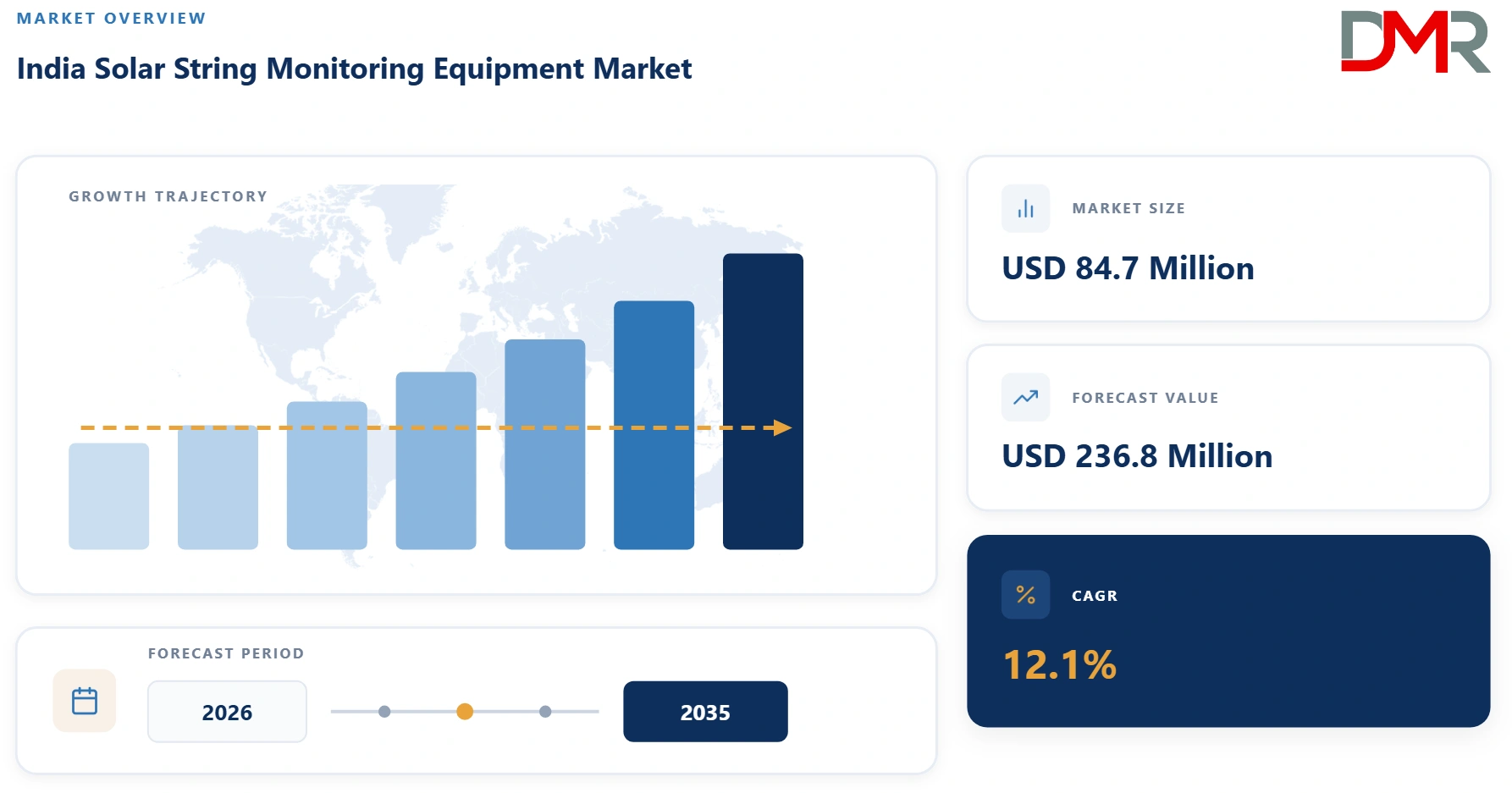
- Market Size (2026): USD 84.7 Mn
- Forecast Value (2035): USD 236.8 Mn
- CAGR (2026-2035): 12.1%
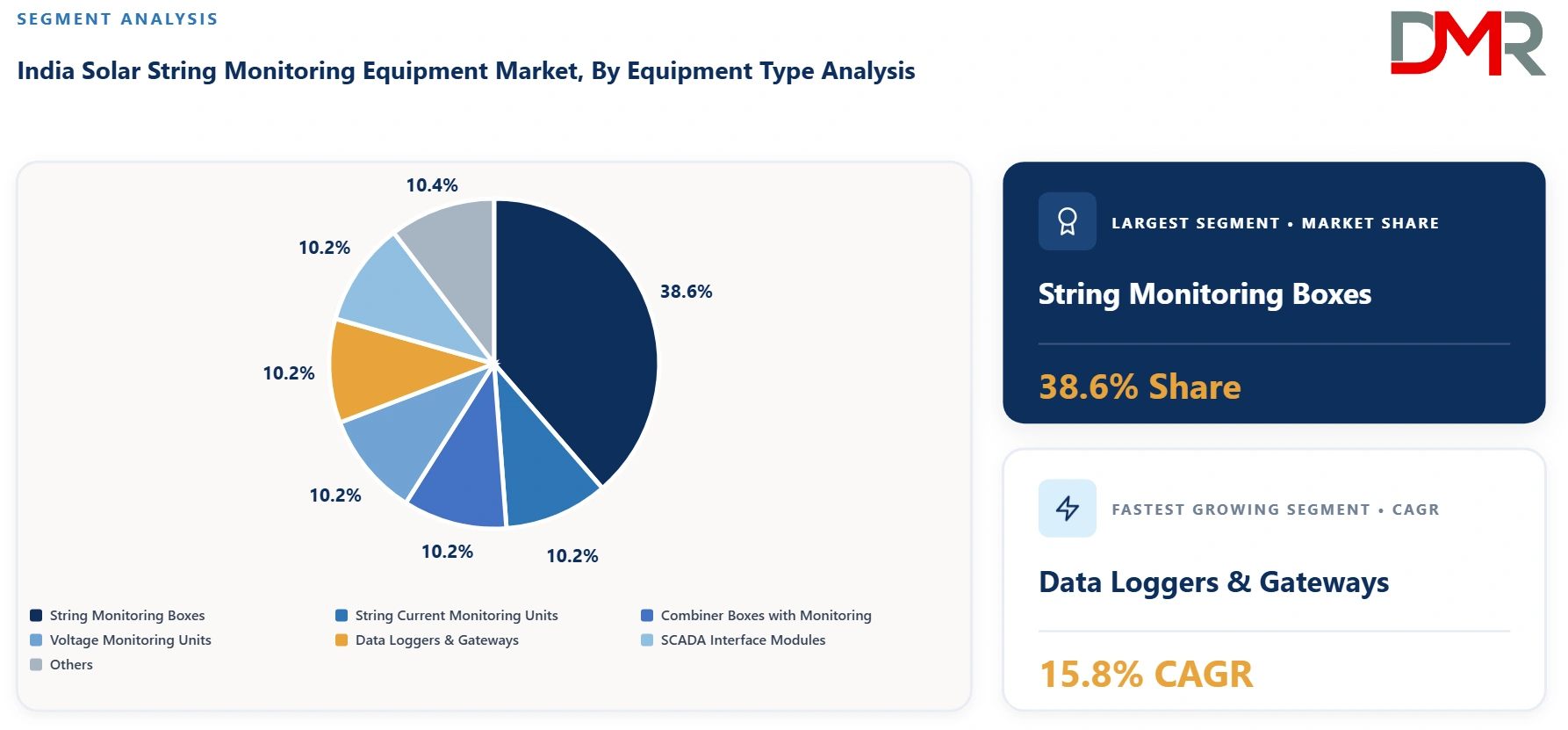
- Leading Equipment Type: String Monitoring Boxes with around 38.6% of 2026 revenue
- Leading Communication Technology: RS485/Modbus with approximately 51.7%
- Leading Application: Utility-Scale Solar Plants with approximately 57.8%
What is India Solar String Monitoring Equipment Market and its Market Size?
The India Solar String Monitoring Equipment Market size is estimated to reach USD 84.7 Mn in 2026 and is further anticipated to reach USD 236.8 Mn by 2035, at a CAGR of 12.1%.
ℹ
To learn more about this report –
Download Your Free Sample Report Here
Solar string monitoring equipment comprises hardware and software used to measure and supervise the electrical behavior of individual photovoltaic strings and associated combiner circuits. Typical systems include string monitoring boxes, current sensing modules, voltage monitoring units, fuse and surge-protection status inputs, data loggers, gateways, communication interfaces, and SCADA integration modules. These systems provide plant operators with granular visibility into string-level performance instead of relying only on inverter-level output.
String monitoring is most valuable in large photovoltaic plants where thousands of module strings operate in parallel. A single failed fuse, connector problem, open circuit, mismatch, shading event, insulation fault, or underperforming string can be difficult to detect from inverter totals alone. String-level current and voltage data allows operators to isolate abnormal circuits quickly, reduce diagnostic time, and prioritize field maintenance.
India's growing solar fleet is expanding the addressable installed base for string monitoring. Utility-scale solar remains the largest application because centralized plants contain large numbers of DC strings and combiner boxes. Commercial and industrial projects are also adopting more granular monitoring as asset owners seek stronger visibility into generation guarantees, uptime, safety, and O&M performance.
Equipment selection depends on channel density, measurement accuracy, DC voltage rating, current range, isolation, surge protection, operating temperature, ingress protection, communication protocol, cybersecurity, data logging, and compatibility with plant SCADA. As higher-voltage DC architectures and larger string blocks become common, suppliers are increasing channel density and integrating monitoring into combiner boxes and smart field junction equipment.
Use Cases
- Utility-Scale String Fault Detection: Operators monitor current and voltage across hundreds or thousands of strings to identify open circuits, fuse failures, mismatch, shading, connector problems, and abnormal underperformance.
- Combiner Box Monitoring: Integrated electronics supervise multiple DC input strings, surge-protection status, enclosure temperature, and outgoing feeder conditions before power reaches the inverter.
- Performance Guarantee Verification: Developers and O&M providers use historical string-level data to compare blocks, validate energy-loss causes, and support warranty or EPC performance investigations.
- Remote O&M Diagnostics: Data loggers and gateways transmit field measurements to SCADA or cloud platforms, allowing engineers to prioritize site visits and reduce manual inspection time.
Key Takeaways
- Market Size: The market is estimated at USD 84.7 Mn in 2026 and projected to reach USD 236.8 Mn by 2035.
- Equipment Type: String Monitoring Boxes lead with approximately 38.6% of 2026 revenue.
- Monitoring Parameter: String Current accounts for about 46.9% of 2026 revenue because current deviation is a primary indicator of string-level underperformance.
- Communication: RS485/Modbus leads with around 51.7%, reflecting broad compatibility with inverters, data loggers, and SCADA systems.
- Application: Utility-Scale Solar Plants represent approximately 57.8% of demand.
- Installed Base: India had 164.59 GW of cumulative solar capacity as of July 31, 2026, including 122.57 GW of ground-mounted solar.
How AI/Gen AI is Transforming the India Solar String Monitoring Equipment Market?
AI is improving how plant operators interpret high-frequency string-level data. Machine-learning models can identify abnormal current patterns, persistent string mismatch, intermittent connector faults, soiling-related losses, shading signatures, and gradual degradation that may be difficult to detect using fixed alarm thresholds. By combining string data with irradiance, temperature, inverter output, weather, and maintenance history, analytics platforms can reduce false alarms and rank issues by estimated energy loss or safety impact.
Generative AI can assist O&M teams by summarizing fault histories, converting alarms into technician-ready maintenance notes, retrieving procedures from equipment manuals, and drafting investigation reports. It can also help operators query large SCADA datasets conversationally. Human review remains necessary because field dispatch, electrical isolation, and safety decisions depend on validated measurements and site-specific engineering procedures.
Key Drivers in the India Solar String Monitoring Equipment Market
Rapid Expansion of Utility-Scale Solar Capacity
India's utility-scale solar fleet continues to expand, increasing the number of strings, combiner boxes, inverters, and field circuits that must be monitored. Large plants can contain tens of thousands of strings, making manual troubleshooting inefficient. String-level monitoring improves fault localization and reduces the time required to identify underperforming circuits. As developers manage larger portfolios, standardized field monitoring becomes more valuable because it enables remote diagnostics, portfolio benchmarking, and faster maintenance response across geographically dispersed assets.
Higher Focus on Plant Availability and Energy Yield
Solar asset owners are placing greater emphasis on operational availability and lifetime generation. Small electrical faults can remain hidden when only inverter-level data is available, yet the cumulative energy loss can be significant across large fleets. String monitoring provides more granular visibility and supports early intervention before faults persist for long periods. This is especially important for performance-linked O&M contracts, lender reporting, warranty claims, and plants operating under aggressive generation targets.
Restraints in the India Solar String Monitoring Equipment Market
Additional Field Hardware and Integration Cost
String monitoring adds sensors, monitoring modules, communication wiring, gateways, enclosure space, power supplies, and SCADA engineering to the DC field architecture. For smaller projects, these additional costs may not be justified when inverter-level monitoring is considered sufficient. Retrofit installations can be more complex because existing combiner boxes may lack space or communication infrastructure. Buyers therefore evaluate the monitoring benefit against project size, expected fault rate, O&M strategy, and lifecycle savings.
Data Quality and Communication Reliability Challenges
Monitoring value depends on accurate sensors, stable communication, correct channel mapping, time synchronization, and reliable SCADA integration. Poorly terminated RS485 networks, communication noise, failed sensors, incorrect string labels, or inconsistent data sampling can generate false alarms or missing data. Large solar sites may also face long cable distances and harsh environmental conditions. These issues require disciplined commissioning and periodic validation, otherwise operators can lose confidence in the monitoring system.
Growth Opportunities in the India Solar String Monitoring Equipment Market
Smart Combiner Boxes with Integrated Monitoring
Combiner boxes are increasingly evolving from passive DC junction equipment into intelligent field devices that integrate current sensing, voltage measurement, surge-protection status, fuse monitoring, temperature inputs, isolation, and communication. This integration reduces separate field components and simplifies installation. Suppliers can differentiate through higher channel density, improved diagnostics, edge processing, remote firmware management, and better compatibility with 1500 V DC architectures and large utility-scale plants.
Wireless and Edge-Enabled Monitoring
Wireless communication and edge analytics can reduce field cabling and improve retrofit economics, particularly in distributed, rooftop, and complex sites. LoRa, cellular, and industrial wireless gateways can aggregate data from string monitoring units and transmit only relevant events or summarized measurements. Edge processing can detect abnormal behavior locally even if central connectivity is interrupted. This creates opportunities for modular retrofit solutions and cloud-connected monitoring services.
Trends in the India Solar String Monitoring Equipment Market
Integration with Plant SCADA and Digital O&M Platforms
String monitoring is increasingly treated as part of an integrated plant-data architecture rather than an isolated field subsystem. Measurements are mapped into SCADA, asset-performance management platforms, and maintenance systems so operators can correlate string performance with inverter alarms, weather, cleaning schedules, and maintenance records. This improves root-cause analysis and allows portfolio-level dashboards to prioritize the largest energy-loss events.
Shift Toward Higher-Channel-Density and 1500 V DC Designs
Utility-scale PV architecture increasingly favors high-voltage DC systems and larger power blocks. Monitoring vendors are responding with higher channel-density devices, broader current ranges, stronger insulation, improved surge protection, and compact designs suitable for large combiner boxes. Higher density reduces enclosure count and installation effort while supporting more strings per monitoring node. The trend also increases the importance of electrical safety and isolation performance.
Research Scope and Analysis
The study evaluates the India solar string monitoring equipment market by equipment type, monitoring parameter, communication technology, application, and end user, with segment leadership and growth assessed across the 2026-2035 forecast period.
ℹ
To learn more about this report –
Download Your Free Sample Report Here
By Equipment Type
String Monitoring Boxes is estimated to lead the equipment type segment with around 38.6% of 2026 revenue. Its position reflects broad use across utility-scale PV plants and established integration with DC combiner and SCADA architectures. Buyers prioritize measurement accuracy, channel density, electrical isolation, communication reliability, high-voltage DC compatibility, environmental protection, and ease of commissioning. Growth, however, is concentrated in Data Loggers & Gateways, which is projected to expand at a CAGR of 15.8% between 2026 and 2035.
By Monitoring Parameter
String Current is estimated to lead the monitoring parameter segment with around 46.9% of 2026 revenue. Its position reflects broad use across utility-scale PV plants and established integration with DC combiner and SCADA architectures. Buyers prioritize measurement accuracy, channel density, electrical isolation, communication reliability, high-voltage DC compatibility, environmental protection, and ease of commissioning. Growth, however, is concentrated in Insulation Resistance, which is projected to expand at a CAGR of 15.2% between 2026 and 2035.
By Communication Technology
RS485/Modbus is estimated to lead the communication technology segment with around 51.7% of 2026 revenue. Its position reflects broad use across utility-scale PV plants and established integration with DC combiner and SCADA architectures. Buyers prioritize measurement accuracy, channel density, electrical isolation, communication reliability, high-voltage DC compatibility, environmental protection, and ease of commissioning. Growth, however, is concentrated in LoRa/LPWAN, which is projected to expand at a CAGR of 18.1% between 2026 and 2035.
By Application
Utility-Scale Solar Plants is estimated to lead the application segment with around 57.8% of 2026 revenue. Its position reflects broad use across utility-scale PV plants and established integration with DC combiner and SCADA architectures. Buyers prioritize measurement accuracy, channel density, electrical isolation, communication reliability, high-voltage DC compatibility, environmental protection, and ease of commissioning. Growth, however, is concentrated in Commercial & Industrial Solar, which is projected to expand at a CAGR of 16.7% between 2026 and 2035.
By End User
Independent Power Producers is estimated to lead the end user segment with around 31.6% of 2026 revenue. Its position reflects broad use across utility-scale PV plants and established integration with DC combiner and SCADA architectures. Buyers prioritize measurement accuracy, channel density, electrical isolation, communication reliability, high-voltage DC compatibility, environmental protection, and ease of commissioning. Growth, however, is concentrated in O&M Service Providers, which is projected to expand at a CAGR of 15.9% between 2026 and 2035.
The India Solar String Monitoring Equipment Market Report is Segmented Based on the Following
By Equipment Type
- String Monitoring Boxes
- String Current Monitoring Units
- Combiner Boxes with Monitoring
- Voltage Monitoring Units
- Data Loggers & Gateways
- SCADA Interface Modules
- Others
By Monitoring Parameter
- String Current
- String Voltage
- Insulation Resistance
- Fuse & SPD Status
- Temperature
- Communication Health
- Others
By Communication Technology
- RS485/Modbus
- Ethernet
- CAN Bus
- LoRa/LPWAN
- Cellular
- Wi-Fi
- Others
By Application
- Utility-Scale Solar Plants
- Commercial & Industrial Solar
- Grid-Connected Rooftop Solar
- Hybrid Solar & Storage Plants
- Solar Parks
- Distributed Solar Projects
- Others
By End User
- Independent Power Producers
- Solar Project Developers
- EPC Contractors
- O&M Service Providers
- Utilities & Government Agencies
- Industrial & Commercial Asset Owners
- Others
Regulatory Landscape
India does not have a standalone regulatory framework dedicated only to solar string monitoring equipment. The market is influenced by broader electrical safety, PV plant design, grid connectivity, metering, quality assurance, and equipment conformity requirements. Utility-scale projects commonly specify plant SCADA, inverter monitoring, DC protection, surge protection, insulation supervision, and performance-data requirements through EPC specifications and owner standards. Equipment used in string monitoring must therefore comply with applicable electrical, electromagnetic compatibility, enclosure, insulation, communication, and safety requirements. As PV plants become larger and more digitally managed, traceable monitoring data is also becoming more important for performance verification and O&M reporting.
Technology Analysis
Technology development is focused on higher channel density, 1500 V DC compatibility, isolated current sensing, smart combiner boxes, edge processing, industrial communication, and cloud integration. Hall-effect sensors and shunt-based measurement are widely used for current monitoring, while data acquisition modules combine voltage, temperature, fuse status, and surge-protection inputs. RS485 and Modbus remain dominant because of cost and installed-base compatibility, while Ethernet, cellular, and LoRa are gaining attention for retrofit and distributed applications. Advanced systems apply local anomaly detection to reduce data volume and send prioritized alarms to SCADA or asset-management platforms.
Competitive Landscape
The India solar string monitoring equipment market includes electrical-component manufacturers, industrial automation companies, meter and instrumentation suppliers, inverter manufacturers, SCADA vendors, solar EPC contractors, and specialist monitoring providers. International suppliers compete on reliability, high-voltage DC design, sensor accuracy, communication interoperability, and broad component portfolios. Indian manufacturers compete on localization, cost, field customization, service support, and integration with domestic EPC practices. Competition is increasingly moving toward integrated smart combiner boxes and digital monitoring platforms rather than standalone sensing devices. Suppliers that combine field hardware with gateways, analytics, and long-term service are better positioned for large portfolio deployments.
Some of the Prominent Players in the India Solar String Monitoring Equipment Market Are:
- Phoenix Contact India Pvt. Ltd.
- Weidmüller Interface (India) Pvt. Ltd.
- Schneider Electric India Pvt. Ltd.
- ABB India Limited
- Siemens Limited
- Socomec Innovative Power Solutions Pvt. Ltd.
- Larsen & Toubro Limited
- Hensel Electric India Pvt. Ltd.
- Mersen India Pvt. Ltd.
- Eaton Power Quality Pvt. Ltd.
- HPL Electric & Power Limited
- Secure Meters Limited
- Selec Controls Pvt. Ltd.
- Rishabh Instruments Limited
- Elmeasure India Pvt. Ltd.
- Masibus Automation and Instrumentation Pvt. Ltd.
- Advantech India Pvt. Ltd.
- Moxa India Industrial Networking Pvt. Ltd.
- ICP DAS India Pvt. Ltd.
- Red Lion Controls
- Campbell Scientific India Pvt. Ltd.
- meteocontrol India
- Solar-Log GmbH
- SMA Solar Technology AG
- Sungrow Power Supply Co., Ltd.
- Huawei Technologies India Pvt. Ltd.
- FIMER India Pvt. Ltd.
- KACO new energy GmbH
- Ingeteam Power Technology India Pvt. Ltd.
- Delta Electronics India Pvt. Ltd.
- Hitachi Energy India Limited
- TMEIC Industrial Systems India Pvt. Ltd.
- Statcon Energiaa Pvt. Ltd.
- KSolare Energy Pvt. Ltd.
- Waaree Energies Limited
- Tata Power Solar Systems Limited
- Adani Solar
- Sterling and Wilson Renewable Energy Limited
- Mahindra Teqo Pvt. Ltd.
- Fourth Partner Energy Pvt. Ltd.
- Other Key Players
Recent Developments
- In July 2026, India's cumulative solar power capacity reached approximately 164.59 GW, including 122.57 GW of ground-mounted solar and 30.74 GW of grid-connected rooftop solar, expanding the installed base for string-level monitoring and O&M.
- In 2026, utility-scale developers in India continued increasing deployment of centralized SCADA, smart combiner monitoring, and remote fault-diagnostic systems across large solar portfolios.
- In 2026, higher-voltage 1500 V DC PV architectures continued to support demand for compatible monitoring, surge-protection, and combiner-box electronics.
- In 2025, domestic solar EPC and O&M providers expanded digital plant-monitoring capabilities to reduce manual troubleshooting and improve fleet-level performance visibility.
- In 2025, industrial automation and electrical-component vendors continued introducing compact gateways, communication modules, and remote I/O suitable for solar field monitoring applications.
- In 2025, growing commercial and industrial solar adoption increased demand for modular monitoring solutions that can integrate inverter, meter, string, weather, and plant-performance data.
Report Details
| Report Characteristics |
| Market Size (2026) |
USD 84.7 Mn |
| Forecast Value (2035) |
USD 236.8 Mn |
| CAGR (2026–2035) |
12.1% |
| Historical Data |
2021 – 2025 |
| Forecast Data |
2026 – 2035 |
| Base Year |
2025 |
| Segments Covered |
By Equipment Type, By Monitoring Parameter, By Communication Technology, By Application, By End User |
| Geographic Coverage |
India |
Frequently Asked Questions
How big is the India Solar String Monitoring Equipment Market?
▾ The India Solar String Monitoring Equipment Market size is estimated to reach USD 84.7 Mn in 2026 and is projected to reach USD 236.8 Mn by 2035, growing at a CAGR of 12.1%.
What is the growth rate of the India Solar String Monitoring Equipment Market?
▾ The market is expected to expand at a CAGR of 12.1% from 2026 to 2035.
Which equipment type holds the largest share in the India Solar String Monitoring Equipment Market?
▾ String Monitoring Boxes lead with approximately 38.6% of 2026 revenue.
Who are the key players in the India Solar String Monitoring Equipment Market?
▾ Prominent participants include Phoenix Contact India, Weidmüller India, Schneider Electric India, ABB India, Siemens, Socomec, and other monitoring and automation suppliers.
Which application is leading the India Solar String Monitoring Equipment Market?
▾ Utility-Scale Solar Plants account for approximately 57.8% of 2026 revenue.
Which communication technology is growing fastest in ndia Solar String Monitoring Equipment Market ?
▾ LoRa/LPWAN is projected to record one of the fastest growth rates, at approximately 18.1% CAGR through 2035, supported by lower wiring requirements and retrofit suitability.
What are the major growth drivers in the India Solar String Monitoring Equipment Market?
▾ Growth is driven by India's expanding utility-scale solar fleet, increased emphasis on plant availability, smart combiner-box adoption, remote O&M, higher-voltage DC systems, and stronger demand for granular fault diagnostics.