Indian Spices Market Snapshot
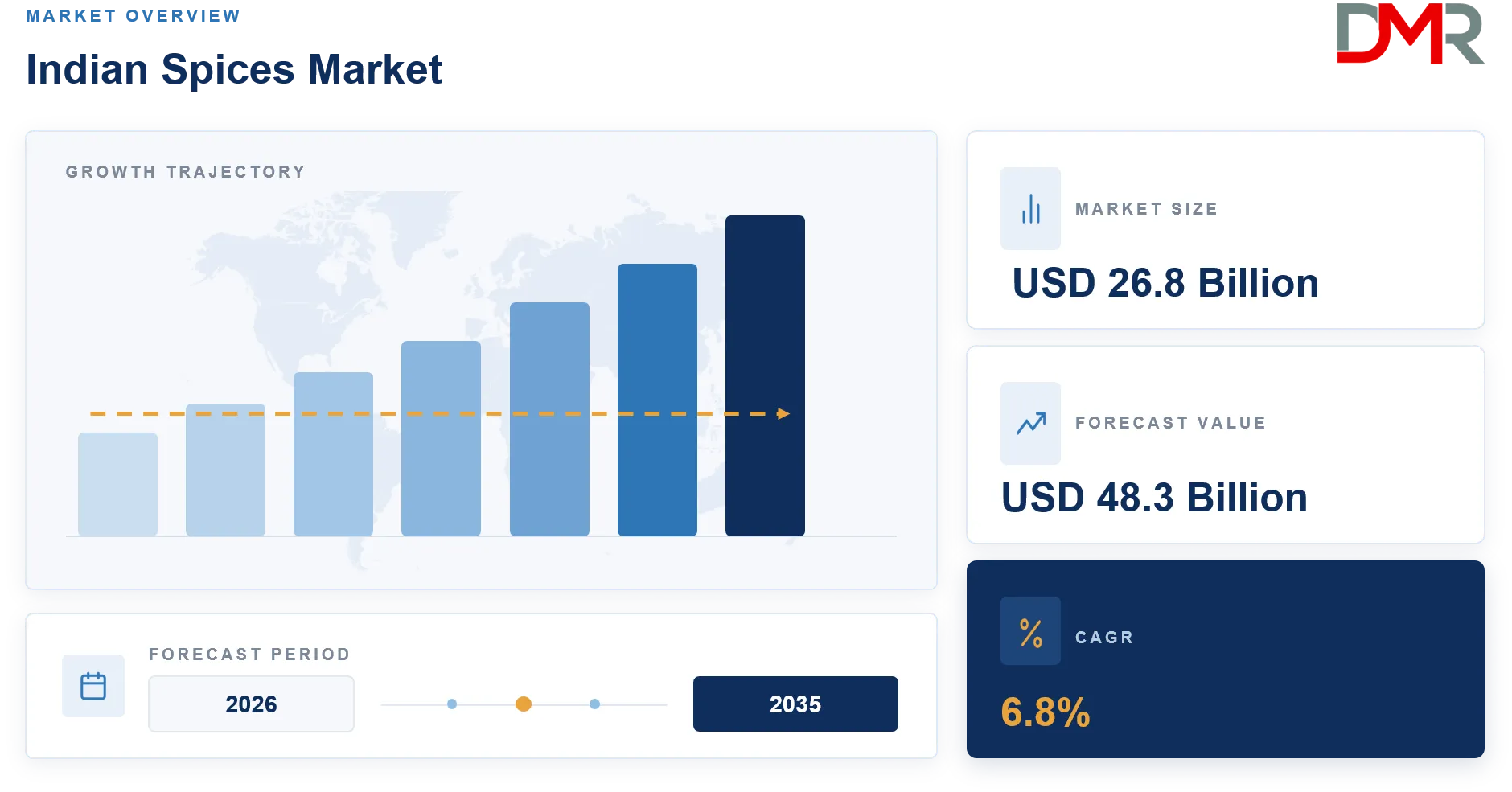
- Market Value: Indian Spices Market is valued at USD 26.8 billion in 2026 and is projected to reach USD 48.3 billion by 2035.
- CAGR: Indian Spices Market is expected to grow at a CAGR of 6.8% from 2026 to 2035.
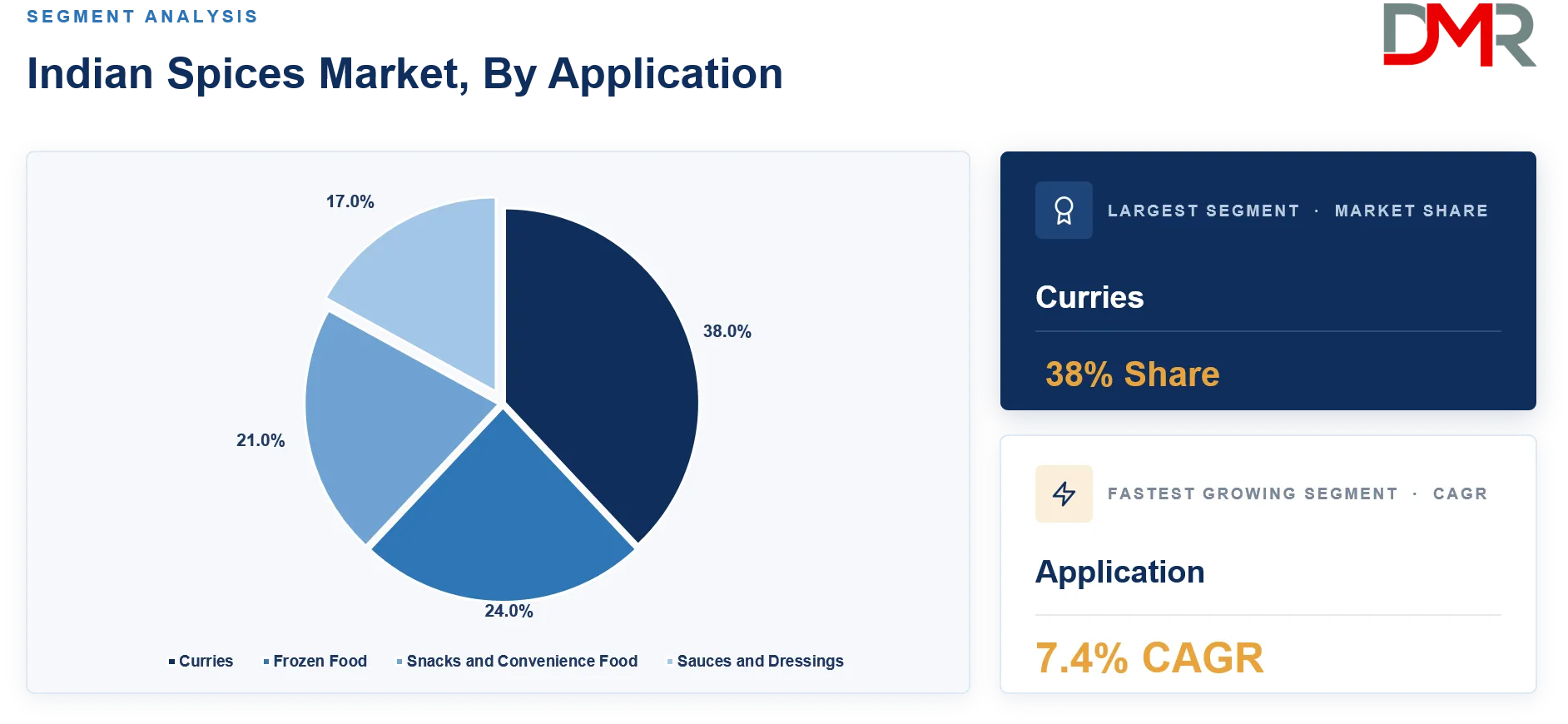
- By Application Segment Analysis: Curries led the application segment with a 38% share in 2026.
- By Product Type Segment Analysis: Pure Spices led product types with a 64% share in 2026.
- By Distribution Channel Segment Analysis: Offline channels held an 86% share in 2026.
- By Form Segment Analysis: Powder form led the market with a 62% share in 2026.
- Major Players: Tata Consumer Products Limited, Synthite Industries Private Limited, and others
What is the Indian Spices Market and its Market Size?
The Indian Spices Market size is projected to be valued at USD 26.8 billion in 2026 and is expected to reach USD 48.3 billion by 2035, expanding at a CAGR of 6.8% during the forecast period. The industry covers pure spices, blended masalas, powdered spices, pastes, and whole spices supplied to households, restaurants, packaged food manufacturers, ingredient processors, and export customers. India also has one of the world's deepest spice production ecosystems. Spices Board estimates overall Indian spice production at about 12.82 million metric tons in 2025-26, including chilli, garlic, ginger, turmeric, cumin, coriander, pepper, cardamom, fenugreek, and other varieties.
ℹ
To learn more about this report –
Download Your Free Sample Report Here
Domestic consumption remains the foundation of Indian spices market demand, while branded packaged spices, food processing, convenience foods, foodservice, modern retail, and international trade are widening the addressable market. Export activity adds another important revenue stream. India exported approximately 1.734 million tons of spices and spice products valued at USD 4.43 billion in 2025-26. The country's broad cultivation base and processing capabilities allow suppliers to serve both mass-market products and higher-value ingredients such as spice oils, oleoresins, extracts, blends, and customized seasonings.
Use Cases
- Household Cooking: Pure and blended spices are used every day in curries, vegetables, rice dishes, snacks, marinades, gravies, pickles, and regional recipes. Demand spans basic products such as turmeric, chilli and cumin as well as convenience blends such as garam masala, sambhar masala and kitchen king.
- Food Processing: Packaged food manufacturers use spice powders and standardized blends in frozen meals, ready-to-eat foods, instant mixes, noodles, sauces, savory snacks, seasonings and convenience products. Consistent flavor, controlled pungency and batch-to-batch quality are important purchasing criteria.
- Foodservice: Restaurants, hotels, cloud kitchens, catering businesses and quick-service chains purchase spices in larger formats. Operators increasingly seek standardized blends that shorten preparation time while delivering repeatable taste across outlets and kitchen locations.
- Ingredient Manufacturing: Industrial processors convert chilli, turmeric, pepper, cardamom and other crops into oleoresins, essential oils, extracts and customized seasoning systems. These products serve food, beverage, flavor, personal care and selected nutraceutical applications.
- Export Supply: Indian exporters supply whole spices, powders, blends and value-added ingredients to the USA, China, UAE, Bangladesh, Saudi Arabia, the UK, Germany and other international destinations. Quality testing, residue compliance, traceability and product consistency strongly influence export competitiveness.
How AI/Gen AI is Transforming the Indian Spices Market?
Advanced analytics and machine learning are becoming useful across spice procurement, production planning, quality management and demand forecasting. Large manufacturers can combine historical sales, weather conditions, commodity prices, distributor orders and regional demand patterns to improve raw-material purchasing and inventory allocation. Computer vision can support grading and sorting, while data-driven quality systems can help flag unusual characteristics in color, particle size or production batches. These tools are particularly relevant in a market where crop quality, moisture, pungency, volatile oil content and prices can vary by season and origin.
Generative systems also create opportunities in product development and commercial planning. Food companies can evaluate flavor combinations, identify regional consumption patterns and shorten early-stage formulation work for masalas, snack seasonings and ready-to-cook products. Sales teams can use structured customer and channel data to improve assortment planning across traditional retail, supermarkets, foodservice and online channels. The highest business value is likely to come from combining digital tools with laboratory validation, experienced sensory teams, traceable sourcing and established food safety procedures rather than replacing those functions.
Key Drivers in the Indian Spices Market
Expansion of Packaged Food and Convenience Consumption
The expansion of packaged foods is increasing industrial demand for consistent spice powders, blends and seasoning systems. Frozen meals, snacks, sauces, instant foods and ready-to-cook products require controlled flavor profiles that are easier to achieve with processed and standardized ingredients. This supports stronger B2B demand from food manufacturers while also creating opportunities for branded masalas aimed at time-conscious households. Curries already represent 38% of the application segment in 2026, showing the importance of everyday meal preparation to overall Indian spices market growth.
Large Production Base and Export Infrastructure
India's broad agricultural base gives processors access to chilli, garlic, ginger, turmeric, cumin, coriander, pepper, cardamom and many other commercially important crops. Total spice production reached an estimated 12.82 million metric tons in 2025-26. The Spices Board also operates export-development, quality and promotion programs, while its SPICED scheme focuses on productivity, post-harvest improvement, value addition and exportable quality. These capabilities support domestic availability as well as long-term Indian spices export market growth.
Restraints in the Indian Spices Market
Raw Material Price and Crop Volatility
Spice processors remain exposed to changes in crop output, rainfall, temperature, disease, acreage and commodity trading conditions. The effect differs sharply by spice. For example, Spices Board estimates show 2025-26 production of about 2.46 million tons of chilli, 1.14 million tons of cumin, 1.14 million tons of dry turmeric and 93,716 tons of pepper. Changes in production for individual crops can alter procurement costs and margins for manufacturers that sell products at fixed or competitive retail price points.
Food Safety and Export Compliance
Quality compliance creates additional costs for exporters and organized processors. Spice consignments can require controls for pesticide residues, aflatoxins, synthetic dyes, ethylene oxide, microbiological contamination and other parameters depending on the destination and product. Spices Board quality programs therefore place strong emphasis on testing and export compliance. Investment in laboratories, approved suppliers, traceability and documented processing is increasingly important for companies seeking premium customers and regulated overseas markets.
Growth Opportunities in the Indian Spices Market
Value-Added Blends and Convenience Products
Blended spices offer manufacturers an opportunity to move beyond commodity competition and capture more value per unit. Garam masala, non-veg masala, paneer and curry masala, kitchen king, chole masala and sambhar masala address specific meal occasions and reduce preparation effort. Growth can also come from regional blends, low-sodium formulations, foodservice packs and customized B2B seasoning systems. Pure spices currently hold 64% of the product type market, leaving a meaningful expansion opportunity for differentiated blended products through 2035.
Premium Exports and Processed Spice Ingredients
Exports provide a significant route for revenue diversification. India shipped USD 4.43 billion of spices and spice products in 2025-26, while major destinations include the USA, China, UAE, Bangladesh, Saudi Arabia, Malaysia, the UK and Germany. Exporters can target higher-value opportunities in tested powders, steam-treated products, organic lines, extracts, oils, oleoresins and customized blends rather than competing only in bulk whole spices. Strong traceability and destination-specific compliance can improve access to premium buyers.
Trends in the Indian Spices Market
Shift Toward Branded and Standardized Spice Products
The market is gradually moving from loose, locally ground spices toward branded products that offer consistent taste, labeling, convenient pack sizes and perceived quality assurance. This shift benefits companies that combine broad distribution with strong sourcing and processing capabilities. Organized brands are extending portfolios from basic chilli, turmeric and coriander powders into recipe-specific masalas, premium variants and regional blends, allowing them to compete across household, institutional and foodservice demand.
Digital Commerce is Expanding Alongside Traditional Retail
Offline channels still dominate with an 86% share in 2026, reflecting the reach of neighborhood stores, supermarkets, wholesalers and distributor networks. Online channels, however, provide a growing route for premium brands, regional products and specialized spice assortments. Digital grocery and quick-commerce platforms can make smaller brands more discoverable and enable faster assortment testing. The result is not an immediate replacement of traditional distribution, but an increasingly integrated route-to-market strategy covering offline and online customers.
Research Scope and Analysis
The Indian Spices Market is segmented based on Application, Product Type, Distribution Channel, End User, Nature, Form, and other relevant categories. The study provides an in-depth analysis of key segments and sub-segments, covering applications, industry adoption, demand patterns, distribution structures and their contribution to overall market growth.
By Application
Curries accounted for 38% of the Indian Spices Market application segment in 2026, making them the leading application. Their position reflects the central role of spice-based gravies and cooked dishes in household and foodservice consumption across India. Turmeric, chilli, cumin, coriander and blended masalas are routinely used to build color, aroma, pungency and flavor in curry preparation. Demand is also supported by restaurants, institutional kitchens and packaged curry products. Frozen foods, snacks and convenience foods, and sauces and dressings provide additional growth as manufacturers expand ready-to-eat and ready-to-cook portfolios.
By Product Type
Pure Spices represented 64% of the Indian Spices Market by product type in 2026. The segment includes cumin, turmeric, garlic, fenugreek, pepper, coriander, tamarind, cardamom, ginger, mustard seeds and red chilli. Their dominance stems from frequent household use, established culinary habits and broad industrial applications. The production base is substantial: 2025-26 estimates include about 3.64 million tons of garlic, 2.60 million tons of fresh ginger, 2.46 million tons of chilli and 1.14 million tons of dry turmeric. Blended spices are positioned for faster value creation as convenience and recipe-specific products gain acceptance.
ℹ
To learn more about this report –
Download Your Free Sample Report Here
By Distribution Channel
Offline distribution held 86% share in 2026, supported by India's large network of supermarkets, hypermarkets, convenience stores, wholesalers, distributors and direct-sales relationships. Spices are high-frequency grocery products, so physical availability near residential areas remains commercially important. Direct sales also play a major role in institutional and industrial procurement where customers purchase larger quantities. Online distribution offers a smaller but strategically important route for premium products, specialty varieties, trial packs and direct brand relationships, particularly in digitally active urban markets.
By Form
Powder form accounted for 62% share in 2026 and remained the leading form in the Indian Spices Market. Ground chilli, turmeric, coriander, cumin and blended masalas offer convenience because consumers can use them without roasting, grinding or other preparation. Powder formats are equally important for packaged foods and foodservice kitchens that require accurate dosing and consistent recipes. Manufacturers are investing in grinding, blending, moisture control and packaging to protect aroma and product stability. Paste and whole forms retain important roles in fresh cooking, premium cuisines and applications where texture or aroma release is required.
The Indian Spices Market Report is segmented on the basis of the following:
By Application
- Curries
- Frozen Food
- Snacks and Convenience Food
- Sauces and Dressings
By Product Type
- Pure Spices
- Cumin
- Turmeric
- Garlic
- Fenugreek
- Pepper
- Coriander
- Tamarind
- Cardamom
- Ginger
- Mustard Seeds
- Red Chilli
- Blended Spices
- Garam Masala
- Non-Veg Masala
- Paneer and Curry Masala
- Kitchen King and Sabzi Masala
- Chole and Channa Masala
- Sambhar and Rasham Masala
By Distribution Channel
- Offline
- Supermarkets/Hypermarkets
- Direct Sales
- Convenience Stores
- Online
By End User
- Industrial Applications
- Household
- Food Service Outlets
By Nature
By Form
Competitive Landscape
The Indian Spices Market has a diverse competitive structure that includes national FMCG companies, established masala brands, regional manufacturers, ingredient processors and export-oriented businesses. Competition differs by customer group. Consumer brands compete through distribution reach, product consistency, regional recipes, pricing, packaging and brand recognition, while B2B suppliers focus more heavily on sourcing, technical specifications, traceability, customization and processing capacity.
Some of the prominent players in the Indian Spices Industry are:
- Tata Consumer Products Limited
- Synthite Industries Private Limited
- McCormick & Company, Incorporated
- Aachi Masala Foods Private Limited
- Olam Food Ingredients Pte. Ltd.
- Eastern Condiments Private Limited
- ITC Limited
- Kancor Ingredients Limited
- Everest Food Products Private Limited
- Dharampal Satyapal Foods Limited
- Nedspice Group B.V
- VKL Seasoning Private Limited
- Mahashian Di Hatti Private Limited
- Orkla India Private Limited
- Akay Natural Ingredients Private Limited
- Others
Regulatory Landscape
The Indian Spices Market operates under a structured food safety and export framework that directly affects sourcing, processing, packaging, labeling, testing and international trade. The Food Safety and Standards Authority of India regulates domestic food businesses under the Food Safety and Standards Act, 2006, while the Spices Board, under the Ministry of Commerce and Industry, supports spice export development and quality evaluation. Manufacturers must manage requirements covering contaminants, pesticide residues, permitted additives, hygiene, packaging and labeling. Export-oriented suppliers face additional destination-specific limits for pesticide residues, aflatoxins, microbiological contamination and other restricted substances. The Spices Board's quality infrastructure and mandatory registration requirements for exporters strengthen oversight of international shipments. For organized manufacturers, investment in accredited testing, supplier audits, traceability, cleaning and sterilization is therefore becoming a competitive requirement as well as a compliance function.
Investment and White Space Analysis
The Indian Spices Market offers investment white space beyond conventional whole and powdered spices as demand moves toward branded, convenient and value-added products. With the market projected to rise from USD 26.8 billion in 2026 to USD 48.3 billion by 2035, opportunities are emerging in regional masala blends, premium pure spices, organic products, foodservice packs, ready-to-cook seasonings and export-grade ingredients. Pure spices hold 64% of product demand, while powder accounts for 62% by form, creating room for companies to differentiate through traceable sourcing, superior processing and specialized formulations rather than competing mainly on price. Offline channels still command 86% of distribution, leaving additional white space for digital-first brands and omnichannel models. B2B opportunities are also expanding in spice extracts, oleoresins, seasoning systems and customized blends for snacks, frozen foods, sauces and convenience products. Investment in processing clusters, sterilization, quality testing and farmer-linked sourcing can improve margins and export readiness.
Recent Developments
Report Details
| Report Characteristics |
| Market Size (2026) |
USD 26.8 Bn |
| Forecast Value (2035) |
USD 48.3 Bn |
| CAGR (2026–2035) |
6.8% |
| Historical Data |
2021 – 2025 |
| Forecast Data |
2027 – 2035 |
| Base Year |
2025 |
| Estimate Year |
2026 |
| Segments Covered |
By Application (Curries, Frozen Food, Snacks and Convenience Food, and Sauces and Dressings), By Product Type (Pure Spices {Cumin, Turmeric, Garlic, Fenugreek, Pepper, Coriander, Tamarind, Cardamom, Ginger, Mustard Seeds, and Red Chilli}, and Blended Spices {Garam Masala, Non-Veg Masala, Paneer and Curry Masala, Kitchen King and Sabzi Masala, Chole and Channa Masala, and Sambhar and Rasham Masala}), By Distribution Channel (Offline {Supermarkets/Hypermarkets, Direct Sales, and Convenience Stores}, and Online), By End User (Industrial Applications, Household, and Food Service Outlets), By Nature (Organic, and Conventional), By Form (Powder, Paste, and Whole) |
| Regional Coverage |
India |
Frequently Asked Questions
What is the current size of the Indian Spices Market?
▾ The Indian Spices Market is valued at USD 26.8 billion in 2026 and is forecast to reach USD 48.3 billion by 2035.
What is the growth rate of the Indian Spices Market during the forecast period?
▾ The Indian Spices Market is expected to grow at a CAGR of 6.8% during the forecast period from 2026 to 2035.
Which region dominates the Indian Spices Market?
▾ North India leads the Indian Spices Market with around 30% share in 2026, driven by strong consumption and trade.
What factors are driving the growth of the Indian Spices Market?
▾ Indian Spices Market growth is driven by packaged foods, branded spices, exports, foodservice demand, and convenience foods.
What are the major challenges restraining the Indian Spices Market?
▾ The Indian Spices Market faces raw material price volatility, crop variability, food safety compliance, and export regulations.
Which segment holds the largest share of the Indian Spices Market?
▾ Pure Spices hold the largest Indian Spices Market product type share at 64% in 2026, supported by widespread daily use.
Who are the leading companies in the Indian Spices Market?
▾ Tata Consumer Products Limited, Synthite Industries Private Limited, McCormick & Company, Incorporated, Aachi Masala Foods Private Limited, Olam Food Ingredients Pte. Ltd., Eastern Condiments Private Limited, ITC Limited, Kancor Ingredients Limited, Everest Food Products Private Limited, Dharampal Satyapal Foods Limited, Nedspice Group B.V, VKL Seasoning Private Limited, Mahashian Di Hatti Private Limited, Orkla India Private Limited, and Akay Natural Ingredients Private Limited are prominent companies in the Indian Spices Market.
How is AI influencing the Indian Spices Market?
▾ AI is influencing the Indian Spices Market through demand forecasting, quality inspection, crop monitoring, and inventory planning.
What are the future opportunities and trends in the Indian Spices Market?
▾ Indian Spices Market opportunities include premium blends, organic spices, exports, digital sales, and value-added ingredients.