What is the Industrial Control Systems Security Market Size?
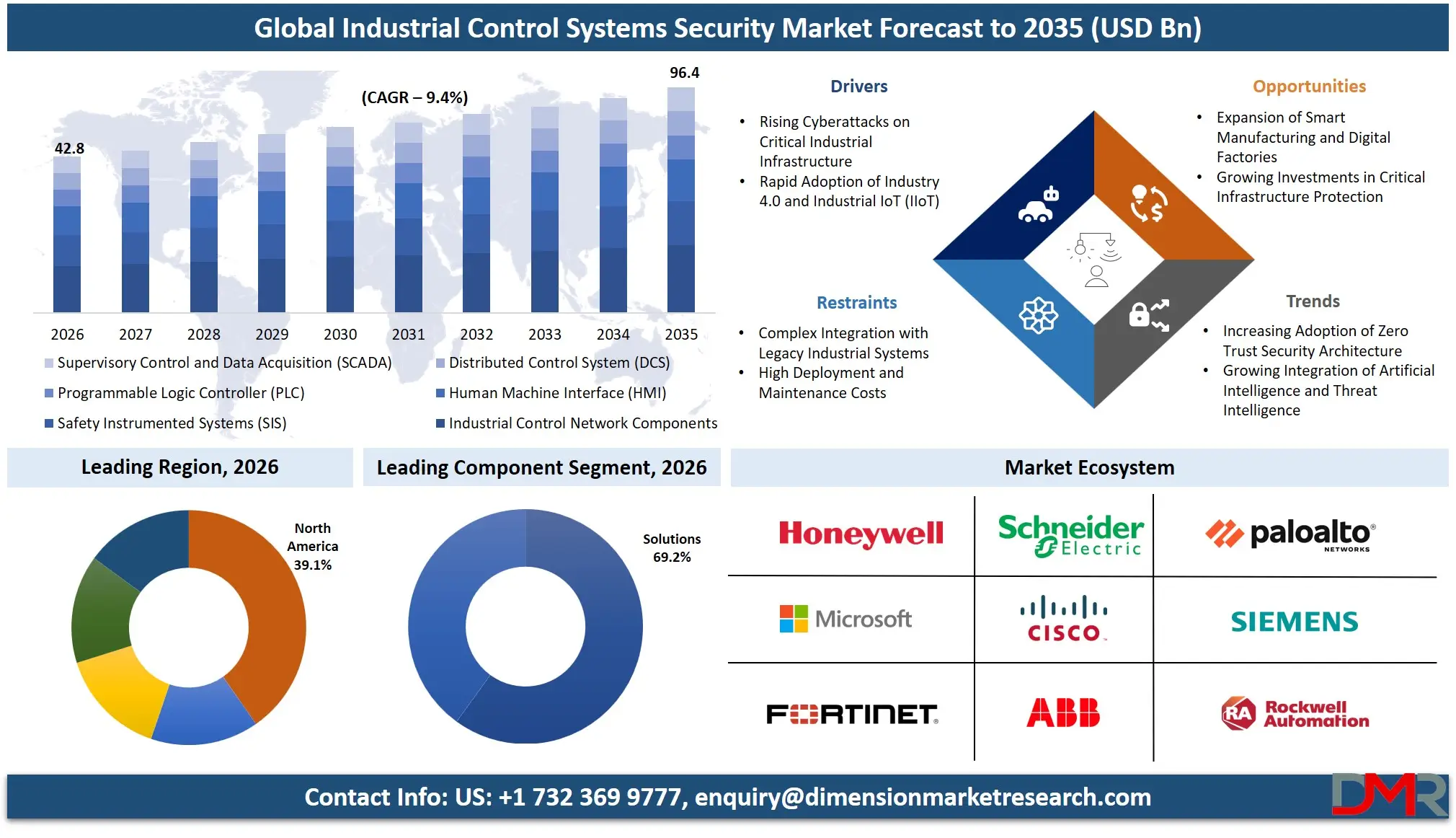
The Global Industrial Control Systems Security Market is expected to reach a value of USD 42.8 billion in 2026, and it is further anticipated to reach USD 96.4 billion by 2035, growing at a CAGR of 9.4% during the forecast period.
ℹ
To learn more about this report –
Download Your Free Sample Report Here
The ICS security market is experiencing accelerated growth as cyber threats increasingly target critical infrastructure and industrial environments. This market encompasses a suite of solutions and services designed to protect Supervisory Control and Data Acquisition (SCADA) systems, Distributed Control Systems (DCS), and other operational technology (OT) assets from cyberattacks. The escalating convergence of IT and OT networks, coupled with the rise of state-sponsored attacks and ransomware targeting energy grids and manufacturing plants, is driving the necessity for specialized security postures. Enterprises and governments are the most frequent adopters, with network security and identity & access management (IAM) remaining top priorities due to their ability to create secure perimeters and manage privileged access. The energy & utilities, manufacturing, and oil & gas industries are key players as they need rugged, real-time security that ensures operational uptime and physical safety.
The US Industrial Control Systems Security Market
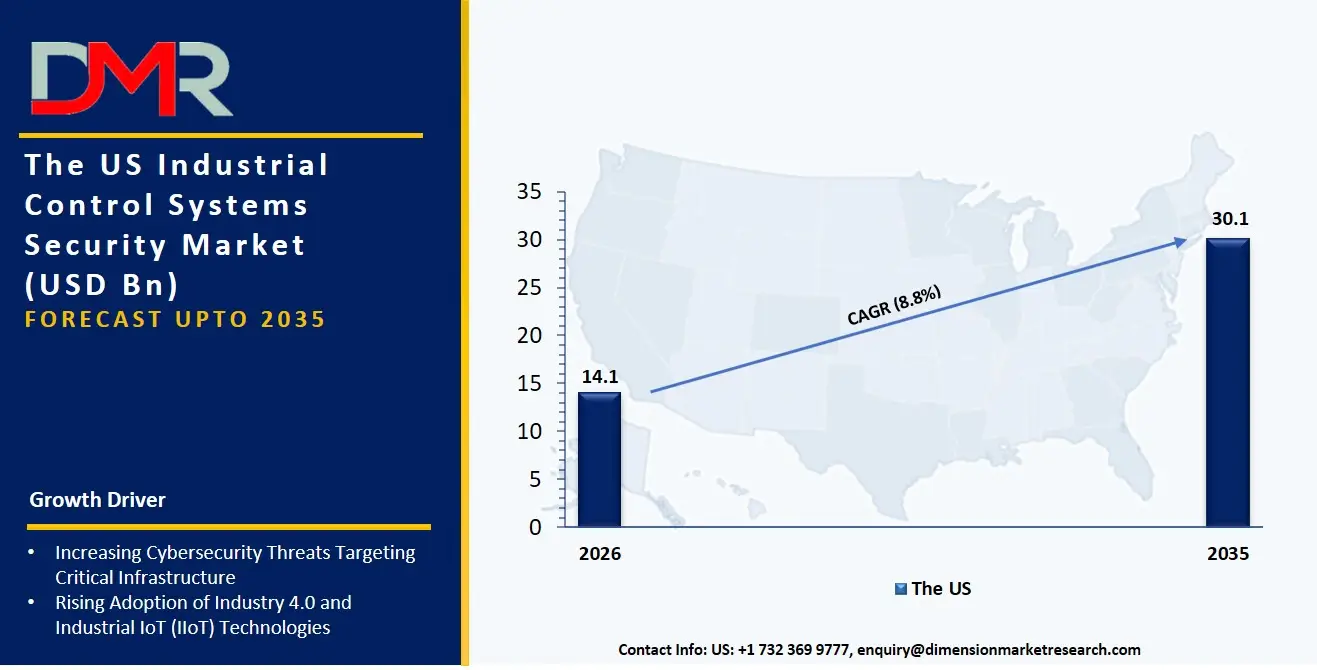
The US ICS Security Market is projected to reach USD 14.1 billion in 2026 at a compound annual growth rate of 8.8% over its forecast period, culminating in a value of USD 30.1 billion by 2035.
ℹ
To learn more about this report –
Download Your Free Sample Report Here
The US continues to be the largest and most developed market in ICS security due to aggressive national security directives and the modernization of aging energy grids. The market has been typified by high demand for Intrusion Detection & Prevention Systems (IDPS) and Risk Assessment & Security Audits, whereby critical infrastructure owners are under pressure to comply with TSA and NERC CIP mandates. Besides, the rise of ransomware-as-a-service targeting manufacturing lines is producing a similar need in Managed Security Services to provide 24/7 threat hunting across operational technology environments where in-house expertise is scarce.
The Europe Industrial Control Systems Security Market
The Europe ICS Security Market is estimated to be valued at USD 12.0 billion in 2026 and is further anticipated to reach USD 26.2 billion by 2035 at a CAGR of 9.1%. The regulatory frameworks, including the NIS2 Directive and sector-specific mandates, have a significant impact on the European market and drive the need to employ Risk Assessment & Security Audits and private, on-premises security deployments. Accelerated growth of Hybrid deployment security services is also being experienced in the region as automotive and chemicals manufacturers in Germany and France try to strike a balance in operational technology (OT) availability with cloud-based threat intelligence. In addition, data sovereignty initiatives are challenging service providers to create dedicated Integration & Deployment services for security technologies that ensure data residency and interoperability across European industrial ecosystems.
The Japan Industrial Control Systems Security Market
The Japan ICS Security Market is projected to be valued at USD 4.5 billion in 2026. It is further expected to witness robust growth, holding USD 9.6 billion in 2035 at a CAGR of 8.8%. The Japanese market is unique, with a corporate drive to secure smart factories against intellectual property theft in response to a declining workforce and automated, interconnected production lines. Risk Assessment & Security Audits and Integration & Deployment services for Endpoint Security make up a large part of the spending as large conglomerates backfill security into legacy industrial robots and DCS platforms. There is also a strong need to deeply integrate with the local market to bridge the gaps between obsolete Human Machine Interface (HMI) panels and modern Identity & Access Management (IAM) solutions, which forms a niche in securing proprietary industrial protocols.
Key Takeaways
- Market Size & Forecast: The Global Industrial Control Systems Security market is projected to reach USD 42.8 billion in 2026, expanding significantly to USD 96.4 billion by 2035, fueled by the dual drivers of escalating cyber-physical attacks and mandatory government-led critical infrastructure resilience planning.
- Growth Rate & Outlook: Global market growth is expected at a CAGR of 9.4%, driven by a critical shortage of OT cybersecurity architects and the escalating complexity of managing legacy industrial protocols that were never designed with security in mind.
- Primary Growth Drivers: Key forces include the widespread IT/OT convergence expanding the attack surface, the need for Risk Assessment & Security Audits to identify vulnerabilities in safety instrumented systems, and the integration of IAM solutions requiring specialized Integration & Deployment skills to manage machine identities.
- Key Market Trends: Major trends include the rise of industry-specific OT security solutions, the use of AI-powered tools within Intrusion Detection & Prevention Systems (IDPS) to analyze deterministic network traffic, and the shift toward Managed Security Services as boards prioritize operational resilience and downtime prevention.
- By Deployment Mode Analysis: On-Premises deployment continues to dominate the Global Industrial Control Systems (ICS) Security Market due to strict operational reliability, low-latency requirements, regulatory compliance, and the need to protect mission-critical operational technology (OT) environments. Hybrid deployments are gaining momentum as organizations securely connect industrial assets with cloud-based monitoring, analytics, and centralized security operations while maintaining control over sensitive production systems.
- By End User Analysis: Energy & Utilities remains the dominant end-user segment owing to rising cyber threats targeting critical infrastructure, smart grid modernization, and stringent cybersecurity regulations. Manufacturing is the fastest-growing sector, driven by accelerating Industry 4.0 adoption, Industrial IoT (IIoT) deployment, connected production environments, and increasing investments in advanced network security, endpoint protection, and zero-trust cybersecurity architectures.
- Regional Leadership: North America is poised to dominate this market with 39.1% of the market share in 2026 due to its well-developed security vendor ecosystem and proactive CISA-led initiatives that place it as a leader in this market.
What is the Industrial Control Systems Security?
Industrial Control Systems Security refers to the specialized cybersecurity technologies and expert services offered by third-party OT security vendors, systems integrators, and consultancies to assist organizations in protecting the entire industrial lifecycle. These services, unlike general IT security (which focuses on data confidentiality), are related to the operational integrity and physical safety of how plants operate. This involves Solutions like Network Security and IDPS to detect unauthorized commands, and Services like Consulting and Risk Assessment to establish a strategic security roadmap without disrupting production. With 90% of critical infrastructure owners running hybrid IT/OT environments, professional ICS security services are needed to achieve air-gap monitoring, secure remote access governance, and compliance with safety standards, making security investments translate into tangible operational resilience, as opposed to a technical checkbox exercise.
Use Cases
- Legacy SCADA Modernization in Power Generation: Energy utilities hire ICS security Integration & Deployment services to overlay encrypted communications and IDPS onto legacy SCADA systems that were originally built without authentication, enabling secure remote telemetry without replacing million-dollar remote terminal units.
- Ransomware Readiness in Oil & Gas: Pipeline operators use Risk Assessment & Security Audits and Managed Security Services to segment their corporate IT from their OT DCS environments and deploy endpoint protection on engineering workstations to prevent lateral movement of ransomware into pipeline control logic.
- Supply Chain Security in Pharmaceuticals: Pharma manufacturers use Identity & Access Management (IAM) solutions to enforce strict biometric authentication and session recording for third-party contractors accessing Programmable Logic Controllers (PLCs) to change drug formulation recipes, ensuring FDA data integrity compliance.
- Anomaly Detection in Water & Wastewater: Municipalities use Network Security services to deploy passive network monitoring sensors that baseline "normal" HMI-PLC communication, generating high-fidelity alerts when rogue engineering commands are injected into the water treatment process.
How AI is Transforming the Industrial Control Systems Security Market?
AI is fundamentally changing the ICS security landscape by enabling the passive detection of threats in environments that cannot tolerate downtime or active scanning. In Intrusion Detection & Prevention Systems (IDPS), AI-driven behavioral analytics tools can automatically learn deterministic machine-to-machine communication baselines, distinguishing between a normal maintenance command and a malicious firmware upload, thereby drastically reducing reaction times for SOC analysts who lack OT experience. Meanwhile, AI-powered features in Security Information & Event Management (SIEM) allow operators to correlate seemingly harmless network scans across firewalls with specific HMI alert floods, offering predictive governance to prevent process disruptions. Governance and risk management projects are also revolving around AI. In the area of Consulting services, generative AI assistants are being used to simulate disaster recovery tabletops for safety instrumented systems, while Risk Assessment & Security Audits leverage AI to analyze thousands of PLC backplane configurations against secure-by-design benchmarks like ISA/IEC 62443, automating compliance mapping and gap analysis.
Market Dynamics
Key Drivers in the Global Industrial Control Systems (ICS) Security Market
Rising Cyberattacks on Critical Industrial Infrastructure
The increasing frequency and sophistication of cyberattacks targeting industrial facilities are driving demand for Industrial Control Systems (ICS) security solutions. Critical infrastructure sectors such as energy, utilities, oil & gas, manufacturing, transportation, and water treatment rely heavily on connected operational technology (OT), making them attractive targets for ransomware, malware, and nation-state attacks. Organizations are investing in advanced ICS security platforms to protect industrial networks, detect threats in real time, and ensure uninterrupted operations. Growing awareness of operational resilience and business continuity has accelerated the deployment of comprehensive cybersecurity solutions across industrial environments worldwide.
Rapid Adoption of Industry 4.0 and Industrial IoT
The growing adoption of Industry 4.0 technologies, Industrial Internet of Things (IIoT), cloud connectivity, and smart manufacturing is significantly increasing the need for robust ICS security. Connected sensors, intelligent machines, remote monitoring, and automated production systems expand the industrial attack surface, requiring stronger cybersecurity controls. Enterprises are deploying network segmentation, endpoint protection, intrusion detection, and identity management solutions to secure digital manufacturing environments. As organizations continue integrating operational technology with enterprise IT systems, demand for comprehensive ICS security solutions capable of protecting increasingly connected industrial ecosystems continues to expand.
Restraints in the Global Industrial Control Systems (ICS) Security Market
Complex Integration with Legacy Industrial Systems
Many industrial facilities continue operating legacy control systems that were designed without modern cybersecurity capabilities. Integrating advanced security solutions into aging SCADA, PLC, DCS, and HMI environments is technically challenging and often requires extensive customization. Compatibility limitations, operational disruptions, and concerns about system availability make organizations cautious when upgrading security infrastructure. These implementation complexities can delay modernization projects and increase deployment costs, limiting faster adoption of comprehensive ICS security solutions, particularly in industries operating older industrial assets.
High Deployment and Maintenance Costs
Implementing enterprise-grade ICS security requires significant investments in cybersecurity software, industrial network monitoring, hardware upgrades, consulting services, employee training, and continuous threat monitoring. Organizations must also comply with evolving regulatory requirements while maintaining uninterrupted industrial operations during deployment. Smaller manufacturers and regional utilities often face budget constraints that slow cybersecurity investments. Ongoing software updates, vulnerability assessments, incident response planning, and managed security services further increase operational expenses, making comprehensive ICS security implementation financially challenging for many organizations.
Growth Opportunities in the Global Industrial Control Systems (ICS) Security Market
Expansion of Smart Manufacturing and Digital Factories
The global expansion of smart factories and digitally connected manufacturing facilities presents substantial opportunities for ICS security providers. Manufacturers increasingly deploy robotics, IIoT devices, AI-driven automation, and cloud-based production management systems that require advanced cybersecurity protection. ICS security solutions help safeguard industrial operations, intellectual property, and connected production assets while supporting regulatory compliance. Growing investments in factory modernization and industrial digital transformation are expected to generate sustained demand for advanced industrial cybersecurity technologies worldwide.
Growing Investments in Critical Infrastructure Protection
Governments and private organizations are increasing investments to strengthen the cybersecurity of critical infrastructure, including power grids, water treatment facilities, transportation systems, and oil & gas operations. National cybersecurity strategies and stricter regulatory frameworks encourage organizations to deploy advanced ICS security platforms capable of protecting operational technology environments against evolving threats. Increasing public-private partnerships, infrastructure modernization programs, and resilience initiatives create long-term growth opportunities for vendors offering industrial threat detection, network security, endpoint protection, and continuous monitoring solutions.
Trends in the Global Industrial Control Systems (ICS) Security Market
Increasing Adoption of Zero Trust Security Architecture
Industrial organizations are increasingly adopting Zero Trust security models to strengthen protection across operational technology environments. Rather than automatically trusting users or devices within industrial networks, Zero Trust continuously verifies identities, device health, and access permissions before granting access to critical systems. This approach reduces insider threats, limits lateral movement during cyberattacks, and strengthens industrial resilience. As IT and OT environments become more interconnected, Zero Trust architecture is emerging as a core strategy for securing modern industrial operations.
Growing Integration of Artificial Intelligence and Threat Intelligence
Artificial intelligence, machine learning, and threat intelligence platforms are becoming integral components of modern ICS security solutions. AI-powered analytics enable organizations to detect abnormal industrial behavior, identify previously unknown threats, prioritize vulnerabilities, and automate incident response. Real-time threat intelligence further enhances visibility into emerging cyber risks affecting industrial environments. As cyber threats become increasingly sophisticated, organizations are investing in intelligent cybersecurity platforms capable of providing predictive protection, continuous monitoring, and automated security operations across complex industrial control systems.
Research Scope and Analysis
The Global Industrial Control Systems Security Market is segmented by Component into Solutions and Services, Security Type, Deployment Mode including On-Premises, Cloud-Based, and Hybrid, Organization Size including Large Enterprises and SMEs, Industrial Control System Type, and End User including Energy and Utilities, Oil and Gas, Manufacturing, Chemicals, Water and Wastewater, Power Generation, Transportation, Pharmaceuticals, Mining and Metals, and Others.
ℹ
To learn more about this report –
Download Your Free Sample Report Here
By Component Analysis
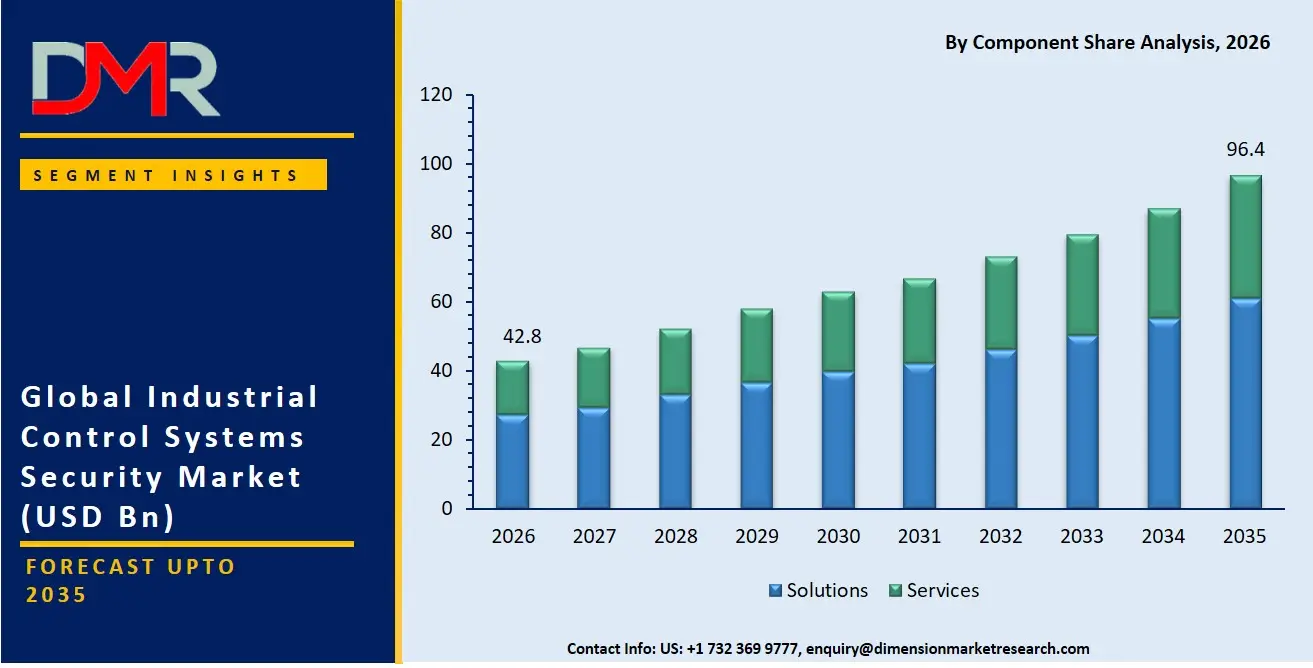
The Solutions segment is projected to dominate the Global Industrial Control Systems (ICS) Security Market as organizations prioritize comprehensive cybersecurity platforms to protect industrial networks, operational technology (OT), and critical infrastructure from increasingly sophisticated cyber threats.
ℹ
To learn more about this report –
Download Your Free Sample Report Here
Solutions such as network security, endpoint protection, SIEM, intrusion detection and prevention systems, and identity and access management provide continuous monitoring, threat detection, vulnerability management, and incident response. Industries including manufacturing, energy, utilities, and oil & gas are investing heavily in integrated security solutions to ensure operational continuity and regulatory compliance. The increasing convergence of IT and OT environments further strengthens demand, making solutions the largest revenue-generating component.
By Security Type Analysis
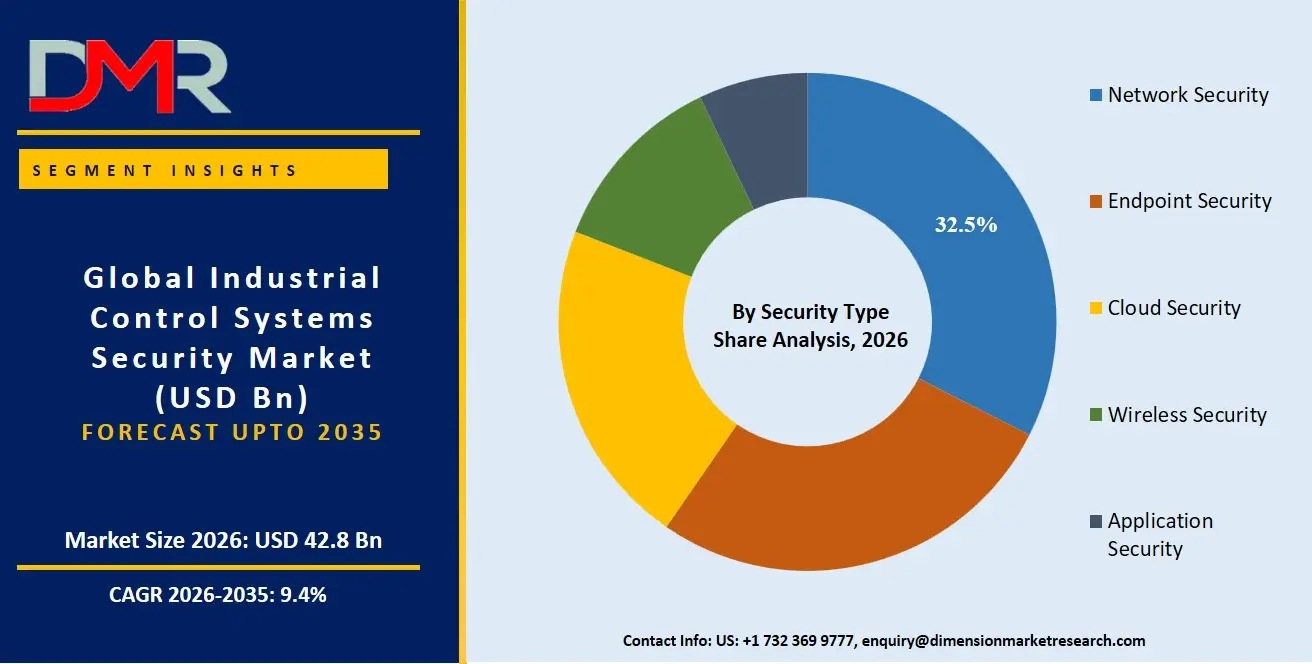
Network Security is poised to dominate the security type segment because industrial communication networks represent the primary target for cyberattacks against operational technology environments. Organizations deploy industrial firewalls, network segmentation, intrusion detection systems, secure remote access, and continuous traffic monitoring to protect SCADA, PLC, and DCS networks from malware, ransomware, and unauthorized access. As industrial operations become increasingly interconnected through IIoT and cloud technologies, securing communication between industrial assets has become essential. The critical role of network protection in preventing operational disruptions and safeguarding critical infrastructure ensures Network Security remains the leading security category.
By Deployment Mode Analysis
The On-Premises deployment segment is expected to dominate the ICS Security Market because industries operating critical infrastructure prioritize complete control over sensitive operational technology environments. Manufacturing plants, power generation facilities, oil & gas operations, and utilities often maintain strict cybersecurity policies that require local deployment to minimize external risks and meet regulatory requirements. On-premises solutions provide lower latency, greater control over industrial networks, and enhanced protection for mission-critical assets. Despite increasing cloud adoption, many organizations continue relying on locally deployed security platforms due to operational reliability, compliance obligations, and the need to secure isolated industrial control environments.
By Organization Size Analysis
Large Enterprises is anticipated to dominate the ICS Security Market because they operate extensive industrial facilities, complex operational technology networks, and geographically distributed critical infrastructure that require advanced cybersecurity protection. These organizations possess the financial resources to invest in comprehensive industrial security platforms, continuous monitoring, managed security services, and regulatory compliance initiatives. Large enterprises also face higher cyber risks due to their extensive digital infrastructure and interconnected production systems. Increasing adoption of Industry 4.0, Industrial IoT, and smart manufacturing technologies further accelerates cybersecurity investments, making large enterprises the largest contributors to global ICS security spending.
By Industrial Control System Type Analysis
Supervisory Control and Data Acquisition (SCADA) systems is expected to dominate the Industrial Control System Type segment because they serve as the central monitoring and control platform for critical infrastructure across energy, utilities, transportation, water treatment, and industrial manufacturing. SCADA systems manage geographically distributed assets and enable real-time operational control, making them highly attractive targets for cyberattacks. Organizations increasingly deploy specialized security solutions to protect SCADA communications, prevent unauthorized access, and maintain operational continuity. Their widespread deployment across essential infrastructure sectors makes SCADA security the largest and most critical application area within the ICS Security Market.
By End User Analysis
The Energy & Utilities segment is projected to dominate the Global Industrial Control Systems Security Market due to the critical importance of protecting power grids, substations, renewable energy facilities, water distribution systems, and utility infrastructure from cyber threats. These organizations operate highly interconnected operational technology environments that require continuous monitoring, network segmentation, identity management, and threat detection to ensure uninterrupted service delivery. Increasing investments in grid modernization, smart grid technologies, renewable energy integration, and national critical infrastructure protection have significantly increased cybersecurity spending. Stringent regulatory requirements and the growing frequency of attacks targeting utility infrastructure continue to reinforce Energy & Utilities as the leading end-user segment.
The Global Industrial Control Systems Security Market Report is segmented on the basis of the following:
By Component
- Solutions
- Network Security
- Endpoint Security
- Application Security
- Database Security
- Identity & Access Management (IAM)
- Security Information & Event Management (SIEM)
- Intrusion Detection & Prevention Systems (IDPS)
- Data Loss Prevention (DLP)
- Others
- Services
- Consulting
- Risk Assessment & Security Audits
- Integration & Deployment
- Managed Security Services
- Support & Maintenance
By Security Type
- Network Security
- Endpoint Security
- Cloud Security
- Wireless Security
- Application Security
By Deployment Mode
- On-Premises
- Cloud-Based
- Hybrid
By Organization Size
- Large Enterprises
- Small & Medium Enterprises (SMEs)
By Industrial Control System Type
- Supervisory Control and Data Acquisition (SCADA)
- Distributed Control System (DCS)
- Programmable Logic Controller (PLC)
- Human Machine Interface (HMI)
- Safety Instrumented Systems (SIS)
- Industrial Control Network Components
By End User
- Energy & Utilities
- Oil & Gas
- Manufacturing
- Chemicals
- Water & Wastewater
- Power Generation
- Transportation
- Food & Beverage
- Pharmaceuticals
- Mining & Metals
- Others
Regional Analysis
Leading Region by Market Share
ℹ
To learn more about this report –
Download Your Free Sample Report Here
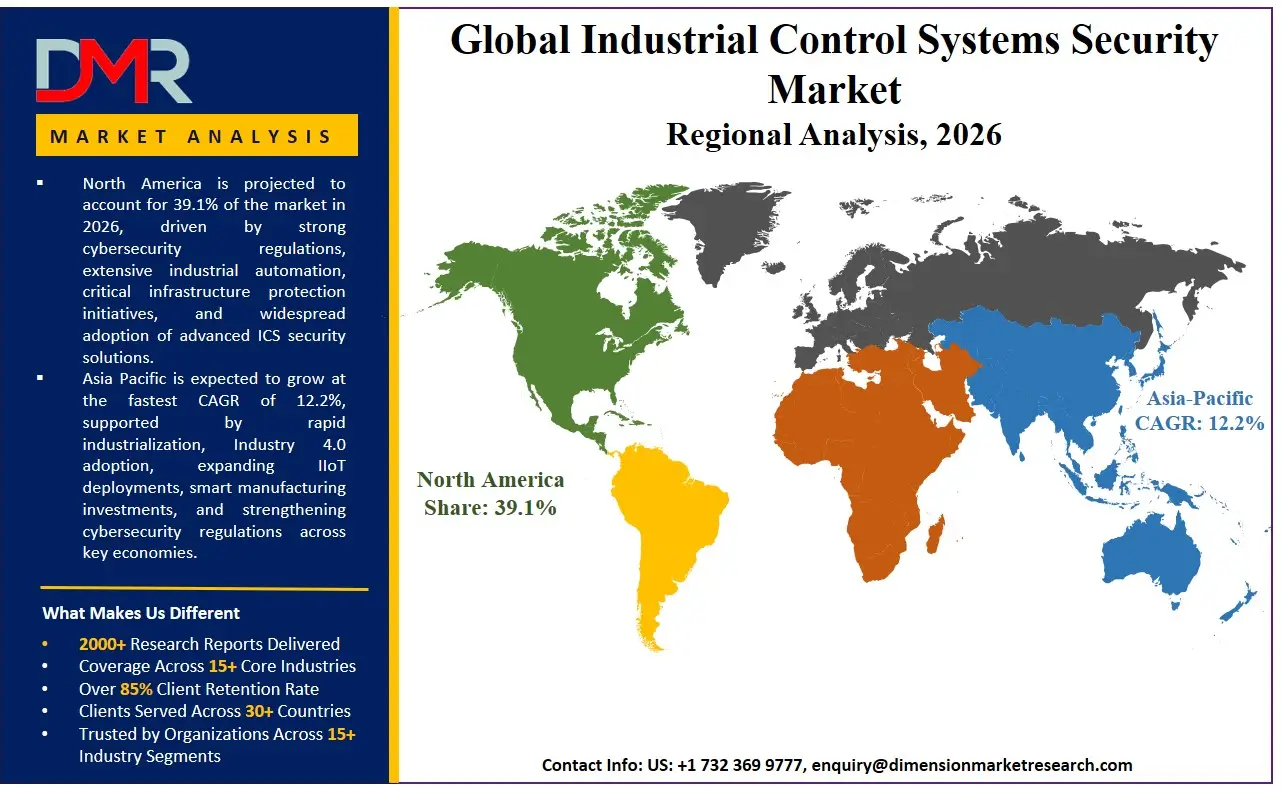
North America is poised to dominate the global ICS security market as it is projected to hold 39.1% of the market share by the end of 2026. The United States, which dominates North America, has the highest share in the ICS security market because of the unmatched concentration of critical infrastructure targets and the aggressive resilience agendas of large energy conglomerates. The area has an established ecosystem of global OT security vendors, boutique control system auditing firms, and a rich pool of cross-trained engineers. Federal investment in zero-trust architectures for defense industrial bases and the mandatory retirement of unmonitored serial connections contribute to the continued demand for Network Security and IDPS along with continuous Managed Security Services. Moreover, an aggressive venture capital climate persistently finances upcoming ICS security startups that deliver expert professional services to achieve rapid vulnerability discovery and incident response.
Fastest-Growing Regional Market
Asia-Pacific is expected to be the most rapidly expanding ICS security market, driven by government-led sweeping smart city and smart grid initiatives in India, China, Japan, and Southeast Asia. The fast-paced industrialization, the rise of a high-tech manufacturing hub economy, and the dynamic expansion of the 5G-connected factory floor is compelling established automotive and semiconductor giants and state-owned utilities to discard unprotected flat-network architectures. Risk Assessment & Security Audits is in high demand to help these large organizations pivot in the direction of ISA/IEC 62443 compliant operating models. There is also a severe lack of qualified OT cybersecurity talent in the region, and it is necessary to outsource Managed Security Services to monitor, detect, and respond to threats across time zones, closing the skills gap and enabling faster cybersecurity investments in greenfield factory projects.
By Region
North America
Europe
- Germany
- The U.K.
- France
- Italy
- Russia
- Spain
- Benelux
- Nordic
- Rest of Europe
Asia-Pacific
- China
- Japan
- South Korea
- India
- ANZ
- ASEAN
- Rest of Asia-Pacific
Latin America
- Brazil
- Mexico
- Argentina
- Colombia
- Rest of Latin America
Middle East & Africa
- Saudi Arabia
- UAE
- South Africa
- Israel
- Egypt
- Rest of MEA
Competitive Landscape
The competitive environment of global ICS security has become highly dynamic with a heterogeneous array of pure-play OT security pioneers, large IT cybersecurity vendors expanding into operational technology, and specialized industrial control engineering services firms. The key to success will be the profound strategic alliances with industrial automation vendors like Siemens, Rockwell, or Emerson because they will open the necessary integration pathways and early access to the proprietary protocols of new controller firmware. The movement towards market consolidation is rapidly progressing with large IT security platform companies acquiring niche OT asset visibility and threat hunting boutiques to broaden their manufacturing coverage. Proprietary intellectual property, including automated vulnerability scanning tools that do not crash PLCs and industry-specific correlation rules for SIEM, is becoming a more important basis of competitive differentiation than just generic IT security scanning or compliance checklist approaches.
Some of the prominent players in the Global Industrial Control Systems Security Market are:
- Siemens AG
- Schneider Electric SE
- Honeywell International Inc.
- ABB Ltd.
- Rockwell Automation, Inc.
- Fortinet, Inc.
- Palo Alto Networks, Inc.
- Cisco Systems, Inc.
- Microsoft Corporation
- IBM Corporation
- Nozomi Networks Inc.
- Claroty Ltd.
- Dragos, Inc.
- TXOne Networks
- Trellix
- Check Point Software Technologies Ltd.
- Broadcom Inc. (Symantec Enterprise Security)
- Kaspersky
- Forcepoint LLC
- Belden Inc. (Tripwire)
- Other Key Players
Recent Developments
- June 2026: Dragos announced the acquisition of Phosphorus, expanding its Operational Technology (OT) cybersecurity platform to secure the broader Extended Operational Technology (xOT) environment, including connected industrial devices used across critical infrastructure sectors.
- January 2026: Nozomi Networks announced that Mitsubishi Electric completed its acquisition of the company. Nozomi will continue operating independently while expanding its OT, IoT, and cyber-physical systems security solutions for industrial and critical infrastructure customers.
- September 2025: Dragos launched Dragos Platform 3.0, introducing AI-enhanced vulnerability analysis, an Insights Hub, and streamlined workflows to improve threat detection and accelerate cyber defense across industrial control system (ICS) and operational technology (OT) environments.
Report Details
| Report Characteristics |
| Market Size (2026) |
USD 42.8 Bn |
| Forecast Value (2035) |
USD 96.4 Bn |
| CAGR (2026–2035) |
9.4% |
| The US Market Size (2026) |
USD 14.1 Bn |
| Historical Data |
2021 – 2025 |
| Forecast Data |
2027 – 2035 |
| Base Year |
2025 |
| Estimate Year |
2026 |
| Segments Covered |
By Component, By Security Type, By Deployment Mode, By Organization Size, By ICS Type, and By End User |
| Regional Coverage |
North America – The US and Canada; Europe – Germany, The UK, France, Russia, Spain, Italy, Benelux, Nordic, & Rest of Europe; Asia-Pacific – China, Japan, South Korea, India, ANZ, ASEAN, Rest of APAC; Latin America – Brazil, Mexico, Argentina, Colombia, Rest of Latin America; Middle East & Africa – Saudi Arabia, UAE, South Africa, Turkey, Egypt, Israel, & Rest of MEA |
Frequently Asked Questions
How big is the Global Industrial Control Systems Security Market?
▾ The Global Industrial Control Systems Security market is poised to be valued at USD 42.8 billion in 2026 and is projected to reach USD 96.4 billion by 2035, driven by the universal need for specialized controls to prevent cyber-physical attacks on critical manufacturing, energy, and utility operations.
What is the CAGR of the Global Industrial Control Systems Security Market from 2026 to 2035?
▾ The market is expected to grow at a CAGR of 9.4% from 2026 to 2035, reflecting the accelerating convergence of IT and OT networks and the persistent shortage of internal security engineering talent fluent in industrial protocols.
What factors are driving the growth of the Global Industrial Control Systems Security Market?
▾ Key drivers include the global OT security skills gap, the imperative to segment legacy flat networks, the management complexity of multi-vendor industrial protocol environments, and the surge in demand for Risk Assessment & Security Audits amid evolving critical infrastructure protection regulations.
Which region held the largest share of the Industrial Control Systems Security Market in 2026?
▾ North America is projected to hold 39.1% of the market share in 2026, driven by a mature regulatory framework and aggressive critical infrastructure investment in Network Security and IDPS technologies against nation-state threats.
Which region is expected to grow the fastest in the Industrial Control Systems Security Market?
▾ The Asia-Pacific region is expected to grow the fastest, fueled by rapid digitalization of the manufacturing sector in China, India, and Japan, where Risk Assessment & Security Audits are critical for transitioning massive conglomerates to secure, interconnected smart factory operations.
What are the major trends in the Global Industrial Control Systems Security Market?
▾ Major trends include the integration of AI into industrial anomaly detection systems, the rise of zero-trust micro-segmentation on the plant floor, the demand for sector-specific OT security solutions, and the focus on securing Safety Instrumented Systems (SIS) against catastrophic logic manipulation.
Who are the key players in the Global Industrial Control Systems Security Market?
▾ Key players include OT-native specialists like Dragos, Claroty, and Nozomi Networks, as well as the industrial automation security divisions of Siemens, Honeywell, and Schneider Electric, alongside IT security giants like Fortinet, Palo Alto Networks, and Microsoft bridging into the OT space.
How is the Global Industrial Control Systems Security Market segmented?
▾ The market is segmented by Component, Security Type, Deployment Mode, ICS Type, Organization Size, and End User.