What is the Internal Communication Software Market Size in 2026?
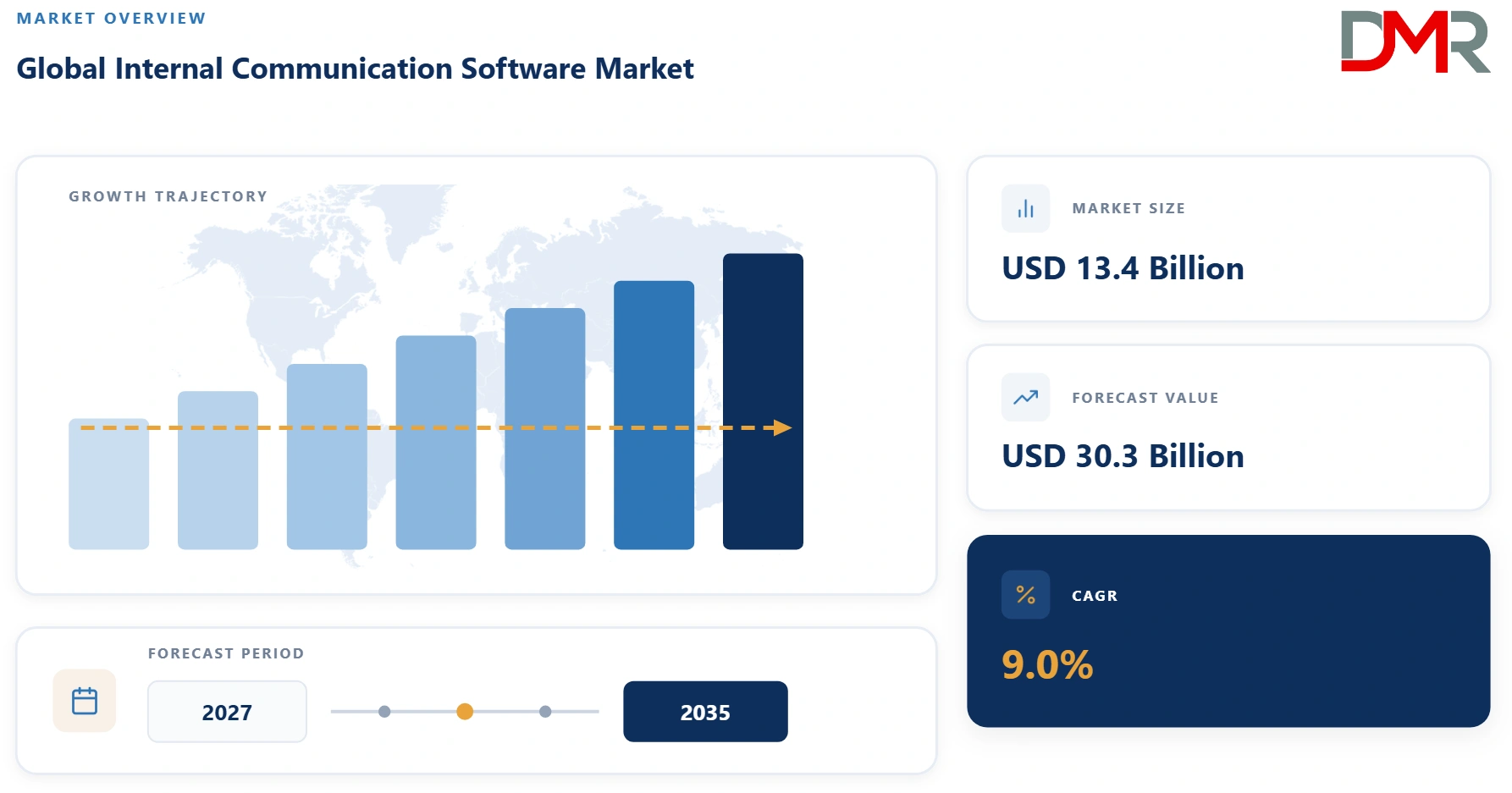
The Global Internal Communication Software Market is valued at USD 13.4 billion in 2026 and is projected to reach USD 30.3 billion by 2035, growing at a CAGR of 9.0% from 2027 to 2035. Market growth is driven by increasing adoption of digital workplace solutions, expansion of remote and hybrid working environments, growing demand for employee engagement platforms, and rising enterprise investments in centralized communication systems.
ℹ
To learn more about this report –
Download Your Free Sample Report Here
Internal communication software is a term used for software applications that enable companies to share information, communicate with employees, coordinate departments and make announcements. The solutions cover instant messaging, employee intranets, in-house newsletters, company announcements, employee directories, communication analytics and mobile communication apps. These help organizations connect their employees, make information easily accessible, promote employee buy-in, and optimize collaboration between work sites.
Global Internal Communication Software Market encompasses communication software and services within an organization, both cloud and on-premises. The market covers small, medium and large businesses across various industries and segments such as IT & telecom, BFSI, retail & e-commerce, manufacturing, healthcare, government, education, transportation & logistics and others. Software subscription and licensing, implementation, integration, customisation, consulting, training and technical support are all included in revenue assessment for internal communication platforms.
Internal Communication Software Market Snapshot
Internal Communication Software Market Snapshot, 2027-2035
| Metric |
Value |
| Market Size (2026) |
USD 13.4 Billion |
| Forecast Value (2035) |
USD 30.3 Billion |
| CAGR (2027–2035) |
9.0% |
| Largest Region (2026) |
North America, 43.1% share |
| Fastest-Growing Region (2027–2035) |
Asia Pacific, 11.2% CAGR |
| Leading Offering (2026) |
Software, 74.2% share |
| Leading Deployment (2026) |
Cloud-Based, 76.8% share |
| Key Players |
Microsoft Corporation; Salesforce, Inc.; Workvivo Limited; Staffbase GmbH; Simpplr Inc.; LumApps SAS; Interact Software; Firstup, Inc. |
Internal Communication Software Market: Key Takeaways
- Market Growth: The market is valued at USD 13.4 billion in 2026 and is projected to reach USD 30.3 billion by 2035, registering a CAGR of 9.0%.
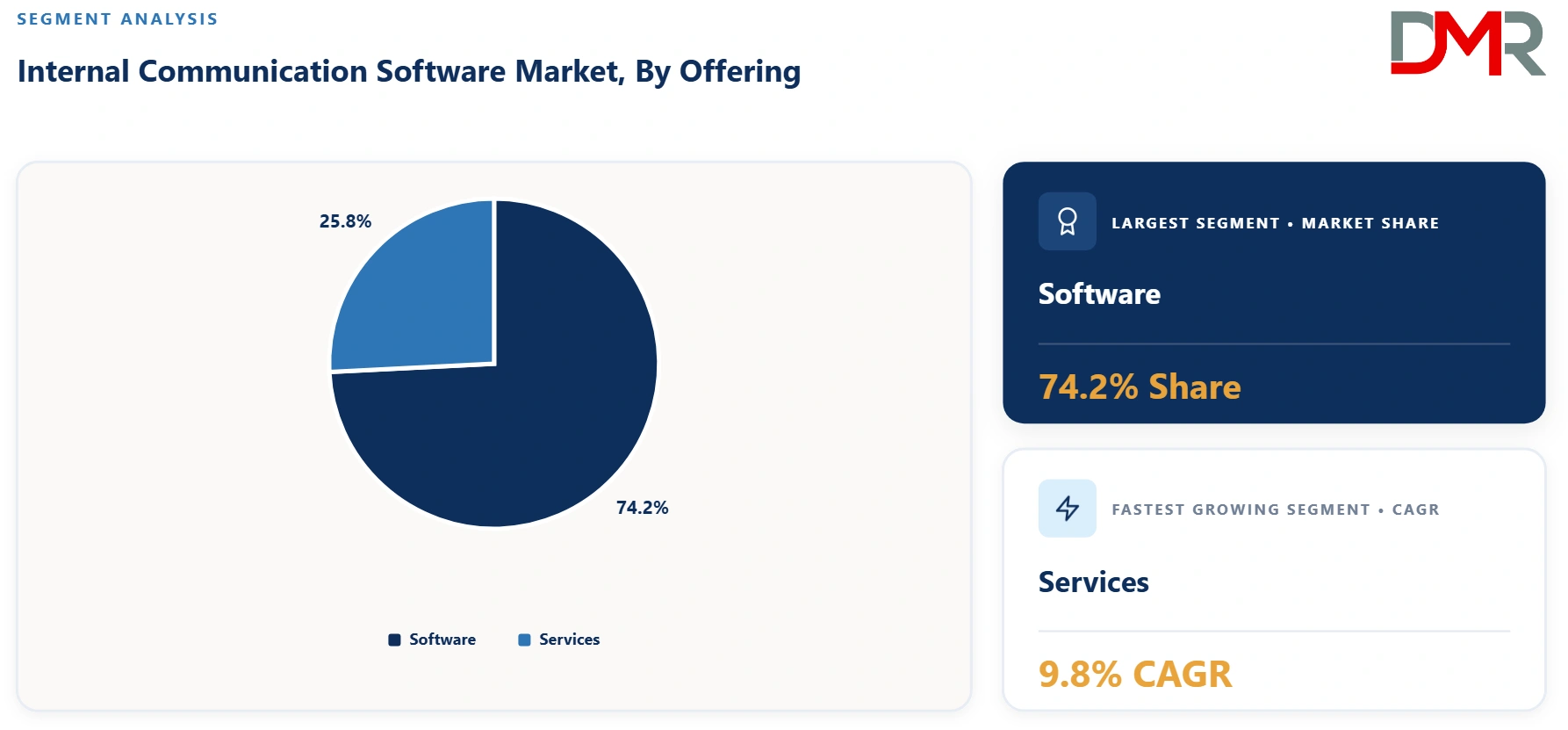
- Offering Leader: Software accounts for 74.2% of market revenue in 2026, supported by increasing adoption of employee communication and digital workplace platforms.
- Fastest-Growing Offering: Services are projected to register a CAGR of 9.8%, driven by growing demand for implementation, system integration, customization, and technical support.
- Deployment Leader: Cloud-Based deployment accounts for 76.8% of market revenue in 2026, supported by remote accessibility, scalability, and centralized communication capabilities.
- Fastest-Growing Deployment: Cloud-Based deployment is projected to register a CAGR of 10.1%, driven by expanding distributed workforces and subscription-based software adoption.
- Regional Picture: North America leads with a 43.1% in 2026 market share in 2026, while Asia Pacific is projected to grow at a CAGR of 11.2%.
What are the Key Use Cases of Internal Communication Software?
- Employee Communication and Announcements: Supports the distribution of corporate announcements, policy updates, organizational news, and important information across departments and business locations.
- Employee Engagement and Feedback: Facilitates employee surveys, feedback collection, recognition programs, and internal discussions to strengthen workforce engagement and organizational culture.
- Frontline Workforce Communication: Enables communication with employees working in retail stores, manufacturing facilities, warehouses, and remote locations through mobile applications and digital notifications.
- Knowledge Sharing and Collaboration: Provides centralized access to company documents, operational guidelines, training materials, and departmental information, improving knowledge accessibility and workplace coordination.
How are Foundation Models and Generative AI Transforming the Internal Communication Software Market?
Foundation models and generative AI are transforming the Internal Communication Software Market through automated content creation, intelligent information retrieval, personalized communication, and employee feedback analysis. Large language models support the preparation of corporate announcements, employee newsletters, meeting summaries, and internal communication campaigns. Automated translation capabilities help multinational organizations distribute consistent information across geographically dispersed and multilingual workforces.
Generative AI also supports conversational search, enabling employees to access company policies, operational guidelines, and organizational information through natural language queries. Sentiment analysis helps communication departments understand employee concerns and evaluate engagement levels. AI-powered content recommendations improve the relevance of internal messages based on employee roles, departments, and locations. Increasing demand for efficient communication, reduced administrative workloads, and personalized employee experiences encourages investment in intelligent internal communication platforms.
Internal Communication Software Market Dynamics at a Glance
Drivers, Restraints, Opportunities and Trends in the Internal Communication Software Market
| Type |
Factor |
Impact |
| Driver |
Increasing Adoption of Remote and Hybrid Working Models |
High |
| Driver |
Growing Focus on Employee Engagement and Organizational Communication |
High |
| Restraint |
Data Security and Employee Privacy Concerns |
High |
| Restraint |
High Implementation and Integration Costs |
Medium |
| Opportunity |
Expanding Demand for Frontline Workforce Communication Solutions |
High |
| Opportunity |
Increasing Adoption Among Small & Medium Enterprises |
High |
| Trend |
Growing Integration of Generative AI and Intelligent Communication Tools |
High |
| Trend |
Increasing Adoption of Personalized and Omnichannel Communication |
High |
What is Driving the Growth of the Internal Communication Software Market?
Increasing Adoption of Remote and Hybrid Working Models
Increasing adoption of remote and hybrid working models is driving demand for internal communication software across enterprise environments. Organizations operating with geographically distributed workforces require reliable platforms for sharing information, coordinating activities, and maintaining employee connectivity. Internal communication software provides instant messaging, corporate announcements, centralized information access, and employee communication channels. These capabilities reduce communication gaps and improve coordination between office-based and remote employees. Growing requirements for flexible working arrangements, consistent information delivery, and effective workforce management encourage investment in dedicated internal communication platforms across industries.
Growing Focus on Employee Engagement and Organizational Communication
Growing focus on employee engagement and organizational communication is accelerating the adoption of internal communication software. Organizations increasingly recognize the importance of transparent communication in improving employee satisfaction, workplace productivity, and retention. Internal communication platforms support employee recognition, feedback collection, leadership announcements, and organizational updates. Communication analytics provide insights into employee participation and content effectiveness. Centralized communication channels also help maintain consistent corporate messaging across departments and business locations. Increasing investments in employee experience management and organizational culture support demand for advanced internal communication software solutions.
What are the Key Restraints in the Internal Communication Software Market?
Data Security and Employee Privacy Concerns
Data security and employee privacy concerns restrict the adoption of internal communication software across organizations handling confidential business information. Communication platforms frequently contain employee records, corporate documents, strategic announcements, and sensitive operational information. Unauthorized access, cybersecurity incidents, and inappropriate data sharing can expose organizations to financial losses and reputational damage. Compliance with data protection requirements increases the complexity of software selection and implementation. Businesses operating in financial services, healthcare, and government environments require advanced security controls and reliable data management practices. These concerns can delay software procurement and restrict the adoption of certain cloud-based communication platforms.
High Implementation and Integration Costs
High implementation and integration costs present challenges for internal communication software adoption, particularly among organizations with limited technology budgets. Enterprise-grade platforms may require expenditure on software subscriptions, system configuration, data migration, employee training, and technical support. Additional costs arise from integration with human resource management systems, enterprise applications, and existing communication infrastructure. Organizations operating with legacy systems may encounter compatibility challenges during implementation. Smaller businesses frequently rely on basic messaging applications and email communication to reduce operational expenditure. These financial considerations restrict the adoption of comprehensive internal communication software across cost-sensitive business environments.
What are the Key Opportunities in the Internal Communication Software Market?
Expanding Demand for Frontline Workforce Communication Solutions
Expanding demand for frontline workforce communication solutions creates opportunities for software providers serving industries with large non-desk employee populations. Employees working in manufacturing facilities, retail stores, warehouses, healthcare facilities, and transportation operations require timely access to organizational information. Conventional email-based communication may provide limited accessibility for employees without dedicated corporate computers. Mobile-first communication platforms enable access to shift updates, safety announcements, operational instructions, and company news. Software providers can address these requirements through multilingual applications, targeted notifications, and simplified mobile interfaces. Increasing investments in frontline employee engagement support commercial opportunities across labor-intensive industries.
Increasing Adoption Among Small & Medium Enterprises
Increasing adoption of internal communication software among Small & Medium Enterprises creates growth opportunities for providers offering affordable and scalable solutions. Expanding digital business operations require structured communication platforms to support employee coordination, organizational announcements, and information sharing. Cloud-based subscription models reduce upfront infrastructure expenditure and simplify software deployment. Smaller organizations increasingly seek communication platforms offering essential functionality, flexible pricing, and integration with existing business applications. Technology providers can address these requirements through modular software packages, simplified onboarding, and self-service administration. Growing digitalization among emerging businesses supports market expansion across developing and established economies.
What are the Latest Trends in the Internal Communication Software Market?
Growing Integration of Generative AI and Intelligent Communication Tools
Growing integration of generative AI reflects changing enterprise requirements for efficient and personalized employee communication. Internal communication platforms increasingly incorporate automated content generation, intelligent search, translation, and message summarization capabilities. These features help communication departments prepare organizational updates and distribute relevant information with reduced administrative effort. AI-powered assistants support employee access to corporate policies, company documents, and frequently requested information. Advanced analytics also assist in understanding employee engagement patterns and identifying communication gaps. Increasing demand for intelligent workplace solutions encourages software providers to expand AI-enabled communication capabilities across enterprise environments.
Increasing Adoption of Personalized and Omnichannel Communication
Increasing adoption of personalized and omnichannel communication reflects growing enterprise demand for consistent information delivery across different workforce groups. Organizations increasingly distribute corporate messages through employee applications, email newsletters, intranets, digital signage, and instant messaging platforms. Personalized communication enables targeted information delivery based on employee roles, departments, locations, and language preferences. Centralized communication management helps maintain consistent messaging while reducing unnecessary information exposure. Integrated analytics allow communication departments to evaluate content reach and employee participation across multiple channels. Growing emphasis on employee experience and communication effectiveness supports demand for personalized and omnichannel internal communication platforms.
Research Scope and Analysis
The research covers the Global Internal Communication Software Market across offering, deployment, enterprise size, end-use industry, and region. The analysis evaluates revenue generated through software subscriptions, licensing, implementation, integration, customization, training, consulting, and associated technical support services. Market assessment incorporates enterprise adoption, technological developments, competitive positioning, software deployment preferences, employee communication requirements, and commercial growth opportunities across diverse industries and geographic markets.
ℹ
To learn more about this report –
Download Your Free Sample Report Here
By Offering Analysis
Software is projected to dominate the offering segment in the Global Internal Communication Software Market, accounting for 74.2% of the total market share in 2026. Dominance is supported by extensive enterprise adoption of employee communication platforms, corporate intranets, instant messaging applications, and digital workplace solutions. Services are projected to be the fastest-growing segment, registering a CAGR of 9.8% from 2027 to 2035, driven by increasing demand for software implementation, system integration, platform customization, employee training, and technical support services.
By Deployment Analysis
Cloud-Based deployment is projected to dominate the deployment segment in the Global Internal Communication Software Market, accounting for 76.8% of the total market share in 2026. Dominance is supported by remote accessibility, flexible subscription models, centralized communication management, and reduced infrastructure requirements. Cloud-Based deployment is also projected to be the fastest-growing segment, registering a CAGR of 10.1% from 2027 to 2035, driven by expanding distributed workforces, increasing enterprise cloud adoption, and growing demand for scalable employee communication platforms.
By Enterprise Size Analysis
Large Enterprises are projected to dominate the enterprise size segment in the Global Internal Communication Software Market, accounting for 61.6% of the total market share in 2026. Dominance is supported by complex organizational structures, geographically distributed operations, extensive employee populations, and substantial investments in digital workplace infrastructure. Small & Medium Enterprises (SMEs) are projected to be the fastest-growing segment, registering a CAGR of 10.5% from 2027 to 2035, driven by increasing availability of affordable cloud-based software, growing business digitalization, and expanding requirements for structured employee communication.
By End-Use Industry Analysis
IT & Telecom is projected to dominate the end-use industry segment in the Global Internal Communication Software Market, accounting for 24.6% of the total market share in 2026. Dominance is supported by established digital workplace infrastructure, distributed technical teams, extensive remote working arrangements, and frequent communication requirements across business operations. Retail & E-Commerce is projected to be the fastest-growing segment, registering a CAGR of 9.6% from 2027 to 2035, driven by expanding retail networks, growing frontline workforce communication requirements, increasing e-commerce operations, and rising demand for real-time organizational updates.
How is the Internal Communication Software Market Segmented?
By Offering
By Deployment
By Enterprise Size
- Small & Medium Enterprises (SMEs)
- Large Enterprises
By End-Use Industry
- IT & Telecom
- BFSI
- Retail & E-Commerce
- Manufacturing
- Healthcare
- Government
- Education
- Transportation & Logistics
- Others
Which Region Leads the Internal Communication Software Market?
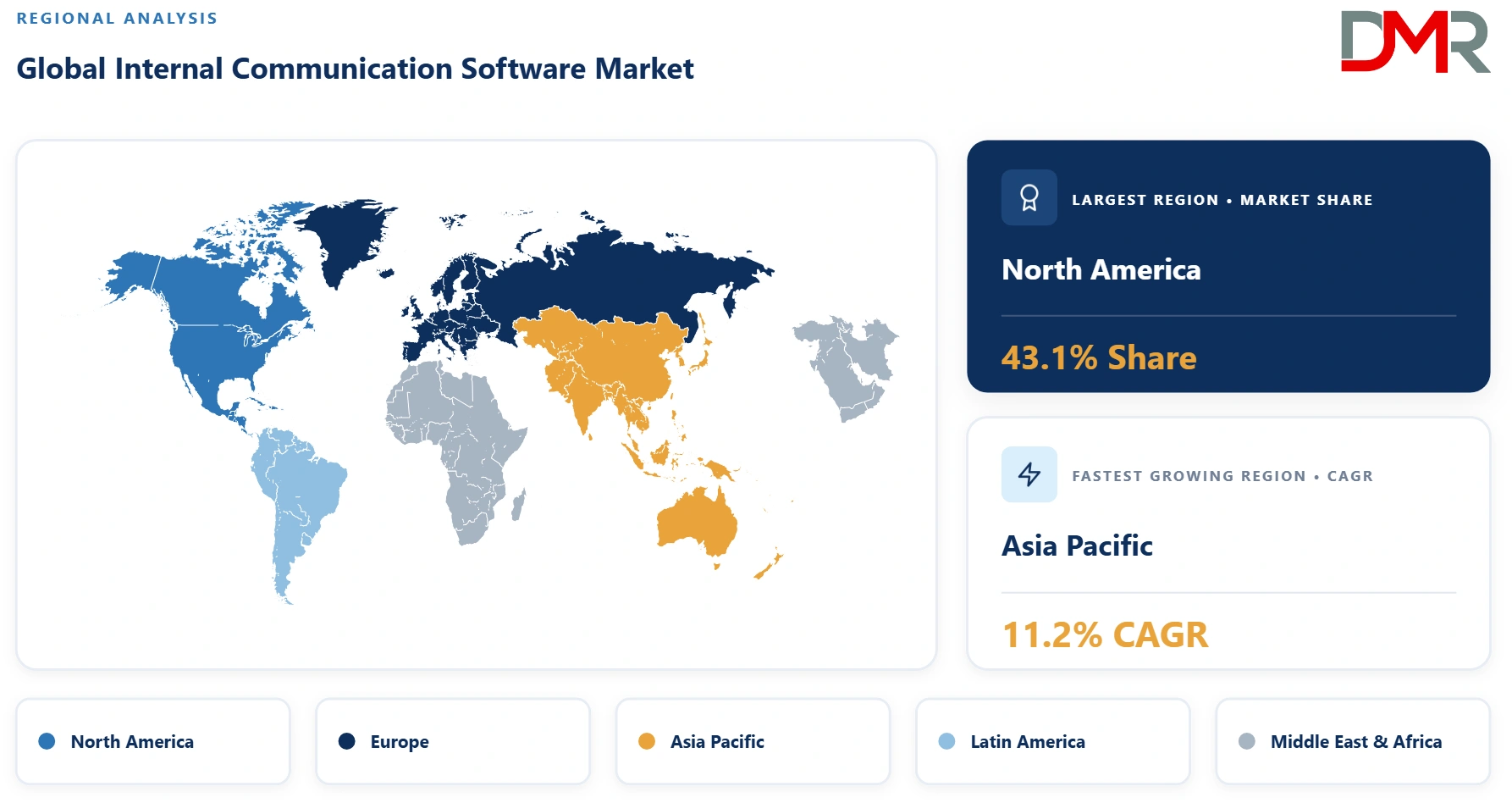
North America leads the Global Internal Communication Software Market with a market share of 43.1% in 2026, while Asia Pacific is projected to register the highest CAGR of 11.2% from 2027 to 2035.
ℹ
To learn more about this report –
Download Your Free Sample Report Here
Region with the Largest Revenue Share
North America dominates the Global Internal Communication Software Market, accounting for 43.1% of the total market share in 2026. Regional dominance is supported by established digital workplace infrastructure, widespread adoption of cloud-based enterprise applications, and substantial investments in employee experience management. The U.S. and Canada contribute to regional demand through enterprise digitalization, hybrid working arrangements, and increasing adoption of employee engagement platforms. The presence of established communication software providers supports technological innovation and product availability. Growing demand for secure information sharing, personalized communication, and integrated workplace platforms further supports regional market expansion.
Region with the Highest CAGR
Asia Pacific is projected to register the highest CAGR of 11.2% in the Global Internal Communication Software Market from 2027 to 2035. Regional growth is supported by rapid enterprise digitalization, expanding information technology infrastructure, increasing smartphone penetration, and growing adoption of cloud-based business applications. China, Japan, India, Australia, and South Korea contribute through technology investments, business expansion, and workforce modernization initiatives. Growing demand for affordable communication platforms, multilingual employee applications, and mobile-first workplace solutions supports market expansion across established and emerging regional economies.
Regional Analysis
Europe Internal Communication Software Market
The Europe Internal Communication Software Market is supported by established enterprise technology infrastructure, increasing adoption of digital workplace platforms, and growing investments in employee engagement solutions. Germany, France, the U.K., Italy, and Spain contribute to regional demand through business modernization, hybrid working arrangements, and workforce digitalization initiatives. Organizations increasingly prioritize communication platforms offering secure information management, multilingual capabilities, and compliance with data protection requirements. Growing demand for centralized employee communication and improved workforce connectivity encourages adoption of cloud-based and on-premises solutions across regional industries.
Latin America Internal Communication Software Market
The Latin America Internal Communication Software Market is supported by expanding business digitalization, increasing internet accessibility, and growing adoption of cloud-based enterprise applications. Mexico and Brazil contribute to regional demand through retail expansion, technology sector development, and modernization of business operations. Organizations increasingly adopt mobile communication platforms to improve information accessibility and workforce coordination. Growing demand for affordable software subscriptions, localized communication tools, and frontline employee engagement solutions supports commercial opportunities across regional enterprises and emerging businesses.
Middle East & Africa Internal Communication Software Market
The Middle East & Africa Internal Communication Software Market is supported by national digital transformation initiatives, expanding information technology infrastructure, and increasing investments in modern workplace technologies. Saudi Arabia, the UAE, and South Africa contribute to regional demand through enterprise modernization, government digitalization, and expanding commercial activities. Organizations increasingly prioritize centralized communication solutions to improve employee connectivity and operational coordination. Growing demand for multilingual employee applications, cloud-based communication platforms, and localized implementation services creates opportunities across established and emerging regional markets.
By Region
North America
Europe
- Germany
- France
- The U.K.
- Italy
- Spain
- Rest of Europe
Asia-Pacific
- China
- Japan
- India
- Australia
- South Korea
- Rest of APAC
Latin America
- Mexico
- Brazil
- Rest of LATAM
Middle East & Africa
- Saudi Arabia
- The UAE
- South Africa
- Rest of MEA
Regulatory Landscape
The regulatory landscape of the Global Internal Communication Software Market is influenced by data protection regulations, employee privacy requirements, information security standards, and industry-specific compliance frameworks. The General Data Protection Regulation (GDPR) and California Consumer Privacy Act (CCPA), as amended, influence the processing and storage of personal information across relevant jurisdictions. Information security standards such as ISO/IEC 27001 support secure software deployment and organizational data management. Enterprises operating in regulated industries require appropriate access controls, data encryption, audit trails, and communication retention capabilities. These requirements create opportunities for software providers offering secure cloud infrastructure, configurable user permissions, and reliable information governance capabilities.
Technology Analysis
Technological advancements in the Global Internal Communication Software Market focus on cloud computing, artificial intelligence, mobile-first applications, communication automation, and advanced employee engagement analytics. Modern platforms incorporate personalized news feeds, corporate intranets, instant messaging, automated notifications, employee surveys, and communication dashboards. Application programming interfaces facilitate integration with human resource management systems, enterprise applications, identity management platforms, and productivity software. Cloud-based infrastructure supports centralized communication management and scalable software deployment across distributed workforces. Increasing demand for accessible and efficient workplace communication encourages investment in intelligent search, automated translation, targeted content distribution, and real-time communication analytics.
Who are the Leading Companies in the Internal Communication Software Market?
The Global Internal Communication Software Market is characterized by competition among established enterprise software providers, specialized employee communication platform providers, and digital workplace technology companies. Major participants include Microsoft Corporation, Salesforce, Inc., Workvivo Limited, Staffbase GmbH, and Simpplr Inc. Competitive differentiation focuses on communication functionality, employee engagement capabilities, mobile accessibility, software integration, information security, analytics, and subscription pricing. Companies strengthen market positioning through product innovation, artificial intelligence integration, strategic partnerships, and expanded employee communication capabilities.
- Microsoft Corporation (Washington, U.S.): Provides enterprise communication solutions through Microsoft Teams, Viva Engage, and SharePoint, supporting instant messaging, organizational announcements, employee communities, and centralized information sharing.
- Salesforce, Inc. (California, U.S.): Offers workplace communication solutions through Slack, supporting real-time messaging, departmental communication channels, information sharing, workflow automation, and enterprise application integration.
- Workvivo Limited (Cork, Ireland): A Zoom-owned employee experiences software provider offering corporate communication, employee engagement, digital intranet, organizational announcements, and mobile workforce connectivity solutions.
- Staffbase GmbH (Chemnitz, Germany): Provides internal communication software supporting employee applications, corporate intranets, email newsletters, digital signage, targeted communication, and employee engagement analytics.
- Simpplr Inc. (California, U.S.): Offers employee experience and internal communication platforms supporting corporate intranets, personalized content distribution, employee engagement, intelligent search, and organizational information management.
Some of the prominent players in the Global Internal Communication Software Market are:
- Microsoft Corporation
- Salesforce, Inc.
- Workvivo Limited
- Staffbase GmbH
- Simpplr Inc.
- LumApps SAS
- Interact Software
- Firstup, Inc.
- Beekeeper AG
- Unily Ltd.
- Happeo Oy
- Haiilo GmbH
- Poppulo Limited
- Appspace, Inc.
- MangoApps Inc.
- Blink
- YOOBIC
- Claromentis Ltd.
- ThoughtFarmer
- Zoho Corporation
- Google LLC
- Cisco Systems, Inc.
- Mattermost, Inc.
- Rocket.Chat Technologies Corp.
- Lark Technologies Pte. Ltd.
- Flip GmbH
- Speakap B.V.
- theEMPLOYEEapp
- ContactMonkey Inc.
- Workshop
- PoliteMail Software
- Intranet Connections
- Igloo Software
- Jostle Corporation
- Axero Solutions, LLC
- Oak Engage Ltd.
- Powell Software
- Jamespot
- AgilityPortal
- Other Key Players
Recent Developments
- In November 2026, Staffbase GmbH announced recognition as a Leader in both the 2026 Gartner Magic Quadrants for Frontline Worker Communications Applications and Intranet Packaged Solutions. The recognition highlights the company's capabilities across employee communication, digital intranets, and frontline workforce connectivity.
- In November 2026, Firstup, Inc. introduced its Q4 2026 product release, featuring behavioral audience targeting and enhanced workforce communication capabilities. The development supports more relevant message distribution and improved visibility into employee responses to organizational communications.
- In October 2026, Staffbase GmbH announced integration with Workday Sana through agent-to-agent technology. The development supports connected employee experiences and improved access to organizational information across workplace applications.
- In August 2026, Workvivo Limited announced that its annual recurring revenue had surpassed USD 100 million. The milestone reflects expanding enterprise adoption of employee experience, internal communication, and workplace engagement solutions.
- In April 2026, LumApps SAS announced a definitive agreement to acquire Comeen, a workplace experience platform covering space management, digital signage and visitor services. The development extends LumApps' AI employee hub into workplace experience, supporting broader internal communication and employee engagement capabilities across enterprise environments.
Report Scope and Research Methodology
Definition: The Internal Communication Software Market encompasses software and services supporting employee communication, organizational announcements, corporate intranets, internal messaging, employee engagement, information sharing, and workforce connectivity across enterprise environments globally. General-purpose collaboration platforms are included only to the extent that revenue is attributable to internal communication functionality and associated services.
Methodology: Dimension Market Research's market estimation methodology combines bottom-up analysis of internal communication software provider revenues, paid subscriptions, enterprise licensing, employee adoption rates, and associated service expenditure with top-down validation against digital workplace software, enterprise communication software, and employee experience platform spending. Primary interviews with software providers, internal communication managers, human resource professionals, information technology managers, and enterprise end users support validation of pricing and adoption assumptions. Forecasts incorporate segment-level growth expectations for 2027–2035 and periodic assessment of technological advancements, enterprise requirements, competitive developments, and market conditions.
Internal Communication Software Market Report Details
| Report Characteristics |
Details |
| Market Size (2026) |
USD 13.4 Billion |
| Market Size (2027) |
USD 15.2 Billion |
| Forecast Value (2035) |
USD 30.3 Billion |
| CAGR (2027–2035) |
9.0 % |
| Historical Data |
2021–2026 |
| Forecast Data |
2027–2035 |
| Base Year |
2026 |
| Estimate Year |
2027 |
| Regional Coverage |
North America (The U.S., Canada); Europe (Germany, France, The U.K., Italy, Spain, Rest of Europe); Asia Pacific (China, Japan, India, Australia, South Korea, Rest of APAC); Latin America (Mexico, Brazil, Rest of LATAM); Middle East & Africa (Saudi Arabia, The UAE, South Africa, Rest of MEA) |
Frequently Asked Questions
How big is the Internal Communication Software Market in 2026?
▾ The Global Internal Communication Software Market is valued at USD 13.4 billion in 2026 and is projected to reach USD 30.3 billion by 2035.
What is the growth rate of the Internal Communication Software Market?
▾ The Global Internal Communication Software Market is projected to grow at a CAGR of 9.0% from 2027 to 2035.
Which region leads the Internal Communication Software Market?
▾ North America dominates the Global Internal Communication Software Market, accounting for 43.1% of the market share in 2026.
Which offering segment dominates the Internal Communication Software Market?
▾ Software dominates the offering segment of the Internal Communication Software Market, accounting for a 74.2% share in 2026.
Which end-use industry is growing fastest in the Internal Communication Software Market?
▾ Retail & E-Commerce is projected to be the fastest-growing end-use industry, registering a CAGR of 9.6% from 2027 to 2035.
Who are the key players in the Internal Communication Software Market?
▾ Key players include Microsoft Corporation, Salesforce, Inc., Workvivo Limited, Staffbase GmbH, Simpplr Inc., LumApps SAS, Interact Software, and Firstup, Inc.
What are the main challenges facing the Internal Communication Software Market?
▾ Data security concerns, employee privacy requirements, high implementation costs, and system integration complexities represent significant market challenges.