What is the IoT in Aerospace and Defense Market Size in 2026?
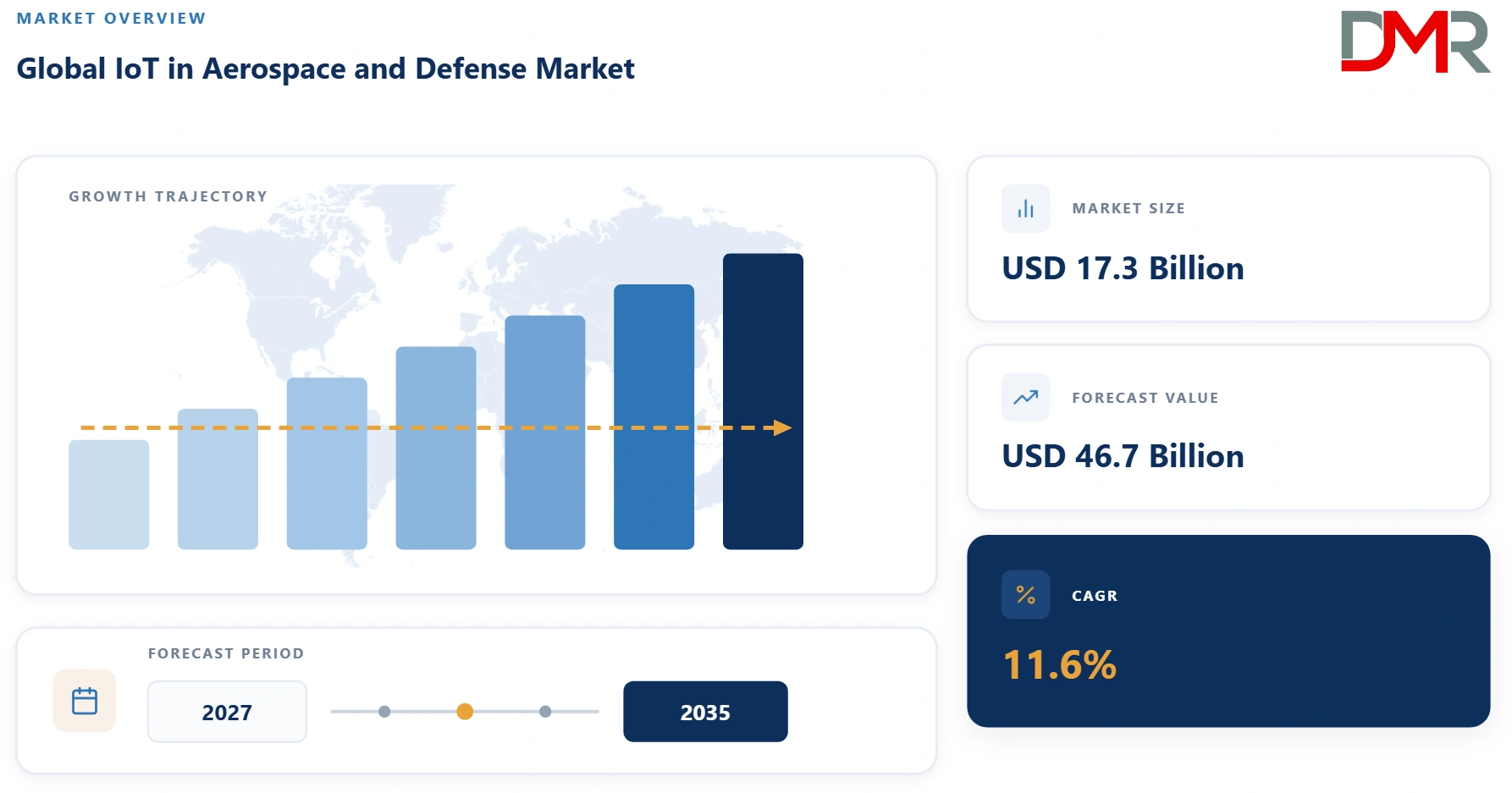
The global IoT in aerospace and defense market is valued at USD 17.3 billion in 2026 and is projected to reach USD 46.7 billion by 2035, growing at a CAGR of 11.6% from 2027 to 2035. Growth is driven by rising defense budgets and fleet modernization, demand for predictive maintenance and real-time readiness data, the spread of connected sensors across aircraft, unmanned systems and satellites, and the integration of artificial intelligence at the edge.
ℹ
To learn more about this report –
Download Your Free Sample Report Here
The IoT in aerospace and defense market comprises connected sensors, embedded devices, communication links, edge and cloud analytics, and related software and services deployed across aircraft, unmanned aerial systems, satellites, ground vehicles, naval vessels, bases, depots and supply chains. These systems collect condition, location, environmental and mission data in real time, so operators can monitor assets, predict failures, track cargo and parts, secure facilities and improve situational awareness. Revenue includes hardware, software licenses and subscriptions, connectivity services, integration and sustainment support. The definition excludes consumer IoT, general industrial IoT not installed on aerospace or defense platforms, and the platforms and weapons themselves.
The IoT in Aerospace and Defense market in this report measures the value of connected sensing, communication, analytics and related services applied to aerospace and defense operations, rather than the aircraft, satellites or weapon systems that carry them. Demand comes from air forces, armies and navies sustaining large fleets, airlines and operators running commercial aircraft, space agencies and satellite operators, and the prime contractors and suppliers that build and support these platforms. The report covers five segments across five regions, including major national markets in each.
IoT in Aerospace and Defense Market Snapshot
IoT in Aerospace and Defense Market Snapshot, 2026-2035
| Metric |
Value |
| Market Size (2026) |
USD 17.3 Billion |
| Forecast Value (2035) |
USD 46.7 Billion |
| CAGR (2027-2035) |
11.6% |
| Largest Region (2026) |
North America, 44.0% share |
| Fastest-Growing Region (2027-2035) |
Asia Pacific, 14.3% CAGR |
| Leading Component (2026) |
Hardware, 43.5% share |
| Leading Application (2026) |
Fleet Management and Asset Tracking, 28.6% share |
| Key Players |
Lockheed Martin, Northrop Grumman, RTX, Boeing, Thales, General Dynamics, Airbus, L3Harris, Leonardo |
IoT in Aerospace and Defense Market: Key Takeaways
- Market growth: The market is valued at USD 17.3 billion in 2026 and is expected to reach USD 46.7 billion by 2035, expanding at an 11.6% CAGR from 2027 to 2035.
- Component leader: Hardware holds a 43.5% share of the market in 2026, led by ruggedized sensors, telemetry units, tags, gateways, and embedded modules qualified for flight and field use.
- Fastest Component: Software is set to grow at a 14.9% CAGR through 2035, ahead of the overall market, on analytics, digital twins, fleet health platforms and AI-driven decision support.
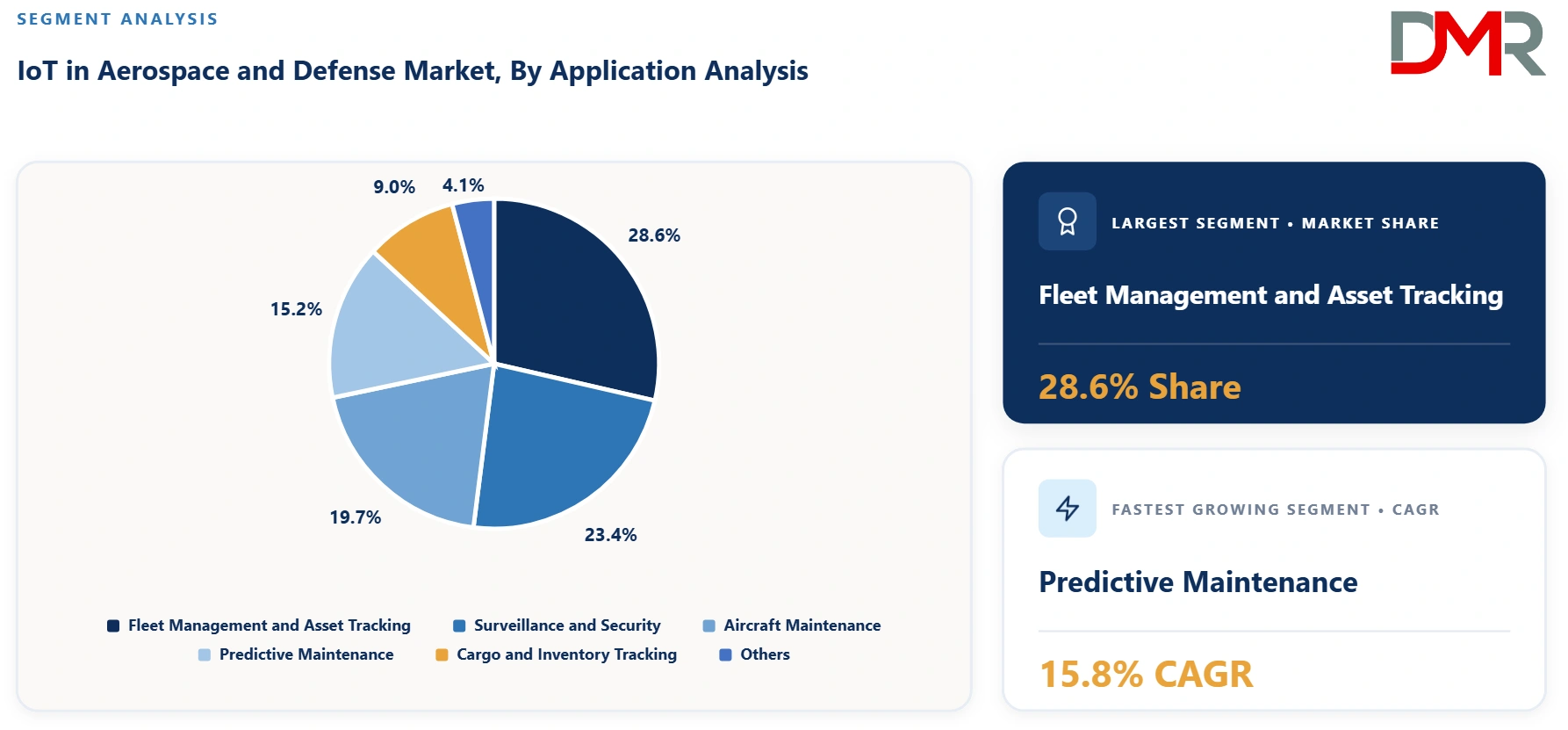
- Application Leader: Fleet Management and Asset Tracking accounts for 28.6% of 2026 demand, as operators track the health, location and utilization of aircraft, vehicles, parts and cargo.
- Fastest Application: Predictive Maintenance is projected to grow at a 15.8% CAGR, supported by sensor retrofits, engine health data, and readiness targets for aging fleets.
- Regional Picture: North America leads with a 44.0% share in 2026, while Asia Pacific is the fastest-growing region at a 14.3% CAGR.
What are the Key Use Cases of IoT in Aerospace and Defense?
- Predictive Maintenance and Asset Health Monitoring: Sensors on engines, airframes, vehicles and vessels track vibration, temperature and wear, so maintainers can fix components before they fail, raising availability and cutting unplanned downtime.
- Fleet Management and Supply Chain Visibility: Connected tags, telemetry and logistics platforms show where aircraft, spare parts and munitions are and how they are used, helping depots allocate parts and plan sustainment.
- Surveillance, Security and Situational Awareness: Networked sensors on unmanned aircraft, bases, borders and ships feed live data to command centers, improving detection, tracking and response.
- Connected Battlespace and Space Operations: Tactical networks and satellite links tie sensors, platforms and operators together, supporting joint operations and in-orbit monitoring of satellite health.
How are Foundation Models and Agentic AI Transforming the IoT in Aerospace and Defense Market?
Foundation models and agentic AI are shifting aerospace and defense IoT from collecting data to acting on it. Large models combine sensor telemetry, maintenance logs, parts records and supplier data, then explain likely failures and supply constraints in plain language to maintainers and planners. AI agents automate routine work such as sourcing, allocation, repair scheduling and customer service, as shown by GE Aerospace's use of Palantir's AI platform across parts of its supply chain. At the tactical edge, compact models run on board aircraft, drones and vehicles so they can classify sensor data when bandwidth is limited or links are jammed. Digital twins let engineers test maintenance and mission choices before applying them to real fleets. Adoption is rising as sustainment contracts bundle analytics, shifting competition toward trusted data, software and secure integration. Providers with large installed bases and long-running fleet datasets gain a clear edge, though assurance, explainability and security remain gating factors.
IoT in Aerospace and Defense Market Dynamics at a Glance
Drivers, Restraints, Opportunities and Trends in the IoT in Aerospace and Defense Market
| Type |
Factor |
Impact |
| Driver |
Defense Modernization and Rising Military Budgets |
High |
| Driver |
Predictive Maintenance and Readiness Demand |
High |
| Restraint |
Cybersecurity Risk and Compliance Burden |
High |
| Restraint |
Legacy Platforms, Integration Complexity and Long Procurement Cycles |
Medium |
| Opportunity |
Sensor Retrofits and Digital Sustainment Contracts |
High |
| Opportunity |
Space-Based and Satellite-Linked IoT |
Medium |
| Trend |
Edge AI and Agentic Sustainment |
High |
| Trend |
Zero Trust and Secure-by-Design Connectivity |
High |
What is Driving the Growth of the IoT in Aerospace and Defense Market?
Defense Modernization and Rising Military Budgets
Governments are raising defense spending and replacing aging systems with connected, data-rich platforms. NATO allies agreed in 2025 to work toward spending 5% of GDP on defense and related security by 2035, while Asia Pacific and Gulf states continue to expand and modernize their forces. Programs that stress networked sensing, joint command and control and unmanned systems all need connected devices, secure links and analytics. This sustains demand for new-build integration and for retrofits across existing fleets in every major region.
Predictive Maintenance and Readiness Demand
Militaries and airlines lose large amounts of flying time to unplanned maintenance and parts shortages, so they are turning to condition-based maintenance backed by sensor data. Engine and airframe makers now bundle digital sustainment with hardware, and defense agencies are writing analytics into support contracts. In February 2026, for example, GE Aerospace won a U.S. Defense Logistics Agency contract that applies AI-driven fleet management and supply optimization to the J85 engine that powers the Air Force's T-38 trainer. As more fleets adopt such models, spending on sensors, connectivity and software grows steadily.
What are the Key Restraints in the IoT in Aerospace and Defense Market?
Cybersecurity Risk and Compliance Burden
Every connected sensor, gateway and data link widens the attack surface of platforms that carry sensitive and sometimes classified data. Suppliers must meet strict security requirements, including DFARS clause 252.204-7012 and NIST SP 800-171 in the United States, and many buyers expect secure-by-design hardware, supply chain assurance and continuous monitoring. The Cybersecurity Maturity Model Certification program began its first phase in November 2025, and in July 2026 the Department of War suspended its Phase II third-party assessment requirement for review, leaving timelines uncertain even though underlying obligations remain. Certification, testing and accreditation add cost and delay, and they weigh most heavily on smaller suppliers and on new products seeking approval.
Legacy Platforms, Integration Complexity and Long Procurement Cycles
Many aircraft, vehicles and ships in service were designed decades ago, generate little native telemetry and use proprietary buses and closed software. Adding sensors requires airworthiness or safety approval, integration with legacy systems and careful handling of data rights between governments and contractors. Defense procurement cycles are long, budgets can shift with political priorities, and pilot projects often struggle to scale into programs of record. These factors slow adoption and lengthen the time between product development and revenue, especially outside the largest prime contractors.
What are the Key Opportunities in the IoT in Aerospace and Defense Market?
Sensor Retrofits and Digital Sustainment Contracts
Large installed fleets of aircraft, engines and vehicles offer a big opening for retrofit sensor packs, analytics and sustainment services. GE Aerospace alone reports an installed base of about 50,000 commercial and 30,000 military engines, and its expanded partnership with Palantir in March 2026 targets military aircraft readiness and its own production system. Operators prefer add-on kits that avoid replacing platforms, and performance-based support contracts reward suppliers that raise availability. Vendors able to certify retrofits, protect data rights and prove readiness gains can secure long, recurring service revenue.
Space-Based and Satellite-Linked IoT
Growing constellations and government space programs create demand for connected monitoring of satellite health, in-orbit servicing, launch operations and ground infrastructure. Satellite links also give remote aircraft, ships, border sensors and ground units connectivity where terrestrial networks are weak or contested. Defense buyers value resilient, multi-path communications, and commercial providers are adapting products for secure government use. Companies that combine low-power sensors, satellite connectivity and trusted data handling can serve both defense and commercial customers.
What are the Latest Trends in the IoT in Aerospace and Defense Market?
Edge AI and Agentic Sustainment
Aerospace and defense users are moving analytics closer to the platform and giving software agents routine decisions. Onboard processing lets aircraft, drones and vehicles detect anomalies and classify sensor data without constant links to the cloud, while agentic tools in the back office coordinate parts, repairs and scheduling. Primes, engine makers and software specialists are forming alliances to pair deep platform knowledge with AI platforms. Expect agentic features to anchor premium sustainment tiers and to drive partnerships and consolidation.
Zero Trust and Secure-by-Design Connectivity
As connected devices multiply, buyers are adopting zero trust architectures that verify every device and user rather than trusting the network. Hardware roots of trust, encrypted links, signed firmware and software bills of materials are becoming standard requirements, and secure supply chains are a selling point. Suppliers are also designing for contested environments, with resilient mesh networking and fallback links. Providers that build security into products from the start can turn compliance into a competitive advantage.
Research Scope and Analysis
The report segments the IoT in aerospace and defense market by application, component, deployment mode, connectivity technology and end use across five regions and key countries.
ℹ
To learn more about this report –
Download Your Free Sample Report Here
By Component Analysis
Hardware leads the component segment with a 43.5% share in 2026 because every deployment needs ruggedized sensors, telemetry units, tags, gateways and embedded modules qualified for flight, shock, vibration and temperature extremes. Software is the fastest-growing component, expanding at a 14.9% CAGR from 2027 to 2035 on analytics, digital twins and fleet health platforms. Services cover integration, certification support and managed sustainment, while Connectivity covers satellite, cellular and tactical network capacity sold as a service.
By Deployment Mode Analysis
Cloud-Based deployment accounts for 52.8% of 2026 revenue, helped by scalable analytics, easier collaboration between operators and suppliers, and the arrival of secure government cloud environments. Hybrid deployment grows fastest at a 15.1% CAGR through 2035, as users combine on-premises and edge processing for sensitive or disconnected operations with cloud analytics for fleet-wide insight. On-premises installations remain important for classified and air-gapped systems.
By Connectivity Technology Analysis
Satellite Communication holds the largest share of connectivity technology at 34.1% in 2026, because aircraft, ships, remote sensors and unmanned systems often operate beyond terrestrial coverage. Tactical Radio and Mesh Networks follow, supporting resilient links between units in contested environments. Cellular technologies, including 4G and 5G, grow fastest at a 15.3% CAGR between 2027 and 2035, as private 5G networks on bases, airfields and depots and 5G-based logistics tracking expand.
By Application Analysis
Fleet Management and Asset Tracking leads the application segment with a 28.6% share in 2026 because operators of large aircraft, vehicle and vessel fleets need continuous visibility of location, health and utilization, and because the payoff in availability is easy to measure. Surveillance and Security follows, using connected sensors on bases, borders and unmanned platforms. Predictive Maintenance is the fastest-growing application, expanding at a 15.8% CAGR from 2027 to 2035 as sensor retrofits, engine health data and AI diagnostics move into sustainment contracts.
By End Use Analysis
Military Aviation leads the end use segment with a 40.2% share in 2026 because air forces run large, expensive fleets with high readiness targets and sustained modernization budgets. Commercial Aviation is the second largest user, driven by connected aircraft and engine health monitoring. Space Systems and Exploration is the fastest-growing end use at a 16.4% CAGR from 2027 to 2035, as satellite constellations, launch operations and government space programs need connected monitoring. Land and Naval Defense adds steady demand for vehicle and vessel health and security systems.
How is the IoT in Aerospace and Defense Market Segmented?
By Component
- Hardware
- Software
- Services
- Connectivity
By Deployment Mode
- Cloud-Based
- On-Premises
- Hybrid
By Connectivity Technology
- Satellite Communication
- Tactical Radio and Mesh Networks
- Cellular (4G/5G)
- Wi-Fi, RFID and Others
By Application
- Fleet Management and Asset Tracking
- Surveillance and Security
- Aircraft Maintenance
- Predictive Maintenance
- Cargo and Inventory Tracking
- Others
By End Use
- Military Aviation
- Commercial Aviation
- Space Systems and Exploration
- Land and Naval Defense
Which Region Leads the IoT in Aerospace and Defense Market?
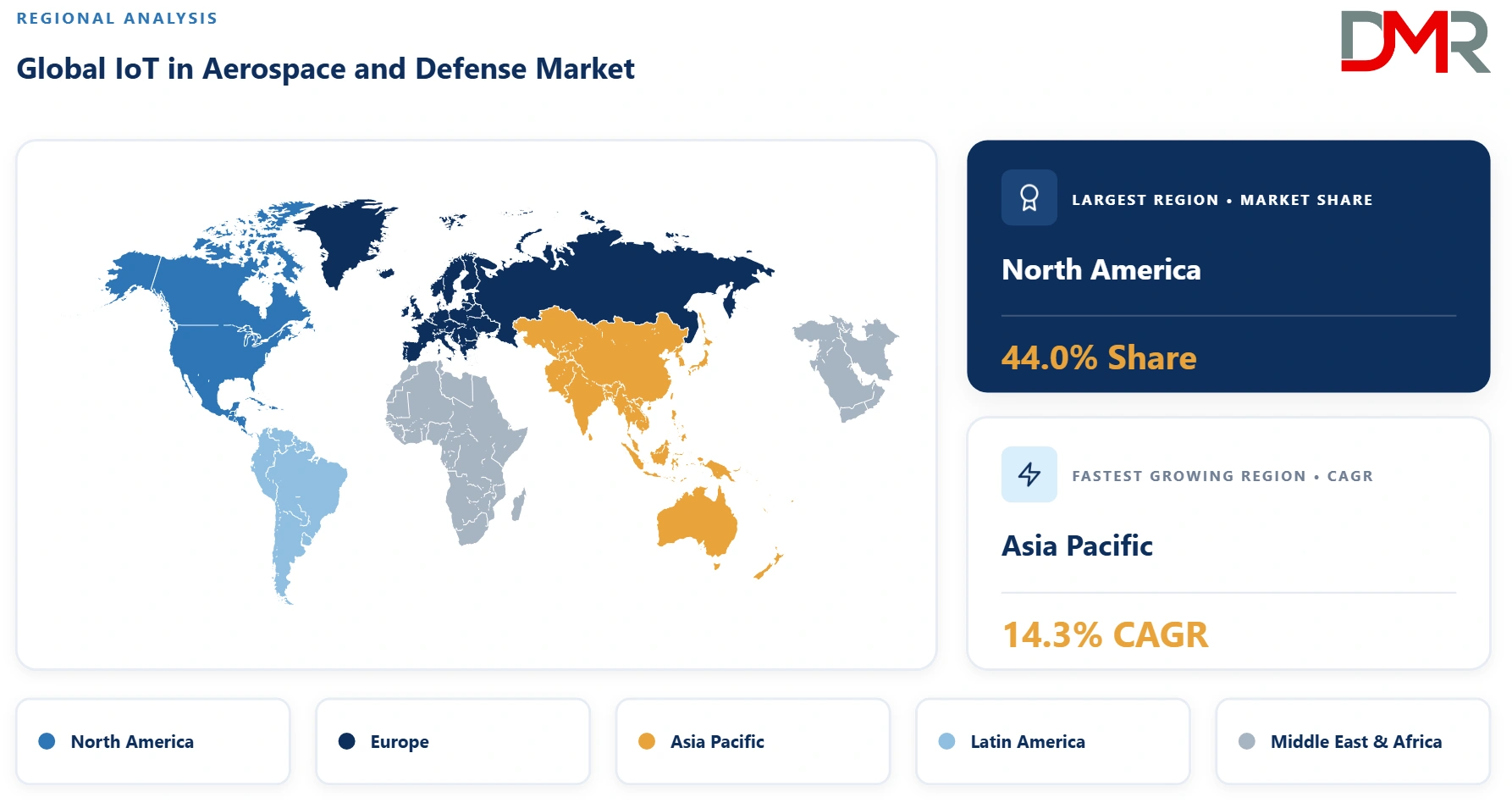
North America leads the IoT in the aerospace and defense market with a 44.0% share in 2026, while Asia Pacific is projected to grow at a 14.3% CAGR from 2027 to 2035.
Region with the Largest Revenue Share
North America accounted for 44.0% of global revenue in 2026, supported by the world's largest defense budget, a deep base of prime contractors and engine makers, and active programs in predictive maintenance, connected battlefield networks and space. The United States dominates regional sales, with companies such as Lockheed Martin, Northrop Grumman, RTX, Boeing and GE Aerospace leading, while Canada adds steady demand through fleet sustainment and space programs. Strict cybersecurity and export control rules shape procurement, but large budgets sustain growth. The region should keep the largest share despite slower expansion than Asia Pacific.
Region with the Highest CAGR (2027-2035)
Asia Pacific is projected to grow at a 14.3% CAGR from 2027 to 2035, the fastest of any region. China is expanding connected military and space capabilities, India is building domestic defense electronics and aerospace through state-owned and private firms, and Japan, South Korea and Australia are raising spending and investing in unmanned and networked systems. Local content policies favor regional suppliers and joint ventures with global primes. Rising budgets, growing fleets and new air and naval programs support adoption through 2035.
Regional Analysis
Europe IoT in Aerospace and Defense Market
Europe is the second largest market, led by the United Kingdom, France, Germany, Italy and Spain. Higher defense budgets, joint funding through the European Defence Fund and national rearmament programs are lifting demand for connected sensors, secure communications and digital sustainment. Thales, Airbus, Leonardo, BAE Systems, Safran, Saab and Rheinmetall hold strong positions, and cross-border programs push interoperability. Data sovereignty rules and NIS2 cybersecurity obligations raise compliance costs but favor trusted regional suppliers. Growth is steady, driven by fleet modernization and cooperative development projects.
ℹ
To learn more about this report –
Download Your Free Sample Report Here
Latin America IoT in Aerospace and Defense Market
Latin America is a small but developing market, led by Brazil and Mexico, with Chile, Colombia and Argentina contributing smaller volumes. Demand comes from air force and border surveillance modernization, commercial aviation maintenance and growing satellite use. Brazil has a notable aerospace industry, and regional operators increasingly seek connected maintenance and tracking tools. Limited defense budgets, currency volatility and reliance on imported systems slow adoption, yet growth is expected to be healthy from a small base, led by commercial aviation and border security.
Middle East & Africa IoT in Aerospace and Defense Market
Middle East and Africa is a smaller but strategic market led by Saudi Arabia, the UAE and South Africa, with Israel and Turkey also important within the rest of the region. Gulf states are investing heavily in modern air forces, unmanned systems and local industry, creating demand for integrated sensors and sustainment technology. In June 2026, the UAE's EDGE and Italy's Leonardo announced plans for a joint venture in defense sensors and mission systems. South Africa has an established aerospace and defense base, while many African markets depend on imported platforms and limited budgets.
By Region
North America
Europe
- Germany
- France
- The U.K.
- Italy
- Spain
- Rest of Europe
Asia-Pacific
- China
- Japan
- India
- Australia
- South Korea
- Rest of APAC
Latin America
- Mexico
- Brazil
- Rest of LATAM
Middle East & Africa
- Saudi Arabia
- The UAE
- South Africa
- Rest of MEA
Regulatory Landscape
Regulation shapes product design, data handling and who can sell to whom. In the United States, suppliers to the Department of War follow DFARS clause 252.204-7012 and NIST SP 800-171 for protecting controlled unclassified information, and the Cybersecurity Maturity Model Certification program is being phased in, although its Phase II third-party assessment requirement was suspended on 13 July 2026 pending review. Export controls such as ITAR and the Export Administration Regulations limit transfers of sensors, communications and software. Airworthiness rules and standards, including DO-326A and ED-202A on aircraft security, govern connected devices on aircraft, while spectrum and satellite licensing rules affect wireless links. In Europe, NIS2 and national data sovereignty rules apply, and NATO standardization agreements guide interoperability. Companies that invest early in certification and secure design can turn compliance into a premium advantage.
Investment and White Space Analysis
Capital and contracts are flowing toward companies that connect platform data to sustainment and readiness outcomes. GE Aerospace's February 2026 Defense Logistics Agency award for J85 engine readiness and its March 2026 expansion with Palantir show how engine makers and software firms are pairing to win digitally enabled support work, while the planned EDGE and Leonardo sensors venture cites an order pipeline of more than EUR 4 billion over five years. White space remains in retrofit kits for aging fleets, satellite-linked monitoring, cybersecurity compliance services for tier-two and tier-three suppliers, edge AI for contested environments, and fast-growing defense markets in India and the Gulf. Risks include budget and program shifts, export control limits, cybersecurity incidents, certification cost, sensor and semiconductor supply constraints, and data rights disputes. Investors should favor assets with proven fleet-level results, secure architectures and long sustainment contracts.
Who are the Leading Companies in the IoT in Aerospace and Defense Market?
The IoT in aerospace and defense market is moderately fragmented, with prime contractors, engine and avionics makers, communications and software specialists, and regional champions competing and partnering. Lockheed Martin, Northrop Grumman, RTX, Boeing, General Dynamics, Thales, Airbus, L3Harris and Leonardo build connected platforms and sensor systems, while GE Aerospace, Honeywell, Safran and Rolls-Royce add engine and avionics health data. Palantir, Cisco, IBM, Microsoft and Amazon Web Services supply analytics, networking and cloud, and Viasat and Iridium provide satellite connectivity. Differentiation increasingly depends on secure architectures, access to fleet data, AI-driven sustainment and the ability to integrate with legacy platforms. Alliances between primes, engine makers and software firms show consolidation around data-rich sustainment offers.
- Lockheed Martin Corporation (Bethesda, US): Largest US defense prime, integrating connected sensors, networks and analytics into aircraft, space and missile defense systems and sustainment programs.
- Northrop Grumman Corporation (Falls Church, US): Supplies autonomous systems, space and sensing products with a focus on digital transformation and cybersecurity for connected defense platforms.
- RTX Corporation (Arlington, US): Combines Collins Aerospace, Pratt & Whitney and Raytheon, offering connected avionics, sensors, engine health monitoring and defense electronics.
- Thales Group (Paris, France): European leader in avionics, sensors, secure communications and cybersecurity for military and civil aerospace customers.
- GE Aerospace (Evendale, US): Engine maker with an installed base of about 50,000 commercial and 30,000 military engines, using Palantir's AI platform to improve military aircraft readiness and supply chains.
Some of the prominent players in the Global IoT in Aerospace and Defense Market are:
- Lockheed Martin Corporation
- Northrop Grumman Corporation
- RTX Corporation
- The Boeing Company
- Thales Group
- General Dynamics Corporation
- Airbus SE
- L3Harris Technologies, Inc.
- Leonardo S.p.A.
- BAE Systems plc
- Honeywell International Inc.
- GE Aerospace
- Safran SA
- Rolls-Royce Holdings plc
- Saab AB
- Rheinmetall AG
- Elbit Systems Ltd.
- Kongsberg Gruppen ASA
- Hanwha Aerospace Co., Ltd.
- Mitsubishi Heavy Industries, Ltd.
- Textron Inc.
- Teledyne Technologies Incorporated
- Curtiss-Wright Corporation
- Moog Inc.
- Parker-Hannifin Corporation
- Viasat, Inc.
- Iridium Communications Inc.
- Motorola Solutions, Inc.
- Palantir Technologies Inc.
- Anduril Industries, Inc.
- General Atomics
- Cisco Systems, Inc.
- IBM Corporation
- Microsoft Corporation
- Amazon Web Services, Inc.
- Siemens AG
- Bharat Electronics Limited
- Hindustan Aeronautics Limited
- EDGE Group PJSC
- Collins Aerospace (RTX)
- Other Key Players
Recent Developments
- In February 2026, GE Aerospace was awarded a Defense Logistics Agency contract to raise U.S. Air Force J85 engine readiness, its first TrueChoice Defense digitally enabled contract, using AI-driven fleet management and supply optimization with Palantir.
- In March 2026, GE Aerospace and Palantir announced a multi-year expansion of their partnership to transform military aircraft readiness for the U.S. Air Force and operations across GE Aerospace's production system.
- In June 2026, the UAE's EDGE and Italy's Leonardo announced plans for a joint venture in advanced defense sensors and mission systems, targeting an order pipeline of more than EUR 4 billion over five years.
- In July 2026, the U.S. Department of War suspended the Phase II requirements of the Cybersecurity Maturity Model Certification program, originally due to start on 10 November 2026, while it reviews the rollout.
IoT in Aerospace and Defense Market Report Scope and Research Methodology
Market definition: IoT in aerospace and defense covers connected sensors, embedded devices, communication links, edge and cloud analytics, software and services deployed across aircraft, unmanned systems, satellites, ground vehicles, naval vessels, bases and supply chains. It excludes consumer IoT, general industrial IoT not installed on aerospace or defense platforms, and the platforms and weapons themselves.
Methodology: Dimension Market Research anchored the headline estimate to published industry sizing for IoT in aerospace and defense, then built segment and regional splits from company revenues, program spending, installed fleets and adoption patterns for each application, component, deployment mode, connectivity technology and end use, and cross-checked the result top-down against wider aerospace and defense electronics and sustainment spending. Published estimates for this market vary widely with scope, so figures here reflect the definition above. Forecasts apply segment-level growth assumptions for 2026-2035 and are reviewed at each report update.
Report Details
| Report Characteristics |
Details |
| Market Size (2026) |
USD 17.3 Billion |
| Forecast Value (2035) |
USD 46.7 Billion |
| CAGR (2027-2035) |
11.6% |
| Historical Data |
2021–2026 |
| Forecast Data |
2027–2035 |
| Base Year |
2026 |
| Estimate Year |
2027 |
| Segments Covered |
By Component, By Deployment Mode, By Connectivity Technology, By Application, By End Use |
| Regional Coverage |
North America (The US, Canada); Europe (Germany, France, The UK, Italy, Spain, Rest of Europe); Asia Pacific (China, Japan, India, Australia, South Korea, Rest of APAC); Latin America (Mexico, Brazil, Rest of LATAM); Middle East & Africa (Saudi Arabia, The UAE, South Africa, Rest of MEA) |
Frequently Asked Questions
How big is the IoT in Aerospace and Defense Market in 2026?
▾ The global IoT in aerospace and defense market is valued at about USD 17.3 billion in 2026 and is projected to reach USD 46.7 billion by 2035.
What is the growth rate of the IoT in Aerospace and Defense Market?
▾ The market is expected to grow at a CAGR of 11.6% from 2027 to 2035, driven by defense modernization, predictive maintenance, connected sensors and edge AI.
Which region leads the IoT in Aerospace and Defense Market?
▾ North America leads with a 44.0% share in 2026, while Asia Pacific is the fastest-growing region at a 14.3% CAGR over 2027 to 2035.
Which component dominates the IoT in Aerospace and Defense Market?
▾ Hardware dominates the component segment with a 43.5% share in 2026.
Which application is growing fastest in the IoT in Aerospace and Defense Market?
▾ Predictive Maintenance is the fastest-growing application at a 15.8% CAGR from 2027 to 2035, as sensor retrofits, engine health data and AI diagnostics move into sustainment contracts.
Who are the key players in the IoT in Aerospace and Defense Market?
▾ Key players include Lockheed Martin, Northrop Grumman, RTX, Boeing, Thales, General Dynamics, Airbus, L3Harris and Leonardo.
What are the main challenges facing the IoT in Aerospace and Defense Market?
▾ Main challenges include cybersecurity risk and compliance, legacy platform integration, long procurement cycles, export controls and certification costs.