Italy Medical Device Second Opinion Market Snapshot
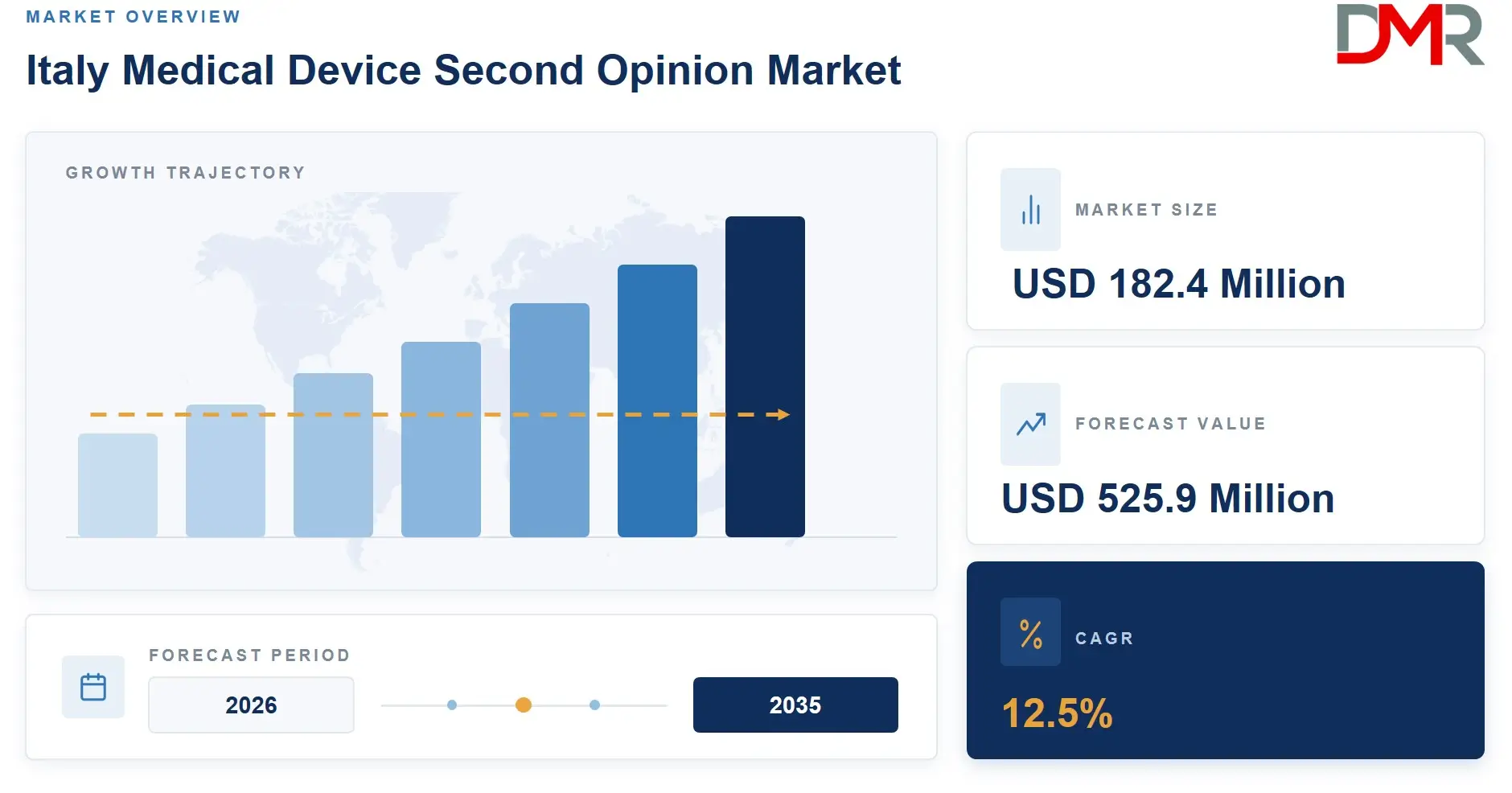
- Italy Medical Device Second Opinion Market Size in 2026: USD 182.4 Million
- Italy Medical Device Second Opinion Market Size in 2035: USD 525.9 Million
- Italy CAGR from 2026 to 2035: 12.5%
- Online/Virtual Second Opinion is the leading Service Type segment in 2026: 54.8%
- Medical Imaging & Device-Generated Data is the leading Referral Source segment in 2026: 61.3%
- Asynchronous/Store-and-Forward Review is the leading Consultation Mode segment in 2026: 49.6%
- Oncology is the leading Application segment in 2026: 36.2%
- Corporate & Employer-Sponsored Benefit Programs is the leading End-User segment in 2026: 41.7%
What is the Italy Medical Device Second Opinion and its Market Size?
The Italy Medical Second Opinion Market is projected to be valued at an estimated USD 182.4 million in 2026 and is projected to reach USD 525.9 million by 2035, expanding at a CAGR of 12.5% during the forecast period a growth rate considerably faster than Italy's broader medical device and diagnostics market, reflecting the category's still-early stage of adoption and its close alignment with the country's rapid post-pandemic shift toward digital health. A "second opinion" in this market is increasingly device- and data-driven rather than purely a face-to-face specialist consultation: the underlying clinical review is most often built around imaging and diagnostic outputs generated by medical devices CT, MRI, and ultrasound studies, digital pathology whole-slide images, cardiac diagnostic recordings, and increasingly genomic and molecular testing reports that are securely transmitted to a remote specialist or specialist panel for independent review. Growth is underpinned by expanding corporate and employer-sponsored "welfare aziendale" health benefit programs that now commonly include second opinion access as a differentiated perk, rising direct-to-consumer awareness of remote specialist access following the COVID-19-era acceleration of Italian telemedicine, and the country's long-standing north–south disparity in specialist density.
ℹ
To learn more about this report –
Download Your Free Sample Report Here
Use Cases
- Oncology Diagnosis and Treatment Plan Confirmation: Patients newly diagnosed with cancer, particularly complex or rare tumor types, submit digital pathology slides, radiology imaging, and molecular testing reports to specialist panels at leading Italian comprehensive cancer centers or international review networks to confirm diagnosis, staging, and proposed treatment pathway before committing to surgery, chemotherapy, or radiotherapy.
- Pre-Surgical Confirmation for Complex Cardiac and Orthopedic Procedures: Patients facing major elective interventions cardiac valve replacement, complex spine surgery, joint revision procedures obtain an independent specialist review of imaging and diagnostic device data before proceeding, particularly when surgery has been recommended in a lower-volume regional facility.
- Rare Disease and Pediatric Diagnostic Confirmation: Families of children with suspected rare or difficult-to-diagnose conditions seek second-opinion review from reference centers such as Ospedale Pediatrico Bambino Gesù in Rome, leveraging remote review of genomic testing, imaging, and clinical records to confirm diagnosis and avoid unnecessary travel for an initial consultation.
- Corporate Employee Benefit Utilization: Employees at large Italian and multinational companies operating in Italy access second opinion services bundled into corporate welfare and supplemental health insurance packages, most commonly for oncology, cardiology, and orthopedic diagnoses, without incurring direct out-of-pocket cost.
Key Takeaways
- Market Size: The Italy Medical Second Opinion Market is estimated at USD 182.4 million in 2026 and forecast to reach USD 525.9 million by 2035, expanding at a CAGR of 12.5%.
- Growth Outlook: Growth is sustained by expanding corporate welfare and supplemental insurance coverage of second opinion benefits, rising consumer comfort with virtual and asynchronous specialist consultation following pandemic-era telehealth adoption, and continued reliance on device-generated diagnostic data (imaging, digital pathology, cardiac diagnostics) as the clinical backbone of remote review.
- Primary Growth Drivers: Persistent north–south specialist access disparities, expansion of corporate-sponsored health benefits, rising oncology and complex-disease diagnostic volumes tied to an aging population, and growing use of AI-assisted triage and pre-review tools that improve the speed and consistency of specialist second reads.
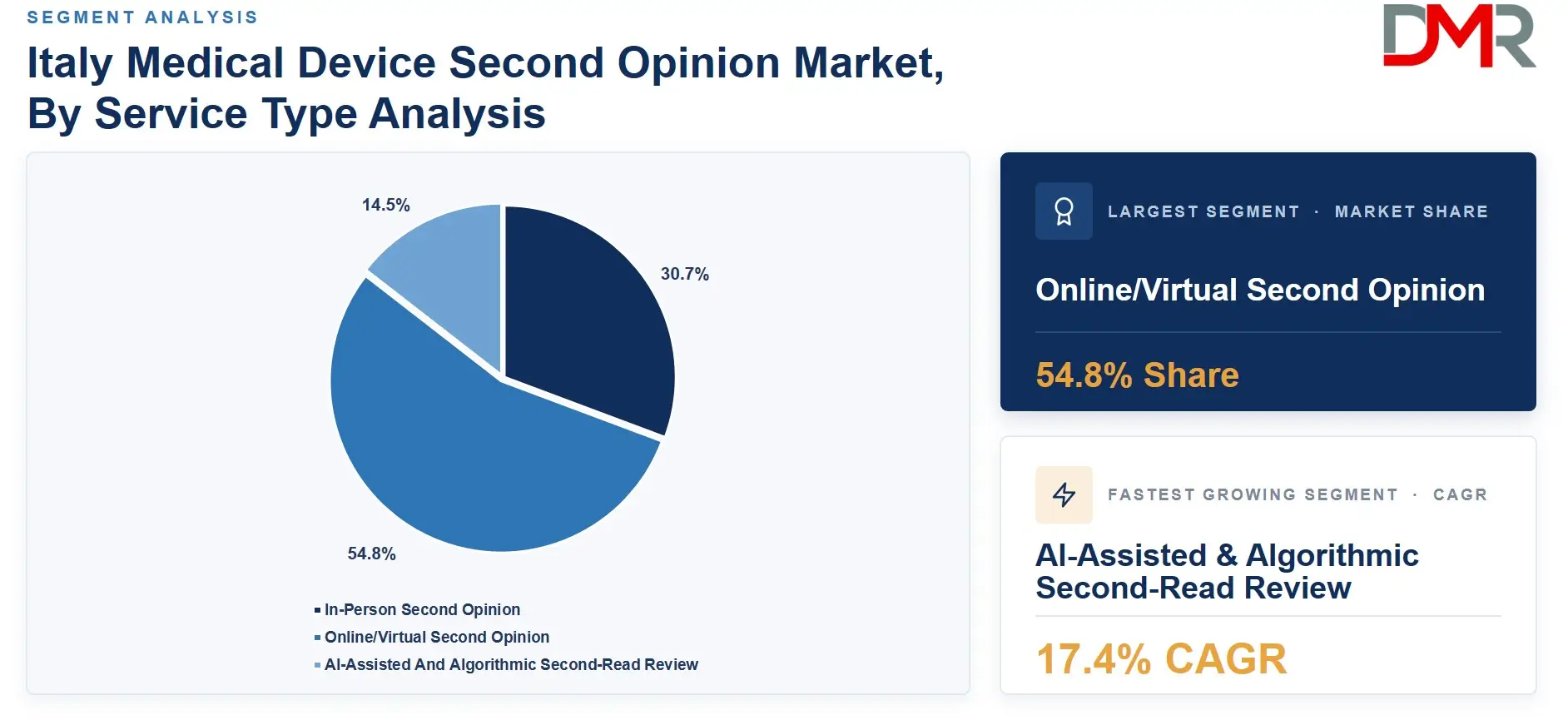
- By Service Type Analysis: Online/Virtual Second Opinion is projected to lead with a 54.8% share in 2026, reflecting the category's structural shift away from in-person-only consultation, while AI-Assisted & Algorithmic Second-Read Review is expected to post the highest CAGR at 17.4%, as AI-supported pre-screening and discrepancy-flagging tools are increasingly layered into radiology and pathology second-read workflows.
- By Referral Source Analysis: Medical Imaging & Device-Generated Data is projected to lead with a 61.3% share in 2026, underscoring that most second opinions are fundamentally reviews of diagnostic device output rather than purely clinical narrative review.
- By Consultation Mode Analysis: Asynchronous/Store-and-Forward Review is projected to lead with a 49.6% share in 2026, given its efficiency for imaging- and pathology-based review, while Hybrid models combining asynchronous data review with a live follow-up consultation are the fastest-growing mode.
- By Application Analysis: Oncology is projected to lead with a 36.2% share in 2026, while Rare & Complex Diseases is expected to see the fastest growth, reflecting the outsized value of remote specialist access for conditions with limited local diagnostic expertise.
- By End-User Analysis: Corporate & Employer-Sponsored Benefit Programs are projected to lead with a 41.7% share in 2026, while Individual Patients/Self-Pay is expected to be the fastest-growing end-user category as direct-to-consumer platform awareness increases.
How AI/Gen AI is Transforming the Medical Device Second Opinion Market?
Artificial intelligence is becoming an increasingly important layer within the Italian second opinion market, most visibly in radiology and digital pathology, where AI-enabled pre-screening tools can flag discrepancies between an original local read and likely findings before a case even reaches a human specialist reviewer, helping prioritize cases and improve reviewer efficiency. Some platforms are beginning to incorporate AI-assisted structured-report generation, converting device-generated imaging and pathology data into standardized summaries that make specialist second review faster and more consistent across reviewers. Generative AI is also being used to help translate complex specialist second-opinion reports into plain-language patient summaries, an important feature in a market that increasingly serves direct-to-consumer patients who may not have a treating physician readily available to help interpret findings.
Key Drivers in the Italy Medical Device Second Opinion Market
Persistent North–South Disparity in Specialist Access
Italy's healthcare system has long featured a well-documented disparity in specialist density and hospital quality between northern regions such as Lombardy, Veneto, and Emilia-Romagna and southern and insular regions such as Calabria, Sicily, and Sardinia, a pattern that has historically driven significant "medical migration" of patients traveling north for complex diagnosis and treatment. Remote second opinion services offer a partial digital substitute for this physical migration, allowing patients in underserved regions to access specialist review from leading northern Italian or international centers without the cost, logistical burden, and treatment delay associated with travel. This structural disparity is expected to remain a durable long-term driver of second opinion demand even as broader healthcare infrastructure investment under the PNRR narrows some regional gaps over the coming decade.
Expansion of Corporate Welfare and Supplemental Health Benefits
Employer-sponsored "welfare aziendale" benefit programs have expanded substantially in Italy in recent years, both as a tax-efficient compensation mechanism and as a competitive tool for talent retention, with supplemental health benefits including second opinion access increasingly bundled into standard packages at large domestic and multinational employers. This corporate channel has emerged as the leading end-user segment for the second opinion market, providing platforms with a scalable, low-customer-acquisition-cost distribution channel relative to direct-to-consumer marketing, and is expected to remain the primary growth engine for the category through the forecast period as benefit adoption extends from large enterprises into mid-sized companies.
Restraints in the Italy Medical Second Opinion Market
Limited Public Awareness and Trust Outside Corporate Channels
Public awareness of structured medical second-opinion services remains relatively limited in Italy, particularly among patients without employer-sponsored healthcare benefits or private insurance coverage. Many patients continue to depend on general practitioners, personal contacts, informal specialist recommendations, or direct visits to renowned hospitals rather than dedicated digital platforms. Concerns regarding physician credibility, diagnostic accuracy, service costs, and the absence of established patient relationships can further weaken trust in remote reviews. Limited consumer education and fragmented promotion restrict self-pay adoption, especially among older patients. Providers must strengthen clinical transparency, specialist verification, outcome evidence, multilingual support, and partnerships with trusted hospitals and patient associations.
Regulatory and Data-Sharing Complexity for Cross-Border and Cross-Regional Review
Second-opinion providers must manage complex requirements when transferring medical images, pathology files, cardiac recordings, genomic information, and clinical records between Italian regions or across international borders. Compliance with the General Data Protection Regulation, Italian privacy rules, cybersecurity obligations, patient consent requirements, and data-retention standards can increase operational costs. Cross-border consultations may also create uncertainty regarding physician licensing, professional liability, clinical accountability, reimbursement, and jurisdiction in cases of diagnostic disagreement. Interoperability limitations between regional health information systems further complicate secure data exchange. Platforms require robust governance, encrypted infrastructure, standardized consent procedures, qualified specialists, and clearly defined responsibilities to scale services safely and effectively.
Growth Opportunities in the Italy Medical Second Opinion Market
Integration with Regional Telemedicine Infrastructure Under the PNRR
Investment under Italy’s National Recovery and Resilience Plan is accelerating telemedicine adoption, electronic health-record development, diagnostic-system modernization, and regional healthcare digitalization. This creates opportunities for second-opinion providers to integrate with regional health information systems, hospital networks, imaging archives, and digital pathology platforms. Effective integration could simplify the secure transfer of radiology scans, cardiac recordings, genomic results, and other device-generated diagnostic data to remote specialists. Providers that support interoperability standards, GDPR-compliant information exchange, and clinician workflows could reduce review times and administrative burdens. Partnerships with regional authorities and hospitals may also expand patient access, strengthen clinical trust, and support reimbursement pathways.
Expansion into Mid-Sized Employers and Direct-to-Consumer Channels
Italy’s extensive base of small and medium-sized enterprises presents an underpenetrated opportunity for second-opinion services as employee health benefits. Providers can develop affordable subscription plans, modular coverage, and industry-specific packages for employers unable to purchase large corporate healthcare programs. Direct-to-consumer expansion also offers potential among individuals without employer or insurance coverage, particularly patients facing cancer, cardiovascular disorders, rare diseases, or complex surgical decisions. Growth will require stronger brand awareness, transparent pricing, simple record-upload processes, and verified access to recognized specialists. Partnerships with patient associations, pharmacies, diagnostic centres, brokers, and private clinics could improve credibility, generate referrals, and broaden geographic reach across Italy.
Trends in the Italy Medical Second Opinion Market
Shift Toward Asynchronous, Data-Centric Review Models
Italy’s medical second-opinion market is increasingly moving toward asynchronous review of diagnostic information rather than relying exclusively on scheduled video consultations. Specialists can examine radiology images, digital pathology slides, cardiac recordings, genomic findings, laboratory results, and clinical records at suitable times, improving reviewer productivity and access to scarce expertise. Patients benefit from fewer scheduling constraints, shorter administrative processes, and structured written recommendations that can be shared with treating physicians. The model also supports multidisciplinary evaluation of complex cases. However, providers must ensure complete data submission, standardized clinical summaries, secure transmission, appropriate turnaround times, and escalation to synchronous consultation when clarification or direct patient interaction is required.
Bundling into Broader Digital Health and Insurance Platforms
Private health insurers, employee-benefit providers, telemedicine companies, and digital health platforms in Italy are increasingly incorporating medical second opinions into broader service packages. These bundles may combine specialist review with primary teleconsultations, mental health support, chronic disease management, preventive screening, care navigation, and wellness programs. Integration improves convenience for patients and allows payers to position second opinions as tools for validating diagnoses, avoiding unnecessary procedures, and directing members toward appropriate treatment. The trend favours providers with broad clinical networks, interoperable technology, and established distribution partnerships. Standalone platforms may face competitive pressure unless they offer exceptional specialist expertise, complex-case capabilities, or differentiated diagnostic review services.
Research Scope and Analysis
The Italy Medical Second Opinion Market is segmented by service type, source of referral, mode of consultation, application, and end user, reflecting both the clinical and commercial dynamics distinguishing this market from broader teleconsultation and telemedicine categories.
By Service Type Analysis
Online/Virtual Second Opinion is projected to lead the market with an estimated 54.8% share in 2026, having become the default delivery model for the category as both corporate benefit administrators and consumers favor the convenience, lower cost, and faster turnaround of remote review over traditional in-person second consultations, which nonetheless retain a meaningful niche for cases requiring in-person physical examination alongside device-generated data review. AI-Assisted & Algorithmic Second-Read Review, while currently the smallest service-type sub-segment, is projected to expand at the fastest CAGR of 17.4% during 2026–2035, as platforms increasingly layer AI-based pre-screening, discrepancy flagging, and structured-report generation into the workflow ahead of final human specialist sign-off, improving both reviewer throughput and consistency of second-read quality across a growing volume of cases.
ℹ
To learn more about this report –
Download Your Free Sample Report Here
By Source of Referral Analysis
Medical Imaging & Device-Generated Data is projected to be the leading referral-source segment, accounting for an estimated 61.3% share in 2026, underscoring that the substantive clinical content underlying most second opinions in this market is device-generated diagnostic output radiology imaging from CT, MRI, and ultrasound systems, digital pathology whole-slide images, cardiac diagnostic recordings such as ECG and echocardiography studies, and increasingly genomic and molecular testing reports rather than clinical narrative alone. This segment's dominance reflects the fact that oncology, cardiology, and complex surgical second opinions in particular hinge on independent expert reinterpretation of existing device data rather than new physical examination.
By Mode of Consultation Analysis
Asynchronous/Store-and-Forward Review is projected to lead the consultation-mode segmentation with an estimated 49.6% share in 2026, reflecting its efficiency for imaging- and pathology-heavy cases where a specialist reviewer can conduct a thorough independent review of submitted device data and clinical records on their own schedule before delivering a written report, without requiring real-time coordination between patient, treating physician, and reviewing specialist across potentially different regions or time zones. Hybrid models combining an initial asynchronous specialist review of device-generated data with a subsequent live video consultation to discuss findings are the fastest-growing consultation mode, increasingly favored by both corporate benefit platforms and premium direct-to-consumer offerings as a way to combine reviewer efficiency with patient-facing engagement quality.
By Application Analysis
Oncology is projected to lead the application segmentation with an estimated 36.2% share in 2026, reflecting both the high clinical stakes of cancer diagnosis and treatment planning and the relatively high patient and payer willingness to fund confirmatory specialist review given the consequences of misdiagnosis or a suboptimal treatment pathway. Rare & Complex Diseases, while a comparatively small share of overall segment revenue in 2026, is projected to be the fastest-growing application category, reflecting the outsized relative value of remote access to reference-center expertise for conditions where local diagnostic capability may be limited, particularly benefiting patients and families served by national reference centers such as Bambino Gesù for pediatric rare disease diagnosis.
By End User Analysis
Corporate & Employer-Sponsored Benefit Programs are projected to lead end-user segmentation with an estimated 41.7% share in 2026, reflecting the scale and growth of Italian welfare aziendale benefit adoption as the primary distribution channel through which most patients currently first encounter formal second opinion services. Individual Patients/Self-Pay, while currently a smaller share of overall end-user revenue, is projected to be the fastest-growing end-user category as direct-to-consumer platform awareness expands and as patients increasingly seek independent confirmatory review for high-stakes diagnoses even when it falls outside employer or insurance-sponsored coverage.
The Italy Medical Device Second Opinion Market Report is segmented based on the following:
By Service Type
- In-Person Second Opinion
- Online/Virtual Second Opinion
- AI-Assisted And Algorithmic Second-Read Review
By Source of Referral
- Medical Imaging And Device-Generated Data
- Radiology
- Digital Pathology
- Cardiac Diagnostics
- Genomic And Molecular Testing
- Clinical Records And Physician Referral
By Mode Of Consultation
- Synchronous Video Consultation
- Asynchronous/Store-And-Forward Review
- Hybrid Consultation
By Application
- Oncology
- Cardiology
- Orthopedics
- Neurology
- Rare And Complex Diseases
- Others
By End User
- Individual Patients/Self-Pay
- Corporate Benefit Programs
- Insurance Companies
- Hospitals And Health Systems
Regulatory Landscape
Italy’s medical device-enabled second opinion market is shaped by GDPR, national privacy rules, EU medical device regulations, telemedicine guidance, and professional licensing requirements. Platforms reviewing radiology, digital pathology, cardiac, or genomic data must ensure lawful consent, secure transmission, data minimization, clinical accountability, and transparent algorithm use. Opportunities arise from alignment with PNRR-funded digital health infrastructure and regional electronic health systems. However, fragmented regional implementation, cross-border data restrictions, cybersecurity exposure, and uncertainty surrounding liability for conflicting diagnoses may delay expansion. Providers with compliant workflows, verified specialists, auditable AI systems, and strong hospital partnerships can build trust, accelerate procurement, and gain a durable competitive advantage.
Technology Analysis
Technology is transforming Italy’s medical second opinion market through cloud-based image exchange, digital pathology, remote cardiac-data interpretation, genomic analysis, AI-assisted second reads, and interoperable clinical platforms. Asynchronous review models enable specialists to assess complex diagnostic files efficiently, improving access and turnaround times across regions. Opportunities include integration with hospital imaging archives, electronic health records, telemedicine systems, and insurer platforms supported by PNRR investment. Key risks include algorithmic bias, inaccurate or incomplete data, cybersecurity breaches, limited system interoperability, and clinician resistance to automated recommendations. Providers combining validated AI tools with specialist oversight, standardized data ingestion, explainable outputs, and secure infrastructure can improve diagnostic confidence, scalability, and market differentiation.
Competitive Landscape
The Italy Medical Second Opinion Market includes a mix of international second-opinion and digital health platforms with established Italian or European commercial operations, domestic teleradiology and telepathology networks, and hospital-affiliated second-opinion programs run by leading Italian centers of excellence. International players with global second-opinion and virtual care networks maintain commercial presence targeting Italian corporate and insurance channels, while domestic teleradiology providers and leading hospital groups such as Humanitas, San Raffaele Hospital, and Bambino Gesù support both formal second-opinion programs and informal referral-based confirmatory review for complex cases. Italian private health insurers increasingly partner with or build in-house second-opinion capabilities as part of broader supplemental health and digital health benefit packages.
Some of the prominent players in the Italy Medical Device Second Opinion Market are:
- Teladoc Health
- MediOrbis
- Global Second Opinion
- Medigo
- Mobi Doctor
- Doctors in Italy
- Pyllola
- Medishare Telemedicine
- UPMC Italy
- Humanitas
- Gruppo San Donato
- Policlinico Universitario Agostino Gemelli
- Istituto Europeo di Oncologia
- Istituto Clinico Humanitas
- IRCCS Ospedale San Raffaele
- Istituto Auxologico Italiano
- Allianz Partners
- Generali Welion
- UniSalute
- AXA Partners
- Bupa Global
- Aon
- Siemens Healthineers
- GE HealthCare
- Philips
- Fujifilm Healthcare
- Agfa HealthCare
- Dedalus Group
- Reply
- Engineering Ingegneria Informatica
- Lunit
- Aidoc
- Qure.ai
- Gleamer
- Ibex Medical Analytics
- Aiforia Technologies
- Paige
- PathAI
- Tempus AI
- SOPHiA GENETICS
- Other Key Players
Recent Developments
- January 2026: Italian medical societies issued new guidance supporting AI-based mammography triage to determine which screening examinations require single or double radiologist reading. The development expands the role of algorithmic second-read systems in diagnostic workflows.
- January 2026: Tuscany advanced plans for a regional digital pathology network connecting hospitals and enabling remote slide review, standardized reporting, specialist collaboration, and future AI integration. The network establishes infrastructure for pathology-based second opinions across institutions.
- January 2025: Aiforia was selected for a three-year initiative to deliver AI-assisted diagnostic solutions supporting the digitalization of anatomical pathology laboratories across 31 Lombardy health authorities. The project strengthens Italy’s capacity for remote pathology review and algorithm-supported second reads.
Report Details
| Report Characteristics |
| Market Size (2026) |
USD 182.4 Million |
| Forecast Value (2035) |
USD 525.9 Million |
| CAGR (2026–2035) |
12.5% |
| Historical Data |
2021 – 2025 |
| Forecast Data |
2026 – 2035 |
| Base Year |
2025 |
| Segments Covered |
By Service Type, By Source of Referral, By Mode of Consultation, By Application, and By End User |
| Country Coverage |
Italy |
Frequently Asked Questions
How big is the Italy Medical Second Opinion Market?
▾ The Italy Medical Second Opinion Market is estimated at USD 182.4 million in 2026 and is projected to reach USD 525.9 million by 2035, reflecting rapid growth from a still-early adoption base driven primarily by corporate benefit expansion and rising oncology and complex-disease diagnostic volumes.
What is the CAGR of the Italy Medical Second Opinion Market from 2026 to 2035?
▾ The market is projected to expand at a CAGR of 12.5% between 2026 and 2035, a considerably faster pace than Italy's broader medical device market, reflecting the category's early-stage growth trajectory.
What factors are driving the growth of the Italy Medical Second Opinion Market?
▾ Growth is driven by Italy's persistent north–south disparity in specialist access, expanding corporate welfare and supplemental insurance coverage of second opinion benefits, rising oncology and complex disease diagnostic volumes tied to an aging population, and growing use of AI-assisted tools to improve second-read speed and consistency.
What are the major trends in the Italy Medical Second Opinion Market?
▾ Major trends include a structural shift toward asynchronous, device-data-centric review models over live-only consultation, and the bundling of second opinion access into broader corporate digital health and supplemental insurance platforms rather than being sold as a standalone service.
Who are the key players in the Italy Medical Second Opinion Market?
▾ Key participants include international virtual second-opinion platforms with Italian/European operations, domestic teleradiology and telepathology networks, hospital-affiliated second-opinion programs at centers such as Humanitas, San Raffaele Hospital, and Bambino Gesù, and Italian private health insurers offering second opinion as a supplemental benefit.
How is the Italy Medical Second Opinion Market segmented?
▾ The market is segmented by service type, source of referral, mode of consultation, application, and end user, with the segmentation structured around the fact that most second opinions in this market are fundamentally independent specialist reviews of medical-device-generated diagnostic data.