Global Janitorial Software Market Snapshot
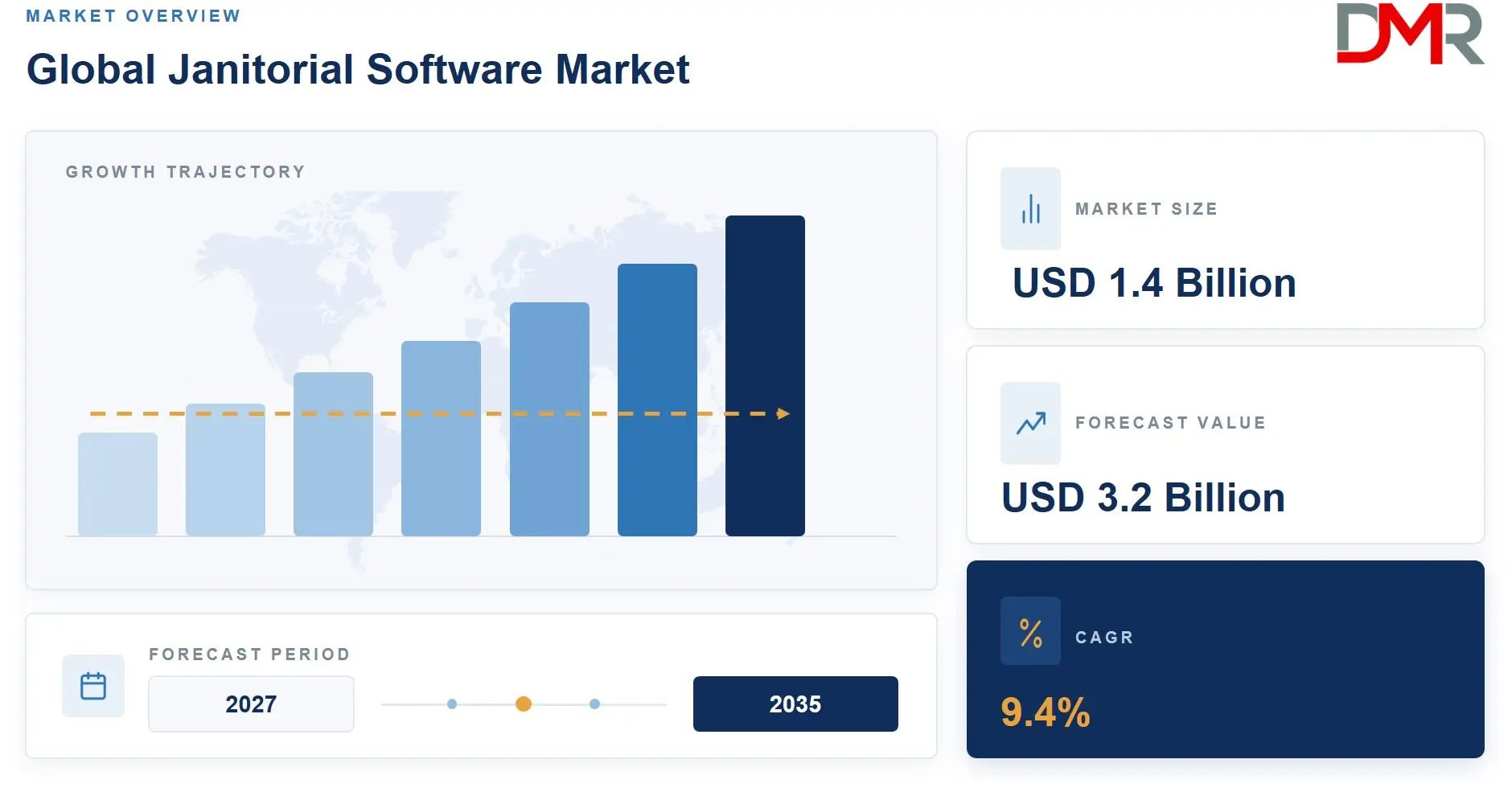
- Global Janitorial Software Market Size in 2026: USD 1.4 billion
- Global Janitorial Software Market Size in 2035: USD 3.2 billion
- Global CAGR from 2027 to 2035: 9.4%
- Cloud-Based is the leading Deployment Mode segment in 2026: 68.0%
- Janitorial Management Software is the leading Software Type segment in 2026: 30.0%
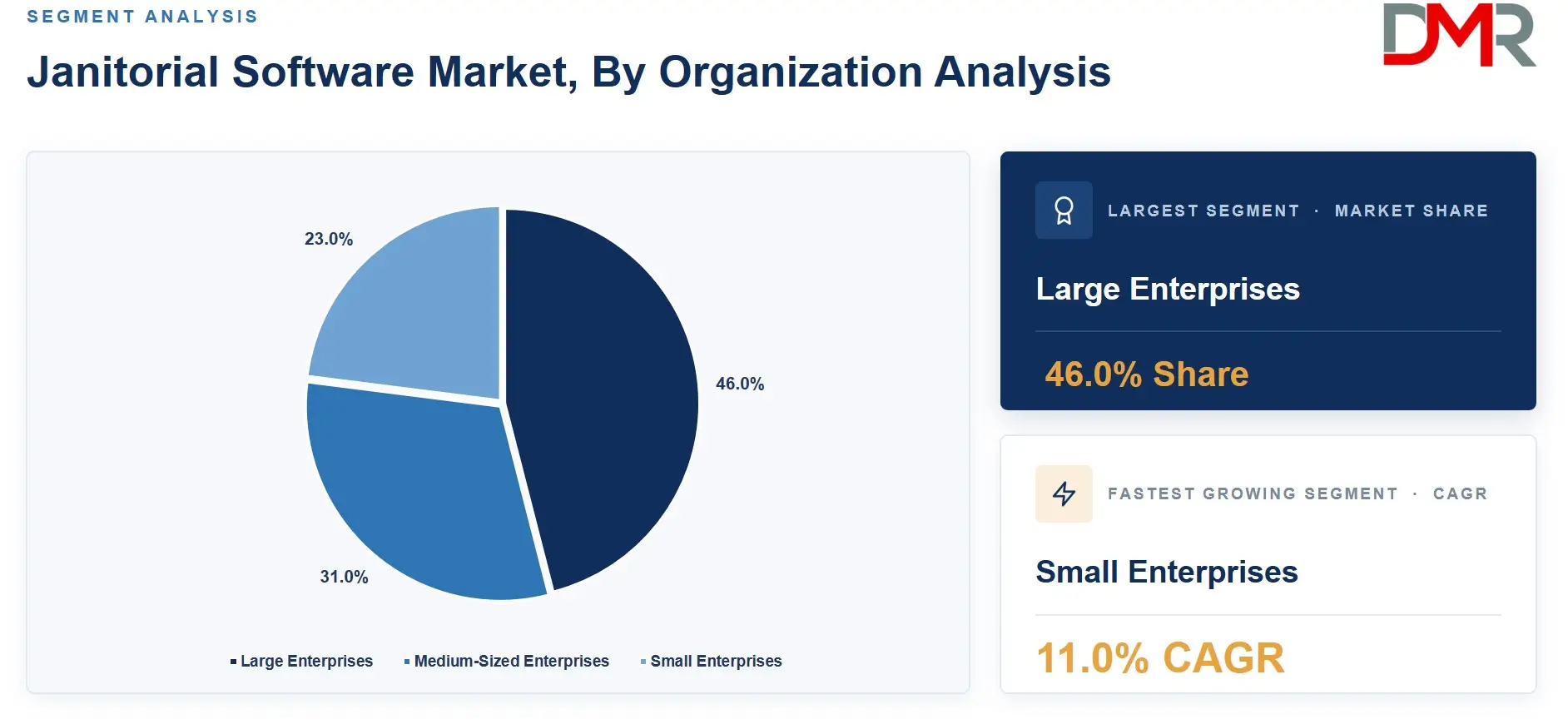
- Large Enterprises is the leading Organization Size segment in 2026: 46.0%
- Cleaning Operations Management is the leading Application segment in 2026: 34.0%
- Commercial Buildings and Offices is the leading End User segment in 2026: 32.0%
- Healthcare Facilities is the fastest-growing End User segment: 11.5% CAGR
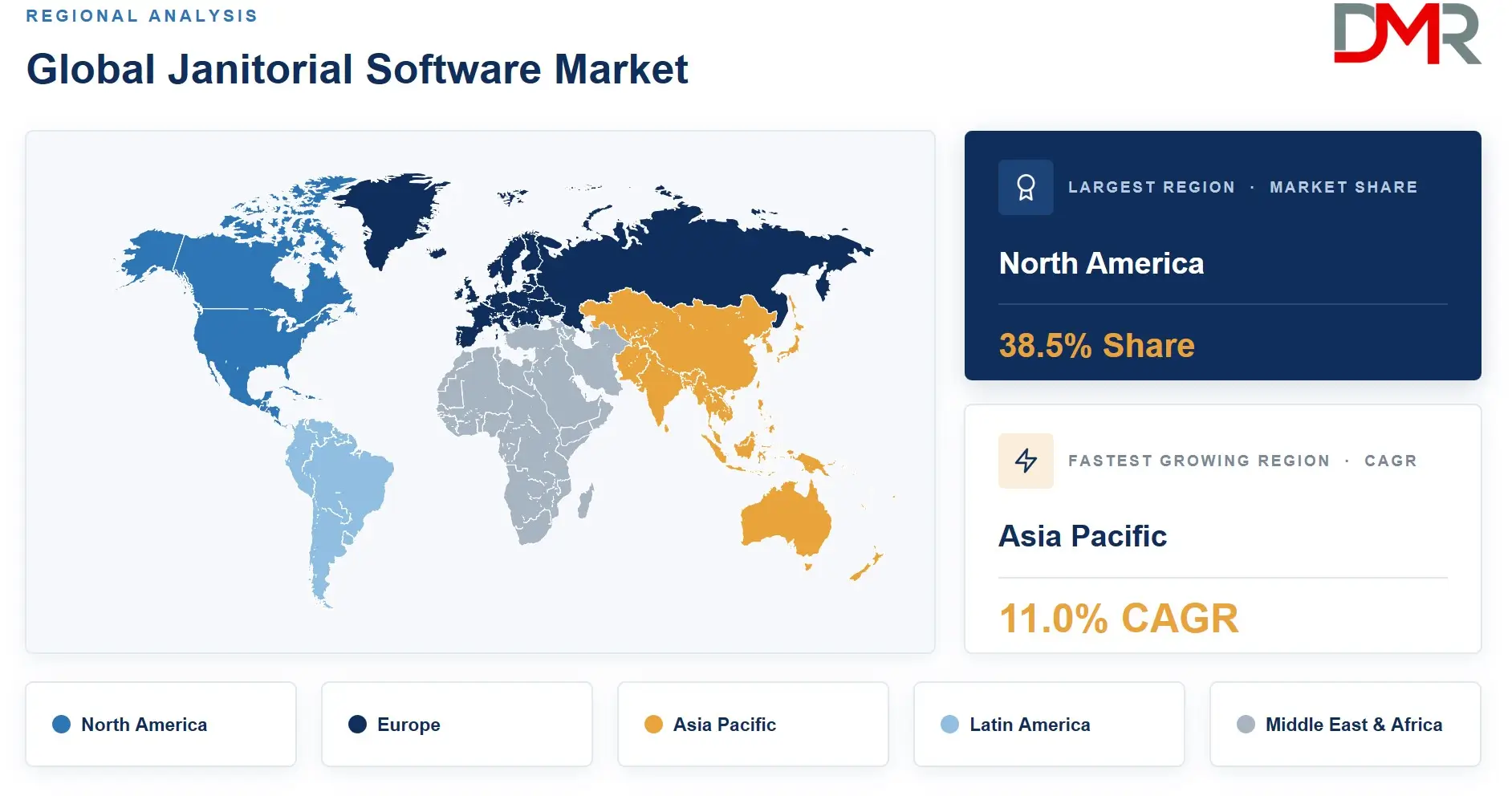
- North America is the leading Region in 2026: 38.5%
- Asia-Pacific is the fastest-growing Region: 11.0% CAGR
What is the Global Janitorial Software and its Market Size?
The Global Janitorial Software Market is projected to be valued at approximately USD 1.4 billion in 2026 and is anticipated to reach USD 3.2 billion by 2035, registering a CAGR of 9.4% during the forecast period. The market comprises specialized digital platforms designed to streamline cleaning operations, manage janitorial workforces, schedule cleaning activities, monitor service quality, maintain inventory, and coordinate contracts across commercial and institutional facilities.
ℹ
To learn more about this report –
Download Your Free Sample Report Here
Growth is primarily supported by increasing outsourcing of commercial cleaning services, rising labor costs, expanding commercial infrastructure, and the growing requirement for measurable cleaning performance. Organizations are transitioning from paper-based schedules, spreadsheets, and disconnected administrative systems toward integrated cloud-based platforms that provide real-time operational visibility. Furthermore, mobile workforce applications, artificial intelligence, automated inspection systems, and IoT-enabled facility monitoring are expanding the functional capabilities of janitorial software.
The increasing complexity of multi-location cleaning contracts is also encouraging facility management companies to implement centralized platforms for employee scheduling, attendance tracking, task allocation, service verification, and billing. Healthcare facilities, educational institutions, hospitality establishments, industrial sites, and corporate offices are increasingly adopting these solutions to maintain consistent cleaning standards and operational accountability. The growing availability of subscription-based software is additionally making digital solutions accessible to small and medium-sized cleaning contractors.
Use Cases
- Cleaning Operations Management: Centralizes cleaning schedules, task allocation, service frequencies, and daily operational workflows across multiple facilities.
- Workforce Scheduling and Attendance: Coordinates employee shifts, tracks attendance, manages labor allocation, and monitors workforce productivity.
- Inspection and Quality Control: Digitizes cleaning inspections, records deficiencies, generates corrective actions, and maintains service-quality documentation.
- Inventory and Supply Management: Tracks cleaning chemicals, consumables, equipment, stock availability, and replenishment requirements across operating locations.
- Contract and Billing Management: Automates client contracts, service documentation, invoicing, cost calculations, and recurring payment administration.
- Compliance and Facility Reporting: Maintains audit records, cleaning logs, safety documentation, and performance reports for regulated environments.
Key Takeaways
- Market Size: The Global Janitorial Software Market is estimated at USD 1.4 billion in 2026 and is projected to reach USD 3.2 billion by 2035.
- Growth Rate: The market is expected to expand at a CAGR of 9.4% during 2027–2035.
- Key Drivers: Increasing commercial cleaning outsourcing, rising labor costs, and growing demand for automated workforce management are supporting adoption.
- Leading Segments: Cloud-based deployment, janitorial management software, large enterprises, and cleaning operations management represent the dominant segments.
- Fastest-Growing Segment: Cloud-based platforms are expected to expand at approximately 11.8% CAGR as organizations increasingly adopt subscription-based digital solutions.
- Regional Leadership: North America leads the global market with an estimated 38.5% share in 2026, while Asia-Pacific is projected to register the fastest regional growth.
How AI/Gen AI is Transforming the Janitorial Software Market?
Artificial intelligence, cloud computing, IoT, and mobile technologies are transforming janitorial software from basic scheduling applications into integrated operational management platforms. AI-enabled solutions support automated task allocation, workload forecasting, cleaning frequency optimization, and anomaly identification through operational data. Cloud infrastructure enables centralized access to cleaning schedules, workforce information, contracts, and inspection records across multiple locations. IoT sensors and connected dispensers can provide information about restroom occupancy, consumable levels, and facility usage, allowing cleaning teams to respond to actual requirements rather than relying exclusively on fixed schedules.
These technologies improve operational efficiency by reducing manual administrative work, minimizing unnecessary cleaning activities, and optimizing workforce deployment. Mobile applications allow supervisors to assign tasks, verify attendance, capture inspection photographs, and receive completion notifications in real time. Cloud-based dashboards improve communication between cleaning contractors and facility managers, while automated reporting strengthens accountability and service transparency. Predictive analytics can also help organizations anticipate inventory requirements and identify recurring operational deficiencies, supporting better resource utilization and cost control.
Key Drivers
Increasing Outsourcing of Commercial Cleaning and Facility Management Services
The increasing outsourcing of commercial cleaning services is a major factor supporting the adoption of janitorial software across developed and emerging economies. Businesses are increasingly engaging specialized cleaning contractors to manage daily sanitation, housekeeping, floor maintenance, and facility hygiene requirements rather than maintaining entirely internal cleaning departments. This creates operational complexity for service providers managing multiple contracts, geographically distributed facilities, and large frontline workforces. Janitorial software helps contractors coordinate employee schedules, allocate cleaning assignments, monitor service completion, and maintain customer-specific service records through centralized platforms. Additionally, the expansion of integrated facility management contracts is increasing the requirement for standardized reporting and performance monitoring. Software solutions allow contractors to demonstrate contractual compliance, track service-level agreements, and generate operational reports for clients. As cleaning service providers expand their geographic coverage and contract portfolios, demand for scalable workforce and operations management platforms is expected to increase.
Rising Labor Costs and Demand for Operational Efficiency
Increasing labor expenses and persistent workforce management challenges are encouraging cleaning contractors and facility operators to adopt digital management systems. Cleaning services are labor-intensive, requiring careful coordination of employee availability, shift schedules, attendance, transportation, and site-specific responsibilities. Manual administration can create scheduling inefficiencies, unnecessary overtime, missed cleaning assignments, and difficulties in verifying completed work. Janitorial software addresses these challenges through automated scheduling, digital attendance records, mobile task allocation, and productivity reporting. These capabilities enable supervisors to identify underutilized labor resources, distribute workloads more effectively, and monitor service delivery across multiple locations. Furthermore, rising customer expectations for consistent service quality are encouraging contractors to adopt performance-based operational models. The ability to connect labor hours with completed tasks and contractual requirements makes software adoption increasingly relevant for cleaning businesses seeking to improve margins and operational accountability.
Restraints
High Initial Implementation Costs and Integration Complexity
The implementation of comprehensive janitorial software can involve significant financial and operational commitments, particularly for small cleaning contractors with limited technology budgets. Expenses may include subscription charges, implementation services, employee training, customization, data migration, mobile devices, and integration with payroll, accounting, and facility management platforms. Businesses operating through spreadsheets or basic scheduling applications may also face difficulties transferring historical employee, customer, inventory, and contract information into new systems. Integration becomes more complicated when customers require compatibility with multiple enterprise platforms or proprietary facility management systems. Additionally, organizations with geographically dispersed workforces must ensure consistent connectivity, device availability, and user adoption. These factors can extend implementation timelines and increase the overall cost of digital transformation. Consequently, smaller service providers may postpone software investments or choose limited-functionality solutions, restricting the adoption of advanced platforms.
Resistance to Digital Adoption and Frontline Workforce Challenges
Resistance to technological adoption among frontline cleaning employees and operational supervisors represents another important market restraint. Many janitorial service providers employ workers with varying levels of digital literacy, making the transition from paper-based instructions and manual attendance records to mobile applications challenging. Employees may also perceive digital monitoring, GPS-based attendance, and task verification systems as additional supervision rather than productivity-enhancing tools. Inconsistent smartphone availability, language barriers, unreliable internet connectivity, and insufficient training can further reduce adoption rates. For cleaning contractors managing large temporary or contract-based workforces, maintaining consistent application usage across different facilities can be difficult. Moreover, concerns regarding employee location tracking, personal information, and data security may create resistance to certain monitoring functionalities. Software providers must therefore invest in intuitive interfaces, multilingual capabilities, offline functionality, and structured onboarding programs to improve adoption.
Growth Opportunities
Expansion of Cloud-Based and Mobile-First Janitorial Software
The increasing availability of cloud-based software presents significant opportunities for vendors targeting small and medium-sized cleaning contractors. Traditional on-premises systems often require infrastructure investment, technical maintenance, and dedicated IT resources, making them less accessible to smaller organizations. Subscription-based SaaS platforms reduce these requirements by offering browser-based access, centralized data management, automatic software updates, and flexible user licensing. Mobile-first applications further allow cleaning employees and supervisors to access schedules, attendance records, work orders, and inspection forms directly from smartphones. Vendors can introduce tiered subscription models that allow businesses to begin with essential scheduling and workforce management functions before expanding into inventory, billing, analytics, and contract administration. This creates opportunities for recurring revenue while increasing customer retention. Emerging economies, where smaller cleaning businesses are progressively adopting digital business tools, offer additional potential for affordable cloud-based platforms.
Integration of AI, IoT, and Predictive Cleaning Management
The integration of artificial intelligence and IoT technologies offers opportunities to develop more intelligent janitorial management platforms. Conventional cleaning schedules generally follow predetermined frequencies, even when actual facility usage varies throughout the day. Connected occupancy sensors, restroom monitoring systems, smart dispensers, and building management technologies can provide real-time information about cleaning requirements and consumable availability. Janitorial software can use these inputs to prioritize cleaning assignments, optimize workforce deployment, and generate replenishment alerts. AI-enabled analytics can additionally identify recurring quality issues, forecast labor requirements, and support predictive inventory planning. These capabilities are particularly relevant for airports, hospitals, shopping centers, corporate campuses, and large educational facilities with variable footfall. Software vendors capable of integrating with building automation systems and third-party facility platforms can differentiate their offerings through data-driven cleaning management and measurable operational improvements.
Trends
Increasing Adoption of AI-Enabled Workforce and Workflow Automation
Janitorial software providers are increasingly incorporating AI-enabled capabilities into scheduling, task assignment, reporting, and operational analytics. Automated workflows can reduce repetitive administrative activities while helping supervisors identify missed assignments, inefficient labor distribution, and recurring service deficiencies. Vendors are also developing more intelligent reporting tools that convert operational records into actionable insights. As customers demand measurable productivity improvements, AI functionality is becoming an increasingly important competitive differentiator.
Shift Toward Outcome-Based and Sensor-Driven Cleaning
Cleaning organizations are gradually moving beyond fixed-frequency cleaning schedules toward demand-based service delivery. IoT-enabled occupancy sensors, smart restroom dispensers, and connected facility equipment can help determine when cleaning activities are required. This approach supports better resource allocation and reduces unnecessary cleaning interventions. Growing interest in sustainability, chemical consumption optimization, and operational efficiency is encouraging vendors to integrate sensor data and automated service verification into janitorial platforms.
Research Scope and Analysis
The Global Janitorial Software Market is segmented by Deployment Mode, Software Type, Organization Size, Application, and End User. The analysis evaluates software adoption patterns, operational requirements, technology preferences, and purchasing behavior across different customer categories.
ℹ
To learn more about this report –
Download Your Free Sample Report Here
By Deployment Mode Analysis
Cloud-Based deployment is expected to dominate the Deployment Mode segment, accounting for approximately 68.0% of the global market in 2026. Its leadership is supported by flexible subscription models, lower infrastructure requirements, centralized data access, and simplified software updates. Cleaning contractors managing geographically distributed employees and multiple customer facilities increasingly prefer cloud platforms because they enable real-time scheduling, attendance monitoring, task allocation, and performance reporting through web and mobile applications. On-Premises deployment is estimated to represent the second-largest share of approximately 32.0%, supported by organizations requiring greater control over internal infrastructure, data storage, and system customization. However, Cloud-Based deployment is also expected to be the fastest-growing sub-segment, registering approximately 11.8% CAGR during 2027–2035. Increasing SaaS adoption, mobile workforce management, remote supervision, and integration with third-party enterprise systems will continue supporting its growth. The availability of scalable subscription packages is also encouraging smaller cleaning contractors to adopt cloud-based solutions.
By Software Type Analysis
Janitorial Management Software is expected to dominate the Software Type segment, accounting for approximately 30.0% of the global market in 2026. Its leadership is attributed to its comprehensive functionality, including cleaning schedules, task allocation, service documentation, employee coordination, and operational monitoring. These platforms provide centralized control over daily cleaning activities and help contractors maintain consistency across multiple customer locations. Work Order Management Software is estimated to represent the second-largest share at approximately 22.0%, supported by increasing demand for digital task assignment, service requests, and work completion tracking. Workforce and Scheduling Management Software is projected to be the fastest-growing sub-segment, registering an estimated CAGR of 11.3% during 2027–2035. Rising labor expenses, employee availability challenges, multi-site contract management, and increasing demand for automated attendance tracking are encouraging adoption. Integration with mobile applications, payroll systems, and employee communication platforms is further strengthening demand for specialized workforce management capabilities.
By Organization Analysis
Large Enterprises are expected to dominate the Organization Size segment, accounting for approximately 46.0% of the global market in 2026. Their leadership is supported by extensive facility portfolios, large cleaning workforces, complex service contracts, and greater financial capacity to invest in integrated digital management platforms. Large cleaning contractors and facility management companies require centralized systems to coordinate employee scheduling, contract administration, inventory procurement, inspection reporting, and service-level monitoring across geographically distributed operations. Medium-Sized Enterprises are estimated to hold the second-largest share of approximately 31.0%, reflecting their increasing adoption of specialized software to improve operational efficiency and customer management. Small Enterprises are projected to be the fastest-growing sub-segment, registering an estimated CAGR of 11.0% during 2027–2035. Affordable SaaS subscriptions, simplified mobile applications, flexible licensing, and reduced IT infrastructure requirements are making digital platforms increasingly accessible to smaller cleaning businesses. Growing competition and customer expectations for digital service documentation are further encouraging adoption among smaller contractors.
By Application Analysis
Cleaning Operations Management is projected to dominate the Application segment, accounting for approximately 34.0% of the global market in 2026. This leadership reflects the central importance of scheduling cleaning activities, allocating personnel, managing site-specific requirements, and monitoring daily service completion. Commercial cleaning contractors and institutional facility operators increasingly depend on centralized platforms to coordinate recurring tasks across multiple buildings and shifts. Staff and Workforce Management is estimated to represent the second-largest share at approximately 25.0%, driven by the labor-intensive nature of janitorial services and the requirement for attendance, scheduling, and productivity monitoring. Compliance and Inspection Management is expected to be the fastest-growing application, registering an estimated CAGR of 11.7% during 2027–2035. Increasing demand for auditable cleaning records, standardized inspection procedures, corrective action tracking, and digital quality verification is supporting adoption. Healthcare facilities, food-related establishments, airports, and other high-traffic environments are particularly important demand sources for these capabilities.
By End User Analysis
Commercial Buildings and Offices are expected to dominate the End User segment, accounting for approximately 32.0% of the global market in 2026. Corporate offices, business parks, commercial complexes, and multi-tenant properties require recurring cleaning services, workforce coordination, and consistent service-quality monitoring. The increasing outsourcing of commercial cleaning operations and adoption of integrated facility management contracts are strengthening software demand among these customers. Healthcare Facilities are estimated to represent the second-largest share of approximately 22.0%, reflecting their extensive cleaning documentation, hygiene monitoring, and inspection requirements. Healthcare Facilities are also projected to be the fastest-growing end-user sub-segment, registering an estimated CAGR of 11.5% during 2027–2035. Hospitals, outpatient centers, diagnostic facilities, and long-term care institutions require detailed cleaning schedules, documented service completion, and traceable inspection records. Increasing attention to infection prevention, environmental hygiene, and standardized operational procedures is expected to support greater adoption of specialized janitorial management platforms.
The Global Janitorial Software Market Report is segmented on the basis of the following:
By Deployment Mode
By Software Type
- Janitorial Management Software
- Work Order Management Software
- Inspection and Quality Control Software
- Inventory and Supply Management Software
- Workforce and Scheduling Management Software
By Organization Size
- Small Enterprises
- Medium-Sized Enterprises
- Large Enterprises
By Application
- Cleaning Operations Management
- Staff and Workforce Management
- Asset and Equipment Management
- Compliance and Inspection Management
- Billing and Contract Management
By End User
- Commercial Buildings and Offices
- Healthcare Facilities
- Educational Institutions
- Hospitality and Retail
- Industrial and Manufacturing Facilities
Regional Analysis
North America is the Leading Region in the Global Janitorial Software Market
North America is expected to maintain its leading position in the Global Janitorial Software Market, accounting for approximately 38.5% of the global market in 2026, equivalent to USD 546.7 million. The region benefits from an established commercial cleaning industry, extensive outsourcing of facility management services, relatively high labor costs, and widespread enterprise software adoption. The United States represents the largest individual country market within the region, supported by large commercial real estate portfolios, healthcare infrastructure, educational facilities, and industrial establishments. Demand is further supported by the increasing adoption of cloud-based workforce management platforms, mobile inspection applications, automated reporting, and integrated facility management technologies. The presence of established software providers and a mature SaaS ecosystem also contributes to regional market leadership.
ℹ
To learn more about this report –
Download Your Free Sample Report Here
Asia Pacific is the Fastest-Growing Region in the Global Janitorial Software Market
Asia-Pacific is projected to be the fastest-growing regional market, registering an estimated CAGR of 11.0% during 2027–2035. The region's growth is supported by rapid urbanization, expansion of commercial real estate, increasing construction of healthcare and educational facilities, and the growing professionalization of outsourced cleaning services. China, India, Japan, South Korea, and Australia represent important demand centers with varying levels of software maturity. The increasing adoption of smartphones, cloud platforms, digital payment systems, and enterprise management applications is creating favorable conditions for janitorial software adoption. Additionally, rising labor expenses in developed Asian economies and increasing institutional hygiene requirements are encouraging service providers to automate workforce management and operational reporting. Affordable SaaS solutions are expected to further expand adoption among small and medium-sized cleaning contractors.
The Europe Janitorial Software Market
The Europe Janitorial Software Market is estimated to reach approximately USD 383.4 million in 2026 and is projected to expand to around USD 780 million by 2035, registering an estimated CAGR of 8.2%. Growth is supported by an established commercial cleaning industry, stringent workplace and building hygiene requirements, and increasing demand for digitally documented facility services. Germany, the United Kingdom, France, Denmark, and the Netherlands represent important markets. European software adoption is increasingly influenced by workforce scheduling requirements, digital quality inspections, payroll integration, and sustainability-focused cleaning practices. The expansion of integrated facility management platforms and acquisitions among specialized cleaning software providers are also strengthening the regional competitive landscape.
Latin America Janitorial Software Market
The Latin America Janitorial Software Market is estimated at approximately USD 82.4 million in 2026 and is projected to reach USD 190 million by 2035, registering an estimated CAGR of 9.7%. Brazil and Mexico represent the major demand centers, supported by commercial infrastructure development, expanding hospitality establishments, healthcare investments, and the growth of outsourced facility services. Increasing smartphone penetration and cloud software availability are encouraging cleaning contractors to replace manual scheduling and administrative processes. Demand is also supported by growing interest in digital invoicing, workforce attendance monitoring, and centralized contract administration. However, price sensitivity and differences in digital infrastructure across countries may influence adoption rates.
MEA Janitorial Software Market
The Middle East and Africa Janitorial Software Market is estimated to reach USD 66.7 million in 2026 and is projected to expand to approximately USD 210 million by 2035, registering an estimated CAGR of 13.6%. Growth is primarily supported by commercial construction, tourism infrastructure, hospitality development, healthcare investments, and large-scale facility management contracts. Saudi Arabia and the UAE are important demand centers, with growing commercial real estate portfolios and infrastructure development programs creating opportunities for digital cleaning management. Large public infrastructure projects, airports, shopping centers, and hospitality facilities increasingly require centralized workforce coordination, inspection documentation, and operational reporting. Cloud-based software and mobile applications are expected to support adoption among regional service providers.
Major Countries Analysis
United States Janitorial Software Market
The United States Janitorial Software Market is estimated to reach approximately USD 410 million in 2026 and is projected to expand to USD 830 million by 2035, registering an estimated CAGR of 8.2%. Growth is supported by a mature commercial cleaning industry, high labor expenses, extensive facility management outsourcing, and widespread adoption of enterprise SaaS platforms. Demand is particularly strong among commercial cleaning contractors, healthcare operators, educational institutions, and multi-location businesses. Integration with payroll, accounting, workforce scheduling, and facility management platforms is increasingly influencing purchasing decisions.
Japan Janitorial Software Market
The Japan Janitorial Software Market is estimated to reach approximately USD 78 million in 2026 and is projected to reach USD 150 million by 2035, registering an estimated CAGR of 7.5%. Growth is supported by labor shortages, an aging workforce, rising automation requirements, and the need to improve productivity across commercial and institutional cleaning operations. Increasing adoption of mobile workforce applications, cloud-based facility management systems, robotics integration, and automated inspection technologies is creating opportunities for specialized software providers. Hospitals, offices, hotels, and transportation facilities represent important application areas.
Saudi Arabia Janitorial Software Market
The Saudi Arabia Janitorial Software Market is estimated at approximately USD 26 million in 2026 and is projected to reach USD 70 million by 2035, registering an estimated CAGR of 11.6%. Growth is supported by commercial infrastructure development, hospitality expansion, healthcare investments, and large-scale construction projects associated with economic diversification initiatives. Increasing demand for outsourced facility management, digital workforce coordination, automated cleaning schedules, and centralized service reporting is encouraging software adoption. Smart building investments and technology-enabled facility operations are expected to further support market expansion.
Technology Analysis
Technology development in the Global Janitorial Software Market is centered on artificial intelligence, cloud computing, mobile workforce applications, IoT integration, and predictive analytics. AI-enabled scheduling can optimize employee allocation and cleaning frequencies, while cloud infrastructure allows centralized management of geographically distributed facilities. IoT-enabled sensors provide information about occupancy, restroom usage, and consumable availability, supporting demand-based cleaning operations. Mobile applications are becoming essential for attendance verification, digital inspections, task completion records, and supervisor communication. Software vendors are increasingly integrating these capabilities with enterprise resource planning, payroll, accounting, and building management systems. Future technology differentiation is expected to depend on interoperability, predictive capabilities, data security, and the ability to generate measurable operational efficiencies.
Investment Analysis
Investment activity in the Global Janitorial Software Market is increasingly focused on cloud-based platforms, workforce automation, AI-enabled analytics, and integrated facility management solutions. Software developers are prioritizing recurring SaaS revenue models, mobile workforce applications, and interoperability with payroll, accounting, and building management systems. Significant white-space opportunities exist in emerging economies, where small and medium-sized cleaning contractors remain dependent on spreadsheets and manual administration. Additional opportunities include multilingual applications, affordable subscription packages, automated quality inspections, and digital contract management solutions. Investors and software providers can also target healthcare, hospitality, airports, and large commercial facilities requiring specialized compliance documentation. However, customer acquisition costs, employee adoption challenges, cybersecurity requirements, and competition from broader facility management platforms remain important investment considerations.
By Region
North America
Europe
- Germany
- France
- The U.K.
- Italy
- Spain
- Rest of Europe
Asia-Pacific
- China
- Japan
- India
- Australia
- South Korea
- Rest of APAC
Latin America
- Mexico
- Brazil
- Rest of LATAM
Middle East & Africa
- Saudi Arabia
- The UAE
- South Africa
- Rest of MEA
Competitive Landscape
The Global Janitorial Software Market is characterized by a fragmented and moderately competitive vendor ecosystem, comprising specialized janitorial software developers, workforce management providers, and broader field service management platforms. Competition is influenced by software functionality, subscription pricing, mobile accessibility, customization capabilities, integration flexibility, and customer support. Specialized providers such as Janitorial Manager, CleanTelligent, Swept, and zvoove Clean focus on cleaning-specific operational requirements, while broader platforms such as Jobber and ServiceTitan compete through scheduling, customer management, invoicing, and workforce coordination capabilities. Market participants are increasingly prioritizing SaaS expansion, AI integration, product innovation, strategic acquisitions, and geographic expansion. Acquisitions are particularly important for established vendors seeking to consolidate regional customer bases and expand their functionality. The ability to provide scalable, user-friendly, and integrated solutions is expected to remain a key competitive differentiator.
Some of the prominent players in the Global Janitorial Software Market are:
- ServiceTitan
- Housecall Pro
- Jobber
- Swept Technologies
- Janitorial Manager
- CleanGuru
- Clean Smarts
- CleanTelligent Software
- Service Autopilot
- Chronotek Pro
- Novagems
- Otuvy
- Pancomp
- WorkWave
- Connecteam
- ServiceM8
- Focus Softnet
- V3 Smart Technologies
- TRAX Analytics
- Optisolve
- CleanManager
- ZenMaid
- Fieldcamp
- Genic Teams
- OrangeQC
- Team Software
- WinTeam
- Smart Service
- Service Fusion
- Workiz
- MaintainX
- FMX
- UpKeep
- GoAudits
- Smart Inspect
- Cinch Janitorial Software
- Method:Me
- CleanBid
- freshOps
- JaniBid
- Other Key Players
Recent Developments
- In March 2026, zvoove Group acquired KleanApp, a German commercial cleaning software provider, strengthening its zvoove Clean portfolio with digital quality inspections, audits, ticketing, and workforce time-tracking capabilities.
- In October 2025, zvoove acquired German payroll specialist adata, expanding its cloud ERP capabilities for facility management and cleaning service businesses through integrated payroll and workforce administration functionalities.
- In September 2025, zvoove acquired Plan4Flex to strengthen its presence in the Dutch market and expand its software capabilities for workforce planning and labor-intensive service industries.
- In August 2025, zvoove acquired Danish SaaS provider CleanManager, expanding its presence across Scandinavia and the UK while strengthening its cleaning software portfolio through scheduling, time tracking, and operational management capabilities.
- In May 2025, zvoove acquired Dutch ERP provider Nocore, strengthening its European cleaning industry software portfolio and expanding integrated enterprise resource planning capabilities for commercial cleaning businesses.
Report Details
| Report Characteristics |
| Market Size (2026) |
USD 1.4 Bn |
| Forecast Value (2035) |
USD 3.2 Bn |
| CAGR (2027–2035) |
9.4% |
| The US Market Size (2026) |
USD 410 Mn |
| Historical Data |
2021 – 2025 |
| Forecast Data |
2027 – 2035 |
| Base Year |
2025 |
| Segments Covered |
By Deployment Mode, By Software Type, By Organization Size, By Application, By End User |
| Regional Coverage |
North America – The US and Canada; Europe – Germany, France, The UK, Italy, Spain, Rest of Europe; Asia-Pacific – China, Japan, India, Australia, South Korea, Rest of APAC; Latin America – Mexico, Brazil, Rest of LATAM; Middle East & Africa – Saudi Arabia, The UAE, South Africa, Rest of MEA |
Frequently Asked Questions
What is the Global Janitorial Software Market size in 2026?
▾ The Global Janitorial Software Market is estimated to reach USD 1.4 billion in 2026, supported by increasing digitalization of commercial cleaning operations.
What will be the Global Janitorial Software Market size by 2035?
▾ The Global Janitorial Software Market is projected to reach approximately USD 3.2 billion by 2035, driven by increasing adoption of integrated cleaning management platforms.
What is the expected CAGR of the Global Janitorial Software Market?
▾ The Global Janitorial Software Market is expected to register a CAGR of approximately 9.4% during the 2027–2035 forecast period.
What are the major growth drivers of the Global Janitorial Software Market?
▾ Increasing commercial cleaning outsourcing, rising labor expenses, workforce automation, and growing demand for digital service documentation are major growth drivers.
What are the key trends in the Global Janitorial Software Market?
▾ AI-enabled scheduling, cloud-based platforms, mobile workforce applications, IoT integration, predictive analytics, and automated quality inspections are important emerging trends.
Which region dominates the Global Janitorial Software Market?
▾ North America dominates the Global Janitorial Software Market with an estimated 38.5% share in 2026, supported by mature cleaning services and enterprise software adoption.
Which region is expected to grow fastest in the Global Janitorial Software Market?
▾ Asia-Pacific is projected to be the fastest-growing region in the Global Janitorial Software Market, registering approximately 11.0% CAGR during 2027–2035.
Who are the key players in the Global Janitorial Software Market?
▾ Key players in the Global Janitorial Software Market include CleanTelligent, Swept, Jobber, ServiceTitan, Clean Guru, Chronotek Pro, and more.