What is the Japan 5G Infrastructure Market Size?
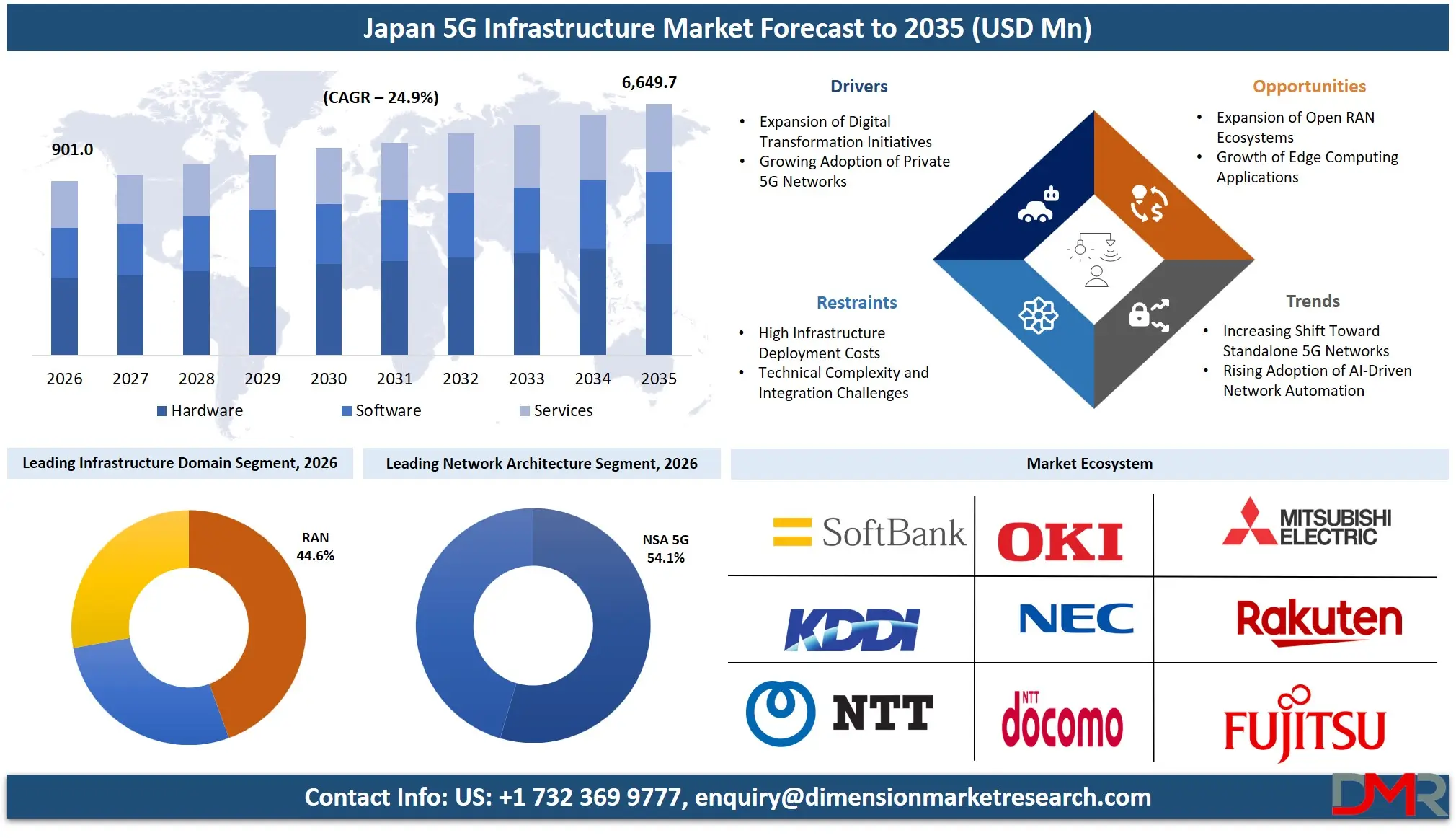
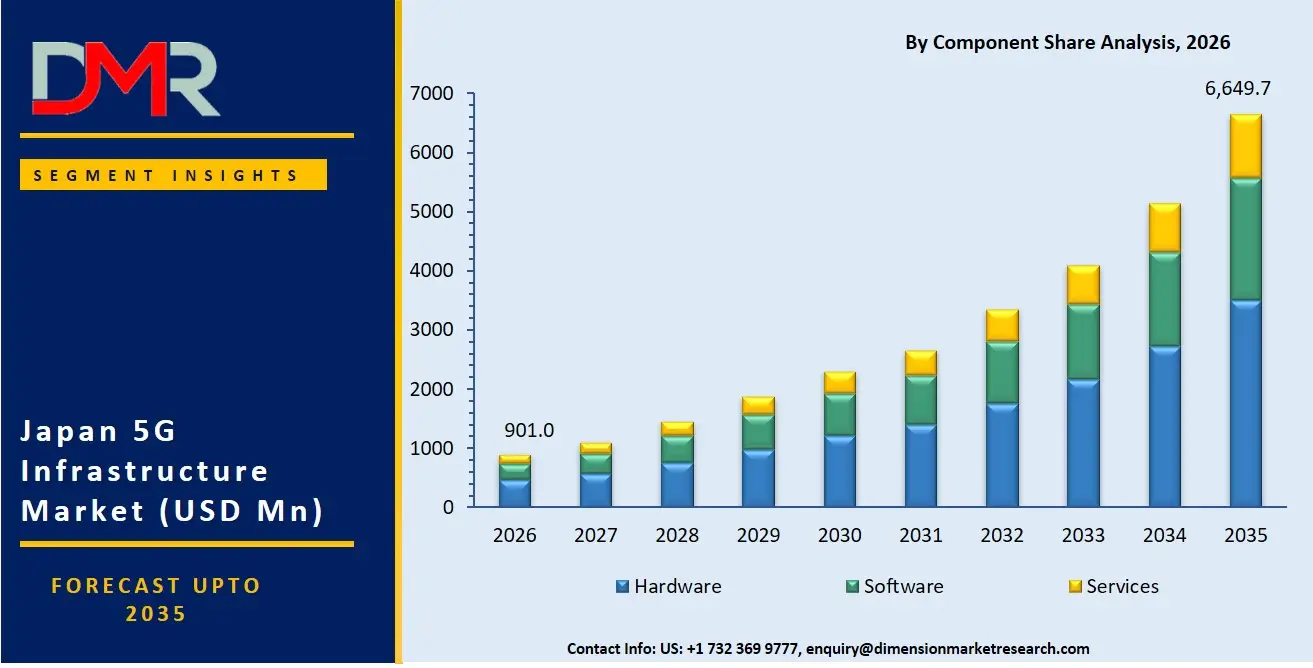
The Japan 5G Infrastructure Market size is expected to be USD 901.0 million in 2026 and increase at a compound annual growth rate of 24.9% to USD 6,649.7 million in 2035 owing to expanding digital transformation efforts.
ℹ
To learn more about this report –
Download Your Free Sample Report Here
Japan 5G infrastructure consists of all those components of hardware, software, and services that facilitate the implementation of fifth-generation wireless network infrastructure in both private and public communication spheres. The market consists of radio access network infrastructure, cloud native core network infrastructure, transport and backhaul infrastructure, management and orchestration software solutions, and deployment services. These are important for facilitating high connectivity, industrial digitization, smart cities projects, and new generations of consumer-oriented services. The increased implementation of standalone architecture, network virtualization, private 5G infrastructure, Open RAN solutions, and edge computing will further change infrastructure development.
Key Takeaways
- Market Size & Forecast: The Japan 5G Infrastructure Market size is projected to reach USD 901.0 million in 2026 and is anticipated to have a value of USD 6,649.7 million in 2035.
- Growth Rate & Outlook: The Japan 5G Infrastructure Market size is set to grow at a compound annual growth rate of 24.9% during the forecast period of 2026 to 2035.
- Primary Growth Drivers: Some of the major growth drivers in the market are Expanding Digital Transformation Efforts, and more.
- Key Market Trends: Some of the major trends in the market are Greater Trending Move to Standalone 5G Network and more.
- By Component Type: Hardware is expected to get the largest revenue share in 2026 in the Japan 5G Infrastructure Market.
- By Network Architecture Type: NSA 5G is expected to get the largest revenue share in 2026 in the Japan 5G Infrastructure Market.
- By Infrastructure Domain Type: RAN segment is expected to get the largest revenue share in 2026 in the Japan 5G Infrastructure Market.
What is the 5G Infrastructure?
The 5G Network Infrastructure refers to the set of hardware and software network resources needed to provide the next generation wireless communication capabilities. Cell towers, small cells, antenna, base station, fiber-optic backhaul networks, core network infrastructure, edge computing resources, and network management software are some of the examples of such resources. The above-mentioned infrastructure elements collectively facilitate fast data transfer, low latency, improved network capacity, and dependable connection services for various types of end-users including IoTs, industries, and self-driven vehicles.
Use Cases
- Smart Manufacturing: 5G infrastructure enables ultra-reliable low-latency communications across manufacturing facilities, supporting automated production lines, industrial robots, predictive maintenance systems, and real-time quality control. Japanese manufacturers increasingly leverage private 5G networks to improve operational efficiency, productivity, and workplace safety.
- Connected Transportation: Transportation operators utilize 5G infrastructure for vehicle-to-everything communications, intelligent traffic management, autonomous mobility services, and railway monitoring systems. Enhanced connectivity improves traffic flow optimization, passenger safety, fleet management, and real-time logistics coordination across urban and intercity transportation networks.
- Healthcare Digitalization: Hospitals and healthcare providers deploy 5G-enabled solutions for remote diagnostics, telemedicine, connected medical devices, and high-resolution medical imaging transmission. The technology supports improved patient care delivery while enabling healthcare institutions to expand digital health capabilities efficiently.
- Smart Cities and Public Safety: Municipal authorities use 5G infrastructure to support surveillance systems, emergency response coordination, environmental monitoring, intelligent lighting, and connected public services. These applications enhance urban management efficiency while improving citizen safety and sustainability outcomes.
How AI Is Transforming the Japan 5G Infrastructure Market
The use of artificial intelligence is changing the scene of Japan's 5G network infrastructure by ensuring intelligent network planning, predictive maintenance, traffic forecasting, and resource allocation. This involves analysis of network data to pinpoint issues such as bottlenecks and optimization of spectrum usage. It allows operators to reduce costs while ensuring efficient networks.
AI can be used to detect any network faults and cybersecurity breaches while enabling self-healing capabilities in the network. Combination of AI with edge computing technology facilitates real-time data analysis for various uses. As the network becomes more complicated, use of AI in automation becomes inevitable in handling 5G networks efficiently.
Market Dynamic
Driving Factors in the Japan 5G Infrastructure Market
Expanding Digital Transformation Efforts
The rapid approach of Japan to its digital transformation is one of the key drivers of investment in 5G infrastructure. Various government initiatives in the areas of digital government, smart cities, industry 4.0 adoption, and interconnected businesses necessitate advanced network solutions. Many organizations within manufacturing, logistics, healthcare, and government sectors rely heavily on fast Internet connections, which encourages infrastructure providers to enhance their network solutions.
Restraints in the Japan 5G Infrastructure Market
Expensive Costs of Infrastructural Implementation
The implementation of high-end infrastructural technology like 5G networks is an expensive process requiring heavy investments in acquiring spectrums, densifying the network, deploying fiber, setting up edge computing, and cloud-based core infrastructures. Operators are required to upgrade existing infrastructures alongside their services. Such financial demands may cause delays in implementing the infrastructural processes.
Opportunities in the Japan 5G Infrastructure Market
Open RAN Ecosystem Growth
There is huge potential for the implementation of open RAN systems due to their ability to offer increased flexibility and diversity among vendors. The Japanese players are keen on developing open RAN solutions in order to limit reliance on proprietary technologies. Growing investment in open networks opens up new opportunities for software firms, system integrators, and cloud companies.
Trends in the Japan 5G Infrastructure Market
Greater Trending Move to Standalone 5G Network
Telecommunications service providers are increasingly making the shift from non-standalone deployment to standalone 5G deployment. Through this move, it will be possible to realize network slicing, lower latency, improved reliability, and more enterprise apps support. This has seen increased investment in cloud native cores, automation, and orchestration technologies.
Research Scope and Analysis
This research on the Japan 5G Infrastructure Market covers an evaluation of performance in the Japanese 5G market with regard to the various segments, the various domains within infrastructure, different types of frequency bands, different architectures of the networks, different ownership types, and industry-specific use cases. In addition, the report takes into consideration several other considerations, such as technological advancements, investment trends, regulatory measures, and much more. Also, the report identifies market demands and provides insight on areas that have a high-growth potential. It also sheds light on some innovative technologies.
ℹ
To learn more about this report –
Download Your Free Sample Report Here
By Component Analysis
Hardware will continue to lead the market share of this industry, contributing approximately 52.8% market share to the market in 2026, driven by increased investments in radio access network, small cell, transport, and cloud-native core upgrades. Telecom operators will continue to focus on network expansions as well as densifications efforts to support increased demand in data traffic.
ℹ
To learn more about this report –
Download Your Free Sample Report Here
Hardware leadership will further be boosted by the implementation of macro cells as well as backhaul technology. On the other hand, software is predicted to be the most rapidly growing segment owing to the rise in usage of network virtualization, orchestration, automation, and network slicing technologies.
By Infrastructure Domain Analysis
Radio Access Network (RAN) will be the dominant revenue contributor with around 44.6%, due to huge investment into expansion of coverage, densification, and capacity upgrade initiatives. The Radio Access Network continues to be the most prominent and capital-intensive segment among other 5G deployment solutions. The demand for macro cell sites, small cells, and distributed antenna systems is driving its segment dominance. But it should be noted that the Core Network segment is set to grow at the fastest pace as telecom operators move towards cloud-native standalone deployments.
By Spectrum Type Analysis
The mid-band spectrum will be dominant in the forecast period 2026, accounting for 57.3% of the market, on account of the optimized balance between coverage, capacity, and cost-effectiveness. Telecom players depend on the mid-band spectrum as it ensures optimal performance in terms of connectivity in urban and suburban areas. This spectrum has been gaining traction due to widespread adoption and favorable properties of the mid-band spectrum. The high-band/mmWave spectrum will register the fastest growth in the forecast period as telecom companies focus on high density areas, industrial campuses, and transport facilities.
By Network Architecture Analysis
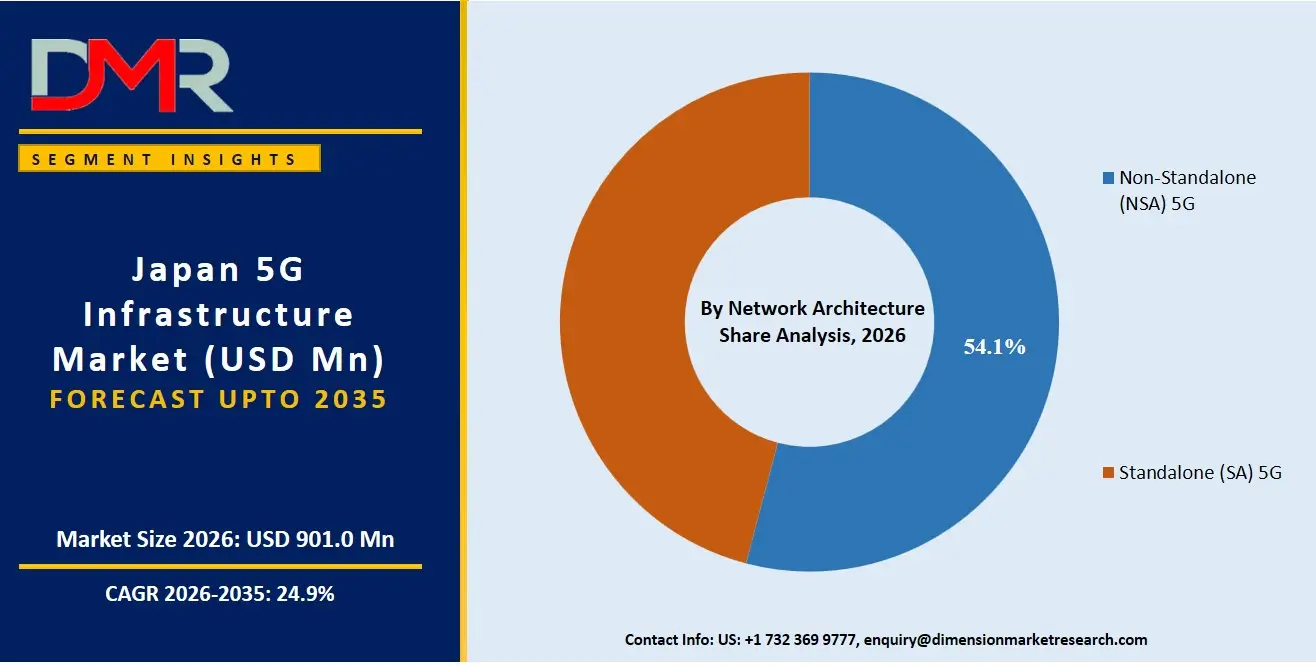
The share of non-standalone (NSA) 5G will be about 54.1% in 2026 because of the large number of current installations based on 4G core networks. Operators continue using NSA technology to maximize their investments and broaden their reach. However, standalone (SA) 5G is the fastest-growing segment due to increasing requirements from businesses to provide features like network slicing, ultrareliable low latency connections, and improved automation. Digital transformations, private network development, and flexible operations are fueling the growth of standalone technologies.
By Network Ownership Model Analysis
It is expected that public 5G networks will maintain their dominance with a projected market share of 71.5% in 2026 owing to aggressive deployments across the nation by prominent telecommunication companies. The main source of connection for businesses, consumers, and governments would continue to be the public network. Nevertheless, the private 5G networks segment is expected to witness faster growth due to increasing business demands for secured, dedicated, and customized communication systems. Businesses involved in manufacturing, logistics, utilities, and transport will be investing in private infrastructure.
By End Use Industry Analysis
The telecommunications segment is anticipated to retain its position as the leader in terms of end use application with an estimated market share of 29.7% in 2026 due to ongoing efforts towards the enhancement and upgrading of telecommunication networks. The telecommunications companies act as major investment drivers in the telecom industry. It is estimated that the manufacturing sector will grow at the highest rate due to the adoption of automation in industries, predictive maintenance tools, and smart factories. Government initiatives to promote industrial digitization are also boosting growth in the sector.
The Japan 5G Infrastructure Market Report is segmented on the basis of the following:
By Component
- Hardware
- Radio Access Network (RAN) Equipment
- Macro Cells
- Small Cells
- Distributed Antenna Systems (DAS)
- Core Network Equipment
- Transport & Backhaul Equipment
- Software
- Network Management & Orchestration
- Network Virtualization (NFV / SDN platforms)
- Network Slicing & Automation Software
- Services
- Planning & Consulting
- Integration & Deployment
- Managed Services & Maintenance
By Infrastructure Domain
- Radio Access Network (RAN)
- Core Network (5G Core / Cloud-native Core)
- Transport Network
- Fiber Backhaul
- Microwave Backhaul
- Fronthaul Solutions
By Spectrum Type
- Low-Band
- Mid-Band
- High-Band / mmWave
By Network Architecture
- Non-Standalone (NSA) 5G
- Standalone (SA) 5G
By Network Ownership Model
- Public 5G Networks
- Private 5G Networks
By End-Use Industry
- Manufacturing
- Telecommunications
- Energy & Utilities
- Transportation & Logistics
- Healthcare
- Smart Cities & Public Safety
- Mining & Heavy Industry
Competitive Landscape
The Japan 5G infrastructure market consists of highly competitive companies as a result of innovation, performance improvements, and long-term agreements for deployments. Key players in the market place emphasis on R&D efforts, cloud networking, Open RAN, partnerships, and the expansion of services portfolios as ways of gaining competitive advantage in the market. Significant barriers to market entry are associated with large investment needs, regulatory requirements, issues concerning intellectual property, and technological skills. Differentiation among competitors is achieved by means of interoperability, automation, cyber security effectiveness, deployment speed, and enterprise/industrial use cases.
Some of the prominent players in the Japan 5G Infrastructure are:
- NTT Docomo
- KDDI Corporation
- SoftBank Corp.
- Rakuten Mobile
- NEC Corporation
- Fujitsu Limited
- NTT Corporation
- Mitsubishi Electric
- Hitachi, Ltd.
- Sumitomo Electric Industries
- Oki Electric Industry
- Furukawa Electric Co., Ltd.
- Fujikura Ltd.
- Yokogawa Electric Corporation
- Sony Semiconductor Solutions
- Renesas Electronics Corporation
- ROHM Co., Ltd.
- Murata Manufacturing Co., Ltd.
- TDK Corporation
- Nisshinbo Micro Devices
- Other Key Players
Recent Developments
- In March 2026, NTT DOCOMO and NEC Corporation introduced the first-ever commercial 5G core network in Japan built upon AWS infrastructure based on a highly intelligent Agentic AI-based approach for providing quick and scalable capacity scaling during high traffic periods. In another milestone achievement for DOCOMO, NTT DOCOMO BUSINESS, and NTT DOCOMO SOLUTIONS, these organizations have designed and deployed a 5G core network on AWS using an Agentic AI- and GitOps-based automation approach, which has helped cut down construction time by 80 percent.
- In March 2026, Microamp and Hytec Inter have established a strategic partnership with the aim of deploying more 5G mmWave connectivity deployments in Japan and the Asia-Pacific. This strategic partnership will utilize Microamp's 5G mmWave connectivity network infrastructure alongside Hytec Inter's implementation capability to deliver high capacity, low latency, and highly reliable connectivity services for business and critical mission operations. The strategic partnership will seek to advance the deployment of mmWave connectivity solutions in sectors including but not limited to industrial automation, critical infrastructure, and defense communications.
- In November 2025, Nokia and NTT DOCOMO have formed an alliance for the roll-out of MantaRay SON(Self Organizing Networks) solution by Nokia within the radio access network environment of DOCOMO, consisting of multiple vendors' LTE and 5G networks. It is the first implementation in Japan involving the utilization of 5G Base Station technology from Nokia and systems from DOCOMO. This solution aids in optimizing network operation by streamlining tasks and reducing costs.
Report Details
| Report Characteristics |
| Market Size (2026) |
USD 901.0 Mn |
| Forecast Value (2035) |
USD 6,649.7 Mn |
| CAGR (2026–2035) |
24.9% |
| Historical Period |
2021 – 2025 |
| Forecast Period |
2027 – 2035 |
| Base Year |
2025 |
| Estimate Year |
2026 |
| Segments Covered |
By Component, By Infrastructure Domain, By Spectrum Type, By Network Architecture, By Network Ownership Model, By End-Use Industry |
| Country Coverage |
Japan |
Frequently Asked Questions
How big is the Japan 5G Infrastructure Market?
▾ The Japan 5G Infrastructure Market size is expected to reach USD 901.0 million by 2026 and is projected to reach USD 6,649.7 million by the end of 2035.
What is the CAGR of the Japan 5G Infrastructure Market from 2026 to 2035?
▾ The market is growing at a CAGR of 24.9 percent over the forecasted period.
What factors are driving the growth of the Japan 5G Infrastructure Market?
▾ Expanding Digital Transformation Efforts, and more are the factors driving the growth of the Japan 5G Infrastructure Market.
What are the major trends in the Japan 5G Infrastructure Market?
▾ Greater Trending Move to Standalone 5G Network, and more are some of the major trends in the market.
Who are the key players in the Japan 5G Infrastructure Market?
▾ Some of the key players in the Japan 5G Infrastructure Market include OKI, NTT, NEC, and more.
How is the Japan 5G Infrastructure Market segmented?
▾ The Japan 5G Infrastructure Market is segmented by component, infrastructure domain, spectrum type, network architecture, network ownership model, end-use industry.