What is the A2P Messaging Market Size?
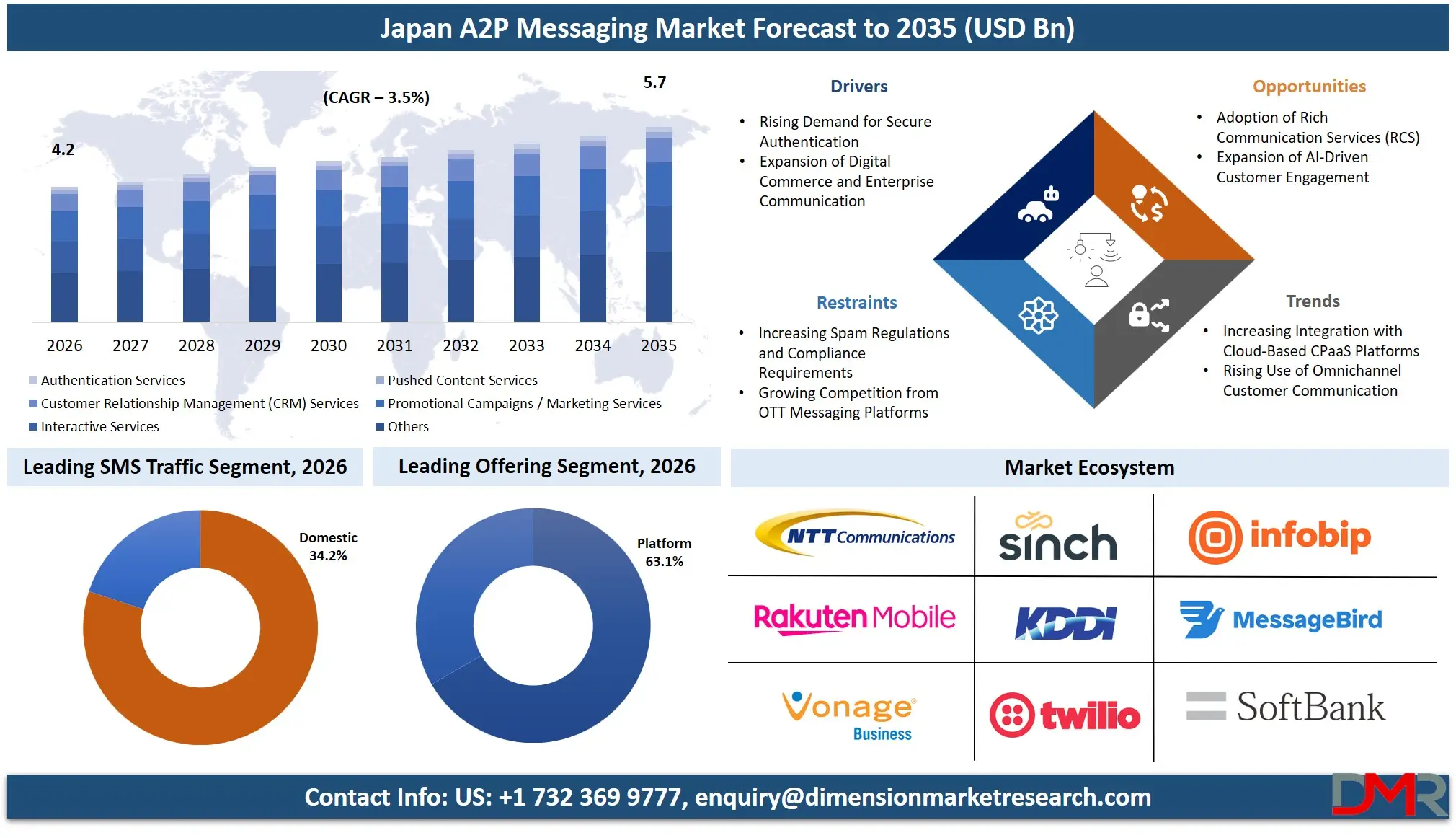
The Japan A2P Messaging Market is expected to reach a value of USD 4.2 billion in 2026, and it is further anticipated to reach USD 5.7 billion by 2035, growing at a CAGR of 3.5% during the forecast period.
ℹ
To learn more about this report –
Download Your Free Sample Report Here
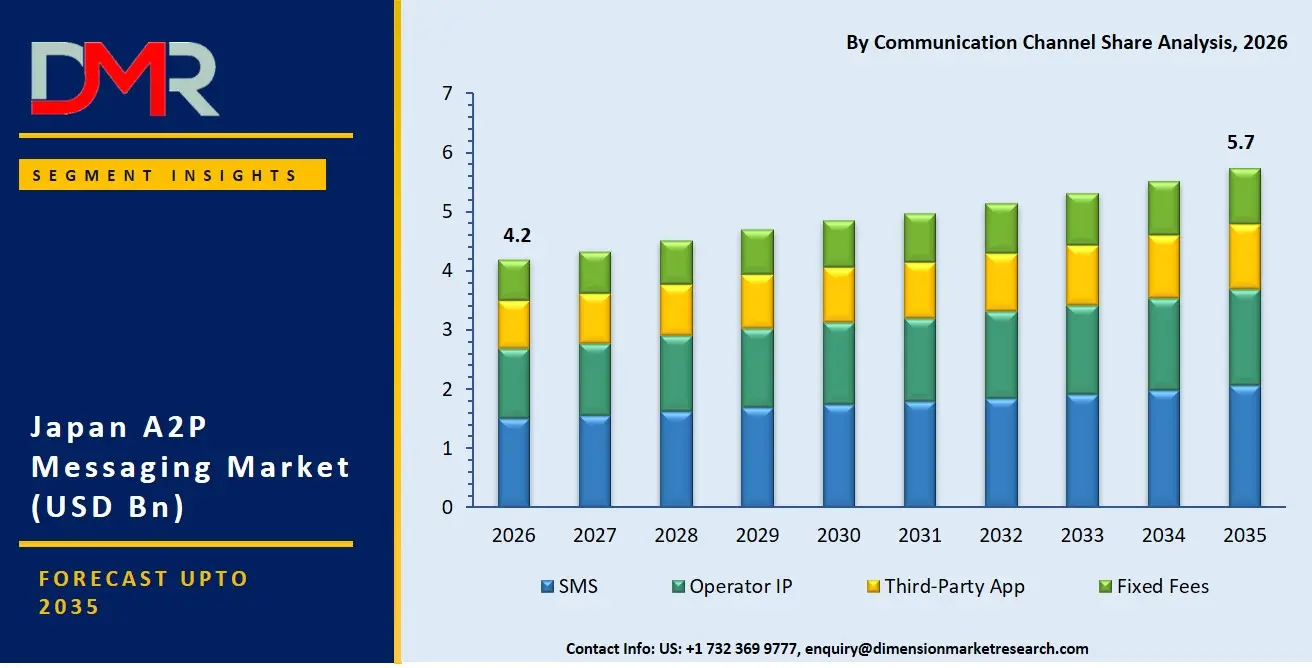
The A2P messaging market has been showing consistent growth due to businesses' rising dependence on mobile means of communication for effective, secure, and scalable engagement with customers. This includes a number of platforms and expert services which help firms send bulk messages from applications to users for transactional, authentication, and marketing purposes. There has been a rising need for professional services owing to the requirements for implementing an omnichannel communication approach, securing transactions against fraud, and delivering highly engaging multimedia content to customers. Enterprises have emerged as the largest consumer segment for A2P messaging services with SMS being the most popular choice due to its wide availability and reliability, while there has been rapid growth in third party messaging apps.
ℹ
To learn more about this report –
Download Your Free Sample Report Here
Key Takeaways
- Market Size & Forecast: The Japan A2P Messaging market is forecasted to be valued at USD 4.2 billion in 2026, growing incrementally to USD 5.7 billion by 2035, due to the joint efforts of digital strategy deployment on the part of enterprises as well as the obligatory deployment of multi-factor authentication technologies.
- Growth Rate & Outlook: Japan market is expected to grow at 3.5% CAGR, propelled by the urgent need to mitigate emerging SMS phishing, also known as smishing, threats alongside increasing challenges in orchestrating multi-channel customer journeys by SMS, Operator IP services and third-party applications.
- Primary Growth Drivers: Major driving factors comprise transition from traditional messaging gateways towards modern cloud-based communication solutions, the necessity to deploy secure and robust authentication services, as well as implementation of messaging APIs necessitating unique platform & services expertise.
- Key Market Trends: Major trends encompass the introduction of interactive and rich media content through Operator IP channels, usage of artificial intelligence within Platforms for routing optimization and preventing fraudulent messages, and increased focus on secure messaging amidst rising consumer data privacy considerations of regulators.
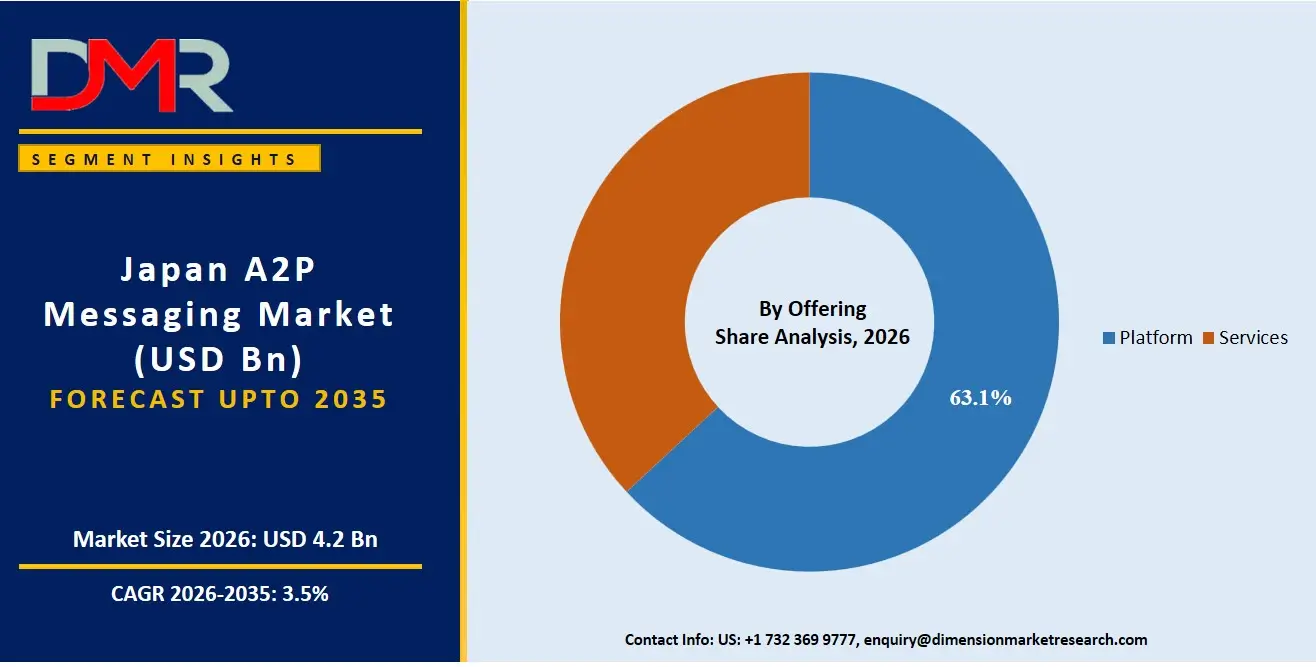
- By Platform Analysis: The platform segment is projected to dominate the Japan A2P Messaging Market due to high demand for scalable cloud messaging platforms by enterprises with capabilities like API integration, analytics, automation, and multi-channel communication, which offer authentication, customer engagement, digital banking, and real-time communication activities within enterprises.
- By Communication Channel Analysis: The SMS segment is projected to dominate the Japan A2P Messaging Market due to its universality, reliability, capability for authentication, and use for sending OTPs, transactional alerts, appointments, deliveries, and emergency communications in banks, hospitals, retail stores, and the government.
- By Deployment Mode Analysis: The cloud deployment mode segment is anticipated to dominate in the Japan A2P Messaging Market as enterprises adopt communication infrastructure that is scalable, flexible, efficient, accessible remotely, provides AI-based analytics, CRM integration, business continuity, and messaging operations at a higher volume.
What is the A2P Messaging?
A2P Messaging is about the unique set of platforms and expertise involved in sending automated messages from an app to a consumer's mobile phone. These services, unlike person-to-person messaging, pertain to "the how and where" of high-volume digital communication. It entails having a Platform to provide the means through which messages can be originated, routed, and delivered securely and reliably, and Services to help integrate, manage costs, and optimize campaigns. As companies take charge of their omnichannel communications, it is important to have services that ensure that messages will be delivered successfully while maintaining cost and security measures.
Use Cases
- Banking Transactions Security: Banking Companies employ A2P Messaging Services for the installation of SMS-based Authentication Services that include OTPs and transaction notifications in order to avoid fraud and increase customer trust.
- Hospital Patient Communications: Hospital Networks rely on A2P Platform for sending out SMS reminders regarding appointments and test results notifications and ensure that the content remains HIPAA compliant.
- Logistics Delivery Services: Logistics Delivery Businesses incorporate A2P messaging APIs in order to push notifications concerning deliveries and surveys to the customers in real-time.
- Retail Promotional Services: Retail Organizations leverage Promotional Campaigns / Marketing Services in a cloud-based Platform to initiate geo-targeted rich media promotions during high traffic seasons.
How AI is Transforming the A2P Messaging Market?
AI is revolutionizing the A2P messaging industry through increased fraud detection and communication customization capabilities. The Platform suite includes AI-based systems that detect smishing threats and grey routes in order to block them instantaneously, thereby preventing any financial losses and damage to reputation. In addition, the AI-driven functions of Promotional Campaigns/Marketing Services help organizations assess customer data, determine appropriate times for sending messages, and customize their communications. AI forms an essential part of governance and customer trust initiatives. Professional services involve intelligent agents that monitor compliance and keep contact lists free of any non-compliant numbers while ensuring that all messages comply with regulations and the stringent opt-in consent procedures in Japan.
Market Dynamics
Key Drivers in the Japan A2P Messaging Market
Rising Demand for Secure Authentication
AI is revolutionizing the A2P messaging industry through increased fraud detection and communication customization capabilities. The Platform suite includes AI-based systems that detect smishing threats and grey routes in order to block them instantaneously, thereby preventing any financial losses and damage to reputation. In addition, the AI-driven functions of Promotional Campaigns/Marketing Services help organizations assess customer data, determine appropriate times for sending messages, and customize their communications. AI forms an essential part of Governance and Customer Trust initiatives. Professional Services involve intelligent agents that monitor compliance and keep contact lists free of any non-compliant numbers while ensuring that all messages comply with regulations and the stringent opt-in consent procedures in Japan.
Expansion of Digital Commerce and Enterprise Communication
The rapid development of the digital economy in Japan creates high demands in the enterprise messaging sector in various fields such as retail, healthcare, logistics, and customer service. Companies today use A2P messaging to communicate important messages related to order confirmation, appointment scheduling, marketing activities, package tracking, and engaging customers. With increased use of smartphones and mobile applications by many users, enterprises have become more interested in adopting an automated communication system that can handle large volumes of messages effectively. In addition, there is a growing need for personalized experiences for the customers, which increases the adoption rate of A2P messaging.
Restraints in the Japan A2P Messaging Market
Increasing Spam Regulations and Compliance Requirements
The increasingly stringent telecom regulations and anti-spam legislations in Japan have brought about difficulties for the A2P messaging vendors as well as businesses. The regulatory bodies are tightening their grip on the control of unsolicited promotional communications, the acquisition and management of consents from customers, and data protection measures in order to minimize problems related to spam. Enterprises are expected to adhere to the highly stringent communication requirements, making their operations more complicated and costly. The violation of such rules subjects an enterprise using bulk messaging services to heavy fines, delivery delays, and reputational harm.
Growing Competition from OTT Messaging Platforms
Growth in the usage of over-the-top (OTT) messaging services like LINE and others is impacting the future growth of A2P messaging within Japan. Internet messaging is preferred over traditional messaging since it offers multimedia capabilities and interactivity, as well as reduced costs for communication purposes. Enterprises have also begun using over-the-top messaging applications as part of their customer engagement activities, relying less on SMS-based campaigns. The use of OTT applications also offers enhanced communication solutions like chatbots, payments, and content personalization. Traditional A2P messaging services are under growing pressure from competing services.
Growth Opportunities in the Japan A2P Messaging Market
Adoption of Rich Communication Services (RCS)
There exist many growth opportunities in the A2P messaging market in Japan through the increasing implementation of Rich Communication Services (RCS). RCS allows businesses to engage in rich media communications other than using standard SMS messages. Images, videos, chatbots, location services, and branded messaging are some features that may be implemented by companies in communicating with their consumers. Companies based in Japan are starting to consider implementing RCS as an alternative for effective digital communication. With improved RCS infrastructure by telcos and improved support in smartphones, many business organizations will spend much money on messaging systems.
Expansion of AI-Driven Customer Engagement
Integration of artificial intelligence in enterprise communication channels is bringing about great prospects for A2P message providers in Japan. Many companies are now using AI-based messaging technology that automates communication processes in order to offer support to customers. AI can help organizations understand how customers behave, customize their messaging content, and determine when the best time is to send the message to customers in order to maximize customer satisfaction and conversions. The increasing use of chatbots, machine learning analytics, and intelligent automation in different sectors such as finance, health care, retail, and transport is driving demand for innovative messaging technology.
Trends in the Japan A2P Messaging Market
Increasing Integration with Cloud-Based CPaaS Platforms
Increasingly, Japanese companies are adopting CPaaS by integrating messaging A2P services that help improve scalability and automation. CPaaS allows organizations to easily integrate messaging APIs into their mobile applications, CRM solutions, and communication processes without having to invest heavily in their existing IT infrastructure. The advantages associated with CPaaS include real-time communication management, analytics, and omnichannel engagement options. Due to the growing adoption of digital transformation approaches in addition to remote business processes, the use of cloud communications has been steadily increasing. The adoption of CPaaS as an alternative to more expensive A2P messaging solutions has continued to gain popularity in Japan.
Rising Use of Omnichannel Customer Communication
Omnichannel approaches are being incorporated by Japanese firms in order to facilitate their customers' interactions using a combination of SMS, email, OTT apps, mobile alerts, and AI-based messaging. Companies are focusing on creating an omnichannel experience that ensures consistency in the quality of customer interaction through different digital channels. A2P messaging continues to be an integral part of these omnichannel approaches owing to their dependability and high open rates. Companies from sectors such as retailing, finance, health care, and transportation have been incorporating messaging services into their digital customer engagement solutions.
Research Scope and Analysis
The Japan A2P Messaging Market is segmented by offering, communication channel, deployment mode, SMS traffic, application, and end user. The market supports authentication, CRM, promotional, and interactive messaging across BFSI, retail, healthcare, government, transportation, media, and tourism sectors through cloud and SMS-based enterprise communication solutions.
ℹ
To learn more about this report –
Download Your Free Sample Report Here
By Offering Analysis
Platform is projected to lead the market of Japan A2P Messaging as a result of the growing need of enterprises in scaling their messaging capabilities through management, application programming interfaces (API), automation, analysis, and omnichannel support. The Japanese businesses have developed a preference for cloud-based messaging platforms for performing such functions as sending authentication alerts, transactional notifications, promotions, and customer engagement. Telecommunication operators, fintechs, and digital commerce enterprises extensively use platforms for executing their messaging activities. The wide adoption of CPaaS solutions, the development of digital banking, and enterprise digital transformations favor platform over stand-alone products.
By Communication Channel Analysis
SMS is anticipated to hold the highest market share in the communication channel category in the Japan A2P Messaging Market due to its universal interoperability, excellent delivery guarantee, strong telecom network infrastructure, and use in authentication and transactional messaging. Banks, e-commerce organizations, healthcare organizations, and government organizations in Japan continue to use SMS for one-time passwords, appointments, deliveries, and emergencies. While third-party applications need internet access and the installation of apps, SMS is not dependent on any of these requirements, and hence is highly reliable on all mobile devices. The regulatory confidence and preference of enterprises for direct contact with customers is strengthening the role of SMS.
By Deployment Mode Analysis
The deployment by cloud is anticipated to dominate the Japan A2P Messaging Market owing to the increasing preference of enterprises toward scalability and flexibility. The Japanese businesses are now using cloud-based messaging solutions to ensure that deployment is fast and can be accessed remotely, along with analysis enabled by artificial intelligence, while ensuring smooth integration with customer relationship management and digital engagement solutions. It also facilitates the varying messaging volumes during promotions, banking notifications, and customer support services without substantial investments in infrastructure. This trend will continue in light of the digital transformation of enterprises, SaaS solutions, and requirements of business continuity and agility.
By SMS Traffic Analysis
Domestic messaging is expected to form the majority of the A2P Messaging Market in Japan as most messaging activities by enterprises tend to target their own consumers, enterprises, and governmental organizations within Japan. Many financial institutions, retailers, healthcare institutions, transport services providers, and telecommunications enterprises send huge amounts of transactional and authenticating messages domestically every day. This is attributed to the solid telecommunications network in place, high adoption rate of mobile devices in Japan, and high levels of data privacy laws. In addition, the huge digital payment system, growing e-commerce industry, and usage of OTP for domestic authentications support the domestic dominance.
By Application Analysis
The segment of authentication services is projected to account for the majority share in the Japan A2P Messaging Market due to the quick rise in digital banks, online payment processing, e-commerce activities, and security-oriented business operations by enterprises. The usage of one-time passwords (OTP), two-factor authentication (2FA), login verification, and security alerts for the user's account is extremely widespread among Japanese businesses via A2P message services. Banks, healthcare facilities, governments, and e-commerce organizations give preference to authentication messages aimed at fighting against any kind of fraud, identity theft, and unauthorized access to the user's personal accounts.
By End User Analysis
The Banking, Financial Services, and Insurance (BFSI) vertical is projected to lead in the Japan A2P Messaging market due to the exceptionally high volume of transactional messages that are transmitted securely every day by the BFSI vertical. Japan has many digital banks and a robust regulatory environment that ensures financial security and the security of information. Moreover, the usage of smartphones for online transactions is becoming more prevalent, which has increased BFSI's lead. Increasing issues surrounding cyber fraud and identity verification have also led to increased investments from enterprises in reliable A2P messaging.
The Japan A2P Messaging Market Report is segmented on the basis of the following:
By Offering
By Communication Channel
- SMS
- Operator IP
- Third-Party App
- Fixed Fees
By Deployment Mode
By SMS Traffic
By Application
- Authentication Services
- Pushed Content Services
- Customer Relationship Management (CRM) Services
- Promotional Campaigns / Marketing Services
- Interactive Services
- Others
By End User
- Banking, Financial Services, And Insurance (BFSI)
- Retail & E-commerce
- Healthcare
- Travel & Tourism
- Media & Entertainment
- Government
- Transportation & Logistics
- Others
Competitive Landscape
The dynamics of competition in the Japan A2P Messaging marketplace have developed to become increasingly dynamic, with a wide range of multinational CPaaS vendors, Japanese message aggregators, and platform players specializing in various niche messaging functions. The essential ingredient for success is found in deep-seated strategic partnerships with mobile network operators in Japan, which open up high-quality direct channels and allow premium Operator IP services to be sold alongside one another. Market consolidation trends are moving rapidly ahead, with established players in the world of IT service providers taking on acquisitions of specialized messaging Platform providers to leverage their API functionalities. Proprietary intellectual property rights, with AI-based anti-fraud algorithms and delivery engines, hold increasing importance compared to just competitive messaging pricing and gateways.
Some of the prominent players in the Japan A2P Messaging Market are:
- NTT Communications
- KDDI Corporation
- SoftBank Corp.
- Rakuten Mobile
- Twilio
- Sinch
- Infobip
- Vonage
- MessageBird
- CM.com
- Telesign
- Route Mobile
- Tanla Platforms
- LINK Mobility
- CLX Communications
- Genesys
- Cisco Systems
- Oracle
- SAP
- Salesforce
- Other Key Players
Recent Developments
- January 2026: Twilio expanded its Japan data center facilities to facilitate the deployment of low-latency authentication services by BFSI and healthcare segments in line with data residency mandates in the country.
- November 2025: NTT Data increased its partnership with KDDI Corporation to help retail and e-commerce segments launch Rich Communication Services (RCS) via operator IP services with CRM and interactive messaging services.
- October 2025: Infobip acquired NetReal Japan to improve its promotional campaigns and international SMS services for cross-border customer engagement processes of enterprises.
Report Details
| Report Characteristics |
| Market Size (2026) |
USD 4.2 Bn |
| Forecast Value (2035) |
USD 5.7 Bn |
| CAGR (2026–2035) |
3.5% |
| Historical Data |
2021 – 2025 |
| Forecast Data |
2027 – 2035 |
| Base Year |
2025 |
| Estimate Year |
2026 |
| Segments Covered |
By Offering, By Communication Channel, By Deployment Mode, By SMS Traffic, By Application, and By End User |
| Country Coverage |
Japan |
Frequently Asked Questions
How big is the Japan A2P Messaging Market?
▾ The Japan A2P Messaging market is poised to be valued at USD 4.2 billion in 2026 and is projected to reach USD 5.7 billion by 2035, driven by the universal need for secure, scalable, and reliable digital customer communications.
What is the CAGR of the Japan A2P Messaging Market from 2026 to 2035?
▾ The market is expected to grow at a CAGR of 3.5% from 2026 to 2035, reflecting the maturing nature of the SMS market and the accelerating complexity of multi-channel, interactive engagement strategies.
What factors are driving the growth of the Japan A2P Messaging Market?
▾ Key drivers include the digital security imperative for fraud prevention, the need to modernize legacy customer engagement systems, the management complexity of multi-channel orchestration, and the surge in demand for secure Authentication Services amid evolving data privacy laws.
What are the major trends in the Japan A2P Messaging Market?
▾ Major trends include the integration of AI into delivery optimization and fraud detection, the rise of Rich Communication Services (RCS) on the Operator IP channel, the demand for vertical-specific messaging solutions, and the focus on ethical, eco-conscious communication practices.
Who are the key players in the Japan A2P Messaging Market?
▾ Key players include global CPaaS leaders like Twilio, Sinch, and Infobip, as well as local telecommunications and IT service aggregators who provide direct, high-quality connectivity to Japan’s mobile network operators.
How is the Japan A2P Messaging Market segmented?
▾ The market is segmented by Offering, Communication Channel, Deployment Mode, SMS Traffic, Application, and End User.