Market Snapshot
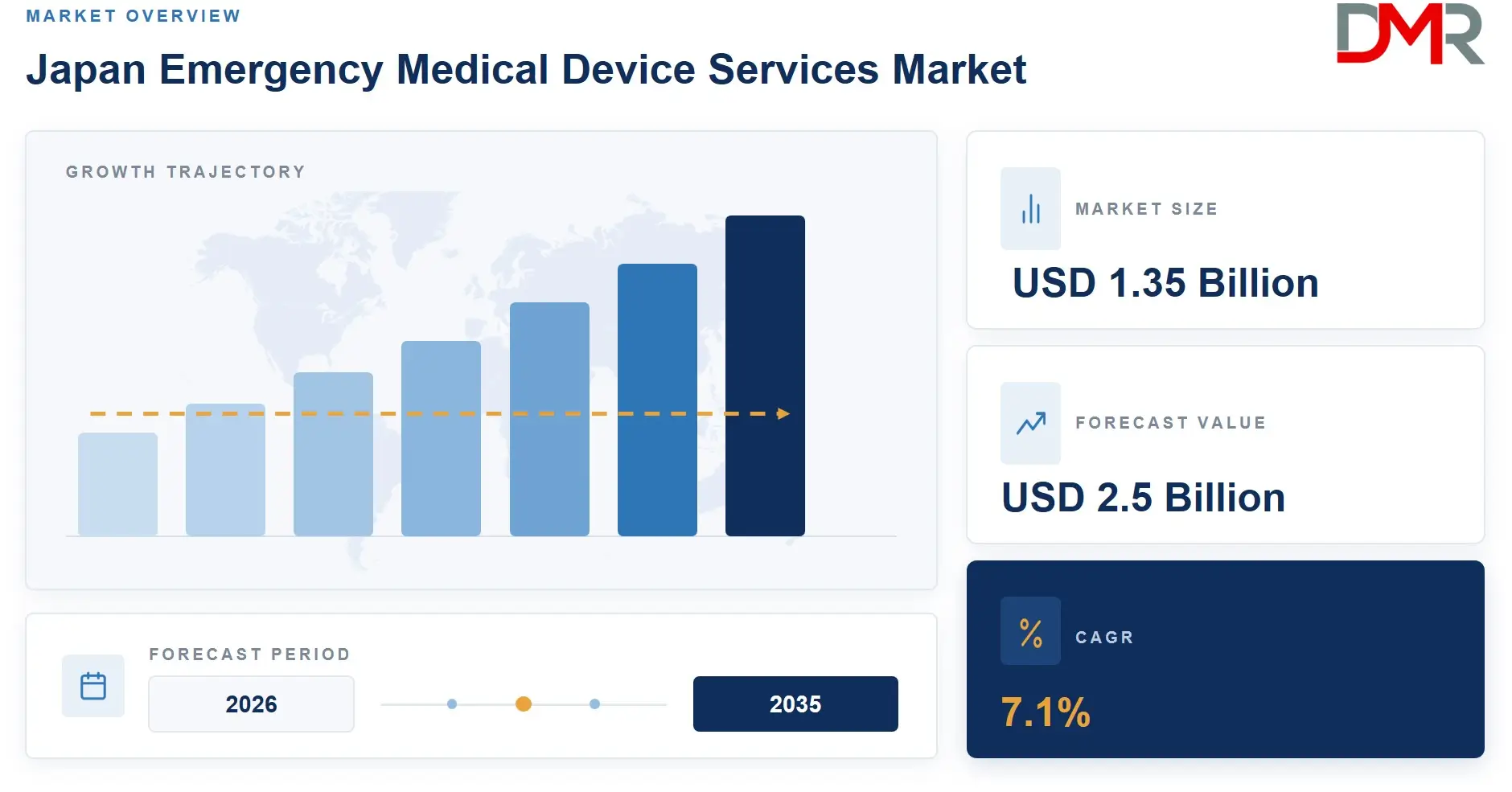
- Market Size (2026): USD 1.35 Bn
- Forecast Value (2035): USD 2.5 Bn
- CAGR (2026-2035): 7.1%
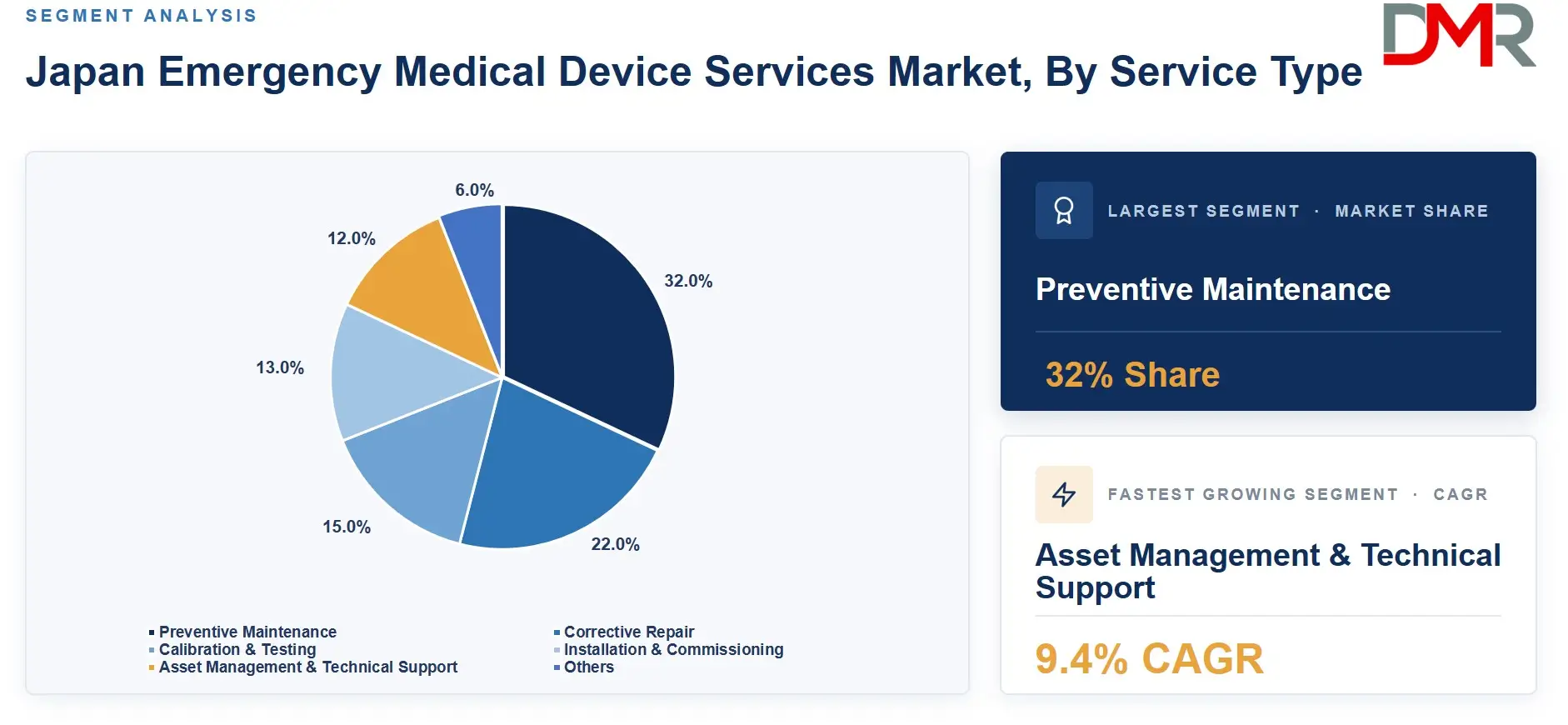
- Leading Service Type (2026): Preventive Maintenance, approximately 32%
- Leading Device Type (2026): Patient Monitoring Systems, around 27%
- Key Players: Nihon Kohden Corporation, Terumo Corporation, Fukuda Denshi Co., Ltd. and others
What is Japan Emergency Medical Device Services Market and its Market Size?
The Japan Emergency Medical Device Services Market size is estimated to reach USD 1.35 Bn in 2026 and is further anticipated to reach USD 2.5 Bn by 2035, at a CAGR of 7.1%.
ℹ
To learn more about this report –
Download Your Free Sample Report Here
Emergency medical device services cover the technical work required to keep life-supporting and time-critical medical equipment available, accurate and compliant. The scope includes preventive maintenance, corrective repair, calibration, safety testing, installation, commissioning, remote diagnostics, asset tracking and technical support for equipment such as defibrillators, automated external defibrillators, patient monitors, emergency ventilators, infusion devices, suction systems and oxygen therapy equipment.
The figures in this report represent service revenue generated inside Japan. They do not represent worldwide revenue earned by Japanese-headquartered manufacturers. Demand is created by hospitals and emergency departments, municipal and fire-based ambulance systems, urgent care facilities, public access sites with AED programs, and community or home-care settings that depend on emergency-ready equipment.
Japan combines a large installed base of mature medical equipment with rising pressure to improve uptime, traceability and lifecycle control. Service providers are moving beyond scheduled inspection toward connected maintenance, device history records, remote fault detection and contract models that bundle parts, software and response times. Buyers increasingly judge providers on availability, regulatory documentation, calibration quality, cybersecurity discipline and the ability to support mixed fleets rather than on repair price alone.
Use Cases
- Hospital Emergency Departments: Biomedical engineering teams and OEM field-service groups maintain defibrillators, bedside monitors, ventilators and infusion systems used in resuscitation bays. Structured preventive maintenance and rapid repair reduce device downtime and help departments keep critical equipment available during unpredictable surges in emergency admissions.
- Municipal Ambulance Fleets: Fire departments and ambulance operators rely on scheduled calibration, battery checks, electrical safety inspection and replacement-part support for transport monitors, defibrillators and portable ventilation equipment. Service contracts standardize readiness across vehicles and reduce the risk that a field unit is unavailable when dispatched.
- Public Access AED Networks: Rail stations, schools, offices, sports venues and commercial facilities use inspection and lifecycle services to track electrode pads, batteries, self-test alerts and replacement dates. Centralized service programs improve the probability that an AED is functional when a cardiac arrest occurs outside a medical facility.
- Community and Home Emergency Care: Home-care providers and respiratory support organizations use technical support, consumable replacement and remote device checks for oxygen, ventilation and monitoring equipment. Service continuity is especially important for older patients who may need urgent escalation without immediate access to hospital biomedical engineering staff.
Key Takeaways
- Market Size & Share: Service demand is forecast to expand by about USD 1.15 Bn between 2026 and 2035 as installed equipment ages and service intensity rises.
- Service Type Analysis: Asset Management & Technical Support is projected to grow at a CAGR of 9.4% from 2026 to 2035, faster than routine maintenance.
- Demand Concentration: Hospitals & Emergency Departments are expected to account for nearly 46% of service revenue in 2026 because they operate the broadest mix of high-acuity devices.
- Service Provider Shift: Independent Service Organizations are projected to expand at a CAGR of 8.5% as hospitals seek multi-vendor fleet support and more flexible pricing.
- Connected Service Model: Remote Monitoring & Subscription Services are expected to record a CAGR of 10.2%, supported by connected diagnostics and predictive maintenance.
- Critical Device Demand: Defibrillators & AEDs are projected to grow at a service CAGR of 8.6%, supported by hospital, ambulance and public-access replacement cycles.
How AI/Gen AI is Transforming the Japan Emergency Medical Device Services Market?
AI is affecting emergency medical device services mainly through maintenance operations rather than through direct clinical decision-making. Service organizations can use anomaly detection on device logs, battery behavior, alarm histories and error codes to identify units that are likely to fail before the next scheduled inspection. Computer vision can also support automated inspection of labels, connectors, cable wear and consumable status when technicians document equipment conditions with mobile devices.
Generative AI has a narrower but practical role in service documentation. Large language models can summarize work orders, convert technician notes into standardized maintenance records, search service manuals and support multilingual troubleshooting. The commercial value comes from faster documentation and more consistent field execution, while final safety decisions remain under trained biomedical or manufacturer-authorized personnel.
- Predictive Maintenance: Machine-learning models rank devices by probable failure risk using historical service events, telemetry and component-age patterns.
- Technician Assistance: LLM-based tools can retrieve approved procedures, parts information and troubleshooting steps from controlled technical documentation.
- Fleet Prioritization: Analytics can combine utilization, location and criticality data to schedule maintenance when disruption to emergency operations is lowest.
- Record Quality: Automated extraction can structure serial numbers, calibration results and service actions from digital forms, reducing manual administrative effort.
Key Drivers in the Japan Emergency Medical Device Services Market
Demand is being pulled by rising equipment intensity in acute care and by stricter expectations for device uptime. Two forces have the largest structural effect on service spending.
- Aging Population and Higher Emergency Care Utilization: Japan's care system must support a large older population with higher incidence of cardiac, respiratory and neurological emergencies. Hospitals and ambulance providers therefore operate more monitoring, defibrillation, ventilation and oxygen-support equipment across longer daily duty cycles. Hospitals & Emergency Departments are expected to represent nearly 46% of service revenue in 2026, creating a large installed base that requires inspection, calibration, repair and consumable replacement. As utilization increases, buyers have less tolerance for equipment downtime, which favors scheduled contracts, faster field response and broader spare-parts coverage rather than ad hoc repair after failure.
- Expansion of Connected and Lifecycle-based Equipment Management: Device fleets are becoming more software-dependent, networked and traceable, increasing the service work required beyond mechanical repair. Asset Management & Technical Support is projected to grow at 9.4% from 2026 to 2035 as hospitals seek device-history visibility, remote diagnostics, software support and structured replacement planning. This changes the provider relationship from occasional maintenance toward recurring lifecycle management. OEMs and specialized service firms can capture more value when they integrate parts, calibration, cybersecurity checks, documentation and remote monitoring into a single contract tied to uptime and fleet performance.
Restraints in the Japan Emergency Medical Device Services Market
Growth is constrained by procurement economics and by the technical controls surrounding high-acuity equipment. These factors can lengthen sales cycles even when the need for service is clear.
- Price Pressure from Long Device Lifecycles and Cost-conscious Procurement: Many emergency devices remain in service for years, and Japanese healthcare buyers often stretch capital and operating budgets through careful maintenance. Pay-per-Service is projected to account for around 24% of service revenue in 2026, showing that a meaningful buyer group still prefers episodic spending rather than broader contracts. Competitive tendering can compress labor and parts margins, while hospitals may keep routine inspection in-house. Service providers therefore need to demonstrate measurable uptime, faster response or reduced administrative burden to justify premium annual contracts and managed-service pricing.
- Regulatory, Training and Multi-vendor Complexity: Emergency equipment combines electrical safety, measurement accuracy, software, batteries, accessories and manufacturer-specific procedures. Original Equipment Manufacturers are expected to hold approximately 44% of service revenue in 2026 because proprietary diagnostics, approved parts and device knowledge remain important for high-risk repairs. Independent providers can compete effectively, but they must maintain qualified technicians, calibration systems, documentation controls and access to parts across multiple brands. These requirements raise operating costs and make rapid nationwide scaling more difficult, particularly for smaller service organizations.
Growth Opportunities in the Japan Emergency Medical Device Services Market
The strongest white space lies in service models that reduce administrative burden while improving readiness. Growth is concentrated in connected contracts and underserved mixed-fleet environments.
- Remote Monitoring and Subscription-based Support: Remote Monitoring & Subscription Services are projected to record the fastest service-model trajectory in the market through 2035. Connected devices can transmit self-test status, battery condition, fault codes or utilization data, allowing providers to prioritize technician visits and replace consumables before a failure creates downtime. This model is particularly attractive for public-access AED networks, distributed clinics and multi-site hospital groups. Providers that combine connectivity, alerts, documentation and field service can create recurring revenue while lowering the cost of unnecessary inspection visits.
- Multi-vendor Managed Services for Hospital Networks: Managed Equipment Services are expected to account for close to 18% of service revenue in 2026, leaving room for expansion as hospital groups consolidate vendors. A single service integrator can coordinate preventive maintenance, repair, asset registers, loaner units and compliance records across equipment from multiple manufacturers. The opportunity is strongest where biomedical teams are understaffed or where mergers have created mixed fleets. Independent Service Organizations are positioned to benefit if they can prove response quality and maintain manufacturer-compatible procedures across complex device categories.
Trends in the Japan Emergency Medical Device Services Market
Service delivery is shifting from calendar-based inspection toward data-supported lifecycle control. Buyers are also separating high-risk proprietary work from standardized tasks that can be competitively sourced.
- Greater Use of Predictive and Condition-based Maintenance: Preventive Maintenance is expected to remain the largest service type in 2026, but the operating model is becoming more selective. Providers are using error logs, self-test results, component age and utilization records to decide which assets need attention first. This reduces unnecessary planned visits on low-use devices while concentrating technical labor on equipment with higher failure probability. The shift can improve technician productivity and make nationwide service networks more scalable without reducing safety requirements.
- Broader Public-access AED Lifecycle Management: Defibrillators & AEDs are expected to represent approximately 23% of device-related service revenue in 2026. Public and commercial AED deployments create recurring demand for battery and electrode replacement, inspection records, connectivity checks and device renewal. The trend is moving from ownership of individual units toward managed networks where service providers track readiness across many locations. This favors centralized dashboards, automated reminders and bundled replacement programs, especially for rail, education, sports and large corporate facilities.
Research Scope and Analysis
Segment performance is assessed across service type, device type, service provider, end user and service model. Each axis identifies where 2026 revenue is concentrated and which sub-segment is expected to expand fastest through 2035, with the operating reason behind each position.
ℹ
To learn more about this report –
Download Your Free Sample Report Here
By Service Type
Preventive Maintenance is expected to hold the largest service-type share in 2026, accounting for approximately 32% of revenue because routine inspection, electrical safety testing and scheduled part replacement are recurring requirements across large installed fleets. Annual planning also makes preventive work easier for hospitals and ambulance operators to budget than unexpected corrective events. Growth, however, is concentrated in Asset Management & Technical Support, expanding at a CAGR of 9.4% from 2026 to 2035 as buyers require equipment histories, remote diagnostics, software support and replacement planning. The faster trajectory reflects a shift from individual device repair toward lifecycle oversight, particularly in hospital networks managing mixed fleets across multiple locations.
By Device Type
Patient Monitoring Systems are projected to lead device-related service revenue in 2026 with close to 27% share, supported by their high unit count, continuous use and regular calibration needs in emergency departments, intensive-care transitions and transport settings. Monitor fleets also include accessories, sensors and network interfaces that increase service touchpoints. The steeper trajectory sits with Defibrillators & AEDs, which are forecast to grow at a CAGR of 8.6% through 2035. Public-access installations, ambulance replacement cycles and newer connected self-test functions increase the need for battery, electrode, software and readiness management. Service providers can therefore earn recurring revenue from both clinical defibrillators and distributed AED estates.
By Service Provider
Original Equipment Manufacturers are expected to command roughly 44% of 2026 revenue by service provider because proprietary diagnostics, approved replacement parts and specialist knowledge are important for high-acuity equipment. Hospitals also use OEM contracts during warranty periods and for complex software-dependent repairs. Growth, however, is more concentrated in Independent Service Organizations, which are projected to expand at a CAGR of 8.5% between 2026 and 2035. Their advantage is the ability to support multiple brands under one agreement, helping hospital groups reduce vendor fragmentation and simplify asset records. Expansion will depend on technician qualification, calibration capability, access to parts and the ability to meet manufacturer-equivalent service documentation requirements.
By End User
Hospitals & Emergency Departments are set to represent nearly 46% of service revenue in 2026, reflecting the concentration of defibrillators, monitors, ventilators, infusion devices and other critical equipment in acute-care facilities. High utilization and the consequence of downtime make hospitals the most service-intensive buyer group. Growth, however, is concentrated in Public Access Facilities, forecast to expand at a CAGR of 9.1% through 2035 as AED networks broaden across transport hubs, workplaces, schools, sports venues and other high-footfall locations. These sites create demand for centralized inspection, consumable replacement and readiness tracking, making managed service models more practical than relying on local staff to maintain each device independently.
By Service Model
Annual Maintenance Contracts are expected to account for around 39% of service-model revenue in 2026 because they give hospitals and EMS operators predictable maintenance schedules, response commitments and budgeting for recurring technical work. They remain especially common for equipment with established service intervals. The fastest growth is expected in Remote Monitoring & Subscription Services at a CAGR of 10.2% from 2026 to 2035. Connected self-tests, error reporting and asset dashboards allow service teams to detect problems without visiting every location. This model lowers field-service cost for distributed fleets and supports recurring revenue, particularly for AED networks, multi-site providers and organizations that need centralized evidence of device readiness.
The Japan Emergency Medical Device Services Market Report is Segmented Based on the Following
By Service Type
- Preventive Maintenance
- Corrective Repair
- Calibration & Testing
- Installation & Commissioning
- Asset Management & Technical Support
- Others
By Device Type
- Patient Monitoring Systems
- Defibrillators & AEDs
- Emergency Ventilators
- Infusion & Drug Delivery Devices
- Suction & Oxygen Therapy Equipment
- Others
By Service Provider
- Original Equipment Manufacturers
- Independent Service Organizations
- Hospital In-house Biomedical Teams
- Authorized Distributors & Channel Partners
- Others
By End User
- Hospitals & Emergency Departments
- Ambulance & Fire-based EMS
- Clinics & Urgent Care Centers
- Public Access Facilities
- Home & Community Emergency Care
- Others
By Service Model
- Annual Maintenance Contracts
- Pay-per-Service
- Managed Equipment Services
- Remote Monitoring & Subscription Services
- Warranty & Extended Coverage
- Others
Competitive Landscape
Competition in Japan is moderately fragmented across domestic medical-device manufacturers, multinational OEM service organizations, authorized distributors and biomedical service specialists. OEMs retain an advantage in proprietary diagnostics, software updates and manufacturer-specific parts, while independent providers compete on multi-vendor coverage, contract flexibility and nationwide field response. Japanese suppliers also benefit from established hospital relationships and local technical networks. Competitive strategies are shifting toward remote diagnostics, recurring maintenance contracts, centralized device records and service bundles that combine parts, consumables, software and technician support. For buyers, the key differentiators are response time, calibration quality, regulatory documentation, loaner availability, parts access and the ability to support mixed fleets without disrupting emergency operations.
Some of the Prominent Players in the Japan Emergency Medical Device Services Market Are
- Nihon Kohden Corporation
- Terumo Corporation
- Fukuda Denshi Co., Ltd.
- Nipro Corporation
- JMS Co., Ltd.
- Atom Medical Corporation
- Acoma Medical Industry Co., Ltd.
- Metran Co., Ltd.
- Senko Medical Instrument Mfg. Co., Ltd.
- Canon Medical Systems Corporation
- FUJIFILM Healthcare Corporation
- Japan Lifeline Co., Ltd.
- Philips Japan, Ltd.
- GE HealthCare Japan Corporation
- Siemens Healthineers Japan
- Stryker Japan K.K.
- Medtronic Japan Co., Ltd.
- Dräger Japan Ltd.
- Getinge Group Japan K.K.
- Baxter Limited Japan
- B. Braun Aesculap Japan Co., Ltd.
- Hamilton Medical Japan
- ResMed Japan
- Masimo Japan Corporation
- Edwards Lifesciences Japan Ltd.
- Teleflex Medical Japan, Ltd.
- Fresenius Kabi Japan K.K.
- ICU Medical Japan K.K.
- Mindray Medical Japan
- Laerdal Medical Japan K.K.
- Cardinal Health Japan
- Air Liquide Healthcare Japan
- Nihon Sanko Co., Ltd.
- Daiken Medical Co., Ltd.
- Murata Manufacturing Co., Ltd.
- OMRON Healthcare Co., Ltd.
- Kono Seisakusho Co., Ltd.
- As One Corporation
- Muranaka Medical Instruments Co., Ltd.
- Matsuyoshi & Co., Ltd.
- Other Key Players
Recent Developments
- In February 2026, Fukuda Denshi added the BDS-2100 patient monitor to its medical product lineup in Japan, broadening the installed base of networked monitoring equipment that requires configuration, inspection, software support and ongoing technical service.
- In February 2026, Fukuda Colin launched the BP-100 Miruru handheld automatic blood-pressure monitor in Japan, adding another portable vital-sign device that can be used across outpatient and acute-care workflows and supported through local service channels.
- In August 2025, Nihon Kohden reported the launch of more affordable fully automatic AED models in Japan, increasing the addressable installed base for battery, electrode, inspection and lifecycle services in public-access and institutional settings.
- In May 2025, Fukuda Denshi brought a new building at its Shirai manufacturing site into full operation for products including patient monitors and AEDs, doubling production area versus the previous facility and strengthening domestic supply and after-sales support capacity.
- In the first quarter of fiscal 2025, Nihon Kohden launched new ventilator and patient-monitor products in Japan, adding service demand linked to installation, training, calibration, software support and maintenance for high-acuity equipment.
- In the fourth quarter of fiscal 2024, Nihon Kohden launched its PRM-2100 MD Linkage medical-device service in Japan, supporting more structured device connectivity and management across hospital equipment fleets.
Report Details
| Report Characteristics |
| Market Size (2026) |
USD 1.35 Bn |
| Forecast Value (2035) |
USD 2.5 Bn |
| CAGR (2026-2035) |
7.1% |
| Historical Data |
2021 - 2025 |
| Forecast Data |
2026 - 2035 |
| Base Year |
2025 |
| Segments Covered |
By Service Type, By Device Type, By Service Provider, By End User, and By Service Model |
| Regional Coverage |
Japan |
Frequently Asked Questions
How big is the Japan Emergency Medical Device Services Market?
▾ The Japan Emergency Medical Device Services Market is estimated at USD 1.35 Bn in 2026. The estimate covers service revenue generated inside Japan from maintenance, repair, calibration, installation, asset management, technical support and related lifecycle services for emergency and critical-care medical devices.
What is the growth rate of the Japan Emergency Medical Device Services Market?
▾ The market is forecast to expand at a CAGR of 7.1% from 2026 to 2035, reaching USD 2.5 Bn by the end of the forecast period. Growth is supported by rising emergency-care utilization, large installed equipment fleets and a gradual shift toward connected maintenance and managed-service contracts.
What is driving demand in the Japan Emergency Medical Device Services Market?
▾ Demand is being driven primarily by greater use of emergency and high-acuity equipment across hospitals, ambulance systems and public-access settings. Japan's aging population raises emergency-care intensity, while buyers increasingly require better device uptime, documented calibration, cybersecurity support and lifecycle visibility for connected monitors, defibrillators, ventilators and related equipment.
Who are the key players in the Japan Emergency Medical Device Services Market?
▾ Key participants include Nihon Kohden Corporation, Terumo Corporation, Fukuda Denshi Co., Ltd., Nipro Corporation, Philips Japan, GE HealthCare Japan and Siemens Healthineers Japan. Competition also includes independent service organizations, authorized distributors and biomedical engineering providers supporting mixed fleets of emergency and critical-care equipment.
Which service type holds the largest share in Japan?
▾ Preventive Maintenance is expected to remain the largest service type in 2026, representing approximately 32% of revenue. Its position reflects recurring inspection, safety testing, calibration and scheduled replacement needs across hospitals, ambulance fleets and public-access equipment, where buyers prioritize reliability before a device is required during an emergency.
Which service model is growing fastest in Japan?
▾ Remote Monitoring & Subscription Services are projected to grow fastest, at a CAGR of 10.2% from 2026 to 2035. Connected self-tests, device logs and centralized dashboards allow providers to identify faults remotely, schedule technician visits more efficiently and manage distributed fleets such as AED networks and multi-site hospital equipment.
What is the outlook for the Japan Emergency Medical Device Services Market through 2035?
▾ The Japan Emergency Medical Device Services Market is expected to shift gradually from reactive repair toward planned lifecycle management. Recurring contracts, remote diagnostics and multi-vendor asset management should capture more spending as buyers seek higher uptime and clearer device records. Service quality, technician capability and access to approved parts will remain central competitive requirements.