What is the Japan Hyperscale Data Center Market Size?
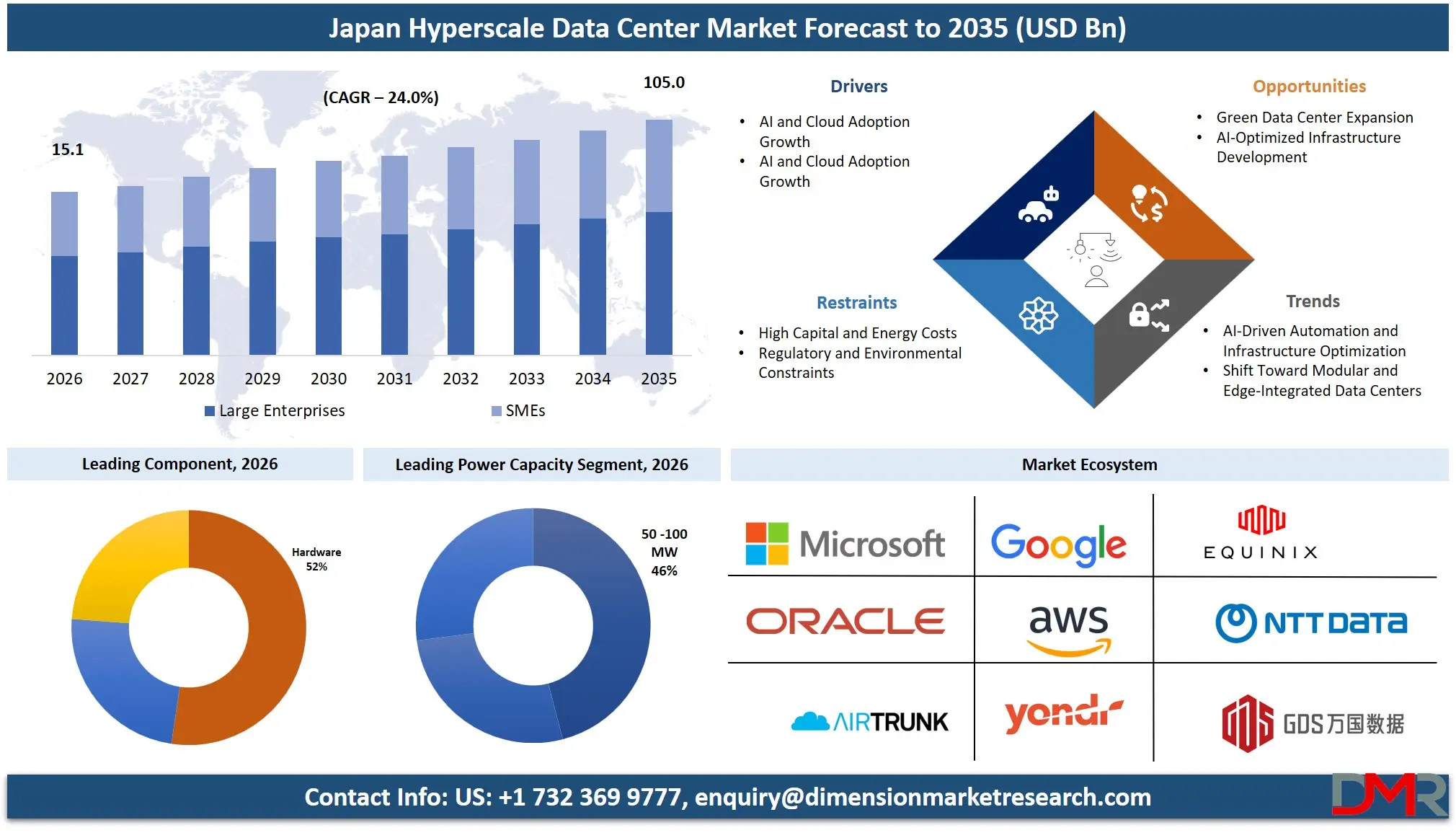
The Japan Hyperscale Data Center Market size is expected to be USD 15.1 billion in 2026 and increase at a compound annual growth rate of 24.0% to USD 105.0 billion in 2035 owing to AI and cloud adoption growth.
ℹ
To learn more about this report –
Download Your Free Sample Report Here
The Japan Hyperscale Data Center Market comprises large-scale, highly automated data center facilities designed to support cloud computing, artificial intelligence workloads, big data analytics, and enterprise digital infrastructure. These facilities integrate advanced IT equipment, high-density servers, scalable storage systems, and energy-efficient cooling technologies to handle massive data processing requirements. The market plays a critical role in Japan's digital economy, supporting hyperscalers, cloud service providers, and telecom operators. Rising demand for AI-driven applications, 5G expansion, and edge computing is reshaping infrastructure design. Sustainability initiatives, including carbon-neutral data centers and renewable energy integration, are key emerging trends driving modernization and long-term market transformation across the country.
Key Takeaways
- Market Size & Forecast: The Japan Hyperscale Data Center Market size is projected to reach USD 15.1 billion in 2026 and is anticipated to have a value of USD 105.0 billion in 2035.
- Growth Rate & Outlook: The Japan Hyperscale Data Center Market size is set to grow at a compound annual growth rate of 24.0% during the forecast period of 2026 to 2035.
- Primary Growth Drivers: Some of the major growth drivers in the market are AI and Cloud Adoption Growth, and more.
- Key Market Trends: Some of the major trends in the market are AI-Driven Automation and Infrastructure Optimization and more.
- By Component Type: Hardware is expected to get the largest revenue share in 2026 in the Japan Hyperscale Data Center Market.
- By Power Capacity Type: 50 – 100 MW is expected to get the largest revenue share in 2026 in the Japan Hyperscale Data Center Market.
- By Organization Type: Large enterprises segment is expected to get the largest revenue share in 2026 in the Japan Hyperscale Data Center Market.
What is the Hyperscale Data Center?
The Hyperscale Data Center refers to a large-scale, highly scalable computing infrastructure designed to handle massive volumes of data processing, storage, and networking demands. These facilities are built to support cloud computing platforms, artificial intelligence, machine learning, and other data-intensive applications with high efficiency and minimal latency. They integrate advanced servers, high-speed networking systems, and intelligent cooling and power management solutions. Hyperscale data centers are essential for enabling global digital services, supporting enterprise workloads, and ensuring seamless scalability for rapidly growing data requirements across industries.
Use Cases
- Cloud Computing Infrastructure: Supports hyperscale cloud platforms enabling enterprises to store, process, and manage massive datasets efficiently across industries.
- Artificial Intelligence & Machine Learning: Provides high-performance computing resources required for AI model training, inference, and advanced analytics workloads.
- Content Delivery & Streaming: Enables low-latency streaming services for video, gaming, and digital media platforms across Asia-Pacific networks.
- Disaster Recovery & Backup Systems: Ensures secure data replication, redundancy, and rapid recovery solutions for enterprises and government agencies.
How AI Is Transforming the Japan Hyperscale Data Center Market
AI technologies are significantly enhancing operational efficiency in hyperscale data centers by enabling predictive maintenance, automated cooling systems, and intelligent workload distribution. These capabilities reduce energy consumption and improve system reliability. AI also optimizes server utilization and enhances cybersecurity through real-time threat detection. In addition, AI-driven analytics help operators forecast demand and manage capacity planning more effectively.
Furthermore, AI is enabling advanced services such as machine learning model training and generative AI workloads, increasing demand for high-performance infrastructure. It is also improving customer experience by ensuring faster data processing and reduced latency across cloud platforms and digital services.
Market Dynamic
Driving Factors in the Japan Hyperscale Data Center Market
AI and Cloud Adoption Growth
Rapid adoption of AI, cloud computing, and big data analytics is significantly driving hyperscale data center expansion in Japan. Enterprises across BFSI, healthcare, and manufacturing increasingly rely on scalable infrastructure to manage data-intensive workloads. The shift toward hybrid and multi-cloud environments is accelerating demand for high-capacity facilities. Government initiatives promoting Society 5.0 and digital transformation further support infrastructure development. These factors collectively enhance investments in hyperscale facilities, enabling faster processing speeds, improved data management, and greater operational efficiency across industries.
Restraints in the Japan Hyperscale Data Center Market
High Capital and Energy Costs
One of the major restraints in the Japan Hyperscale Data Center Market is the extremely high capital investment required for construction, equipment, and maintenance. Additionally, Japan's limited land availability and high electricity costs significantly increase operational expenses. Energy-intensive workloads such as AI training further strain power infrastructure. These cost barriers restrict entry for smaller players and slow down expansion in certain regions. As a result, market growth is heavily dependent on large-scale investments from global hyperscalers and established telecom operators.
Opportunities in the Japan Hyperscale Data Center Market
Green Data Center Expansion
Growing emphasis on sustainability presents a major opportunity in Japan's hyperscale data center market. Demand for carbon-neutral and energy-efficient facilities is increasing due to corporate ESG commitments and government climate goals. Investments in renewable energy integration, liquid cooling systems, and energy-efficient hardware are expected to rise. Companies adopting green infrastructure can gain competitive advantage while aligning with Japan's carbon neutrality targets, creating long-term growth potential.
Trends in the Japan Hyperscale Data Center Market
AI-Driven Automation and Infrastructure Optimization
AI-powered automation is transforming hyperscale data center operations in Japan by improving energy efficiency, predictive maintenance, and workload management. Intelligent systems optimize cooling, reduce downtime, and enhance resource utilization. This trend is improving operational efficiency while reducing costs. The integration of AI in infrastructure management is becoming standard practice among leading operators.
Research Scope and Analysis
The research scope and analysis of the Hyperscale Data Center market covers infrastructure components, ownership models, capacity segmentation, workload types, end-user industries, and regional dynamics. It evaluates demand drivers, technological advancements, and competitive strategies. The study also examines AI integration, sustainability trends, and investment patterns shaping future market growth and scalability.
ℹ
To learn more about this report –
Download Your Free Sample Report Here
By Component Analysis
The Japan Hyperscale Data Center Market is segmented into hardware, software, and services, with hardware dominating due to high demand for servers, storage systems, and networking equipment. In 2026, hardware is estimated to hold around 52% share, driven by continuous infrastructure expansion, rapid hyperscale facility construction, and increasing AI workload density that requires advanced GPU-enabled servers and high-capacity storage systems. Software, particularly DCIM and automation tools, is the fastest-growing segment due to rising demand for intelligent infrastructure management, predictive analytics, and energy optimization. Services such as managed services, consulting, and integration are also expanding as enterprises increasingly outsource operations to improve efficiency, reduce downtime risks, and ensure scalability in complex hyperscale environments.
By Data Center Ownership Analysis
Cloud provider-owned data centers dominate with an estimated 58% share in 2026, driven by hyperscalers aggressively expanding infrastructure to support AI, machine learning, and large-scale cloud computing workloads. These providers benefit from economies of scale, advanced technology integration, and strong global connectivity. Colocation facilities are growing rapidly due to enterprise demand for flexible, cost-efficient, and secure infrastructure without heavy capital investment. Enterprise-owned centers are gradually declining in share as companies shift toward outsourced cloud models and hybrid architectures. Growth is strongly influenced by hybrid cloud adoption, digital transformation strategies, and rising demand for resilient, high-performance computing environments capable of supporting mission-critical applications.
By Power Capacity Analysis
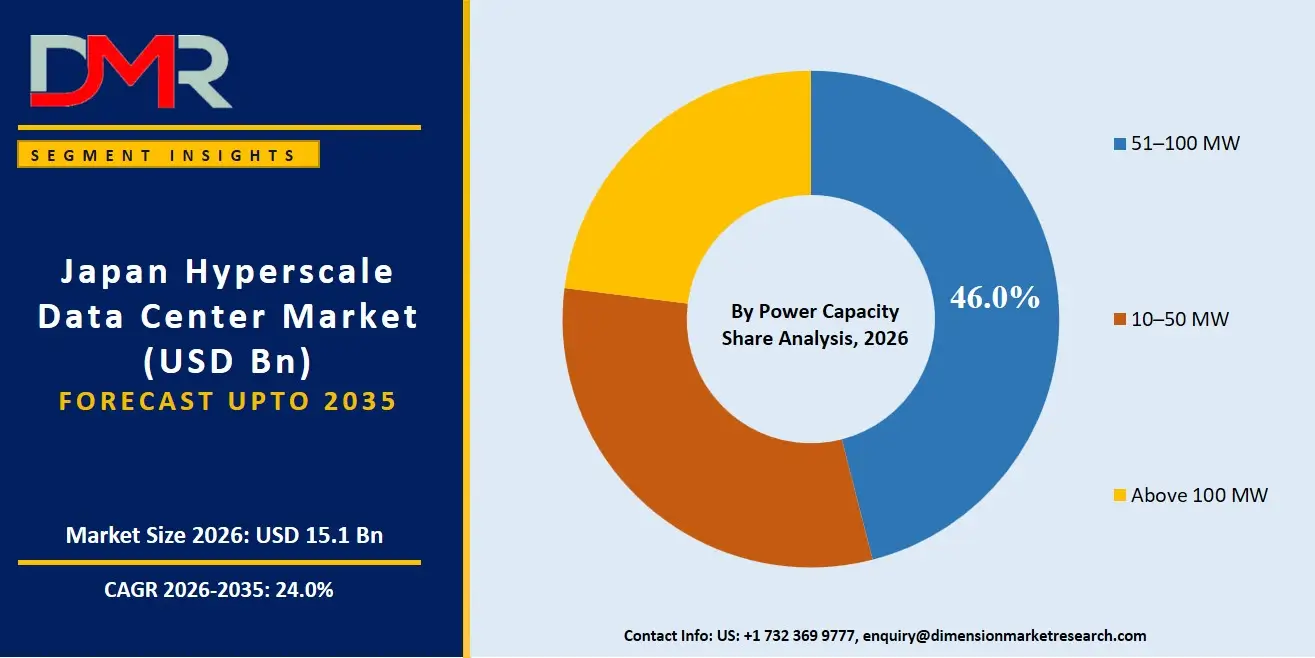
The 51–100 MW segment holds the leading share at approximately 46% in 2026, driven by strong demand for mid-to-large hyperscale deployments that balance scalability and operational efficiency. These facilities are widely preferred by cloud providers and large enterprises due to their optimal capacity for handling high-density workloads. Facilities above 100 MW are the fastest-growing segment, fueled by AI model training, generative AI workloads, and massive cloud expansion requiring extreme computing power and energy supply. Smaller 10–50 MW centers remain relevant for edge computing and localized workloads, especially in urban clusters. Increasing energy consumption and modular infrastructure adoption are reshaping capacity planning strategies across Japan.
By Organization Size Analysis
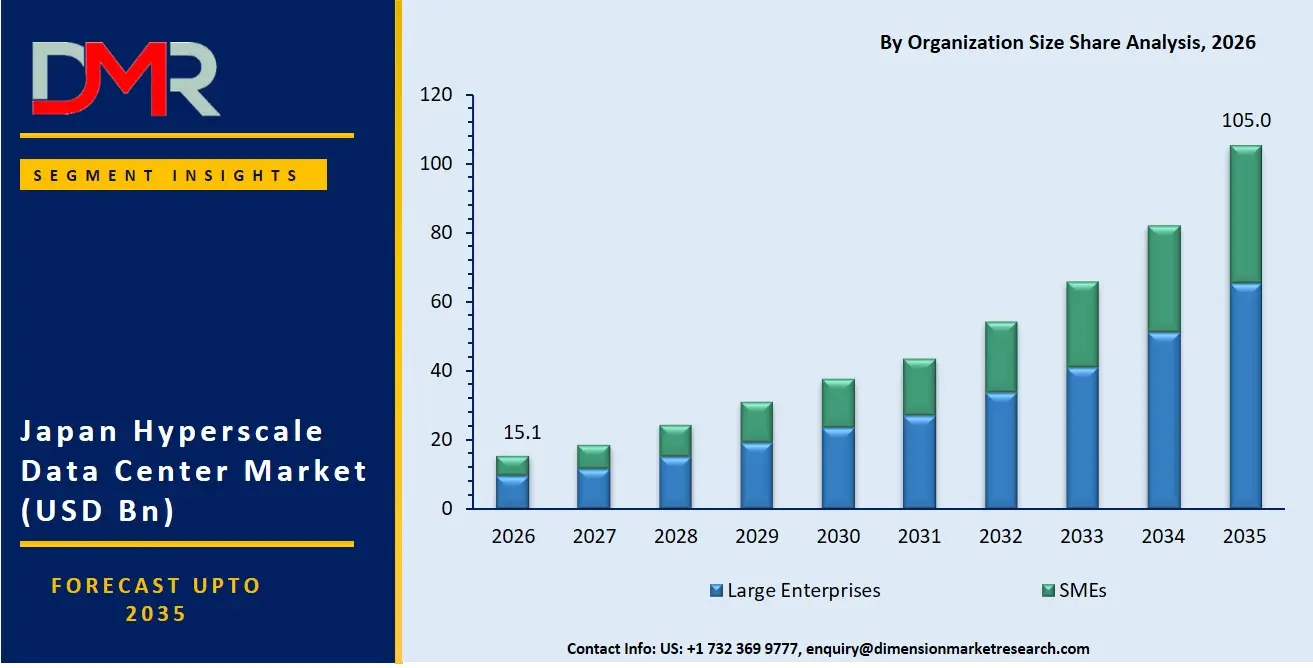
Large enterprises dominate the market with an estimated 62% share in 2026, owing to their strong financial capacity to invest in large-scale hyperscale infrastructure and digital transformation initiatives. These organizations prioritize private cloud setups, hybrid models, and high-performance computing systems to support critical business operations.
ℹ
To learn more about this report –
Download Your Free Sample Report Here
SMEs represent the fastest-growing segment as cloud platforms become more affordable, scalable, and accessible through subscription-based models and managed services. Increasing digitalization, SaaS adoption, and remote working trends are significantly driving SME demand for flexible data center services. This shift is broadening the market base and accelerating overall hyperscale adoption across multiple industry verticals.
By Workload Type Analysis
Cloud computing leads with an estimated 40% share in 2026, driven by widespread enterprise adoption of hybrid and multi-cloud environments for scalable data storage and processing. AI & ML workloads are the fastest-growing segment due to rapid integration of generative AI, predictive analytics, and automation technologies across industries such as BFSI, healthcare, and manufacturing. Big data analytics is expanding steadily, supported by the need for real-time insights and decision-making capabilities. Edge computing is also gaining momentum due to IoT expansion and low-latency application requirements. Overall demand is shifting toward high-performance, data-intensive workloads requiring robust and energy-efficient hyperscale infrastructure.
By End User Analysis
Cloud service providers dominate with an estimated 48% share in 2026, driven by continuous hyperscale expansion and increasing global demand for cloud-based applications and storage solutions. IT & telecom, BFSI, and government sectors also contribute significantly due to their need for secure, scalable, and high-availability infrastructure. Healthcare and manufacturing are among the fastest-growing segments, fueled by digital transformation, AI integration, and smart automation initiatives. Media, retail, and energy sectors are increasingly leveraging hyperscale infrastructure for real-time analytics, content delivery, and operational optimization. This diversified demand base is strengthening overall market resilience and accelerating adoption across Japan's digital economy.
The Japan Hyperscale Data Center Market Report is segmented on the basis of the following:
By Component
- Hardware
- IT Equipment
- Servers
- Storage Systems
- Networking Equipment
- Power Infrastructure
- UPS Systems
- Power Distribution Units (PDUs)
- Generators
- Switchgear & Transformers
- Cooling Infrastructure
- Cooling Systems
- Racks & Cabinets
- Software
- DCIM Software
- Infrastructure Automation Software
- Monitoring Software
- Security Software
- Services
- Design & Consulting
- Installation & Integration
- Maintenance & Support
- Managed Services
By Data Center Ownership
- Cloud Provider-Owned
- Colocation Provider-Owned
- Enterprise-Owned
By Power Capacity
- 10–50 MW
- 51–100 MW
- Above 100 MW
By Organization Size
- Large Enterprises
- Small & Medium Enterprises (SMEs)
By Workload Type
- Artificial Intelligence & Machine Learning
- High-Performance Computing (HPC)
- Cloud Computing
- Big Data Analytics
- Content Delivery & Streaming
- Disaster Recovery
- Enterprise Applications
- Edge Computing
- Other Workloads
By End User
- Cloud Service Providers
- IT & Telecommunications
- BFSI
- Government
- Healthcare
- Manufacturing
- Retail & E-commerce
- Media & Entertainment
- Energy & Utilities
- Others
Competitive Landscape
The Japan Hyperscale Data Center Market is highly competitive, with operators focusing on capacity expansion, energy efficiency, and AI-ready infrastructure to strengthen market positioning. Companies are investing heavily in renewable energy integration, modular construction, and advanced cooling technologies to reduce operational costs and improve sustainability. Strategic partnerships with cloud providers, telecom operators, and technology vendors are common to enhance service offerings. High entry barriers, including capital intensity and regulatory compliance, limit new entrants. Continuous innovation and long-term infrastructure planning remain key competitive differentiators.
Some of the prominent players in the Japan Hyperscale Data Center are:
- Amazon Web Services
- Microsoft
- Google Cloud
- Oracle
- NTT DATA
- Equinix
- Digital Realty
- MC Digital Realty
- AirTrunk
- Yondr Group
- Colt Data Centre Services
- STACK Infrastructure
- Princeton Digital Group
- GDS Holdings
- EdgeConneX
- CyrusOne
- Global Switch
- Vantage Data Centers
- KDDI Corporation
- Other Key Players
Recent Developments
- In June 2025, Google Cloud expanded its partnership ecosystem in Japan to enhance hyperscale cloud services and AI capabilities. The collaboration includes infrastructure upgrades and increased data processing capacity within Japanese data centers. The initiative focuses on supporting generative AI workloads and enterprise digital transformation. This development strengthens cloud accessibility and accelerates adoption of advanced analytics and machine learning solutions across Japanese industries, improving overall market competitiveness and innovation.
- In March 2025, NTT Global Data Centers invested in new hyperscale infrastructure across Japan to support AI-driven workloads and 5G expansion. The investment focuses on building energy-efficient facilities with renewable energy integration. The initiative aligns with Japan's carbon neutrality goals and aims to enhance capacity for cloud service providers. This move reinforces NTT's leadership in domestic digital infrastructure and supports long-term scalability for enterprise and government digital transformation projects.
- In January 2025, Equinix announced the expansion of its Tokyo data center campus to support growing demand for AI and cloud workloads. The expansion includes additional high-density server capacity and advanced liquid cooling systems designed for hyperscale operations. The project aims to enhance interconnection services for global cloud providers and enterprises. This development strengthens Equinix's position in Japan's competitive colocation and hyperscale ecosystem while supporting low-latency connectivity across Asia-Pacific digital networks.
Report Details
| Report Characteristics |
| Market Size (2026) |
USD 15.1 Bn |
| Forecast Value (2035) |
USD 105.0 Bn |
| CAGR (2026–2035) |
24.0% |
| Historical Period |
2021 – 2025 |
| Forecast Period |
2027 – 2035 |
| Base Year |
2025 |
| Estimate Year |
2026 |
| Segments Covered |
By Component, By Data Center Ownership, By Power Capacity, By Organization Size, By Workload Type, By End User |
| Country Coverage |
Japan |
Frequently Asked Questions
How big is the Japan Hyperscale Data Center Market?
▾ The Japan Hyperscale Data Center Market size is expected to reach USD 15.1 billion by 2026 and is projected to reach USD 105.0 billion by the end of 2035.
What is the CAGR of the Japan Hyperscale Data Center Market from 2026 to 2035?
▾ The market is growing at a CAGR of 24.0 percent over the forecasted period.
What factors are driving the growth of the Japan Hyperscale Data Center Market?
▾ AI and Cloud Adoption Growth, and more are the factors driving the growth of the Japan Hyperscale Data Center Market.
What are the major trends in the Japan Hyperscale Data Center Market?
▾ AI-Driven Automation and Infrastructure Optimization, and more are some of the major trends in the market.
Who are the key players in the Japan Hyperscale Data Center Market?
▾ Some of the key players in the Japan Hyperscale Data Center Market include AWS, Google, NTT, and more.
How is the Japan Hyperscale Data Center Market segmented?
▾ The Japan Hyperscale Data Center Market is segmented by component, data center ownership, power capacity, organization size, workload type, end user.