What is the Japan Network Automation Market Size?
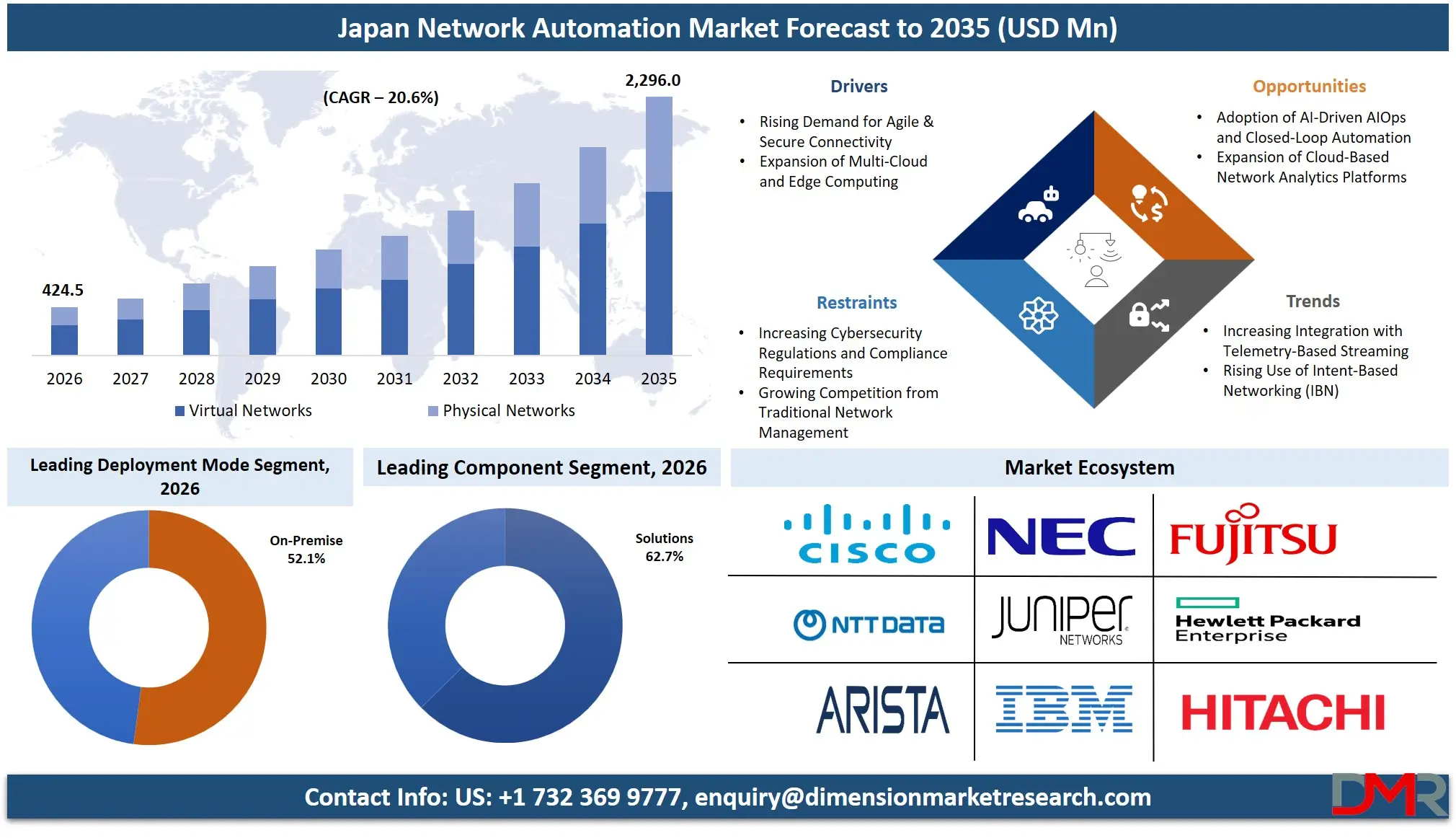
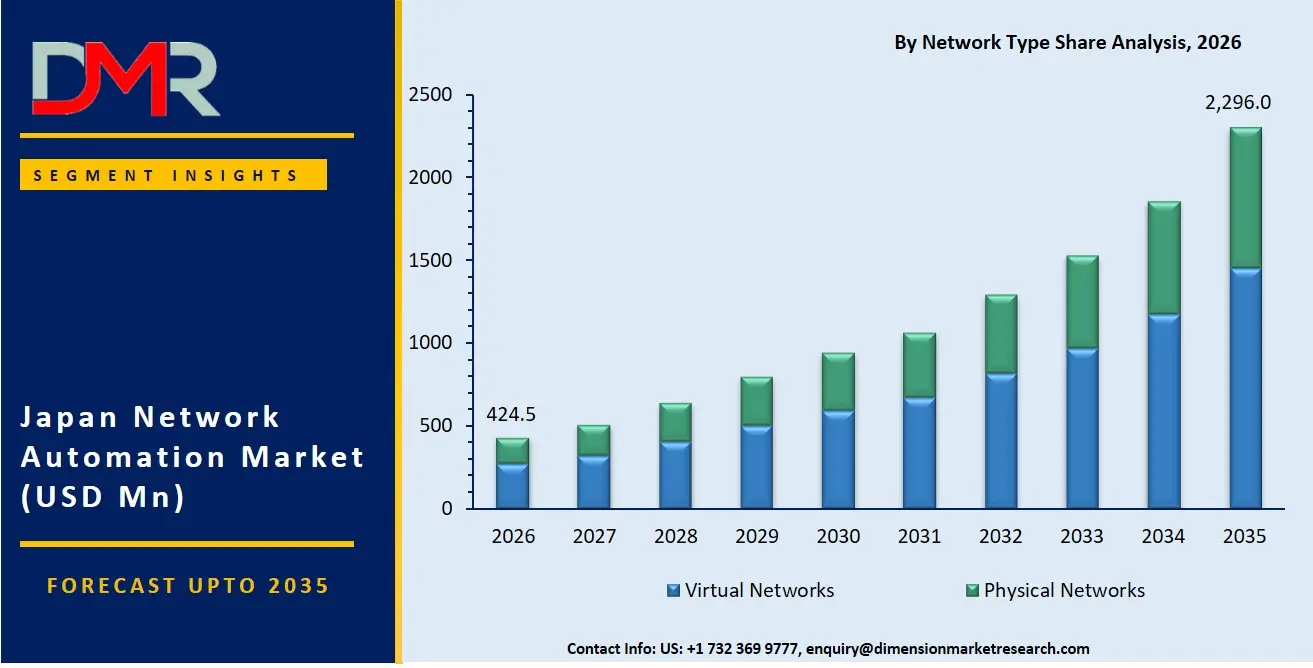
The Japan Network Automation Market is expected to reach a value of USD 424.5 million in 2026, and it is further anticipated to reach USD 2,296.0 million by 2035, growing at a CAGR of 20.6% during the forecast period.
ℹ
To learn more about this report –
Download Your Free Sample Report Here
The network automation market has been showing consistent growth due to Japan's rising dependence on software-driven, API-centric, and cloud-native networking for effective, secure, and scalable connectivity. This includes SDN, NFV, and AIOps platforms along with expert professional services that help enterprises and telecom operators deploy intelligent automation for data centers, campus networks, and WAN infrastructure. There has been a rising need for security orchestration services owing to the requirements for implementing zero-touch provisioning, securing operational continuity against cyber threats, and delivering high-performance intent-based networking systems to customers. IT & telecom operators have emerged as the largest consumer segment for network automation solutions, with software platforms being the most popular choice due to their scalability and programmability, while there has been rapid growth in AI-driven analytics and managed security services.
ℹ
To learn more about this report –
Download Your Free Sample Report Here
Key Takeaways
- Market Size & Forecast: The Japan Network Automation Market is forecasted to be valued at USD 424.5 million in 2026, growing incrementally to USD 2,296.0 million by 2035, due to the joint efforts of digital transformation on the part of enterprises as well as the mandatory deployment of zero-touch and resilient network technologies.
- Growth Rate & Outlook: Japan market is expected to grow at 20.6% CAGR, propelled by the urgent need to mitigate multi-cloud networking complexity, alongside increasing challenges in orchestrating east-west traffic flows from distributed data centers, edge computing nodes, and remote workforces.
- Primary Growth Drivers: Major driving factors comprise the transition from manual CLI-based network management towards modern intent-based automation systems, the necessity to deploy secure and robust APIs for network programmability, as well as the implementation of closed-loop automation requiring unique platform and services expertise.
- Key Market Trends: Major trends encompass the introduction of AI-driven network monitoring through commercial channels, usage of machine learning for predictive traffic engineering and anomaly detection, and increased focus on automated security compliance amidst rising regulatory scrutiny in Japan.
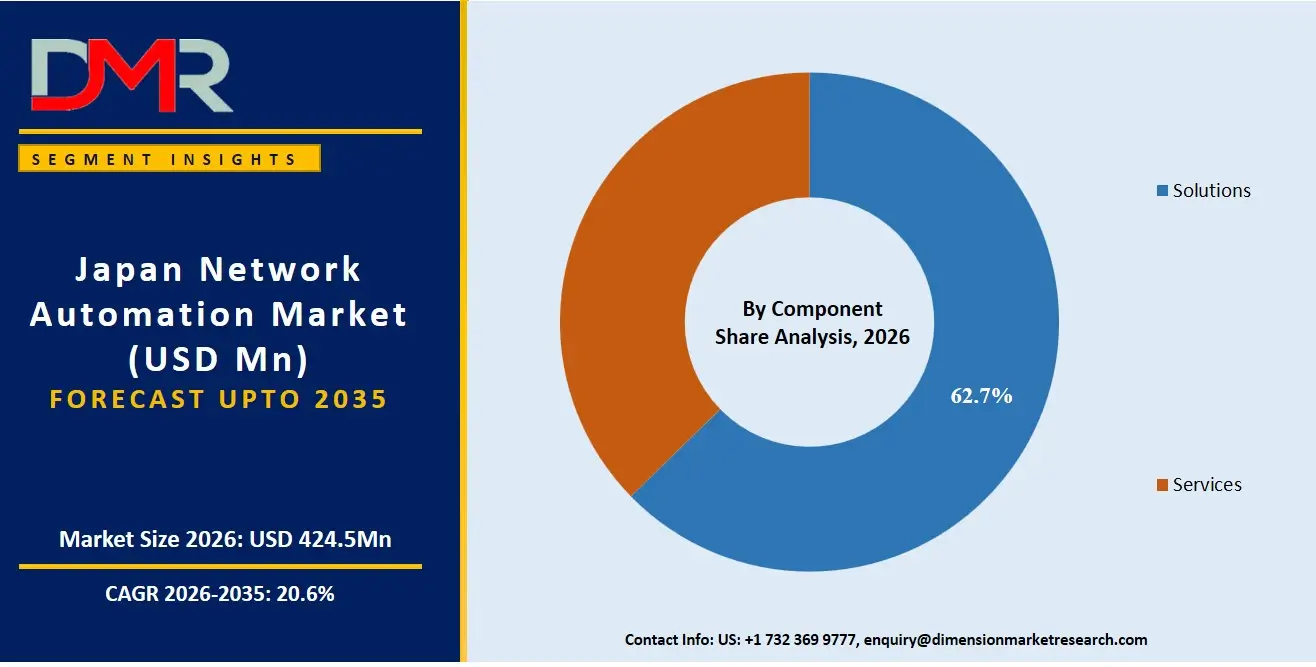
- By Component Analysis: The solutions segment is projected to dominate the Japan Network Automation Market due to high demand for scalable SDN controllers and AIOps platforms by telecom and enterprise IT operators, with capabilities like real-time configuration, intent validation, and closed-loop remediation, which offer daily operations, regional load balancing, and real-time performance monitoring within network management.
- By Network Type Analysis: The virtual networks segment is projected to dominate the Japan Network Automation Market due to SDN, NFV, cloud-native adoption, and 5G expansion enabling programmable automation. Physical networks retain relevance in legacy enterprise, manufacturing, and government systems where reliability, security, and deterministic performance remain essential.
- By Application Analysis: The network provisioning segment is anticipated to dominate in the Japan Network Automation Market; however, network monitoring and security & compliance are experiencing the fastest growth in Japan, driven by BFSI and government mandates for real-time visibility and automated threat response.
What is Network Automation?
Network Automation refers to the combination of software platforms and technical expertise used to operate intelligent, programmable, and API-driven network infrastructures. Unlike traditional manual network management, it enables real-time, policy-based control of connectivity across complex environments. It includes automation platforms such as SDN controllers, NFV orchestrators, and intent-based networking (IBN) engines that define and enforce network policies for optimized traffic flow. It also involves services that support cloud integration, operational efficiency, cost reduction, and improved network security and performance. As enterprises advance their digital transformation initiatives, network automation plays a critical role in ensuring scalable, secure, and agile network operations.
Use Cases
- Data Center Fabric Automation: IT departments employ Network Automation Solutions for the installation of zero-touch EVPN-VXLAN fabrics that include real-time telemetry and automated path failover to avoid application downtime and increase operational trust.
- Hospital Network Security Compliance: Hospital networks rely on Network Automation Platforms for deploying automated security group tagging and micro-segmentation, ensuring compliance with Japan's medical data protection laws and maintaining audit readiness.
- Public Infrastructure Connectivity: Municipal authorities incorporate SD-WAN automation APIs in order to push bandwidth policies and application adherence notifications to central NOCs in real-time.
- Telecom 5G Orchestration: Mobile network operators leverage NFV and AIOps platforms in a cloud-native suite to initiate geo-targeted network slicing during large-scale events.
How AI is Transforming the Network Automation Market?
AI is revolutionizing the network automation market due to its ability to provide various functionalities such as traffic prediction, anomaly detection, and proactive remediation. AI-based AIOps tools use artificial intelligence (AI) and machine learning (ML) to perform analysis of network performance metrics and detect configuration deviations, as well as detect any inefficient network practices in complex hybrid and multi-cloud IT infrastructure. Enterprises and telecom providers can use this information to initiate timely corrective actions using closed-loop automation. AI technologies are helping achieve improvements in terms of intent-based networking by automatically adjusting policies according to the network workload.
Moreover, AI is making network orchestration more efficient in managing QoS parameters, making better routing decisions, and scheduling maintenance procedures. Not only does the implementation of AI increase operational efficiency, but it also helps in ensuring that the organization is compliant with the relevant laws and regulations. This is particularly important for the Japanese enterprise and telecom market due to the stringent legal requirements. Moreover, the use of intelligent automation technology and tools is increasingly being used in professional services to help automate the network management process.
Market Dynamics
Key Drivers in the Japan Network Automation Market
Rising Demand for Agile & Secure Connectivity
AI is revolutionizing the network automation industry through increased traffic forecasting, anomaly detection, and predictive remediation capabilities. The AIOps platform suite includes AI/ML-based systems that detect configuration drift and network inefficiencies in order to resolve them instantaneously via closed-loop automation, thereby preventing any financial losses and operational damage. In addition, the AI-driven functions of network orchestration services help organizations assess flow behavior, determine optimal QoS policies, and customize their maintenance windows. AI forms an essential part of governance and customer trust initiatives. Professional services involve intelligent agents that monitor compliance and keep network configuration logs free of any non-compliant entries while ensuring that all operations adhere to regulations and the stringent cybersecurity protocols in Japan.
Expansion of Multi-Cloud and Edge Computing
The rapid development of multi-cloud adoption in Japan creates high demands in the IT sector in various fields such as hybrid cloud connectivity, edge computing, 5G transport, and containerized network functions. Companies today use network automation solutions to achieve critical goals related to operational efficiency, workload placement, asset tracking, and regulatory reporting. With increased use of distributed cloud resources by many enterprise operators, network owners have become more interested in adopting an automated network management system that can handle multi-vendor environments effectively. In addition, there is a growing need for predictable application performance for network managers, which increases the adoption rate of network automation platforms.
Restraints in the Japan Network Automation Market
Increasing Cybersecurity Regulations and Compliance Requirements
The increasingly stringent network security regulations and data protection legislations in Japan (including amendments to the Act on the Protection of Personal Information) have brought about difficulties for network automation vendors as well as enterprise operators. The regulatory bodies are tightening their grip on the control of network configuration deployments, the acquisition and management of data consents from local communities, and encryption measures in order to minimize risks related to cyber intrusions. Enterprises are expected to adhere to highly stringent operational requirements, making their deployments more complicated and costly. The violation of such rules subjects an enterprise operator using network automation to heavy fines, delivery delays, and reputational harm.
Growing Competition from Traditional Network Management
Growth in the usage of conventional network infrastructure with limited automation is impacting the future growth of network automation within Japan. Traditional CLI-based systems are preferred over intelligent automation for certain legacy applications since they offer lower upfront costs and reduced learning curve for remote area purposes. Some enterprise operators have also begun using legacy SNMP-based monitoring as part of their daily operations, relying less on cloud-based AIOps campaigns. The use of conventional systems also offers simpler maintenance solutions without advanced analytics. Modern network automation solutions are under growing pressure from competing legacy infrastructure investments.
Growth Opportunities in the Japan Network Automation Market
Adoption of AI-Driven AIOps and Closed-Loop Automation
There exist many growth opportunities in the network automation market in Japan through the increasing implementation of AIOps (Artificial Intelligence for IT Operations) platforms. These intelligent solutions allow enterprise operators to engage in real-time, predictive network remediation other than using standard reactive troubleshooting. Higher reliability, rapid root cause isolation, and lower total cost of ownership are some features that may be implemented by network operators in digitalizing their infrastructures. Service providers based in Japan are starting to consider implementing AIOps as an alternative for effective lean IT management. With improved telemetry infrastructure by telecom suppliers and increased sensor accuracy, many enterprises will spend significant money on advanced network automation systems.
Expansion of Cloud-Based Network Analytics Platforms
Integration of cloud computing in network analytics platforms is bringing about great prospects for network automation providers in Japan. Many enterprise operators are now using cloud-based analytics technology that automates bandwidth response processes in order to offer predictive maintenance support to network managers. AI can help organizations understand traffic behavior, customize QoS policies, and determine when the best time is for preventive maintenance in order to maximize operational uptime and cost savings. The increasing use of machine learning analytics, intelligent automation, and predictive diagnostics in different sectors such as IT & telecom, BFSI, and manufacturing is driving demand for innovative analytics technology.
Trends in the Japan Network Automation Market
Increasing Integration with Telemetry-Based Streaming
Increasingly, Japanese enterprise operators are adopting streaming telemetry-based sensor networks by integrating network automation services that help improve scalability and fault automation. Streaming telemetry allows organizations to easily integrate network device APIs into their AIOps platforms, workforce management solutions, and maintenance processes without having to invest heavily in existing polling-based infrastructure. The advantages associated with streaming telemetry include real-time asset management, network quality analytics, and multi-site engagement options. Due to the growing adoption of digital transformation approaches in addition to remote network management processes, the use of telemetry has been steadily increasing. The adoption of streaming telemetry as an alternative to more expensive on-premise polling solutions has continued to gain popularity in Japan.
Rising Use of Intent-Based Networking (IBN)
Intent-based approaches are being incorporated by Japanese enterprise firms in order to facilitate their network operations using a combination of SDN, NFV, IBN, and AI-based assurance. Companies are focusing on creating an integrated network experience that ensures consistency in the delivery of business intent through different network domains. Network automation solutions continue to be an integral part of these IBN approaches owing to their real-time visibility and continuous verification. Companies from sectors such as financial services, healthcare, and municipal services have been incorporating IBN into their digital IT management solutions.
Research Scope and Analysis
The Japan Network Automation Market is segmented by component, network type, deployment mode, network infrastructure, technology, application, and industry vertical. The market supports enterprise campus networks, data center fabrics, telecom 5G transport, and government infrastructure across individual consumers, telecom operators, public authorities, and IT companies through cloud-based and on-premise network management solutions.
ℹ
To learn more about this report –
Download Your Free Sample Report Here
By Component Analysis
Solutions are expected to lead the Japan Network Automation Market in 2026 with a projected market share of 49.9% as a result of enterprise operators' growing preference for scalable SDN controllers, NFV orchestrators, and AIOps platforms. Japanese enterprises have developed a preference for software-defined networking, intent-based engines, and automation suites for performing such functions as traffic engineering, change validation, and real-time telemetry analysis. Services are likely to occupy the second place with a 24.2% share due to the rising trend in favor of professional services for multi-vendor integration and ongoing managed services across distribution networks. Consulting & system integration, though currently at a 17.1% share, is expected to grow steadily as a consequence of increased knowledge about network modernization and ongoing maintenance requirements, particularly for digital transformation projects in Tokyo, Osaka, and Nagoya.
By Network Type Analysis
Virtual networks are projected to dominate the Japan Network Automation Market in 2026, with an estimated share of 54.7%, owing to accelerating adoption of software-defined networking (SDN), network functions virtualization (NFV), and cloud-native automation across telecom and enterprise environments. Japanese enterprise and telecom operators favor virtual networks because they enable scalable, programmable, and policy-driven connectivity with high agility and reduced operational complexity. Physical networks follow, driven by continued use in legacy enterprise infrastructure, manufacturing systems, and government networks, where reliability, security, and deterministic performance remain critical. Overlay networks (VXLAN, NVGRE) are primarily used by data center operators with multi-tenant requirements. Network virtualization is growing rapidly due to increased deployment for edge computing and distributed cloud environments in metropolitan and semi-urban areas.
By Deployment Mode Analysis
On-premise deployment is projected to lead the Japan Network Automation Market in 2026, with an estimated share of 54.6%, owing to stringent data sovereignty requirements and strong security mandates across Japan's BFSI, government, telecom, and healthcare sectors. Japanese enterprises continue to prefer on-premise and private-controlled automation platforms to maintain full visibility and control over sensitive network configurations and telemetry data. This is reinforced by Japan's risk-averse IT culture and large legacy enterprise infrastructure base. Cloud-based deployment is expected to grow steadily, driven by increasing adoption of SaaS-based AIOps platforms, SDN/NFV virtualization, and demand for scalable, distributed network management. Hybrid models are also gaining traction as enterprises balance security with cloud-driven agility and analytics.
By Network Infrastructure Analysis
Wired networks are projected to hold the largest share of the Japan Network Automation Market in 2026, with an estimated share of 56.8%, due to their extensive use in data center fabrics, enterprise campus backbones, and telecom transport infrastructure. Japanese enterprises rely on wired automation for high-bandwidth, low-latency applications such as financial systems, industrial automation, and carrier-grade networks. Wireless networks are expected to grow at a faster pace, driven by increasing adoption of Wi-Fi 6/6E, private 5G, and automated WLAN management across retail, healthcare, logistics, and manufacturing sectors. Automation use cases such as RF optimization, roaming management, and AI-based security enforcement are expanding steadily across enterprise wireless environments in Japan.
By Technology Analysis
SDN (Software-Defined Networking) is projected to lead the Japan Network Automation Market in 2026, with an estimated share of 35.7%, owing to its mature adoption in data center environments and wide area networks. Japanese telecom operators and large enterprises have deployed SDN controllers for traffic engineering, network slicing, and multi-cloud connectivity. AI & ML Integration (AIOps) is expected to experience the fastest growth, driven by the need for predictive analytics, anomaly detection, and closed-loop remediation across complex network environments. NFV (Network Functions Virtualization) maintains a steady share as telecom operators virtualize CPE and edge functions. Intent-Based Networking (IBN) is gaining traction among BFSI and government enterprises requiring continuous verification and compliance automation. Traditional Network Management is gradually declining as organizations migrate to programmable automation platforms.
By Application Analysis
Network provisioning is set to dominate the Japan Network Automation Market in 2026 with a projected share of 39.3%, thanks to its high deployment penetration for zero-touch provisioning (ZTP), government-backed digital transformation initiatives, and low complexity for end-users. Provisioning solutions enable automated device onboarding, configuration templating, and intent translation that do not necessitate manual CLI expertise. However, network monitoring is experiencing robust growth and is nearly co-dominant in Japan due to heightened enterprise preference for real-time telemetry, streaming analytics, and automated alerting. Security & compliance will experience very strong growth in the coming years because of stringent Japanese financial regulations (FSA) and government cybersecurity mandates, driving demand for automated security policy enforcement and audit trail generation. Policy management holds 9.6% share, primarily deployed in BFSI and government sectors to reduce configuration drift and maintain compliance.
By Industry Vertical Analysis
The IT & Telecom segment is projected to continue dominating the Network Automation Market of Japan, with an expected market share of 46.9% in 2026, owing to 5G rollouts, data center expansion, and cloud adoption, as well as heavy reliance on real-time network visibility and automated lifecycle management solutions. Businesses in the IT & Telecom segment are increasingly adopting network automation technologies due to the benefits offered by such systems, including lower operational costs, predictable service delivery, and regulatory compliance with telecommunications mandates. The BFSI segment is expected to experience the fastest growth, thanks to the increasing deployment of automated security policy enforcement, network segmentation, and compliance reporting driven by stringent financial regulations and digital banking expansion. Government & Defense follows closely due to digital agency modernization initiatives. Other significant verticals include Manufacturing with Industrial IoT network automation and retail with SD-WAN deployment.
The Japan Network Automation Market Report is segmented based on the following:
By Component
By Network Type
- Physical Networks
- Virtual Networks
By Deployment Mode
By Network Infrastructure
- Wired Networks
- Wireless Networks
By Technology
- SDN (Software-Defined Networking)
- NFV (Network Functions Virtualization)
- Intent-Based Networking (IBN)
- AI & ML Integration
- Traditional Network Management
By Application
- Network Provisioning
- Network Configuration
- Network Monitoring
- Security & Compliance
- Policy Management
- Troubleshooting & Diagnostics
- Others
By Industry Vertical
- IT & Telecom
- BFSI
- Healthcare
- Manufacturing
- Retail & E-commerce
- Government & Defense
- Energy & Utilities
- Others
Competitive Landscape
The dynamics of competition in the Japan Network Automation marketplace have developed to become increasingly dynamic, with a wide range of multinational networking vendors, Japanese system integrators, and specialized AIOps software players focusing on various niche automation functions. The essential ingredient for success is found in deep-seated strategic partnerships with cloud providers and enterprise operators in Japan, which open up high-quality channels and allow premium managed automation services to be sold alongside software platforms. Market consolidation trends are moving steadily ahead, with established players in the world of enterprise networking and telecom infrastructure taking on acquisitions of specialized analytics platform providers to leverage their AI forecasting functionalities. Proprietary intellectual property rights, with AI-based predictive maintenance algorithms and closed-loop assurance engines, hold increasing importance compared to just competitive hardware pricing and basic orchestration.
Some of the prominent players in the Japan Network Automation Market are:
- Cisco Systems, Inc.
- NEC Corporation
- Fujitsu Limited
- NTT DATA Corporation
- Hitachi, Ltd.
- Hewlett Packard Enterprise Company
- Juniper Networks, Inc.
- IBM Corporation
- Arista Networks, Inc.
- VMware, Inc. (Broadcom Inc.)
- Nokia Corporation
- Telefonaktiebolaget LM Ericsson
- Huawei Technologies Co., Ltd.
- Extreme Networks, Inc.
- NetBrain Technologies, Inc.
- SolarWinds Corporation
- BMC Software, Inc.
- F5, Inc.
- Palo Alto Networks, Inc.
- KDDI Corporation
- Other Key Players
Recent Developments
- February 2026: Hewlett Packard Enterprise Company (through its Networking division including Juniper Networks, Inc.) advanced its AI-native networking strategy by integrating Juniper Mist AI capabilities into Aruba Central, enabling unified AIOps-driven network automation across enterprise and edge environments, supporting autonomous troubleshooting, client experience optimization, and intent-based network operations.
- November 2025: Cisco Systems, Inc. announced Cisco Unified Edge, a next-generation distributed AI and network automation platform that integrates compute, networking, storage, and security into a single architecture to support agentic AI workloads at the network edge, significantly advancing intent-based and AI-driven network automation capabilities for enterprise and service provider environments.
- September 2025: Nokia Corporation launched its upgraded MantaRay Autonomous Network platform, strengthening AI-powered closed-loop automation for 5G and IP networks, enabling real-time network optimization, self-healing capabilities, and intent-based orchestration for communication service providers, including deployments across Asia-Pacific markets such as Japan.
- February 2025: Juniper Networks, Inc. and IBM Corporation expanded their collaboration to integrate Juniper Mist AI with IBM watsonx, enabling AI-powered IT network operations, automated troubleshooting, and generative AI-driven network diagnostics to reduce manual intervention and improve enterprise network reliability.
Report Details
| Report Characteristics |
| Market Size (2026) |
USD 424.5 Mn |
| Forecast Value (2035) |
USD 2,296.0 Mn |
| CAGR (2026–2035) |
20.6% |
| Historical Data |
2021 – 2025 |
| Forecast Data |
2027 – 2035 |
| Base Year |
2025 |
| Estimate Year |
2026 |
| Segments Covered |
By Component, By Network Type, By Deployment Mode, By Network Infrastructure, By Technology, By Application, By Industry Vertical |
| Country Coverage |
Japan |
Frequently Asked Questions
How big is the Japan Network Automation Market?
▾ The Japan Network Automation Market is poised to be valued at USD 424.5 million in 2026 and is projected to reach USD 2,296.0 million by 2035.
What is the CAGR of the Japan Network Automation Market from 2026 to 2035?
▾ The market is expected to grow at a CAGR of 20.6% from 2026 to 2035, reflecting the maturing nature of the AIOps market and the accelerating complexity of multi-cloud, intent-based networking strategies.
What factors are driving the growth of the Japan Network Automation Market?
▾ Key drivers include the digital transformation imperative for operational efficiency, the need to modernize legacy CLI-based network systems, the management complexity of multi-cloud network orchestration, and the surge in demand for security automation amid evolving data protection laws in Japan.
What are the major trends in the Japan Network Automation Market?
▾ Major trends include the integration of AIOps into traffic forecasting and predictive remediation, the rise of intent-based networking (IBN) on commercial channels, the demand for vertical-specific compliance automation solutions (e.g., FSA for BFSI), and the focus on secure, closed-loop network assurance practices.
Who are the key players in the Japan Network Automation Market?
▾ Key players include Cisco Systems, Juniper Networks, Hewlett Packard Enterprise Company, NEC Corporation, Fujitsu Limited, NTT DATA Corporation, IBM Corporation, Arista Networks, Inc., Nokia Corporation, and many more.
How is the Japan Network Automation Market segmented?
▾ The market is segmented by component, network type, deployment mode, network infrastructure, technology, application, and industry vertical.