Market Snapshot
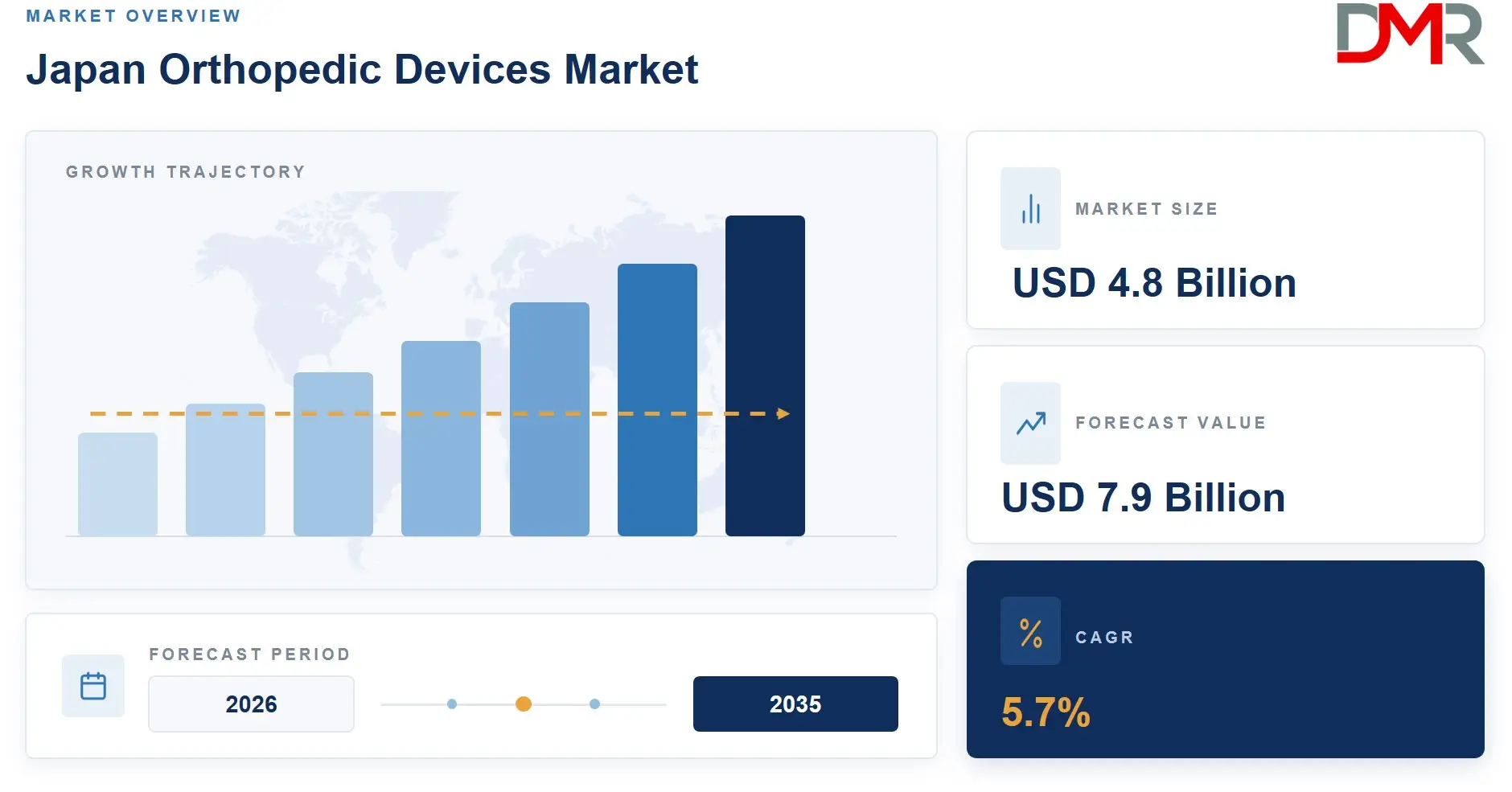
- Market Size (2026): USD 4.8 Bn
- Forecast Value (2035): USD 7.9 Bn
- CAGR (2026-2035): 5.7%
- Leading Product (2026): Joint Reconstruction Devices, approximately 34%
- Leading Technology (2026): Conventional Instruments and Implants, around 55%
- Key Players: Zimmer Biomet, Stryker, Teijin Nakashima Medical and others
What is Japan Orthopedic Devices Market and its Market Size?
The Japan Orthopedic Devices Market size is estimated to reach USD 4.8 Bn in 2026 and is further anticipated to reach USD 7.9 Bn by 2035, at a CAGR of 5.7%. Orthopedic devices include implants, fixation systems, surgical instruments, navigation platforms, robotic systems and supporting biomaterials used to restore skeletal stability, joint function and mobility after degeneration, trauma or deformity.
ℹ
To learn more about this report –
Download Your Free Sample Report Here
The figures cover demand generated inside Japan, rather than worldwide revenue earned by Japanese-headquartered manufacturers. The boundary includes devices used in joint reconstruction, trauma fixation, spine surgery, sports medicine and related orthopedic procedures, while general diagnostic imaging, pharmaceuticals and routine rehabilitation equipment are outside the core scope unless they are sold as an integral orthopedic treatment system.
Demand is anchored by Japan's older population, high procedure volumes for degenerative joint disease and a hospital system capable of supporting complex implant surgery. Buyers increasingly evaluate products on implant longevity, revision risk, infection control, operating-room efficiency and compatibility with navigation or robotic workflows. Reimbursement discipline keeps price expansion constrained, so suppliers must demonstrate clinical and workflow value rather than depend on premium pricing alone.
Structural change is coming from digital surgical planning, compact robotic assistance, patient-specific instrumentation, porous and additively manufactured implants, and surface technologies designed to improve fixation or reduce infection risk. Domestic manufacturers retain credibility in materials engineering and joint reconstruction, while multinational companies compete through broad portfolios, surgeon training, procedural ecosystems and capital equipment tied to recurring implant consumption.
Use Cases
- Total Knee Arthroplasty in Acute Hospitals: Orthopedic departments deploy knee implants, alignment tools and navigation systems for patients with advanced osteoarthritis. Better planning and more consistent bone preparation can reduce intraoperative variability, while standardized instrument sets help hospitals manage high procedure volumes and support faster postoperative mobilization.
- Hip Reconstruction for Older Adults: Surgeons use acetabular cups, femoral stems, bearings and fixation accessories to restore mobility after severe joint degeneration or fracture. Implant selection increasingly reflects bone quality, infection risk and expected longevity, which raises the value of advanced surfaces, ceramic bearings and revision-ready component families.
- Trauma Fixation in Emergency Networks: Regional hospitals use plates, screws, intramedullary nails and external fixation systems for fractures caused by falls and accidents. Modular trauma inventories allow surgeons to address varied anatomy quickly, while improved locking designs can support fixation in osteoporotic bone that may not tolerate conventional constructs.
- Spine Procedures in Specialist Centers: Spine teams deploy pedicle screws, interbody devices, rods and navigation-compatible instruments for degenerative instability and deformity. Minimally invasive approaches can reduce tissue disruption and length of stay for selected patients, creating demand for implants designed around smaller access corridors and image-guided placement.
Key Takeaways
- Market Size & Share: Joint reconstruction is projected to represent roughly 34% of 2026 revenue, supported by knee and hip replacement demand.
- Technology Analysis: Robotic-assisted systems are expected to expand at a CAGR of 11.8% through 2035 as hospitals seek reproducible planning and execution.
- Demand Concentration: Japan is estimated to account for about 8.5% of the worldwide orthopedic devices parent market in 2026, reflecting high procedure intensity and purchasing power.
- End User Shift: Ambulatory surgical centers are modeled to grow at a CAGR of 8.6%, although hospitals remain the dominant site of care.
- Materials: Metals and alloys are expected to hold close to 52% of 2026 material revenue because titanium and cobalt-chromium remain central to load-bearing implants.
How AI/Gen AI is Transforming the Japan Orthopedic Devices Market?
AI is affecting orthopedic devices mainly through planning, imaging interpretation, workflow support and post-procedure analytics rather than through autonomous clinical decision-making. Computer vision can support landmark recognition and alignment assessment, while machine-learning models can combine imaging and patient variables to help clinicians compare implant sizes, surgical approaches and expected functional trajectories.
Generative AI has a narrower but useful operational role. Hospitals and suppliers can apply large language models to summarize device documentation, structure adverse-event narratives, support regulatory dossier preparation and retrieve technical information for trained staff. Digital twins and generative design also have longer-term relevance for patient-specific implants and instrumentation, particularly where additive manufacturing makes complex geometries commercially practical.
- Preoperative Planning: AI-assisted image analysis can identify anatomical landmarks and support implant sizing before joint or spine procedures.
- Robotic Workflow Optimization: Algorithms can combine intraoperative measurements with planned alignment targets to guide controlled bone preparation.
- Regulatory Documentation: LLM-based tools can organize technical files, complaint narratives and literature evidence under human review.
- Generative Design: Computational optimization can create porous structures and patient-matched geometries suited to additive manufacturing.
Key Drivers in the Japan Orthopedic Devices Market
Growth is shaped by demographic need and by hospitals' search for more reproducible orthopedic procedures. These forces support implant replacement demand while also increasing the value of digital assistance.
- Aging Population and Degenerative Joint Burden: Japan's orthopedic demand base is unusually exposed to age-related osteoarthritis, fragility fractures and spinal degeneration. Joint reconstruction alone is expected to account for approximately 34% of market revenue in 2026 because knee and hip procedures address mobility-limiting disease that becomes more prevalent with age. Older patients also create demand for trauma fixation suited to osteoporotic bone and for implants with stronger revision strategies. The commercial mechanism is persistent procedure need rather than rapid unit-price inflation, favoring suppliers with broad primary and revision portfolios, surgeon education, dependable inventory and evidence supporting long implant survival.
- Digitization of Surgical Planning and Execution: Hospitals are moving from stand-alone mechanical instrumentation toward navigation, image-guided workflows and robotic assistance where case economics and surgeon volume justify capital deployment. Robotic-assisted systems are forecast to grow at 11.8% from 2026 to 2035, well above the headline market rate. The attraction is greater planning consistency, data capture and procedural standardization, particularly in knee reconstruction. Suppliers can use capital platforms to deepen recurring implant relationships, but adoption depends on throughput, training requirements and the ability to demonstrate benefits within Japan's reimbursement and hospital-budget environment.
Restraints in the Japan Orthopedic Devices Market
Japan offers clinically sophisticated demand, but reimbursement discipline and implementation friction limit how quickly premium technologies can scale. Suppliers face pressure to prove measurable value.
- Reimbursement and Hospital Budget Constraints: Japan's centrally influenced reimbursement environment limits the freedom to raise device prices simply because a product adds digital features or premium materials. Conventional instruments and implants are still projected to hold around 55% of technology revenue in 2026, partly because installed workflows are familiar and capital requirements are lower. Hospitals must weigh acquisition cost, maintenance, disposables, training and operating-room time against reimbursed procedure economics. This slows conversion to robotics and high-cost patient-specific systems, particularly outside major centers, and pushes vendors toward leasing, bundled pricing, utilization commitments and stronger health-economic evidence.
- Regulatory, Training and Workflow Friction: Advanced implants and software-enabled systems require regulatory clearance, local clinical confidence, technical support and surgeon training before broad use. Ambulatory surgical centers are expected to grow at 8.6%, yet their 2026 share remains limited because complex orthopedic cases still depend heavily on hospital infrastructure. Smaller sites may lack staff dedicated to robotics, sterile processing capacity for expanded instrument sets or sufficient procedure volume to justify capital systems. Vendors therefore face a long commercialization curve in which service coverage, education and dependable case support can matter as much as the device specification itself.
Growth Opportunities in the Japan Orthopedic Devices Market
White space is strongest where technology addresses infection, bone quality, revision complexity and surgical productivity. Opportunities favor targeted clinical value rather than undifferentiated portfolio expansion.
- Infection-Resistant and Advanced Implant Surfaces: Revision surgery caused by infection is clinically difficult and expensive, creating room for surfaces designed to limit bacterial adhesion while preserving fixation. Ceramics are projected to grow at 7.1% through 2035, and advanced coatings can add another route to differentiation in hip and knee reconstruction. Japan has domestic materials expertise that can support collaboration between implant manufacturers, ceramics specialists and research hospitals. Suppliers that generate credible local evidence on infection risk, osseointegration and long-term wear can build premium positions without relying solely on digital capital equipment.
- Outpatient and Lower-Footprint Surgical Models: Ambulatory surgical centers hold only about 8% of end-user revenue in 2026, leaving meaningful runway if payment models, patient selection and perioperative pathways continue to improve. The opportunity is not merely to move hospital systems into smaller facilities. Vendors can design compact navigation, streamlined instrument trays, rapid sterilization workflows and implant sets optimized for predictable primary procedures. These offerings can reduce setup burden and capital intensity, helping smaller orthopedic facilities participate in technology-assisted care while preserving economics under tighter reimbursement.
Trends in the Japan Orthopedic Devices Market
Product strategy is shifting toward connected procedural ecosystems, smaller footprints and materials-led differentiation. Competition increasingly spans implants, software, instrumentation and service.
- Robotics Moving Toward Compact, Procedure-Specific Platforms: Large capital systems established the category, but the next phase favors smaller platforms that fit existing operating rooms and reduce imaging or setup requirements. Robotic-assisted systems are modeled at a 12% share of technology revenue in 2026, leaving substantial room for penetration. Handheld or image-free approaches can appeal to Japanese hospitals where space, staffing and case throughput influence purchasing. This trend also changes competitive economics because vendors can tie software, disposables, service and implant pull-through to one workflow while lowering the initial barrier compared with large fixed systems.
- Patient-Specific and Additively Manufactured Components: 3D-printed and patient-specific devices are expected to represent nearly 9% of technology revenue in 2026, with adoption concentrated in complex reconstruction, spine and cases where standard geometry is inadequate. Additive manufacturing supports porous structures, anatomical customization and lower-volume designs that would be difficult to machine conventionally. Japan's precision manufacturing base creates partnership potential, but commercialization still depends on validation, lead times and regulatory controls. The market impact is a gradual move from catalog-only implants toward hybrid portfolios that combine standardized components with digitally planned customization.
Research Scope and Analysis
Segment performance is assessed across product, technology, application, end user and material. Each axis identifies where 2026 revenue is concentrated and which sub-segment is expanding fastest through 2035, together with the commercial mechanism behind those positions.
ℹ
To learn more about this report –
Download Your Free Sample Report Here
By Product
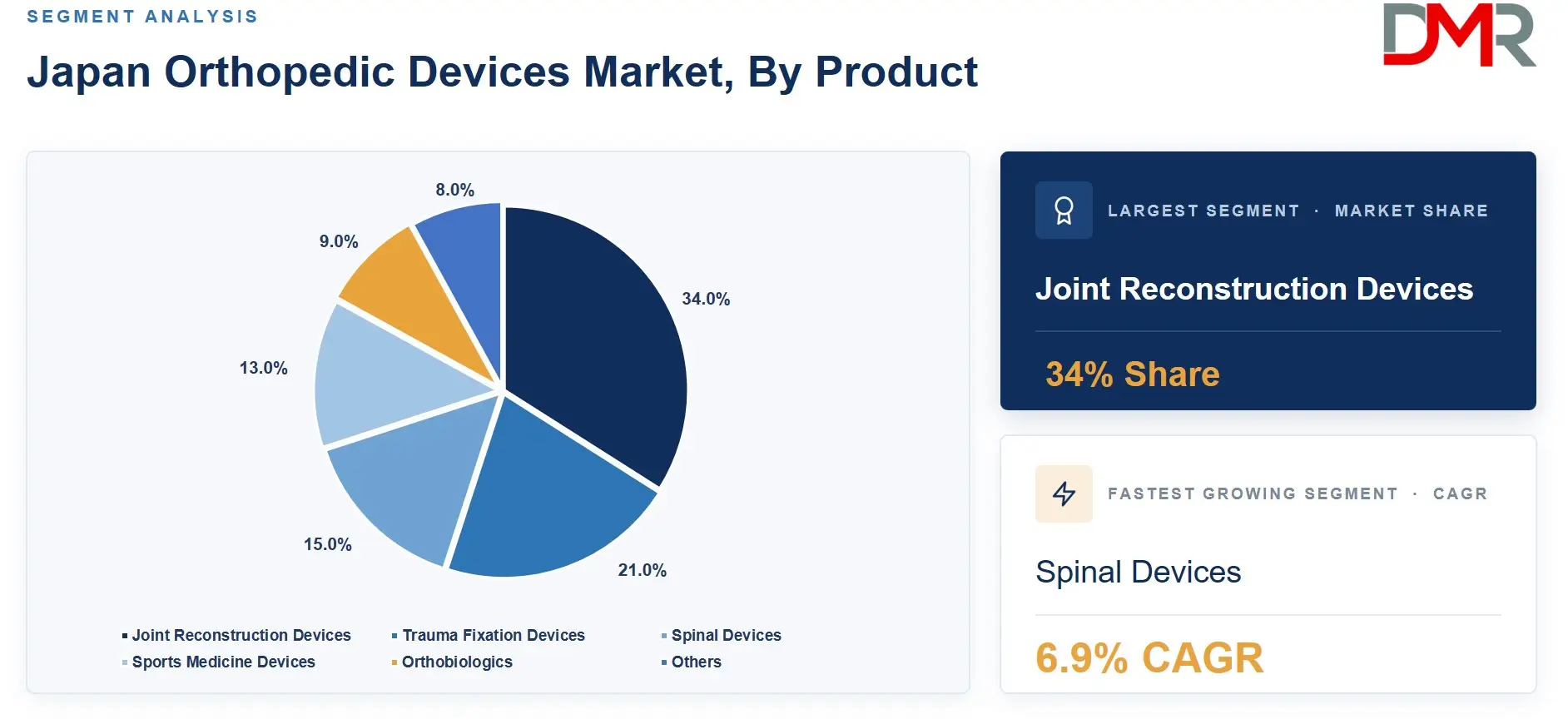
Joint Reconstruction Devices are projected to lead product revenue in 2026 with a share of roughly 34%, reflecting the persistent volume of knee and hip replacement in an aging population and the recurring need for primary, revision and instrument components. Established surgeon familiarity and hospital procurement pathways reinforce this position. Growth, however, is concentrated in Spinal Devices, which are forecast to expand at a CAGR of 6.9% from 2026 to 2035. Degenerative spinal disease, minimally invasive techniques and navigation-compatible fixation are increasing the addressable procedure base. Suppliers that combine screws, interbody devices, biologic adjuncts and digital guidance can capture more value per case, although reimbursement and surgeon training will continue to shape the pace of adoption.
By Technology
Conventional Instruments and Implants are expected to retain the largest technology share in 2026 at approximately 55%, because most orthopedic procedures still rely on established mechanical guides, manual instruments and standard implant systems with predictable capital requirements. Their installed base and familiarity remain strong across hospital tiers. The steeper trajectory sits with Robotic-Assisted Systems, advancing at a CAGR of 11.8% through 2035. Hospitals are adopting these platforms to improve planning consistency, alignment control and data capture, especially in knee reconstruction. Compact and image-free systems may broaden access by lowering space and workflow burdens. Vendor success will depend on demonstrating utilization, training efficiency and implant pull-through rather than treating robotics as a stand-alone capital sale.
By Application
Knee applications are projected to account for close to 30% of 2026 revenue, supported by osteoarthritis prevalence, total knee arthroplasty volume and the broad device content required across implants, instruments and navigation. The segment also benefits from frequent technology upgrades because alignment and soft-tissue balancing are central procedural concerns. Knee is also modeled as the fastest-growing application, at a CAGR of 6.5% from 2026 to 2035, as robotic assistance and personalized alignment strategies gain wider clinical use. Unlike more fragmented trauma demand, knee reconstruction offers repeatable workflows that suit platform-based selling. Competition will therefore center on implant survivorship, kinematic options, revision capability and the economics of digitally assisted procedure ecosystems.
By End User
Hospitals are set to represent around 68% of end-user revenue in 2026 because complex joint replacement, trauma and spine procedures depend on operating-room infrastructure, inpatient support and broad specialist teams. Major hospitals also have the volume needed to justify navigation and robotic capital systems. Growth, however, is concentrated in Ambulatory Surgical Centers, forecast to expand at a CAGR of 8.6% through 2035. Carefully selected primary orthopedic procedures can move toward shorter-stay pathways as anesthesia, pain management and rehabilitation protocols improve. The opportunity favors compact equipment, reduced instrument burden and predictable case packs. Expansion will remain selective because Japan's care delivery model and reimbursement structure still keep much orthopedic surgery anchored in hospitals.
By Material
Metals and Alloys are expected to hold the largest material share in 2026 at nearly 52%, reflecting the load-bearing requirements of joint, trauma and spine implants and the established use of titanium, stainless steel and cobalt-chromium alloys. Manufacturing familiarity, mechanical strength and extensive clinical history support continued dominance. The faster trajectory is expected in Ceramics, growing at a CAGR of 7.1% through 2035 as low-wear bearing surfaces and advanced material combinations gain relevance in joint reconstruction. Ceramic technologies can support younger or more active patients where long-term wear matters, while surface engineering creates additional differentiation. Adoption depends on cost, surgeon preference, fracture resistance and evidence demonstrating meaningful lifecycle advantages over established alternatives.
The Japan Orthopedic Devices Market Report is Segmented Based on the Following
By Product
- Joint Reconstruction Devices
- Trauma Fixation Devices
- Spinal Devices
- Sports Medicine Devices
- Orthobiologics
- Others
By Technology
- Conventional Instruments and Implants
- Computer-Assisted Navigation
- Robotic-Assisted Systems
- 3D-Printed and Patient-Specific Devices
- Others
By Application
- Knee
- Hip
- Spine
- Trauma and Extremities
- Shoulder
- Others
By End User
- Hospitals
- Orthopedic Clinics
- Ambulatory Surgical Centers
- Rehabilitation Centers
- Others
By Material
- Metals and Alloys
- Polymers
- Ceramics
- Composites
- Bioresorbable Materials
- Others
Competitive Landscape
Competition combines multinational orthopedic majors with Japanese manufacturers, distributors and biomaterials specialists. Large vendors compete through joint reconstruction, trauma, spine and sports medicine portfolios supported by surgeon training, procedural planning and service coverage. Domestic companies differentiate through materials engineering, anatomical fit, local clinical relationships and distribution depth. Robotics is raising switching costs because capital platforms can influence implant selection and recurring consumable demand. At the same time, reimbursement pressure prevents technology alone from guaranteeing premium pricing. Winning strategies increasingly combine clinical evidence, efficient instrument logistics, compact digital systems, infection-control features and reliable local support. Partnerships between implant companies and Japanese materials or distribution specialists remain important where regulatory navigation and hospital access are difficult to build quickly.
Some of the Prominent Players in the Japan Orthopedic Devices Market Are
- Zimmer Biomet
- Stryker
- DePuy Synthes
- Smith+Nephew
- Medtronic
- Globus Medical
- Arthrex
- Enovis
- B. Braun
- Orthofix
- MicroPort Orthopedics
- Mathys
- Kyocera Corporation
- Teijin Nakashima Medical
- Olympus Terumo Biomaterials
- HOYA Technosurgical
- Japan Medical Dynamic Marketing
- KiSCO
- Century Medical
- M.E.SYSTEM
- BEAR Medic
- Nemoto Shokai
- Yufu Itonaga
- artmedica
- Nippon Sigmax
- ALCARE
- Takiron
- Robert Reid
- Zeria Pharmaceutical
- NGK Spark Plug
- Integra LifeSciences
- CONMED
- Acumed
- Paragon 28
- Exactech
- Corin Group
- LimaCorporate
- Bioventus
- Anika Therapeutics
- Medacta
- Other Key Players
Recent Developments
- In April 2026, Zimmer Biomet highlighted its Japan-origin iodine-treated orthopedic implant technology after recognition in Asia-Pacific medtech awards, reinforcing commercial attention around infection-resistant implant surfaces and locally developed materials innovation.
- In December 2025, Zimmer Biomet announced Japanese reimbursement listing and the first domestic case using its iodine-treated iTaperloc Complete and iG7 hip replacement system, moving the technology from regulatory approval into reimbursed clinical use.
- In September 2025, Japan's PMDA approved Zimmer Biomet's iodine-treated total hip replacement system, creating a differentiated option designed to inhibit bacterial adhesion and biofilm formation on implant surfaces.
- In the third quarter of 2025, Smith+Nephew expanded the CATALYSTEM primary hip system launch into Japan, adding a newer reconstruction platform to its established orthopedic portfolio in the country.
- In March 2025, Zimmer Biomet launched the A.T.S. 5000 surgical tourniquet system in Japan, broadening operating-room support around orthopedic procedures and strengthening its perioperative product offering.
Report Details
| Report Characteristics |
| Market Size (2026) |
USD 4.8 Bn |
| Forecast Value (2035) |
USD 7.9 Bn |
| CAGR (2026-2035) |
5.7% |
| Historical Data |
2021 - 2025 |
| Forecast Data |
2026 - 2035 |
| Base Year |
2025 |
| Segments Covered |
By Product, By Technology, By Application, By End User and By Material |
| Regional Coverage |
Japan |
Frequently Asked Questions
How big is the Japan Orthopedic Devices Market?
▾ The Japan Orthopedic Devices Market is estimated at USD 4.8 Bn in 2026. Demand is supported by joint replacement, trauma fixation, spine procedures and sports medicine, with hospitals remaining the main purchasing channel. The market includes implants, fixation devices, surgical instruments and digital assistance technologies used within Japan.
What is the growth rate of the Japan Orthopedic Devices Market?
▾ The market is forecast to grow at a CAGR of 5.7% from 2026 to 2035. Growth reflects an aging population, sustained orthopedic procedure demand, wider adoption of navigation and robotic assistance, and continued innovation in implant materials, while reimbursement discipline and capital-budget constraints keep expansion measured rather than explosive.
What is driving demand in the Japan Orthopedic Devices Market?
▾ Demand is driven primarily by age-related osteoarthritis, fragility fractures and degenerative spine conditions, combined with hospitals' need for reproducible surgical workflows. Joint reconstruction is expected to account for approximately 34% of 2026 product revenue, illustrating the importance of knee and hip replacement to domestic orthopedic device spending.
Who are the key players in the Japan Orthopedic Devices Market?
▾ Key participants include Zimmer Biomet, Stryker, DePuy Synthes, Smith+Nephew, Kyocera Corporation, Teijin Nakashima Medical and Olympus Terumo Biomaterials. Competition is based on implant breadth, clinical evidence, surgeon support, digital workflow integration, materials expertise and dependable distribution across Japanese hospitals and specialist orthopedic centers.
Which technology is growing fastest in the Japan Orthopedic Devices Market?
▾ Robotic-Assisted Systems are forecast to grow fastest, at a CAGR of 11.8% from 2026 to 2035. Adoption is being pulled by interest in reproducible planning, controlled bone preparation and intraoperative data. Compact and image-free platforms may improve the economics for hospitals that cannot justify larger fixed robotic installations.
Which end user dominates orthopedic device demand in Japan?
▾ Hospitals are projected to hold around 68% of end-user revenue in 2026. They dominate because joint replacement, spine and complex trauma procedures require operating rooms, anesthesia, imaging, sterile processing and multidisciplinary postoperative care. Their procedure volumes also make them the most viable customers for navigation and robotic capital systems.
What is the outlook for the Japan Orthopedic Devices Market through 2035?
▾ The Japan Orthopedic Devices Market is anticipated to reach USD 7.9 Bn by 2035. The outlook favors suppliers that combine durable implants with digital planning, efficient instrument logistics and strong local clinical support. Infection-resistant surfaces, robotics, patient-specific components and lower-footprint surgical systems should create the clearest areas of differentiation.