Market Snapshot
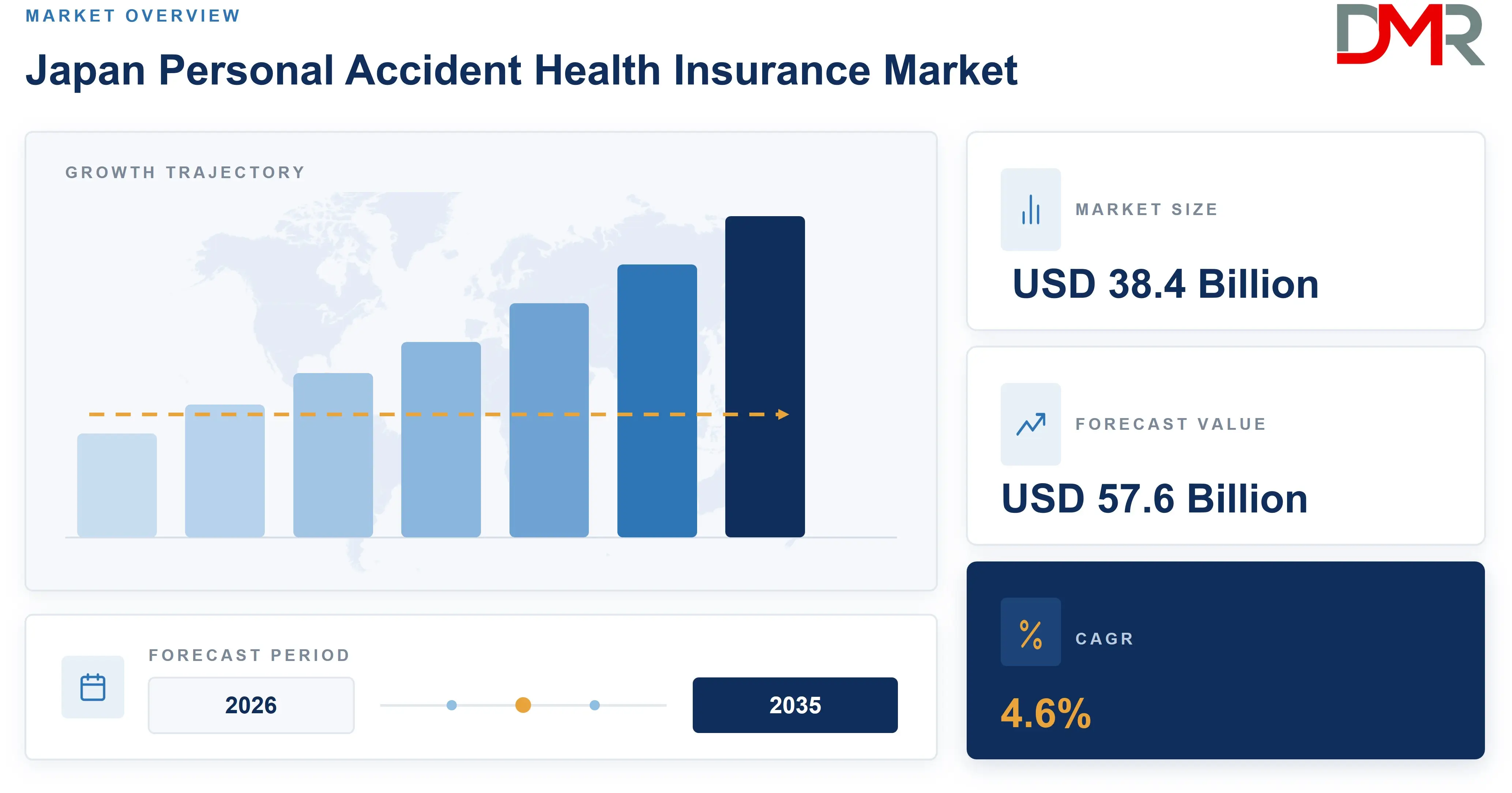
- Market Size (2026): USD 38.4 Bn
- Forecast Value (2035): USD 57.6 Bn
- CAGR (2026-2035): 4.6%
- Leading Product Type (2026): Medical and Health Insurance, approximately 48.3%
- Leading Coverage Type (2026): Hospitalization and Surgical, around 39.4%
- Key Players: Nippon Life Insurance Company, Aflac Life Insurance Japan Ltd., Dai-ichi Life Insurance Co., Ltd., and others
What is Japan Personal Accident Health Insurance Market and its Market Size?
The Japan Personal Accident Health Insurance Market size is estimated to reach USD 38.4 Bn in 2026 and is further anticipated to reach USD 57.6 Bn by 2035, at a CAGR of 4.6%.
ℹ
To learn more about this report –
Download Your Free Sample Report Here
This market covers premiums and related revenue generated inside Japan from privately purchased or employer-arranged insurance that pays benefits for accidental injury, hospitalization, surgery, medical treatment, critical illness, disability, income interruption, and selected travel-related accident and health risks. The boundary is domestic demand, not the worldwide revenue of insurers headquartered in Japan. It includes life insurers, non-life insurers, and specialist carriers where the insured risk is personal health or accidental bodily injury, while excluding statutory public health insurance contributions and stand-alone life protection without accident or health benefits.
Demand sits beside Japan's universal public health insurance system rather than replacing it. Private policies are purchased to cover cash needs that remain after public benefits, including hospitalization-related expenses, treatment-related outlays, income disruption, rehabilitation costs, and household financial pressure during recovery. Product design therefore reflects the interaction between statutory medical reimbursement, high-cost medical expense protections, employment arrangements, household savings, and the preference for fixed benefits that can be used flexibly. Whole life medical coverage remains important, while modular benefit structures are expanding as consumers seek to add or remove specific protections over time.
Structural change is coming from population aging, shorter hospital stays, outpatient treatment, digital sales, and stronger scrutiny of distribution practices. Carriers are redesigning products around treatment episodes while direct and mobile channels reduce acquisition friction for simple products. Agency suitability, comparison practices, disclosure quality, underwriting discipline, and claims handling remain central because Japan has a large installed base of long-duration policies and a dense intermediary network. Competitive advantage increasingly depends on clear benefit design, efficient underwriting, responsive claims service, and health-related support without product complexity that weakens customer understanding.
Use Cases
- Household Medical Expense Buffer: Working-age households use medical and accident policies to create cash support around hospitalization, surgery, follow-up treatment, transport, and temporary income disruption. The cover supplements statutory benefits and household savings, helping families preserve liquidity when treatment creates costs outside standard reimbursement.
- Employer Voluntary Benefit Programs: Companies and benefit administrators arrange group or voluntary accident and health protection for employees seeking additional coverage. Standardized enrollment and payroll-linked access can improve convenience while giving workers a way to protect household cash flow after injury, illness, or disability.
- Senior Treatment and Recovery Support: Older consumers use medical, accident, and simplified-underwriting products for hospitalization, surgery, fracture, rehabilitation, and post-discharge needs. Insurers respond with easier eligibility paths, treatment-focused benefit combinations, and support services that help policyholders navigate care and claims.
- Travel and Activity Protection: Travelers, students, sports participants, and outdoor users buy short-duration cover for injury, medical treatment, emergency assistance, and selected trip contingencies. Mobile issuance and embedded distribution make protection easier to purchase close to the activity without a long advice process.
Key Takeaways
- Market Size & Share: Whole life or permanent policies are projected at roughly 46.2% of tenure revenue in 2026.
- Product Type Analysis: Travel Accident and Health Insurance is forecast at a 6.9% CAGR during 2026-2035.
- Demand Concentration: Tied agents and sales representatives hold close to 36.1% of revenue in 2026.
- Coverage Analysis: Outpatient and Medical Expense coverage is forecast at a 6.6% CAGR during 2026-2035.
- Digital Distribution: Direct Online and Mobile channels are projected at around 13.8% of revenue in 2026.
- Aging Demand: Consumers aged 60 and above are expected at approximately 27.6% of demand in 2026.
How AI/Gen AI is Transforming the Japan Personal Accident Health Insurance Market?
AI is changing underwriting, service, distribution, and claims operations more than the basic insured promise. Machine learning can prioritize applications for straight-through processing, identify claims needing manual review, forecast service demand, and support lapse prevention. Value comes from reducing turnaround time while keeping underwriting rules, human escalation, and explainability aligned with insurer governance.
Generative AI has a practical role in document-heavy workflows. Large language model document processing can summarize medical forms, extract information from claim narratives, draft customer communications, and help staff retrieve policy wording. The gain is strongest where models assist trained employees rather than make unsupported coverage decisions, because accident and health claims involve sensitive data, exclusions, and benefit conditions.
- Application Triage: Machine learning ranks cases by complexity so standard applications move faster while higher-risk or incomplete cases are routed to experienced underwriters.
- Claims Document Processing: LLM-based extraction and classification organize medical certificates, receipts, accident descriptions, and supporting forms before adjusters apply policy conditions.
- Fraud and Anomaly Detection: Pattern models flag unusual claim combinations, repeated providers, inconsistent timing, or behavioral signals for investigation without automatically rejecting legitimate claims.
- Agent and Service Assistance: Retrieval-based AI helps sales and service teams locate product rules, required disclosures, claim procedures, and approved explanations during customer interactions.
Key Drivers in the Japan Personal Accident Health Insurance Market
Demand is being reshaped by aging and treatment patterns that rely less on long inpatient stays.
- Aging Population and Longer Protection Needs: People aged 60 and above are expected to account for approximately 27.6% of age-group demand in 2026, creating a large customer pool for hospitalization, surgery, fracture, rehabilitation, and simplified-underwriting products. The mechanism is not simply age itself. Longer life expectancy increases the period over which households must manage treatment costs, care coordination, and the risk that retirement income is less flexible than employment income. Insurers that can keep benefit structures understandable while controlling age-related underwriting and claims costs are positioned to capture this demand without relying only on broad premium increases.
- Need to Supplement Treatment-Related Cash Costs: Hospitalization and Surgical coverage is projected to account for around 39.4% of coverage-type revenue in 2026 because households still value predictable cash benefits tied to major treatment events. Japan's public system covers core medical services, but private insurance addresses deductibles, non-covered expenses, income disruption, transport, family support, and other costs that can accompany illness or injury. This creates persistent demand for supplemental protection. Product growth depends on aligning benefits with actual treatment patterns, particularly as surgery and follow-up care increasingly span both inpatient and outpatient settings.
Restraints in the Japan Personal Accident Health Insurance Market
Growth is limited by an established policy base, public coverage, and costly advice-led distribution.
- Large Stock of Long-duration Policies: Whole life or permanent policies are expected to represent roughly 46.2% of policy-tenure revenue in 2026, which creates renewal stability but also reduces the frequency with which consumers shop for replacement coverage. Mature policyholders may already hold several layers of medical, cancer, accident, or rider-based protection, so a new product must demonstrate a clear benefit gap rather than simply replicate existing coverage. This limits easy volume expansion and raises the importance of policy review, modular additions, and conversion pathways that preserve customer value without encouraging unnecessary replacement.
- High Distribution and Compliance Burden: Tied agents and sales representatives are projected to retain close to 36.1% of distribution revenue in 2026, keeping a substantial portion of acquisition tied to human advice, training, supervision, and documentation. This model is valuable for complex protection needs but expensive to operate. Stricter expectations around customer interests, comparative recommendation, suitability, conflicts, and agency governance increase process costs further. Carriers must invest in better sales controls and digital support while avoiding scripted complexity that can make product comparison harder for consumers. Cost control therefore becomes a strategic requirement.
Growth Opportunities in the Japan Personal Accident Health Insurance Market
White space is strongest in simpler digital journeys and narrowly defined protection products.
- Direct Digital Protection Journeys: Direct Online and Mobile distribution is forecast to expand at a CAGR of 8.2% during 2026-2035, the fastest pace among distribution channels. The opportunity is strongest for products with simple eligibility, transparent benefits, quick quotation, and low documentation requirements. Insurers can use mobile identity verification, electronic disclosures, rule-based underwriting, and digital claims intake to lower acquisition and servicing costs. The commercial opening is not to digitize every complex product, but to separate simple protection from advice-intensive needs and create smooth escalation to human support when a customer's circumstances require it.
- Short-term and On-demand Accident Cover: Short-term or On-demand policies are expected to represent around 10.3% of policy-tenure demand in 2026, leaving room for growth through travel, sports, mobility, event, and activity-based protection. Embedded insurance can place coverage inside booking, payment, membership, or service journeys when the risk becomes relevant. The format can attract younger consumers and occasional buyers who resist long-duration commitments. Success depends on clear exclusions, simple claims, and disciplined pricing because low-premium products can become uneconomic if acquisition expense or service friction is too high. Claims simplicity remains essential for repeat use.
Trends in the Japan Personal Accident Health Insurance Market
Product design is shifting toward treatment episodes, modular benefits, and contextual purchase points.
- Shift from Hospital-day Benefits Toward Treatment-based Protection: Outpatient and Medical Expense coverage is projected to grow at a CAGR of 6.6% during 2026-2035 as shorter admissions, day procedures, and follow-up treatment reduce the usefulness of designs built mainly around long inpatient stays. Carriers are responding with lump sums, surgery benefits, treatment-linked payments, and outpatient support that better matches the way care is delivered. The trend favors modular policies because customers can combine a core medical benefit with selected riders rather than buy a large fixed package that may duplicate existing protection.
- More Contextual Accident and Travel Insurance: Travel Accident and Health Insurance is forecast to grow at a CAGR of 6.9% during 2026-2035, supported by digital booking, mobile payments, and the return of situational protection purchases. Coverage can be offered closer to departure, activity registration, or transaction completion, reducing the time between recognizing a risk and buying protection. This pushes insurers toward simpler wording, instant issuance, multilingual assistance, and API-enabled distribution partnerships. It also increases pressure to keep claims service efficient because short-term customers judge the product heavily on post-purchase responsiveness.
Research Scope and Analysis
Segment performance is assessed across five axes: product type, coverage type, policy tenure, distribution channel, and age group. Each axis shows where revenue is concentrated in 2026 and which sub-segment is expected to expand fastest through 2035, together with the commercial mechanism behind each position.
ℹ
To learn more about this report –
Download Your Free Sample Report Here
By Product Type
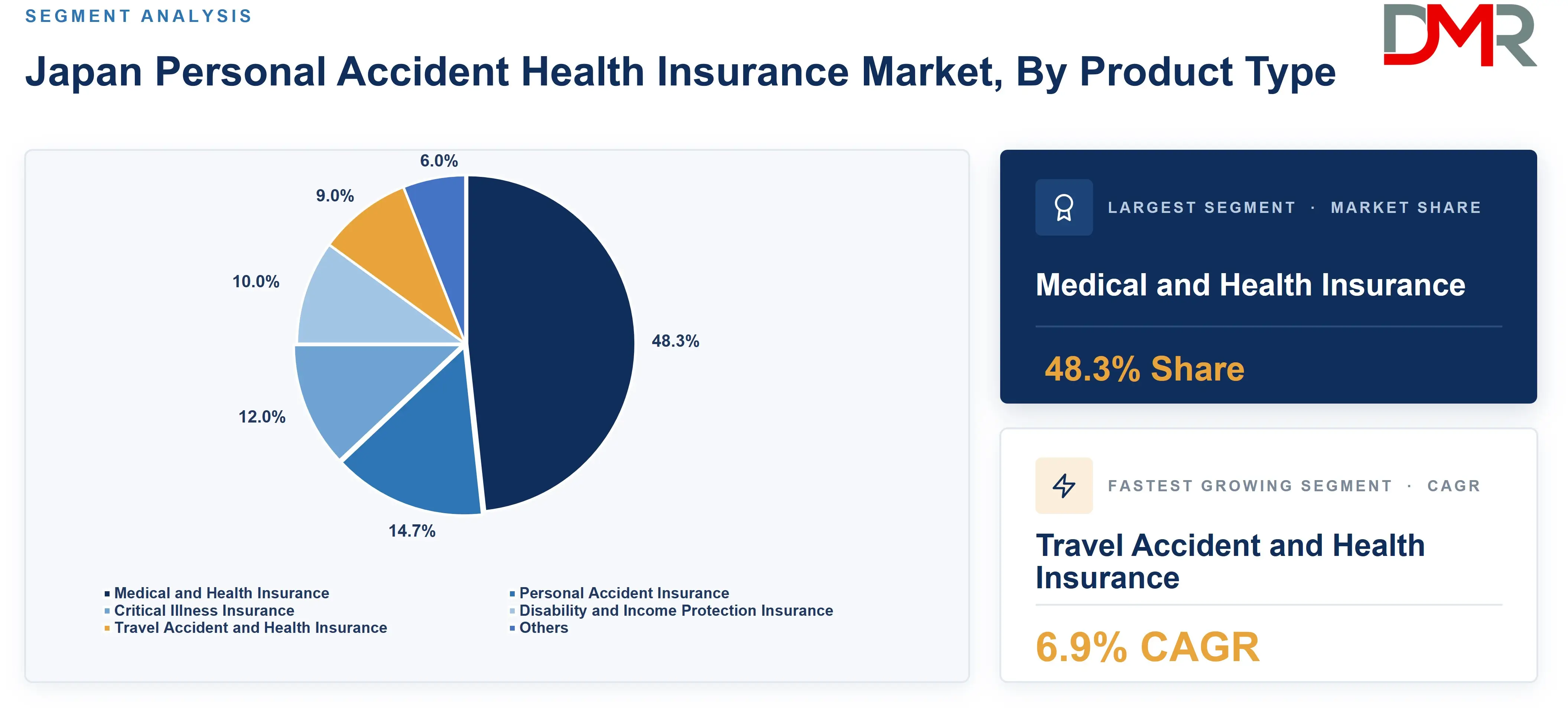
Medical and Health Insurance is projected to hold the largest product-type share in 2026, accounting for approximately 48.3% of revenue because hospitalization, surgery, treatment, and broader medical cash needs affect a wide household base and fit alongside statutory health coverage. Long-duration medical policies also benefit from a substantial installed base and familiar consumer use cases. Growth, however, is concentrated in Travel Accident and Health Insurance, which is forecast to expand at a CAGR of 6.9% during 2026-2035. Digital trip booking, outbound mobility, student travel, and activity-based purchasing make this product easier to attach to a specific need, while mobile issuance lowers the friction associated with buying temporary protection. at checkout.
By Coverage Type
Hospitalization and Surgical coverage is expected to lead in 2026 with close to 39.4% of coverage-type revenue, supported by the long-standing role of fixed benefits that pay around admissions, procedures, and treatment events. Consumers value predictable cash because it can be used for both medical and non-medical expenses linked to recovery. Growth, however, is concentrated in Outpatient and Medical Expense coverage, which is projected to record a CAGR of 6.6% during 2026-2035. Shorter hospital stays, more day treatment, and continuing care after discharge increase the relevance of benefits that follow the patient across settings, encouraging insurers to redesign products around the full episode of care rather than inpatient duration alone.
By Policy Tenure
Whole Life or Permanent policies are expected to account for roughly 46.2% of policy-tenure revenue in 2026, reflecting Japan's preference for stable long-term protection and the large stock of medical policies designed to remain in force through older ages. Predictable renewal economics and established agency servicing reinforce this position. The steeper trajectory sits with Short-term or On-demand policies, which are forecast to grow at a CAGR of 7.4% during 2026-2035. Mobile distribution, travel recovery, leisure activity protection, and embedded purchase points allow insurers to cover narrow risks for defined periods. This format also gives younger consumers a low-commitment entry point into protection products before they consider broader long-duration coverage. over time.
By Distribution Channel
Tied Agents and Sales Representatives are projected to hold the largest distribution share in 2026 at around 36.1%, supported by established insurer brands, recurring policy reviews, and the need for guidance when customers combine medical, critical illness, accident, and disability benefits. Human advice remains valuable where underwriting or product trade-offs are difficult to compare. Growth, however, is concentrated in Direct Online and Mobile channels, expanding at a CAGR of 8.2% during 2026-2035. Better digital identity, electronic applications, rule-based underwriting, and simplified product design allow more policies to be completed without a full in-person sales process, while hybrid escalation preserves advisor involvement for customers whose needs are more complex. when needed.
By Age Group
Consumers aged 30-59 are expected to represent the largest age-group share in 2026, accounting for approximately 52.8% of demand because this cohort combines household financial responsibilities, active employment income, and stronger motivation to protect against treatment and income shocks. Employer contact and agency relationships also make this group accessible through multiple channels. Growth, however, is concentrated among consumers aged 60 and above, with a forecast CAGR of 5.9% during 2026-2035. Population aging, longer retirement periods, and higher exposure to hospitalization, surgery, and recovery needs sustain demand, although insurers must balance accessibility with underwriting limits, age-based pricing, and simpler product structures that older customers can understand and maintain. in later life.
The Japan Personal Accident Health Insurance Market Report is Segmented Based on the Following
By Product Type
- Medical and Health Insurance
- Personal Accident Insurance
- Critical Illness Insurance
- Disability and Income Protection Insurance
- Travel Accident and Health Insurance
- Others
By Coverage Type
- Hospitalization and Surgical
- Accidental Death and Dismemberment
- Outpatient and Medical Expense
- Critical Illness Lump Sum
- Income Replacement
- Others
By Policy Tenure
- Whole Life or Permanent
- Long-term Fixed-term
- Annual Renewable
- Short-term or On-demand
- Others
By Distribution Channel
- Tied Agents and Sales Representatives
- Independent Agencies and Insurance Shops
- Bancassurance and Financial Institutions
- Direct Online and Mobile
- Corporate and Affinity
- Others
By Age Group
- 30-59
- 60 and Above
- 18-29
- Under 18
- Others
Regulatory Landscape
Japan's personal accident and health insurance sector operates under the Insurance Business Act, Financial Services Agency supervision, product requirements, solvency oversight, privacy rules, and detailed standards for insurance solicitation. Current policy direction emphasizes tighter agency governance, clearer comparative recommendation practices, stronger conflict management, and more accountable customer-interest controls. The commercial opening lies with insurers that turn these requirements into simpler disclosures, consistent digital evidence, and disciplined intermediary supervision. Corporate and affinity channels are expected to represent about 7.6% of distribution demand in 2026, making partner governance relevant as well. Compliance costs can slow rollout, but stronger controls favor carriers with scalable sales and claims infrastructure.
Investment and White Space Analysis
Investment is shifting from branch-heavy acquisition toward digital underwriting, claims automation, health-service ecosystems, customer data platforms, and modular product administration. Carriers are also partnering with medical-data, wellness, payment, and affinity platforms to add prevention, treatment navigation, and post-claim engagement around insurance. Direct Online and Mobile channels are projected to account for around 13.8% of distribution revenue in 2026, showing headroom for digital conversion. White space is strongest in simplified senior products, flexible outpatient protection, embedded accident cover, and hybrid advice journeys. The brake is execution risk: technology spending must improve customer understanding and claims outcomes rather than add sales complexity.
Competitive Landscape
Competition is broad because personal accident and health protection is written by life insurers, non-life insurers, digital carriers, and specialists with different distribution strengths. Large domestic life insurers compete through trusted brands, sales forces, bancassurance relationships, long-duration policy servicing, and broad household portfolios. Foreign and specialist insurers differentiate through medical, cancer, critical illness, travel, direct, or simplified-underwriting propositions. Non-life carriers are particularly relevant in personal accident, travel, affinity, and employer-linked risk. The strongest strategies combine modular coverage, faster underwriting, digital claims, health support, and disciplined agency management. Consolidation at the group level increases scale, but product competition remains active because customer needs vary by age, channel, health status, and desired policy duration. Execution quality matters as much as brand scale.
Some of the Prominent Players in the Japan Personal Accident Health Insurance Market Are
- Nippon Life Insurance Company
- Dai-ichi Life Insurance Co., Ltd.
- Meiji Yasuda Life Insurance Company
- Sumitomo Life Insurance Company
- Japan Post Insurance Co., Ltd.
- Tokio Marine & Nichido Fire Insurance Co., Ltd.
- Sompo Japan Insurance Inc.
- Mitsui Sumitomo Insurance Co., Ltd.
- Aflac Life Insurance Japan Ltd.
- MetLife Insurance K.K.
- AXA Life Insurance Co., Ltd.
- AIG General Insurance Company, Ltd.
- Fukoku Mutual Life Insurance Company
- Asahi Mutual Life Insurance Company
- Taiyo Life Insurance Company
- Daido Life Insurance Company
- Sony Life Insurance Co., Ltd.
- ORIX Life Insurance Corporation
- SBI Life Insurance Co., Ltd.
- Rakuten Life Insurance Co., Ltd.
- Lifenet Insurance Company
- Sompo Himawari Life Insurance, Inc.
- Mitsui Sumitomo Aioi Life Insurance Company, Limited
- Tokio Marine & Nichido Life Insurance Co., Ltd.
- FWD Life Insurance Company, Limited
- Zurich Life Insurance Japan Company Ltd.
- Manulife Life Insurance Company
- NN Life Insurance Company, Ltd.
- Cardif Assurance Vie Japan
- Crédit Agricole Life Insurance Company Japan Ltd.
- The Prudential Life Insurance Co., Ltd.
- The Gibraltar Life Insurance Co., Ltd.
- Aioi Nissay Dowa Insurance Co., Ltd.
- au Insurance Company, Limited
- JI Accident & Fire Insurance Co., Ltd.
- The Kyoei Fire and Marine Insurance Company, Limited
- Nisshin Fire & Marine Insurance Co., Ltd.
- SECOM General Insurance Co., Ltd.
- H.S. Insurance Co., Ltd.
- Capital Insurance Corporation
- Other Key Players
Recent Developments
- In May 2026, Nippon Life completed the acquisition of Medical Data Vision as a wholly owned subsidiary, strengthening its access to healthcare data and related capabilities that can support health services, customer engagement, and product development around medical needs.
- In April 2026, Nippon Life launched its Pitaho treatment support insurance, using benefits linked to medical fee points and adding support for treatment-related expenses and services, reflecting a shift toward coverage designed around actual treatment pathways rather than hospital days alone.
- In December 2025, Aflac Japan launched Anshin Palette, a modular medical insurance offering designed to let customers select and adjust protection components, reinforcing the market shift toward flexible benefit structures and more individualized medical coverage.
- In April 2025, Medicare Life revised its core New Medi-Fit A whole life medical insurance product, enhancing benefits while continuing to distribute through insurance shops, financial institutions, and other agency channels.
Report Details
| Report Characteristics |
| Market Size (2026) |
USD 38.4 Bn |
| Forecast Value (2035) |
USD 57.6 Bn |
| CAGR (2026-2035) |
4.6% |
| Historical Data |
2021 - 2025 |
| Forecast Data |
2026 - 2035 |
| Base Year |
2025 |
| Segments Covered |
By Product Type, By Coverage Type, By Policy Tenure, By Distribution Channel, and By Age Group |
| Regional Coverage |
Japan |
Frequently Asked Questions
How big is the Japan Personal Accident Health Insurance Market?
▾ Japan has a large supplemental protection pool supported by medical, accident, critical illness, disability, and travel-related policies. The 2026 market is estimated at USD 38.4 Bn. Domestic demand complements statutory health coverage, with households using private benefits to manage treatment-related cash costs, income disruption, and expenses that remain outside public reimbursement.
What is the growth rate of the Japan Personal Accident Health Insurance Market?
▾ The industry is forecast to expand at a CAGR of 4.6% during 2026-2035. Growth is moderate because penetration is already high and long-duration policies are widely held. Expansion comes from outpatient-oriented product redesign, senior protection, digital distribution, travel and activity coverage, and cross-selling where older policies no longer match current treatment or income-protection needs.
What is driving demand in the Japan Personal Accident Health Insurance Market?
▾ Aging, changing treatment patterns, and household cash-flow protection are the strongest demand factors. People aged 60 and above are expected to represent approximately 27.6% of age-group demand in 2026. This increases the relevance of hospitalization, surgery, fracture, rehabilitation, and simplified-underwriting products while encouraging clearer servicing for older policyholders. and families.
Who are the key players in the Japan Personal Accident Health Insurance Market?
▾ Key participants include Nippon Life Insurance Company, Dai-ichi Life Insurance Co., Ltd., Meiji Yasuda Life Insurance Company, Sumitomo Life Insurance Company, Aflac Life Insurance Japan Ltd., Tokio Marine & Nichido Fire Insurance Co., Ltd., and Sompo Japan Insurance Inc. Competition spans life and non-life carriers across agency, direct, affinity, and employer channels.
Which product type holds the largest share of the Japan Personal Accident Health Insurance Market?
▾ Medical and Health Insurance is expected to hold the largest product-type share in 2026 at approximately 48.3%. Its lead reflects broad demand for hospitalization, surgery, treatment, and medical cash benefits that supplement the statutory system, supported by a large installed base and continued redesign around treatment episodes and flexible add-on benefits.
Which distribution channel is growing fastest in the Japan Personal Accident Health Insurance Market?
▾ Direct Online and Mobile distribution is forecast to grow fastest at a CAGR of 8.2% during 2026-2035. Simple eligibility, transparent benefits, digital identity, electronic applications, and rule-based underwriting reduce acquisition friction, while hybrid handoffs to agents remain useful when medical history or protection needs become more complex. during enrollment or claims.
What is the outlook for the Japan Personal Accident Health Insurance Market?
▾ The Japan Personal Accident Health Insurance Market is expected to remain mature but steadily evolving. Short-term or On-demand policies are forecast to grow at a CAGR of 7.4% during 2026-2035, while medical products anchor premium volume. Competition will center on modular benefits, digital servicing, senior accessibility, outpatient relevance, agency governance, and faster claims handling.