Market Snapshot
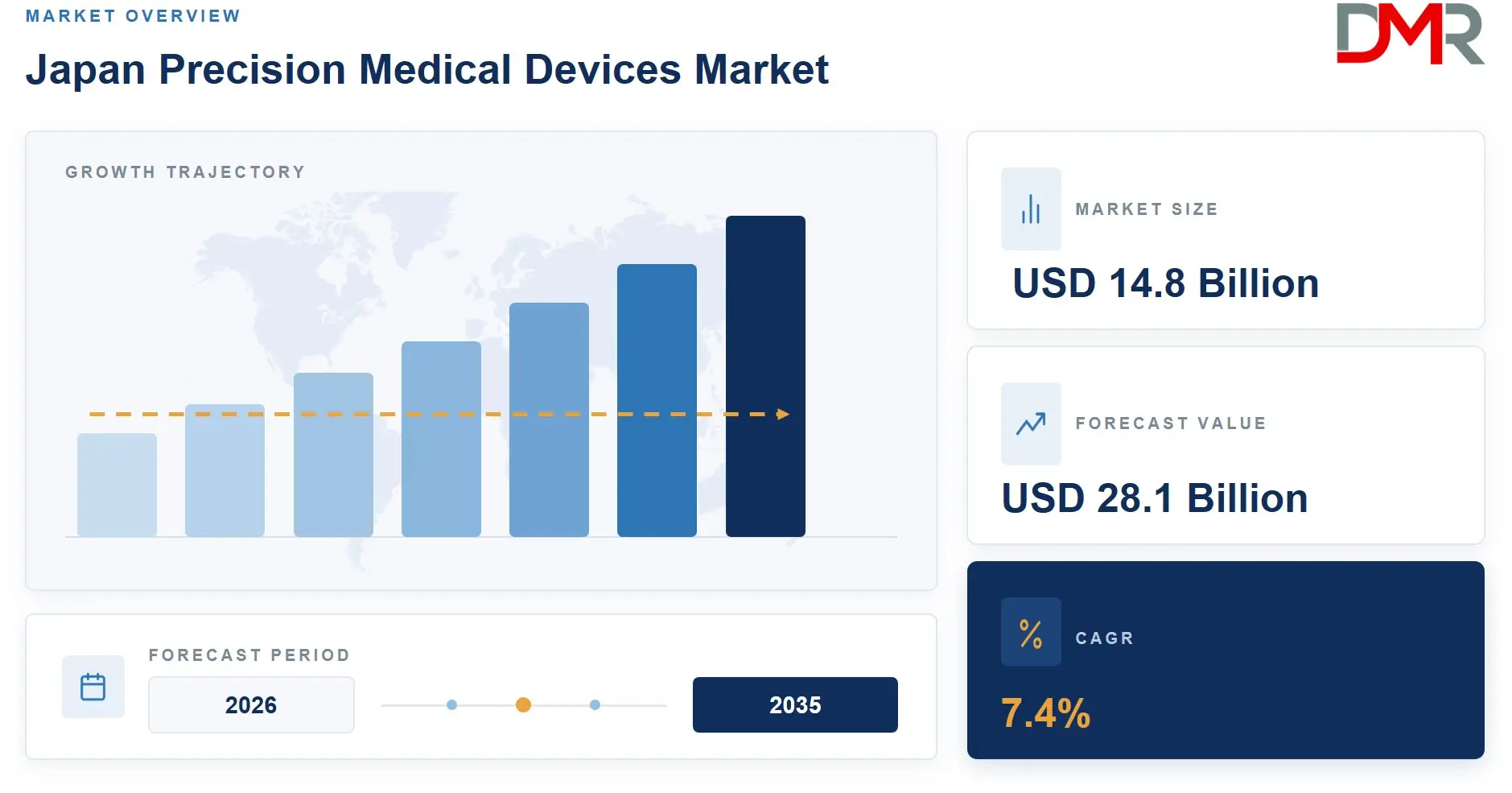
- Market Size (2026): USD 14.8 Bn
- Forecast Value (2035): USD 28.1 Bn
- CAGR (2026-2035): 7.4%
- Leading Product Type (2026): Surgical and Minimally Invasive Instruments, approximately 28%
- Leading Technology (2026): Conventional Precision Engineering, around 46%
- Key Players: Terumo Corporation, Olympus Corporation, Nipro Corporation and others
What is Japan Precision Medical Devices Market and its Market Size?
The Japan Precision Medical Devices Market size is estimated to reach USD 14.8 billion in 2026 and is further anticipated to reach USD 28.1 billion by 2035, at a CAGR of 7.4%. The scope covers revenue generated from precision-oriented medical hardware, instruments, diagnostic systems, implantable and interventional devices, monitoring platforms and associated digital control layers sold for clinical use inside Japan. It does not represent worldwide revenue earned by companies headquartered in Japan.
ℹ
To learn more about this report –
Download Your Free Sample Report Here
Precision medical devices are distinguished by their need for tightly controlled measurement, positioning, imaging, actuation or tissue interaction. The category includes minimally invasive surgical tools, advanced imaging components, patient monitoring systems, catheter-based devices, implantable products, ophthalmic instruments and laboratory systems where repeatable performance and traceability are central to clinical value. Buyers include university hospitals, national and private hospital groups, specialty clinics, diagnostic centers and academic institutions.
Japan offers a demanding operating environment because suppliers must combine miniaturization and manufacturing accuracy with regulatory evidence, quality systems and service support. An aging population increases procedure intensity, while hospitals are under pressure to control labor and reduce avoidable variation. That combination favors devices that shorten setup, simplify workflow or enable more precise treatment without creating a large staffing burden.
Structural change is increasingly tied to software, imaging intelligence and connected instrumentation rather than mechanical refinement alone. Devices are moving toward sensor-rich architectures, AI-assisted interpretation, robotic or computer-assisted control and digitally documented quality assurance. At the same time, reimbursement pressure and the cost of regulatory entry make commercial success dependent on measurable clinical utility, lifecycle economics and evidence generated in Japanese care settings.
Use Cases
- Image-Guided Intervention: Tertiary hospitals and cardiovascular centers deploy high-resolution catheters, navigation systems and precision imaging tools to place devices in narrow anatomical targets. Better measurement accuracy reduces procedural variability, supports smaller access routes and helps clinical teams complete complex interventions with fewer manual adjustments.
- Microsurgery and Endoscopic Procedures: Surgical departments use fine instruments, energy devices, miniature optics and articulated endoscopic tools where millimeter-scale control is important. These systems improve access to difficult anatomy and let surgeons perform tissue dissection, biopsy and treatment through smaller incisions than conventional open approaches.
- High-Accuracy Physiological Monitoring: Acute-care hospitals and specialty clinics use calibrated sensors, ECG systems, pressure monitors and laboratory analyzers to detect subtle changes in patient status. Precision sensing improves repeatability and supports earlier intervention when readings move outside expected clinical ranges.
- Personalized Implant Planning: Orthopedic, dental and reconstructive teams combine imaging data with patient-specific design workflows to select or manufacture components that better match anatomy. The result is more consistent fit, reduced intraoperative modification and a clearer path toward customized implants for complex cases.
Key Takeaways
- Market Size & Share: 2026 revenue is estimated at USD 14.8 billion, supported by high-acuity hospital demand and a dense domestic medtech supply base.
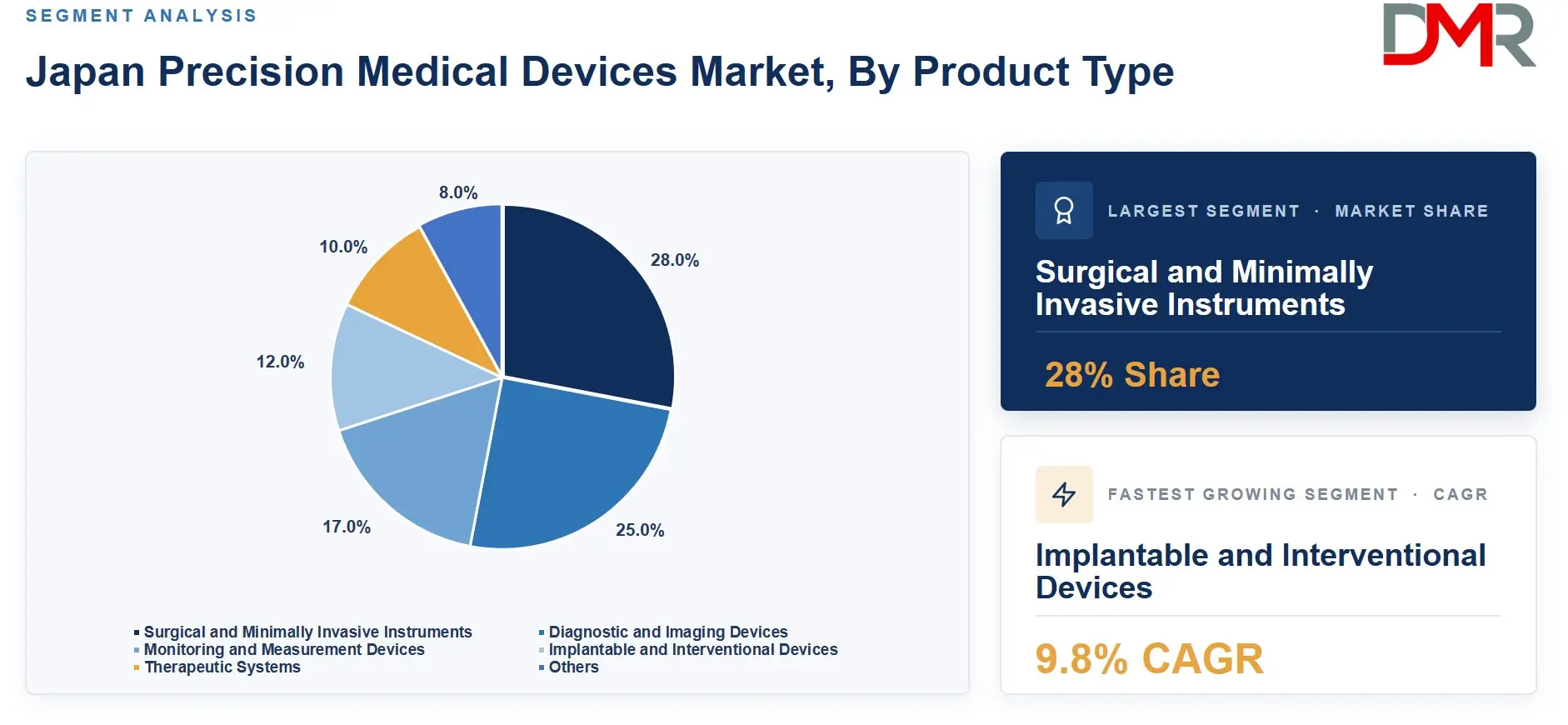
- Product Type Analysis: Surgical and Minimally Invasive Instruments are projected to account for approximately 28% of 2026 revenue.
- Demand Concentration: Japan is estimated to represent close to 8.9% of the worldwide precision medical device opportunity in 2026.
- Technology Shift: AI-Enabled Imaging and Diagnostics are forecast to expand at a CAGR of 13.6% through 2035, faster than the broader market.
- Care Setting: Hospitals are expected to hold around 56% of 2026 demand because complex procedures and capital equipment remain concentrated in acute-care settings.
- Digital Components: Control Software and Digital Interfaces are forecast to grow at a CAGR of 12.8% from 2026 to 2035.
How AI/Gen AI is Transforming the Japan Precision Medical Devices Market?
AI is most valuable where precision devices already generate structured images, waveforms or procedural data. Computer vision can support lesion recognition, instrument tracking and automated measurement, while machine learning can identify abnormal physiological patterns and prioritize review. These uses improve consistency without turning the physical device into a purely software product.
Generative AI has a smaller role in regulated engineering. It can support design exploration, summarize risk records and organize technical documentation under human review. Near-term value is therefore strongest in workflow, service and evidence management.
- Computer Vision: supports image enhancement, anatomical recognition and instrument localization in endoscopy, ophthalmology and guided procedures.
- Predictive Monitoring: combines sensor streams to identify deterioration patterns and focus clinician attention.
- Generative Design: evaluates component geometries and patient-specific concepts before prototyping.
- LLM Document Processing: assists controlled review of technical files, complaints and regulatory records.
Key Drivers in the Japan Precision Medical Devices Market
Demand is being shaped by procedure intensity and the need to improve accuracy without proportionally increasing clinical labor.
- Aging Population and Higher Procedure Complexity: Japan's demographic profile raises the number of patients requiring cardiovascular, ophthalmic, orthopedic and cancer-related intervention. This supports a market estimated at USD 14.8 billion in 2026 because hospitals need devices that can treat complex patients through lower-trauma approaches. Precision catheters, endoscopic tools, implant systems and imaging platforms are valuable when smaller access routes can reduce procedural burden and improve repeatability.
- Hospital Productivity and Standardization Requirements: Acute-care providers are expected to represent around 56% of 2026 end-user demand. Staffing constraints increase the value of automated calibration, guided setup, digital checks and workflow integration. Suppliers are therefore moving from isolated hardware toward systems that combine precision mechanics with software, training and service, especially when they can shorten preparation or reduce rework.
Restraints in the Japan Precision Medical Devices Market
Growth is moderated by evidence requirements and the economics of introducing complex devices into a reimbursement-sensitive health system.
- Regulatory and Evidence Burden: Implantable, interventional and software-enabled devices require substantial verification, clinical evidence and local regulatory support. Although Implantable and Interventional Devices are forecast to grow at 9.8% through 2035, development can be lengthy because engineering changes must align with quality management, risk documentation and Japanese approval pathways.
- Reimbursement Pressure and Capital Budget Discipline: Precision systems can carry high acquisition and maintenance costs. Conventional Precision Engineering is still expected to account for around 46% of 2026 technology revenue partly because established platforms fit existing workflows and budgets. New robotic, AI-enabled or connected devices must justify incremental cost through throughput, outcomes or labor savings.
Growth Opportunities in the Japan Precision Medical Devices Market
White space is strongest where precision can reduce labor, enable less invasive treatment or turn device data into a reusable clinical asset.
- AI-Enabled Imaging and Decision Support: AI-Enabled Imaging and Diagnostics are forecast to expand at a CAGR of 13.6% from 2026 to 2035. Japan has deep installed bases in endoscopy, imaging, ophthalmology and laboratory systems, creating opportunities for image triage, automated measurement and quality assurance software that can be deployed across existing hardware.
- Ambulatory and Specialty Procedure Platforms: Ambulatory Surgical Centers are forecast to grow at a CAGR of 10.6% through 2035. Compact imaging, minimally invasive tools and simplified monitoring can support selected procedures outside tertiary hospitals. Vendors that reduce footprint, setup and service complexity can reach specialty settings with modular devices and procedure-specific systems.
Trends in the Japan Precision Medical Devices Market
Technology development is moving toward smaller form factors, connected workflows and patient-specific configuration, while buyers expect measurable operating benefits.
- Sensor-Rich and Software-Defined Devices: Sensors and Measurement Modules are projected to hold close to 29% of component revenue in 2026, while Control Software and Digital Interfaces grow faster. More devices combine physical precision with automated checks, guided workflows and data exchange, increasing the importance of cybersecurity and interoperability.
- Patient-Specific Manufacturing and Miniaturization: Additive manufacturing, advanced polymers, micro-machining and precision optics support smaller and more customized devices. Additive Manufacturing and Customization represent around 3% of technology revenue in 2026, but their influence is broader because they shorten prototyping and enable complex geometries in orthopedic, dental and minimally invasive applications.
Regulatory Landscape
Japan regulates medical devices under the PMD Act, with MHLW responsible for administrative approval decisions and PMDA responsible for review and post-market safety. Pathways vary by device risk class, from notification for low-risk products to certification or approval for higher-risk devices. Implantable, interventional, AI and software-enabled products generally require more extensive evidence and quality documentation.
Software-related regulation is becoming more important as precision hardware incorporates AI and connectivity. Manufacturers must align product architecture with QMS conformity, cybersecurity, clinical evidence, post-market surveillance and the role of a Japanese Marketing Authorization Holder. Early regulatory planning can reduce redesign risk and improve the commercial readiness of new platforms.
Technology Analysis
The technology stack spans precision machining, micro-mechanics, optics, sensing, imaging, robotics, software and advanced materials. Conventional Precision Engineering remains the largest technology group in 2026 because mechanical reliability and calibration underpin endoscopy, catheters, monitors and surgical instruments. Computer-assisted systems are gaining share where navigation and motion control reduce operator variability.
The fastest change is occurring where AI is layered onto image and signal-rich devices. AI-Enabled Imaging and Diagnostics are expected to grow at 13.6% through 2035 as algorithms support feature detection, measurement and workflow prioritization. Winning architectures increasingly combine tightly engineered hardware with software that improves setup, interpretation, traceability and serviceability.
Clinical Trials Analysis
Clinical evaluation is most relevant for higher-risk implantable, interventional and novel software-enabled devices where bench testing alone cannot establish safety and performance. Japanese programs may use domestic, multinational or scientifically justified foreign evidence, but local data remain commercially valuable because they help clinicians judge fit with Japanese workflows and patient populations.
Precision-device trials increasingly use procedural accuracy, complication rates, device performance, time-to-completion and user outcomes as measurable endpoints. Digital products may also need plans for algorithm version control and data representativeness. Aligning clinical evidence with approval and reimbursement strategy can improve adoption in cardiovascular intervention, neurology, endoscopy and patient-specific implants.
Research Scope and Analysis
Segment performance is assessed across five axes: product type, technology, application, end user and component. Each axis identifies where 2026 revenue is concentrated and where growth is moving through 2035, linking share and CAGR patterns to clinical workflow, installed base and technology adoption.
ℹ
To learn more about this report –
Download Your Free Sample Report Here
By Product Type
Surgical and Minimally Invasive Instruments are projected to hold the largest product share in 2026, accounting for approximately 28% of revenue because Japan has a large base of endoscopy, microsurgery and catheter-based procedures that depend on fine mechanical control. Strong domestic capabilities in optics, micro-machining and disposable procedure tools reinforce this position. Growth, however, is concentrated in Implantable and Interventional Devices, forecast to expand at a CAGR of 9.8% between 2026 and 2035. Demand is being pulled by structural heart, vascular, orthopedic and other therapies that treat complex disease with smaller access routes. Better imaging, delivery systems and patient selection are expanding the number of cases that can be addressed with precision implants rather than conventional surgery.
By Technology
Conventional Precision Engineering is expected to remain the largest technology segment in 2026 with around 46% of revenue, supported by the installed base of mechanically precise instruments, imaging hardware, pumps, monitors and laboratory equipment. Hospitals continue to value predictable performance and long service life, especially where existing training and maintenance infrastructure is already in place. The steeper trajectory sits with AI-Enabled Imaging and Diagnostics, advancing at a CAGR of 13.6% through 2035. Growth is driven by the ability to add image interpretation, automated measurement and workflow prioritization to existing device ecosystems. As regulatory pathways for SaMD mature, suppliers can increasingly monetize software layers without relying entirely on full hardware replacement cycles.
By Application
Cardiovascular applications are projected to lead in 2026 with close to 24% of revenue because catheter intervention, electrophysiology, hemodynamic monitoring and structural heart procedures require high-precision navigation and measurement. Japan's aging population also sustains a large treatment pool for vascular and cardiac disease. Growth, however, is concentrated in Neurology, forecast to expand at a CAGR of 10.9% from 2026 to 2035. Better imaging, microcatheters, neurostimulation, surgical navigation and monitoring are extending device use across stroke, movement disorders and other neurological conditions. The segment benefits from high unmet need and from a broader shift toward interventions that require smaller instruments and more accurate targeting in sensitive anatomy.
By End User
Hospitals are expected to account for approximately 56% of 2026 revenue, reflecting their control of operating rooms, interventional suites, advanced imaging and intensive monitoring infrastructure. University and large urban hospitals also tend to adopt new devices first because they have specialist physicians, clinical engineering teams and larger capital budgets. Growth, however, is concentrated in Ambulatory Surgical Centers, expanding at a CAGR of 10.6% through 2035 as compact devices and minimally invasive techniques move selected procedures into lower-acuity settings. Vendors that can reduce setup, sterilization, training and maintenance complexity are better positioned to serve these facilities, particularly in ophthalmology, orthopedics, endoscopy and minor interventional procedures.
By Component
Sensors and Measurement Modules are projected to hold the largest component share in 2026, representing nearly 29% of revenue because precise sensing is essential to monitoring, imaging, laboratory systems and guided therapy. Japanese manufacturers have long-standing strengths in optics, electronics and micro-scale measurement, supporting a deep supplier base. The faster growth sits with Control Software and Digital Interfaces, forecast to rise at a CAGR of 12.8% between 2026 and 2035. Hospitals increasingly expect automated calibration, guided workflows, connectivity and data traceability. Software also creates a route to recurring upgrades, remote service and analytics, allowing device companies to increase lifecycle value without depending solely on new hardware placements.
The Japan Precision Medical Devices Market Report is Segmented Based on the Following
By Product Type
- Surgical and Minimally Invasive Instruments
- Diagnostic and Imaging Devices
- Monitoring and Measurement Devices
- Implantable and Interventional Devices
- Therapeutic Systems
- Others
By Technology
- Conventional Precision Engineering
- Computer-Assisted and Robotic Systems
- AI-Enabled Imaging and Diagnostics
- Connected and IoT-Enabled Devices
- Additive Manufacturing and Customization
- Others
By Application
- Cardiovascular
- Orthopedics
- Oncology
- Ophthalmology
- Diagnostic Laboratories
- Neurology
- Others
By End User
- Hospitals
- Specialty Clinics
- Diagnostic Centers
- Ambulatory Surgical Centers
- Academic and Research Institutes
- Others
By Component
- Sensors and Measurement Modules
- Actuators and Micro-Mechanical Assemblies
- Imaging and Optical Components
- Control Software and Digital Interfaces
- Implant and Procedure Components
- Others
Competitive Landscape
Competition combines large Japanese device manufacturers with multinational medtech groups and focused specialists. Domestic leaders benefit from engineering depth, established hospital relationships and service networks, while global firms remain strong in advanced implants, robotic surgery, cardiovascular intervention and imaging. The basis of competition is shifting from product specifications alone toward integrated workflow, evidence, software, service and reimbursement value. Major strategies include expanding minimally invasive portfolios, adding AI and connectivity to installed systems, acquiring specialist technologies and building physician training around complex procedures. Japanese suppliers also use global expansion to improve scale, while international vendors rely on local regulatory, distribution and clinical partnerships to deepen access to the country.
Some of the Prominent Players in the Japan Precision Medical Devices Market Are
- Terumo Corporation
- Olympus Corporation
- Nipro Corporation
- FUJIFILM Corporation
- Canon Medical Systems Corporation
- Nihon Kohden Corporation
- Sysmex Corporation
- NIDEK CO., LTD.
- Topcon Corporation
- HOYA Corporation
- Shimadzu Corporation
- Fukuda Denshi Co., Ltd.
- OMRON Healthcare Co., Ltd.
- PHC Holdings Corporation
- MANI, INC.
- JMS Co., Ltd.
- Nikkiso Co., Ltd.
- Kaneka Corporation
- Toray Medical Co., Ltd.
- Hogy Medical Co., Ltd.
- ASAHI INTECC CO., LTD.
- Medikit Co., Ltd.
- Mizuho Medical Co., Ltd.
- Senko Medical Instrument Mfg. Co., Ltd.
- Medtronic plc
- Abbott Laboratories
- Boston Scientific Corporation
- Edwards Lifesciences Corporation
- Stryker Corporation
- Zimmer Biomet Holdings, Inc.
- Siemens Healthineers AG
- GE HealthCare Technologies Inc.
- Koninklijke Philips N.V.
- B. Braun SE
- Becton, Dickinson and Company
- Baxter International Inc.
- Johnson & Johnson MedTech
- Intuitive Surgical, Inc.
- Roche Diagnostics
- Beckman Coulter, Inc.
- Other Key Players
Recent Developments
- In May 2026, Terumo launched TR Band Distal in Japan for distal radial artery procedures, expanding its access-site management portfolio with a device designed for more precise hemostasis and improved workflow after minimally invasive vascular intervention.
- In April 2026, Sysmex completed the acquisition of JEOL's clinical chemistry testing business and began operations through Sysmex BioMajesty in Tokyo, strengthening its domestic instrument manufacturing and development base in laboratory diagnostics.
- In December 2025, Sysmex launched the compact CN-700 automated blood coagulation analyzer in Japan, targeting laboratories that need high-performance hemostasis testing with a smaller footprint and stronger quality-control support.
- In November 2025, Olympus began sales in Japan of its EVIS X1 endoscopy system with the combined NBI+TXI observation mode, adding a new visualization option intended to support more precise endoscopic observation.
- In October 2025, Olympus announced Japan availability of SecureFlex, a single-use fine needle biopsy device for endoscopic ultrasound-guided tissue sampling, extending its precision diagnostic portfolio for lesions such as pancreatic abnormalities.
Report Details
| Report Characteristics |
| Market Size (2026) |
USD 14.8 Bn |
| Forecast Value (2035) |
USD 28.1 Bn |
| CAGR (2026-2035) |
7.4% |
| Historical Data |
2021 - 2025 |
| Forecast Data |
2026 - 2035 |
| Base Year |
2025 |
| Segments Covered |
By Product Type, By Technology, By Application, By End User and By Component |
| Regional Coverage |
Japan |
Frequently Asked Questions
How big is the Japan Precision Medical Devices Market?
▾ The Japan Precision Medical Devices Market is estimated at USD 14.8 billion in 2026. Demand is concentrated in hospital-based diagnostic, surgical and interventional workflows where accuracy, miniaturization and repeatable performance are essential. The market includes precision instruments, imaging and monitoring systems, implantable and interventional devices, and the software and components directly tied to their clinical operation.
What is the growth rate of the Japan Precision Medical Devices Market?
▾ The market is forecast to grow at a CAGR of 7.4% from 2026 to 2035. Expansion is supported by minimally invasive procedures, advanced diagnostics, connected instrumentation and growing use of AI-assisted imaging. Growth is moderated by reimbursement pressure, regulatory evidence requirements and the capital cost of sophisticated systems, particularly outside major tertiary hospitals.
What is driving demand in the Japan Precision Medical Devices Market?
▾ Demand is driven by Japan's aging population, rising procedure complexity and the need to standardize clinical workflows under staffing pressure. Hospitals increasingly value devices that improve measurement, targeting and repeatability while reducing manual steps. Minimally invasive treatment, digital quality control and software-assisted diagnostics are particularly important because they can raise clinical productivity without requiring a proportional increase in specialized staff.
Which product type leads the Japan Precision Medical Devices Market?
▾ Surgical and Minimally Invasive Instruments are expected to lead product revenue in 2026 with a share of approximately 28%. Their position reflects Japan's large installed base of endoscopy and microsurgical systems, strong domestic capabilities in optics and precision manufacturing, and continued clinical preference for smaller-access procedures that reduce tissue disruption and support faster recovery.
Which technology is growing fastest in the Japan Precision Medical Devices Market?
▾ AI-Enabled Imaging and Diagnostics are forecast to be the fastest-growing technology area, expanding at a CAGR of 13.6% from 2026 to 2035. Growth comes from image interpretation, automated measurement, workflow prioritization and quality control across endoscopy, radiology, ophthalmology and laboratory systems, especially where algorithms can be layered onto established hardware platforms.
Who are the key players in the Japan Precision Medical Devices Market?
▾ Key participants include Terumo Corporation, Olympus Corporation, Nipro Corporation, FUJIFILM Corporation, Canon Medical Systems Corporation, Nihon Kohden Corporation and Sysmex Corporation. Competition also includes multinational firms with strong positions in implants, intervention, imaging and surgical systems. Success depends on regulatory execution, clinical evidence, service coverage and the ability to integrate hardware with software and workflow support.
What is the outlook for the Japan Precision Medical Devices Market?
▾ The Japan Precision Medical Devices Market is expected to become more software-enabled, connected and procedure-specific through 2035. Mechanical precision will remain essential, but revenue growth will increasingly come from AI-assisted imaging, digital interfaces, minimally invasive devices and patient-specific solutions. Suppliers that combine engineering quality with local evidence, reimbursement value and service capability should be best positioned to capture new demand.