Japan Short-Term Rental Market Snapshot
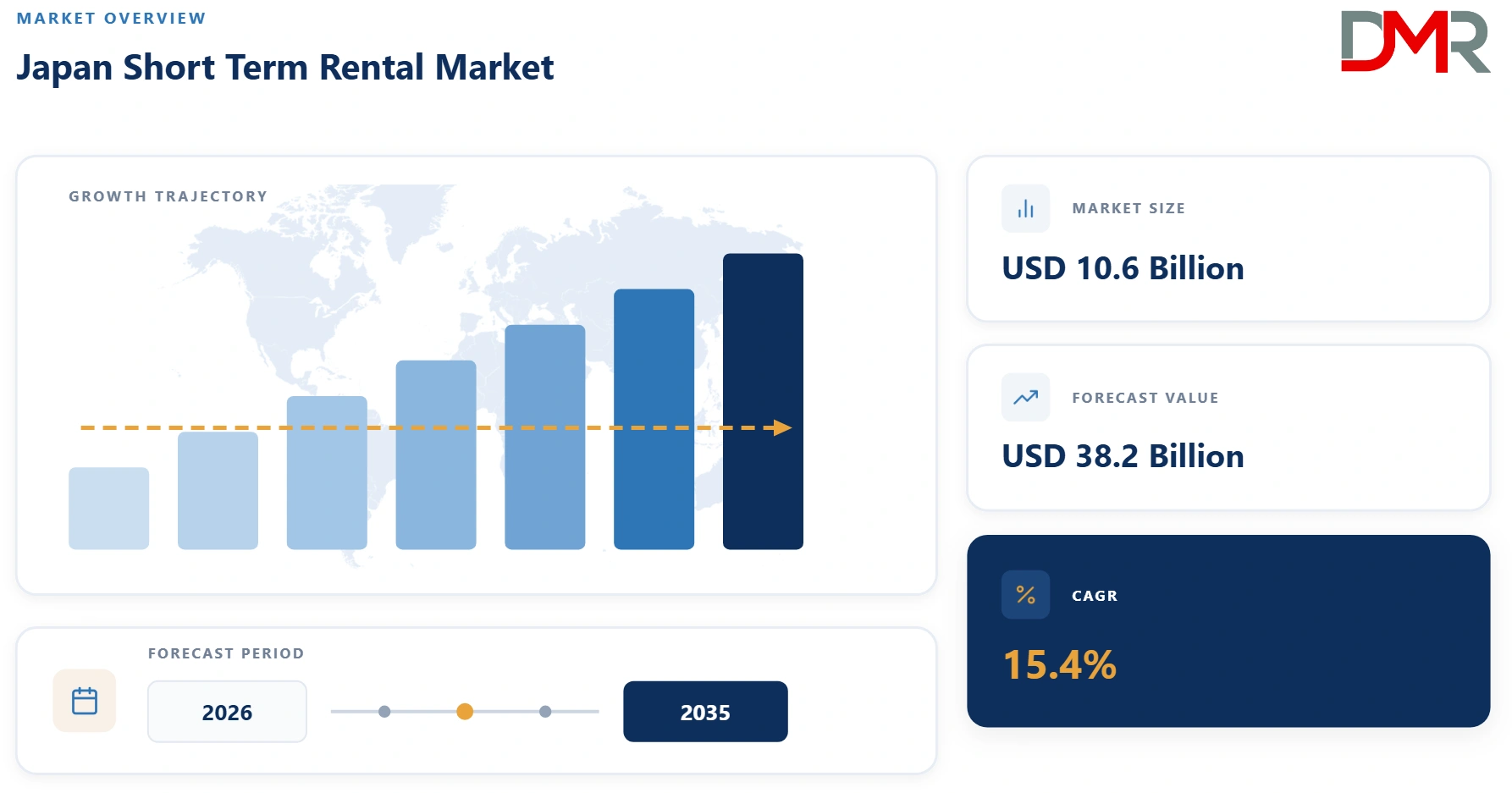
- Japan Short-Term Rental Market Size in 2026: USD 10.6 Billion
- Japan Short-Term Rental Market Size in 2035: USD 38.2 Billion
- Japan CAGR from 2026 to 2035: 15.4%
- Apartments are the leading accommodation type segment in 2026: 34.8%
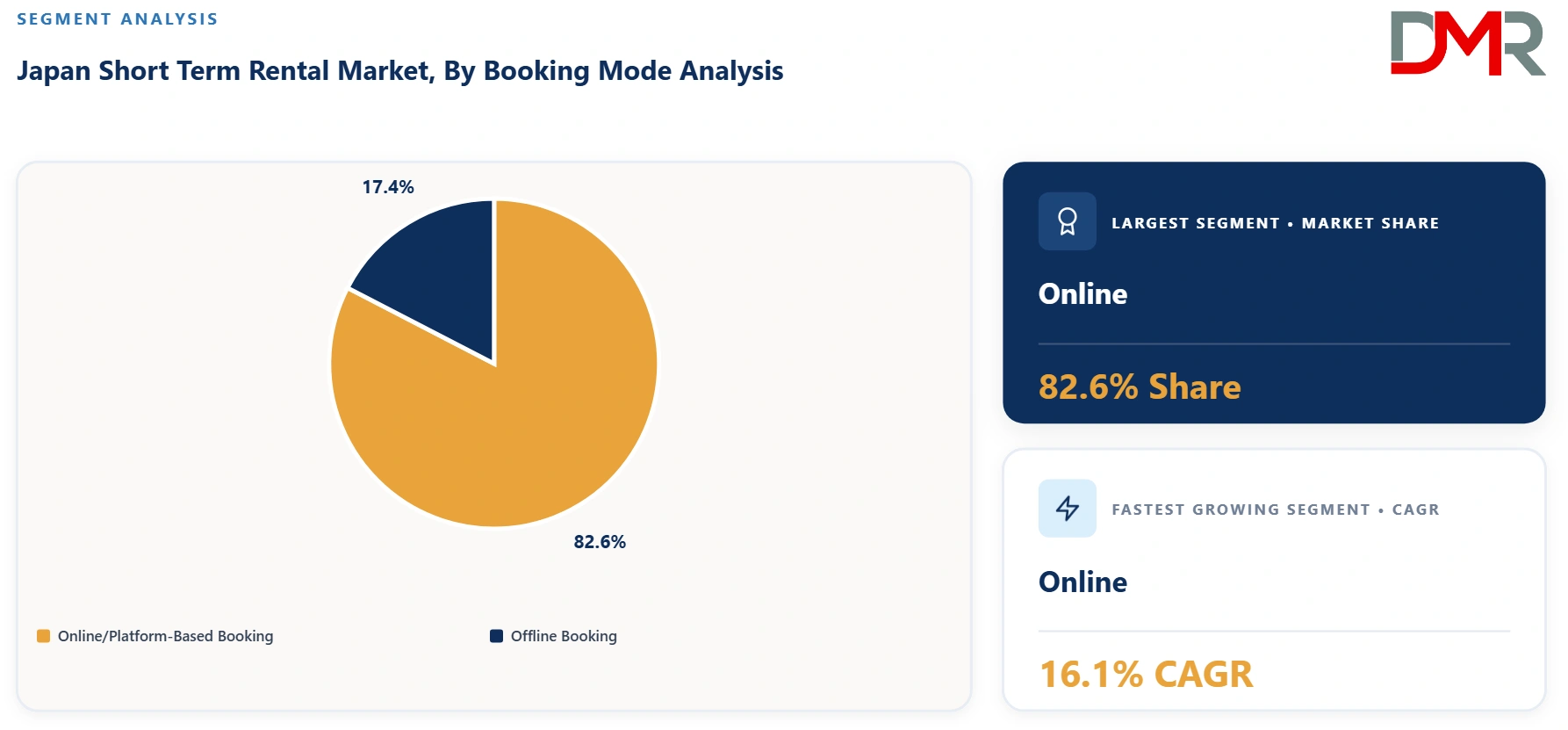
- Online Platform Based Booking is the leading booking mode segment in 2026: 82.6%
- Leisure Travelers are the leading end-user segment in 2026: 64.3%
What is the Japan Short-Term Rental Market and its Market Size?
The Japan Short-Term Rental Market is projected to reach USD 10.6 billion in 2026 and grow at a compound annual growth rate of 15.4% until 2035 to reach a value of USD 38.2 billion.
ℹ
To learn more about this report –
Download Your Free Sample Report Here
The Japan short-term rental market covers furnished apartments, houses, villas, condominiums, guesthouses, serviced apartments, and other residential accommodations rented for limited periods. Properties are booked through digital platforms, travel aggregators, property managers, travel agencies, or directly from operators. Demand is supported by inbound tourism, domestic travel, extended stays, group travel, remote working, and traveler preference for flexible, locally integrated, home-like accommodation.
Use Cases
- Leisure and Cultural Tourism: Short-term rentals provide leisure travelers with convenient access to major tourism destinations such as Tokyo, Kyoto, Osaka, Hokkaido, Okinawa, and Fukuoka. Guests benefit from kitchens, laundry facilities, additional living space, and neighborhood-based experiences. These properties are particularly attractive to international visitors seeking longer stays, cultural immersion, privacy, and alternatives to conventional hotels during peak travel seasons.
- Family and Group Accommodation: Families and groups use entire homes, apartments, villas, and condominiums to stay together while reducing per-person accommodation expenses. Multiple bedrooms, shared kitchens, dining areas, parking facilities, and private amenities make rentals suitable for family holidays, reunions, educational tours, and group excursions. Large-capacity properties also address limited availability of connecting hotel rooms across popular Japanese destinations.
- Business and Extended Stays: Business travelers, project teams, consultants, and relocating employees use serviced apartments and professionally managed rentals for assignments lasting several days or months. Furnished units offer workspace, internet connectivity, housekeeping, kitchens, and flexible booking arrangements. Demand is expanding around commercial centers, technology clusters, industrial locations, convention venues, and redevelopment projects where conventional hotels may be expensive or unsuitable for extended occupancy.
- Regional and Experience-Based Tourism: Short-term rentals convert vacant houses, traditional machiya townhouses, farmhouses, coastal homes, and rural properties into tourism accommodation. This supports regional revitalization while providing visitors with access to local food, nature, winter sports, wellness, and cultural activities. Municipalities and operators can use renovated properties to distribute tourism beyond Tokyo, Kyoto, and Osaka and generate income within less-visited communities.
Key Takeaways
- Market Size: The Japan Short-Term Rental Market is anticipated to be valued at USD 10.6 billion in 2026 and is forecast to reach USD 38.2 billion by 2035, expanding at a CAGR of 15.4%.
- Growth Outlook: Market expansion is supported by record inbound tourism, increasing domestic leisure travel, growth in online accommodation platforms, demand for larger living spaces, longer average stays, mobile booking, automated property management, regional tourism promotion, renovation of vacant housing, and traveler preference for flexible and experience-oriented accommodation.
- Primary Growth Drivers: Rising international visitor arrivals, a comparatively favorable yen for overseas travelers, constrained hotel capacity during peak periods, growth in independent travel, increasing family and group tourism, digital booking adoption, and government efforts to distribute visitor spending across regional destinations are strengthening demand for professionally managed short-term rentals.
- By Accommodation Type Analysis: Apartments are projected to lead the accommodation type segment with a 34.8% share in 2026, supported by extensive availability in Tokyo, Osaka, Kyoto, Fukuoka, and other urban markets. Serviced apartments are expected to expand at the highest CAGR of approximately 17.3%, driven by business travel, extended stays, professional management, standardized services, and demand for flexible accommodation.
- By Booking Mode Analysis: Online Platform Based Booking is expected to dominate with an 82.6% share in 2026 and expand at approximately 16.1% CAGR. Growth is supported by mobile reservations, real-time availability, digital payments, verified reviews, multilingual interfaces, automated pricing, platform marketing, and increased use of Airbnb, Booking.com, Agoda, Vrbo, Rakuten Travel, Vacation STAY, and domestic travel websites.
- By End User Analysis: Leisure Travelers are anticipated to dominate with a 64.3% share in 2026, supported by cultural tourism, seasonal travel, theme parks, winter sports, beach destinations, and regional experiences. Business Travelers are projected to record the highest CAGR of approximately 17.2%, supported by extended assignments, hybrid work, corporate mobility, exhibitions, conventions, and demand for furnished accommodation with workspace.
How AI and Generative AI are Transforming the Japan Short-Term Rental Market?
Artificial intelligence is improving pricing, occupancy forecasting, guest communication, fraud detection, and property operations across Japan’s short-term rental sector. Revenue-management systems adjust nightly rates according to seasonality, events, transport demand, competitor pricing, and booking patterns. Generative AI supports multilingual guest communication, listing descriptions, itinerary recommendations, review responses, and automated customer service. Computer vision assists property inspections and damage assessment, while predictive systems schedule cleaning and maintenance. AI-powered personalization also helps platforms recommend suitable properties based on group size, budgets, accessibility requirements, locations, amenities, and previous booking behavior.
Key Drivers in the Japan Short-Term Rental Market
Record Inbound Tourism and Diversifying Visitor Demand
Japan received a record 36.87 million international visitors in 2024, representing growth of 47.1% over 2023, according to the Japan National Tourism Organization. International arrivals subsequently exceeded 40 million for the first time in 2025, widening demand for apartments, homes, villas, and guesthouses. Independent travelers increasingly seek kitchens, laundry facilities, larger rooms, neighborhood experiences, and accommodation for families or groups. Demand is spreading beyond Tokyo, Osaka, and Kyoto toward Hokkaido, Okinawa, Fukuoka, Nagano, Hiroshima, and regional cultural destinations, creating opportunities for professionally managed rental inventory across multiple price categories.
Expansion of Registered Supply and Professional Property Management
Japan’s official private lodging portal reported 42,070 active notified residences as of July 15, 2026, following sustained growth in registrations under the Private Lodging Business Act. Expanding legal supply gives travelers greater choice while encouraging standardized safety, identification, guest reporting, and management practices. Professional operators are introducing automated check-in, smart locks, dynamic pricing, multilingual assistance, centralized cleaning, and remote property monitoring. These capabilities reduce operating complexity and allow owners to manage multiple units efficiently. Renovation of vacant homes and underused residential buildings is further expanding inventory, especially in destinations experiencing tourism growth and demographic decline.
Restraints in the Japan Short-Term Rental Market
Strict Operating Limits and Different Municipal Requirements
Japan’s Private Lodging Business Act generally limits notified minpaku properties to 180 operating days annually. Municipalities may impose additional restrictions based on zoning, school areas, residential conditions, weekdays, seasons, and neighborhood considerations. Properties operating under the Inns and Hotels Act or special-zone frameworks face separate licensing and facility requirements. Hosts must meet fire-safety standards, maintain guest records, display registration information, and arrange qualified management when absent. Regulatory differences across prefectures, cities, and Tokyo wards increase compliance expenses and restrict scalable portfolio development, particularly for small hosts and overseas property investors unfamiliar with local rules.
Community Concerns and Increasing Operating Costs
Noise, waste disposal, unauthorized parties, overcrowding, security concerns, and inconsiderate guest behavior can create opposition from residents and condominium associations. Community complaints may lead municipalities to introduce additional operating restrictions or enforcement measures. At the same time, operators face rising property acquisition costs, cleaning expenses, utility charges, platform commissions, insurance, maintenance, staffing shortages, and multilingual service requirements. Seasonal occupancy variations can make it difficult to recover fixed costs, especially where the 180-day limitation applies. Operators therefore require strong revenue management, guest screening, neighborhood communication, and diversified booking channels to maintain profitability.
Growth Opportunities in the Japan Short-Term Rental Market
Regional Revitalization Through Vacant Property Conversion
Japan has substantial numbers of vacant and underused houses that can be renovated into compliant tourism accommodation. Converting akiya homes, machiya townhouses, farmhouses, coastal residences, and traditional properties creates new revenue sources while preserving local architecture and supporting regional employment. Opportunities are particularly strong in areas connected to nature tourism, skiing, hot springs, cycling, food tourism, pilgrimage routes, and cultural heritage. Partnerships involving municipalities, property owners, technology providers, and professional operators can improve property standards and destination visibility. Successful projects can distribute visitor expenditure beyond heavily visited urban centers and reduce pressure on conventional hotels.
Professionally Managed Serviced and Extended-Stay Rentals
Growing business mobility, digital work, project-based employment, international assignments, and blended business-leisure travel are creating opportunities for furnished serviced apartments. Operators can differentiate through reliable internet, dedicated workspaces, housekeeping, kitchens, laundry facilities, multilingual assistance, corporate billing, and flexible cancellation policies. Properties offering weekly and monthly arrangements can also reduce exposure to short-stay seasonality and operating-day restrictions, depending on applicable tenancy structures. Technology-enabled companies capable of managing compliance, pricing, cleaning, maintenance, and distribution across multiple properties are well positioned to consolidate fragmented supply and attract institutional property owners.
Trends in the Japan Short-Term Rental Market
Growth of Unmanned and Technology-Enabled Operations
Smart locks, digital identity verification, tablet-based registration, automated check-in, remote concierge services, connected sensors, and cloud property-management systems are becoming central to Japanese rental operations. These technologies respond to labor shortages while enabling operators to serve international guests outside conventional reception hours. Centralized dashboards help manage reservations, pricing, cleaning, access, maintenance, and regulatory reporting across dispersed portfolios. Operators are also adopting noise monitoring and occupancy controls to reduce neighborhood disturbances. Technology-led operations are particularly relevant for apartment portfolios, serviced units, and standalone villas requiring consistent service without permanent front-desk staffing.
Shift Toward Larger and Experience-Oriented Properties
Travelers are increasingly selecting entire homes, villas, resort condominiums, and renovated traditional properties that offer privacy, group capacity, kitchens, outdoor areas, hot tubs, saunas, or scenic locations. Demand is moving beyond basic accommodation toward curated stays connected to local food, culture, wellness, skiing, beaches, nature, and community activities. Platforms and operators are responding with themed properties and region-specific experiences. This trend supports higher average daily rates and differentiation from standardized hotels, although operators must preserve authenticity while maintaining professional cleanliness, safety, accessibility, and customer-service standards.
Research Scope and Analysis
The Japan short term rental market includes apartments, homes and villas, resorts and condominiums, hostels and guesthouses, serviced apartments, other accommodations, online platform based booking, vacation rental platforms, travel aggregator websites, property management platforms, offline booking, direct bookings, travel agencies and tour operators, leisure travelers, business travelers, group travelers, solo travelers, across Japan through 2035.
ℹ
To learn more about this report –
Download Your Free Sample Report Here
By Accommodation Type Analysis
Apartments are projected to dominate the accommodation type segment with a 34.8% market share in 2026, supported by broad urban availability, competitive pricing, convenient locations, and suitability for independent travelers.
Serviced Apartments are expected to record the highest CAGR of approximately 17.3% through 2035, exceeding the overall market rate as corporate travel, extended stays, professional management, and demand for standardized amenities increase.
By Booking Mode Analysis
Online Platform Based Booking is projected to dominate the booking mode segment with an 82.6% share in 2026, supported by mobile accessibility, transparent pricing, property comparisons, verified reviews, multilingual support, and secure digital payments.
The segment is also expected to record the highest CAGR of approximately 16.1% through 2035 as platforms expand inventory, personalization, dynamic pricing, loyalty programs, and automated reservation management.
By End User Analysis
Leisure Travelers are projected to lead the end-user segment with a 64.3% share in 2026, driven by international tourism, domestic holidays, seasonal attractions, cultural experiences, and family travel.
Business Travelers are anticipated to record the highest CAGR of approximately 17.2% through 2035, supported by corporate assignments, hybrid work, conventions, project travel, relocation, and rising demand for flexible furnished apartments.
The Japan Short-Term Rental Market Report is Segmented Based on the following:
By Accommodation Type
- Apartments
- Homes and Villas
- Resorts and Condominiums
- Hostels and Guesthouses
- Serviced Apartments
- Others
By Booking Mode
- Online Platform-Based Booking
- § Vacation Rental Platforms
- § Travel Aggregator Websites
- § Property Management Platforms
- Offline Booking
- § Direct Bookings including Walk-ins and Phone Reservations
- § Travel Agencies and Tour Operators
By End User
- Leisure Travelers
- Business Travelers
- Group Travelers
- Solo Travelers
Regulatory Landscape
Japan’s short-term rental sector operates primarily under the Private Lodging Business Act, the Inns and Hotels Act, and the National Strategic Special Zones framework. Standard minpaku registrations generally permit operations for up to 180 days annually, while local authorities can impose tighter zoning or scheduling restrictions. Operators must satisfy fire-safety, sanitation, guest-record, identity-verification, signage, reporting, and property-management requirements. The regulatory environment creates opportunities for licensed managers, compliance software, legal advisory services, and professionally operated properties. However, stricter municipal controls, zero-day restrictions, neighborhood complaints, and inconsistent local rules may limit supply, increase compliance costs, and encourage portfolio concentration in operator-friendly jurisdictions.
Technology Analysis
Technology is reshaping rental distribution, operations, pricing, and guest services across Japan. Cloud-based property-management systems connect listings with multiple booking platforms while synchronizing calendars, prices, availability, payments, and housekeeping. Smart locks and remote verification facilitate unmanned check-in, addressing hospitality labor shortages. AI-based revenue tools use seasonality, events, demand signals, and competitor prices to optimize rates. Multilingual chatbots support international guests, while noise sensors and occupancy monitoring help prevent community disruption. Opportunities exist for integrated platforms covering compliance reporting, identity checks, cleaning, maintenance, and owner dashboards. Cybersecurity, data privacy, system interoperability, and excessive dependence on third-party platforms remain important operational risks.
Competitive Landscape
The Japan short-term rental market includes global booking platforms, domestic travel websites, branded accommodation operators, property-management companies, serviced-apartment providers, and regional specialists. Competition focuses on legal inventory, property location, pricing, guest ratings, multilingual support, mobile booking, loyalty benefits, professional cleaning, and automated check-in. Airbnb, Booking.com, Agoda, Expedia, Vrbo, Rakuten Travel, and Vacation STAY provide extensive digital reach. Domestic operators differentiate through local market knowledge and property-management capabilities. Consolidation is expected as regulatory complexity, technology costs, and service expectations favor professional operators capable of managing compliant, standardized portfolios across multiple cities.
Some of the Prominent Players in the Japan Short-Term Rental Market Are
- Airbnb, Inc.
- Booking Holdings Inc.
- Expedia Group, Inc.
- Vrbo
- Agoda Company Pte. Ltd.
- Trip.com Group Limited
- Rakuten Group, Inc.
- Rakuten STAY, Inc.
- Vacation STAY
- Jalan.net
- Yahoo Travel Japan
- Ikkyu Corporation
- Relux
- HomeToGo SE
- TripAdvisor LLC
- Klook Travel Technology Limited
- AsiaYo Co. Ltd.
- Tujia
- Hyakusenrenma Inc.
- STAY JAPAN
- matsuri technologies Inc.
- SQUEEZE Inc.
- Spacemarket, Inc.
- Hmlet Japan Co. Ltd.
- Weave Living Japan
- MetroResidences Japan
- Oakwood
- The Ascott Limited
- Tokyu Resorts and Stays Co. Ltd.
- Tokyu Stay
- APARTMENT HOTEL MIMARU
- Cosmos Hotel Management Co. Ltd.
- H2 Group
- Nisade
- Cansell Co. Ltd.
- Kasoku Co. Ltd.
- Unito, Inc.
- ADDress Inc.
- Tabist Co. Ltd.
- Hoshino Resorts Inc.
- Other Key Players
Recent Developments
- In July 2026, the Japan Tourism Agency issued technical guidance to local governments concerning private lodging regulations, including zero-day restrictions and requirements involving the use of information and communication technology for property management. The guidance reflected increasing attention to balancing tourism accommodation growth with neighborhood protection and effective local oversight.
- In September 2025, Matsuri Technologies partnered with Japan Food Guide to allow guests staying in its properties to discover and reserve restaurants and culinary experiences. The collaboration expanded the company’s guest offering beyond accommodation and responded to inbound travelers’ demand for multilingual local dining discovery and simplified booking.
- In May 2025, Airbnb’s collaboration with Japanese real estate partners highlighted a shift toward developing purpose-built, compliant short-term rental supply. The model enables Airbnb to support property design and guest experience while working with local developers and operators capable of managing ownership, licensing, and day-to-day operations.
- In 2025, Japan recorded more than 40 million international visitor arrivals for the first time, according to JNTO. This milestone strengthened demand for alternative accommodations and encouraged booking platforms, professional property managers, and owners to expand compliant rental supply in major cities and regional destinations.
Report Details
| Report Characteristics |
| Market Size (2026) |
USD 10.6 Bn |
| Forecast Value (2035) |
USD 38.2 Bn |
| CAGR (2026–2035) |
15.4% |
| Historical Data |
2021 – 2025 |
| Forecast Data |
2026 – 2035 |
| Base Year |
2025 |
| Segments Covered |
By Accommodation Type, By Booking Mode, By End User |
Frequently Asked Questions
How big is the Japan Short-Term Rental Market?
▾ The Japan Short-Term Rental Market is projected to be valued at USD 10.6 billion in 2026 and reach USD 38.2 billion by 2035.
What is the CAGR of the Japan Short-Term Rental Market from 2026 to 2035?
▾ The Japan Short-Term Rental Market is expected to expand at a compound annual growth rate of approximately 15.4% from 2026 to 2035.
What factors are driving the growth of the Japan Short-Term Rental Market?
▾ Growth is driven by record inbound tourism, domestic leisure travel, online booking adoption, extended stays, regional tourism development, vacant-home conversion, flexible accommodation demand, and growing preference for apartments and entire homes among families and groups.
What are the major trends in the Japan Short-Term Rental Market?
▾ Major trends include technology-enabled property management, automated check-in, dynamic pricing, multilingual guest services, professionally managed portfolios, serviced-apartment growth, experience-oriented rentals, regional property conversion, and increasing use of artificial intelligence.
Who are the key players in the Japan Short-Term Rental Market?
▾ Key players include Airbnb, Booking.com, Expedia, Vrbo, Agoda, Trip.com, Rakuten Travel, Vacation STAY, STAY JAPAN, matsuri technologies, SQUEEZE, Hmlet Japan, MetroResidences, Oakwood, and MIMARU.
How is the Japan Short-Term Rental Market segmented?
▾ The market is segmented by accommodation type into apartments, homes and villas, resorts and condominiums, hostels and guesthouses, serviced apartments, and others. By booking mode, it includes online platform-based and offline booking. By end user, it covers leisure, business, group, and solo travelers.