Market Snapshot
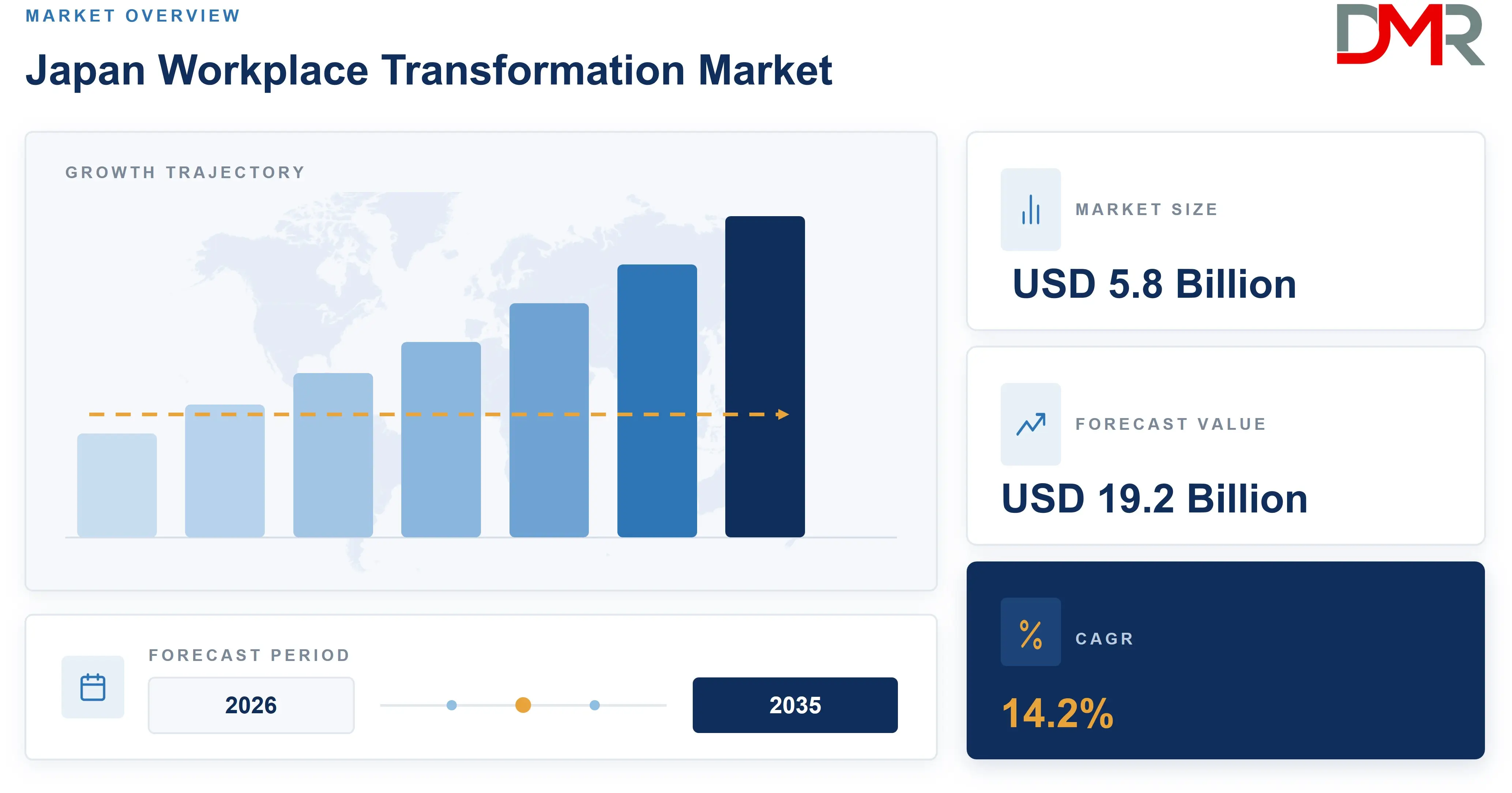
- Market Size (2026): USD 5.8 Bn
- Forecast Value (2035): USD 19.2 Bn
- CAGR (2026-2035): 14.2%
- Leading Offering (2026): Solutions & Platforms, approximately 44%
- Leading Deployment (2026): Cloud, around 58%
- Key Players: NTT DATA, Fujitsu, NEC Corporation and others
What is Japan Workplace Transformation Market and its Market Size?
The Japan Workplace Transformation Market size is estimated to reach USD 5.8 Bn in 2026 and is further anticipated to reach USD 19.2 Bn by 2035, at a CAGR of 14.2%. Workplace transformation in Japan covers software, cloud infrastructure, integration, managed services and digital workplace capabilities used to redesign how employees communicate, access applications, automate routine work and operate across office, remote and field environments.
ℹ
To learn more about this report –
Download Your Free Sample Report Here
The market boundary reflects demand generated inside Japan rather than worldwide revenue earned by companies headquartered in the country. Spending includes collaboration suites, cloud workspaces, workflow platforms, workplace analytics, identity controls, employee experience tools, systems integration and recurring operational support. It excludes general-purpose hardware purchases not tied to a workplace modernization program and ordinary IT outsourcing without a transformation component.
Japanese enterprises are moving from isolated telework tools toward integrated operating models in which cloud productivity, secure access, AI assistants and business workflows share a common data and governance layer. Labor scarcity increases the value of automation, while large employers also need to preserve institutional knowledge as experienced workers retire. Buyers therefore assess programs on measurable productivity, adoption, security and process outcomes rather than software deployment alone.
Demand is strongest where legacy applications, distributed teams and complex approval processes create visible friction. Large organizations can fund broad platform consolidation, while mid-sized companies increasingly buy packaged cloud services and managed transformation support. This shifts competition toward vendors that combine technology with migration, change management, cybersecurity and ongoing optimization.
Use Cases
- Enterprise Collaboration Modernization: Large Japanese corporations deploy integrated messaging, meetings, document collaboration and secure access across headquarters, branches and remote teams. The program reduces tool fragmentation, shortens coordination cycles and gives IT departments a consistent policy layer for identity, information sharing and endpoint access.
- Manufacturing Knowledge Transfer: Manufacturers connect field workers, engineers and experienced technicians through digital work instructions, expert collaboration and searchable knowledge repositories. This helps plants preserve operational know-how, accelerate troubleshooting and reduce dependence on a small number of specialists when workforce demographics tighten.
- Financial Services Process Redesign: Banks and insurers combine digital workspaces with controlled document workflows and role-based access for customer servicing, internal approvals and compliance-sensitive collaboration. Employees spend less time moving information between systems, while governance teams gain clearer control over permissions, records and process accountability.
- Public Sector Workforce Enablement: Government bodies and public institutions modernize employee portals, collaboration environments and administrative workflows to support distributed service delivery. Standardized digital processes reduce manual handoffs, make information easier to locate and create a more consistent employee experience across departments with different legacy systems.
Key Takeaways
- Market Size & Share: Managed Services is expected to represent roughly 24% of 2026 revenue as enterprises seek operational support after platform deployment.
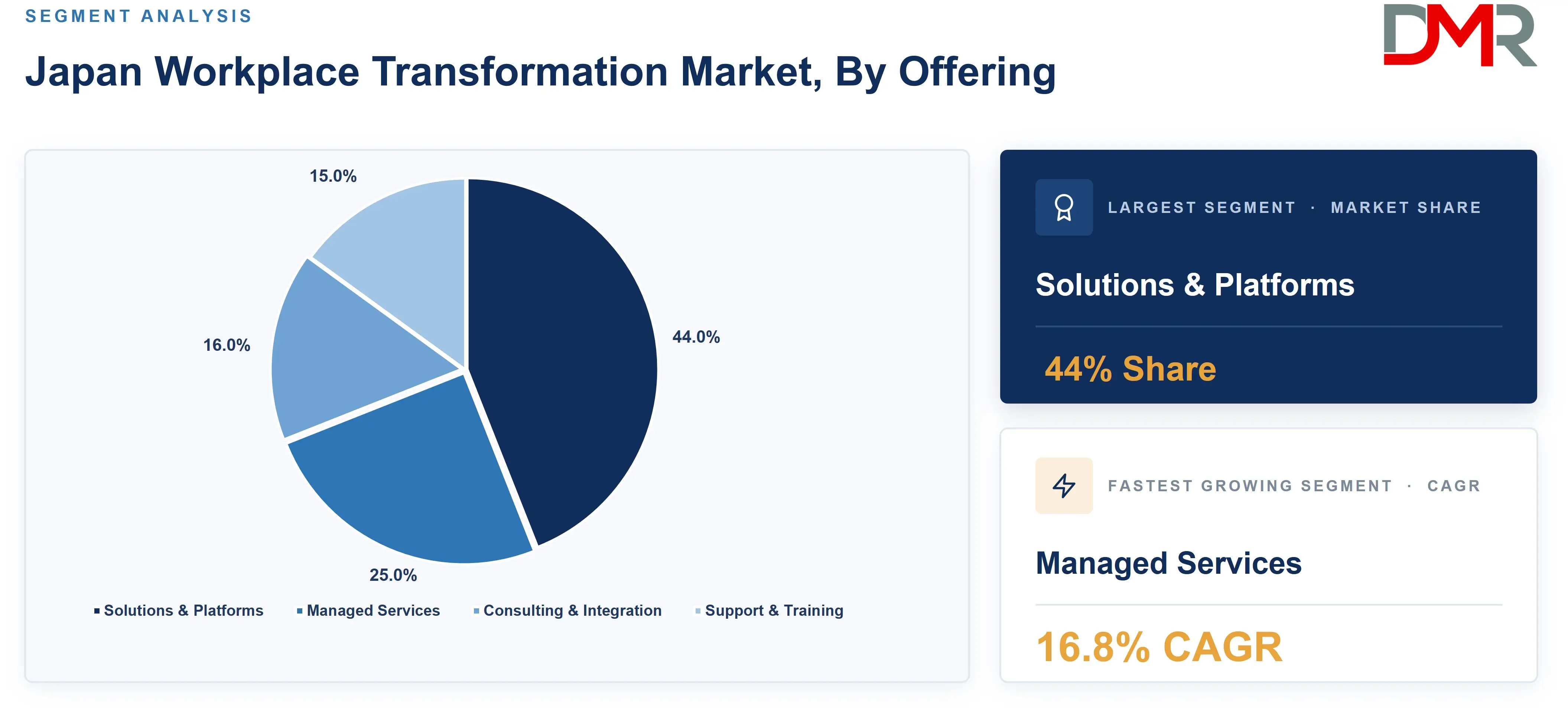
- Offering Analysis: Solutions & Platforms is projected to hold approximately 44% of 2026 revenue, supported by recurring cloud and digital workplace subscriptions.
- Demand Concentration: IT & Telecommunications is set to account for close to 22% of 2026 demand because digitally intensive employers adopt new workplace stacks early.
- Automation Momentum: AI & Automation is forecast to expand at a CAGR of 20.1% through 2035 as enterprises embed assistants and agents into daily work.
- Deployment Shift: Hybrid deployment is projected to grow at a CAGR of 17.6% through 2035 as regulated and legacy-heavy organizations combine cloud services with controlled environments.
- Industrial Opportunity: Manufacturing is expected to grow at a CAGR of 16.3% through 2035 as knowledge transfer, frontline digitization and workflow modernization converge.
How AI/Gen AI is Transforming the Japan Workplace Transformation Market?
AI is changing workplace transformation from a migration exercise into continuous process redesign. Japanese organizations are introducing large language model assistants for document summarization, meeting preparation, enterprise search and knowledge retrieval, while machine learning supports service routing, employee support and usage analytics. The commercial effect is broader demand for data integration, permission management, observability and change management because useful AI depends on governed access to business information.
Generative AI also changes the role of integrators. Instead of configuring only collaboration and cloud platforms, providers increasingly map workflows, define human approval points, connect enterprise data and measure adoption. Agentic systems can execute multi-step tasks, but Japanese buyers remain sensitive to information leakage, model governance and accountability, keeping human oversight and identity controls central to deployment design.
- LLM Knowledge Assistance: Enterprise search and retrieval-augmented generation help employees locate policies, project history and technical knowledge across fragmented repositories.
- Workflow Agents: AI agents can prepare documents, route requests and coordinate routine multi-step work while preserving approval gates for higher-risk actions.
- Workplace Analytics: Machine learning identifies adoption patterns, support bottlenecks and collaboration friction so transformation teams can target training and process changes.
- Digital Twin Operations: Workplace and facility data can be combined with digital twins to support space planning, maintenance coordination and operational decision-making.
Key Drivers in the Japan Workplace Transformation Market
Demand is being pulled by structural labor constraints and by the need to convert fragmented digital tools into measurable operating productivity.
- Labor Scarcity and Productivity Pressure: Japan's aging workforce raises the economic value of every hour saved from repetitive coordination, document handling and administrative work. This supports platform consolidation, workflow automation and knowledge capture across office and frontline roles. The mechanism is especially strong in large employers where small productivity gains scale across thousands of users. AI & Automation is expected to represent around 21% of technology spending in 2026, with buyers prioritizing use cases that shorten task cycles, reduce manual re-entry and preserve specialist knowledge without expanding headcount at the same pace.
- Cloud-Based Operating Model Standardization: Hybrid work exposed the cost of disconnected file stores, meeting tools, VPN-dependent applications and inconsistent identity policies. Enterprises are standardizing collaboration, access and workflow layers so employees can move between office, home and customer sites without recreating processes. Cloud deployment is projected to account for approximately 58% of 2026 revenue. This creates follow-on demand for migration, governance, endpoint security and managed adoption services rather than ending with the initial software license.
Restraints in the Japan Workplace Transformation Market
Transformation programs face practical brakes where legacy estates, governance requirements and employee adoption costs are underestimated.
- Legacy Integration and Data Fragmentation: Many Japanese enterprises operate customized core systems, departmental databases and long-lived workflows that cannot be moved into a modern workplace stack without interface redesign. Integration work raises project duration and makes business cases harder to standardize. On-Premises deployment is expected to retain around 25% of 2026 revenue, reflecting workloads tied to controlled infrastructure. When identity, content and process data stay fragmented, AI assistants also deliver weaker results, forcing buyers to fund data cleanup and access governance before advanced automation can scale.
- Change Management and Security Friction: New collaboration and AI tools create value only when employees change established routines, yet broad adoption requires training, policy design and visible management support. Security teams must control confidential information, external sharing and machine access to repositories. Support & Training is projected to hold close to 12% of 2026 offering revenue, showing that adoption is a material cost. Programs can stall when organizations license new tools faster than they redesign processes, define acceptable AI use or measure whether employees change how work is completed.
Growth Opportunities in the Japan Workplace Transformation Market
White space is opening in managed transformation for mid-sized employers and in frontline digitization for labor-intensive industries.
- Managed Transformation for Mid-Sized Enterprises: Smaller IT teams often lack specialists for cloud governance, workflow engineering, cybersecurity and AI adoption, creating room for packaged managed workplace services. Providers can combine assessment, migration, user support and continuous optimization under predictable contracts. Managed Services is projected to grow at a CAGR of 16.8% through 2035. The opportunity is strongest for vendors that localize support, integrate commonly used Japanese business applications and prove outcomes through adoption and process metrics rather than requiring customers to assemble multiple specialist partners.
- Frontline and Industrial Workplace Modernization: Factory, logistics and field employees remain less digitized than office knowledge workers, even though labor scarcity and skills transfer are acute. Mobile workflows, remote expert support, digital instructions and secure access can connect operational staff without forcing desktop-centric processes onto them. Manufacturing represents roughly 18% of 2026 end-use revenue. Commercial openings sit in solutions that connect workplace platforms with operational systems, cameras, sensors and maintenance data while meeting site-level reliability and cybersecurity requirements.
Trends in the Japan Workplace Transformation Market
Buyer behavior is shifting from tool deployment toward platform consolidation, AI-ready processes and outcome-based workplace operations.
- From Copilots to Agentic Workflows: Enterprises are moving beyond conversational assistance toward systems that coordinate several steps across documents, approvals and business applications. This changes procurement because organizations need orchestration, auditability and human checkpoints in addition to model access. Workflow Automation is expected to represent around 23% of application revenue in 2026. Integrators that can redesign processes and establish control points gain an advantage over vendors focused only on seat deployment, while buyers increasingly evaluate return through cycle-time reduction and task completion.
- Experience-Led Office and Hybrid Design: Physical offices are being treated less as default work locations and more as collaboration, learning and customer interaction environments. Digital booking, meeting-room technology, occupancy insight and virtual collaboration are being integrated with employee experience platforms. Workplace & Space Management is expected to account for nearly 11% of 2026 application revenue. The shift encourages convergence between IT, facilities and human resources budgets, creating larger multi-domain projects but also requiring interoperability across building systems, collaboration tools and employee-facing applications.
Research Scope and Analysis
Segment performance is assessed across offering, deployment, technology, application and end-use industry. Each axis identifies where 2026 revenue is concentrated and where spending is moving fastest through 2035, linking share positions to installed systems, procurement behavior, labor constraints and technology adoption.
ℹ
To learn more about this report –
Download Your Free Sample Report Here
By Offering
Solutions & Platforms is projected to hold the largest offering share in 2026, accounting for approximately 44% of revenue as collaboration suites, digital workplace platforms, automation tools and employee experience software form the recurring technology layer of transformation programs. Subscription licensing keeps platform spending visible after migration. Growth, however, is concentrated in Managed Services, expanding at a CAGR of 16.8% between 2026 and 2035 as enterprises seek continuous administration, security, adoption support and workflow optimization. The shift reflects a shortage of specialist internal resources and the growing complexity of integrated cloud and AI environments. Providers that combine operational support with measurable process improvement are positioned to capture more recurring spend than project-only integrators.
By Deployment
Cloud is expected to lead deployment in 2026 with around 58% of revenue because collaboration, content management and productivity platforms increasingly use subscription delivery, centralized updates and identity integration. Cloud architectures also make it easier to extend common services across branches and remote employees. The steeper trajectory sits with Hybrid deployment, forecast to grow at a CAGR of 17.6% through 2035 as large organizations preserve selected controlled workloads while connecting them to cloud collaboration and automation layers. This model fits buyers with customized legacy applications, sensitive information or phased modernization schedules. Demand therefore shifts toward integration and policy consistency across environments rather than a simple replacement of every on-premises system.
By Technology
Collaboration & Communication is projected to account for close to 29% of technology revenue in 2026 because messaging, meetings, shared content and team coordination remain the common entry point for workplace modernization. Their broad user base makes them foundational to identity and adoption programs. Growth, however, is concentrated in AI & Automation, expanding at a CAGR of 20.1% from 2026 to 2035 as assistants and agents move into document work, knowledge retrieval and process execution. The pull comes from labor scarcity and better integration between productivity suites and enterprise data. Security, permissions and workflow governance become more valuable because automated actions require clearer controls than passive collaboration tools.
By Application
Hybrid Work Enablement is set to hold the largest application share in 2026 at approximately 27%, supported by sustained demand for secure access, meetings, shared workspaces and consistent employee experiences across locations. The installed base keeps spending recurring through upgrades and integration. The faster trajectory belongs to Workflow Automation, forecast to expand at a CAGR of 18.9% through 2035 as organizations target repetitive approvals, document handling, service requests and cross-application tasks. Generative AI increases the range of processes that can be automated, but value depends on redesigning steps and preserving human control for exceptions. Vendors combining process mapping with low-code tools and AI orchestration can address a broader budget than collaboration-only providers.
By End Use Industry
IT & Telecommunications is expected to hold the leading end-use share in 2026, representing roughly 22% of revenue because digitally intensive employers have large knowledge-worker populations, distributed teams and stronger internal capability to adopt new platforms. They also serve as early reference customers for emerging workplace technologies. Growth, however, is concentrated in Manufacturing, expanding at a CAGR of 16.3% through 2035 as factories digitize frontline work, capture specialist knowledge and connect engineering teams with production sites. Labor constraints and skills transfer create a clear return case for digital instructions, remote assistance and workflow tools. Successful offerings must bridge office IT and operational environments without weakening plant reliability or access controls.
The Japan Workplace Transformation Market Report is Segmented Based on the Following
By Offering
- Solutions & Platforms
- Managed Services
- Consulting & Integration
- Support & Training
By Deployment
- Cloud
- On-Premises
- Hybrid
- Others
By Technology
- Collaboration & Communication
- Cloud Workspace & VDI
- AI & Automation
- Workplace Analytics
- Identity & Security
- Others
By Application
- Hybrid Work Enablement
- Workflow Automation
- Knowledge & Collaboration
- Employee Experience
- Workplace & Space Management
- Others
By End Use Industry
- IT & Telecommunications
- BFSI
- Manufacturing
- Government & Public Sector
- Healthcare
- Retail & Consumer Services
- Others
Technology Analysis
Japan's workplace stack is converging around cloud productivity, identity, workflow automation and enterprise AI, with value moving from isolated applications toward integrated data and orchestration layers. The current shift is from assistant-style AI to agents that can execute controlled multi-step work across business systems. Commercial openings sit in retrieval-augmented generation, low-code automation, secure enterprise search, workplace analytics and digital twin integration for physical operations. The main brake is architecture debt: fragmented permissions and customized legacy systems limit what automation can safely access. Technology leadership will therefore depend less on model novelty and more on integration quality, governance, observability and the ability to convert enterprise data into repeatable workflows.
Investment and White Space Analysis
Investment is moving toward programs that connect software deployment with measurable process redesign, particularly where labor scarcity makes automation economically visible. Large enterprises remain the anchor buyers, but white space is widening among mid-sized organizations that need managed migration, governance and adoption support without building specialist teams internally. Another opening lies in frontline environments, where manufacturing, logistics and field service still have many manual handoffs and undocumented practices. Providers can differentiate through packaged industry workflows, Japanese-language support and outcome measurement. The principal risk is fragmented budgeting across IT, human resources, facilities and business units, which can slow enterprise-wide decisions and favor modular projects over broad transformation commitments.
Competitive Landscape
Competition in Japan combines global cloud and software platforms with domestic systems integrators, telecom operators, office technology vendors and specialist SaaS providers. Platform vendors compete on installed user base, AI capabilities, security and ecosystem depth, while Japanese providers differentiate through local support, legacy integration, industry knowledge and nationwide service coverage. Major strategies include bundling collaboration with AI, expanding managed services, building workflow templates and linking workplace platforms with cybersecurity and data governance. No single vendor controls the full transformation stack, so partnerships remain central. Domestic incumbents can defend large accounts through integration depth, while cloud-native specialists gain share in focused workflows where faster deployment and simpler user experience matter more than broad infrastructure ownership.
Some of the Prominent Players in the Japan Workplace Transformation Market Are
- NTT DATA
- Fujitsu
- NEC Corporation
- Ricoh Company, Ltd.
- Hitachi, Ltd.
- Canon Inc.
- Konica Minolta, Inc.
- KDDI Corporation
- SoftBank Corp.
- SCSK Corporation
- TIS Inc.
- Otsuka Corporation
- Cybozu, Inc.
- Sansan, Inc.
- HENNGE K.K.
- kubell Co., Ltd.
- WingArc1st Inc.
- Panasonic Connect Co., Ltd.
- Internet Initiative Japan Inc.
- Works Applications Co., Ltd.
- Microsoft
- Google
- Amazon Web Services
- Cisco Systems
- IBM
- Salesforce
- ServiceNow
- Zoom Communications
- Adobe
- Atlassian
- Box
- Broadcom
- Citrix
- Dell Technologies
- HP Inc.
- Lenovo
- Accenture
- Deloitte
- PwC
- Kyndryl
- Other Key Players
Recent Developments
- In July 2026, NTT DATA disclosed an enterprise agreement with Google Cloud around Agentic Workplace Transformation, using Google Workspace and Gemini Enterprise internally to build operating practices that can also support customer workplace and AI transformation programs.
- In June 2026, Ricoh began a Japan-based co-creation pilot with Thread AI that combines AI orchestration, multimodal AI and digital twins for facility-management operations, creating a path from workplace insight toward automated operational execution.
- In March 2026, Ricoh Japan applied RICOH Virtual Workplace to a Tokyo construction-related design project, using a virtual environment to improve information sharing, simulation and stakeholder agreement around infrastructure planning.
- In August 2025, NEC announced AI technology that recognizes and digitizes worker tasks from multi-camera video without task-specific pre-training, targeting faster worksite visualization and process optimization across industrial environments.
- In May 2025, NEC expanded its BluStellar digital transformation approach with generative AI capabilities, strengthening its ability to combine transformation consulting, secure technology deployment and operational change for enterprise customers.
Report Details
| Report Characteristics |
| Market Size (2026) |
USD 5.8 Bn |
| Forecast Value (2035) |
USD 19.2 Bn |
| CAGR (2026-2035) |
14.2% |
| Historical Data |
2021 - 2025 |
| Forecast Data |
2026 - 2035 |
| Base Year |
2025 |
| Segments Covered |
By Offering, By Deployment, By Technology, By Application and By End Use Industry |
| Regional Coverage |
Japan |
Frequently Asked Questions
How big is the Japan Workplace Transformation Market?
▾ The Japan Workplace Transformation Market is estimated at USD 5.8 Bn in 2026. Demand covers digital workplace platforms, cloud collaboration, workflow automation, workplace analytics, secure access, integration and managed transformation services purchased for employees and operations inside Japan. Spending is increasingly tied to measurable productivity and process outcomes rather than simple deployment of remote-work tools.
What is the growth rate of the Japan Workplace Transformation Market?
▾ The industry is forecast to expand at a CAGR of 14.2% from 2026 to 2035. Growth is supported by labor scarcity, cloud platform consolidation, AI-enabled workflow redesign and continued modernization of hybrid and frontline work. The strongest programs combine technology deployment with governance, employee adoption, process mapping and recurring operational support.
What is driving demand in the Japan Workplace Transformation Market?
▾ Demand is driven by the need to raise employee productivity while Japan faces structural workforce constraints. Enterprises are also replacing fragmented collaboration and access tools with integrated cloud environments, while AI creates new reasons to modernize data, permissions and workflows. Manufacturing knowledge transfer and mid-sized enterprise managed services add further demand beyond office-centric hybrid work.
Which offering holds the largest share in the Japan Workplace Transformation Market?
▾ Solutions & Platforms is expected to hold the largest offering share in 2026 at approximately 44%. Collaboration suites, digital workplace platforms, workflow tools, employee experience software and related cloud services create the recurring technology foundation for most transformation programs, while integration and managed services are layered around these platforms to support migration, governance and adoption.
Which technology is growing fastest in the Japan Workplace Transformation Market?
▾ AI & Automation is forecast to be the fastest-growing technology segment, expanding at a CAGR of 20.1% from 2026 to 2035. Enterprises are applying assistants and agents to knowledge retrieval, document work and multi-step workflows. Adoption also increases demand for secure data access, identity governance, monitoring and human approval controls.
Who are the key players in the Japan Workplace Transformation Market?
▾ Key participants include NTT DATA, Fujitsu, NEC Corporation, Ricoh, Microsoft, Google and Cisco Systems. Competition spans global software platforms, domestic systems integrators, telecom operators and specialist SaaS providers. Buyers often combine several vendors because workplace transformation requires cloud applications, integration, security, change management and ongoing support rather than a single standalone product.
What is the outlook for the Japan Workplace Transformation Market?
▾ The Japan Workplace Transformation Market is moving toward integrated, AI-ready operating environments in which collaboration, identity, enterprise data and workflow automation are managed as one transformation agenda. Growth opportunities are strongest in agentic workflows, managed services for mid-sized firms and frontline digitization, while legacy integration, governance and employee adoption remain important execution constraints.