Global Long Range Identification Tracking Market Snapshot
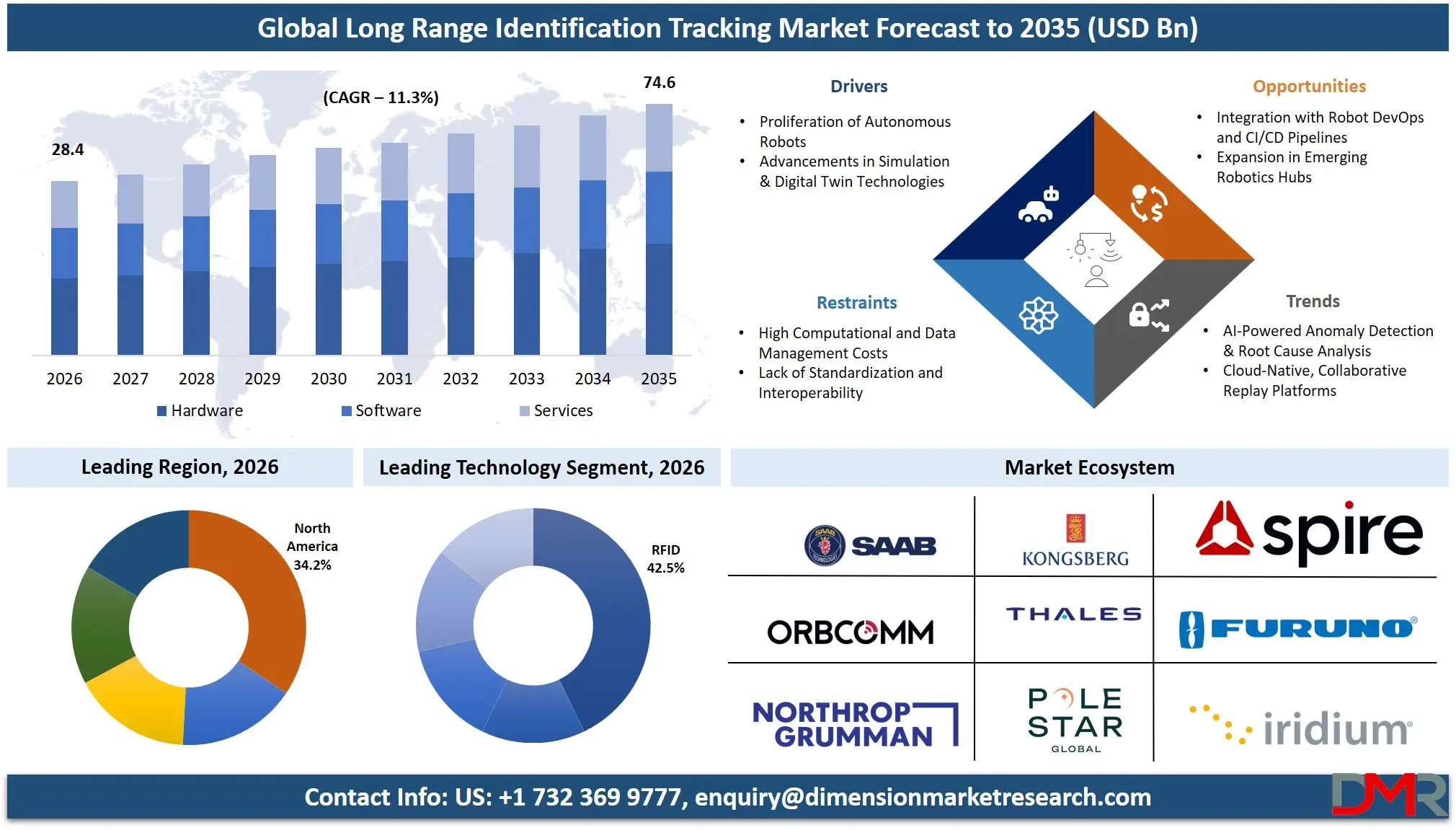
- Market Size in 2026: USD 28.4 Billion
- Market Size in 2035: USD 74.6 Billion
- Global CAGR (2026-2035): 11.3%
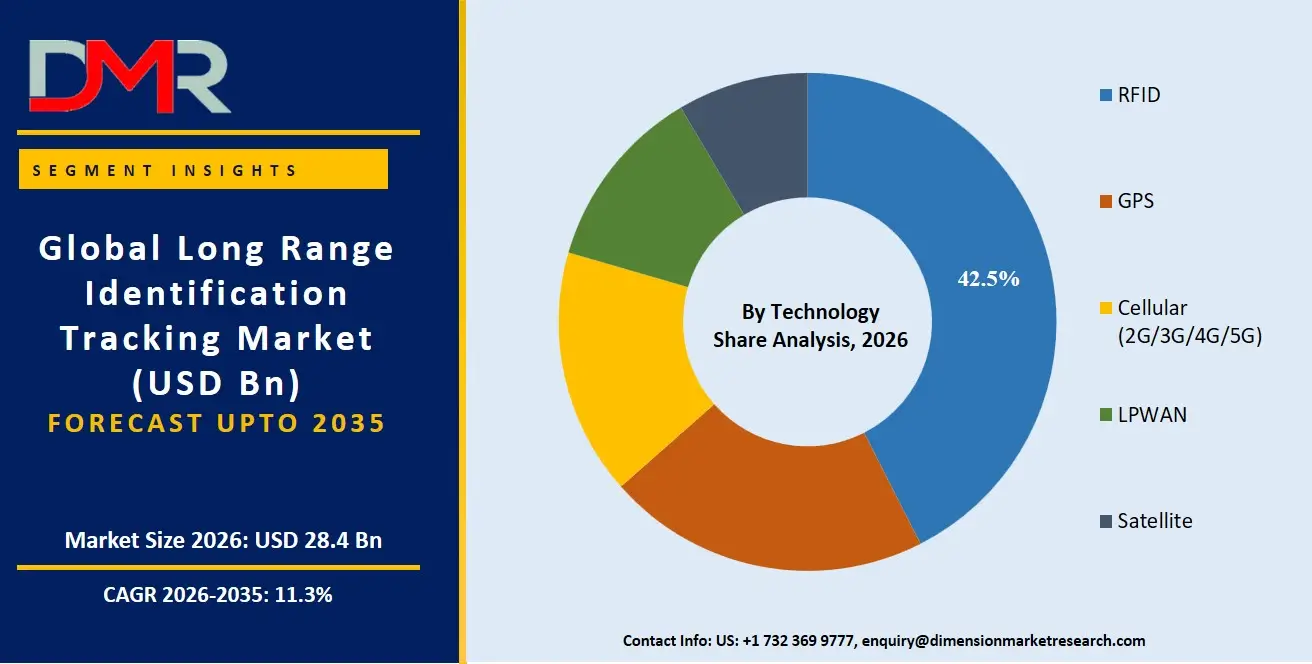
- Leading Technology Segment in 2026: RFID Technology, 42.5% share
- Leading Component Segment in 2026: Hardware Segment, 48.7% share
- Leading Application Segment in 2026: Asset Tracking, 31.8% share
- Fastest-Growing Segment: Satellite & LPWAN-Based Tracking, 15.6% CAGR
- Leading Region in 2026: North America, 34.2% share
What is Long Range Identification Tracking and its Market Size?
Long Range Identification Tracking refers to advanced identification and monitoring systems designed to locate, identify, and track assets, vehicles, inventory, equipment, animals, and personnel over extended distances using technologies such as RFID, GPS, cellular networks, LPWAN, satellite communication, and IoT-enabled platforms. The market includes hardware components, tracking devices, sensors, connectivity solutions, software platforms, analytics tools, and managed tracking services.
ℹ
To learn more about this report –
Download Your Free Sample Report Here
These solutions enable real-time visibility, operational optimization, security enhancement, and automation across industries including transportation, logistics, manufacturing, healthcare, retail, agriculture, defense, and energy.
The global Long Range Identification Tracking market is projected to reach approximately USD 28.4 billion in 2026 and expand to USD 74.6 billion by 2035, registering a CAGR of 11.3% during the forecast period.
Market expansion is driven by increasing demand for real-time asset visibility, supply chain digitization, industrial automation, smart logistics infrastructure, and IoT adoption. Rising e-commerce activity, growing transportation complexity, and the need for predictive monitoring solutions are encouraging enterprises to invest in long-range tracking technologies. Additionally, declining sensor costs, improved wireless connectivity, and advancements in AI-powered analytics are accelerating adoption across commercial and industrial applications.
Use Cases
- Asset Tracking: Enables enterprises to monitor location, status, and movement of valuable assets across large operational areas.
- Fleet Management: Provides real-time vehicle tracking, route optimization, fuel monitoring, and driver performance analytics.
- Inventory Management: Improves warehouse visibility by tracking goods, containers, and materials throughout supply chains.
- Supply Chain Monitoring: Supports end-to-end shipment visibility, reducing delays, losses, and operational inefficiencies.
- Livestock Tracking: Enables monitoring of animal location, health conditions, and movement patterns across farms.
- Personnel Tracking: Enhances worker safety through location monitoring in hazardous industrial environments.
Key Takeaways
- The Long Range Identification Tracking market is expected to grow from USD 28.4 billion in 2026 to USD 74.6 billion by 2035 at an 11.3% CAGR.
- Increasing adoption of IoT, AI analytics, and connected infrastructure is driving market expansion.
- RFID remains the leading technology segment due to cost efficiency and broad industrial adoption.
- Satellite and LPWAN-enabled tracking solutions represent the fastest-growing segment due to demand for remote monitoring.
- North America leads the global market because of advanced logistics infrastructure, enterprise IoT adoption, and strong technology investments.
How AI/Gen AI is Transforming the Long Range Identification Tracking Market?
Artificial Intelligence (AI) and Internet of Things (IoT) technologies are significantly transforming Long Range Identification Tracking systems by enabling intelligent data processing, predictive analytics, and automated decision-making. IoT-enabled tracking devices collect continuous location, environmental, and operational data, while AI algorithms analyze this information to identify patterns, optimize routes, and predict maintenance requirements
These technologies improve operational efficiency by reducing manual monitoring, lowering asset losses, and enhancing visibility across complex supply chains. AI-powered tracking platforms enable anomaly detection, automated alerts, and predictive insights, allowing organizations to respond quickly to disruptions.
The integration of AI, cloud computing, and edge analytics is reshaping competition by shifting market focus from basic tracking devices toward intelligent tracking ecosystems. Companies are increasingly differentiating through software capabilities, analytics platforms, and integrated IoT solutions rather than hardware alone.
Key Drivers in the Global Long Range Identification Tracking Market
Growing Demand for Real-Time Asset Visibility
The increasing complexity of global supply chains is driving organizations to adopt Long Range Identification Tracking solutions for improved transparency and operational control. Businesses across logistics, manufacturing, retail, and healthcare require accurate location information to reduce asset losses, optimize inventory, and improve customer service.
Expansion of IoT and Connected Infrastructure
The rapid expansion of IoT ecosystems is accelerating demand for connected tracking solutions capable of collecting and transmitting real-time information. Lower sensor costs, improved wireless connectivity, and cloud-based platforms are making advanced tracking accessible to enterprises of all sizes.
Restraints in the Global Long Range Identification Tracking Market
High Initial Deployment Costs
Although tracking technologies provide long-term operational benefits, initial investments in hardware infrastructure, software platforms, connectivity services, and system integration can limit adoption among small and medium-sized enterprises.
Data Security and Privacy Concerns
Long Range Identification Tracking systems generate large volumes of location and operational data, creating concerns regarding cybersecurity, unauthorized access, and regulatory compliance.
Growth Opportunities in the Global Long Range Identification Tracking Market
Integration with AI-Based Analytics Platforms
The combination of tracking systems with AI analytics creates significant opportunities for predictive operations, automated decision-making, and intelligent resource management.
Growth in Emerging Markets
Developing economies represent significant opportunities due to expanding logistics networks, smart city initiatives, industrial modernization, and increasing digital transformation investments.
Trends in the Global Long Range Identification Tracking Market
Shift Toward Hybrid Tracking Technologies
Companies are increasingly adopting hybrid solutions combining RFID, GPS, cellular, and satellite connectivity to overcome limitations of individual technologies.
Increasing Adoption of Sustainable Logistics Tracking
Sustainability initiatives are encouraging companies to use tracking technologies to optimize transportation efficiency and reduce carbon emissions.
Research Scope and Analysis
The Global Long Range Identification Tracking Market is analyzed across four primary segmentation categories: By Technology, By Component, By Application, and By End User Industry. These segments provide insights into adoption patterns, revenue contribution, technological evolution, and future investment opportunities across industries and geographic regions.
ℹ
To learn more about this report –
Download Your Free Sample Report Here
By Technology Analysis
RFID accounted for the largest market share of 42.5% in 2026, primarily due to its widespread adoption in inventory management, warehouse automation, retail operations, manufacturing, and healthcare asset tracking. Passive RFID solutions continue to dominate because of their low implementation cost, minimal maintenance requirements, and suitability for high-volume identification applications. Organizations increasingly deploy RFID systems to improve inventory accuracy, reduce manual labor, and enhance operational visibility. GPS represented the second-largest technology segment with an estimated 26.8% market share, supported by growing demand for fleet management, vehicle tracking, and outdoor asset monitoring. Meanwhile, Satellite and LPWAN technologies, including LoRaWAN and NB-IoT, are projected to register the fastest CAGR of 15.6% through 2035, driven by increasing adoption in remote industrial operations, agriculture, maritime logistics, mining, oil & gas exploration, and smart infrastructure where traditional cellular connectivity remains limited.
By Component Analysis
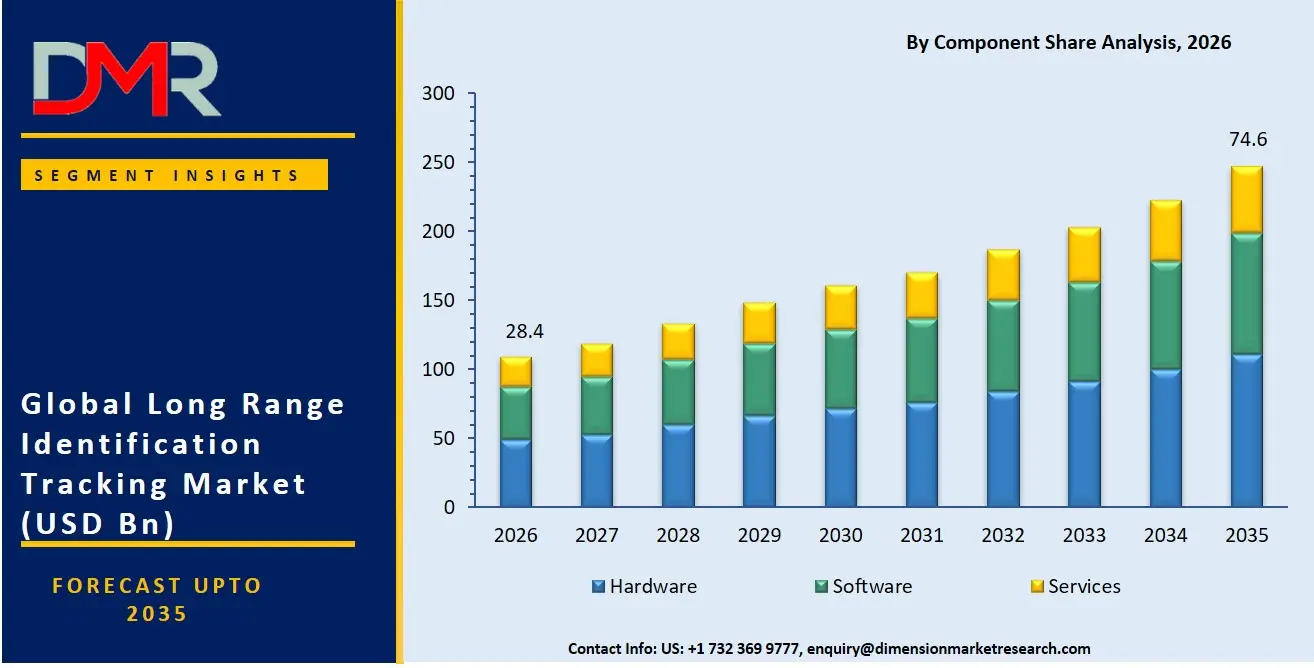
The Hardware segment dominated the market with approximately 48.7% revenue share in 2026, supported by strong demand for RFID readers, GPS devices, tracking sensors, gateways, communication modules, and edge computing equipment. Increasing deployment of connected tracking devices across logistics, transportation, healthcare, and manufacturing continues to drive hardware sales.
ℹ
To learn more about this report –
Download Your Free Sample Report Here
The Software segment accounted for nearly
30.9% of the market, benefiting from growing investments in cloud-based monitoring platforms, analytics dashboards, AI-driven reporting, and enterprise integration solutions. However, the Services segment is expected to witness the fastest CAGR of
13.8% during the forecast period as organizations increasingly outsource system integration, deployment, maintenance, consulting, cybersecurity, and managed tracking services to improve operational efficiency and reduce implementation complexity.
By Application Analysis
Asset Tracking remained the leading application with 31.8% market share in 2026, reflecting widespread adoption across logistics, manufacturing, utilities, healthcare, and construction sectors where real-time visibility improves operational efficiency and reduces equipment losses. Continuous monitoring enables preventive maintenance, higher asset utilization, and improved inventory management. Fleet Management represented the second-largest application with approximately 24.6% share, supported by increasing demand for vehicle monitoring, route optimization, driver safety, and fuel management. Supply Chain & Logistics Monitoring is expected to be the fastest-growing application, expanding at a CAGR of 14.4% through 2035 due to rapid digitalization of global trade networks, increasing cross-border transportation, expanding e-commerce activities, and growing emphasis on end-to-end shipment visibility.
By End User Industry Analysis
The Transportation & Logistics sector led the global market with an estimated 28.9% share in 2026, driven by increasing investments in fleet digitization, cargo monitoring, warehouse automation, and real-time shipment tracking. Growing international trade volumes and expanding last-mile delivery networks continue to support market leadership. Manufacturing held the second-largest share of 18.7%, reflecting increasing deployment of tracking systems for production assets, industrial equipment, inventory management, and factory automation. The Healthcare sector is projected to register the highest CAGR of 14.9%, fueled by rising adoption of medical equipment tracking, pharmaceutical supply chain monitoring, patient safety solutions, laboratory asset management, and regulatory compliance initiatives.
The Global Long Range Identification Tracking Market Report is segmented on the basis of the following:
By Technology
- RFID
- Active RFID
- Passive RFID
- Semi-Passive RFID
- GPS
- Cellular (2G/3G/4G/5G)
- LPWAN
- Satellite
By Component
- Hardware
- Software
- Services
By Application
- Asset Tracking
- Fleet Management
- Inventory & Warehouse Management
- Supply Chain & Logistics Monitoring
- Personnel Tracking
- Livestock Tracking
By End User Industry
- Transportation & Logistics
- Manufacturing
- Retail
- Healthcare
- Government & Defense
- Energy & Utilities
- Construction & Mining
- Agriculture
- Maritime
- Aviation & Aerospace
Regional Analysis
North America is the Leading Region in the Global Long Range Identification Tracking Market
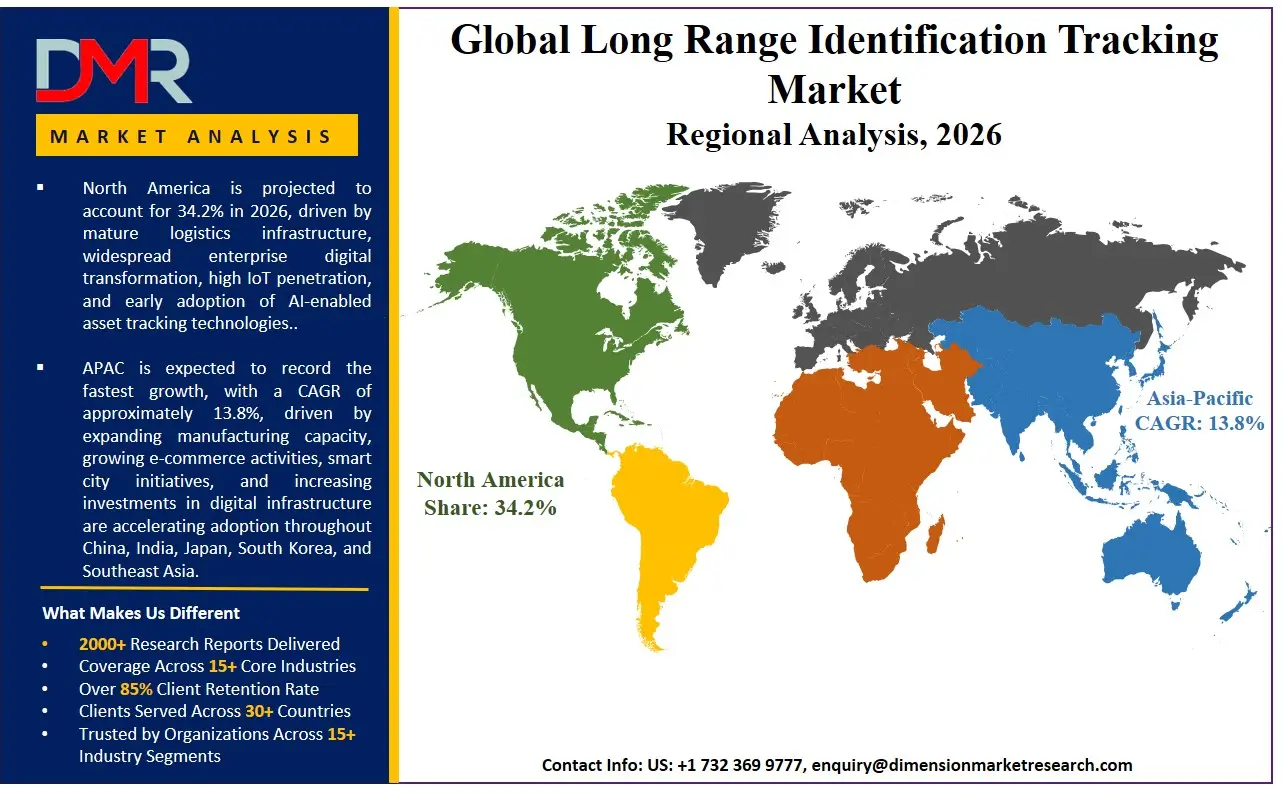
North America maintained the largest position in the global Long Range Identification Tracking Market with an estimated 34.2% market share in 2026. The region benefits from mature logistics infrastructure, widespread enterprise digital transformation, high IoT penetration, and early adoption of AI-enabled asset tracking technologies.
ℹ
To learn more about this report –
Download Your Free Sample Report Here
Large investments in warehouse automation, connected transportation systems, industrial IoT, and defense modernization continue to stimulate demand. The presence of major technology providers, robust cloud infrastructure, supportive innovation ecosystems, and increasing adoption across retail, healthcare, manufacturing, and government sectors further strengthen regional leadership.
Asia Pacific is the Fastest-Growing Region in the Global Long Range Identification Tracking Market
Asia-Pacific is expected to register the fastest CAGR of approximately 13.8% during the forecast period. Rapid industrialization, expanding manufacturing capacity, growing e-commerce activities, smart city initiatives, and increasing investments in digital infrastructure are accelerating adoption throughout China, India, Japan, South Korea, and Southeast Asia. Government initiatives promoting Industry 4.0, intelligent transportation systems, and logistics modernization are encouraging deployment of RFID, GPS, LPWAN, and satellite-based tracking solutions across both public and private sectors.
Europe Long Range Identification Tracking Market
Europe's market was valued at approximately USD 7.1 billion in 2026 and is projected to reach nearly USD 17.8 billion by 2035, growing at a CAGR of around 10.8%. Strong regulatory emphasis on supply chain transparency, sustainability, worker safety, and industrial automation supports continued adoption. Germany, the United Kingdom, France, Italy, and the Nordic countries continue investing in smart manufacturing, connected logistics, and digital healthcare infrastructure. Growing implementation of IoT-enabled asset monitoring and predictive maintenance further supports regional expansion.
Latin America Long Range Identification Tracking Market
Latin America accounted for approximately USD 2.3 billion in 2026 and is forecast to reach nearly USD 5.6 billion by 2035, registering a CAGR of 10.4%. Market growth is supported by expanding transportation infrastructure, retail modernization, mining operations, agriculture digitization, and increasing investment in logistics optimization. Brazil and Mexico remain the largest contributors due to industrial expansion, growing cross-border trade, and rising enterprise technology adoption.
Middle East & Africa Long Range Identification Tracking Market
The Middle East & Africa market reached approximately USD 1.9 billion in 2026 and is projected to exceed USD 4.9 billion by 2035, expanding at a CAGR of 11.1%. Growth is driven by smart city projects, oil & gas asset monitoring, transportation modernization, port expansion, mining activities, and increasing adoption of connected infrastructure across Gulf Cooperation Council countries and South Africa.
Major Countries Analysis
United States Long Range Identification Tracking Market
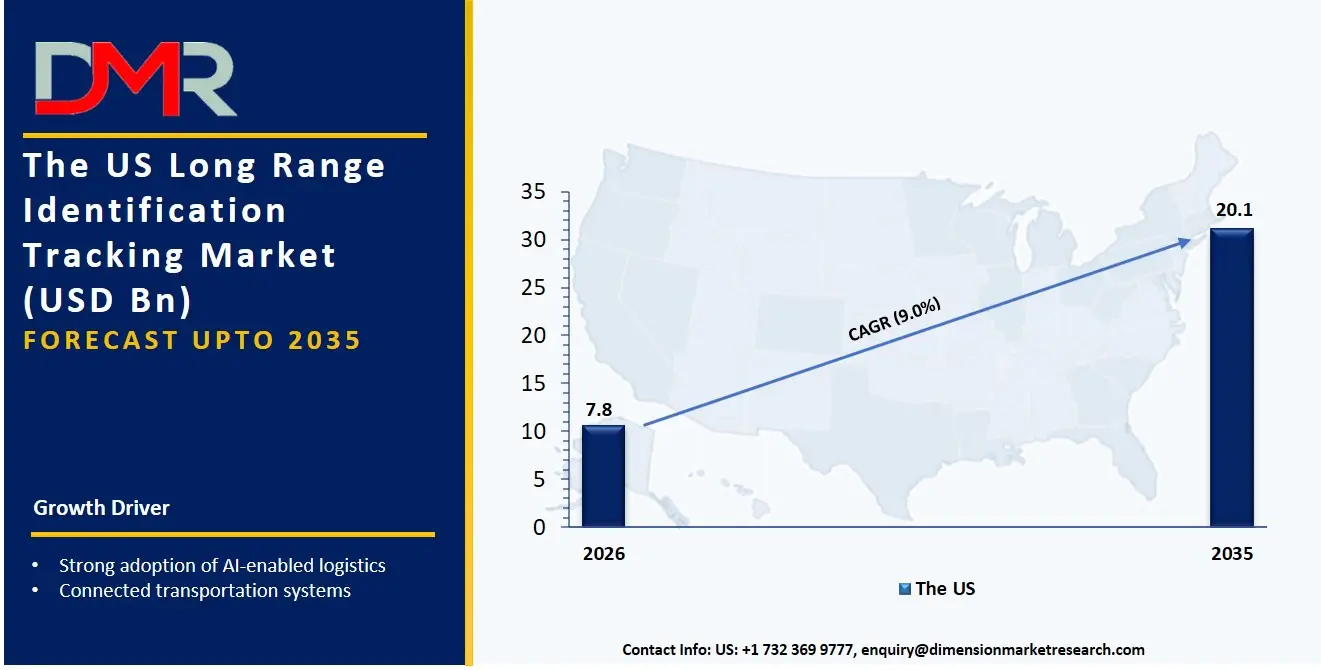
The U.S. Long Range Identification Tracking Market was valued at approximately USD 7.8 billion in 2026 and is expected to reach USD 20.1 billion by 2035, registering a CAGR of 11.2%.
ℹ
To learn more about this report –
Download Your Free Sample Report Here
Strong adoption of AI-enabled logistics, cloud computing, warehouse automation, defense modernization, healthcare digitalization, and connected transportation systems continues to support market expansion. Increasing investments in industrial IoT and autonomous operations further strengthen demand.
Japan Long Range Identification Tracking Market
Japan's market reached approximately USD 2.1 billion in 2026 and is projected to approach USD 5.3 billion by 2035, growing at a CAGR of 10.9%. Advanced manufacturing capabilities, robotics integration, smart factory initiatives, and aging workforce challenges continue to accelerate investments in automated identification and tracking technologies across manufacturing, logistics, and healthcare industries.
Saudi Arabia Long Range Identification Tracking Market
Saudi Arabia generated approximately USD 620 million in 2026 and is forecast to exceed USD 1.7 billion by 2035, expanding at a CAGR of 12.0%. National economic diversification initiatives, logistics hub development, smart city projects, energy sector modernization, and digital transformation programs continue driving investments in advanced tracking technologies across transportation, construction, and public infrastructure.
Regulatory Landscape
The Long Range Identification Tracking Market operates within an evolving regulatory framework focused on data privacy, cybersecurity, wireless communication standards, and industry-specific compliance. In North America, organizations deploying tracking technologies must comply with data protection regulations, radio frequency spectrum requirements, and cybersecurity guidelines governing connected devices.
Europe continues to enforce stringent privacy requirements under the General Data Protection Regulation (GDPR), requiring organizations to implement secure handling of location and personal data. The transportation and logistics sector is also influenced by customs security programs, electronic freight documentation standards, and international maritime regulations for long-range vessel identification.
Healthcare applications require compliance with medical device regulations and patient data protection standards, while government and defense deployments must adhere to national security requirements. Growing adoption of IoT devices has also increased the importance of cybersecurity certification, secure firmware updates, encryption protocols, and interoperability standards, encouraging vendors to develop solutions that meet both regional regulatory requirements and international quality standards.
Investment and White Space Analysis
The market presents significant investment opportunities across AI-enabled tracking software, satellite communication technologies, edge computing platforms, and cloud-based asset intelligence solutions. Investors are increasingly focusing on companies developing predictive analytics, digital twin integration, autonomous logistics monitoring, and next-generation IoT connectivity platforms.
Emerging economies across Asia-Pacific, Latin America, and the Middle East remain underserved markets where industrial modernization, infrastructure expansion, and smart city investments are creating substantial demand for advanced tracking systems.
Additional white space exists within healthcare asset monitoring, pharmaceutical cold chain tracking, livestock management, autonomous vehicle infrastructure, renewable energy asset monitoring, and construction equipment management. Small and medium-sized enterprises also represent an untapped customer base as demand grows for subscription-based Software-as-a-Service (SaaS) tracking platforms requiring lower upfront investment.
By Region
North America
Europe
- Germany
- The U.K.
- France
- Italy
- Spain
- Rest of Europe
Asia-Pacific
- China
- Japan
- South Korea
- India
- Australia
- Rest of APAC
Latin America
- Brazil
- Mexico
- Rest of LATAM
Middle East & Africa
- Saudi Arabia
- The UAE
- South Africa
- Rest of MEA
Competitive Landscape
The Global Long Range Identification Tracking Market is moderately fragmented, with competition driven by technology innovation, product reliability, software capabilities, geographic expansion, and strategic partnerships. Leading companies compete by offering integrated hardware, cloud platforms, AI-powered analytics, and managed services that provide end-to-end visibility across supply chains and industrial operations.
Major participants continue investing in research and development to improve battery performance, communication range, cybersecurity, and interoperability with enterprise software systems. Strategic acquisitions, partnerships with telecommunications providers, and expansion into emerging markets remain common growth strategies. Increasing customer demand for scalable and cloud-native solutions is encouraging vendors to develop subscription-based platforms capable of integrating RFID, GPS, LPWAN, satellite, and cellular technologies within unified asset management ecosystems.
Some of the prominent players in the Global Long Range Identification Tracking Market are
- Saab AB
- Thales Group
- Kongsberg Gruppen
- ORBCOMM
- Iridium Communications
- Inmarsat
- Spire Global
- L3Harris Technologies
- Northrop Grumman
- Lockheed Martin
- Leonardo S.p.A.
- Indra Sistemas
- Furuno Electric
- Japan Radio Co., Ltd.
- Cobham Satcom
- Hughes Network Systems
- Viasat
- KVH Industries
- Pole Star Global
- exactEarth
- SRT Marine Systems
- MarineTraffic
- FleetMon
- Global Fishing Watch
- EM-trak
- Mackay Communications
- NSSLGlobal
- Orange Business
- SES
- Eutelsat Group
- Intelsat
- Speedcast
- Marlink
- Navtor
- Transas
- Wärtsilä Voyage
- Blue Sky Network
- Garmin
- Honeywell
- RTX
- Other Key Players
Recent Developments
- May 2026: ORBCOMM launched next-generation satellite IoT tracking devices designed for global container monitoring, cold chain visibility, and remote industrial asset management.
- March 2026: Honeywell expanded its connected logistics portfolio with advanced industrial tracking solutions supporting cloud-based monitoring, predictive maintenance, and autonomous warehouse operations.
- January 2026: Zebra Technologies introduced an AI-powered enterprise asset visibility platform integrating RFID, machine vision, and predictive analytics to improve warehouse productivity and inventory accuracy.
- November 2025: Samsara introduced new AI-enabled fleet intelligence capabilities combining real-time GPS tracking, video analytics, predictive maintenance, and driver safety monitoring for commercial transportation operators.
- August 2025: Semtech announced enhancements to its LoRa-based IoT ecosystem, enabling improved long-range connectivity, lower power consumption, and expanded industrial IoT applications.
Report Details
| Report Characteristics |
| Market Size (2026) |
USD 28.4 Bn |
| Forecast Value (2035) |
USD 74.6 Bn |
| CAGR (2026–2035) |
11.3% |
| Historical Period |
2021 – 2025 |
| Forecast Period |
2027 – 2035 |
| Base Year |
2025 |
| Estimate Year |
2026 |
| Segments Covered |
By Technology, By Component, By Application, By End User Industry |
| Regional Coverage |
North America – The US and Canada; Europe – Germany, The UK, France, Spain, Italy, & Rest of Europe; Asia-Pacific – China, Japan, South Korea, India, Australia, Rest of APAC; Latin America – Brazil, Mexico, & Rest of Latin America; Middle East & Africa – Saudi Arabia, The UAE, South Africa, & Rest of MEA |
Frequently Asked Questions
What is the projected size of the Global Long Range Identification Tracking Market?
▾ The market is projected to grow from approximately USD 28.4 billion in 2026 to USD 74.6 billion by 2035, driven by increasing adoption of IoT, AI, cloud computing, and digital supply chain solutions.
What CAGR is expected during the forecast period?
▾ The global market is anticipated to expand at a compound annual growth rate (CAGR) of 11.3% between 2026 and 2035.
What are the primary growth drivers in Long Range Identification Tracking Market ?
▾ Key growth drivers include rising demand for real-time asset visibility, expansion of connected logistics, increasing IoT deployment, AI-powered predictive analytics, warehouse automation, and industrial digital transformation.
Which technology segment dominates the Long Range Identification Tracking Market ?
▾ RFID technology holds the largest market share owing to its cost-effectiveness, operational efficiency, widespread deployment across logistics, retail, manufacturing, and healthcare industries.
Which region leads the Long Range Identification Tracking Market ?
▾ North America remains the leading regional market due to advanced logistics infrastructure, early technology adoption, strong industrial automation, and significant investments in enterprise digitalization.
Which region is expected to grow the fastest in Long Range Identification Tracking Market ?
▾ Asia-Pacific is projected to record the fastest growth because of expanding manufacturing activities, smart city initiatives, industrial automation, and increasing investments in digital infrastructure.
Who are the major market participants in Long Range Identification Tracking Market ?
▾ Leading companies include Zebra Technologies, Honeywell International, Impinj, Trimble, ORBCOMM, Semtech, Quectel, HID Global, Geotab, Samsara, Sensitech, Bosch Connected Industry, AT&T, and Verizon.
How is the market segmented in Long Range Identification Tracking Market ?
▾ The market is segmented by Technology, Component, Application, End User Industry, and Region, enabling comprehensive evaluation of adoption trends, investment opportunities, and future growth potential.