Global LTE and LTE Advanced Mobile Technologies Market Snapshot
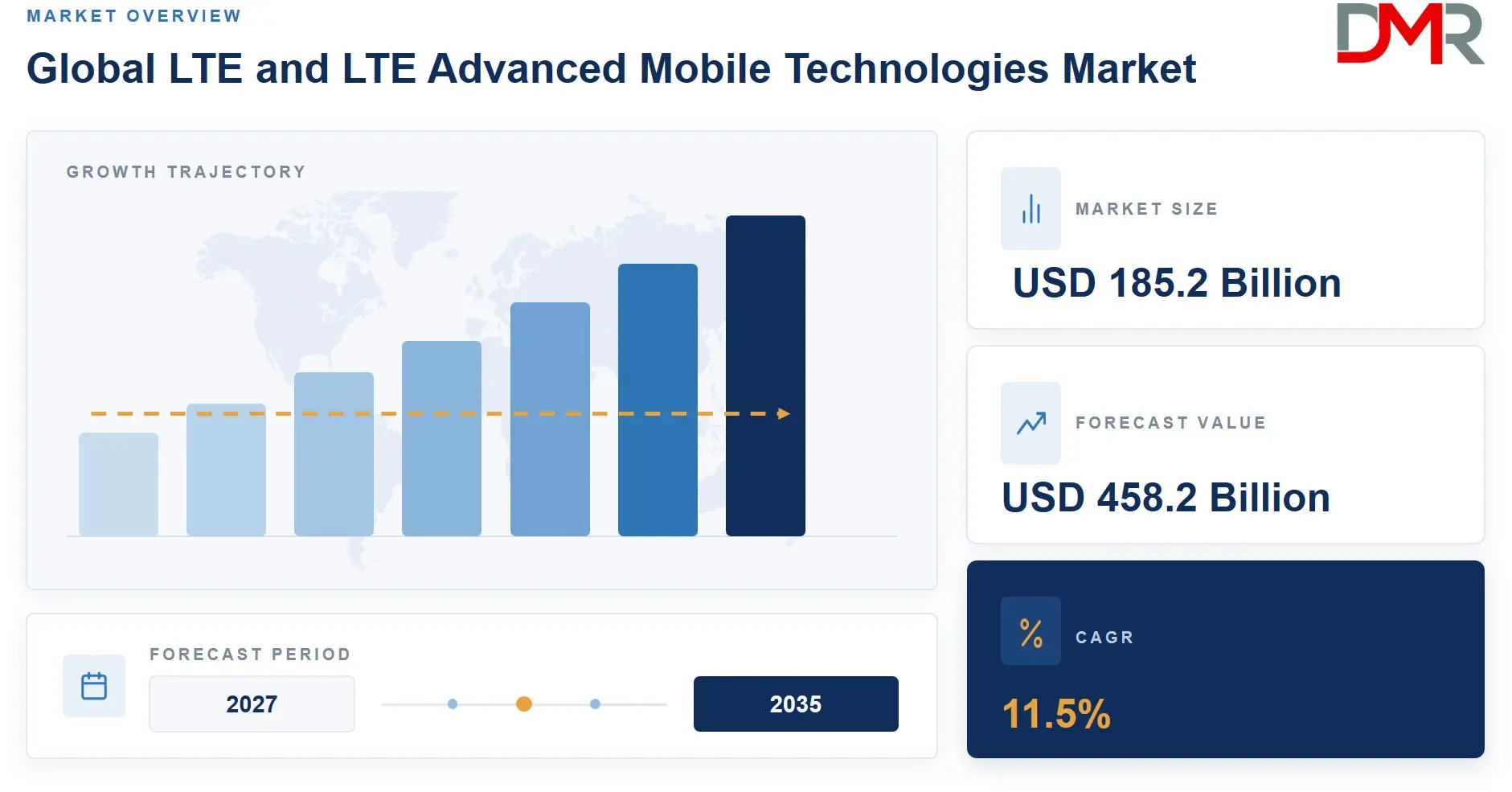
- Global LTE and LTE Advanced Mobile Technologies Market Size in 2026: USD 185.2 billion
- Global LTE and LTE Advanced Mobile Technologies Market Size in 2035: USD 458.2 billion
- Global CAGR from 2027 to 2035: 11.5%
- LTE is the leading Technology segment in 2026: 48.6%
- Hardware is the leading Component segment in 2026: 52.4%
- LTE Advanced Pro is the fastest-growing Technology segment: 11.8% CAGR
- Software is the fastest-growing Component segment: 11.7% CAGR
- North America is the leading Region in 2026: 49.8%
- Asia Pacific is the fastest-growing Region: 12.1% CAGR
What is the Global LTE and LTE Advanced Mobile Technologies Market Size?
The Global LTE and LTE Advanced Mobile Technologies Market size is projected to be valued at USD 185.2 billion in 2026, and it is further anticipated to reach a market value of USD 458.2 billion by 2035 at a CAGR of 11.5%.
ℹ
To learn more about this report –
Download Your Free Sample Report Here
The Global LTE and LTE Advanced Mobile Technologies Market includes all hardware, software, and services supporting high-speed wireless communication, mobile internet connectivity, voice communication, and connected devices. Long-Term Evolution (LTE) provides improved data transmission speeds and network efficiency, while LTE Advanced and LTE Advanced Pro offer enhanced network capacity, faster connectivity, and improved performance. These technologies can be used for mobile broadband, fixed wireless access, voice communication, machine-to-machine communication, and public safety services. Smartphones, routers, modems, IoT devices, and wireless network equipment are used by consumers and enterprises to improve communication and digital accessibility. Some of the industries where LTE technologies are gaining momentum include telecommunications, manufacturing, transportation, healthcare, and public safety. Market growth is being driven by increasing mobile data consumption, expanding wireless network coverage, and growing adoption of connected devices. However, the primary challenges for telecommunications providers are infrastructure costs, spectrum availability, and competition from advanced 5G networks.
Use Cases
- Mobile Broadband Connectivity: Consumers use LTE and LTE Advanced technologies to access high-speed internet, stream digital content, and communicate through mobile applications. Wireless broadband networks support reliable connectivity, improved data transmission, and enhanced digital experiences.
- Fixed Wireless Access: Telecommunications providers deploy LTE networks to deliver broadband internet services across residential and commercial locations. Wireless connectivity enables customers to access internet services without requiring extensive fiber-optic or wired broadband infrastructure.
- Industrial IoT and Machine-to-Machine Communication: Industrial organizations utilize LTE technologies to connect equipment, monitor operational activities, and exchange information between connected devices. These solutions support remote monitoring, predictive maintenance, operational efficiency, and industrial automation.
- Public Safety and Emergency Communication: Government agencies and emergency service organizations employ LTE-enabled communication systems to exchange information and coordinate response activities. Reliable wireless connectivity supports real-time communication, location tracking, video transmission, and efficient emergency management.
Key Takeaways
- Global Market Value: The Global LTE and LTE Advanced Mobile Technologies Market is generating revenue of USD 185.2 billion in 2026 and is further anticipated to reach USD 458.2 billion by 2035.
- Global Growth Rate: The Global LTE and LTE Advanced Mobile Technologies Market is expected to have a CAGR of 11.5% during the forecast period from 2027 to 2035.
- Technology Trends: Increasing integration of artificial intelligence, carrier aggregation, network virtualization, advanced antenna systems, and cloud-based network management is supporting the development of LTE technologies.
- Market Drivers: Factors supporting market growth include increasing mobile internet usage, growing demand for high-speed connectivity, rising adoption of IoT devices, and expanding wireless network infrastructure.
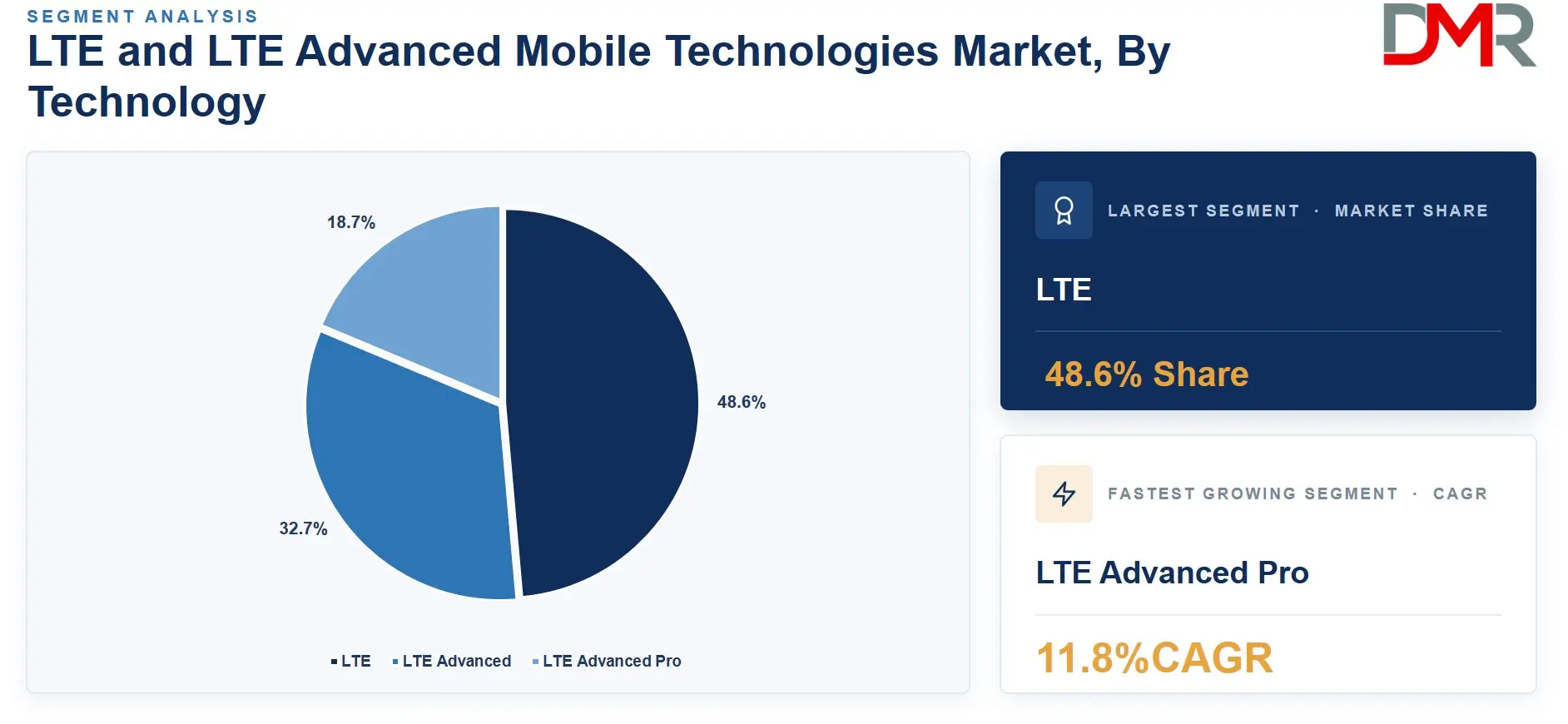
- Technology Segment Analysis: The LTE segment is anticipated to be the largest Technology segment, having a market share of 48.6% by the end of 2026. Whereas the LTE Advanced Pro segment is expected to be the fastest-growing segment with a CAGR of 11.8% from 2027 to 2035.
- Component Segment Analysis: The Hardware segment is the major Component segment, representing the highest market share of 52.4% in 2026, while the Software segment is projected to have the highest growth rate with a CAGR of 11.7% during the forecast period.
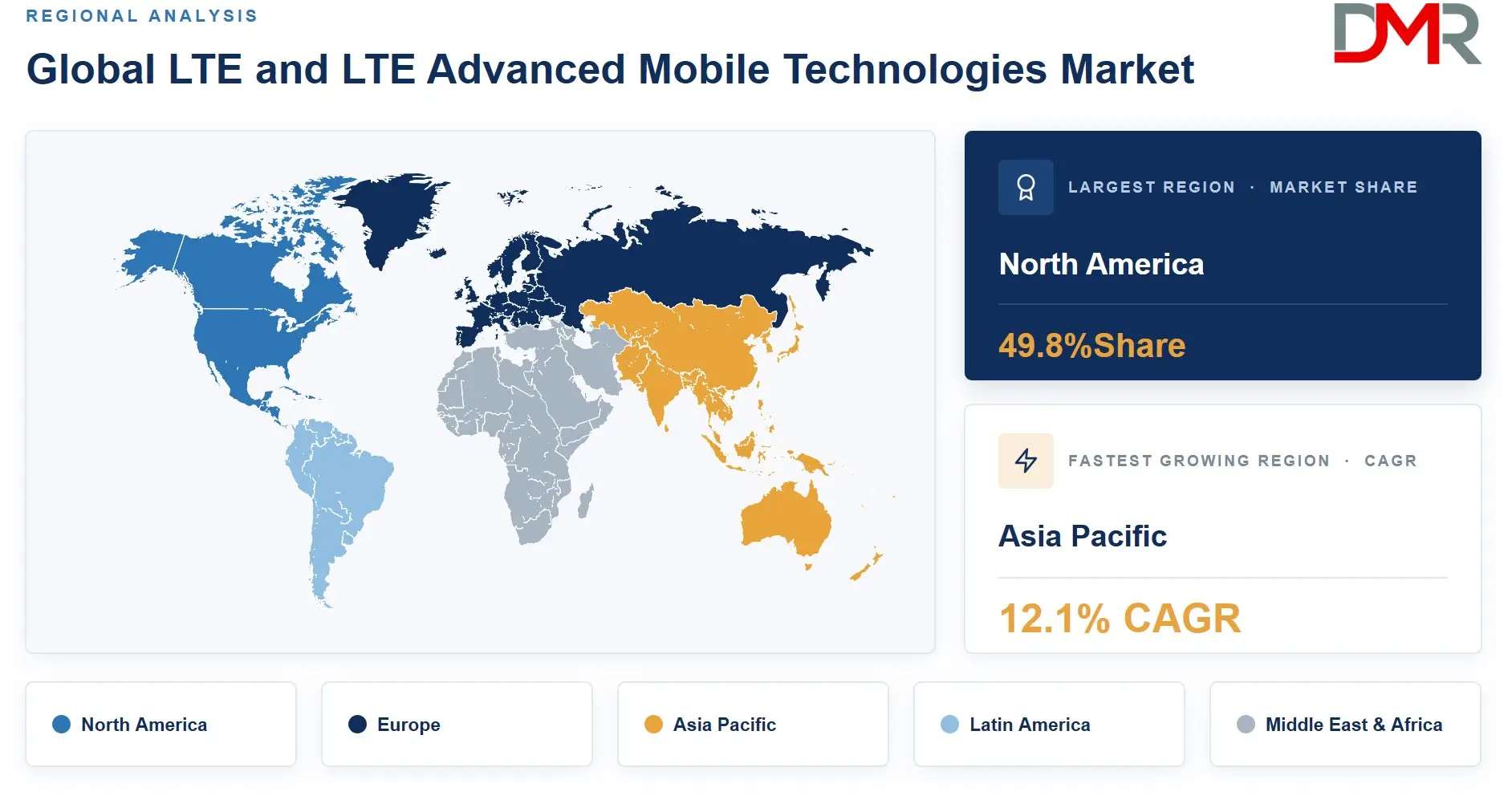
- Regional Analysis: The North America region is poised to hold the largest market share of 49.8% in the global market in 2026. The Asia Pacific region is expected to be the fastest-growing region with a CAGR of 12.1% during the forecast period.
How AI/Gen AI is Transforming the LTE and LTE Advanced Mobile Technologies Market?
Artificial Intelligence (AI) and Generative AI (Gen AI) are reshaping the Global LTE and LTE Advanced Mobile Technologies Market by providing intelligent network management, automated technical support, and improved connectivity. AI-based network systems can analyze network traffic, identify communication problems, detect unusual activities, and offer network optimization recommendations. These functions help to ensure service reliability and enhance the efficiency of wireless networks. Using generative AI, network configurations can be automatically suggested, along with technical documentation, troubleshooting instructions, and network performance reports. AI-powered predictive analytics also helps operators improve equipment maintenance, traffic management, and network security processes. AI, cloud computing, and network management platforms enable more efficient communication infrastructure. Agentic AI technologies are transforming network operations by facilitating automated troubleshooting and intelligent operational recommendations.
Key Drivers
Increasing Demand for High-Speed Mobile Internet Connectivity
The Global LTE and LTE Advanced Mobile Technologies Market is growing due to the rise in demand for high-speed mobile internet connectivity. Smartphones, tablets, connected devices, and wireless communication systems are being used by consumers to access digital services and online applications. LTE and LTE Advanced technologies can be used to support video streaming, online gaming, voice communication, and high-speed data transmission. Residential, commercial, and industrial consumers are adopting these technologies to achieve reliable connectivity and improve communication efficiency. The expansion of digital services and the increasing demand for mobile broadband are encouraging investments in wireless network infrastructure. The deployment of advanced communication systems also contributes to network efficiency by improving data transmission speeds and network capacity.
Growing Adoption of IoT Devices and Connected Industrial Systems
Increasing demand for connected devices is driving the adoption of LTE and LTE Advanced technologies across industrial and commercial sectors. Organizations are transitioning from conventional communication methods toward wireless platforms offering remote monitoring, real-time data transmission, and automated operational support. LTE connectivity supports industrial device communication without requiring extensive wired network infrastructure. Organizations can connect manufacturing equipment, transportation systems, smart meters, and security devices through wireless communication networks. LTE Advanced solutions also support efficient data exchange, remote equipment management, and machine-to-machine communication. Manufacturing companies, logistics providers, utility operators, and industrial equipment suppliers are increasingly investing in wireless connectivity to improve operational capabilities. Growing demand for connected infrastructure, reliable communication, and improved operational productivity is strengthening market adoption.
Restraints
High Infrastructure Investment and Network Deployment Costs
LTE and LTE Advanced communication platforms require investment in specialized hardware, software licenses, network equipment, and supporting communication infrastructure. The acquisition and deployment of advanced wireless technologies can create financial challenges, particularly for organizations operating with limited technology budgets. Network operators adopting LTE platforms must allocate resources for equipment procurement, spectrum licensing, network installation, and technical maintenance. Advanced base stations, antenna systems, and high-performance network infrastructure can increase overall deployment expenses. Additional costs associated with software updates, network expansion, and integration services may affect long-term investment decisions. Concerns regarding measurable returns on investment can also influence technology adoption.
Increasing Competition from 5G Communication Technologies
The expansion of LTE and LTE Advanced technologies can involve competitive challenges, particularly within markets adopting next-generation wireless networks. LTE technologies increasingly face competition from 5G communication systems offering higher data speeds, lower latency, improved network capacity, and advanced connectivity capabilities. Differences in network performance, device compatibility, and communication requirements can influence technology adoption. Network operators may also incur additional expenses associated with infrastructure modernization, equipment replacement, spectrum management, and ongoing technical support. Organizations operating across multiple communication networks can face challenges involving technology investment decisions and the gradual transition toward advanced 5G infrastructure.
Growth Opportunities
Expansion of Private LTE and Industrial Communication Networks
The increasing adoption of private LTE networks is creating significant opportunities in the Global LTE and LTE Advanced Mobile Technologies Market. Organizations are investing in dedicated wireless networks, connected industrial equipment, and secure communication platforms to improve operational efficiency and network reliability. Advanced communication systems enable organizations to connect industrial devices, monitor operational activities, and improve data transmission across facilities. Private LTE also supports automated manufacturing, equipment monitoring, asset tracking, and secure industrial communication within dedicated network environments. LTE technology providers can develop integrated private network capabilities to improve industrial connectivity and reduce dependence on public networks. Growing demand for reliable wireless communication across manufacturing, mining, logistics, and utilities is creating opportunities for specialized LTE solutions.
Growing Demand for Fixed Wireless Access in Underserved Areas
Underserved geographical areas represent an important opportunity for the expansion of LTE and LTE Advanced technologies across residential and commercial markets. Fixed wireless access platforms enable consumers to access broadband internet, digital services, and online applications without substantial wired infrastructure investment. Increasing digital adoption, affordable network equipment availability, and growing internet connectivity requirements are encouraging telecommunications providers to expand wireless broadband services. LTE-based broadband platforms provide flexible installation, wider network coverage, remote accessibility, and reliable communication capabilities. Technology providers can develop affordable packages and wireless connectivity solutions to meet different consumer requirements. Expanding telecommunications infrastructure across emerging markets in Asia Pacific, Latin America, and the Middle East and Africa is also creating opportunities for LTE technology vendors.
Trends
Increasing Integration of AI-Based Network Management Solutions
AI-based network management solutions are becoming an important trend in the Global LTE and LTE Advanced Mobile Technologies Market. Technology providers are introducing advanced analytical capabilities to identify network problems, analyze communication traffic, detect service disruptions, and provide network optimization recommendations. AI-powered network tools can recognize equipment conditions, identify maintenance requirements, and generate recommendations for network operators. Predictive analytics also supports equipment maintenance planning and network performance optimization. Telecommunications providers can use intelligent network management platforms to monitor communication performance, equipment conditions, and service quality. The integration of generative AI enables automated technical documentation and interactive network troubleshooting capabilities.
Growing Adoption of Advanced LTE Network Technologies
Telecommunications organizations are increasingly adopting advanced LTE technologies that combine improved data transmission, carrier aggregation, network capacity, and reliable communication capabilities. Conventional LTE networks can experience performance limitations during periods of high network traffic. Modern LTE Advanced and LTE Advanced Pro solutions help network operators improve mobile broadband connectivity, voice communication, industrial networking, and connected device performance. Improvements in spectrum efficiency, antenna performance, signal processing, and network management are supporting wireless communication capabilities. Technology providers are expanding network capacity, advanced antenna systems, and software compatibility to address communication requirements. Growing emphasis on network reliability, higher data speeds, and efficient spectrum utilization is strengthening demand for advanced LTE solutions.
Research Scope and Analysis
On the basis of Technology, the Global LTE and LTE Advanced Mobile Technologies Market is segmented into LTE, LTE Advanced, and LTE Advanced Pro. The market can be segmented on the basis of Component into Hardware, Software, and Services. On the basis of Device Type, the market includes Smartphones, Tablets & Laptops, Routers & Modems, IoT Devices, and Others. By Application, the market includes Mobile Broadband, Fixed Wireless Access, Voice over LTE (VoLTE), Machine-to-Machine Communication, Public Safety Communication, and Others. On the basis of End-User, the market includes Residential, Commercial, Industrial, Government & Public Safety, and Others.
ℹ
To learn more about this report –
Download Your Free Sample Report Here
By Technology
LTE is projected to dominate the Technology segment in the Global LTE and LTE Advanced Mobile Technologies Market, accounting for 48.6% of the total market share in 2026. The dominance is supported by widespread network coverage, affordable device availability, established communication infrastructure, and increasing demand for mobile broadband connectivity. LTE Advanced Pro is anticipated to register the highest CAGR of 11.8% during the forecast period from 2027–2035, driven by increasing demand for higher data speeds, improved spectrum efficiency, advanced carrier aggregation, and reliable wireless communication.
By Component
Hardware is projected to dominate the Component segment in the Global LTE and LTE Advanced Mobile Technologies Market, accounting for 52.4% of the total market share in 2026. The dominance is supported by increasing demand for base stations, antennas, routers, modems, and communication equipment. Hardware components enable telecommunications providers to establish wireless connectivity and maintain reliable network operations. Software is anticipated to register the highest CAGR of 11.7% during the forecast period from 2027–2035, supported by increasing demand for network management platforms, automated network optimization, communication security applications, cloud-based infrastructure, and intelligent monitoring solutions.
By Device Type
Smartphones are projected to dominate the device type segment of the Global LTE and LTE Advanced Mobile Technologies Market, accounting for 58.3% of the total market share in 2026.The dominance is attributed to increasing mobile internet usage, widespread smartphone availability, growing digital service adoption, and demand for reliable communication. Growing consumption of online multimedia content further supports consumer demand. IoT Devices is anticipated to register the highest CAGR of 11.6% during the forecast period from 2027–2035, driven by increasing demand for connected industrial equipment, smart home devices, remote monitoring systems, automated data transmission, and machine-to-machine communication.
By Application
Mobile Broadband is projected to dominate the Application segment in the Global LTE and LTE Advanced Mobile Technologies Market, accounting for 43.7% of the total market share in 2026. The dominance is attributed to increasing internet consumption, growing smartphone adoption, expanding digital services, and rising demand for high-speed wireless connectivity. Machine-to-Machine Communication is anticipated to register the highest CAGR of 12.0% during the forecast period from 2027–2035, driven by increasing industrial automation, growing adoption of connected devices, remote equipment monitoring, expanding smart infrastructure, and rising demand for efficient data communication.
By End-User
Residential is projected to dominate the End-User segment in the Global LTE and LTE Advanced Mobile Technologies Market, accounting for 42.6% of the total market share in 2026. The dominance is supported by increasing adoption of smartphones, home broadband services, connected household devices, and digital entertainment platforms. Industrial is anticipated to register the highest CAGR of 11.9% during the forecast period from 2027–2035, driven by increasing industrial automation investment, growing demand for private LTE networks, advanced equipment monitoring, connected manufacturing systems, and rising adoption of wireless technologies across industrial facilities.
The Global LTE and LTE Advanced Mobile Technologies Market Report is segmented based on the following:
By Technology
- LTE
- LTE Advanced
- LTE Advanced Pro
By Component
- Hardware
- Software
- Services
By Device Type
- Smartphones
- Tablets & Laptops
- Routers & Modems
- IoT Devices
- Others
By Application
- Mobile Broadband
- Fixed Wireless Access
- Voice over LTE (VoLTE)
- Machine-to-Machine Communication
- Public Safety Communication
- Others
By End-User
- Residential
- Commercial
- Industrial
- Government & Public Safety
- Others
Regional Analysis
North America is the Leading Region
North America is expected to become the dominant force within the Global LTE and LTE Advanced Mobile Technologies Market as it will hold a market share of 49.8% in 2026. The dominance of the market is supported by widespread adoption of wireless communication technologies, increasing investment in network infrastructure, established digital connectivity, and the strong presence of telecommunications providers across the United States and Canada. Growing demand for mobile broadband, connected devices, and private LTE networks is supporting regional market development.
ℹ
To learn more about this report –
Download Your Free Sample Report Here
Asia Pacific is the Fastest-Growing Region
Asia Pacific is expected to witness the fastest-growing regional market with a compound annual growth rate of 12.1% during the forecast period from 2027–2035, due to rapid digitalization, expanding telecommunications infrastructure, increasing smartphone adoption, and growing investment in wireless connectivity across China, India, Japan, Australia, and South Korea. Network operators are increasingly deploying advanced mobile broadband platforms, industrial communication solutions, and fixed wireless access technologies to improve connectivity.
Europe LTE and LTE Advanced Mobile Technologies Market
The Europe LTE and LTE Advanced Mobile Technologies Market is supported by increasing adoption of wireless communication technologies, growing enterprise investment in digital infrastructure, and rising demand for reliable connectivity. Telecommunications providers across Germany, France, the United Kingdom, Italy, and Spain are introducing advanced broadband platforms and private network capabilities to modernize communication infrastructure. The manufacturing, transportation, healthcare, logistics, and energy industries represent important adopters of LTE technologies. Organizations are increasingly integrating wireless communication applications with connected devices and industrial automation systems to improve operational coordination and communication efficiency.
Latin America LTE and LTE Advanced Mobile Technologies Market
The Latin America LTE and LTE Advanced Mobile Technologies Market is supported by expanding telecommunications infrastructure, increasing digital adoption, and growing investment in wireless communication technologies. Brazil, Mexico, Argentina, and Chile represent important markets as telecommunications providers modernize network operations and expand broadband capabilities. Manufacturing companies, logistics providers, commercial enterprises, and residential consumers are adopting LTE technologies to improve internet accessibility, device connectivity, and communication efficiency. Fixed wireless access solutions provide flexible installation options and reduce dependence on expensive wired infrastructure. Increasing availability of affordable smartphones and expanding network coverage are supporting demand for advanced wireless communication platforms.
Middle East and Africa (MEA) LTE and LTE Advanced Mobile Technologies Market
The Middle East and Africa LTE and LTE Advanced Mobile Technologies Market is supported by increasing digital transformation initiatives, telecommunications infrastructure investment, and growing adoption of wireless communication platforms. Saudi Arabia, the United Arab Emirates, and South Africa represent important regional markets as organizations modernize communication infrastructure across manufacturing, energy, transportation, healthcare, and commercial activities. The expansion of mobile broadband networks and digital infrastructure is creating demand for integrated wireless communication solutions. Network operators are investing in LTE Advanced applications, fixed wireless broadband, and private communication networks to improve connectivity and operational reliability.
Major Countries Analysis
United States LTE and LTE Advanced Mobile Technologies Market
The US LTE and LTE Advanced Mobile Technologies Market is projected to be valued at USD 48.6 billion in 2026. It is expected to witness subsequent growth in the upcoming period, reaching USD 120.3 billion in 2035. The market is supported by increasing adoption of wireless communication technologies, connected devices, and private LTE networks. Rising demand for mobile broadband, industrial automation, fixed wireless access, and reliable communication systems is encouraging investment across telecommunications, manufacturing, transportation, and commercial industries throughout the country.
China LTE and LTE Advanced Mobile Technologies Market
The China LTE and LTE Advanced Mobile Technologies Market is supported by digital transformation, increasing adoption of connected devices, and growing demand for reliable mobile connectivity. Chinese telecommunications providers are investing in advanced network platforms to support mobile broadband, industrial communication, smart infrastructure, and connected applications. The manufacturing, electronics, transportation, logistics, and consumer electronics industries represent important adopters of LTE solutions. Advanced network management, wireless broadband services, and machine-to-machine communication are gaining importance as organizations seek to improve operational efficiency and communication reliability.
India LTE and LTE Advanced Mobile Technologies Market
The India LTE and LTE Advanced Mobile Technologies Market is supported by digital development initiatives, increasing investment in telecommunications infrastructure, and growing adoption of smartphones. Indian network operators are deploying advanced communication platforms to support mobile broadband, voice communication, digital services, and fixed wireless access. The telecommunications, manufacturing, retail, healthcare, and transportation industries represent important adopters of LTE solutions. Affordable internet services, connected devices, and advanced wireless communication technologies are gaining importance as organizations seek to improve digital accessibility, strengthen communication infrastructure, and address growing consumer requirements.
Regulatory Landscape
Spectrum Licensing Regulations, Telecommunications Standards, Data Protection Laws, and Cybersecurity Requirements are important factors influencing the Global LTE and LTE Advanced Mobile Technologies Market. Telecommunications enterprises deploying wireless technologies must consider applicable spectrum regulations, particularly when LTE-enabled equipment operates across licensed frequency bands. In the United States, Federal Communications Commission requirements influence spectrum allocation, equipment authorization, and radio frequency safety. In the European Union, the Radio Equipment Directive introduces requirements concerning equipment safety, electromagnetic compatibility, and efficient spectrum utilization. International telecommunications standards, including 3GPP specifications, provide technical guidance for LTE network development and interoperability.
Investment and White Space Analysis
The Global LTE and LTE Advanced Mobile Technologies Market presents investment opportunities in private LTE networks, fixed wireless access, industrial communication applications, and advanced network management technologies. Organizations are increasingly seeking integrated wireless solutions capable of improving connectivity, strengthening network reliability, and supporting connected industrial operations. Technology providers can expand offerings through AI-powered network optimization, automated equipment monitoring, intelligent traffic management, and advanced communication security. Growing demand for integration with industrial automation systems, connected devices, and telecommunications infrastructure is creating opportunities for software development and network integration services. Rural and underserved communities represent an expanding market for affordable wireless broadband solutions with simplified installation and flexible pricing structures. Emerging economies across Asia Pacific, Latin America, and the Middle East and Africa offer opportunities as telecommunications investment and digital connectivity increase.
By Region
North America
Europe
- Germany
- France
- The U.K.
- Italy
- Spain
- Rest of Europe
Asia Pacific
- China
- Japan
- India
- Australia
- South Korea
- Rest of APAC
Latin America
- Mexico
- Brazil
- Rest of LATAM
Middle East & Africa
- Saudi Arabia
- The UAE
- South Africa
- Rest of MEA
Competitive Landscape
The Global LTE and LTE Advanced Mobile Technologies Market is characterized by competition among telecommunications equipment manufacturers, network software providers, mobile chipset developers, and specialized wireless communication companies. Major participants include Ericsson, Nokia, Huawei, Samsung, ZTE, Qualcomm, Cisco, and other wireless technology providers. Competition is influenced by network performance, equipment compatibility, data transmission speed, spectrum efficiency, deployment flexibility, and solution pricing. Some companies focus on network infrastructure, wireless broadband connectivity, and advanced communication equipment, while others provide mobile chipsets, network management platforms, and private LTE solutions. Organizations increasingly require platforms capable of connecting communication devices across industrial environments and enterprise applications. Technology providers are investing in artificial intelligence, network automation, advanced antenna technologies, and communication security capabilities to strengthen product portfolios. Strategic partnerships, product development, and technology integration are influencing the competitive environment as network operators seek scalable wireless solutions with improved connectivity and operational reliability.
Some of the prominent players in the Global LTE and LTE Advanced Mobile Technologies Market are:
- Telefonaktiebolaget LM Ericsson
- Nokia Corporation
- Huawei Technologies Co., Ltd.
- Samsung Electronics Co., Ltd.
- ZTE Corporation
- Qualcomm Incorporated
- Cisco Systems, Inc.
- NEC Corporation
- Fujitsu Limited
- Mavenir Systems, Inc.
- Airspan Networks
- JMA Wireless
- CommScope
- Parallel Wireless, Inc.
- Baicells Technologies
- Casa Systems
- MediaTek Inc.
- Broadcom Inc.
- Intel Corporation
- UNISOC
- Sequans Communications S.A.
- Sony Semiconductor Israel Ltd.
- Semtech Corporation
- Telit Cinterion
- Quectel Wireless Solutions Co., Ltd.
- Fibocom Wireless Inc.
- u-blox AG
- Motorola Solutions, Inc.
- Hytera Communications Corporation Limited
- Digi International Inc.
- Leonardo
- NETGEAR, Inc.
- Burns & McDonnell
- TP-Link
- Teltonika Networks
- Inseego Corp.
- Celona, Inc.
- Druid Software
- Athonet (Hewlett Packard Enterprise)
- OneLayer
Recent Developments
- In September 2026, Ericsson and Vodafone three began deploying an upgraded core network in the United Kingdom. The platform combines LTE and 5G network functions within a unified cloud-based infrastructure to support improved communication performance, operational efficiency, and network reliability.
- In August 2026, Tampa Electric selected Ericsson, OneLayer, and Burns & McDonnell to expand and secure its private LTE network. The collaboration focuses on connected device management, network security, and reliable wireless communication across electricity distribution infrastructure.
- In November 2025, Nokia and OneLayer announced a partnership to accelerate secure private LTE and 5G adoption across utility networks. The integrated offering supports connected device management, network monitoring, cybersecurity, and reliable communication across critical infrastructure.
- In June 2025, Nokia and Leonardo announced a partnership to deliver private wireless networks for public safety and critical infrastructure. The integrated solution supports voice communication, real-time video transmission, and secure data services over LTE and 5G networks.
Report Details
| Report Characteristics |
| Market Size (2026) |
USD 185.2 Bn |
| Forecast Value (2035) |
USD 458.2 Bn |
| CAGR (2027–2035) |
11.5% |
| Historical Data |
2021 – 2026 |
| Forecast Data |
2027 – 2035 |
| Base Year |
2026 |
| Segments Covered |
By Technology, By Component, By Device Type, By Application, By End-User, By Region |
| Regional Coverage |
North America – The US and Canada; Europe – Germany, France, The UK, Italy, Spain, Rest of Europe; Asia-Pacific – China, Japan, India, Australia, South Korea, Rest of APAC; Latin America – Mexico, Brazil, Colombia, Argentina, Rest of LATAM; Middle East & Africa – Saudi Arabia, The UAE, South Africa, Rest of MEA |
Frequently Asked Questions
How big is the LTE and LTE Advanced Mobile Technologies Market?
▾ The Global LTE and LTE Advanced Mobile Technologies Market is projected to be valued at USD 185.2 billion in 2026 and is expected to reach USD 458.2 billion by 2035.
What is the CAGR of the LTE and LTE Advanced Mobile Technologies Market from 2027 to 2035?
▾ The Global LTE and LTE Advanced Mobile Technologies Market is anticipated to grow at a compound annual growth rate (CAGR) of 11.5% during the forecast period from 2027 to 2035.
What factors are driving the growth of the LTE and LTE Advanced Mobile Technologies Market?
▾ The market is supported by increasing demand for high-speed internet, rising smartphone adoption, growing investment in wireless infrastructure, and expanding IoT applications. Organizations are adopting LTE solutions to improve communication reliability, strengthen industrial connectivity, and support digital services.
What are the major trends in the LTE and LTE Advanced Mobile Technologies Market?
▾ Major trends include increasing integration of artificial intelligence, network virtualization, carrier aggregation, advanced antenna systems, and intelligent network management. Technology providers are also focusing on private LTE networks, automated network optimization, cloud-based communication platforms, and advanced cybersecurity solutions.
Which region held the largest share of the LTE and LTE Advanced Mobile Technologies Market in 2026?
▾ North America is poised to hold the largest share of the Global LTE and LTE Advanced Mobile Technologies Market in 2026, accounting for 49.8% of the total market.
Which region is expected to grow the fastest in the LTE and LTE Advanced Mobile Technologies Market?
▾ Asia Pacific is projected to be the fastest-growing regional market during the forecast period, registering a CAGR of 12.1%.
Who are the key players in the LTE and LTE Advanced Mobile Technologies Market?
▾ Companies relevant to the market include Ericsson, Nokia, Huawei, Samsung, ZTE, Qualcomm, Cisco, NEC, Fujitsu, Mavenir, and other wireless technology providers. These companies offer telecommunications equipment, mobile chipsets, network management platforms, private LTE solutions, wireless broadband, and related communication technologies.
How is the LTE and LTE Advanced Mobile Technologies Market segmented?
▾ The market is segmented by Technology into LTE, LTE Advanced, and LTE Advanced Pro. By Component, the market includes Hardware, Software, and Services. By Device Type, the market includes Smartphones, Tablets & Laptops, Routers & Modems, IoT Devices, and Others. By Application, the market covers Mobile Broadband, Fixed Wireless Access, Voice over LTE (VoLTE), Machine-to-Machine Communication, Public Safety Communication, and Others. By End-User, the market includes Residential, Commercial, Industrial, Government & Public Safety, and Others. Geographically, the market covers North America, Europe, Asia Pacific, Latin America, and the Middle East and Africa.