What is the Mailroom Management Software Market Size in 2026?
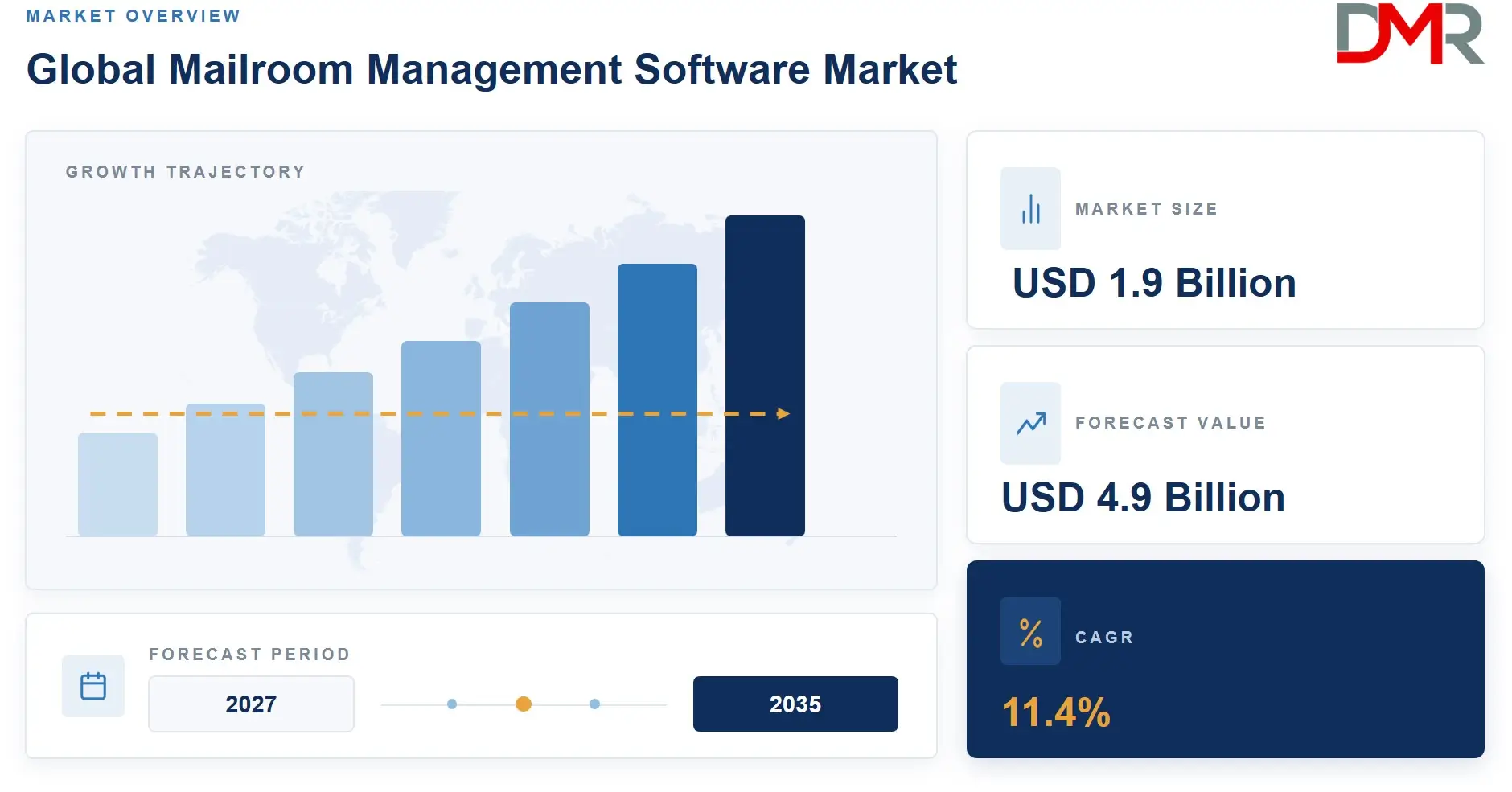
The global mailroom management software market is valued at USD 1.9 billion in 2026 and is projected to reach USD 4.9 billion by 2035, growing at a CAGR of 11.4% from 2027 to 2035. Growth is driven by digital mailroom transformation, hybrid-work mail visibility needs, compliance and audit requirements, and AI-enabled package-tracking automation across corporate, government, and healthcare facilities.
ℹ
To learn more about this report –
Download Your Free Sample Report Here
Mailroom management software is a digital platform that centralizes the logging, tracking, routing, notification, and audit of inbound and outbound mail and packages. It replaces manual registers with barcode and QR-code scanning, chain-of-custody records, automated recipient alerts, delivery verification, and analytics dashboards. Deployed in cloud, on-premise, or hybrid modes, it serves corporate offices, government organizations, educational institutions, healthcare facilities, and property managers seeking accountability, speed, and compliance across physical mail operations.
The report covers software platforms and associated scanning hardware integration used to manage physical mail and parcel flows across enterprises and institutions. It examines deployment models, application areas, organization sizes, end-user verticals, and functionality modules. Revenue scope includes subscription licenses, perpetual licenses, implementation, and support services. Regional coverage spans North America, Europe, Asia Pacific, Latin America, and the Middle East and Africa, with company-level competitive profiling and forecast analysis through 2035.
Mailroom Management Software Market Snapshot
Mailroom Management Software Market Snapshot, 2026-2035
| Metric |
Value |
| Market Size (2026) |
USD 1.9 Billion |
| Forecast Value (2035) |
USD 4.9 Billion |
| CAGR (2027-2035) |
11.4% |
| Largest Region (2026) |
North America, 38.2% share |
| Fastest-Growing Region (2027-2035) |
Asia Pacific, 14.6% CAGR |
| Leading Deployment Mode (2026) |
Cloud-Based, 56.4% share |
| Leading Application (2026) |
Inbound Mail Management, 34.8% share |
| Key Players |
Pitney Bowes, Neopost (Quadient), Ricoh Company, Fujitsu, Zebra Technologies, Honeywell International, Bell and Howell, Eagle Information Systems |
Mailroom Management Software Market: Key Takeaways
- Market growth: The market expands from USD 1.9 billion in 2026 to USD 4.9 billion by 2035 at an 11.4% CAGR.
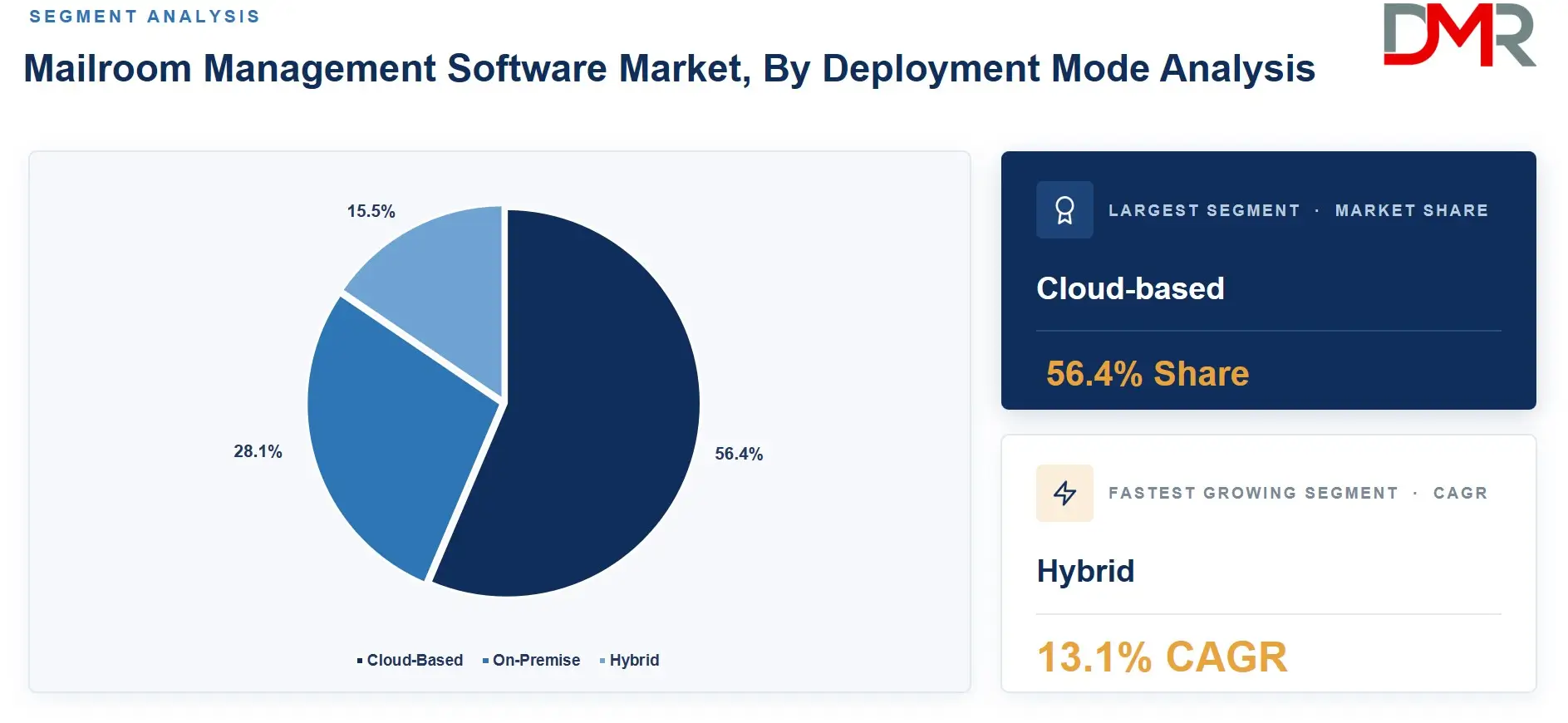
- Deployment leader: Cloud-based deployment holds 56.4% share in 2026, led by lower upfront costs, remote mail visibility, and rapid scalability.
- Fastest deployment mode: Hybrid deployment is set to grow at 13.1% CAGR through 2035, ahead of the overall market, as regulated entities retain on-premise core records.
- Application leader: Inbound mail management accounts for 34.8% of 2026 demand, as organizations prioritize package receipt, sorting, and recipient notification.
- Fastest application: Mailroom analytics and reporting is projected to grow at 14.2% CAGR, supported by audit, compliance, and operational benchmarking needs.
- Regional picture: North America leads with 38.2% share in 2026, while Asia Pacific is fastest-growing at 14.6% CAGR.
What are the Key Use Cases of Mailroom Management Software?
- Inbound Mail Digitization for Hybrid Workforces — Cloud platforms scan, classify, and route inbound mail to remote employees, cutting physical handling and accelerating internal response times.
- Package Tracking and Chain-of-Custody Verification — Barcode and QR scanning plus recipient notifications provide auditable proof of delivery, reducing lost parcels and liability disputes in large campuses.
- Automated Outbound Mail and Compliance Archiving — Workflow automation manages bulk outbound correspondence while maintaining audit trails, supporting regulatory compliance and reducing postage waste.
- Digital Mailroom for Multi-Tenant Properties — Centralized logging and notification systems serve residential and commercial property managers, streamlining mail distribution across hundreds of tenants with minimal staff.
How are Foundation Models and Generative AI Transforming the Mailroom Management Software Market?
Foundation models and generative AI are reshaping mailroom software by enabling intelligent document classification, OCR-free address extraction, and natural-language search across mail logs. AI models automatically categorize inbound mail by department, urgency, and recipient, flagging suspicious packages and routing exceptions before human intervention. Operational benefits include faster sorting, fewer misdeliveries, and reduced manual data entry, with early adopters reporting double-digit gains in processing throughput.
Adoption is accelerating as vendors embed copilots that let staff query mailroom data conversationally and auto-generate compliance reports. Generative AI also supports predictive volume forecasting, helping facilities staff peak seasons and optimize courier schedules. Market impact is pronounced in cloud deployments, where AI features ship as continuous updates, reinforcing cloud's share gains and pressuring on-premise vendors to add intelligence layers. Over the forecast period, AI-differentiated platforms are expected to command pricing premiums and drive consolidation.
Mailroom Management Software Market Dynamics at a Glance
Drivers, Restraints, Opportunities and Trends in the Mailroom Management Software Market
| Type |
Factor |
Impact |
| Driver |
Digital mailroom transformation programs |
High |
| Driver |
Hybrid-work mail visibility and compliance mandates |
High |
| Restraint |
High integration costs with legacy systems |
Medium |
| Restraint |
Data privacy and physical-mail security concerns |
High |
| Opportunity |
AI-enabled document classification and analytics |
Medium |
| Opportunity |
Cloud expansion across Asia Pacific SMEs |
High |
| Trend |
Barcode and QR-code-first package workflows |
Medium |
| Trend |
Mailroom analytics as a compliance and ESG reporting tool |
High |
What is Driving the Growth of the Mailroom Management Software Market?
Digital Mailroom Transformation Programs
Enterprises and public institutions are replacing manual mail registers with digital mailroom platforms to cut processing costs and improve accountability. Government digitization initiatives and corporate shared-service centers increasingly mandate electronic logging of physical correspondence, supported by barcode scanning and audit trails. Vendor evidence shows digital mailrooms reduce mail handling time by 30–50% and virtually eliminate lost-item disputes, strengthening the business case. This transformation wave broadens the addressable base beyond traditional mailrooms to legal, HR, and finance departments, sustaining double-digit software spending growth through the forecast period.
Hybrid-Work Mail Visibility and Compliance Mandates
With distributed workforces, employees are no longer on-site to collect mail, driving demand for recipient notifications, digital forwarding, and pickup verification. Simultaneously, regulated sectors face stricter record-keeping and chain-of-custody requirements for official correspondence, pushing compliance-driven adoption. Healthcare, legal, and government buyers cite audit readiness as a top purchase criterion. Vendors responding with compliance dashboards and retention controls are winning larger contracts, and this regulatory pull is expected to keep demand resilient even amid broader IT budget caution.
What are the Key Restraints in the Mailroom Management Software Market?
High Integration Costs with Legacy Systems
Many organizations operate entrenched mailroom processes tied to legacy ERP, facilities, and security systems, making integration complex and costly. Custom connectors, hardware replacement, and staff retraining inflate total cost of ownership, particularly for mid-sized enterprises with limited IT resources. Procurement cycles lengthen as buyers require proof of interoperability before committing. Vendors that offer pre-built integrations and phased migration paths mitigate this restraint, but integration friction remains a meaningful barrier to faster adoption, especially in on-premise environments and price-sensitive segments.
Data Privacy and Physical-Mail Security Concerns
Mail often contains sensitive personal, financial, and legal information, raising privacy and security scrutiny. Organizations worry about digitized mail images residing in third-party clouds, cross-border data transfers, and unauthorized access to recipient records. High-profile parcel theft and mail-fraud incidents heighten caution. Compliance with data protection regimes adds requirements for encryption, access controls, and audit logging. While these concerns disproportionately slow cloud adoption among conservative public-sector buyers, they also create differentiation opportunities for vendors with strong security certifications and regional data residency options.
What are the Key Opportunities in the Mailroom Management Software Market?
AI-Enabled Document Classification and Analytics
AI-driven classification, extraction, and analytics represent the largest white space in the market. Most installed mailroom systems still rely on manual categorization, leaving room for intelligent automation that routes mail by content and urgency. Vendors can monetize AI modules through tiered subscriptions and usage-based pricing. Analytics also opens a compliance and ESG reporting angle, helping facilities demonstrate audit readiness and sustainability gains from reduced paper handling. Early movers embedding AI natively are already reporting higher win rates and expansion revenue in enterprise accounts.
Cloud Expansion Across Asia Pacific SMEs
Small and medium enterprises across Asia Pacific remain largely underserved, with many still using manual registers or basic spreadsheets. Affordable cloud subscriptions, mobile-first scanning, and local-language interfaces lower adoption barriers. Rapid e-commerce growth in China, India, and Southeast Asia is swelling parcel volumes at offices and residential complexes, creating urgent need for tracking and notification tools. Channel partnerships with facilities managers and courier aggregators can accelerate penetration.
What are the Latest Trends in the Mailroom Management Software Market?
Barcode and QR-Code-First Package Workflows
Mailrooms are standardizing on barcode and QR-code scanning as the primary data-capture method, replacing manual entry. Mobile scanning apps let receiving staff log items in seconds, while QR codes on notification slips enable contactless pickup verification. Carriers and courier aggregators are aligning label standards, improving interoperability. The shift reduces data-entry errors and speeds chain-of-custody records, and it creates a hardware attach opportunity for rugged scanners. Vendors bundling software with scanning hardware report stronger retention, and barcode-first design is becoming a baseline buyer expectation across all segments.
Mailroom Analytics as a Compliance and ESG Reporting Tool
Analytics dashboards are evolving from operational metrics to compliance and sustainability reporting. Organizations use mail volumes, delivery-cycle times, and exception rates to evidence audit readiness and to quantify paper reduction for ESG disclosures. Facilities teams leverage benchmarking to justify staffing and automation investments. Vendors adding configurable compliance reports and carbon-savings calculators differentiate in public-sector and healthcare tenders. This trend elevates mailroom software from back-office utility to governance tooling, supporting premium pricing and expanding buyer stakeholders beyond facilities management into compliance and sustainability offices.
Research Scope and Analysis
The study sizes the mailroom management software market across deployment modes, applications, organization sizes, and end-user verticals, with revenue attributed to software subscriptions, licenses, implementation, and support. Regional splits and company shares are reconciled bottom-up and top-down for internal consistency. Forecasts reflect segment-level adoption assumptions, pricing trends, and AI feature monetization through 2035, with historical context from 2021 to 2026 anchoring baseline estimates and competitive benchmarking.
ℹ
To learn more about this report –
Download Your Free Sample Report Here
By Deployment Mode Analysis
Cloud-based deployment leads with 56.4% share in 2026, driven by lower upfront costs, remote mail visibility for hybrid teams, and continuous feature updates including AI modules. Subscription pricing aligns with operating budgets and scales with mailroom volume, making cloud the default choice for new deployments. Hybrid deployment is the fastest-growing mode at 13.1% CAGR from 2027 to 2035, as regulated government and healthcare entities retain on-premise custody of sensitive records while adopting cloud analytics and notification layers. On-premise remains relevant for air-gapped security environments but cedes share steadily.
By Application Analysis
Inbound mail management dominates with 34.8% share in 2026, reflecting the core pain point of receiving, sorting, and notifying recipients about letters and packages amid rising e-commerce volumes. Package tracking and delivery management is the fastest-growing application at 13.8% CAGR, propelled by parcel surges at corporate offices and residential complexes and by recipient expectation of real-time notifications and verified pickup. Digital mailroom management and outbound mail management follow, with analytics and reporting gaining traction as compliance and ESG use cases mature across large enterprises and public institutions.
By Organization Size Analysis
Large enterprises hold the leading share at 46.2% in 2026, owing to multi-site mailroom complexity, compliance obligations, and budgets for integrated scanning hardware and analytics. Medium enterprises are the fastest-growing segment at 13.5% CAGR from 2027 to 2035, as affordable cloud subscriptions and packaged templates lower adoption barriers. Small enterprises increasingly adopt lightweight tracking tools through channel partners and facilities-management bundles, though price sensitivity tempers growth. Vendors are tailoring tiered editions and self-service onboarding to capture the underserved medium and small enterprise tiers across both mature and emerging markets.
By End User Analysis
Corporate offices lead with 41.5% share in 2026, driven by hybrid-work mail visibility needs and shared-service center consolidation. Government organizations are the fastest-growing end user at 13.9% CAGR, supported by digitization mandates, chain-of-custody requirements for official correspondence, and public-sector modernization funding. Healthcare facilities adopt for time-sensitive lab kits and patient documents, while educational institutions and residential and commercial property management round out demand, the latter benefiting from parcel-tracking needs in multi-tenant buildings and gated communities across urbanizing regions.
By Functionality Analysis
Barcode and QR code scanning leads with 38.6% share in 2026, as it forms the data-capture backbone of every mailroom workflow, enabling fast logging, chain-of-custody records, and error-free tracking that all other modules depend on. Mail and package logging follows closely, with recipient notifications gaining rapid traction among hybrid-work enterprises. Workflow automation and audit management is the fastest-growing functionality at 14.5% CAGR from 2027 to 2035, driven by compliance, audit-readiness mandates, and demand for exception handling and ESG reporting across government, healthcare, and large enterprise mailrooms.
How is the Mailroom Management Software Market Segmented?
By Deployment Mode
- Cloud-Based
- On-Premise
- Hybrid
By Application
- Inbound Mail Management
- Outbound Mail Management
- Package Tracking and Delivery Management
- Digital Mailroom Management
- Mailroom Analytics and Reporting
By Organization Size
- Small Enterprises
- Medium Enterprises
- Large Enterprises
By End User
- Corporate Offices
- Government Organizations
- Educational Institutions
- Healthcare Facilities
- Residential and Commercial Property Management
By Functionality
- Mail and Package Logging
- Barcode and QR Code Scanning
- Recipient Notifications
- Pickup and Delivery Verification
- Workflow Automation and Audit Management
Which Region Leads the Mailroom Management Software Market?
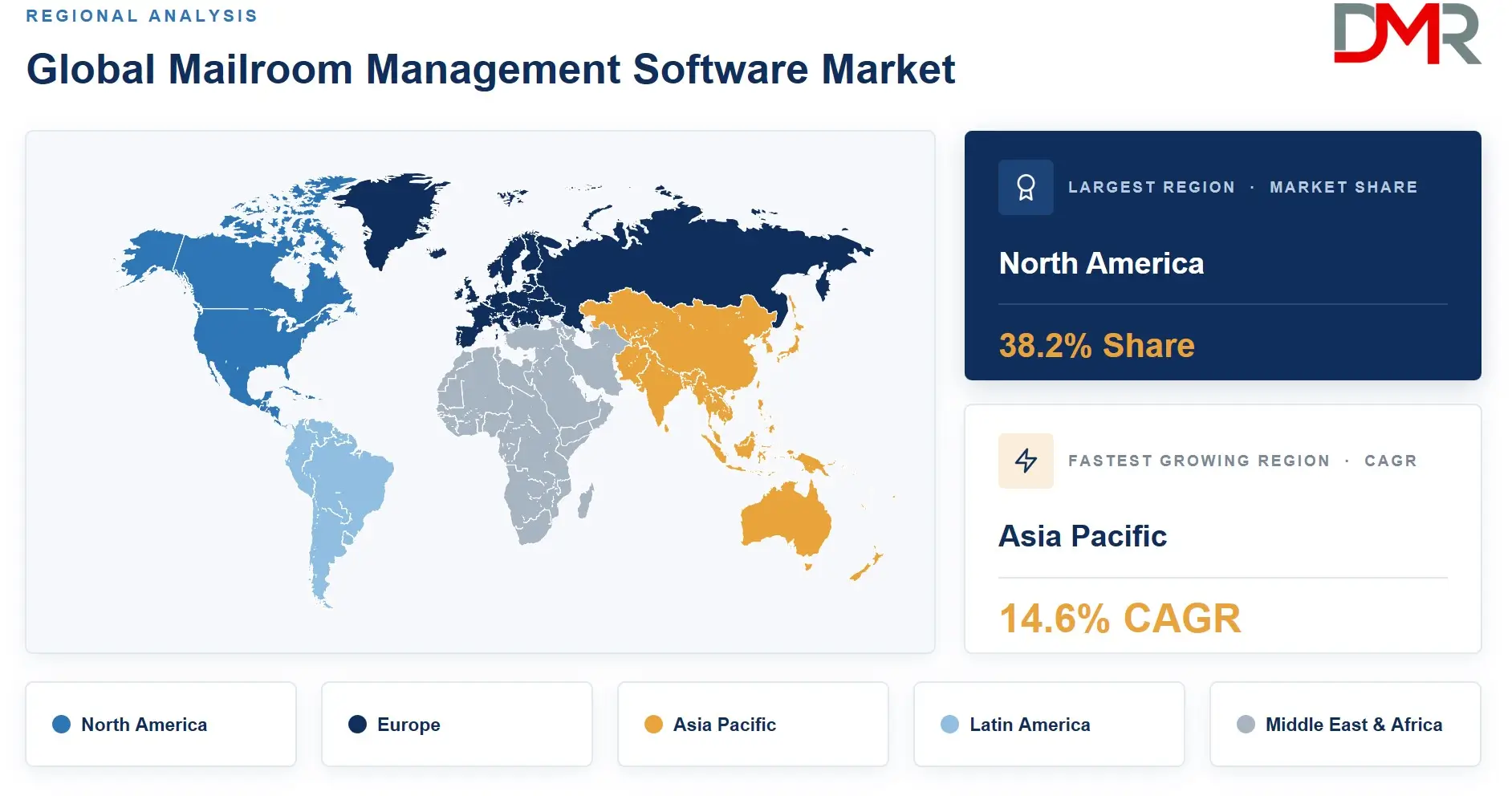
North America leads with 38.2% share in 2026, while Asia Pacific is projected to grow at 14.6% CAGR from 2027 to 2035.
Region with the Largest Revenue Share
North America holds 38.2% share in 2026 and grows at 10.2% CAGR through 2035. The United States dominates, with corporate shared-service centers, government agencies, and healthcare networks driving compliance-led adoption. Canada contributes steady demand from public-sector digitization. Mature cloud infrastructure and vendor presence support rapid deployment. The outlook remains positive, with AI feature upsells and replacement cycles sustaining growth as legacy on-premise systems migrate to cloud and hybrid models across enterprise and institutional buyers.
ℹ
To learn more about this report –
Download Your Free Sample Report Here
Region with the Highest CAGR
Asia Pacific grows at 14.6% CAGR, the fastest globally, from a 24.1% share base in 2026. China and India lead volume growth, fueled by e-commerce parcel surges, corporate office expansion, and government digitization programs. Japan and South Korea contribute mature, compliance-driven demand, while Australia and Southeast Asia show rising SME adoption through channel partners. Local-language interfaces and affordable cloud tiers are key enablers. The outlook is the strongest in the market, with infrastructure investment and urbanization sustaining double-digit growth through 2035.
Regional Analysis
Europe Mailroom Management Software Market
Germany, France, and the United Kingdom lead regional demand, driven by GDPR-aligned data residency requirements, public-sector digitization programs, and corporate hybrid-work mail visibility needs. Italy and Spain show rising adoption among medium enterprises and property managers, while the Rest of Europe contributes steady institutional demand. Regional data-residency preferences favor hybrid deployments and local cloud providers, shaping competitive dynamics and vendor partnership strategies across the forecast period, with compliance depth and localized hosting emerging as decisive tender criteria for public-sector and healthcare buyers.
Latin America Mailroom Management Software Market
Brazil and Mexico dominate regional demand, supported by corporate office expansion, e-commerce parcel growth, and government modernization initiatives. Local currency volatility and budget constraints slow large-enterprise deals but favor affordable cloud subscriptions and channel-led selling. Partnerships with facilities managers and courier aggregators are expanding reach into medium enterprises. The outlook is positive, with improving connectivity and urbanization underpinning steady adoption gains, while localized pricing and Portuguese and Spanish language support become key differentiators for vendors targeting the region's underserved mid-market.
Middle East & Africa Mailroom Management Software Market
The UAE and Saudi Arabia lead regional demand, driven by smart-city programs, government digitization mandates, and corporate headquarters expansion in Gulf hubs. South Africa anchors the sub-Saharan market with public-sector and healthcare adoption. Infrastructure variability and security concerns temper growth in some markets, but cloud availability and mobile-first scanning tools are lowering barriers to entry. The outlook is favorable, with giga-project mailroom requirements adding high-value opportunities for vendors offering regional hosting, Arabic-language interfaces, and integration with national courier and postal networks.
By Region
North America
Europe
- Germany
- France
- The U.K.
- Italy
- Spain
- Rest of Europe
Asia-Pacific
- China
- Japan
- India
- Australia
- South Korea
- Rest of APAC
Latin America
- Mexico
- Brazil
- Rest of LATAM
Middle East & Africa
- Saudi Arabia
- The UAE
- South Africa
- Rest of MEA
Regulatory Landscape
Mailroom software sits at the intersection of data protection, records management, and physical security regulation. In Europe, GDPR governs digitized mail images and recipient data, pushing vendors toward regional data residency, encryption, and access-logging features. In the United States, sector rules such as HIPAA for healthcare mail and federal records-retention requirements shape audit-trail functionality. Postal and courier regulations influence barcode standards and chain-of-custody records. Emerging AI regulations add transparency obligations for automated classification. Vendors that certify compliance across jurisdictions gain tender advantages, while regulatory fragmentation raises localization costs and favors hybrid deployments.
Technology Analysis
Technology investment is concentrating on AI classification, OCR-free extraction, and mobile-first scanning. Foundation-model copilots for mailroom queries and automated compliance reporting are emerging differentiators, with vendors racing to embed them natively rather than via partnerships. Hardware-software bundles pairing rugged scanners with cloud platforms improve margins and retention. White space exists in analytics for ESG and compliance reporting, in local-language interfaces for Asia Pacific SMEs, and in integration marketplaces connecting facilities, ERP, and courier systems. Risks include AI model accuracy on handwritten mail and data privacy scrutiny; mitigation through human-in-the-loop workflows and regional hosting sustains market impact.
Who are the Leading Companies in the Mailroom Management Software Market?
The market is moderately concentrated, with established mailroom hardware incumbents and specialist software vendors competing on AI features, integrations, and compliance depth. Leaders differentiate through end-to-end scanning hardware plus cloud platforms, while challengers win on usability and pricing. Partnerships with courier aggregators, facilities managers, and system integrators are expanding channel reach, and recent strategic developments center on AI copilots, data-residency options, and acquisition of analytics startups to strengthen compliance reporting portfolios.
- Pitney Bowes (United States): SendTech and mailing systems; broad enterprise installed base and integrated shipping and mailroom platforms.
- Quadient (France): Mail-related solutions and digital mailroom platforms; strong European public-sector and corporate presence.
- Ricoh Company (Japan): Document workflow and mailroom digitization services; hardware-software integration and managed services.
- Fujitsu (Japan): Document imaging and mailroom automation; public-sector and healthcare compliance strengths.
- Zebra Technologies (United States): Barcode and QR scanning hardware; rugged devices integrated with mailroom tracking software.
Some of the prominent players in the Global Mailroom Management Software Market are:
- Pitney Bowes
- Quadient
- Ricoh Company
- Fujitsu
- Zebra Technologies
- Honeywell International
- Bell and Howell
- Eagle Information Systems
- Neopost Technologies
- Siemens Logistics
- OPEX Corporation
- Kern
- Fluence Automation
- Mailing Systems, Inc.
- FP Mailing Solutions
- Francotyp-Postalia
- Hasler
- Giro
- Data-Pac Mailing Systems
- BCC Software
- Melissa Global Intelligence
- Satori Software
- Anchor Software
- Window Book
- GrayHair Software
- ShipScience
- Notifii
- Luxer One
- Parcel Pending
- Smiota
- Cleveron
- Position Imaging
- MailBoxes Etc.
- Idiso
- Neopost Shipping
- ProShip
- Transtream
- ShipEngine
- MetaFarms
- Fluence Automation
- Other Key Players
Recent Developments in the Mailroom Management Software Market
- In January 2026, Notifii released a multi-tenant package-notification upgrade for residential property managers, accelerating adoption in urban multifamily buildings across North America.
- In November 2025, Zebra Technologies introduced a rugged QR-code scanner bundle with integrated mailroom tracking software, targeting medium enterprises and property managers.
- In September 2025, Ricoh Company acquired a document-AI startup to embed OCR-free extraction into its managed mailroom services, deepening enterprise differentiation.
- In June 2025, Quadient expanded its digital mailroom suite with regional data-residency options in Europe, strengthening GDPR positioning for public-sector tenders.
- In March 2025, Pitney Bowes launched an AI-assisted mail classification module for its cloud mailroom platform, improving inbound routing accuracy and expanding analytics upsell opportunities.
Mailroom Management Software Market Report Scope and Research Methodology
Market definition. Mailroom management software digitizes logging, tracking, routing, notification, verification, and audit of inbound and outbound mail and packages across deployment modes, applications, organization sizes, end-user verticals, and functionality modules, with revenue covering subscriptions, licenses, implementation, and support.
Methodology. Dimension Market Research built the estimate bottom-up from company revenues, shipment data, and AI value per unit for each product and end-user segment, then checked it top-down against enterprise software spending totals. Primary interviews with mailroom operations managers, facilities directors, and software vendors validated adoption rates and pricing. Forecasts apply segment-level growth assumptions for 2027–2035 and are reviewed at each report update.
Mailroom Management Software Market Report Details
| Report Characteristics |
Details |
| Market Size (2026) |
USD 1.9 Billion |
| Forecast Value (2035) |
USD 4.9 Billion |
| CAGR (2027-2035) |
11.4% |
| Historical Data |
2021–2026 |
| Forecast Data |
2027–2035 |
| Base Year |
2026 |
| Estimate Year |
2027 |
| Segments Covered |
By Deployment Mode, By Application, By Organization Size, By End User, By Functionality |
| Regional Coverage |
North America (The US, Canada); Europe (Germany, France, The UK, Italy, Spain, Rest of Europe); Asia Pacific (China, Japan, India, Australia, South Korea, Rest of APAC); Latin America (Mexico, Brazil, Rest of LATAM); Middle East & Africa (Saudi Arabia, The UAE, South Africa, Rest of MEA) |
Frequently Asked Questions
How big is the Mailroom Management Software Market in 2026?
▾ The global mailroom management software market is valued at USD 1.9 billion in 2026.
What is the growth rate of the Mailroom Management Software Market?
▾ The market is projected to grow at an 11.4% CAGR from 2027 to 2035, reaching USD 4.9 billion by 2035.
Which region leads the Mailroom Management Software Market?
▾ North America leads with a 38.2% share in 2026, supported by corporate shared-service centers, government agencies, and healthcare networks.
Which product segment dominates the Mailroom Management Software Market?
▾ Cloud-based deployment dominates with a 56.4% share in 2026, driven by lower upfront costs and remote mail visibility for hybrid teams.
Which end user is growing fastest in the Mailroom Management Software Market?
▾ Government organizations are the fastest-growing end user at a 13.9% CAGR, supported by digitization mandates and chain-of-custody requirements.
Who are the key players in the Mailroom Management Software Market?
▾ Key players include Pitney Bowes, Quadient, Ricoh Company, Fujitsu, Zebra Technologies, Honeywell International, Bell and Howell, and Eagle Information Systems.
What are the main challenges facing the Mailroom Management Software Market?
▾ High integration costs with legacy systems and data privacy and physical-mail security concerns are the main challenges restraining faster adoption.