Global Main Automation Contractor In Oil Gas Market Snapshot
- Market Size (2026): USD 18.74 Billion
- Projected Market Size (2035): USD 33.58 Billion
- Global CAGR (2026–2035): 6.7%
- Leading Offering Segment (2026): Services, 42.8% Market Share
- Leading Project Type (2026): Brownfield, 61.4% Market Share
- Leading Operation Segment (2026): Downstream, 44.2% Market Share
- Fastest-Growing Segment: Industrial IoT & Analytics Software, 9.6% CAGR
- Leading Region (2026): North America, 34.8% Market Share
What is Main Automation Contractor In Oil Gas and its Market Size?
The Main Automation Contractor (MAC) in Oil & Gas Market comprises engineering, automation, and digital solution providers responsible for delivering integrated automation systems throughout the lifecycle of upstream, midstream, and downstream oil and gas facilities. Unlike conventional automation suppliers that provide individual products, MACs act as single-point partners responsible for the engineering, design, integration, commissioning, cybersecurity, maintenance, and lifecycle optimization of plant-wide automation infrastructure.
ℹ
To learn more about this report –
Download Your Free Sample Report Here
Their solutions encompass Distributed Control Systems (DCS), Programmable Logic Controllers (PLC), SCADA platforms, Safety Instrumented Systems (SIS), field instrumentation, Industrial Internet of Things (IIoT), Advanced Process Control (APC), Asset Performance Management (APM), cloud-enabled monitoring platforms, and digital twin technologies. By integrating multiple automation vendors and software platforms into a unified operational environment, MACs help operators improve productivity, minimize project risks, reduce commissioning timelines, strengthen cybersecurity, and maximize operational reliability across complex oil and gas facilities.
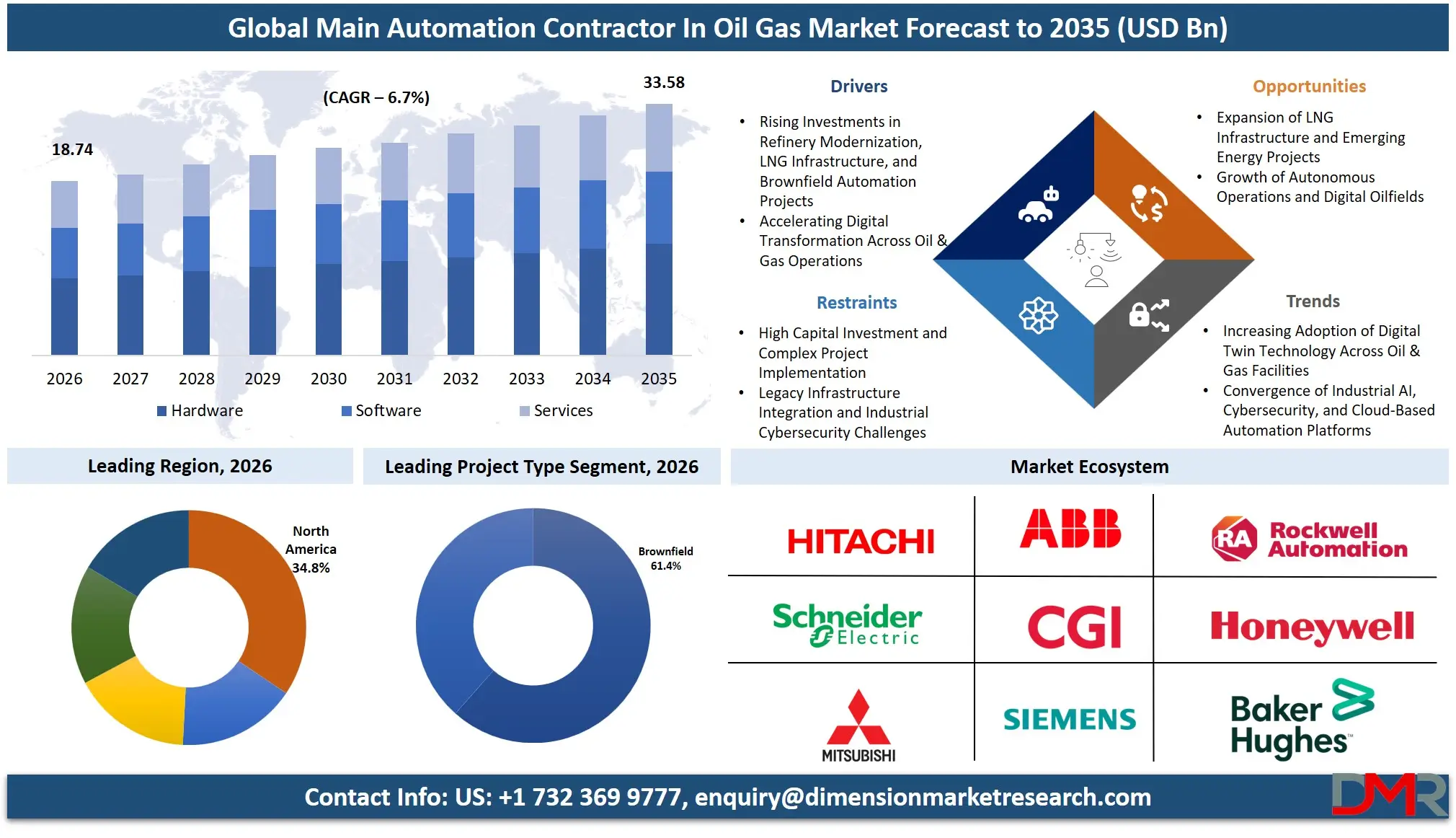
The Global Main Automation Contractor (MAC) in Oil &Gas Market is estimated to reach USD 18.74 billion in 2026 and is projected to grow to approximately USD 33.58 billion by 2035, registering a compound annual growth rate (CAGR) of 6.7% during the forecast period.
Market expansion is being driven by increasing investments in refinery modernization, LNG export terminals, offshore production platforms, petrochemical complexes, and digital oilfield initiatives. Rising demand for integrated automation engineering, industrial cybersecurity, predictive maintenance, and AI-powered operational optimization is encouraging oil and gas operators to consolidate automation responsibilities under experienced Main Automation Contractors. Furthermore, the growing adoption of Industrial IoT, edge computing, cloud-based process monitoring, and digital twin technologies is expanding the role of MACs from system integrators to strategic digital transformation partners capable of delivering end-to-end automation solutions throughout the asset lifecycle.
Use Cases
- Refinery Process Automation: Integrates process control, safety systems, and production optimization across refining operations.
- Offshore Platform Automation: Enables centralized monitoring, remote operations, and predictive maintenance for offshore production assets.
- LNG Facility Automation: Supports integrated automation throughout liquefaction, storage, regasification, and export terminals.
- Pipeline & Terminal Automation: Enhances leak detection, remote monitoring, flow management, and operational safety.
- Digital Asset Performance Management: Utilizes AI and Industrial IoT for predictive maintenance and equipment reliability improvement.
- Safety Automation: Implements emergency shutdown systems, fire & gas detection, and functional safety solutions for hazardous facilities.
Key Takeaways
- The global market is projected to increase from USD 18.74 billion in 2026 to USD 33.58 billion by 2035, growing at a 6.7% CAGR.
- Increasing digital transformation across upstream, midstream, and downstream operations is a primary growth catalyst.
- Services represent the largest offering segment owing to extensive engineering, system integration, and lifecycle maintenance requirements.
- Industrial IoT & Analytics Software is expected to record the fastest growth as operators increasingly adopt predictive maintenance and AI-driven process optimization.
- Brownfield projects continue to dominate due to widespread modernization of aging oil and gas infrastructure.
- North America leads the global market, supported by advanced automation adoption, shale production, LNG expansion, and strong investments in refinery upgrades.
How AI/Gen AI is Transforming the Main Automation Contractor In Oil Gas Market?
The adoption of advanced digital technologies is fundamentally reshaping the role of Main Automation Contractors (MACs) in the oil & gas industry. Traditionally focused on engineering, control system integration, and commissioning, MACs are increasingly becoming strategic digital transformation partners that deliver intelligent, connected, and data-driven automation ecosystems.
Artificial Intelligence (AI), Industrial Internet of Things (IIoT), Digital Twins, Cloud Computing, and Edge Computing are enabling oil & gas operators to optimize production, improve asset reliability, strengthen operational safety, and reduce lifecycle costs. These technologies are being embedded across Distributed Control Systems (DCS), SCADA platforms, Safety Instrumented Systems (SIS), and Asset Performance Management (APM) solutions to provide real-time visibility and autonomous decision-making capabilities throughout upstream, midstream, and downstream operations.
Artificial Intelligence is enhancing operational efficiency by analyzing massive volumes of process data to identify equipment anomalies, optimize production parameters, and predict failures before they occur. AI-powered predictive maintenance minimizes unplanned downtime while extending the operational life of critical assets such as compressors, turbines, pumps, valves, and rotating equipment.
Industrial IoT sensors continuously collect operational data from field instruments, enabling real-time monitoring of pipelines, offshore platforms, LNG terminals, and refineries. When integrated with cloud-based analytics platforms, these systems provide centralized visibility across geographically dispersed assets, allowing operators to improve production planning, reduce maintenance costs, and make informed operational decisions.
Key Drivers in the Global Main Automation Contractor In Oil Gas Market
Rising Investments in Refinery Modernization, LNG Infrastructure, and Brownfield Automation Projects
Growing investments in refinery upgrades, petrochemical expansions, LNG liquefaction terminals, offshore production facilities, and pipeline infrastructure are significantly driving demand for Main Automation Contractors. Most existing oil and gas facilities worldwide were commissioned decades ago and require modernization to improve operational efficiency, meet stricter environmental regulations, and integrate digital technologies. Rather than replacing entire production facilities, operators are increasingly undertaking brownfield modernization projects that require seamless integration of new automation systems with legacy infrastructure.
Accelerating Digital Transformation Across Oil & Gas Operations
Digital transformation has become a strategic priority for oil and gas operators seeking to maximize production efficiency while reducing operating costs and improving asset reliability. Companies are rapidly deploying Artificial Intelligence, Industrial Internet of Things (IIoT), Digital Twins, predictive analytics, cloud computing, and advanced process control solutions to optimize operations across upstream, midstream, and downstream facilities.
Restraints in the Global Main Automation Contractor In Oil Gas Market
High Capital Investment and Complex Project Implementation
Large-scale automation projects require substantial upfront capital investments covering engineering design, automation hardware, software licensing, cybersecurity infrastructure, system integration, commissioning, workforce training, and long-term maintenance. These investments are particularly significant for greenfield LNG plants, offshore production platforms, refineries, and petrochemical complexes where highly customized automation architectures are required. Smaller operators and independent exploration companies often face budget constraints that delay automation upgrades or limit project scope.
Legacy Infrastructure Integration and Industrial Cybersecurity Challenges
Many oil and gas facilities continue to operate legacy automation systems installed decades ago, creating significant interoperability challenges when integrating modern digital technologies. Differences in communication protocols, proprietary control systems, outdated hardware, and limited data accessibility complicate modernization initiatives. At the same time, increasing connectivity through Industrial IoT and cloud platforms expands the cyberattack surface for critical industrial infrastructure.
Growth Opportunities in the Global Main Automation Contractor In Oil Gas Market
Expansion of LNG Infrastructure and Emerging Energy Projects
The rapid expansion of global LNG production, storage, transportation, and regasification infrastructure presents substantial opportunities for Main Automation Contractors. New LNG export terminals, floating LNG facilities, gas processing plants, and cross-border pipeline projects require highly integrated automation systems capable of managing complex process operations while ensuring safety and regulatory compliance. In parallel, investments in carbon capture, utilization and storage (CCUS), hydrogen production, biofuels, and renewable energy integration are creating additional demand for advanced automation engineering and digital control solutions.
Growth of Autonomous Operations and Digital Oilfields
Oil and gas companies are increasingly investing in autonomous operations that reduce human intervention while improving safety, production efficiency, and operational resilience. Digital oilfield initiatives leverage Artificial Intelligence, machine learning, robotics, remote monitoring, and predictive analytics to enable real-time optimization of drilling, production, transportation, and refining activities. Main Automation Contractors are well positioned to capitalize on this transition by providing integrated automation architectures that connect field devices, enterprise software, cloud platforms, and operational control systems.
Trends in the Global Main Automation Contractor In Oil Gas Market
Increasing Adoption of Digital Twin Technology Across Oil & Gas Facilities
Digital Twin technology is becoming an integral component of automation strategies throughout the oil and gas industry. By creating dynamic virtual models of physical assets, operators can simulate production scenarios, validate engineering changes, optimize maintenance schedules, and improve asset reliability without disrupting live operations. Main Automation Contractors are integrating Digital Twins during project design, commissioning, and lifecycle management to accelerate project delivery, reduce engineering risks, and enhance operational performance.
Convergence of Industrial AI, Cybersecurity, and Cloud-Based Automation Platforms
The convergence of Artificial Intelligence, industrial cybersecurity, cloud computing, and advanced automation software is redefining the competitive landscape for Main Automation Contractors. Oil and gas operators increasingly demand unified digital platforms capable of integrating operational technology (OT) with information technology (IT) while maintaining high levels of cybersecurity and regulatory compliance. Cloud-enabled automation architectures support centralized asset monitoring, enterprise-wide analytics, and remote operational management across geographically distributed facilities.
Research Scope and Analysis
The Global Main Automation Contractor (MAC) in Oil & Gas Market is segmented based on Offering, Project Type, Operation, Application, and End User. Each segment reflects distinct customer requirements, investment priorities, and technology adoption trends across upstream, midstream, and downstream oil and gas operations. Services continue to dominate the market owing to the engineering-intensive nature of automation projects, while software solutions are witnessing rapid growth as operators accelerate digital transformation initiatives.
ℹ
To learn more about this report –
Download Your Free Sample Report Here
By Offering Analysis
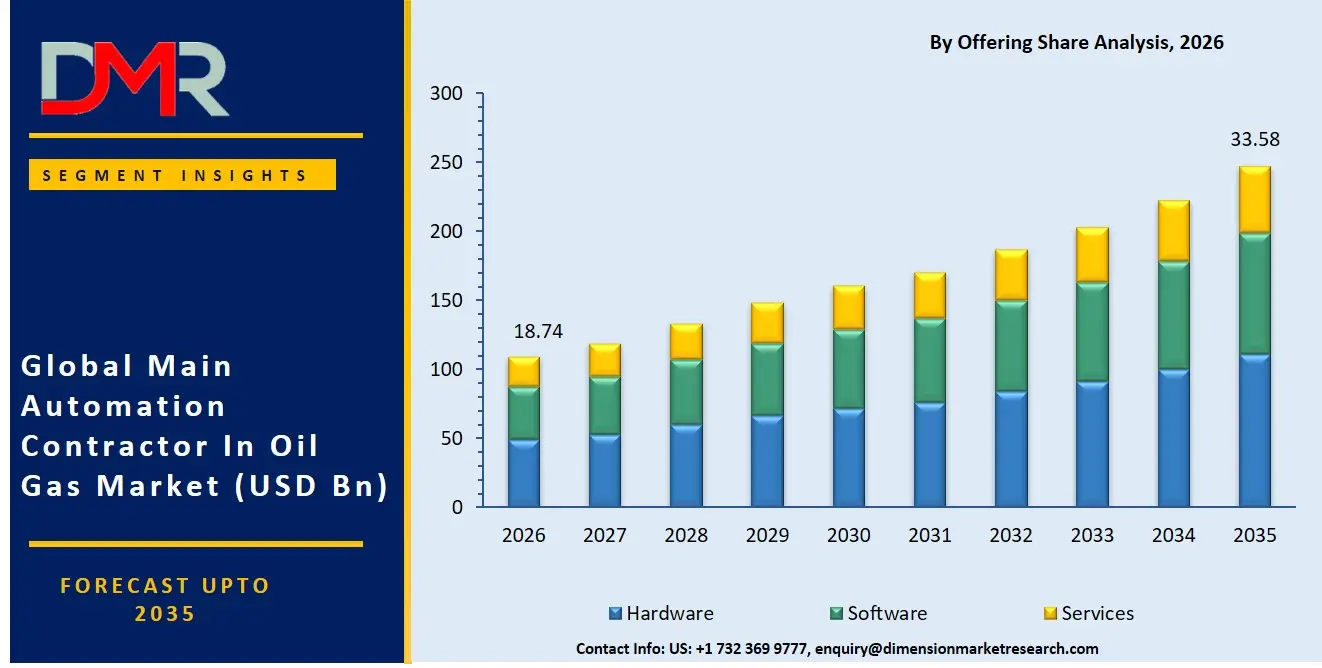
Based on offering, the market is segmented into Hardware, Software, and Services. The Services segment accounted for the largest market share of 42.8% in 2026, driven by the extensive engineering, project management, system integration, commissioning, and lifecycle maintenance activities required throughout large-scale oil and gas automation projects. Most operators prefer engaging a single Main Automation Contractor to manage the complete automation lifecycle, reducing integration risks and ensuring seamless coordination among multiple technology vendors.
ℹ
To learn more about this report –
Download Your Free Sample Report Here
Engineering & Design and System Integration services constitute the largest share within the services segment due to their critical role in project execution. Hardware represented the second-largest segment with 37.6% of the market, supported by continued investments in Distributed Control Systems (DCS), Safety Instrumented Systems (SIS), SCADA platforms, PLCs, and field instrumentation across new and existing facilities. Meanwhile, the Software segment is projected to register the fastest CAGR of 9.6% during the forecast period, fueled by increasing adoption of Industrial IoT & Analytics, Asset Performance Management (APM), Advanced Process Control (APC), AI-driven predictive maintenance, Digital Twin platforms, and cloud-based operational analytics that enable intelligent, data-driven plant optimization.
By Project Type Analysis
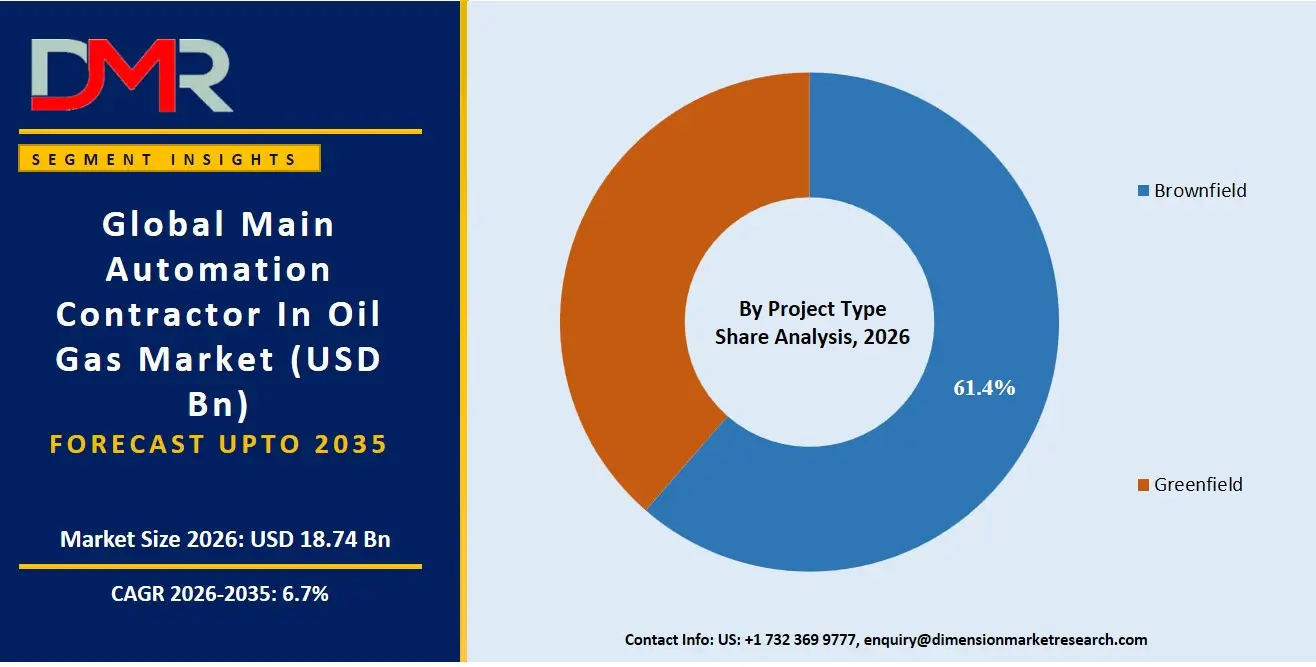
Based on project type, the market is categorized into Greenfield and Brownfield projects. Brownfield projects dominated the global market with a 61.4% share in 2026, as oil and gas companies increasingly prioritize modernization of aging refineries, offshore platforms, LNG terminals, petrochemical plants, and pipeline infrastructure rather than constructing entirely new facilities. Brownfield projects typically involve upgrading legacy control systems, integrating Industrial IoT technologies, enhancing cybersecurity, and implementing advanced automation while maintaining uninterrupted production. This creates substantial demand for experienced Main Automation Contractors capable of managing complex migration projects with minimal operational disruption. Greenfield projects accounted for the remaining 38.6% of the market but are expected to exhibit the fastest growth, registering a 7.8% CAGR through 2035. Rising investments in LNG export terminals, offshore developments, hydrogen production facilities, carbon capture projects, and large-scale petrochemical complexes are driving demand for fully integrated automation systems designed from the project planning stage, enabling greater operational efficiency and long-term scalability.
By Operation Analysis
Based on operation, the market is segmented into Upstream, Midstream, and Downstream. Downstream operations held the largest market share of 44.2% in 2026, supported by extensive automation requirements across refineries, petrochemical complexes, fuel processing facilities, and specialty chemical plants. These facilities rely on highly sophisticated Distributed Control Systems, Safety Instrumented Systems, Advanced Process Control software, and predictive maintenance solutions to maximize production efficiency, maintain product quality, and ensure compliance with stringent environmental and safety regulations. Upstream operations represented the second-largest segment with a 34.1% market share, driven by automation investments in offshore platforms, drilling operations, production facilities, and digital oilfield initiatives. The Midstream segment is expected to register the fastest CAGR of 8.2% during the forecast period, supported by increasing investments in LNG infrastructure, cross-border pipeline networks, storage terminals, compressor stations, and intelligent pipeline monitoring systems. Growing adoption of remote monitoring technologies, leak detection systems, AI-based asset management, and cloud-enabled SCADA platforms is accelerating automation across midstream operations.
By Application Analysis
Based on application, the market is divided into Process Automation, Safety Automation, Pipeline & Terminal Automation, Asset Monitoring & Predictive Maintenance, and Production Optimization. Process Automation emerged as the dominant application segment, accounting for 36.8% of the global market in 2026, owing to its central role in maintaining stable production, improving operational efficiency, reducing energy consumption, and optimizing process performance across oil and gas facilities. Distributed Control Systems, Advanced Process Control software, and Industrial IoT platforms are extensively deployed to automate complex production processes while ensuring operational consistency. Safety Automation represented the second-largest application segment with a 24.5% market share, reflecting increasing regulatory requirements for emergency shutdown systems, fire and gas detection, and functional safety solutions. Asset Monitoring & Predictive Maintenance is anticipated to be the fastest-growing application, expanding at a 10.1% CAGR throughout the forecast period. The rapid integration of Artificial Intelligence, machine learning, predictive analytics, Digital Twins, and Industrial IoT sensors is enabling operators to continuously monitor equipment health, predict failures before they occur, reduce unplanned downtime, and significantly lower maintenance costs.
By End User Analysis
Based on end user, the market is segmented into National Oil Companies (NOCs), International Oil Companies (IOCs), EPC Contractors, and Oilfield Service Companies. National Oil Companies (NOCs) accounted for the largest market share of 39.3% in 2026, driven by substantial government-backed investments in refinery modernization, offshore developments, LNG infrastructure, and national energy security initiatives. NOCs typically manage large-scale capital projects requiring comprehensive automation integration, long-term lifecycle services, and advanced cybersecurity capabilities, making them the largest customers for Main Automation Contractors. International Oil Companies (IOCs) represented the second-largest segment with a 31.7% market share due to continuous investments in offshore exploration, digital oilfields, carbon reduction initiatives, and global production optimization programs. EPC Contractors are projected to register the fastest CAGR of 8.7% during the forecast period as engineering, procurement, and construction firms increasingly partner with Main Automation Contractors to deliver turnkey automation solutions for complex greenfield and brownfield projects. This trend is being reinforced by rising investments in LNG facilities, petrochemical megaprojects, hydrogen infrastructure, and integrated energy developments requiring coordinated automation engineering from project inception through operational handover.
The Global Main Automation Contractor In Oil Gas Market Report is segmented on the basis of the following:
By Offering
- Hardware
- Distributed Control Systems (DCS)
- Programmable Logic Controllers (PLC)
- SCADA Systems
- Safety Instrumented Systems (SIS)
- Field Instruments & Sensors
- Software
- Asset Performance Management (APM)
- Advanced Process Control (APC)
- Industrial IoT & Analytics
- Services
- Engineering & Design
- System Integration
- Installation & Commissioning
- Maintenance & Lifecycle Support
By Project Type
By Operation
- Upstream
- Midstream
- Downstream
By Application
- Process Automation
- Safety Automation
- Pipeline & Terminal Automation
- Asset Monitoring & Predictive Maintenance
- Production Optimization
By End User
- National Oil Companies (NOCs)
- International Oil Companies (IOCs)
- EPC Contractors
- Oilfield Service Companies
Regional Analysis
North America is the Leading Region in the Global Main Automation Contractor In Oil Gas Market
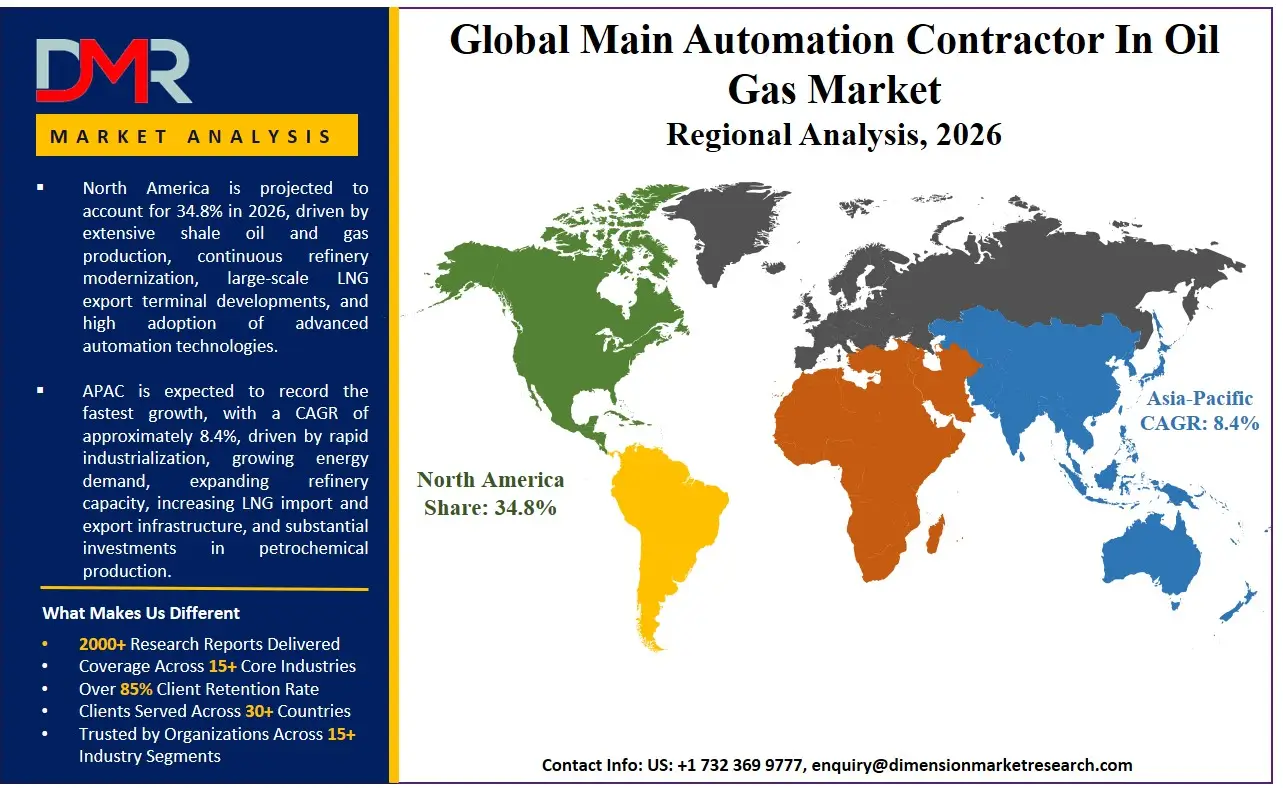
North America accounted for the largest market share of 34.8% in 2026 and is expected to maintain its leadership throughout the forecast period. The region's dominance is primarily attributed to extensive shale oil and gas production, continuous refinery modernization, large-scale LNG export terminal developments, and high adoption of advanced automation technologies. Oil and gas operators across the United States and Canada continue to invest heavily in Distributed Control Systems (DCS), Safety Instrumented Systems (SIS), Industrial Internet of Things (IIoT), Artificial Intelligence (AI), and Digital Twin technologies to improve operational efficiency and asset reliability.
ℹ
To learn more about this report –
Download Your Free Sample Report Here
The presence of globally recognized automation vendors, engineering firms, and EPC contractors further strengthens the regional ecosystem. Additionally, stringent industrial safety regulations, increasing investments in industrial cybersecurity, and widespread deployment of predictive maintenance solutions continue to drive demand for comprehensive Main Automation Contractor services across upstream, midstream, and downstream operations.
Asia Pacific is the Fastest-Growing Region in the Global Main Automation Contractor In Oil Gas Market
Asia-Pacific is projected to register the fastest CAGR of 8.4% during the forecast period. The region is benefiting from rapid industrialization, growing energy demand, expanding refinery capacity, increasing LNG import and export infrastructure, and substantial investments in petrochemical production. Countries including China, India, Japan, South Korea, Australia, and members of ASEAN are undertaking numerous greenfield and brownfield projects requiring integrated automation systems and digital engineering services. Government initiatives supporting industrial digitalization, smart manufacturing, and energy infrastructure modernization are accelerating the adoption of AI-enabled automation, Industrial IoT platforms, and cloud-based monitoring systems. The increasing presence of international automation vendors and regional EPC contractors is further enhancing the market outlook, making Asia-Pacific one of the most attractive destinations for future automation investments.
Europe Main Automation Contractor In Oil Gas Market
The Europe Main Automation Contractor (MAC) in Oil & Gas Market was valued at approximately USD 4.31 billion in 2026 and is projected to reach nearly USD 7.08 billion by 2035, expanding at a CAGR of 5.7% during the forecast period. Market growth is supported by refinery modernization programs, offshore developments in the North Sea, increasing investments in LNG infrastructure, and the integration of digital technologies across industrial operations. European oil and gas companies are actively adopting Advanced Process Control (APC), Asset Performance Management (APM), Industrial IoT, and Digital Twin technologies to enhance operational efficiency while complying with stringent environmental and functional safety regulations. The region is also witnessing growing investments in hydrogen production, carbon capture, utilization and storage (CCUS), and renewable energy integration, creating additional opportunities for Main Automation Contractors to deliver advanced automation and lifecycle engineering solutions.
Latin America Main Automation Contractor In Oil Gas Market
The Latin America Main Automation Contractor (MAC) in Oil & Gas Market was estimated at USD 1.69 billion in 2026 and is expected to reach approximately USD 2.93 billion by 2035, registering a CAGR of 6.3%. Market expansion is primarily driven by offshore oil exploration in Brazil, refinery modernization initiatives in Mexico, and increasing investments in pipeline infrastructure and petrochemical production across the region. National oil companies and international energy firms are adopting integrated automation solutions to improve production efficiency, enhance operational safety, and reduce maintenance costs. Growing implementation of SCADA systems, Industrial IoT platforms, and predictive maintenance technologies is creating new opportunities for Main Automation Contractors, particularly in large-scale offshore and deepwater developments.
Middle East & Africa Main Automation Contractor In Oil Gas Market
The Middle East & Africa Main Automation Contractor (MAC) in Oil & Gas Market reached approximately USD 2.56 billion in 2026 and is forecast to attain USD 4.79 billion by 2035, growing at a CAGR of 7.2%. The region remains one of the world's largest centers for upstream oil production, refinery expansion, LNG exports, and petrochemical manufacturing. Countries including Saudi Arabia, the United Arab Emirates, Qatar, Kuwait, and Oman continue to invest in smart oilfields, digital transformation, and advanced process automation to improve production efficiency and operational resilience. Simultaneously, African nations such as Egypt, Nigeria, and Angola are expanding offshore exploration and gas processing infrastructure, creating sustained demand for integrated automation engineering, cybersecurity solutions, and lifecycle maintenance services.
Major Countries Analysis
United States Main Automation Contractor In Oil Gas Market
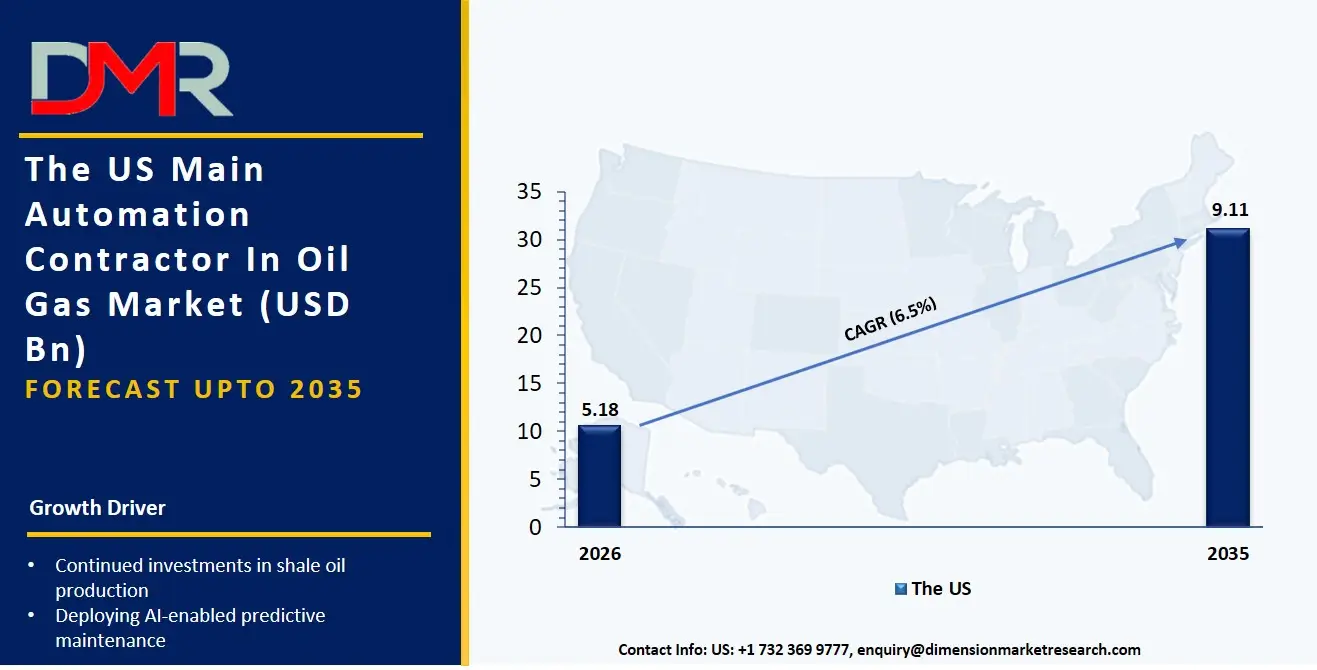
The United States Main Automation Contractor (MAC) in Oil & Gas Market was valued at approximately USD 5.18 billion in 2026 and is projected to reach nearly USD 9.11 billion by 2035, registering a CAGR of 6.5%. Growth is fueled by continued investments in shale oil production, LNG export terminals, refinery upgrades, petrochemical expansion, and digital oilfield initiatives.
ℹ
To learn more about this report –
Download Your Free Sample Report Here
Oil and gas companies are increasingly deploying AI-enabled predictive maintenance, Industrial IoT, Digital Twins, cloud-based operations centers, and industrial cybersecurity solutions, creating strong demand for integrated automation services delivered by experienced Main Automation Contractors.
Japan Main Automation Contractor In Oil Gas Market
Japan's Main Automation Contractor (MAC) in Oil & Gas Market was valued at approximately USD 0.86 billion in 2026 and is expected to reach USD 1.39 billion by 2035, expanding at a CAGR of 5.5%. Growth is supported by modernization of LNG terminals, advanced refinery automation, industrial robotics, and increasing adoption of intelligent process control systems. Japanese operators continue to invest in energy efficiency, hydrogen infrastructure, Digital Twin technology, and AI-driven operational optimization to enhance plant reliability while addressing evolving energy transition objectives.
Saudi Arabia Main Automation Contractor In Oil Gas Market
Saudi Arabia accounted for a market value of approximately USD 0.98 billion in 2026 and is anticipated to reach USD 1.92 billion by 2035, recording a CAGR of 7.8%. The market is driven by large-scale upstream expansion projects, refinery upgrades, petrochemical megaprojects, and ongoing investments under Vision 2030. National initiatives promoting digital oilfields, Industrial IoT, AI-based production optimization, and advanced automation technologies are significantly increasing the demand for Main Automation Contractors capable of delivering integrated engineering, system integration, and lifecycle support services across the Kingdom's energy sector.
Regulatory Landscape
The Global Main Automation Contractor (MAC) in Oil & Gas Market operates within a highly regulated environment where safety, cybersecurity, operational reliability, and environmental compliance significantly influence automation system design and implementation. International standards such as IEC 61511 govern the design and lifecycle management of Safety Instrumented Systems (SIS), while IEC 62443 establishes cybersecurity requirements for Industrial Automation and Control Systems (IACS), helping operators protect critical infrastructure against evolving cyber threats.
IEC 61131 provides standardized programming frameworks for Programmable Logic Controllers (PLCs), and ISA-95 and ISA-88 facilitate integration between enterprise and operational technologies while improving manufacturing and batch process automation. In addition, ISO 55001 supports asset management practices that enhance equipment reliability and lifecycle optimization.
Oil and gas facilities must also comply with regional regulations such as OSHA's Process Safety Management (PSM) standards in the United States, the European Union's ATEX and Seveso III Directives, and API Recommended Practices governing pipeline integrity, process safety, and equipment performance.
Increasing emphasis on environmental sustainability, emissions monitoring, and digital resilience is encouraging operators to deploy automation architectures that integrate functional safety, industrial cybersecurity, real-time monitoring, and predictive maintenance capabilities while ensuring compliance with evolving global regulations.
Investment and White Space Analysis
Investment activity within the Main Automation Contractor (MAC) in Oil & Gas Market is increasingly shifting toward digital transformation, intelligent automation, and next-generation energy infrastructure. Significant capital is being directed toward greenfield LNG export terminals, refinery modernization projects, offshore production facilities, hydrogen production plants, carbon capture, utilization and storage (CCUS) projects, and smart pipeline infrastructure, all of which require comprehensive automation engineering and lifecycle integration services.
Brownfield modernization remains a particularly attractive investment area as operators seek to extend asset life by integrating legacy control systems with Artificial Intelligence (AI), Industrial Internet of Things (IIoT), Digital Twin technologies, cloud-based analytics, and advanced cybersecurity solutions. High-growth white spaces are emerging in autonomous operations, remote operations centers, predictive maintenance platforms, industrial edge computing, AI-assisted process optimization, and cloud-native industrial automation software.
Rapid industrialization and expanding energy investments across Southeast Asia, the Middle East, Africa, and Latin America present substantial opportunities for Main Automation Contractors capable of delivering turnkey automation solutions with strong digital engineering and cybersecurity expertise. Companies that combine automation integration with long-term lifecycle services, data analytics, and sustainability-focused technologies are expected to capture significant market opportunities throughout the forecast period.
By Region
North America
Europe
- Germany
- The U.K.
- France
- Italy
- Spain
- Rest of Europe
Asia-Pacific
- China
- Japan
- South Korea
- India
- Australia
- Rest of APAC
Latin America
- Brazil
- Mexico
- Rest of LATAM
Middle East & Africa
- Saudi Arabia
- The UAE
- South Africa
- Rest of MEA
Competitive Landscape
The Global Main Automation Contractor (MAC) in Oil & Gas Market is moderately consolidated, with competition centered on a combination of multinational automation companies, industrial software providers, engineering, procurement and construction (EPC) firms, and specialized system integrators. Leading companies compete by offering end-to-end automation solutions encompassing engineering design, control system integration, cybersecurity, digital transformation, commissioning, and long-term lifecycle services. Strategic partnerships with EPC contractors, acquisitions of industrial software companies, expansion into emerging energy markets, and continuous investments in Artificial Intelligence (AI), Digital Twins, Industrial Internet of Things (IIoT), and cloud-enabled automation platforms have become common competitive strategies. Increasingly, customers are selecting Main Automation Contractors based not only on hardware capabilities but also on expertise in project execution, digital engineering, operational technology (OT) cybersecurity, lifecycle support, and the ability to integrate multi-vendor automation ecosystems. As digitalization accelerates across the oil and gas industry, technology innovation, software integration capabilities, and comprehensive service portfolios are becoming the primary differentiators among leading market participants.
Some of the prominent players in the Global Main Automation Contractor In Oil Gas Market are
- ABB
- Siemens AG
- Schneider Electric
- Honeywell
- Emerson Electric
- Yokogawa Electric Corporation
- Rockwell Automation
- Valmet
- Mitsubishi Electric
- Hitachi
- SLB
- Baker Hughes
- Halliburton
- Technip Energies
- Wood plc
- KBR
- Worley
- Fluor Corporation
- Saipem
- Petrofac
- McDermott
- TechnipFMC
- Aker Solutions
- AVEVA
- Aspen Technology
- AVEVA Select
- CGI
- Endress+Hauser
- VEGA Grieshaber
- Kongsberg Gruppen
- Bosch Rexroth
- Omron
- Phoenix Contact
- Pepperl+Fuchs
- Belden
- Cisco
- Huawei
- IBM
- Oracle
- SAP
- Other Key Players
Recent Developments
- In March 2025, ABB Ltd. expanded its industrial digitalization portfolio by introducing enhanced AI-driven asset performance management capabilities designed to improve predictive maintenance and operational efficiency across large-scale oil and gas facilities.
- In January 2025, Honeywell International Inc. launched new cybersecurity solutions for industrial control systems, enabling oil and gas operators to strengthen operational resilience against increasingly sophisticated cyber threats while supporting secure digital transformation initiatives.
- In September 2024, Emerson Electric Co. introduced advanced software enhancements to its DeltaV distributed control platform, integrating Artificial Intelligence and cloud-based analytics to optimize refinery and petrochemical process automation.
- In July 2024, Siemens AG announced the expansion of its Industrial Edge ecosystem with new applications for predictive maintenance, energy optimization, and remote asset monitoring tailored for process industries, including oil and gas.
- In May 2024, Yokogawa Electric Corporation enhanced its OpreX automation portfolio by incorporating Digital Twin capabilities and advanced process optimization tools to improve lifecycle performance of complex industrial facilities.
- In February 2024, Schneider Electric SE expanded its EcoStruxure Automation Expert platform with improved interoperability and software-defined automation features, enabling more flexible and scalable industrial automation architectures.
- In November 2023, Technip Energies N.V. secured multiple engineering and automation integration contracts for LNG infrastructure projects, reinforcing its position as a leading provider of integrated automation solutions for complex energy developments.
- In August 2023, Wood PLC strengthened its digital consulting and automation engineering capabilities through expanded industrial software services, supporting customers in accelerating digital transformation and operational optimization initiatives.
Report Details
| Report Characteristics |
| Market Size (2026) |
USD 18.74 Bn |
| Forecast Value (2035) |
USD 33.58 Bn |
| CAGR (2026–2035) |
6.7% |
| Historical Period |
2021 – 2025 |
| Forecast Period |
2027 – 2035 |
| Base Year |
2025 |
| Estimate Year |
2026 |
| Segments Covered |
By Offering, By Project Type, By Operation, By Application, By End User |
| Regional Coverage |
North America – The US and Canada; Europe – Germany, The UK, France, Spain, Italy, & Rest of Europe; Asia-Pacific – China, Japan, South Korea, India, Australia, Rest of APAC; Latin America – Brazil, Mexico, & Rest of Latin America; Middle East & Africa – Saudi Arabia, The UAE, South Africa, & Rest of MEA |
Frequently Asked Questions
What is the current size of the Global Main Automation Contractor (MAC) in Oil & Gas Market?
▾ The Global Main Automation Contractor (MAC) in Oil & Gas Market is estimated to reach USD 18.74 billion in 2026, supported by increasing automation investments across upstream, midstream, and downstream energy operations.
What will be the market size of the Main Automation Contractor in Oil & Gas Market by 2035?
▾ The market is projected to reach approximately USD 33.58 billion by 2035, expanding at a steady growth rate due to digital transformation, asset modernization, and increasing demand for integrated automation solutions.
What is the expected CAGR of the Main Automation Contractor in Oil & Gas Market during 2026–2035?
▾ The market is expected to register a CAGR of 6.7% between 2026 and 2035, driven by investments in LNG facilities, refinery upgrades, industrial digitalization, and smart oilfield technologies.
What are the major factors driving the growth of the MAC in Oil & Gas Market?
▾ Key growth drivers include increasing brownfield modernization projects, rising adoption of Industrial IoT, AI-enabled predictive maintenance, digital twin technologies, cybersecurity requirements, and demand for integrated automation execution.
Which offering segment dominates the Global MAC in Oil & Gas Market?
▾ The Services segment dominates the market with a 42.8% share in 2026, driven by extensive requirements for engineering design, system integration, commissioning, maintenance, and lifecycle support.
Which region leads the Global Main Automation Contractor in Oil & Gas Market?
▾ North America leads the global market with a 34.8% share in 2026, supported by advanced automation adoption, LNG expansion, shale production, and refinery modernization initiatives.
Which region is expected to witness the fastest growth during the forecast period?
▾ Asia-Pacific is projected to be the fastest-growing region with an estimated 8.4% CAGR, driven by expanding energy infrastructure, industrialization, LNG investments, and digital transformation initiatives.
Who are the major players operating in the Main Automation Contractor in Oil & Gas Market?
▾ Major players include ABB, Siemens, Schneider Electric, Honeywell, Emerson, Yokogawa Electric, Rockwell Automation, Mitsubishi Electric, Wood, Worley, Technip Energies, Fluor, and Larsen & Toubro.