Global Massive Machine Type Communication Market Snapshot
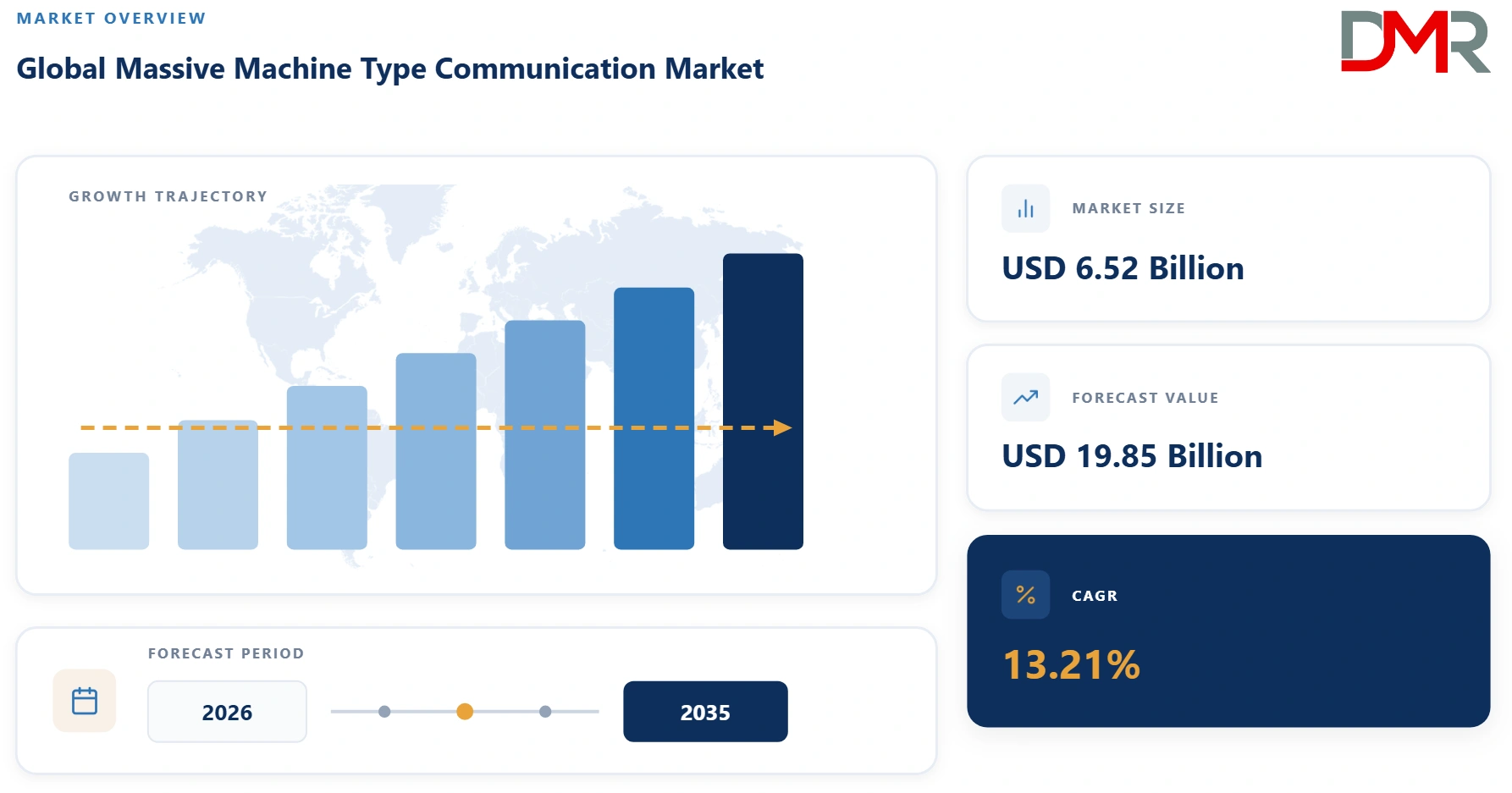
- Market Size in 2026: USD 6.52 billion
- Market Size in 2035: USD 19.85 billion
- Global CAGR, 2026-2035: 13.21%
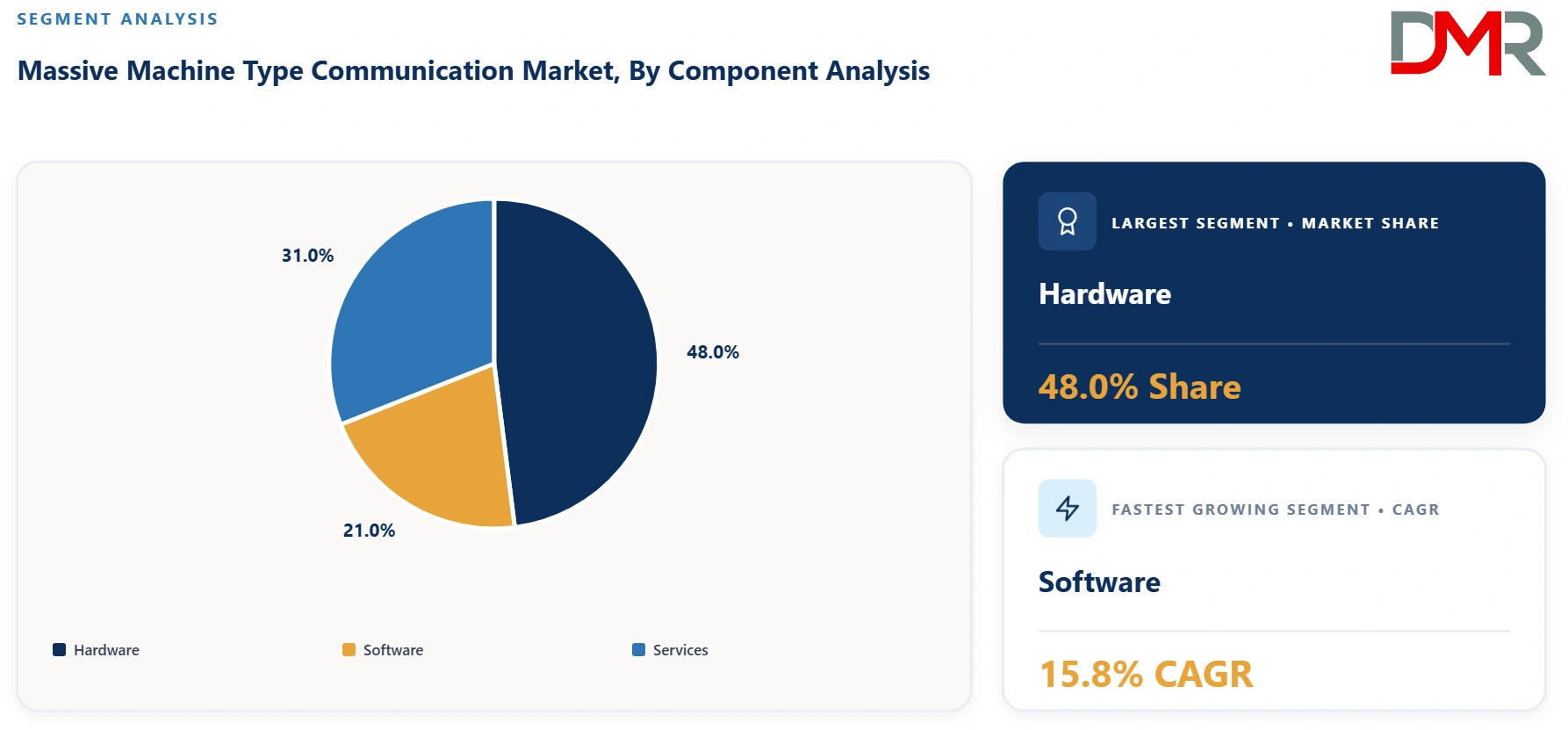
- Leading Component Segment: Hardware, 48.0% share
- Leading Communication Technology: Cellular, 57.0% share
- Leading Application Segment: Smart Metering, 19.0% share
- Fastest-Growing Segment: Cloud deployment, 16.1% CAGR
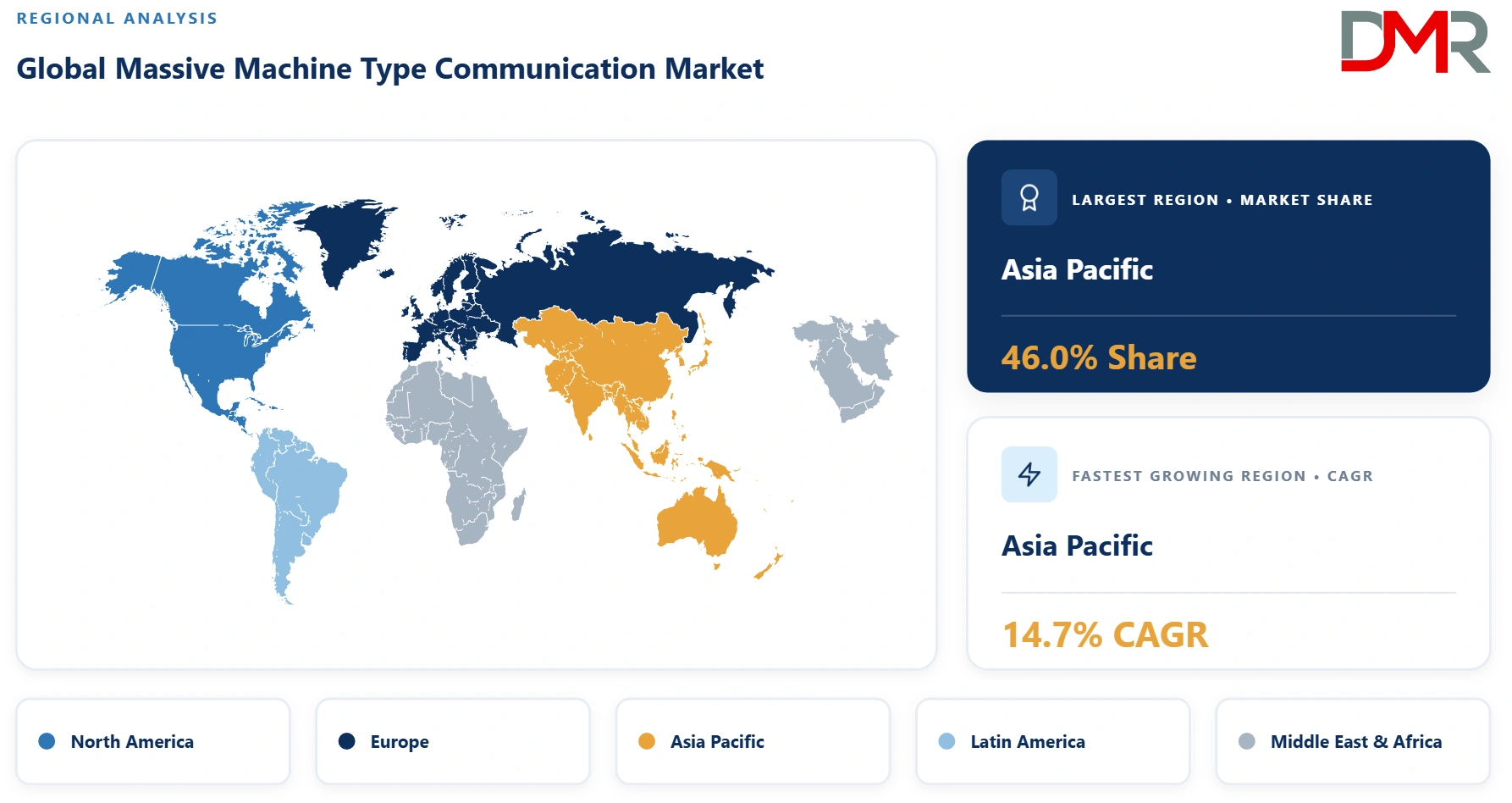
- Leading Region Asia-Pacific, 46.0% share
What is the Global Massive Machine Type Communication and its Market Size?
Massive Machine Type Communication (mMTC) is a 5G-oriented communications paradigm designed to connect extremely large numbers of low-power, low-cost machines, sensors, meters, trackers and other devices with limited human intervention. Unlike enhanced mobile broadband, mMTC prioritizes device density, low energy consumption, low module cost, broad coverage and long battery life rather than high data throughput.
ℹ
To learn more about this report –
Download Your Free Sample Report Here
In commercial deployments, NB-IoT and LTE-M remain the principal cellular technologies associated with massive IoT, while 5G RedCap and enhanced RedCap increasingly broaden the adjacent addressable market. GSMA describes Massive IoT as licensed-spectrum LPWA connectivity intended for low-data-rate, long-battery-life and difficult-to-reach applications.
The global Massive Machine Type Communication (mMTC) market is estimated at USD 6.52 billion in 2026 and is projected to reach approximately USD 19.85 billion by 2035, representing a 13.21% CAGR. Growth is being driven by accelerating smart-meter deployments, industrial automation, connected logistics, smart-city infrastructure, agricultural monitoring and the migration of enterprises from fragmented connectivity solutions toward managed cellular IoT.
Use Cases
- Smart Metering: Utilities deploy massive populations of connected electricity, gas and water meters for automated readings and network optimization.
- Asset Tracking: Low-power cellular trackers provide location, status and condition information for vehicles, containers, equipment and distributed assets.
- Smart Agriculture: Soil, weather, irrigation and livestock sensors enable precision farming across geographically dispersed agricultural areas.
- Environmental Monitoring: Connected sensors monitor air quality, water conditions, temperature, pollution and environmental risks in remote locations.
- Smart Buildings: Sensors monitor occupancy, energy consumption, lighting, HVAC performance and equipment health across commercial facilities.
- Industrial Monitoring: Large sensor populations capture machine condition, production and environmental data for predictive maintenance and operational optimization.
Key Takeaways
- Market Size: The global market is estimated at USD 6.52 billion in 2026, reaching approximately USD 19.85 billion by 2035.
- Growth: A projected 13.21% CAGR reflects rising IoT device density, 5G evolution and industrial digitization.
- Technology Leadership: Cellular connectivity remains the principal commercial technology because licensed-spectrum networks offer security, coverage and operator-managed service.
- Segment Dominance: Hardware leads because modules, sensors, gateways and communication equipment constitute the largest initial deployment expenditure.
- Fastest Growth: Cloud deployment is expected to grow fastest as enterprises shift toward centralized IoT management, analytics and device orchestration.
- Regional Leadership: Asia-Pacific accounts for approximately 46% of 2026 revenue, supported by extensive 5G investment, manufacturing concentration and large-scale smart-city and utility deployments.
- Technology Direction: NB-IoT and LTE-M remain central to low-end mMTC, while RedCap/eRedCap expand the 5G IoT device ecosystem.
How AI/Gen AI is Transforming the Massive Machine Type Communication Market?
AI and edge computing add intelligence to the connectivity layer. Rather than merely transmitting sensor readings, connected devices and gateways can identify anomalies, classify events and prioritize traffic locally. This reduces unnecessary backhaul traffic, lowers response times and improves predictive maintenance, energy management and asset tracking.
Technology is also changing the competitive structure. Connectivity vendors increasingly compete on managed platforms, APIs, device lifecycle management, security, analytics and vertical-specific solutions, rather than radio equipment alone. The emerging combination of 5G SA, network slicing, RedCap, edge computing and AI creates opportunities for vendors to sell complete IoT outcomes rather than individual connectivity components.
Key Drivers in the Global Massive Machine Type Communication Market
Rapid Expansion of Connected Devices and Industrial Digitalization
The fundamental growth engine is the continuing expansion of connected endpoints across utilities, manufacturing, logistics, agriculture, buildings and public infrastructure. Enterprises increasingly need thousands or millions of inexpensive sensors rather than a limited number of high-performance devices. mMTC is specifically designed around this economic model: low device complexity, low data requirements, long battery life and broad geographic coverage.
5G Network Evolution and RedCap Expansion
The migration from LTE toward 5G creates a second structural growth driver. Operators are increasingly seeking network architectures that support multiple IoT requirements without maintaining disconnected technology stacks. Release 17 RedCap and Release 18 eRedCap reduce the cost and complexity of 5G devices and address applications between traditional mMTC and full-performance 5G.
Restraints in the Global Massive Machine Type Communication Market
Device Economics and Fragmented Technology Ecosystems
Although connectivity costs have declined, the economics of very large deployments remain challenging. An IoT project involving hundreds of thousands of devices must account for hardware, SIM/eSIM provisioning, installation, connectivity subscriptions, cloud services, security, maintenance and eventual replacement. For extremely simple use cases, unlicensed LPWAN, Wi-Fi or proprietary protocols can sometimes offer lower upfront costs.
Growth Opportunities in the Global Massive Machine Type Communication Market
Private 5G and Industrial mMTC
Private cellular networks offer an important opportunity in factories, warehouses, ports, mines, campuses and utilities. Enterprises can deploy controlled connectivity with predictable coverage, security and device management while integrating sensors into existing operational technology environments.
Emerging Markets and Underserved Infrastructure
Developing markets represent significant whitespace because many assets remain unconnected or depend on manual data collection. Utilities, agriculture, logistics and municipal infrastructure can leapfrog legacy systems using cellular IoT.
Trends in the Global Massive Machine Type Communication Market
Convergence of mMTC with RedCap and eRedCap
The historical boundary between mMTC and broader cellular IoT is becoming less rigid. NB-IoT and LTE-M remain optimized for very low data rates, while RedCap and eRedCap provide a progression toward higher throughput and more interactive applications.
Intelligent and Cloud-Native IoT Management
IoT deployments are moving from basic connectivity toward intelligent device-management platforms combining cloud orchestration, analytics, AI and edge processing. Vendors increasingly seek recurring software and services revenue rather than relying solely on hardware.
Research Scope and Analysis
The market is segmented By Component, By Communication Technology, By Network Type, By Deployment, By Application and By End-Use Industry. Revenue estimates encompass hardware, software, connectivity/network technologies and associated services supporting large-scale machine communications.
ℹ
To learn more about this report –
Download Your Free Sample Report Here
By Component Analysis
Hardware is the dominant component segment, accounting for approximately 48.0% of the global market in 2026, supported by demand for IoT modules, sensors, gateways, communication equipment and edge devices deployed in large volumes. Hardware remains dominant because every connected endpoint requires physical communications functionality, while large smart-metering and industrial-monitoring programs involve substantial upfront device expenditure. Services represent the second-largest segment at approximately 31.0%, supported by connectivity management, installation, integration, maintenance and managed IoT operations. Software accounts for approximately 21.0%, but is the fastest-growing sub-segment at about 15.8% CAGR, driven by cloud-native device management, analytics, cybersecurity, digital twins and API-based orchestration. As hardware becomes increasingly commoditized, software and recurring managed services are expected to capture a growing proportion of customer lifetime value.
By Communication Technology Analysis
Cellular leads with approximately 57.0% share in 2026, reflecting the security, reliability, geographic reach and operator-managed nature of NB-IoT, LTE-M and emerging 5G IoT technologies. Cellular is particularly strong in smart metering, logistics and distributed infrastructure where enterprises require wide-area coverage. LPWAN represents the second-largest category at approximately 24.0%, benefiting from low power consumption and inexpensive endpoints. Satellite represents a smaller share but is the fastest-growing segment at approximately 18.2% CAGR, because satellite connectivity can address remote agriculture, maritime assets, mining, environmental monitoring and infrastructure beyond terrestrial coverage. Short-range wireless remains important inside buildings and industrial environments, often functioning as a complementary technology rather than a standalone wide-area mMTC solution.
By Network Type Analysis
Public networks account for an estimated 69.0% share in 2026, reflecting the widespread availability of operator-managed cellular infrastructure and the economics of using existing nationwide networks for distributed IoT endpoints. Public networks are especially attractive for utilities, transportation, environmental monitoring and asset tracking because enterprises do not need to build and maintain their own radio infrastructure. Private networks hold approximately 31.0%, but are the fastest-growing category at around 17.4% CAGR, driven by manufacturing, logistics, ports, mining and large campuses. Private 5G provides greater control over security, traffic policies, coverage and latency. RedCap is particularly relevant because it makes 5G connectivity more economical for large populations of industrial sensors and devices. Samsung's 2025 Hyundai Motor trial illustrates the emerging role of RedCap in private industrial networks.
By Deployment Analysis
On-premises deployments hold approximately 55.0% share in 2026, reflecting continued requirements for local control in manufacturing, utilities, government and critical infrastructure. Enterprises with sensitive operational data may prefer local infrastructure because it offers direct control over data flows and integration with operational technology. Cloud deployments account for approximately 45.0%, but represent the fastest-growing deployment model at about 16.1% CAGR. Cloud IoT platforms reduce deployment complexity and allow centralized provisioning, analytics, monitoring and firmware management across geographically distributed devices. Hybrid architectures are also becoming increasingly common, with edge gateways processing time-sensitive information locally while cloud systems manage analytics, fleet-level intelligence and long-term data storage.
By Application Analysis
Smart Metering is the leading application, representing approximately 19.0% of 2026 market revenue, because utilities deploy very large numbers of low-power devices with predictable data patterns. Smart Buildings represent about 15.0%, followed by Industrial Monitoring at approximately 14.0%. Industrial monitoring is expected to be the fastest-growing application at approximately 16.7% CAGR, supported by predictive maintenance, factory digitization and private cellular networks. Asset tracking, environmental monitoring, smart agriculture, connected healthcare and smart-city infrastructure collectively represent significant expansion opportunities. The application mix is shifting from simple periodic data collection toward systems that combine sensing, analytics, location and automated response. Ericsson reports that massive IoT technologies continue to support large populations of low-complexity devices while the broader cellular IoT market increasingly adds higher-performance device categories.
By End User Industry Analysis
Energy & Utilities lead with approximately 21.0% share in 2026, reflecting extensive smart-metering and grid-monitoring requirements. Manufacturing follows at around 18.0%, driven by Industry 4.0, machine monitoring and private cellular networks. Transportation & Logistics represents approximately 15.0%, with asset tracking and fleet visibility as important applications. Healthcare and Agriculture are smaller but high-potential categories. Agriculture is expected to be the fastest-growing end-use segment at approximately 17.0% CAGR, supported by precision irrigation, remote sensing, livestock monitoring and autonomous agricultural equipment. Government infrastructure, retail and other distributed industries add further demand as cities and enterprises digitize previously manual assets.
The Global Massive Machine Type Communication Market Report is segmented on the basis of the following:
By Component
- Hardware
- Software
- Services
By Communication Technology
- Cellular
- LPWAN
- Satellite
- Short-Range Wireless
By Network Type
By Deployment
By Application
- Smart Metering
- Smart Buildings
- Industrial Monitoring
- Asset Tracking
- Environmental Monitoring
- Smart Agriculture
- Connected Healthcare
- Smart City Infrastructure
By End-Use Industry
- Manufacturing
- Energy & Utilities
- Transportation & Logistics
- Healthcare
- Agriculture
- Government & Public Infrastructure
- Retail
- Others
Regional Analysis
Asia Pacific is the Leading Region in the Global Massive Machine Type Communication Market
Asia-Pacific is expected to maintain leadership, accounting for approximately 46.0% of global mMTC revenue in 2026, equivalent to roughly USD 3.00 billion. The region benefits from extensive 5G infrastructure investment, high manufacturing concentration, large smart-city programs and significant utility digitization. China is particularly influential because of its large mobile-operator ecosystem, extensive industrial IoT deployments and rapid adoption of RedCap. Japan and South Korea contribute through advanced manufacturing, robotics and connected infrastructure, while India represents a major long-term opportunity because of urbanization, digital infrastructure investment and smart-metering expansion. Mordor Intelligence also identifies Asia-Pacific as the largest regional market, with a 45.7% share reported for 2024.
ℹ
To learn more about this report –
Download Your Free Sample Report Here
Asia Pacific is the Fastest-Growing Region in the Global Massive Machine Type Communication Market
Asia-Pacific is also projected to be the fastest-growing major regional market, with an estimated 14.7% CAGR through 2035. Growth is supported by continued 5G rollout, manufacturing digitalization, smart-grid investment, connected transportation and large-scale public-sector IoT initiatives. China is accelerating RedCap commercialization, while Japan and South Korea are developing sophisticated industrial and private-network applications. India's opportunity is driven by the digitization of utilities, agriculture and public infrastructure. Huawei reported in June 2026 that RedCap connections had exceeded 10 million and that China had achieved nationwide RedCap coverage, illustrating the region's scale and momentum.
The Europe Massive Machine Type Communication Market
The Europe mMTC market is estimated at USD 1.17 billion in 2026 and is projected to reach approximately USD 3.23 billion by 2035, representing a 11.9% CAGR. Demand is concentrated in smart utilities, industrial automation, transportation, healthcare and environmental monitoring. European adoption is supported by strong privacy and cybersecurity requirements, advanced industrial capabilities and sophisticated mobile networks. However, regulatory compliance can increase implementation costs. The Cyber Resilience Act, NIS2 and associated cybersecurity frameworks are pushing connected-device manufacturers and operators toward secure-by-design architectures and stronger lifecycle management.
Latin America Massive Machine Type Communication Market
The Latin American market is estimated at USD 0.33 billion in 2026, rising to approximately USD 1.08 billion by 2035, at a modeled 14.1% CAGR. Smart metering, logistics, agriculture and fleet management are the principal opportunities. Brazil and Mexico represent the largest markets because of their economic scale, industrial bases and expanding digital infrastructure. Cellular IoT is attractive in Latin America because it can leverage established operator networks rather than requiring enterprises to construct dedicated communications infrastructure. Agricultural monitoring and remote asset management provide particularly strong opportunities in geographically dispersed markets.
MEA Massive Machine Type Communication Market
The Middle East & Africa market is estimated at USD 0.26 billion in 2026, increasing to approximately USD 0.93 billion by 2035, corresponding to an estimated 15.1% CAGR. Smart cities, utilities, logistics, energy infrastructure, agriculture and environmental monitoring are key applications. Gulf countries are investing heavily in connected infrastructure and digital transformation, while African markets offer opportunities for leapfrog deployments in utilities, agriculture and logistics. Saudi Arabia's CST has established IoT guidelines and dedicated IoT regulatory arrangements, supporting market formalization.
Major Countries Analysis
United States Massive Machine Type Communication Market
The United States market is estimated at USD 1.45 billion in 2026 and is projected to reach approximately USD 4.05 billion by 2035, reflecting an estimated 12.1% CAGR. Key drivers include industrial IoT, smart utilities, logistics, connected healthcare, private wireless and enterprise cloud adoption. The United States also has a strong ecosystem of chipset, cloud, network and industrial technology providers, supporting high-value IoT deployments and advanced edge-AI integration.
Japan Massive Machine Type Communication Market
Japan's mMTC market is estimated at approximately USD 0.35 billion in 2026 and is projected to reach USD 1.05 billion by 2035, corresponding to approximately 13.0% CAGR. Aging infrastructure, industrial automation, robotics, smart manufacturing and energy efficiency are major drivers. Japan's mature mobile infrastructure and advanced electronics ecosystem support sophisticated deployments in factories, transportation and utilities.
Saudi Arabia Massive Machine Type Communication Market
Saudi Arabia is estimated at approximately USD 0.07 billion in 2026, rising to approximately USD 0.26 billion by 2035, representing an estimated 15.8% CAGR. Smart-city development, energy-sector digitization, logistics, connected infrastructure and Vision 2030 investments are central drivers. The country's CST has specifically developed IoT regulatory guidance and licensing arrangements to facilitate IoT market development.
Regulatory Landscape
The regulatory environment is increasingly focused on spectrum authorization, cybersecurity, data protection, device certification, interoperability and lifecycle security. In Europe, NIS2 establishes cybersecurity obligations across critical sectors, while the Cyber Resilience Act establishes cybersecurity requirements for products with digital elements. Radio equipment is also subject to the EU Radio Equipment Directive, with cybersecurity requirements increasingly coordinated with the CRA. In India, national digital communications policy has explicitly promoted licensed and unlicensed spectrum for IoT/M2M and 5G-enabled IoT infrastructure. Saudi Arabia's CST regulates IoT under its telecommunications and IT framework and has published dedicated IoT guidelines. Globally, compliance increasingly favors secure provisioning, authenticated devices, encrypted communications, vulnerability management, software updates and auditable data governance.
Investment and White Space Analysis
The most attractive white spaces are industrial private 5G, smart-grid modernization, agricultural IoT, remote asset monitoring, edge-AI gateways, cloud device management and satellite-cellular convergence. Investors can target markets where connectivity exists but device management and analytics remain fragmented. Another opportunity lies in migrating legacy LTE/2G/3G devices to newer LTE-M, NB-IoT, RedCap or eRedCap platforms as operators retire older networks. RedCap is especially attractive because it creates an intermediate device category between very low-data mMTC and full 5G NR. Huawei reported in 2026 that RedCap connections had surpassed 10 million, while Ericsson reported 14 service providers with commercial RedCap launches and 42 providers in 27 countries investing in the technology.
By Region
North America
Europe
- Germany
- France
- The U.K.
- Italy
- Spain
- Rest of Europe
Asia-Pacific
- China
- Japan
- India
- Australia
- South Korea
- Rest of APAC
Latin America
- Mexico
- Brazil
- Rest of LATAM
Middle East & Africa
- Saudi Arabia
- The UAE
- South Africa
- Rest of MEA
Competitive Landscape
The global mMTC market is moderately consolidated at the network-equipment and chipset level but fragmented at the application and solution level. Major participants include Ericsson, Nokia, Huawei, Qualcomm, Samsung Electronics, Cisco, ZTE, Intel and major telecom operators. Competition increasingly centers on complete IoT ecosystems rather than standalone radio products. Differentiators include network coverage, module economics, power efficiency, security, device-management software, cloud integration, private-network capabilities, AI functionality and vertical expertise. Strategic partnerships are particularly important because successful deployments require coordination among operators, chipset suppliers, module vendors, cloud providers, system integrators and end users.
Some of the prominent players in the Global Massive Machine Type Communication Market are:
- Huawei Technologies
- Ericsson
- Nokia
- Qualcomm Technologies
- Cisco Systems
- Intel
- Samsung Electronics
- ZTE
- MediaTek
- Sierra Wireless
- Telit Cinterion
- u-blox
- Sequans Communications
- Nordic Semiconductor
- Semtech
- Fibocom Wireless
- Quectel Wireless Solutions
- Murata Manufacturing
- Sony Semiconductor Solutions
- Advantech
- NXP Semiconductors
- STMicroelectronics
- Texas Instruments
- Renesas Electronics
- Infineon Technologies
- Microchip Technology
- AT&T
- Verizon Communications
- Vodafone Group
- Deutsche Telekom
- China Mobile
- China Telecom
- China Unicom
- NTT DOCOMO
- Orange
- Telefónica
- SK Telecom
- KT Corporation
- LG Uplus
- Telecom Italia
- Other Key Players
Recent Developments
- In June 2026, Huawei highlighted the scaling of 5G-A IoT and RedCap, reporting that RedCap connections had exceeded 10 million and that nationwide RedCap coverage had been achieved in China, while eRedCap commercialization was expected to expand.
- In March 2026, Ericsson outlined a next-generation massive-IoT strategy for the 6G era, noting that real-world IoT traffic is becoming more frequent, interactive and data-intensive than the assumptions behind early NB-IoT and LTE-M deployments.
- In January 2026, Qualcomm expanded its industrial IoT portfolio, introducing an expanded ecosystem of processors, software, services and developer tools, including Dragonwing processors for intelligent cameras, industrial vision, drones and other edge-AI applications.
- In August 2025, Ericsson outlined its 6G strategy for Massive IoT, emphasizing the need for future networks to support a broader range of IoT device capabilities while reducing complexity and improving cost efficiency.
- In February 2025, Samsung Electronics and Hyundai Motor completed an industry-first end-to-end RedCap trial over a private 5G network, demonstrating industrial connectivity for vehicle inspection and smart-factory applications.
Report Details
| Report Characteristics |
| Market Size (2026) |
USD 6.52 Bn |
| Forecast Value (2035) |
USD 19.85 Bn |
| CAGR (2026–2035) |
13.21% |
| The US Market Size (2026) |
USD 1.45 Bn |
| Historical Data |
2021 – 2025 |
| Forecast Data |
2026 – 2035 |
| Base Year |
2025 |
| Segments Covered |
By Component, By Communication Technology, By Network Type, By Deployment, By Application, By End-Use Industry |
| Regional Coverage |
North America – The US and Canada; Europe – Germany, France, The UK, Italy, Spain, Rest of Europe; Asia-Pacific – China, Japan, India, Australia, South Korea, Rest of APAC; Latin America – Mexico, Brazil, Colombia, Argentina, Rest of LATAM; Middle East & Africa – Saudi Arabia, The UAE, South Africa, Rest of MEA |
Frequently Asked Questions
What is the size of the Global Massive Machine Type Communication Market in 2026?
▾ The Global Massive Machine Type Communication Market is estimated at approximately USD 6.52 billion in 2026, based on modeled industry estimates.
What will the Global Massive Machine Type Communication Market be worth by 2035?
▾ The Global Massive Machine Type Communication Market is projected to reach approximately USD 19.85 billion by 2035, supported by expanding IoT deployments.
What is the CAGR of the Global Massive Machine Type Communication Market from 2026 to 2035?
▾ The Global Massive Machine Type Communication Market is expected to expand at a 13.21% CAGR during the 2026-2035 forecast period.
What are the key drivers of the Global Massive Machine Type Communication Market?
▾ Key drivers include smart-meter deployment, industrial digitalization, 5G infrastructure expansion, connected assets, smart cities and demand for low-power connectivity.
What are the major trends in the Global Massive Machine Type Communication Market?
▾ Major trends include RedCap and eRedCap adoption, private 5G networks, AI-enabled IoT, edge computing and cloud-based device-management platforms.
Which region leads the Global Massive Machine Type Communication Market?
▾ Asia-Pacific leads the Global Massive Machine Type Communication Market, accounting for approximately 46% of global market revenue in 2026.
Which region is the fastest-growing in the Global Massive Machine Type Communication Market?
▾ Asia-Pacific is projected to be the fastest-growing major region, with an estimated 14.7% CAGR, driven by 5G deployment and industrial IoT adoption.
Who are the key players in the Global Massive Machine Type Communication Market?
▾ Key players include Ericsson, Nokia, Huawei, Qualcomm, Samsung Electronics, Cisco, ZTE and Intel, alongside major telecom operators and IoT platform providers.