Market Snapshot
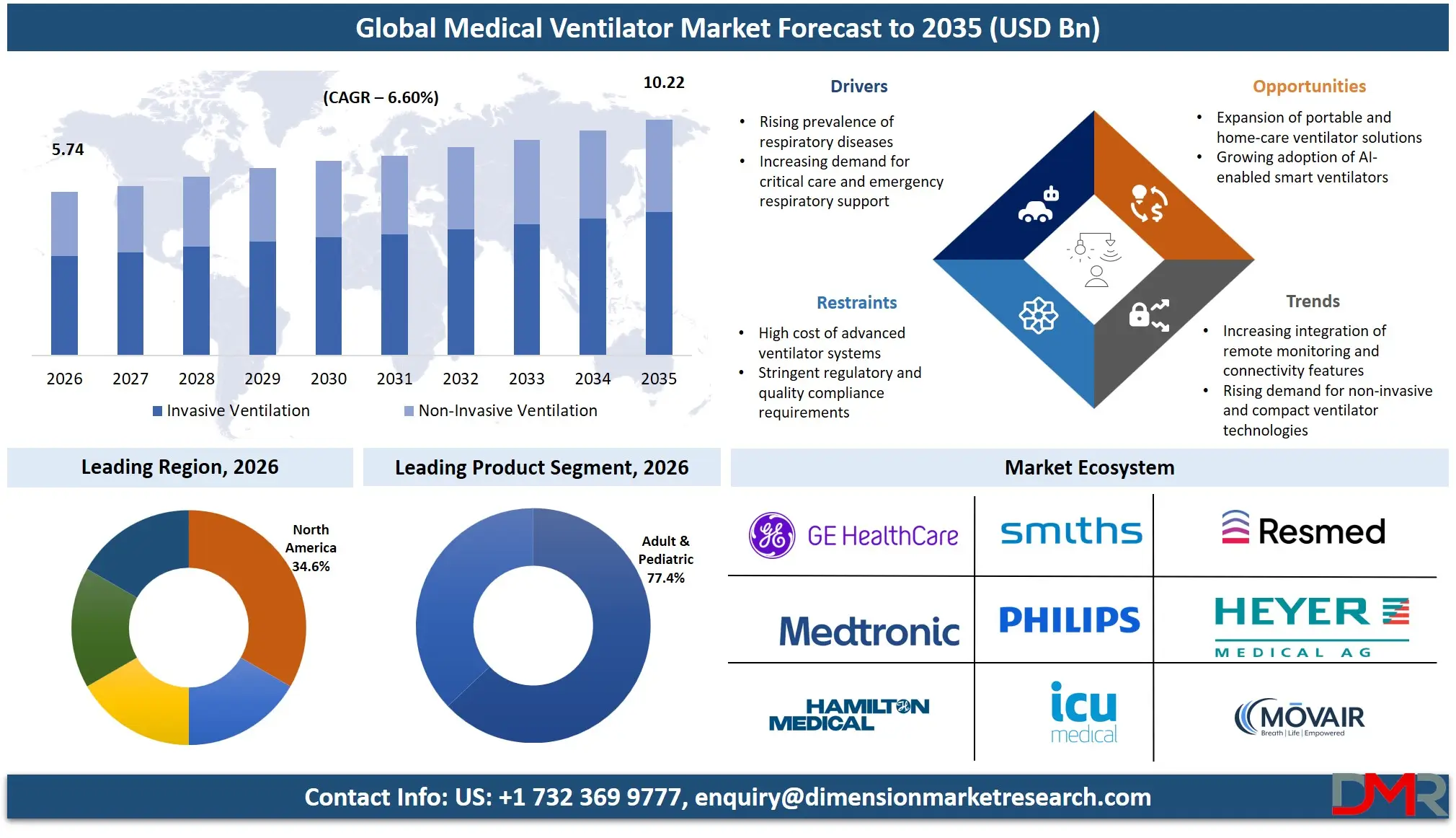
- The medical ventilator market size is USD 5.38 Billion in 2025, reached USD 5.74 Billion in 2026, and is projected to hit USD 10.22 Billion by 2035 at a CAGR of 6.60%.
- By Product Type: Intensive Care Ventilators led with a 46.2% share in 2026.
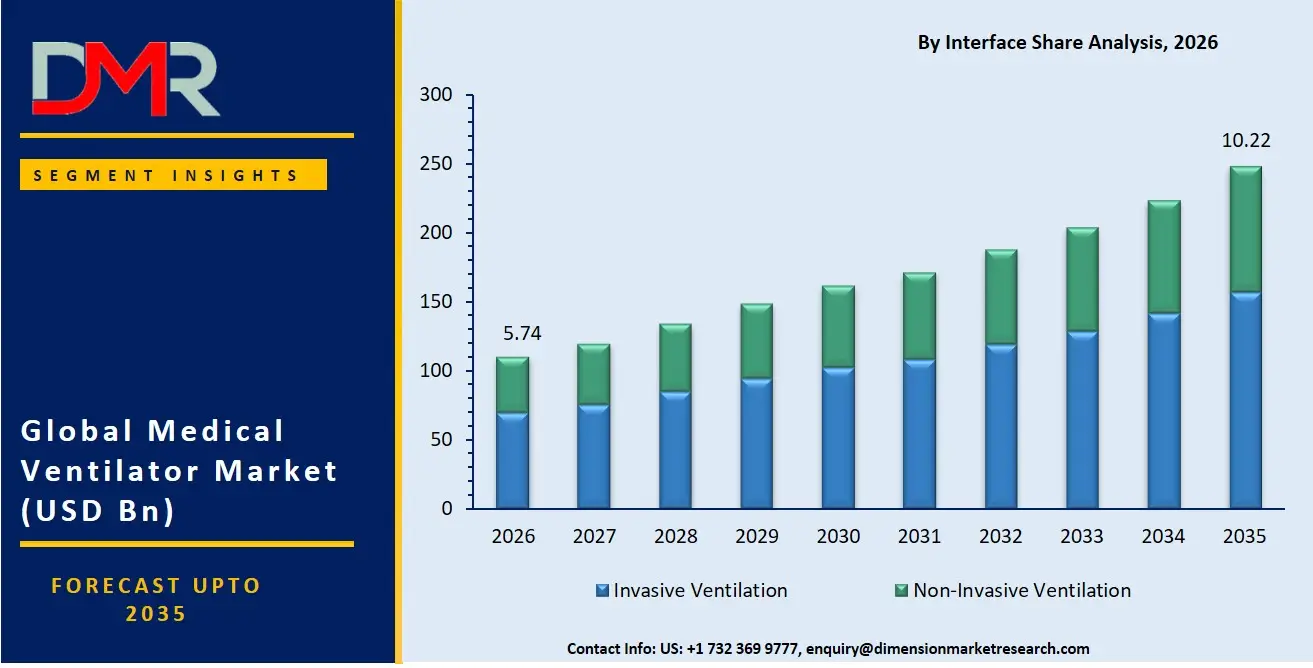
- By Interface: Invasive Ventilation led with a 55.7% share in 2026.
- By Mode: Volume-Controlled Ventilation led with a 40.3% share in 2026.
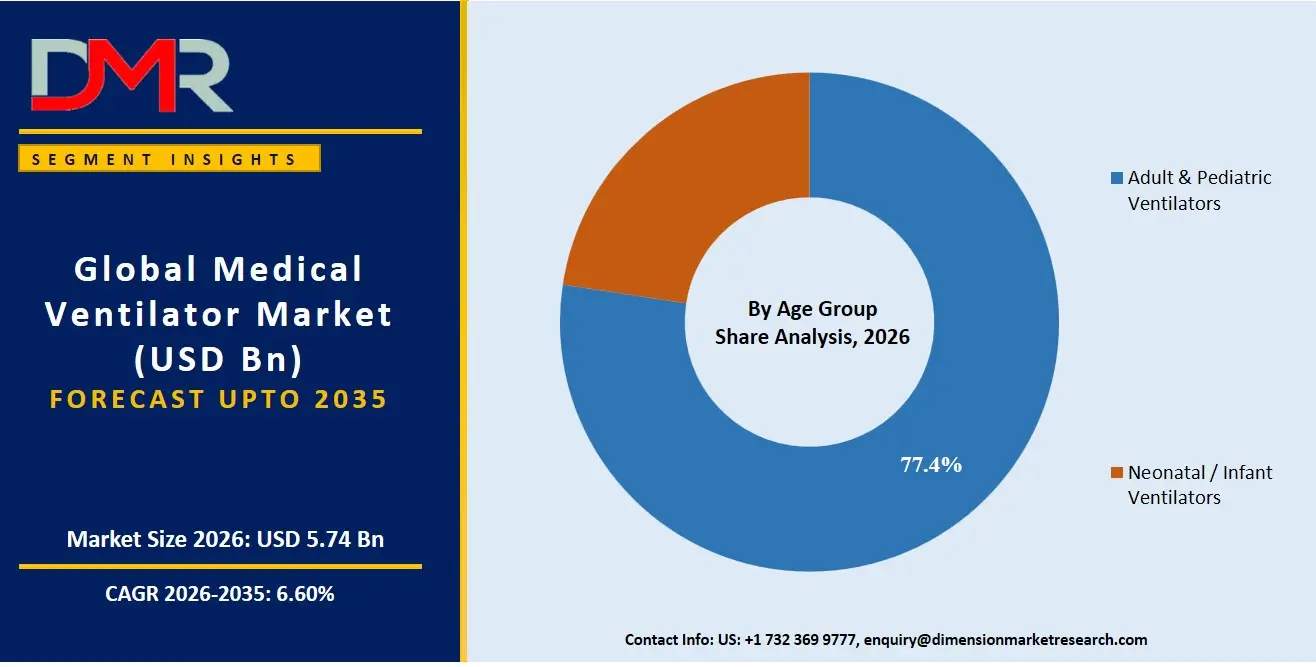
- By Age Group: Adult & Pediatric Ventilators led with a 77.4% share in 2026.
- By End User: Hospitals & Clinics led with a 63.8% share in 2026.
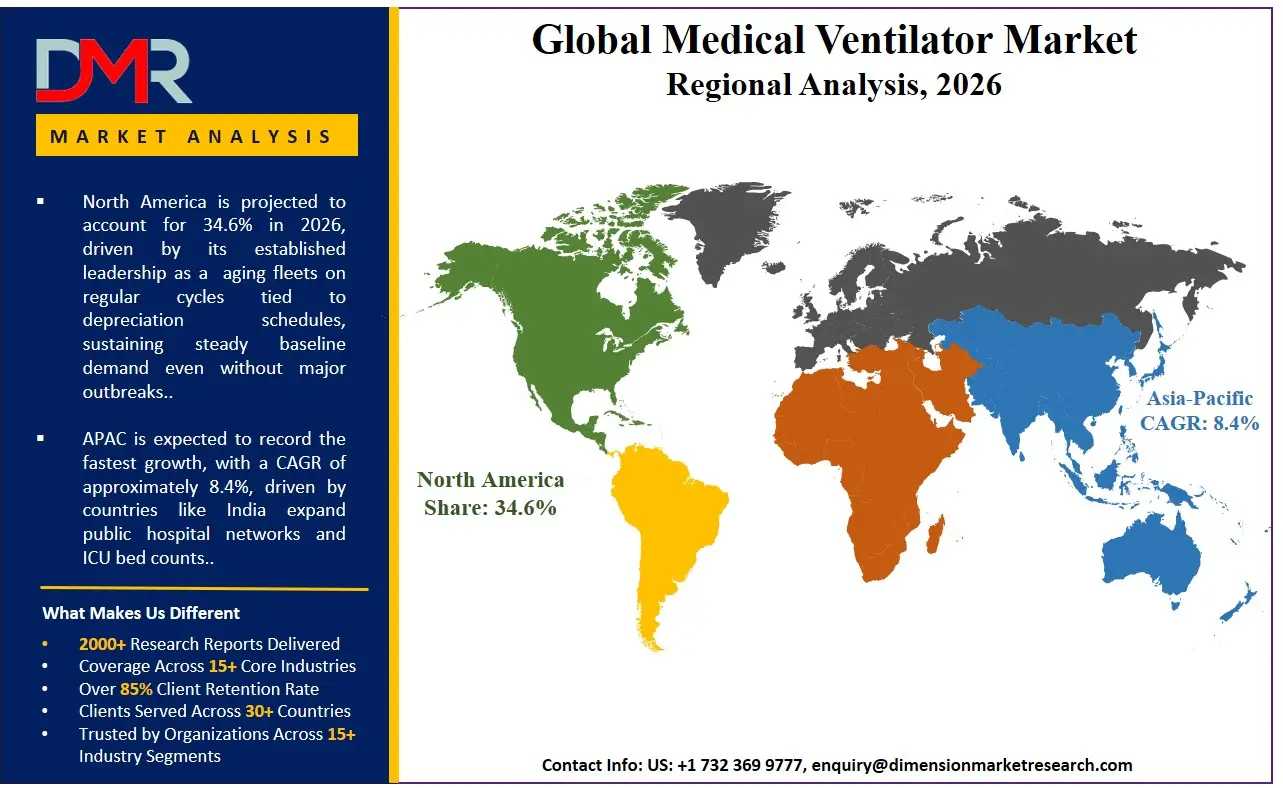
- By Region: North America led with a 34.6% share in 2026.
- The US ventilator market alone reached USD 1.11 Billion in 2026, growing at a separate 2.5% CAGR through 2030.
Market Overview
The medical ventilator market covers devices that mechanically support or replace breathing for patients in respiratory failure. This spans intensive care units, transport settings, neonatal wards, and home care, but excludes oxygen concentrators that do not deliver mechanical breaths. Hospitals buy these machines as core infrastructure, not optional equipment. A facility without working ventilators cannot run a functioning ICU.
ℹ
To learn more about this report –
Download Your Free Sample Report Here
Ventilators sit inside the broader respiratory care and critical care equipment industry. Buyers who purchase ventilators also invest in monitors, oxygen delivery systems, and infection control products from the same vendors. Premier Medical Systems announced a ₹60 crore investment in a new manufacturing facility at the Medical Device Park in Noida in September 2025, expanding domestic production of ventilators and related critical care devices. Moves like this signal that manufacturers expect sustained procurement volume from India's public hospital network.
Regulators continue to monitor device safety closely. React Health reported no serious injuries linked to its VOCSN V+Pro oxygen leak issue as of March 4, 2026. Hospitals weighing new purchases will read this as evidence that early reporting and rapid recall response can limit reputational damage. Vendors with strong post-market surveillance systems gain an edge in tenders where safety records matter.
Market Size and Forecast
The Global Medical Ventilator Market size is estimated at USD 5.74 Billion in 2026 from USD 5.38 Billion in 2025, and is projected to reach USD 10.22 Billion by 2035, exhibiting a CAGR of 6.60% during the forecast period.
Hospital capital budgets recover unevenly after pandemic-era ventilator stockpiling. Many health systems still hold excess inventory purchased between 2020 and 2022, which slows replacement cycles in mature markets. Growth instead concentrates in emerging markets building ICU capacity for the first time and in home care channels serving aging populations.
Device safety incidents shape near-term forecasts. The React Health VOCSN V+Pro recall, opened on March 25, 2026 and posted May 1, 2026, addressed a manufacturing deviation causing a possible undetected oxygen leak. Hospitals running VOCSN fleets may accelerate replacement purchases to avoid liability, pulling some 2027 demand into 2026. Vendors positioned to fill that gap quickly stand to gain share before larger competitors react.
Product Type Analysis
Intensive Care Ventilators led the Product Type segment with a 46.2% share in 2026.
ICU ventilators dominate because critical care units treat the sickest patients first and cannot substitute simpler devices. Hospitals prioritize these purchases even when budgets tighten elsewhere. ISO 80601-2-84:2023 now specifies tidal volume test categories of 500 mL for volumes at or above 300 mL, 150 mL for the 50 to 300 mL range, and 30 mL for volumes at or below 50 mL, at a set rate of 10 breaths per minute. Compliance with this standard becomes a baseline requirement for any vendor selling into ICU tenders.
Transport and portable ventilators serve ambulances and inter-facility transfers, while neonatal and pediatric units address a smaller but clinically demanding population. High-frequency oscillatory ventilators remain a niche category for severe lung injury cases. Non-invasive ventilators grow fastest among these categories as hospitals shift stable patients off invasive support earlier. Vendors that build modular platforms spanning ICU and non-invasive use capture both replacement and expansion budgets within the same hospital account.
Interface Analysis
With a 55.7% share in 2026, Invasive Ventilation outpaced all other Interface categories.
ℹ
To learn more about this report –
Download Your Free Sample Report Here
Invasive ventilation remains standard for patients in acute respiratory failure who cannot protect their airway. ICUs default to invasive support for the most unstable patients regardless of cost pressure. This share reflects clinical necessity rather than purchasing preference, which makes the segment resilient even during budget cuts.
Non-invasive ventilation, CPAP, BiPAP, and high-flow nasal cannula together address a growing population of patients managed outside the ICU. Sleep clinics, pulmonology practices, and home care providers drive demand for these interfaces. Clinicians increasingly choose non-invasive options first to reduce infection risk and shorten hospital stays, a shift that favors vendors with strong outpatient distribution networks over those focused only on hospital tenders.
Mode Analysis
Volume-Controlled Ventilation accounted for 40.3% of Mode demand in 2026, the highest of any category.
Volume-controlled ventilation gives clinicians predictable tidal volumes, which matters most in ICUs managing patients with unstable lung mechanics. Training programs emphasize this mode first, so it remains the default choice across most hospital protocols. Familiarity drives adoption as much as clinical performance.
Pressure-controlled ventilation, dual or combined modes, SIMV, and proportional assist or adaptive support ventilation fill specialized roles. Adaptive support ventilation appeals to facilities seeking to reduce clinician workload through automated weaning protocols. Smaller hospitals with limited respiratory therapist staffing increasingly request ventilators offering multiple modes on one platform, since this flexibility reduces the need for separate device types across different patient populations.
Age Group Analysis
A 77.4% share made Adult & Pediatric Ventilators the clear leader across Age Group categories in 2026.
ℹ
To learn more about this report –
Download Your Free Sample Report Here
Adult and pediatric patients make up the bulk of ICU admissions tied to COPD, pneumonia, and ARDS. Hospitals stock far more adult-capable units than neonatal devices simply because adult cases occur more often. This volume advantage shapes manufacturing priorities across the industry.
Neonatal and infant ventilators serve a smaller but rising population linked to preterm birth rates. Getinge expanded its Servo-c platform with a neonatal option in June 2025, enabling respiratory support from premature newborns through to adults on a single device. Platforms spanning both age groups reduce the number of separate units a NICU or combined ward must stock, a feature increasingly weighed in procurement decisions.
End User Analysis
Hospitals & Clinics captured 63.8% of the End User segment in 2026, ahead of all rivals.
Hospitals and clinics buy the majority of ventilators because they run the ICUs, emergency departments, and operating rooms where mechanical ventilation begins. Procurement happens through centralized hospital purchasing departments, giving large health systems negotiating leverage over price and service terms.
Ambulatory surgical centers, emergency medical services, home care settings, and long-term acute care facilities represent the remaining demand. Home care settings grow fastest as chronic respiratory patients shift from extended hospital stays to managed care at home. EMS providers replace transport ventilators on fixed cycles tied to vehicle fleet maintenance schedules, creating predictable but smaller-volume demand compared to hospital tenders.
Key Market Segments
By Product Type
- Intensive Care Ventilators
- Transport / Portable Ventilators
- Neonatal / Pediatric Ventilators
- High-Frequency Oscillatory Ventilators
- Non-Invasive Ventilators
By Interface
- Invasive Ventilation
- Non-Invasive Ventilation
- Continuous Positive Airway Pressure (CPAP)
- Bi-level Positive Airway Pressure (BiPAP)
- High-Flow Nasal Cannula (HFNC)
By Mode
- Volume-Controlled Ventilation
- Pressure-Controlled Ventilation
- Dual / Combined Modes
- Synchronized Intermittent Mandatory Ventilation (SIMV)
- Proportional Assist / Adaptive Support Ventilation
By Age Group
- Adult & Pediatric Ventilators
- Neonatal / Infant Ventilators
By End User
- Hospitals & Clinics
- Ambulatory Surgical Centers
- Emergency Medical Services (EMS)
- Home Care Settings
- Long-Term Acute Care Facilities
Regional Analysis
North America led the Regional segment with a 34.6% share, valued at approximately USD 1.86 Billion, in 2026.
ℹ
To learn more about this report –
Download Your Free Sample Report Here
North America leads on the strength of dense ICU infrastructure and high per-capita healthcare spending. The US alone reached USD 1.11 Billion in 2026, with that segment growing at a separate 2.5% CAGR through 2030. Hospitals in the US replace aging fleets on regular cycles tied to depreciation schedules, sustaining steady baseline demand even without major outbreaks.
Asia Pacific offers the fastest growth as countries like India expand public hospital networks and ICU bed counts. Premier Medical Systems committed to a new manufacturing facility at the Medical Device Park in Noida in September 2025, positioning domestic production closer to this demand. Europe maintains stable replacement demand tied to strict device safety regulation, while Latin America and the Middle East and Africa remain smaller markets where government procurement programs determine the pace of adoption. Vendors entering Asia Pacific early gain manufacturing cost advantages that competitors relying on imports cannot easily match.
Key Regions and Countries
North America
Europe
- Germany
- France
- The UK
- Spain
- Italy
- Rest of Europe
Asia Pacific
- China
- Japan
- South Korea
- India
- Australia
- Rest of APAC
Latin America
- Brazil
- Mexico
- Rest of Latin America
Middle East & Africa
- GCC
- South Africa
- Rest of MEA
Market Dynamics
Driver: Chronic Respiratory Disease Burden Sustains ICU Demand
Global cases of COPD, asthma, and ARDS exceed 260 million patients, creating a permanent base load of respiratory failure cases. Hospitals cannot defer ventilator purchases when this patient pool keeps growing year over year. Aging populations and rising preterm birth rates add patients who need long-term ventilatory support beyond a single ICU stay.
Governments in emerging markets back this demand with direct procurement incentives. Public health agencies fund ICU bed expansion as part of broader infrastructure programs, locking in multi-year purchase commitments. Vendors with established government tender relationships benefit most from this structural floor under demand.
Restraint: Recalls and Cost Barriers Slow Adoption
High device acquisition costs combined with thin reimbursement coverage keep many developing-region hospitals on older equipment. Facilities delay upgrades until existing units fail completely, which slows the replacement cycle vendors depend on for recurring revenue.
Device recalls compound this caution. The Baxter Life2000 ventilator recall, opened April 7, 2025 and posted May 9, 2025, resulted in permanent removal of all units in use due to a cybersecurity vulnerability. The UK-ROX trial found 90-day mortality of 35.4% in the conservative-oxygen group versus 34.9% in the usual-oxygen group among mechanically ventilated ICU adults. Findings like these feed clinician skepticism toward new device features until long-term safety data accumulates.
Opportunity: Home and Frugal-Design Ventilators Open New Channels
Portable home ventilators scale as care shifts from hospital ICUs to ambulatory respiratory support, a transition that creates an entirely new buyer category outside traditional hospital procurement. Vendors selling directly to home care providers and durable medical equipment distributors reach patients hospitals never would have kept long-term.
Frugal-engineering designs tailored to India and Asia Pacific public health systems close the affordability gap that keeps many facilities on outdated equipment. Rostec's Shvabe Holding introduced the AIVL-D portable ventilator in 2025, the first Russian-made portable unit designed for hospital, transport, and home-care use. Domestic manufacturing programs like this signal that countries previously dependent on imports now compete directly in price-sensitive segments.
Market Trends
AI Integration and Non-Invasive Shift Redefine Device Design
Embedded AI and remote monitoring algorithms now tune ventilator performance and support real-time clinical decisions, turning ventilators into connected diagnostic tools rather than standalone machines. Getinge added Neural Pressure Support to its Servo-u system in March 2025, giving ICU ventilators a neurally controlled mode previously unavailable on that platform. Non-invasive ventilation continues overtaking invasive interfaces on lower infection risk and better patient comfort. The UK-ROX trial reported an adjusted absolute risk difference of just 0.7 percentage points between oxygen targeting strategies, reinforcing that incremental clinical refinements now matter more than wholesale therapy changes. Vendors that pair AI features with non-invasive platforms position themselves ahead of buyers shifting away from invasive-only fleets.
Market Competition Overview
The medical ventilator market remains moderately fragmented, with more than twenty named manufacturers competing across product categories rather than a single dominant supplier controlling the field. Large diversified medical device companies hold advantages in ICU ventilators through existing hospital relationships and service networks built over decades. Smaller specialists compete in niche categories like neonatal devices or portable home units, where switching costs for buyers are lower.
Consolidation activity reshapes the competitive map faster than organic growth does. Companies exiting financial distress create opportunities for rivals to acquire established product lines and instantly gain market share in categories they previously lacked. The UK-ROX trial's mortality findings, showing 35.4% versus 34.9% across oxygen-targeting groups, illustrate how narrow clinical differences now separate competing protocols, pushing vendors toward feature differentiation rather than core ventilation performance claims.
Company Profiles
ZOLL Medical Corporation strengthened its respiratory care position by emerging as the successful bidder for Vyaire Medical's ventilator business in August 2024 during Vyaire's Chapter 11 restructuring. ZOLL completed the acquisition in October 2024, gaining the Bellavista, Fabian, LTV, and 3100 HFOV product lines. This acquisition gave ZOLL instant scale across ICU, neonatal, and high-frequency ventilation categories without years of internal development, though integrating four distinct product platforms carries execution risk if support and supply chains are not unified quickly.
Shenzhen Mindray Bio-Medical Electronics unveiled its next-generation SV900 and SV700 ventilator series at ESICM 2025 in November 2025, introducing advanced intelligent respiratory care capabilities aimed at ICU buyers. Mindray's strategy leans on rapid product cycles and competitive pricing to gain share in markets where Western vendors carry premium price tags. Hospitals in Asia Pacific and Latin America increasingly view Mindray as a credible alternative for ICU-grade equipment, pressuring established vendors to defend share through service quality rather than price alone.
Key Players
- Medtronic plc
- Koninklijke Philips N.V.
- GE HealthCare Technologies Inc.
- Drägerwerk AG & Co. KGaA
- Hamilton Medical AG
- Getinge AB
- Fisher & Paykel Healthcare Corporation
- ResMed Inc.
- Smiths Group plc
- Nihon Kohden Corporation
- Shenzhen Mindray Bio-Medical Electronics Co., Ltd.
- ZOLL Medical Corporation
- Air Liquide Medical Systems
- Skanray Technologies Ltd.
- Allied Healthcare Products Inc.
- Intersurgical Ltd.
- Bunnell Incorporated
- Shenzhen Comen Medical Instruments
- Telesair Inc.
- ICU Medical, Inc.
- Schiller AG
- Metran Co., Ltd
- MAGNAMED
- HEYER Medical AG
- Viemed Healthcare
- Movair
Recent Developments
- January 2024 Getinge launched the Servo-air Lite ventilator, expanding its Servo portfolio with a non-invasive ventilation and high-flow therapy platform for respiratory care settings.
- July 2024 Air Liquide Medical Systems launched the Monnal TEO intensive care ventilator, a platform developed in collaboration with clinicians for critical-care applications.
- August 2024 ZOLL emerged as the successful bidder to acquire Vyaire Medical's ventilator business as part of Vyaire's Chapter 11 restructuring.
- June 2025 Getinge expanded the Servo-c ventilator platform with a neonatal option, enabling respiratory support from premature newborns to adults on a single platform.
Report Details
| Report Characteristics |
| Market Value (2025) |
USD 5.38 Billion |
| Market Value (2026) |
USD 5.74 Billion |
| Forecast Revenue (2035) |
USD 10.22 Billion |
| CAGR (2026 to 2035) |
6.60% |
| Base Year for Estimation |
2025 |
| Historic Period |
2020 to 2024 |
| Forecast Period |
2026 to 2035 |
| Report Coverage |
Revenue Forecast, Market Dynamics, Competitive Landscape, Recent Developments |
| Segments Covered |
By Product Type (Intensive Care Ventilators, Transport / Portable Ventilators, Neonatal / Pediatric Ventilators, High-Frequency Oscillatory Ventilators, Non-Invasive Ventilators), By Interface (Invasive Ventilation, Non-Invasive Ventilation, CPAP, BiPAP, HFNC), By Mode (Volume-Controlled Ventilation, Pressure-Controlled Ventilation, Dual / Combined Modes, SIMV, Proportional Assist / Adaptive Support Ventilation), By Age Group (Adult & Pediatric Ventilators, Neonatal / Infant Ventilators), By End User (Hospitals & Clinics, Ambulatory Surgical Centers, Emergency Medical Services, Home Care Settings, Long-Term Acute Care Facilities) |
| Regional Analysis |
North America (US and Canada), Europe (Germany, France, The UK, Spain, Italy, and Rest of Europe), Asia Pacific (China, Japan, South Korea, India, Australia, and Rest of APAC), Latin America (Brazil, Mexico, and Rest of Latin America), Middle East & Africa (GCC, South Africa, and Rest of MEA) |
| Competitive Landscape |
Medtronic plc, Koninklijke Philips N.V., GE HealthCare Technologies Inc., Drägerwerk AG & Co. KGaA, Hamilton Medical AG, Getinge AB, Fisher & Paykel Healthcare Corporation, ResMed Inc., Smiths Group plc, Nihon Kohden Corporation, Shenzhen Mindray Bio-Medical Electronics Co., Ltd., ZOLL Medical Corporation, Air Liquide Medical Systems, Skanray Technologies Ltd., Allied Healthcare Products Inc., Intersurgical Ltd., Bunnell Incorporated, Shenzhen Comen Medical Instruments, Telesair Inc., ICU Medical, Inc., Schiller AG, Metran Co., Ltd, MAGNAMED, HEYER Medical AG, Viemed Healthcare, Movair |
| Customization Scope |
Customization for segments and region or country level will be provided. Additional customization can be done based on requirements. |
| Purchase Options |
Three license options: Single User License, Multi-User License (Up to 5 Users), Corporate Use License (Unlimited Users and Printable PDF) |
Frequently Asked Questions
What is the biggest investment opportunity in Medical Ventilator Market?
▾ Portable home ventilators represent the strongest opportunity as care shifts from hospital ICUs to home-based respiratory support, with this segment scaling at a 10.5% CAGR.
Who are the top companies in Medical Ventilator Market?
▾ Medtronic, Philips, GE HealthCare, Drägerwerk, Getinge, and Mindray lead the market alongside specialists like ResMed and ZOLL, which expanded through acquisitions.
Which segment is growing fastest in Medical Ventilator Market and why?
▾ Home non-invasive ventilation for COPD is expanding fastest, projected at a 13.6% CAGR, as chronic care moves into decentralized home settings.
Which region is growing fastest in Medical Ventilator Market and why?
▾ Asia Pacific grows fastest as countries like India expand ICU bed capacity and attract domestic manufacturing investment, including new production facilities near Noida.
What is the biggest challenge holding Medical Ventilator Market back?
▾ High device costs paired with limited reimbursement in developing regions slow replacement cycles, and device recalls tied to safety issues add further hesitation among hospital buyers.