What is the Global Medication Adherence Technology Market Size?
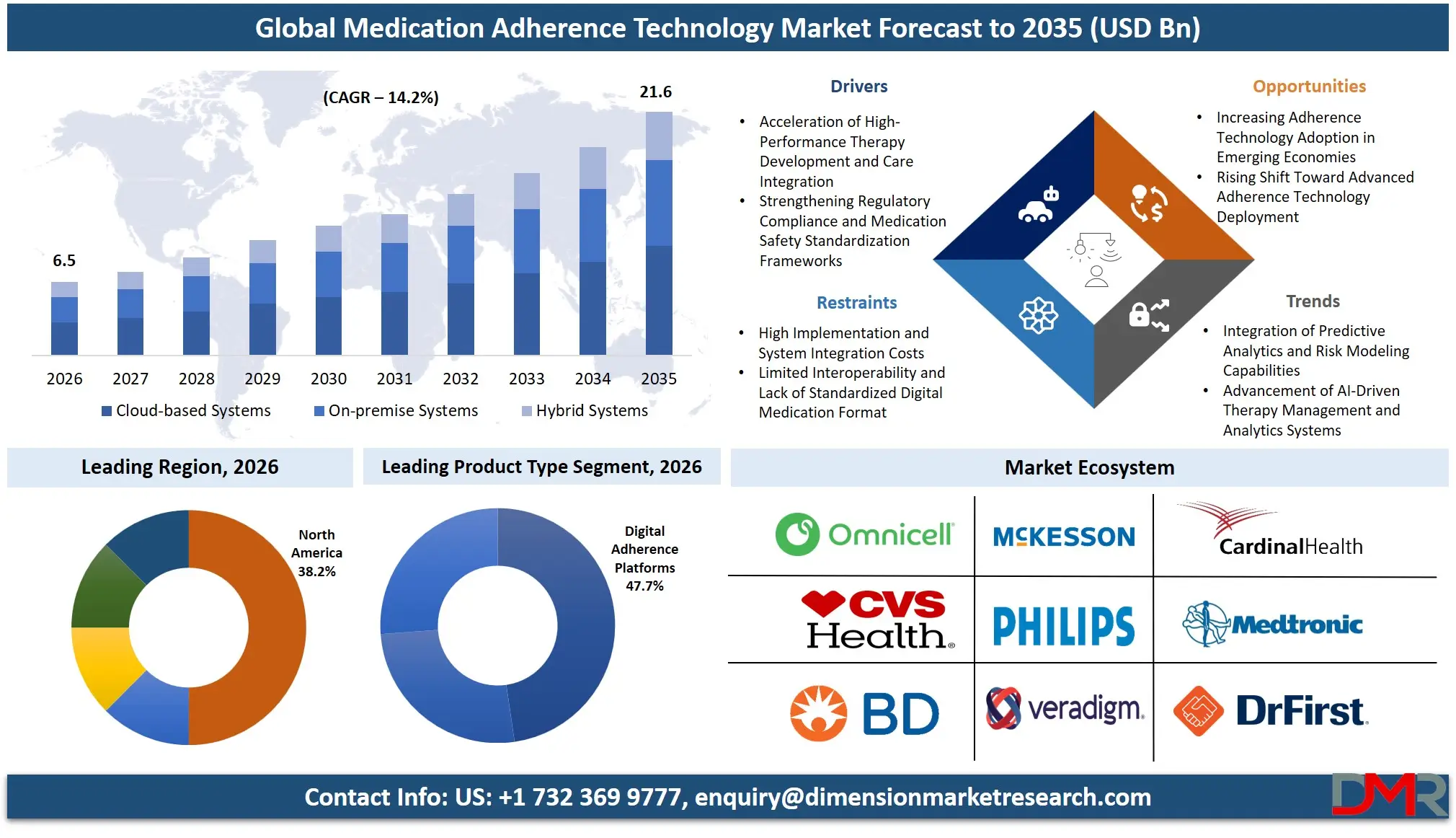
The Global Medication Adherence Technology Market size is estimated at USD 6.5 billion in 2026 and is projected to reach USD 21.6 billion by 2035, exhibiting a CAGR of 14.2% during the forecast period, driven by the rising use of real-time medication ingestion monitoring and automated refill validation, decentralized adherence deployment patterns in modular pharmacy architectures, and connected digital governance and compliance management systems.
ℹ
To learn more about this report –
Download Your Free Sample Report Here
The global medication adherence technology market is expanding because of increasing use of high-fidelity regimen compatibility testing and dose profiling in detecting and analyzing anomalous intake patterns, increasing regulatory mandates, which reduce the chance of adverse drug events during therapy and speed up compliance audits for new medication programs, and more funding in automating privacy-preserving adherence logging.
Some other reasons for expansion in this market include new technologies in runtime therapy stability management, non-adherence prediction through behavior analytics, automated prescription lifecycle handling, high-volume patient adherence data platforms, and improved cross-provider medication-sharing rules. The digital shift in specialty medication therapy and chronic disease management has been helpful in speeding up treatment development and making sensitive patient transaction management easier. This includes polypharmacy analytics research. In addition, government plans focusing on preventing medication errors and the secure medication supply economy have ensured steady research in adherence technology systems.
ℹ
To learn more about this report –
Download Your Free Sample Report Here
The US Medication Adherence Technology Market
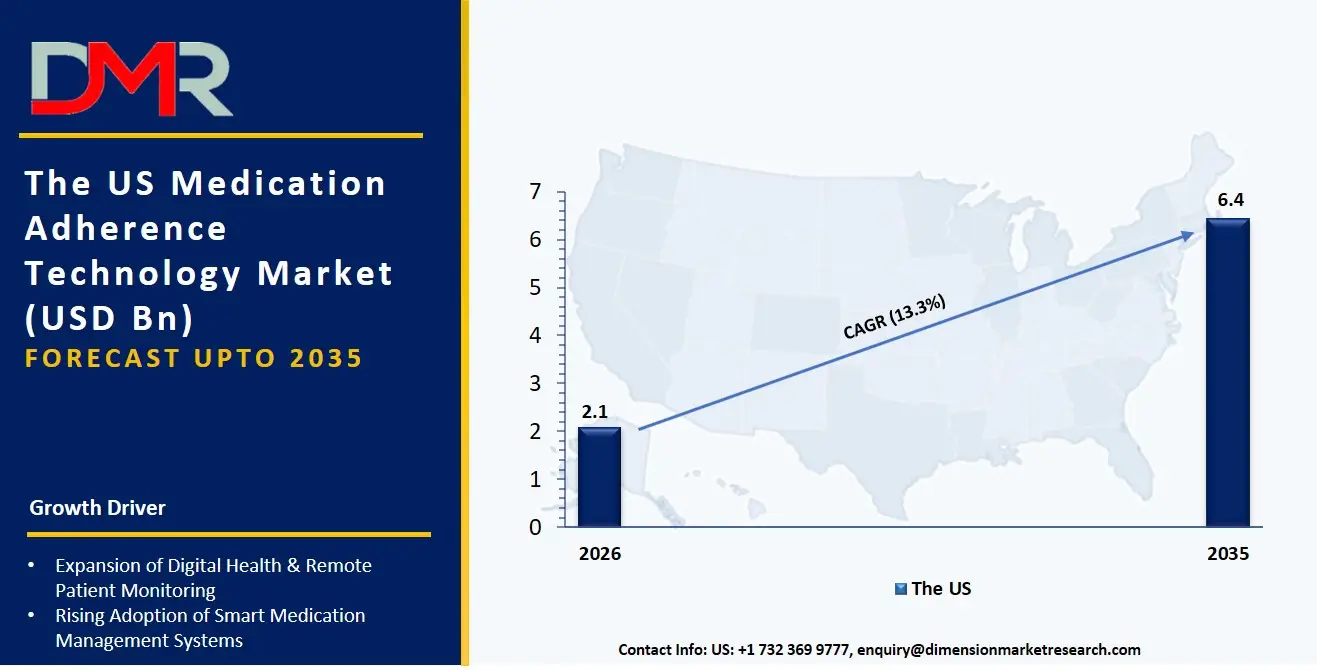
The US Medication Adherence Technology Market is estimated to grow to USD 2.1 billion in 2026 with a compound annual growth rate of 13.3% during the forecast period.
The US market is shaped by major federal and state-level programs promoting error-resistant medication architectures, secure digital adoption supported by FDA and ONC, and CMS-led medication modernization initiatives. These programs encourage the use of real-time dose tracking, patient-specific intake protection, and predictive compliance software for regimen management. Automated medication safety platforms are being rapidly adopted, and the US continues to invest in better data sharing between R&D labs, encrypted adherence audit systems, and reliable adverse event detection tools for adherence platforms. Service providers are also influenced by laws like the 21st Century Cures Act, USP <795> standards, and national digital health strategies to offer services that ensure medication safety, rule-following, and smooth integration across hybrid and modular pharmacy environments.
ℹ
To learn more about this report –
Download Your Free Sample Report Here
Europe Medication Adherence Technology Market
The European Medication Adherence Technology Market is estimated to be valued at USD 1.8 billion in 2026, witnessing growth at a CAGR of 13.1%, during the forecast period.
Europe's medication adherence technology market is well-established, shaped by EU-wide policies such as the Falsified Medicines Directive, GDPR for health data, and national policies to support sustainable digital health markets (e.g., Germany's digital health application (DiGA) programs and France's national medication adherence strategies). Countries are also making medication safety management more flexible to align provider and patient demands and enable the sharing of anonymized adherence data across borders. The market grows due to new tools like software for real-time therapeutic response validation and risk scoring systems for therapy stability. Use is made easier by teamwork between public and private groups and shared digital safety rules. Providers have access to technologies such as biologic therapy fine-tuning, drug interaction modeling, and secure adherence audit logging, and Europe is at the forefront of the digitisation of safe and efficient medication therapy operations.
Japan Medication Adherence Technology Market
The Japan Medication Adherence Technology Market is projected to be valued at USD 428.0 million in 2026, progressing at a CAGR of 14.8%, during the period spanning from 2026 to 2035.
Japan's medication adherence technology market is well developed, with high-fidelity digital pill data platforms, connected secure medication management systems, and a wide array of therapy aging simulation software tools. National focus on automation, efficiency, and therapy integrity is delivered via predictive adherence models and smart medication protection. Growth opportunities are helped by government measures under the Society 5.0 initiative by Japan's Ministry of Health, Labour and Welfare (MHLW), and continued investment in healthcare cloud modernization. AI-driven adherence research, multi-party analytics for patient-specific data sharing, and virtualized medication safe environments all need effective adherence software to keep pace with high-risk medication therapy. Higher costs for validating new adherence systems and connecting them with older infrastructure are significant, but there are opportunities for the export of Japanese adherence technologies to the Asian and Pacific markets.
Key Takeaways
- Market Size & Forecast: The Global Medication Adherence Technology Market is estimated to be valued at USD 6.5 billion in 2026 and is expected to grow to USD 21.6 billion by 2035.
- Growth Rate & Outlook: The market is expected to witness growth at a compound annual growth rate of 14.2% in the forecast period.
- Primary Growth Drivers: The availability of new digital adherence technologies that use real-time intake detection, the need to speed up compliance results and improve success rates of patient data sharing, and more government investment in a national secure medication infrastructure are key growth drivers.
- Key Market Trends: The real-time profiling of therapy stability risks, polypharmacy management, and the shift to AI-driven medication therapy management platforms and automated digital inventory management are key market trends.
- By Product Type: The Digital Adherence Platforms segment is expected to take the largest revenue share in the global medication adherence technology market in 2026.
- By Therapeutic Area: The Cardiovascular Diseases segment is expected to take the largest revenue share in 2026 in the medication adherence technology market.
- By End User: The Hospitals & Health Systems segment is estimated to take the lead in 2026 with the largest share in the medication adherence technology market.
- Regional Leadership: North America is estimated to take the lead in 2026 with 38.2% share in the medication adherence technology market.
What is Medication Adherence Technology?
Medication Adherence Technology refers to a combination of digital monitoring and real-time reminder technologies that provide healthcare providers, patients, and payers with enhanced capabilities beyond basic medication tracking, including helping to protect patient therapy regimens during treatment, preventing adverse events via dose optimization, and enabling secure multi-party adherence analytics. They include medication management software, smart pill dispensers, connected pill bottles, and adherence analytics platforms. These platforms use modern systems such as real-time ingestion confirmation, digital medication inventory management software, and remote patient coaching to manage, verify, and track sensitive medication events and outcomes. To improve medication safety outcomes, manage therapy variability and patient-specific programs, and expand protection into customized digital coverage to support individual patient needs and promote the development of safe medication therapies.
Use Cases
- Market Stability for Daily Operations: Medication adherence technology platforms can provide market-balancing benefits through software (encrypted adherence analytics, attestation) and control systems to reduce adverse event risk and support settlement of safe medication transactions in minutes, compared to days with only manual medication handling.
- Long-Term Chronic Medication Asset Management: Long-term data on ongoing therapy stability issues, including dose intermittency, drug price spikes, or therapy degradation, are studied to better understand market performance and to help plan long-term software-based medication care.
- Workload Load Balancing: Medication safety is handled through adherence platforms and smart software in hospital and retail pharmacy settings to support market capacity balance for high-risk medication workloads.
- Government & Regulated Programs: Faster adherence software development helps data innovation and development of targeted safe medication programs; government programs, through smart monitoring of national medication supply data, advance national medication protection strategies and help the adoption of operational standards.
How AI Is Transforming the Global Medication Adherence Technology Market?
Artificial intelligence (AI) is being used progressively more often in medication adherence platforms to improve therapy demand forecasting, find safety quality trends in patient intake patterns, and automatically spot unusual non-adherence patterns in medication cycling data. It also allows faster therapy verification because it can handle digital prescription submissions on a large scale. Encrypted adherence audit logs are easier to study and help registries find integration issues, reduce mistakes, and improve the overall accuracy of medication certification. This has resulted in operations being cost-effective, quicker, and more efficient than the old manual review method.
AI is also strengthening research and development by improving medication risk assessment and enabling more accurate capacity planning for therapy management. It helps providers predict how many safe medication regimens will be needed, find possible adherence delays, and monitor the performance of medication safety networks more effectively. In addition, automation of routine medication compliance checks and performance tracking is reducing operational workload, lowering administrative costs, and improving overall efficiency. This is leading to better financial results and more stable operations across the medication adherence technology production chain.
Market Dynamics
Key Drivers of the Global Medication Adherence Technology Market
Acceleration of High-Performance Therapy Development and Care Integration
The market is growing with the rise of advanced digital therapies for medication management, better management of sensitive medication therapies, and a closer connection between therapy performance monitoring and secure care integration. Medication adherence platforms provide real-time data that allows monitoring of patient intake patterns, helping to spot non-adherence early, and checking medication safety performance much faster. This has improved operational efficiency and reduced human errors and healthcare costs. At the same time, demand for more automated research and development is being helped by more activity in predictive analytics for the assessment of individual therapy risks, as medication science further digitizes therapy formulation and patient management tasks.
Strengthening Regulatory Compliance and Medication Safety Standardization Frameworks
There is increasing emphasis on medication safety, therapy purity, and rule-following within the medication adherence technology system. Rules and frameworks such as the FDA Drug Supply Chain Security Act (DSCSA), 21st Century Cures Act interoperability requirements, and medication modernization efforts in key markets are encouraging better medication handling practices and more structured medication safety processes. These advances are supporting the need for systems that can offer steady monitoring of sensitive medication therapies and standardized reporting. At the same time, active work to improve the sharing of adherence performance data and reduce verification issues is strengthening the need for more effective management systems in both government and private market participants.
Restraints in the Global Medication Adherence Technology Market
High Implementation and System Integration Costs
The rollout of medication adherence technology systems remains costly, requiring significant investment in smart dispensing hardware, ingestion validation technologies, system integration, testing, and alignment with existing pharmacy and EHR workflows. In addition, following data privacy regulations such as HIPAA and GDPR adds to setup complexity. These factors increase upfront costs and can limit adoption, especially among smaller healthcare providers and new companies entering the market.
Limited Interoperability and Lack of Standardized Digital Medication Format
There is still fragmentation in the market in terms of digital medication record formats and data handling procedures. Although some areas have put in place organized digital management systems, many healthcare organizations continue to work with both legacy medication administration records and modern automated adherence systems. Lack of standardized therapy stability protocols limits the ability to share adherence performance data between providers and adherence technology suppliers and results in inefficiencies in production, deployment, and system integration.
Growth Opportunities in the Global Medication Adherence Technology Market
Increasing Adherence Technology Adoption in Emerging Economies
Newly developing economies such as Brazil, Indonesia, Nigeria, the UAE, and Vietnam are slowly building their medication adherence infrastructure. These regions have long-term growth possibilities, with more people adopting chronic disease treatments, and with more healthcare organizations becoming aware of medication safety programs and slowly modernizing digital health infrastructure. These markets have few older medication management systems and can be used with new, technology-driven adherence platforms that can grow over time.
Rising Shift Toward Advanced Adherence Technology Deployment
The move to safer medication systems, decentralized care networks, and real-time therapy performance checks is creating the adoption of advanced adherence systems. These systems allow centralized patient data access, better coordination between providers and payers, and faster digital medication inventory management. Advanced digital setups are increasingly becoming a trend among modern medication adherence providers as operational efficiency becomes one of the competitive factors.
Global Medication Adherence Technology Market Trends
Integration of Predictive Analytics and Risk Modeling Capabilities
Medication adherence platforms are gradually adding data-driven technology to find non-adherence trends and improve accuracy in digital medication inventory management. These systems allow providers and payers to study their patient populations' intake behavior better, simplify the management of their digital portfolios, and improve their overall medication safety performance. This move is slowly turning the industry more proactive and data-driven in medication safety instead of being purely reactive in market operations.
Advancement of AI-Driven Medication Therapy Management and Analytics Systems
The use of AI-based medication therapy management systems is currently becoming a basic part of today's healthcare delivery operations. These systems allow real-time therapy stability monitoring, centralized digital medication administration, and better network coordination among market participants. Advanced adherence platforms are improving the efficiency and responsiveness of platform providers that operate in different regions by reducing dependence on manual medication management processes and allowing operations to grow more easily.
Research Scope and Analysis
The global medication adherence technology market is witnessing strong growth driven by rising adoption of digital therapeutics, chronic disease management, and increasing demand for high-safety and high-efficiency medication adherence solutions. The market is segmented based on product type, therapeutic area, deployment mode, technology, and end user.
ℹ
To learn more about this report –
Download Your Free Sample Report Here
By Product Type Analysis
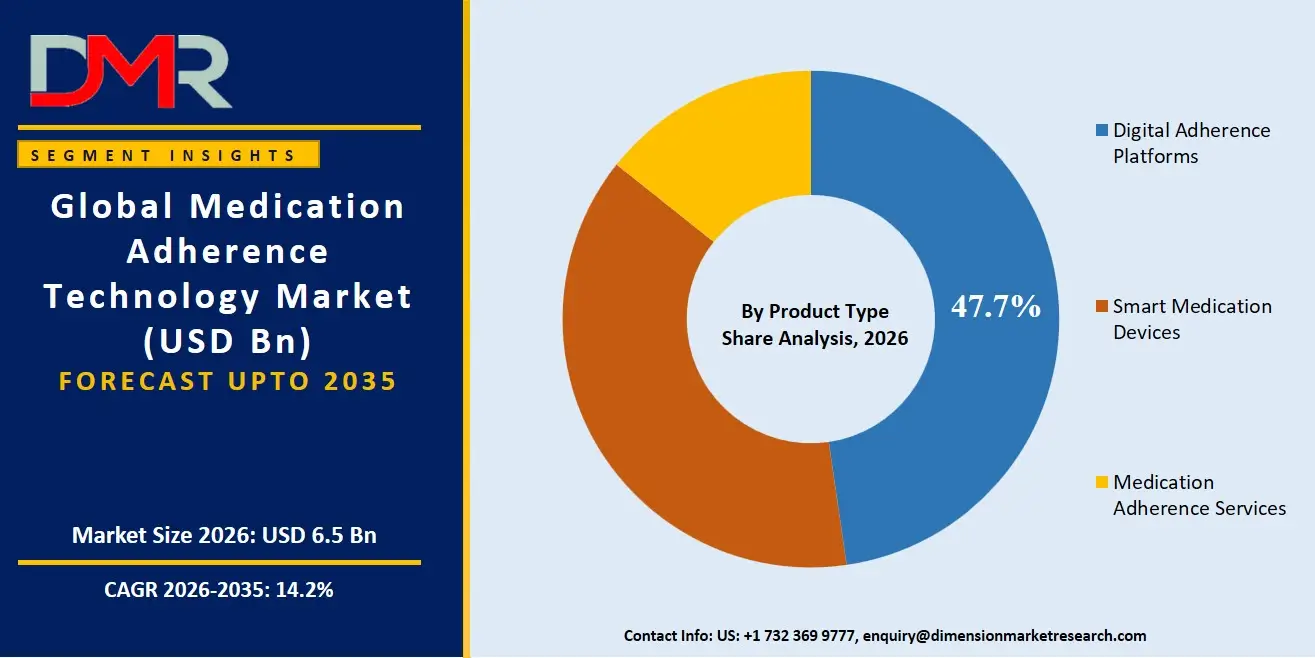
The Digital Adherence Platforms segment is likely to continue dominating the market in 2026, accounting for approximately 47.7% of the global medication adherence technology market share. This is due to its key role in enabling medication management applications, patient engagement tools, real-time monitoring, and AI-driven adherence analytics, and its usefulness in various healthcare settings where operational efficiency and connectivity are needed. Within Digital Adherence Platforms, mobile adherence applications and patient engagement platforms hold the largest share, driven by high deployment volumes in remote monitoring and chronic care management. The Smart Medication Devices segment is the second-largest, driven by smart pill dispensers, connected pill bottles, and automated dispensing systems that support medication tracking and dose verification. The Medication Adherence Services segment is the fastest-growing, supported by medication synchronization programs, adherence coaching, and pharmacy-led patient support services, reflecting the shift toward value-based care and patient-centric medication management.
By Therapeutic Area Analysis
The Cardiovascular Diseases segment is the largest therapeutic area in 2026, accounting for approximately 28.3% share, driven by the need for consistent daily medication adherence, polypharmacy management, and long-term treatment monitoring. Healthcare systems are adopting adherence technology for visibility and control over high-risk cardiovascular patient populations. The Diabetes segment is the second-largest, supported by insulin management requirements, connected insulin pens, and continuous glucose monitoring integration. Central Nervous System (CNS) Disorders represents a rapidly growing segment due to adherence challenges in psychiatric conditions and neurological disorders such as epilepsy and Parkinson's disease. Oncology, Respiratory Diseases (asthma/COPD), and Gastrointestinal Disorders represent specialized segments with dedicated adherence technology requirements for biologic therapies, injectables, and complex dosing schedules.
By Deployment Mode Analysis
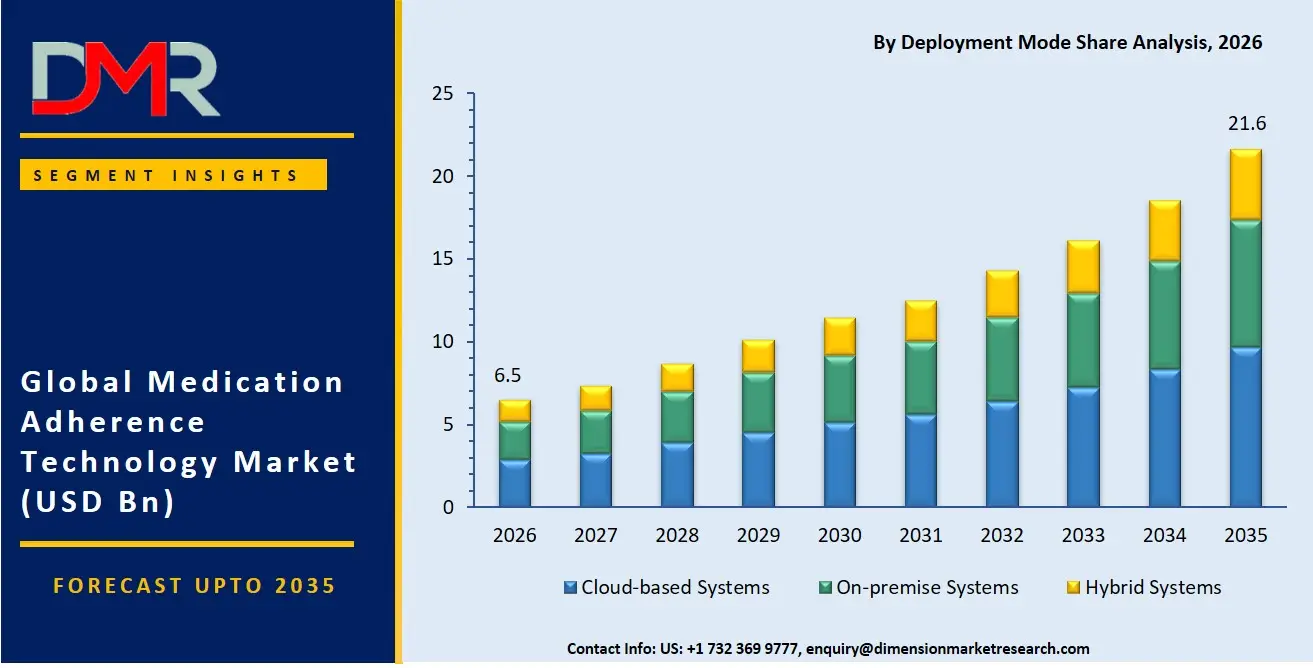
The Cloud-based Systems segment is likely to continue holding the lead in 2026, accounting for approximately 66.0% of the global medication adherence technology market share, driven by strong demand for scalability, real-time patient data access across care settings, and lower upfront costs, as well as flexible deployment across multiple end users. This segment reflects the continued shift toward agile and data-driven medication management operations. The On-premise Systems segment is the second-largest, supported by healthcare organizations needing localized security, controlled data management, and integration with legacy EHR systems. Hybrid Systems remains the fastest-growing, supported by large health systems requiring both cloud agility and on-premises security for sensitive patient medication data and enterprise workflow integration.
By Technology Analysis
The IoT-enabled Medication Adherence Systems segment is expected to dominate with around 31.7% market share in 2026, driven by its irreplaceable role in connecting smart pill dispensers, connected inhalers, and ingestible sensors to cloud platforms, enabling real-time adherence tracking, automated refill generation, and caregiver alerts. IoT systems support customized medication plans because they can offer multiple levels of dose timing, device integration, and remote monitoring capabilities. The Mobile Health (mHealth) Technologies segment is the second-largest, driven by the proliferation of medication reminder apps, patient engagement platforms, and SMS-based adherence campaigns. Artificial Intelligence (AI) & Machine Learning Analytics is the fastest-growing within Technology, witnessing strong growth with increasing needs for predictive non-adherence risk scoring, personalized intervention recommendations, and population health stratification. Digital Therapeutics, Smart Packaging Technologies, and Connected Drug Delivery Systems represent specialized segments with dedicated adherence technology requirements for prescription digital therapeutics, blister pack sensors, and smart injectors.
By End User Analysis
The Hospitals & Health Systems segment is the largest end user in 2026, accounting for approximately 41.5% share, driven by the need for enterprise-wide medication safety, discharge medication reconciliation, readmission reduction, and significant IT budgets. Hospitals are adopting adherence platforms to improve quality metrics, support value-based purchasing programs, and ensure operational excellence across inpatient and outpatient settings. The Pharmacies segment is the second-largest, supported by medication synchronization programs, adherence packaging services, and pharmacy-led patient engagement initiatives under medication therapy management (MTM) contracts. The Home Healthcare Settings segment is the fastest-growing, driven by the shift toward aging-in-place, remote patient monitoring, and post-discharge care management. Long-term Care Facilities and Clinics & Ambulatory Care Centers represent specialized segments with dedicated adherence technology requirements for medication administration records (MARs), controlled substance monitoring, and chronic care management.
The Global Medication Adherence Technology Market Report is segmented based on the following:
By Product Type
- Smart Medication Devices
- Digital Adherence Platforms
- Medication Adherence Services
By Therapeutic Area
- Cardiovascular Diseases
- Diabetes
- Central Nervous System (CNS) Disorders
- Oncology
- Respiratory Diseases
- Gastrointestinal Disorders
- Others
By Deployment Mode
- Cloud-based Systems
- On-premise Systems
- Hybrid Systems
By Technology
- IoT-enabled Medication Adherence Systems
- Artificial intelligence (AI) & Machine Learning Analytics
- Digital Therapeutics
- Mobile Health (mHealth) Technologies
- Smart Packaging Technologies
- Connected Drug Delivery Systems
By End User
- Hospitals & Health Systems
- Pharmacies
- Home Healthcare Settings
- Long-term Care Facilities
- Clinics & Ambulatory Care Centers
- Others
Regional Analysis
Largest Region in the Medication Adherence Technology Market
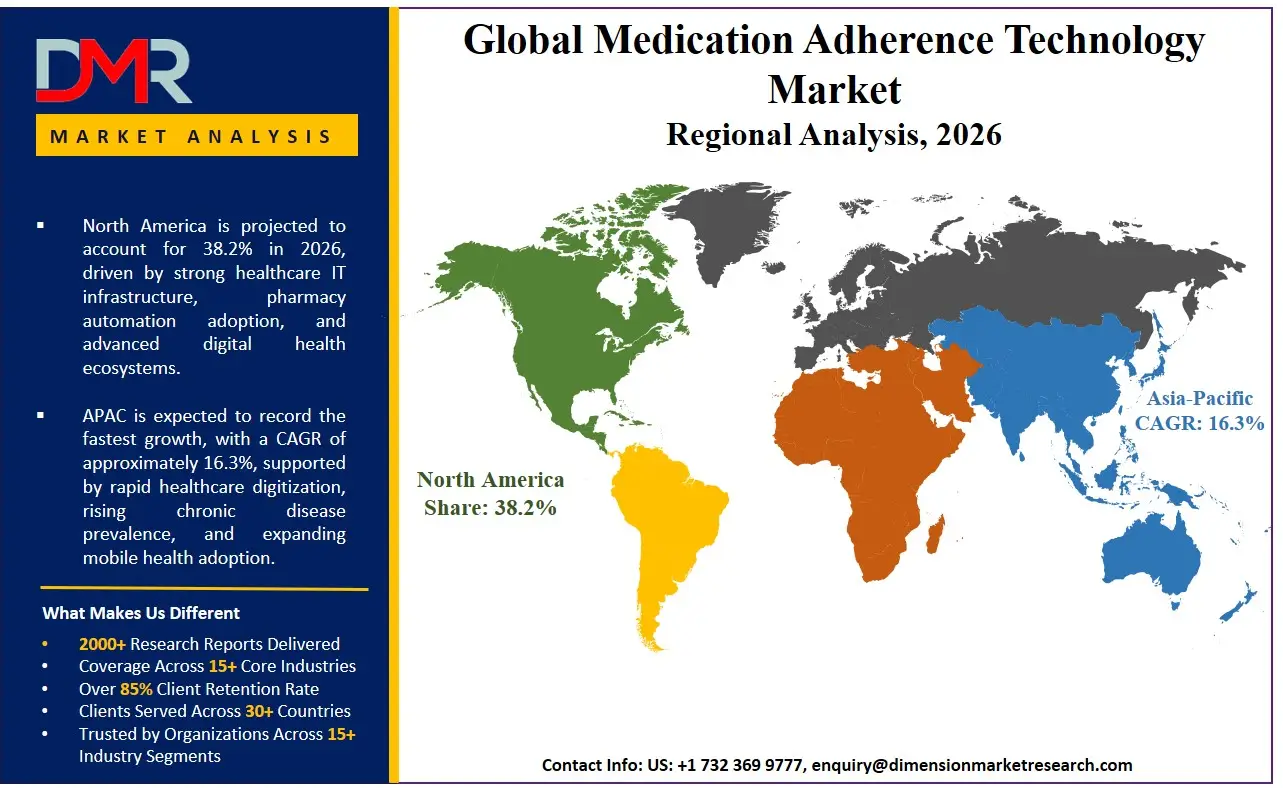
It is projected that North America will take the lead in the global medication adherence technology market, covering a market share of about 38.2% in the year 2026. The region's dominance is driven by the presence of major adherence technology vendors, strong regulatory frameworks such as the 21st Century Cures Act and DSCSA mandating medication safety and interoperability, and early adoption of AI-driven adherence analytics and smart dispensers across hospital and retail pharmacy sectors. North America benefits from significant investment in healthcare digitalization, the highest concentration of hospital medication modernization projects, and strong government support through CMS value-based purchasing programs. The region is also home to major pharmacy chains and health systems, enabling rapid deployment of enterprise-wide adherence platforms. Additionally, ongoing investments in patient engagement using mobile health apps and remote monitoring further strengthen North America's leading position. The widespread adoption of advanced adherence technologies for chronic disease management, specialty medication tracking, and medication synchronization continues to reinforce the region's market leadership.
ℹ
To learn more about this report –
Download Your Free Sample Report Here
Fastest-Growing Region in the Medication Adherence Technology Market
Asia-Pacific is the fastest-growing region, supported by aggressive domestic healthcare infrastructure expansion in China and India, substantial government funding for digital health and telemedicine initiatives, and increasing investments in greenfield hospital projects that integrate adherence technology from the initial design phase. The region is witnessing rapid growth in chronic disease prevalence, driving demand for cloud-based medication management and adherence analytics software. Asia-Pacific is also at the forefront of AI-driven medication deployment in high-growth sectors like diabetes care and mental health. The region benefits from large patient populations and mobile-first healthcare delivery, along with rising corporate commitments to operational excellence and patient safety compliance. Growing focus on specialty medications and pharmaceutical traceability for export markets further accelerates market expansion. Moreover, increasing healthcare regulations and the need to reduce medication errors in rapidly industrializing economies are expected to keep Asia-Pacific's growth momentum as the highest CAGR region during the forecast period.
By Region
North America
Europe
- Germany
- The U.K.
- France
- Italy
- Russia
- Spain
- Benelux
- Nordic
- Rest of Europe
Asia-Pacific
- China
- Japan
- South Korea
- India
- ANZ
- ASEAN
- Rest of Asia-Pacific
Latin America
- Brazil
- Mexico
- Argentina
- Colombia
- Rest of Latin America
Middle East & Africa
- Saudi Arabia
- UAE
- South Africa
- Israel
- Egypt
- Rest of MEA
Competitive Landscape
The medication adherence technology market is highly competitive, with new ideas and strategic partnerships shaping the competitive environment. To gain an advantage, companies and providers are focused on developing better adherence platforms (such as AI-powered medication management, automated adherence detection systems, and software development kits for medication safety management), smart adherence analytics, and cloud-based non-adherence monitoring. There are high barriers to entering the market due to the large amount of money needed for regulatory approval, specialized medication therapy knowledge, and the need for mature software systems and rule-following.
Strategic approaches to increase market presence include partnerships with healthcare research groups and digital registries, mergers between adherence software providers and medication manufacturers, and long-term support contracts with customers and government institutions. Additionally, research and development in digital medication-sharing rules and flexible adherence designs are important for staying competitive and meeting the changing needs of the medication adherence technology community.
Some of the prominent players in the Global Medication Adherence Technology Market are:
- Omnicell, Inc.
- McKesson Corporation
- Cardinal Health, Inc.
- CVS Health Corporation
- Koninklijke Philips N.V.
- Medtronic plc
- Becton, Dickinson and Company
- Johnson & Johnson
- DrFirst, Inc.
- Medisafe Limited
- AdhereTech, Inc.
- MedMinder Systems, Inc.
- MedAdvisor International Pty Ltd
- ResMed Inc. (Propeller Health division)
- Adherium Limited
- SMRxT Inc.
- HealthPrize Technologies, LLC
- Amazon.com, Inc. (PillPack division)
- Veradigm Inc.
- Proteus Digital Health, Inc.
- Other Key Players
Recent Developments
- February 2026: Omnicell, Inc. announced its Fiscal Year 2025 results and highlighted the commercial launch of its next-generation Titan XT automated dispensing system, powered by its OmniSphere cloud platform. The company emphasized expansion of its "autonomous medication management" ecosystem, integrating AI-driven workflow automation across pharmacy and nursing care environments.
- November 2025: McKesson Corporation announced enhancements to its pharmacy automation and digital adherence support systems, strengthening its enterprise pharmacy technology offerings and expanding patient engagement tools across its specialty and retail pharmacy network.
- October 2025: Koninklijke Philips N.V. expanded its Medication Adherence Solutions portfolio within its Philips HealthSuite platform, strengthening connected patient monitoring and remote therapy management capabilities across chronic disease programs.
- September 2025: Medtronic plc announced expanded deployment of its connected health ecosystem for chronic disease management, integrating adherence-linked remote monitoring tools across its diabetes and cardiovascular care platforms to improve long-term therapy compliance and patient engagement outcomes.
Report Details
| Report Characteristics |
| Market Size (2026) |
USD 6.5 Bn |
| Forecast Value (2035) |
USD 21.6 Bn |
| CAGR (2026–2035) |
14.2% |
| The US Market Size (2026) |
USD 2.1 Bn |
| Historical Period |
2021 – 2025 |
| Forecast Period |
2027 – 2035 |
| Base Year |
2025 |
| Estimated Year |
2026 |
| Segments Covered |
By Product Type, By Therapeutic Area, By Deployment Mode, By Technology, By End User |
| Regional Coverage |
North America – The US and Canada; Europe – Germany, The UK, France, Russia, Spain, Italy, Benelux, Nordic, & Rest of Europe; Asia-Pacific – China, Japan, South Korea, India, ANZ, ASEAN, Rest of APAC; Latin America – Brazil, Mexico, Argentina, Colombia, Rest of Latin America; Middle East & Africa – Saudi Arabia, UAE, South Africa, Turkey, Egypt, Israel, & Rest of MEA |
Frequently Asked Questions
How big is the Global Medication Adherence Technology Market?
▾ The Global Medication Adherence Technology Market is estimated to be valued at USD 6.5 billion in 2026 and is expected to reach USD 21.6 billion by the end of 2035.
What is the CAGR of the Global Medication Adherence Technology Market from 2026 to 2035?
▾ The market is growing at a CAGR of 14.2% over the forecasted period.
What factors are driving the growth of the Global Medication Adherence Technology Market?
▾ The market is driven by advances in real-time non-adherence detection and automated safety enforcement, regulatory pressure to speed up medication compliance results and reduce adverse event mistakes, and increased government investment in national secure medication supply infrastructure.
What are the major trends in the Global Medication Adherence Technology Market?
▾ The key market trends include the adoption of real-time therapy stability tracking and polypharmacy analytics, along with a growing shift toward AI-driven medication therapy management platforms and data-enabled digital medication inventory management systems.
Which region held the largest share of the Global Medication Adherence Technology Market in 2026?
▾ North America is expected to account for the largest market share in 2026, with a share of about 38.2%.
Which region is expected to grow the fastest in the Global Medication Adherence Technology Market?
▾ Asia Pacific is the fastest-growing region in the market during the forecast period.
Who are the key players in the Global Medication Adherence Technology Market?
▾ Some of the major key players in the Global Medication Adherence Technology Market are Omnicell, Inc., McKesson Corporation, Cardinal Health, Inc. CVS Health Corporation, DrFirst, Inc., Medisafe Limited, and many others.
How is the Global Medication Adherence Technology Market segmented?
▾ The market is segmented by product type, therapeutic area, deployment mode, technology, and end user.