Middle East Oil & Gas Pipeline Infrastructure Market Snapshot
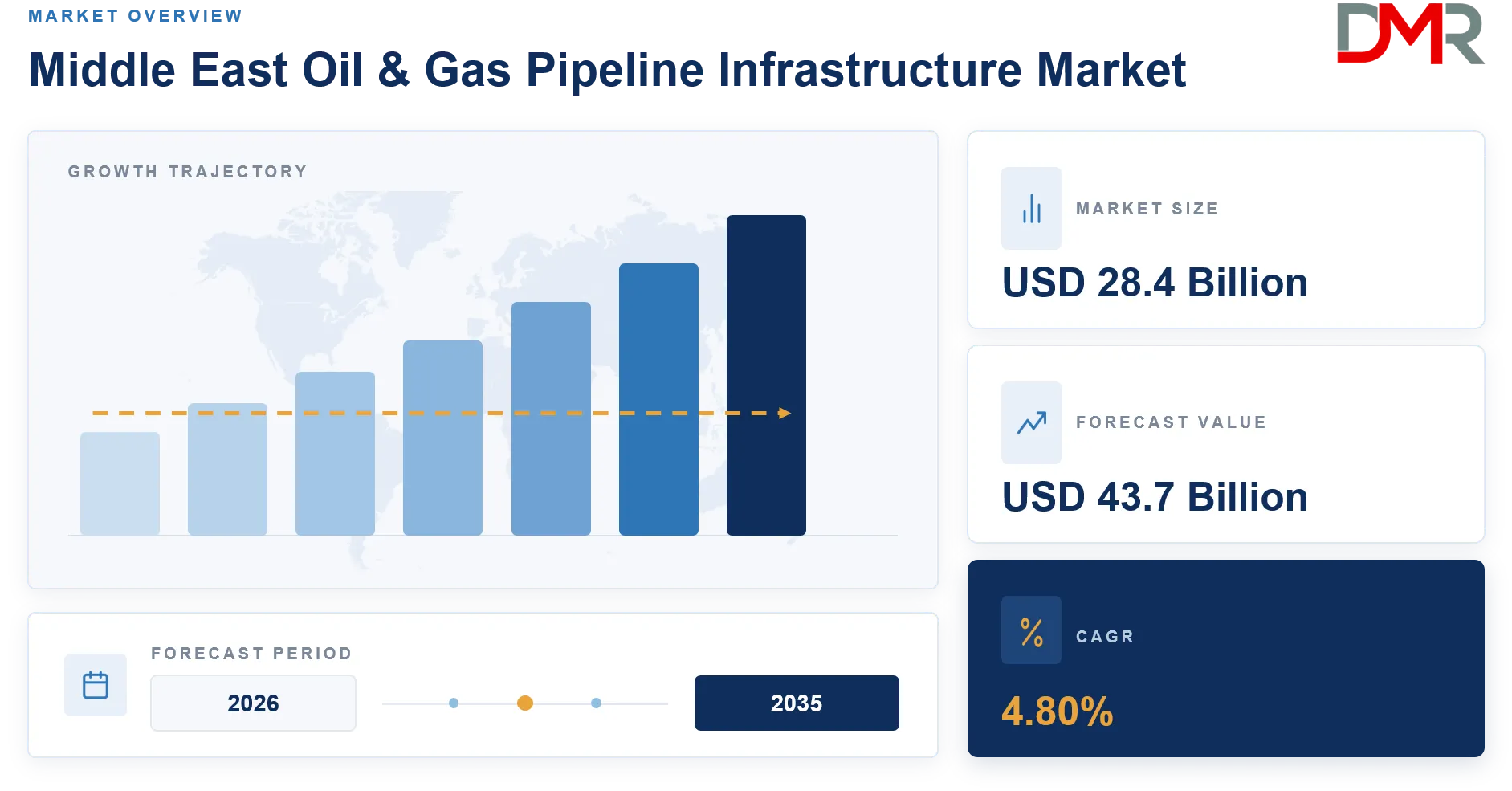
- Market Value: Middle East Oil & Gas Pipeline Infrastructure Market is valued at USD 28.4 billion in 2026 and is projected to reach USD 43.7 billion by 2035.
- CAGR: Middle East Oil & Gas Pipeline Infrastructure Market is expected to grow at a CAGR of 4.8% from 2026 to 2035.
- UAE Market Size: The UAE Oil & Gas Pipeline Infrastructure Market size is expected to reach USD 10.5 billion by 2035 from USD 6.8 billion in 2026, at a CAGR of 4.9%.
- Saudi Arabia Market Size: Saudi Arabia Oil & Gas Pipeline Infrastructure Market size is expected to reach USD 14.0 billion by 2035 from USD 9.1 billion in 2026, at a CAGR of 4.8%.
- Kuwait Market Size: The Kuwait Oil & Gas Pipeline Infrastructure Market size is expected to reach USD 4.4 billion by 2035 from USD 2.8 billion in 2026, at a CAGR of 4.7%.
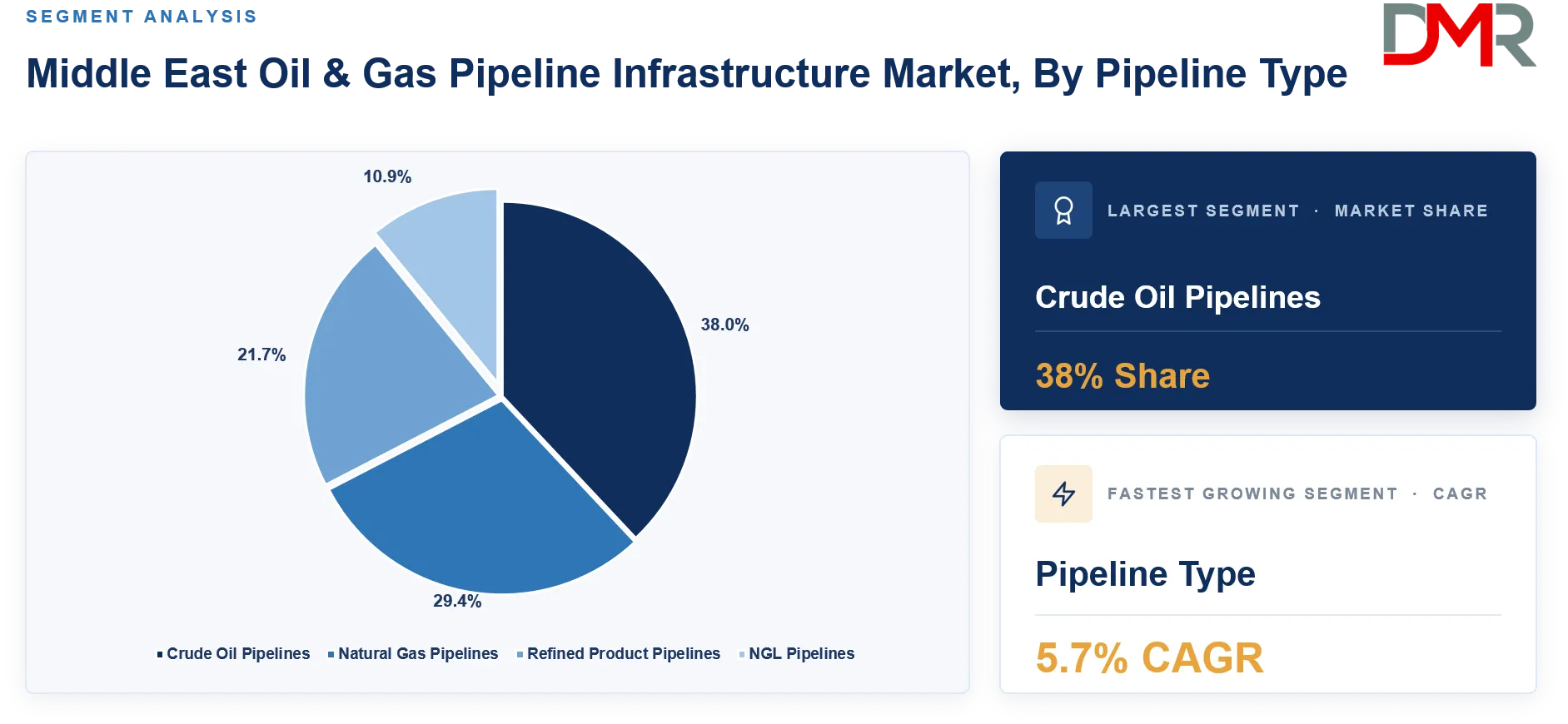
- By Pipeline Type Analysis: Crude Oil Pipipelines led the segment with a 38% share in 2026.
- By Pipeline Operation Analysis: Transmission Pipelines led the pipeline operation segment with a 52% share in 2026.
- By Construction Location Analysis: Onshore Pipelines led the construction location segment with a 78% share in 2026.
- Major Players: Saudi Aramco, ADNOC Gas Pipeline Assets, NMDC Energy, Saipem, and Others.
What is the Middle East Oil & Gas Pipeline Infrastructure Market and its Market Size?
The Middle East Oil & Gas Pipeline Infrastructure Market size is projected to be valued at USD 28.4 billion in 2026 and is expected to reach USD 43.7 billion by 2035, expanding at a CAGR of 4.8% during the forecast period. The market covers physical and digital infrastructure required to transport crude oil, natural gas, natural gas liquids, and refined petroleum products from production fields to processing facilities, refineries, export terminals, petrochemical complexes, storage centers, power plants, and domestic distribution networks.
ℹ
To learn more about this report –
Download Your Free Sample Report Here
Pipeline infrastructure has strategic importance across the Middle East because several countries are simultaneously expanding upstream production, natural gas processing capacity, LNG supply chains, refining operations, and industrial gas consumption. Saudi Arabia is investing heavily in domestic gas transmission capacity through the expansion of the Master Gas System. Aramco awarded around USD 8.8 billion of contracts for the third expansion phase of the system, covering multiple pipeline and associated infrastructure packages. In the UAE, ADNOC Gas operates a gas pipeline network extending approximately 3,260 kilometers and supplying around 60% of the country's gas requirements. These large networks create recurring demand for new pipelines, compressor stations, pumping systems, metering, inspection, integrity management, and control infrastructure.
Use Cases
- Crude Oil Transportation: Long distance pipelines move crude from producing fields and gathering centers to refineries, storage terminals, and export facilities. Large producers such as Saudi Arabia, the UAE, Kuwait, Iraq, and Oman depend on high capacity networks to maintain reliable flows while reducing reliance on continuous road or marine transport between domestic facilities.
- Natural Gas Transmission: Gas pipelines connect processing plants and production areas with power stations, industrial cities, petrochemical plants, desalination facilities, and distribution networks. Expansion of gas based electricity generation and industrial consumption is increasing demand for large diameter transmission pipelines, compression facilities, metering systems, and network interconnections.
- Offshore Field Development: Offshore and subsea pipelines transport hydrocarbons from platforms and offshore processing facilities to onshore terminals. Projects around fields such as Marjan, Safaniya, Berri, and Abu Safah require subsea pipelines, risers, tie ins, protective systems, offshore installation vessels, and engineering services designed for high pressure marine environments.
- Refined Product Distribution: Product pipelines move gasoline, diesel, jet fuel, and other refined products between refineries, storage centers, airports, industrial areas, and distribution terminals. Pipeline based product transportation helps refiners improve logistics efficiency while supporting the expansion of downstream manufacturing, petrochemical clusters, and fuel distribution infrastructure.
- Water and Gas Injection: Pipeline networks also support oilfield pressure management by transporting injection water and gas to producing reservoirs. These systems are important in mature fields where enhanced recovery programs require stable injection volumes, corrosion resistant pipe materials, pumping equipment, monitoring systems, and integrated field infrastructure.
How AI/Gen AI is Transforming the Middle East Oil & Gas Pipeline Infrastructure Market?
Artificial intelligence is changing pipeline operations from scheduled maintenance toward condition based asset management. Operators can combine pressure, temperature, flow, vibration, corrosion, acoustic, and inspection data to identify abnormal operating conditions before they lead to unplanned shutdowns. Machine learning models can support leak detection, corrosion assessment, pump and compressor optimization, and remaining life estimates for critical assets. This is particularly valuable in the Middle East, where operators manage extensive pipelines across deserts, offshore fields, industrial zones, and remote production areas.
Generative AI is also being evaluated for engineering document review, maintenance knowledge retrieval, inspection reporting, operating procedure support, and analysis of large volumes of technical records. Its commercial value is strongest when connected with verified operational data rather than used as a standalone system. For pipeline owners, the wider opportunity lies in combining intelligent analytics with SCADA systems, digital twins, inline inspection records, drones, fiber optic sensing, and centralized control rooms. This can shorten fault detection time, improve maintenance planning, and help operators allocate inspection spending toward assets with the highest operational risk.
Key Drivers in the Middle East Oil & Gas Pipeline Infrastructure Market
Large Scale Gas Network Expansion
Natural gas infrastructure expansion is becoming one of the strongest sources of pipeline demand across the region. Saudi Arabia's Master Gas System expansion illustrates the scale of investment required as gas production is connected with power generation, industry, and petrochemical demand centers. Aramco has awarded multibillion dollar contracts for Phase III works involving new transmission pipelines and supporting facilities. Similar gas network investment in the UAE is creating demand for pipe, valves, compressors, construction, automation, and engineering services.
Upstream Capacity and Offshore Field Development
Large producing countries continue to invest in field development and hydrocarbon transportation infrastructure. Offshore projects create particularly high value opportunities because they require subsea pipelines, platforms, risers, tie ins, installation vessels, corrosion protection, and specialist engineering. In February 2026, Saipem announced an approximately USD 500 million offshore contract in Saudi Arabia that includes a large diameter trunkline associated with the Safaniya development. Continued field investment supports recurring EPC and pipeline installation demand.
Restraints in the Middle East Oil & Gas Pipeline Infrastructure Market
High Capital and Project Execution Requirements
Large pipeline projects require substantial initial capital because spending extends beyond pipe procurement to compressors, pumping stations, valves, storage, metering, control systems, civil works, testing, and commissioning. Offshore projects add installation vessels, subsea engineering, and marine logistics. Long approval cycles and complex interfaces between operators, EPC firms, equipment suppliers, and government agencies can also delay execution. Cost inflation in steel, specialist equipment, construction labor, and logistics can weaken project economics and increase contingency requirements.
Integrity, Corrosion, and Operational Risk
Middle Eastern pipelines operate under challenging conditions including high temperatures, corrosive fluids, desert environments, offshore exposure, pressure cycling, and long operating lives. Internal corrosion, external corrosion, erosion, coating damage, and mechanical defects can raise maintenance costs and require frequent inspection. Operators therefore need sustained investment in cathodic protection, inline inspection, leak detection, corrosion resistant materials, coating systems, and integrity management. These requirements raise lifecycle spending even after initial construction is complete.
Growth Opportunities in the Middle East Oil & Gas Pipeline Infrastructure Market
Pipeline Modernization and Integrity Management
The installed pipeline base creates a large opportunity beyond new construction. Operators are increasingly required to inspect, repair, replace, reroute, and digitally monitor aging assets while maintaining production. This supports demand for intelligent pigging, corrosion monitoring, fiber optic sensing, leak detection, automated valves, digital twins, and predictive maintenance services. Contractors that combine engineering expertise with inspection data and asset integrity capabilities can participate across a pipeline's full operating life rather than only during the construction phase.
Gas, LNG, and Industrial Infrastructure Integration
Growth in regional gas production creates opportunities for pipelines linking gas fields, processing facilities, LNG plants, industrial clusters, utilities, and export infrastructure. The UAE provides a strong example because its existing ADNOC Gas network already supplies a major portion of national gas requirements while additional gas and LNG investments are expanding the infrastructure base. Similar development across Saudi Arabia, Qatar, Oman, and Kuwait can increase demand for transmission lines, compressor stations, metering systems, and high pressure pipe solutions.
Trends in the Middle East Oil & Gas Pipeline Infrastructure Market
Growth of Integrated EPC Contracting
Operators increasingly favor contractors capable of managing engineering, procurement, construction, installation, testing, and commissioning under integrated scopes. Long term agreements are also becoming important in large offshore markets. Saipem's Saudi Aramco offshore framework extends through 2027, while McDermott received a three year extension to its Aramco long term framework arrangement in 2025. Such agreements improve contractor visibility and allow operators to access established engineering, fabrication, marine construction, and project management capacity.
Pipeline Assets as Infrastructure Investments
Oil and gas pipelines are increasingly attracting infrastructure investors because established networks can generate long duration cash flows backed by critical energy transportation demand. Kuwait illustrated this shift in July 2026 when Kuwait Oil Company signed a USD 16.0 billion lease and lease back transaction involving its domestic and export crude pipeline network with a consortium led by Blackstone, Brookfield, and KKR. The model can unlock capital while allowing national operators to retain access to strategically important transportation assets.
Research Scope and Analysis
The Middle East Oil & Gas Pipeline Infrastructure Market study evaluates infrastructure investment, pipeline construction, replacement activity, transmission capacity expansion, project awards, technology adoption, asset integrity requirements, and competitive positioning across major oil and gas producing countries. The assessment covers onshore, offshore, and subsea infrastructure serving upstream, midstream, and downstream activities.
ℹ
To learn more about this report –
Download Your Free Sample Report Here
By Pipeline Type
Crude Oil Pipelines dominated the Middle East Oil & Gas Pipeline Infrastructure Market with a 38% share in 2026. The segment benefits from the region's large crude production base and the requirement to connect producing fields with gathering centers, stabilization plants, refineries, tank farms, export terminals, and marine loading facilities. Saudi Arabia, the UAE, Kuwait, Iraq, and Oman operate extensive crude transportation systems that require both capacity additions and continuous integrity spending. High throughput trunklines also use large diameter steel pipe, pumping stations, metering facilities, isolation valves, corrosion protection, and centralized monitoring systems, raising their value contribution compared with smaller gathering networks.
By Pipeline Operation
Transmission Pipelines accounted for 52% of the market in 2026, making the segment the largest by pipeline operation. Transmission networks carry high volumes of crude oil, natural gas, and refined products over long distances between production regions, processing facilities, industrial cities, storage centers, refineries, and export terminals. Saudi Arabia's Master Gas System is a major example of the strategic role of transmission infrastructure. Expansion of gas processing, power generation, refining, LNG, and petrochemical capacity requires new interconnections between supply and demand centers, supporting expenditure on large diameter pipes, compressors, pumping stations, valves, metering equipment, and control systems.
By Construction Location
Onshore Pipelines held a 78% share of the Middle East Oil & Gas Pipeline Infrastructure Market in 2026. The segment's leadership reflects the extensive land based networks connecting inland producing fields with refineries, gas processing plants, industrial zones, storage facilities, ports, and power plants. Onshore routes are central to Saudi Arabia, Kuwait, Iraq, Oman, the UAE, and other markets with large domestic hydrocarbon transportation requirements. Future opportunities include greenfield gas transmission lines, crude and product pipelines, replacement of aging sections, compressor and pumping station upgrades, pipeline automation, integrity services, and connections to new industrial developments.
The Middle East Oil & Gas Pipeline Infrastructure Market Report is segmented on the basis of the following:
By Pipeline Type
- Crude Oil Pipelines
- Natural Gas Pipelines
- Refined Product Pipelines
- NGL Pipelines
By Pipeline Operation
- Gathering Pipelines
- Transmission Pipelines
- Distribution Pipelines
By Construction Location
- Onshore Pipelines
- Offshore Pipelines
- Subsea Pipelines
By Pipe Type
- Seamless Pipes
- Welded Pipes
- Electric Resistance Welded
- Submerged Arc Welded
By Material Type
- Carbon Steel
- Alloy Steel
- Stainless Steel
- Duplex Stainless Steel
By Pipeline Diameter
- Below 12 Inches
- 12 to 24 Inches
- Above 24 Inches
By Sector
- Upstream Operations
- Midstream Operations
- Downstream Operations
By Application
- Oil Transportation
- Gas Transportation
- Product Transportation
- Gas Gathering
- Water Injection
- Gas Injection
By Infrastructure Component
- Pipeline Systems
- Pumping Stations
- Compressor Stations
- Metering Stations
- Storage Facilities
- Control Systems
Major Countries Analysis
- Saudi Arabia
- United Arab Emirates
- Qatar
- Kuwait
- Oman
- Bahrain
- Iraq
- Iran
- Israel
- Jordan
- Turkey
- Egypt
- Rest of Middle East
Saudi Arabia Oil & Gas Pipeline Infrastructure Market
Saudi Arabia Oil & Gas Pipeline Infrastructure Market size is projected to increase from USD 9.1 billion in 2026 to USD 14.0 billion by 2035 at a CAGR of 4.8%. Aramco remains the central infrastructure owner and project sponsor, with spending directed toward crude, natural gas, offshore, and field support networks. Master Gas System Phase III is expanding domestic gas transportation, while offshore projects generate contracts for Saipem, McDermott, L&T, and other engineering and construction providers. Continued localization also supports Saudi fabrication, contracting, maintenance, and equipment supply opportunities.
United Arab Emirates Oil & Gas Pipeline Infrastructure Market
The UAE Oil & Gas Pipeline Infrastructure Market size is projected to rise from USD 6.8 billion in 2026 to USD 10.5 billion by 2035, recording a CAGR of 4.9%. ADNOC's integrated upstream, gas, LNG, refining, and industrial strategy creates demand across both new and existing pipeline assets. ADNOC Gas' extensive transmission system provides a major installed base for network enhancement, debottlenecking, integrity management, compression, and metering. NMDC Energy's EPC role in the Estidama sales gas network enhancement program also demonstrates the opportunity available to domestic engineering and construction companies.
Kuwait Oil & Gas Pipeline Infrastructure Market
The Kuwait Oil & Gas Pipeline Infrastructure Market size is projected to grow from USD 2.8 billion in 2026 to USD 4.4 billion by 2035 at a CAGR of 4.7%. Kuwait Oil Company operates strategically important crude transportation networks connecting production areas with processing, storage, refinery, and export infrastructure. In July 2026, a USD 16.0 billion infrastructure partnership involving KOC's domestic and export crude pipeline network highlighted the financial value of these assets. Future demand will include maintenance, integrity upgrades, pumping systems, automation, field connections, and infrastructure required to support production capacity.
Competitive Landscape
The Middle East Oil & Gas Pipeline Infrastructure Market has a concentrated project ownership structure but a broad EPC and service provider base. National energy companies including Saudi Aramco and ADNOC control many of the region's largest pipeline investment programs, giving approved contractor status and long term framework agreements significant competitive value. Saipem and McDermott maintain strong positions in Saudi offshore EPCI, while NMDC Energy benefits from its established presence in UAE offshore and onshore energy construction.
L&T Energy Hydrocarbon, Petrofac, Technip Energies, Técnicas Reunidas, CPP, Sicim, Petrojet, Galfar, Lamprell, and regional contractors compete across engineering, pipeline installation, fabrication, compressor and pumping facilities, maintenance, and brownfield work. Competition increasingly depends on local content, safety performance, project execution capability, access to fabrication yards and marine assets, digital engineering, and the ability to deliver complex packages under operator framework agreements. Contractors with both construction capability and lifecycle services are positioned to benefit from growing spending on inspection, repair, integrity management, automation, and network modernization.
Some of the prominent players in the Middle East Oil & Gas Pipeline Infrastructure Industry are:
- Saudi Aramco
- ADNOC Gas Pipeline Assets
- NMDC Energy
- Saipem
- McDermott International
- Larsen & Toubro (L&T) Energy Hydrocarbon
- Petrofac
- Technip Energies
- Técnicas Reunidas
- Target Engineering Construction Company
- Al Dafrah Pipeline & Contracting Co (APCC)
- Al Jaber Precision Engineering & Contracting LLC
- Al Yusr Industrial Contracting (AYTB)
- Abuljadayel Co for Contracting & Maintenance Ltd
- Agap Arabia Ltd
- Lamprell Energy
- China Petroleum Pipeline Engineering (CPP/CPECC)
- Sicim
- Galfar Engineering & Construction
- Petrojet
- Others
Investment and White Space Analysis
Investment opportunities in the Middle East Oil & Gas Pipeline Infrastructure Market are expanding beyond greenfield pipeline construction into network upgrades, compressor and pumping stations, integrity management, automation, and brownfield replacement. Saudi Arabia offers major white space around gas transmission expansion, offshore field connectivity, and localization of pipeline engineering and maintenance. The UAE presents opportunities linked to ADNOC's gas network expansion, offshore developments, industrial gas supply, and LNG infrastructure. Kuwait also provides scope for pipeline modernization, asset monetization, and production support infrastructure.
Additional opportunities are emerging in Iraq and Oman, where field development and export capacity require dependable gathering and transmission systems. Contractors and investors can target high value niches such as subsea installation, corrosion monitoring, smart leak detection, digital twins, inline inspection, high pressure pipe systems, and lifecycle asset services, where technical capability and long term operating support create stronger barriers to entry.
Regulatory Landscape
The Middle East Oil & Gas Pipeline Infrastructure Market operates under country specific regulatory frameworks shaped by national energy ministries, state owned oil companies, environmental authorities, industrial safety rules, and local content policies. Pipeline projects typically require approvals covering route selection, land access, environmental impact, engineering standards, construction safety, pressure testing, commissioning, and ongoing integrity management. Saudi Arabia places strong emphasis on domestic participation through localization programs connected with major energy projects, influencing contractor selection and procurement strategies.
In the UAE, operators must align pipeline development with federal and emirate level environmental, occupational safety, and energy requirements, alongside ADNOC technical specifications. Kuwait, Qatar, Oman, and other producing countries also maintain operator led engineering and HSE standards. Compliance increasingly extends to methane management, leak detection, corrosion control, emergency response, digital monitoring, and lifecycle documentation, making regulatory capability an important competitive factor for EPC and maintenance providers.
Recent Developments
- August 2026: Saipem Awarded $1.8 billion offshore EPCI contract in the Middle East for subsea/offshore facilities, leveraging regional vessels and engineering capabilities to expand pipeline infrastructure.
- August 2026: Larsen & Toubro (L&T) Energy Hydrocarbon Signed ultra-mega >₹15,000 crore EPC contract for gas compression facilities and associated pipeline infrastructure for a Middle East client, strengthening regional midstream capacity.
- January 2026: McDermott International Awarded ADNOC Offshore's Nasr 115 expansion ($900–950 million) for offshore production facilities and subsea pipelines, advancing Abu Dhabi's pipeline infrastructure development.
Report Details
| Report Characteristics |
| Market Size (2026) |
USD 28.4 Bn |
| Forecast Value (2035) |
USD 43.7 Bn |
| CAGR (2026–2035) |
4.8% |
| Historical Data |
2021 – 2025 |
| Forecast Data |
2027 – 2035 |
| Base Year |
2025 |
| Estimate Year |
2026 |
| Segments Covered |
By Pipeline Type (Crude Oil Pipelines, Natural Gas Pipelines, Refined Product Pipelines, and NGL Pipelines), By Pipeline Operation (Gathering Pipelines, Transmission Pipelines, and Distribution Pipelines), By Construction Location (Onshore Pipelines, Offshore Pipelines, and Subsea Pipelines), By Pipe Type (Seamless Pipes and Welded Pipes {Electric Resistance Welded and Submerged Arc Welded}), By Material Type (Carbon Steel, Alloy Steel, Stainless Steel, and Duplex Stainless Steel), By Pipeline Diameter (Below 12 Inches, 12–24 Inches, and Above 24 Inches), By Sector (Upstream Operations, Midstream Operations, and Downstream Operations), By Application (Oil Transportation, Gas Transportation, Product Transportation, Gas Gathering, Water Injection, and Gas Injection), By Infrastructure Component (Pipeline Systems, Pumping Stations, Compressor Stations, Metering Stations, Storage Facilities, and Control Systems), By Country (Saudi Arabia, United Arab Emirates, Qatar, Kuwait, Oman, Bahrain, Iraq, Iran, Israel, Jordan, Turkey, Egypt, and Rest of Middle East) |
| Regional Coverage |
Middle East |
Frequently Asked Questions
What is the current size of the Middle East Oil & Gas Pipeline Infrastructure Market?
▾ Middle East Oil & Gas Pipeline Infrastructure Market size is USD 28.4 billion in 2026 and may reach USD 43.7 billion by 2035.
What is the growth rate of the Middle East Oil & Gas Pipeline Infrastructure Market during?
▾ The Middle East Oil & Gas Pipeline Infrastructure Market is forecast to grow at a 4.8% CAGR from 2026 to 2035.
Which country dominates the Middle East Oil & Gas Pipeline Infrastructure Market?
▾ Saudi Arabia leads the Middle East Oil & Gas Pipeline Infrastructure Market with a 32% revenue share in 2026.
What factors are driving the growth of the Middle East Oil & Gas Pipeline Infrastructure Market?
▾ Gas network expansion and offshore projects drive the Middle East Oil & Gas Pipeline Infrastructure Market growth.
What are the major challenges restraining the Middle East Oil & Gas Pipeline Infrastructure Market?
▾ High project costs, corrosion, and execution risks restrain the Middle East Oil & Gas Pipeline Infrastructure Market.
Which segment holds the largest share of the Middle East Oil & Gas Pipeline Infrastructure Market?
▾ Crude oil pipelines lead the Middle East Oil & Gas Pipeline Infrastructure Market with a 38% share in 2026.
Who are the leading companies in the global Middle East Oil & Gas Pipeline Infrastructure Market?
▾ Saudi Aramco, ADNOC Gas Pipeline Assets, NMDC Energy, Saipem, McDermott International, Larsen & Toubro (L&T) Energy Hydrocarbon, Petrofac, Technip Energies, Técnicas Reunidas, Target Engineering Construction Company, Al Dafrah Pipeline & Contracting Co (APCC), Al Jaber Precision Engineering & Contracting LLC, Al Yusr Industrial Contracting (AYTB), Abuljadayel Co for Contracting & Maintenance Ltd, Agap Arabia Ltd, Lamprell Energy, China Petroleum Pipeline Engineering (CPP/CPECC), Sicim, Galfar Engineering & Construction, and Petrojet are prominent companies in the market.
How is AI influencing the Middle East Oil & Gas Pipeline Infrastructure Market?
▾ AI improves leak detection and maintenance across the Middle East Oil & Gas Pipeline Infrastructure Market.
What are the future opportunities and trends in the Middle East Oil & Gas Pipeline Infrastructure Market?
▾ Gas expansion and smart monitoring offer growth in the Middle East Oil & Gas Pipeline Infrastructure Market.