What is the Mobile Geofencing Market Size in 2026?
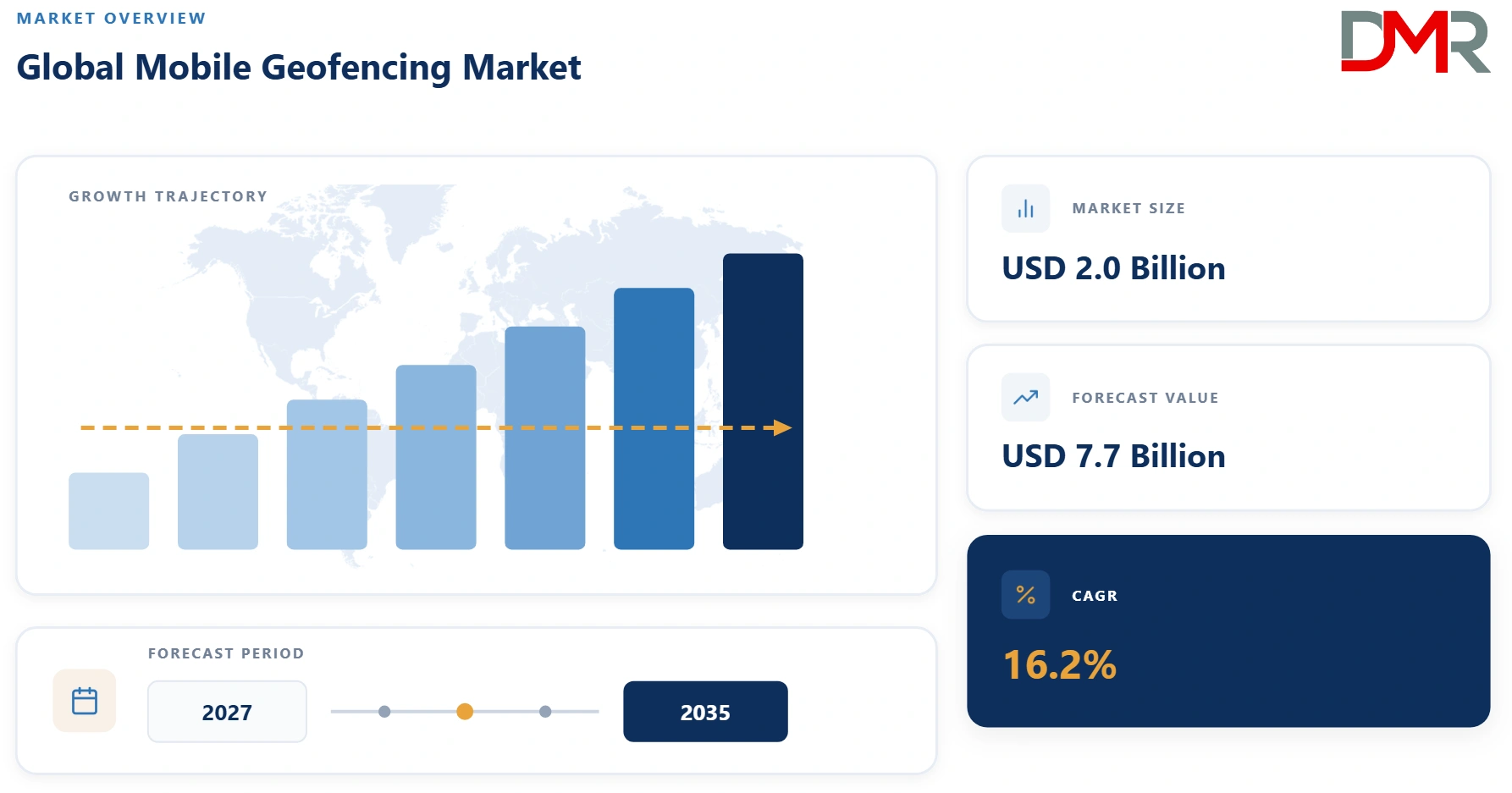
The global mobile geofencing market is valued at USD 2.0 billion in 2026 and is projected to reach USD 7.7 billion by 2035, growing at a CAGR of 16.2% from 2027 to 2035. Growth is driven by rising smartphone penetration, the demand for location-based personalized marketing, and the increasing need for fleet and asset tracking across logistics and retail sectors.
ℹ
To learn more about this report –
Download Your Free Sample Report Here
Mobile geofencing is a location-based service technology that uses GPS, RFID, Wi-Fi, or cellular data to define geographical boundaries, known as virtual fences. When a mobile device enters or exits these predefined areas, it triggers a pre-programmed action, such as sending a push notification, an email, or a text message. This technology is integral for location-based marketing, asset management, security, and customer engagement across various industries.
The report covers the global mobile geofencing market, providing historical data from 2021 to 2026 and forecasts for 2027 to 2035. It segments the market by component, technology, application, deployment mode, end user, and region. The analysis includes a detailed examination of market drivers, restraints, opportunities, and trends, alongside a competitive landscape featuring key players and recent strategic developments shaping the industry.
Mobile Geofencing Market Snapshot
Mobile Geofencing Market Snapshot, 2026-2035
| Metric |
Value |
| Market Size (2026) |
USD 2.0 Billion |
| Forecast Value (2035) |
USD 7.7 Billion |
| CAGR (2027-2035) |
16.2% |
| Largest Region (2026) |
North America, 38.5% share |
| Fastest-Growing Region (2027-2035) |
Asia Pacific, 18.9% CAGR |
| Leading Component (2026) |
Software, 65.2% share |
| Leading End User (2026) |
Retail and E-commerce, 29.3% share |
| Key Players |
IBM Corporation, Google LLC, Microsoft Corporation, Esri, Cisco Systems, Inc., LocationGuru Solutions, Bluedot Industries, Thumbvista |
Key Takeaways
- Market growth: The market is set to expand from USD 2.0 billion in 2026 to USD 7.7 billion by 2035, at a robust 16.2% CAGR.
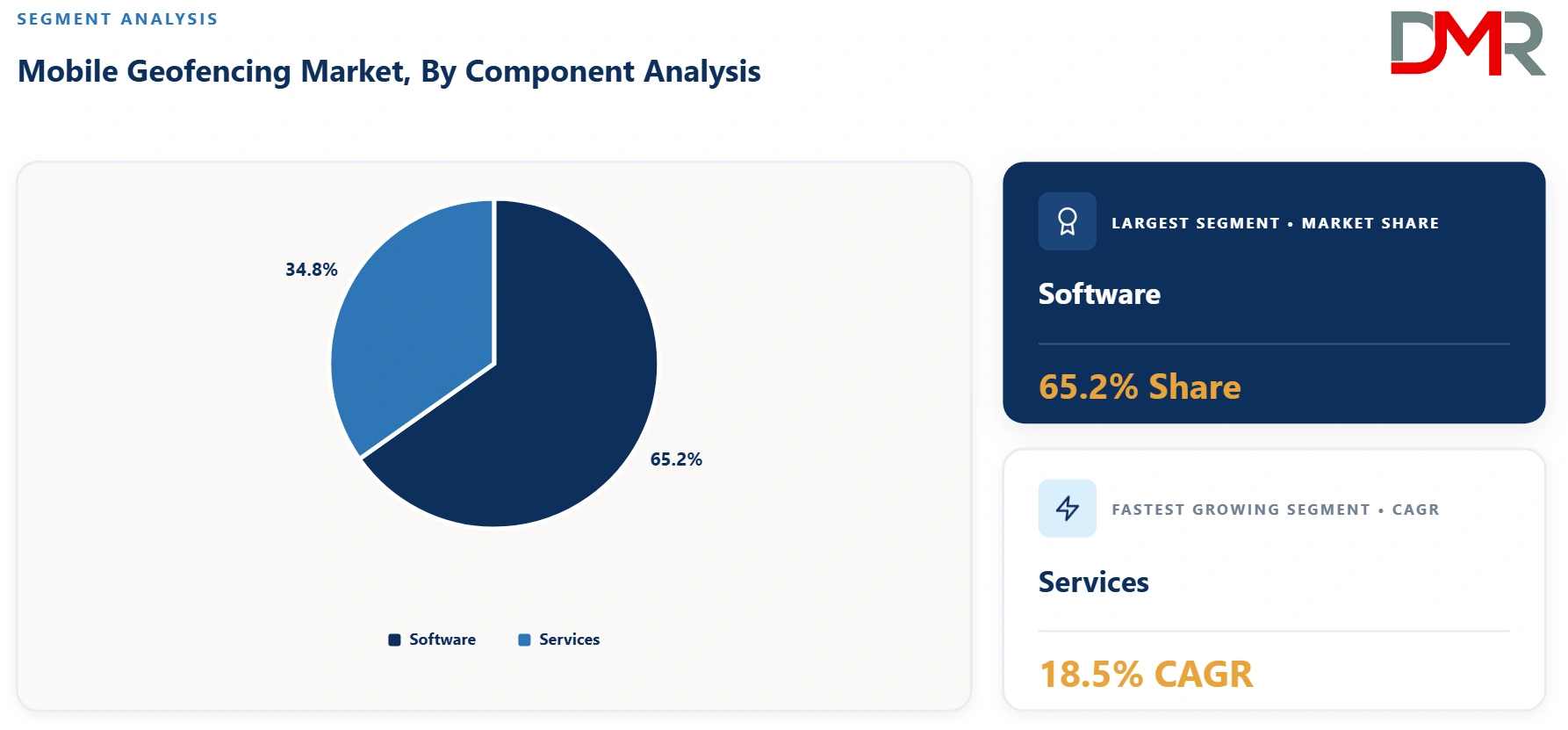
- Component leader: The software segment holds a 65.2% share in 2026, led by the increasing adoption of cloud-based geofencing platforms.
- Fastest component: The services segment is set to grow at 18.5% CAGR through 2035, ahead of the overall market, driven by demand for integration and managed services.
- End user leader: The retail and e-commerce sector accounts for 29.3% of 2026 demand, as businesses leverage geofencing for targeted promotions and customer engagement.
- Fastest end user: The healthcare sector is projected to grow at 19.2% CAGR, supported by applications in patient tracking and asset management.
- Regional picture: North America leads with 38.5% share in 2026, while Asia Pacific is fastest-growing at 18.9% CAGR.
What are the Key Use Cases of Mobile Geofencing?
- Proximity-Based Retail Marketing: Retailers use geofencing to send real-time, location-specific promotional offers to customers' smartphones when they enter a mall or store.
- Real-Time Fleet and Asset Tracking: Logistics companies employ geofences to create virtual boundaries around warehouses and delivery zones for real-time fleet tracking.
- Healthcare Asset and Patient Safety Monitoring: Healthcare facilities use geofencing to track high-value medical equipment and ensure the safety of patients with cognitive conditions.
- Location-Based Fraud Detection and Security Alerts: Financial institutions leverage geofencing to trigger security alerts or card-not-present fraud checks when a transaction occurs outside a customer's typical area.
How are Foundation Models and Generative AI Transforming the Mobile Geofencing Market?
Foundation models and generative AI are revolutionizing mobile geofencing by enabling hyper-personalization and predictive analytics. AI algorithms analyze vast datasets of consumer behavior, mobility patterns, and environmental factors to create dynamic, adaptive geofences that predict where a user is likely to go, rather than just reacting to their presence. This allows businesses to send proactive and highly relevant offers, significantly boosting conversion rates and customer engagement. For example, an AI model could identify a user's routine and send a coffee shop coupon just before their usual morning commute.
Operationally, generative AI is streamlining the creation and management of geofencing campaigns. Marketers can use natural language prompts to generate campaign copy, design A/B tests, and determine optimal geofence locations, drastically reducing manual effort. Adoption is growing rapidly as businesses seek a competitive edge. The market impact is substantial, with AI-driven geofencing leading to higher ROI for marketing campaigns, improved operational efficiency in logistics, and the emergence of new, proactive service models across retail, transport, and smart city applications.
Mobile Geofencing Market Dynamics at a Glance
Drivers, Restraints, Opportunities and Trends in the Mobile Geofencing Market
| Type |
Factor |
Impact |
| Driver |
Rising adoption of location-based advertising and personalized marketing |
High |
| Driver |
Increasing need for real-time asset and fleet tracking in logistics |
High |
| Restraint |
Data privacy and security concerns regarding user location data |
Medium |
| Restraint |
High initial deployment costs and technical complexity for SMEs |
High |
| Opportunity |
Integration of AI and machine learning for predictive geofencing |
Medium |
| Opportunity |
Untapped potential in emerging economies and smart city projects |
High |
| Trend |
Convergence with IoT platforms and 5G technology |
Medium |
| Trend |
Shift towards context-aware and hyper-personalized customer engagement |
High |
What is Driving the Growth of the Mobile Geofencing Market?
Rising Adoption of Location-Based Advertising
The proliferation of smartphones and the consumer expectation for personalized experiences are fueling the demand for location-based advertising. Businesses are increasingly using geofencing to deliver targeted promotions, alerts, and content to users based on their real-time location. This method offers significantly higher engagement and conversion rates compared to traditional digital advertising. For instance, retailers use geofences around competitor stores to lure customers with special offers, a tactic that directly impacts foot traffic and sales, thereby driving the market forward.
Increasing Need for Real-Time Asset and Fleet Tracking
The logistics and transportation industry is undergoing a digital transformation, with a strong focus on operational efficiency and supply chain visibility. Mobile geofencing provides a cost-effective solution for real-time tracking of vehicles, trailers, and high-value assets. By creating virtual boundaries around key locations like warehouses, distribution centers, and customer sites, companies can automate entry/exit logging, optimize routes, and improve delivery estimates. This drives significant fuel savings and enhances overall supply chain management, creating robust demand for the technology.
What are the Key Restraints in the Mobile Geofencing Market?
Data Privacy and Security Concerns
The collection and use of precise user location data raise significant privacy and security concerns. Regulations like GDPR in Europe and CCPA in California impose strict rules on data collection and user consent. High-profile data breaches have made consumers more wary of sharing their location information. This creates a challenging environment for market growth, as companies must invest heavily in robust security infrastructure and transparent data policies to build and maintain user trust, potentially slowing down adoption rates.
High Initial Deployment Costs and Technical Complexity
Implementing a sophisticated mobile geofencing solution, especially for small and medium-sized enterprises (SMEs), can be prohibitively expensive. The costs associated with purchasing software licenses, integrating with existing systems (like CRM or ERP), and hiring skilled personnel to manage the technology are significant. Furthermore, the technical complexity of creating, managing, and analyzing multiple geofences across different platforms can be a major barrier for organizations lacking in-house technical expertise, hindering broader market penetration.
What are the Key Opportunities in the Mobile Geofencing Market?
Integration of AI and Machine Learning for Predictive Geofencing
A significant opportunity lies in the integration of AI and machine learning to evolve from reactive to predictive geofencing. Instead of simply triggering an action when a user enters a zone, AI algorithms can analyze historical data and real-time context to predict a user's future location and intent. This allows for proactive engagement, such as sending a restaurant coupon to a user who is predicted to be looking for lunch in the area soon, creating new revenue streams and enhancing customer experience.
Untapped Potential in Emerging Economies and Smart City Projects
Emerging economies in Asia Pacific, Latin America, and the Middle East present substantial growth opportunities due to rapid urbanization, increasing smartphone penetration, and growing digitalization. Furthermore, government-led smart city initiatives are creating a favorable environment for geofencing technologies. These projects leverage location data for traffic management, public safety, and efficient delivery of citizen services, offering a massive scale-up opportunity for providers of geofencing platforms and services.
What are the Latest Trends in the Mobile Geofencing Market?
Convergence with IoT Platforms and 5G Technology
The market is witnessing a strong trend of convergence between geofencing and the Internet of Things (IoT). Geofences are increasingly used to trigger actions in a connected ecosystem, such as adjusting a smart thermostat when a user is a certain distance from home or managing drone flight paths. The rollout of 5G networks is a key enabler, providing the low latency and high bandwidth necessary for real-time, data-intensive IoT and geofencing applications, expanding their use cases in industrial automation and autonomous systems.
Shift Towards Context-Aware and Hyper-Personalized Customer Engagement
The trend is moving beyond simple location triggers to context-aware engagement. Modern geofencing platforms are integrating other data points like time of day, weather, user purchase history, and social media activity to create highly personalized and relevant experiences. This allows a coffee shop to send a cold drink offer on a hot afternoon or a retailer to promote a new product based on a customer's browsing history when they enter the store, making marketing efforts more effective and less intrusive.
Research Scope and Analysis
The research scope encompasses the global mobile geofencing market, detailing revenue forecasts from 2027 to 2035. It analyzes market segmentation by component, technology, application, deployment mode, and end user. The analysis provides a comprehensive view of the competitive landscape and regional dynamics, offering a detailed revenue assessment for each sub-segment.
ℹ
To learn more about this report –
Download Your Free Sample Report Here
By Component Analysis
The software segment leads the market with a 65.2% share in 2026, driven by the widespread adoption of cloud-based platforms that offer scalability and advanced analytics. The services segment is the fastest-growing, with a projected CAGR of 18.5% from 2027 to 2035, fueled by the increasing need for expert consulting, seamless system integration, and ongoing managed services to maximize the value of geofencing investments.
By Technology Analysis
The GPS/GNSS segment holds the largest share of 52.1% in 2026 due to its high accuracy and ubiquitous availability in modern smartphones. The Bluetooth Beacon segment is the fastest-growing, with a CAGR of 20.3%, driven by its low energy consumption and high precision for indoor proximity marketing and indoor navigation applications in venues like malls and airports.
By Application Analysis
Location-based marketing and advertising is the dominant application segment, accounting for a 35.8% share in 2026, as it directly enhances customer engagement and drives foot traffic for retailers. The fleet and asset tracking segment is expected to be the fastest-growing at 19.5% CAGR, supported by the logistics industry's focus on supply chain optimization and real-time operational visibility.
By Deployment Mode Analysis
The cloud-based segment leads the market with an 80.5% share in 2026, owing to its cost-effectiveness, scalability, and ease of integration. This segment is also the fastest-growing at 17.2% CAGR, as businesses increasingly shift from on-premises infrastructure to flexible, subscription-based cloud models that offer automatic updates and remote accessibility.
By End User Analysis
The retail and e-commerce sector dominates with a 29.3% share in 2026, leveraging geofencing for personalized promotions and customer analytics. The healthcare sector is poised to be the fastest-growing end user at a CAGR of 19.2%, driven by applications in patient safety, asset tracking for medical devices, and improving operational workflows within hospitals.
How is the Mobile Geofencing Market Segmented?
By Component
- Software
- Geofencing Platforms
- Location Intelligence Software
- Geospatial Analytics Software
- Campaign Management Software
- Mobile Application SDKs
- Services
- Consulting Services
- Deployment and Integration Services
- Support and Maintenance Services
- Managed Services
By Technology
- GPS/GNSS
- Wi-Fi
- Bluetooth Beacon
- Cellular Network
- RFID/NFC
By Application
- Location-Based Marketing and Advertising
- Customer Engagement and Targeted Promotions
- Fleet and Asset Tracking
- Workforce and Attendance Management
- Security and Access Control
By Deployment Mode
- Cloud-Based
- On-Premises
- Hybrid
By End User
- Retail and E-commerce
- Transportation and Logistics
- Healthcare
- Banking, Financial Services and Insurance (BFSI)
- Hospitality and Tourism
- Real Estate
- Media and Entertainment
- Government and Public Sector
- Other Industries
Which Region Leads the Mobile Geofencing Market?
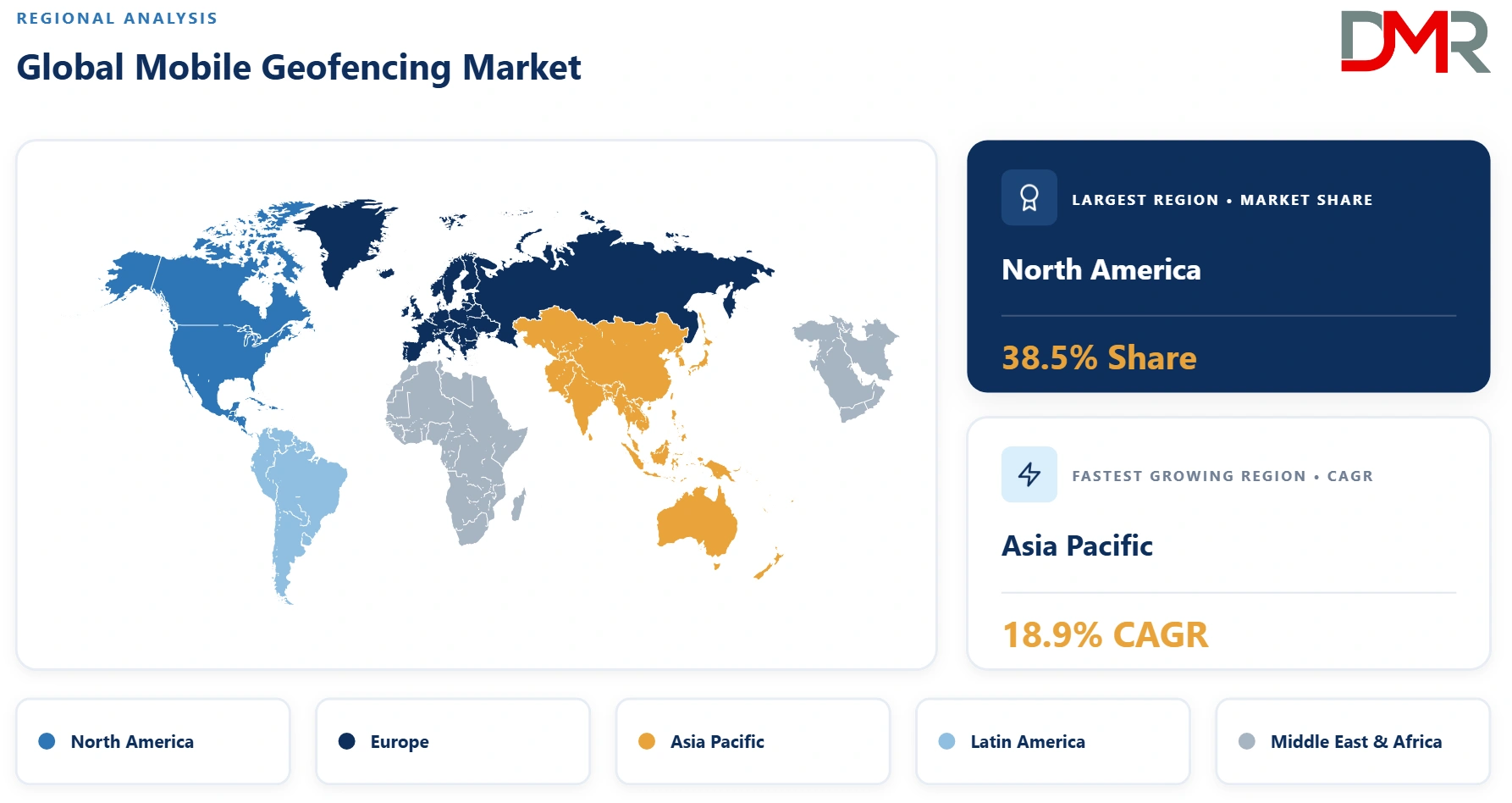
North America leads with a 38.5% share in 2026, while Asia Pacific is projected to grow at the highest CAGR of 18.9% from 2027 to 2035.
ℹ
To learn more about this report –
Download Your Free Sample Report Here
Region with the Largest Revenue Share
North America dominates the mobile geofencing market with a 38.5% share in 2026, driven by the U.S. and Canada. The region's advanced technological infrastructure, high smartphone penetration, and early adoption of location-based services contribute to its leadership. A strong presence of key market players and a regulatory environment that, while stringent, provides clear guidelines for data usage, further solidify its position. The market is expected to grow at a steady 15.1% CAGR, fueled by continuous innovation in AI-powered marketing and IoT applications.
Region with the Highest CAGR
Asia Pacific is the fastest-growing region, projected to expand at an 18.9% CAGR from 2027 to 2035. This growth is driven by rapid urbanization, a massive and expanding smartphone user base, and increasing digitalization across countries like China, India, and Japan. The proliferation of mobile commerce and a tech-savvy young population are creating a fertile ground for location-based marketing. Furthermore, government investments in smart city infrastructure and logistics modernization are expected to create significant demand for mobile geofencing solutions.
Regional Analysis
Europe Mobile Geofencing Market
The European market is characterized by steady growth. Germany, the U.K., and France are key contributors. Stringent data privacy regulations like GDPR have forced providers to innovate in privacy-compliant geofencing, which has built greater consumer trust. Demand is particularly strong in retail, transportation, and for smart city initiatives across the region.
Latin America Mobile Geofencing Market
This region is emerging as a promising market. Brazil and Mexico are the primary markets, driven by growing smartphone adoption and a booming e-commerce sector. Retailers are increasingly using geofencing to compete with global online marketplaces, while logistics companies are adopting the technology to improve delivery efficiency in rapidly expanding urban areas.
Middle East & Africa Mobile Geofencing Market
The MEA market is expected to show healthy growth, with the UAE and Saudi Arabia leading adoption. The region's focus on economic diversification and mega-events like Expo 2020 Dubai have spurred investments in smart city technologies and enhanced customer experiences, creating opportunities for geofencing in tourism, retail, and public safety.
By Region
North America
Europe
- Germany
- France
- The U.K.
- Italy
- Spain
- Rest of Europe
Asia-Pacific
- China
- Japan
- India
- Australia
- South Korea
- Rest of APAC
Latin America
- Mexico
- Brazil
- Rest of LATAM
Middle East & Africa
- Saudi Arabia
- The UAE
- South Africa
- Rest of MEA
Regulatory Landscape
The regulatory landscape is primarily shaped by data privacy laws like the GDPR in Europe and CCPA in California, which mandate strict user consent and data minimization for location data. Other regions are enacting similar legislation, creating a complex global compliance environment. These regulations require companies to be transparent about data collection, provide users with control over their data, and implement robust security measures. Adherence to these laws is non-negotiable, pushing providers to develop privacy-by-design solutions, which is becoming a key competitive differentiator. This focus on privacy is shaping product development and consumer trust.
Investment and White Space Analysis
Investment in the mobile geofencing market is robust, with significant funding flowing towards platforms that integrate AI and machine learning for predictive analytics. Key opportunities, or white space, exist in developing specialized solutions for high-growth sectors like healthcare and smart manufacturing. Another major opportunity is in emerging markets, where adoption is still low but growth potential is immense. The primary risk is the evolving regulatory landscape, which could create compliance hurdles. A significant market impact will come from the ability of companies to offer seamless, omnichannel experiences and demonstrate clear ROI to hesitant adopters.
Who are the Leading Companies in the Mobile Geofencing Market?
The mobile geofencing market is moderately fragmented with a mix of established technology giants and specialized vendors. Key players are differentiating through AI-driven analytics, seamless integration with marketing and CRM platforms, and robust privacy features. Strategic partnerships and the acquisition of niche tech firms are common to expand capabilities and market reach.
- IBM Corporation (US): Offers location intelligence and geospatial analytics solutions, focusing on enterprise-grade security and integration.
- Google LLC (US): Provides geofencing capabilities through its Google Maps Platform and Android APIs, dominant in consumer and developer markets.
- Microsoft Corporation (US): Integrates geofencing into its Azure cloud platform and Dynamics 365 suite for business applications.
- Esri (US): A leader in geographic information systems (GIS), providing powerful geospatial analytics and geofencing tools.
- Cisco Systems, Inc. (US): Leverages its networking hardware and software to offer location-based services and analytics.
- LocationGuru Solutions (India): Specializes in providing geofencing solutions for fleet management and workforce tracking.
- Bluedot Industries (US): Known for its precise location technology and platform for mobile apps, enabling better geofencing for marketers.
- Thumbvista (US): Offers a range of location-based marketing solutions, including geofencing and beacon marketing platforms.
Some of the prominent players in the Global Mobile Geofencing Market are:
- IBM Corporation
- Google LLC
- Microsoft Corporation
- Esri
- Cisco Systems, Inc.
- LocationGuru Solutions
- Bluedot Industries
- Thumbvista
- Pulsate
- Radar Labs, Inc.
- Proximity.Directory
- Gimbal, Inc.
- Sense360
- Foursquare Labs, Inc.
- Here Technologies
- TomTom International BV
- Qualcomm Technologies, Inc.
- Zebra Technologies Corp.
- SAP SE
- Salesforce.com, Inc.
- Oracle Corporation
- Adobe Inc.
- Airbnb, Inc.
- Uber Technologies, Inc.
- Lyft, Inc.
- Mapbox
- CartoDB
- SafeGraph
- PlaceIQ
- Factual Inc.
- xAd
- Verve, Inc.
- GroundTruth
- Reveal Mobile
- Aislelabs
- RetailNext
- Estimote, Inc.
- Kontakt.io
- InMarket
- SocialSign.in
- Other Key Players
Recent Developments
- In May 2025, Google announced updates to its Android Geofencing API, offering improved battery efficiency and higher accuracy for location triggers, benefiting app developers and marketers.
- In March 2025, Microsoft integrated new AI-powered predictive location features into its Dynamics 365 Customer Insights platform, enabling businesses to anticipate customer needs based on movement patterns.
- In January 2025, Bluedot Industries secured a significant funding round to expand its geofencing platform's capabilities in the electric vehicle (EV) charging sector, focusing on automating charging and payment processes.
- In November 2024, Foursquare Labs launched a new privacy-first attribution tool that uses aggregated and anonymized location data to help advertisers measure the effectiveness of their geofenced campaigns.
- In September 2024, Esri partnered with a major smart city in Europe to deploy its geospatial platform for traffic management and public safety, utilizing advanced geofencing for real-time vehicle routing.
Report Scope and Research Methodology
Market definition: Mobile Geofencing refers to location-based technology that creates virtual boundaries around specific geographical areas using GPS, Wi-Fi, or cellular signals. It enables businesses to trigger location-specific notifications, advertisements, alerts, and automated actions when mobile devices enter, exit, or remain within predefined geographic zones.
Methodology: Dimension Market Research built the estimate bottom-up from company revenues, software subscription data, and AI value per unit for each product and end-user segment, then checked it top-down against overall global IT and marketing technology spending totals. Primary interviews with industry experts, software vendors, and end-users validated adoption rates and pricing models. Forecasts apply segment-level growth assumptions for 2027–2035, considering technological advancements, regulatory shifts, and competitive dynamics, and are reviewed at each report update.
Report Details
| Report Characteristics |
Details |
| Market Size (2026) |
USD 2.0 Billion |
| Forecast Value (2035) |
USD 7.7 Billion |
| CAGR (2027-2035) |
16.2% |
| Historical Data |
2021–2026 |
| Forecast Data |
2027–2035 |
| Base Year |
2026 |
| Estimate Year |
2027 |
| Segments Covered |
By Component, By Technology, By Application, By Deployment Mode, By End User |
| Regional Coverage |
North America (The US, Canada); Europe (Germany, France, The UK, Italy, Spain, Rest of Europe); Asia Pacific (China, Japan, India, Australia, South Korea, Rest of APAC); Latin America (Mexico, Brazil, Rest of LATAM); Middle East & Africa (Saudi Arabia, The UAE, South Africa, Rest of MEA) |
Frequently Asked Questions
How big is the Mobile Geofencing Market in 2026?
▾ The Mobile Geofencing Market is valued at USD 2.0 billion in 2026.
What is the growth rate of the Mobile Geofencing Market?
▾ The Mobile Geofencing Market is projected to grow at a 16.2% CAGR from 2027 to 2035.
Which region leads the Mobile Geofencing Market?
▾ North America leads the Mobile Geofencing Market with a 38.5% revenue share in 2026.
Which region is fastest-growing in the Mobile Geofencing Market?
▾ Asia Pacific is the fastest-growing Mobile Geofencing Market region at 18.9% CAGR through 2035.
Which product segment dominates the Mobile Geofencing Market?
▾ The software segment dominates the Mobile Geofencing Market with a 65.2% share in 2026.
Which end user is growing fastest in the Mobile Geofencing Market?
▾ The healthcare sector is the fastest-growing Mobile Geofencing Market end user at 19.2% CAGR.
Who are the key players in the Mobile Geofencing Market?
▾ Key Mobile Geofencing Market players include IBM, Google, Microsoft, Esri, and Cisco Systems.
What are the main challenges facing the Mobile Geofencing Market?
▾ The Mobile Geofencing Market faces data privacy concerns and high deployment costs for SMEs.