Global Mobile Medical Imaging Service Market Snapshot
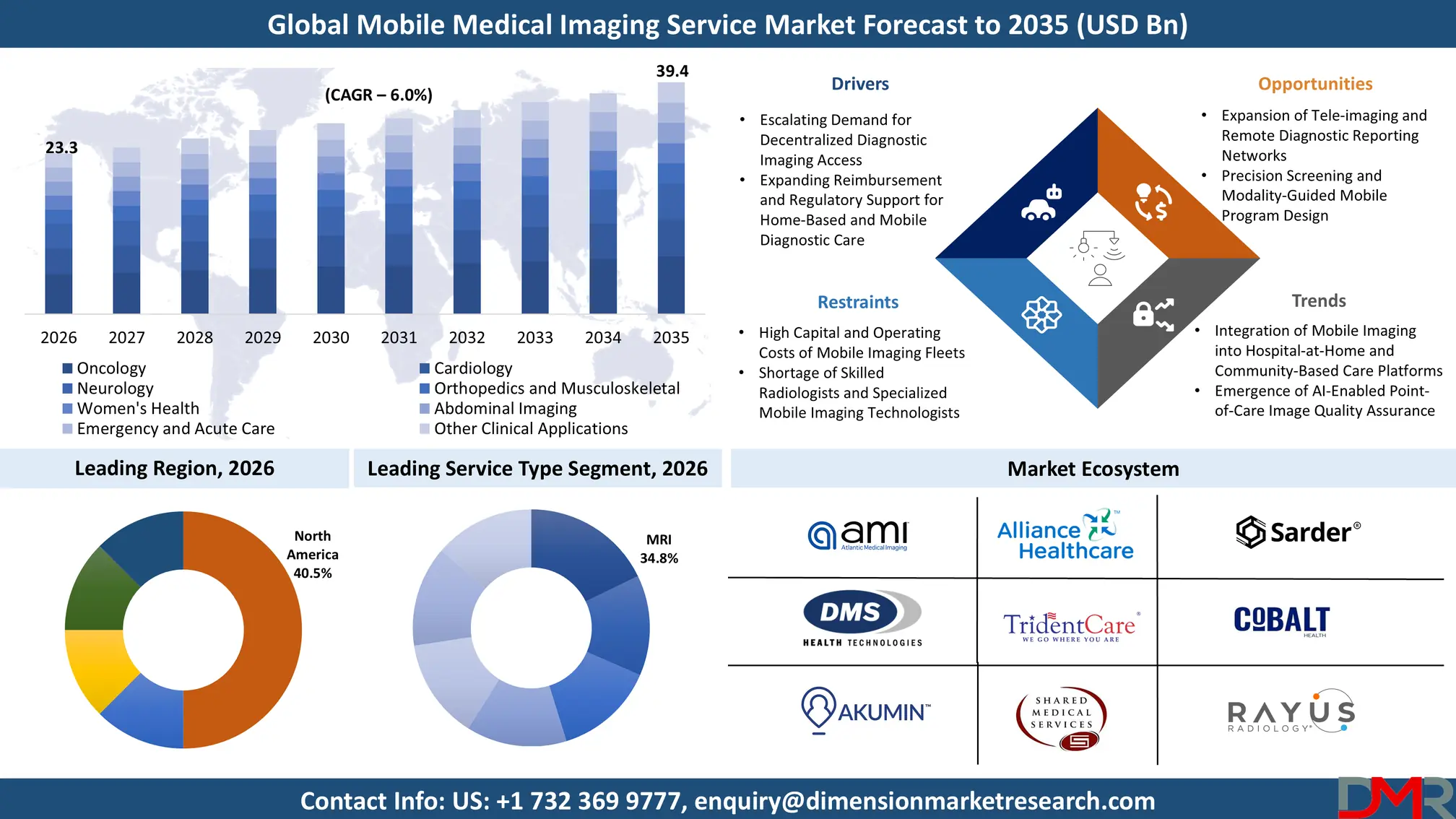
- Global Mobile Medical Imaging Service Market Size in 2026: USD 23.3 Billion
- Global Mobile Medical Imaging Service Market Size in 2035: USD 39.4 Billion
- Global CAGR from 2026 to 2035: 6.0%
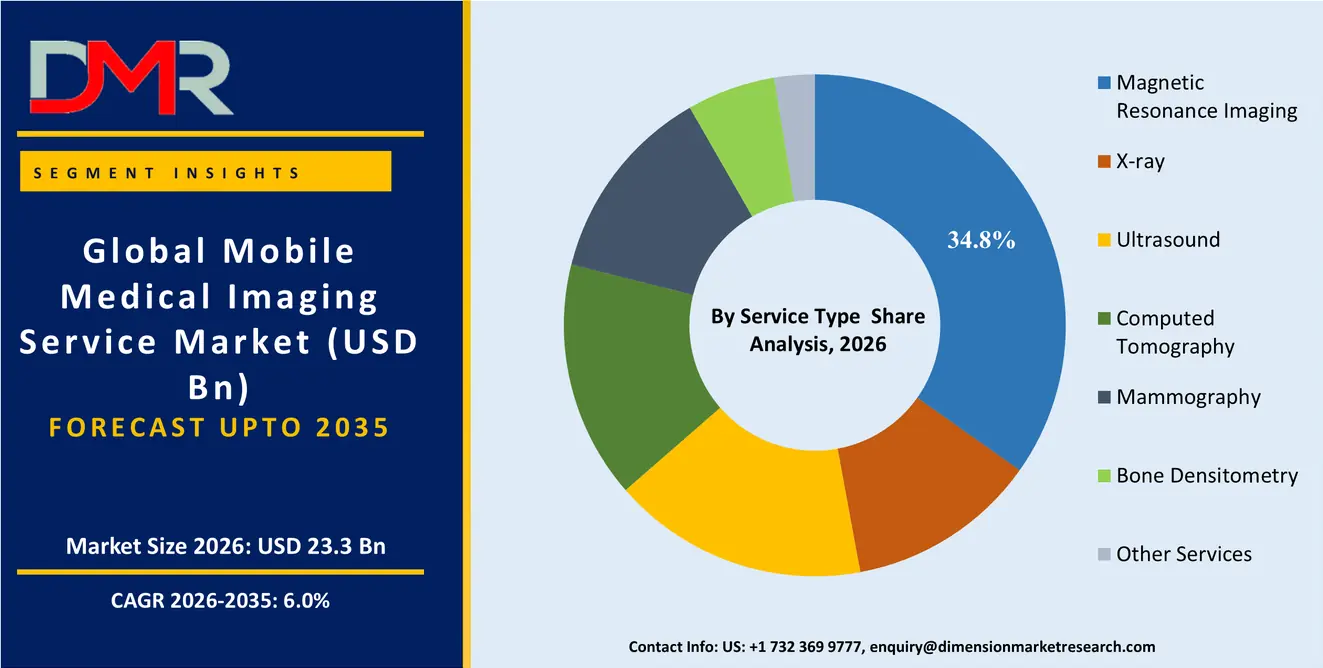
- Magnetic Resonance Imaging is the leading service type segment in 2026: 35.2%
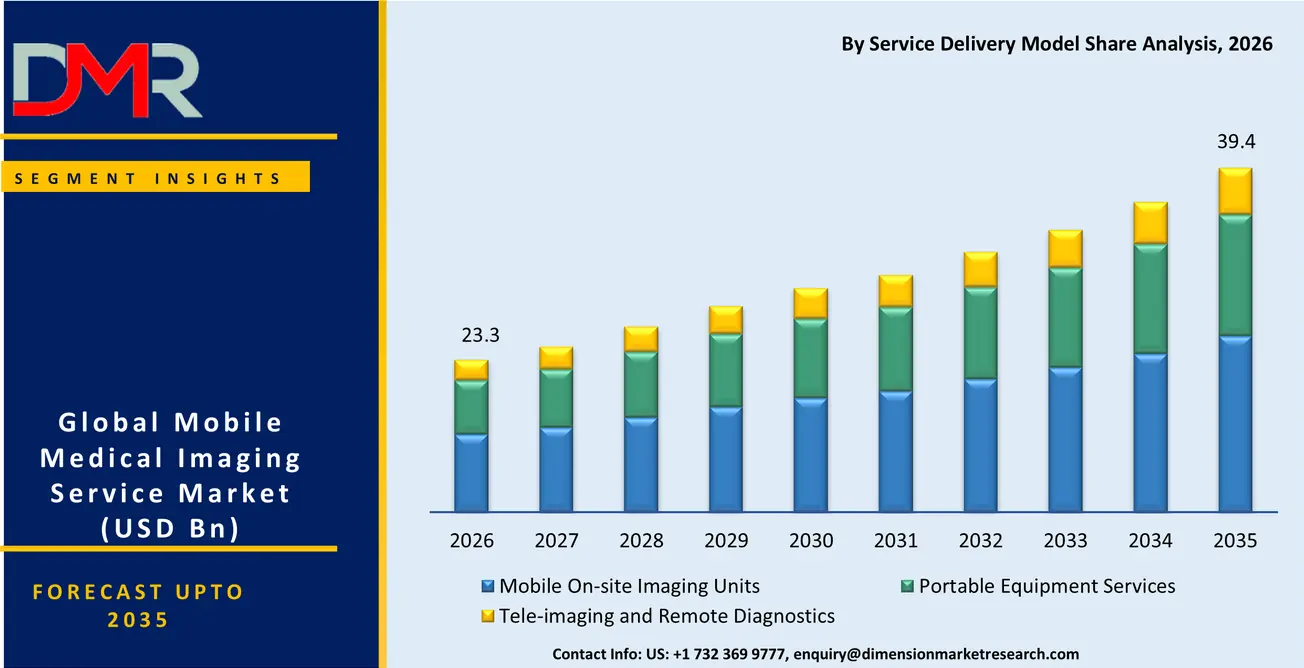
- Mobile On-site Imaging Units is the leading service delivery model segment in 2026: 49.7%
- Orthopedics and Musculoskeletal is the leading clinical application segment in 2026: 30.8%
- Hospitals and Clinics is the leading end user segment in 2026: 64.3%
- North America is the leading region in 2026: 40.5%
What is the Global Mobile Medical Imaging Service and its Market Size?
The Global Mobile Medical Imaging Service Market is projected to advance to USD 23.3 billion in 2026, which is further expected to reach USD 39.4 billion by 2035, expanding at a compound annual growth rate (CAGR) of 6.0% across the forecast period.
ℹ
To learn more about this report –
Download Your Free Sample Report Here
Growth is being propelled by the accelerating shift of diagnostic imaging away from fixed hospital-based radiology suites toward on-site, point-of-care, and home-delivered imaging services, driven by an aging, increasingly homebound population and the persistent shortage of imaging infrastructure in rural and underserved regions. The proliferation of trailer-based and van-based mobile imaging units equipped with mobile MRI, mobile CT, and portable ultrasound systems, the rising deployment of tele-imaging and remote diagnostic reporting networks, and expanding reimbursement frameworks for home-based and community-based imaging services are reshaping diagnostic care delivery paradigms.
Use Cases
- Rural and Underserved Community Screening Outreach: Public health agencies and hospital outreach programs deploy trailer-based mobile mammography and portable X-ray units to deliver breast cancer and tuberculosis screening to geographically isolated and medically underserved populations lacking access to fixed imaging centers.
- Home-Based Imaging for Homebound and Geriatric Patients: Home healthcare providers and nursing home operators utilize portable ultrasound, handheld X-ray, and point-of-care diagnostic devices to perform bedside imaging for frail, immobile, and long-term care residents, reducing costly and disruptive hospital transport.
- Mobile Orthopedic and Sports Medicine Imaging at the Point of Injury: Sports medicine centers and rehabilitation clinics employ cart-based and van-based mobile imaging units to deliver on-site musculoskeletal ultrasound and digital X-ray assessment at athletic facilities, urgent care events, and rehabilitation centers.
- Emergency and Disaster Response Diagnostic Imaging: Emergency care providers and disaster relief organizations deploy mobile CT and portable X-ray units to remote or crisis-affected sites for rapid trauma triage, expanding acute diagnostic imaging capacity beyond fixed hospital infrastructure.
Key Takeaways
- Market Size: The Global Mobile Medical Imaging Service Market is anticipated to be valued at USD 23.3 billion in 2026 and is forecast to reach USD 39.4 billion by 2035, expanding at a CAGR of 6.0%.
- Growth Outlook: Market expansion is sustained by the inexorable rise in the geriatric and homebound population requiring convenient imaging access, the global expansion of decentralized and community-based screening programs, the push toward tele-imaging and remote diagnostic reporting, and the integration of digital health tools for mobile fleet coordination and image transmission.
- Primary Growth Drivers: A mounting demand for point-of-care and home-based diagnostic imaging, breakthrough advances in compact and portable imaging hardware, regulatory and reimbursement incentives for mobile diagnostic service models, and shifting payment structures toward value-based, access-oriented imaging care are accelerating investment across the mobile imaging services continuum.
- By Service Type Analysis: Magnetic Resonance Imaging is projected to lead the service type segment with a dominant 35.2% share in 2026, driven by the rising deployment of mobile MRI trailers to extend high-resolution neurological, oncological, and musculoskeletal imaging access to hospitals lacking permanent MRI suites, alongside growing demand for open MRI configurations suited to mobile delivery.
- By Service Delivery Model Analysis: Mobile On-site Imaging Units are expected to dominate with a 49.7% share in 2026, supported by the operational maturity of trailer-based and van-based fleets that deliver hospital-grade imaging directly to underserved sites, while Tele-imaging and Remote Diagnostics is projected to exhibit the highest CAGR at 9.2% as connected imaging platforms and remote radiologist reporting networks expand.
- By Clinical Application Analysis: Orthopedics and Musculoskeletal imaging is anticipated to hold a 30.8% share in 2026, reflecting the high-volume demand for on-site X-ray and ultrasound assessment of musculoskeletal injuries across sports medicine, rehabilitation, and long-term care settings, while Oncology is projected to register the highest CAGR at 7.6% due to expanding mobile mammography and PET CT screening initiatives.
- By End User Analysis: Hospitals and Clinics are expected to lead with a 64.3% share in 2026 as the primary commissioners and operators of mobile imaging fleets supporting outreach and capacity expansion, while Home Healthcare Providers represent the fastest-growing end-user segment at 6.2% CAGR due to rising patient preference for in-home diagnostic services and favorable reimbursement for home-based imaging.
How AI/Gen AI is Transforming the Mobile Medical Imaging Service Market?
Artificial intelligence and digital health technologies are fundamentally reshaping mobile medical imaging by enabling real-time image quality assurance, automated triage, and remote diagnostic decision support at the point of care. Machine learning algorithms embedded directly into portable ultrasound and handheld X-ray devices now guide non-specialist operators through image acquisition protocols and flag technically inadequate scans before a patient leaves a mobile imaging site, closing critical gaps in field-based diagnostic quality. These AI-enabled acquisition tools are increasingly paired with cloud-based tele-imaging platforms that transmit studies captured in mobile trailers, home visits, or rural outreach sites to centralized radiologist networks for near-real-time interpretation. AI-powered image analysis of mobile mammography and portable CT scans further supports automated lesion flagging and structured reporting, allowing mobile imaging fleets to deliver diagnostic turnaround times approaching those of fixed hospital-based radiology departments.
Key Drivers in the Global Mobile Medical Imaging Service Market
Escalating Demand for Decentralized Diagnostic Imaging Access
Aging populations, rising chronic disease burden, and persistent geographic disparities in fixed imaging infrastructure remain the dominant forces behind the shift toward mobile and portable diagnostic imaging services. The unabated rise in homebound elderly patients, rural healthcare deserts, and long-term care facility populations is expanding the pool of individuals who cannot readily access hospital-based imaging suites. As the global geriatric population continues to expand, the downstream demand for mobile X-ray, portable ultrasound, and on-site diagnostic imaging intensifies commensurately. National and institutional outreach screening mandates targeting underserved and homebound populations with community-based mammography and bone densitometry testing are increasingly incorporated into public health guidelines, directly fueling the utilization of trailer-based imaging units and portable equipment services, the twin pillars of market growth.
Expanding Reimbursement and Regulatory Support for Home-Based and Mobile Diagnostic Care
A growing wave of payer and regulatory support for home-based and mobile diagnostic imaging services has repositioned portable and point-of-care imaging as a mainstream component of the care continuum rather than a niche outreach tool. The robust clinical and cost-efficiency benefits demonstrated in hospital-at-home and community screening program evaluations have triggered major updates to national health policy, expanding the eligible reimbursement scope to include a broader range of mobile diagnostic modalities and home healthcare imaging encounters. This evidence-driven policy shift is generating sustained, high-volume demand across mobile imaging service categories, elevating the mobile on-site imaging unit segment's market dominance and propelling double-digit growth for tele-imaging and remote diagnostic delivery models.
Restraints in the Global Mobile Medical Imaging Service Market
High Capital and Operating Costs of Mobile Imaging Fleets
Despite their access-expanding benefits, mobile MRI trailers, mobile CT units, and mobile mammography vehicles impose substantial capital acquisition, vehicle maintenance, and specialized staffing costs on operators, particularly in low- and middle-income regions where fleet financing and trained mobile technologist availability are constrained. Deploying and maintaining trailer-based and van-based imaging units requires significant investment in vehicle-mounted shielding, power generation, and route logistics planning, limiting reach in remote and sparsely populated regions. Even in high-income nations, the total cost of ownership for a single mobile MRI or CT unit frequently runs into the millions of dollars annually, creating unsustainable pressure on smaller hospital systems and independent imaging operators.
Growth Opportunities in the Global Mobile Medical Imaging Service Market
Expansion of Tele-imaging and Remote Diagnostic Reporting Networks
The global shift toward tele-imaging and remote diagnostic reporting represents a high-growth opportunity for mobile imaging operators, cloud platform developers, and teleradiology service providers. Health systems are incentivizing connected mobile imaging deployment through value-based payment models that reward reduced hospital transport, expanded screening reach, and improved diagnostic turnaround for outreach populations. This creates a fertile market for cloud-based image transmission platforms, remote radiologist staffing networks, and mobile fleet coordination software. Companies that integrate AI-driven image quality assurance, predictive routing analytics for mobile fleet deployment, and telehealth-enabled reporting into a cohesive mobile imaging ecosystem can capture a disproportionate share of the rapidly growing tele-imaging and remote diagnostics segment.
Precision Screening and Modality-Guided Mobile Program Design
Emerging data on population-level screening yield by modality and clinical application is enabling more precise deployment of mobile imaging resources beyond generic outreach scheduling. This paves the way for a precision mobile imaging market where fleet composition and route planning are matched to specific community disease burden profiles, such as high musculoskeletal injury rates in sports-focused deployments or elevated cancer screening needs in underserved oncology corridors, rather than one-size-fits-all mobile scheduling. Operators that develop and commercialize data-driven, reimbursable mobile screening programs capable of predicting community-level diagnostic yield and optimizing fleet utilization will unlock a premium-priced service market. Concurrently, mobile imaging providers are pursuing partnerships for targeted deployment in demographically defined high-risk populations, such as PET CT-based cancer surveillance corridors, creating high-value niche markets.
Trends in the Global Mobile Medical Imaging Service Market
Integration of Mobile Imaging into Hospital-at-Home and Community-Based Care Platforms
A defining trend is the dissolution of silos between hospital-based radiology, home healthcare, and community outreach programs, driven by the shared demand for a decentralized, patient-centered diagnostic imaging continuum. Clinical practice is consolidating around holistic care delivery models that simultaneously address inpatient imaging needs, home-based diagnostic access, and community screening reach. This convergence is expanding the use of mobile services with multi-site deployment flexibility (portable ultrasound, mobile X-ray, cart-based equipment) and fostering the development of integrated scheduling platforms that coordinate imaging across hospital, home, and community settings on a single logistics dashboard. The market implications include broader deployment across care settings, increased mobile imaging utilization frequency, and the rise of hospital-at-home-focused digital coordination applications.
Emergence of AI-Enabled Point-of-Care Image Quality Assurance
Portable and handheld imaging devices augmented by embedded deep learning algorithms are transforming the acquisition phase of mobile diagnostic workflows. AI models trained on annotated point-of-care ultrasound and portable X-ray datasets can now guide non-specialist operators through standardized image capture protocols and flag suboptimal scans in real time with near-expert accuracy. This trend is commercializing as cloud-connected, AI-assisted portable imaging devices that mobile imaging operators adopt to standardize field-based image quality, reduce repeat-visit rates, and enrich remote radiologist reporting with consistently diagnostic-grade studies. The increasing use of AI-enabled acquisition guidance in mobile imaging service delivery, particularly for home healthcare and rural outreach deployments requiring non-specialist operation, is creating a new adjacency market at the intersection of portable imaging hardware and clinical decision support software.
Research Scope and Analysis
The Global Mobile Medical Imaging Service Market is segmented by service type, service delivery model, clinical application, and end user. Service type includes X-ray, ultrasound, computed tomography, MRI, mammography, bone densitometry, PET CT, and other services. Service delivery model covers mobile on-site imaging units, portable equipment services, and tele-imaging and remote diagnostics. End users include hospitals and clinics, home healthcare providers, diagnostic imaging centers, nursing homes, and rehabilitation and geriatric care centers.
ℹ
To learn more about this report –
Download Your Free Sample Report Here
By Service Type Analysis
Magnetic Resonance Imaging (MRI) is expected to dominate the Global Mobile Medical Imaging Service Market with 34.8% market share. Its strong position is driven by increasing demand for detailed soft-tissue imaging across neurological, orthopedic, cardiovascular, and oncological conditions. Mobile MRI services enable healthcare facilities to expand diagnostic capacity without establishing permanent MRI infrastructure, making them suitable for hospitals, temporary facilities, and underserved locations. Growing deployment of compact and mobile MRI technologies further supports market expansion. Meanwhile, PET CT is projected to register the highest CAGR of 6.3%, supported by expanding oncology diagnostics, disease staging, and treatment monitoring.
ℹ
To learn more about this report –
Download Your Free Sample Report Here
By Service Delivery Model Analysis
Mobile On-site Imaging Units are projected to dominate the Global Mobile Medical Imaging Service Market with 51.2% market share. Trailer-based and van-based imaging units provide hospitals, clinics, and healthcare networks with flexible access to MRI, CT, X-ray, mammography, and other diagnostic services. Demand is supported by temporary capacity requirements, equipment replacement periods, hospital renovations, rural healthcare programs, and expanding diagnostic outreach. Meanwhile, Tele-imaging and Remote Diagnostics are anticipated to register the highest CAGR of 9.6%, driven by expanding teleradiology, cloud connectivity, radiologist shortages, remote interpretation capabilities, and digital healthcare adoption.
By Clinical Application Analysis
Orthopedics and Musculoskeletal applications are expected to dominate the Global Mobile Medical Imaging Service Market with 32.6% market share. Mobile imaging is extensively used for diagnosing fractures, joint injuries, degenerative conditions, osteoporosis, spinal abnormalities, and sports-related injuries. Growing musculoskeletal disease prevalence, aging populations, orthopedic procedure volumes, and demand for bedside diagnostics strengthen utilization of mobile X-ray, MRI, CT, ultrasound, and bone densitometry services. Increasing adoption across rehabilitation and long-term care environments further supports demand. Meanwhile, Oncology is projected to register the highest CAGR of 7.4%, supported by increasing cancer imaging, staging, treatment planning, and follow-up requirements.
By End User Analysis
Hospitals and Clinics are projected to dominate the Global Mobile Medical Imaging Service Market with 62.8% market share. High diagnostic imaging volumes across emergency departments, intensive care units, inpatient wards, surgical departments, and specialty clinics support their leading position. Mobile imaging services enable healthcare facilities to expand diagnostic capacity, manage equipment downtime, provide bedside examinations, and minimize transportation of critically ill or mobility-limited patients. Meanwhile, Home Healthcare Providers are anticipated to register the highest CAGR of 6.8%, supported by aging populations, home-based care expansion, decentralized diagnostics, and increasing demand for convenient imaging services outside conventional facilities.
The Global Mobile Medical Imaging Service Market Report is segmented based on the following:
By Service Type
- Magnetic Resonance Imaging
- X-ray
- Portable X-ray
- Digital X-ray
- Ultrasound
- Portable Ultrasound
- Point-of-Care Ultrasound
- Computed Tomography
- Mammography
- Mobile Mammography
- Digital Mammography
- Bone Densitometry
- Portable Bone Densitometry
- DXA
- Other Services
By Service Delivery Model
- Mobile On-site Imaging Units
- Trailer-based Units
- Van-based Units
- Portable Equipment Services
- Handheld Equipment
- Cart-based Equipment
- Tele-imaging and Remote Diagnostics
By Clinical Application
- Oncology
- Cardiology
- Neurology
- Orthopedics and Musculoskeletal
- Women's Health
- Abdominal Imaging
- Emergency and Acute Care
- Other Clinical Applications
By End User
- Hospitals and Clinics
- Home Healthcare Providers
- Diagnostic Imaging Centers
- Nursing Homes and Long-term Care Facilities
- Rehabilitation and Geriatric Care Centers
- Emergency Care Providers
- Sports Medicine Centers
- Other End Users
Regional Analysis
North America is the Leading Region in the Global Mobile Medical Imaging Service Market
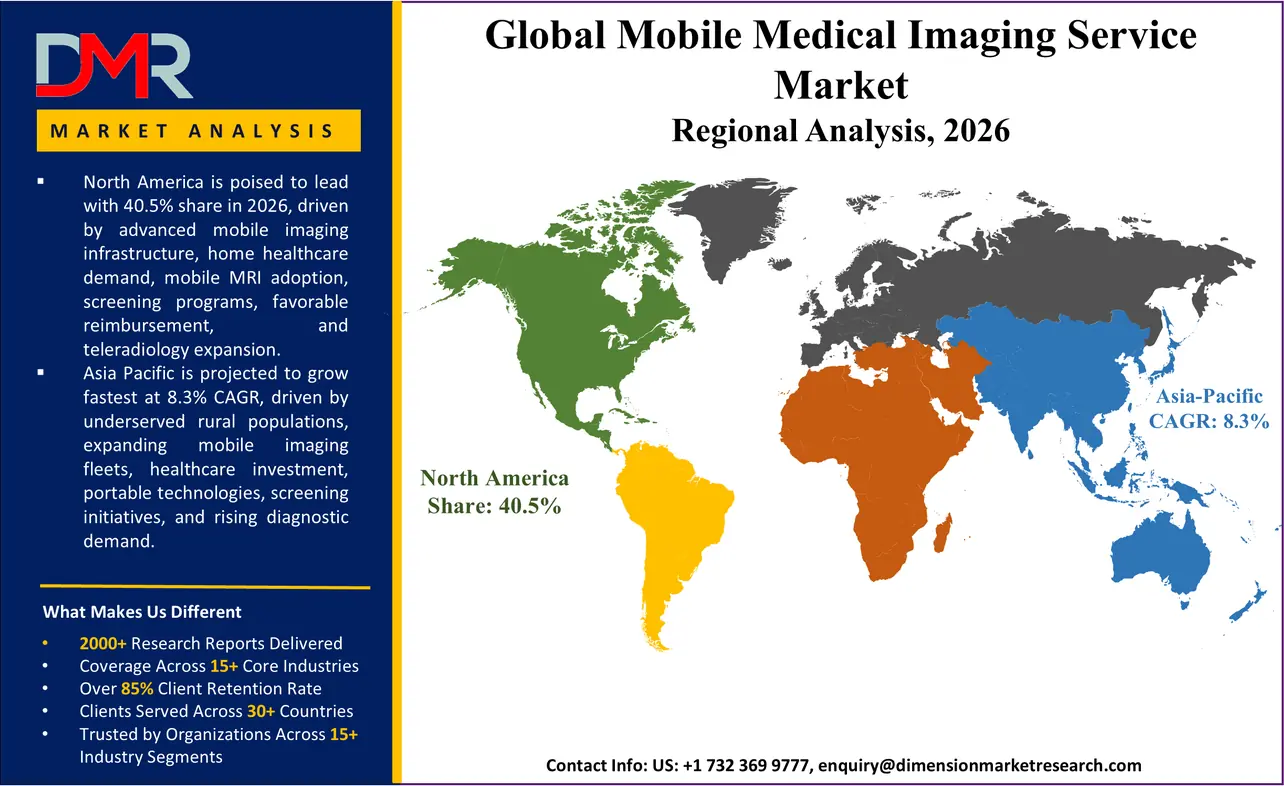
North America is poised to lead the Global Mobile Medical Imaging Service Market with an estimated 40.5% revenue share in 2026. The region's dominance is anchored by a mature mobile imaging fleet infrastructure, extensive rural and community outreach screening programs, and the world's highest per-capita expenditure on home healthcare and hospital-at-home diagnostic services. The United States, in particular, is characterized by early and broad adoption of mobile mammography and mobile MRI contracting models, robust commercial and public insurance coverage for home-based and portable imaging services, and a dynamic teleradiology ecosystem supported by expanding telehealth policy reforms.
ℹ
To learn more about this report –
Download Your Free Sample Report Here
Asia Pacific is the Fastest-Growing Region in the Global Mobile Medical Imaging Service Market
Asia Pacific is projected to register the fastest CAGR of 8.3% through 2035, driven by the region's enormous rural and geographically dispersed population lacking access to fixed imaging infrastructure, particularly in China and India, which together represent vast underserved diagnostic imaging catchment areas. Economic development is enabling substantial investments in mobile fleet expansion, with both public and private providers rapidly deploying portable and trailer-based imaging units to meet previously unmet diagnostic demand. Additionally, governments are implementing national mobile screening initiatives that are boosting community-based cancer and tuberculosis detection rates and driving mobile imaging service utilization.
The Europe Mobile Medical Imaging Service Market
Europe represents one of the largest regional markets, characterized by universal healthcare coverage models that fund extensive community and rural mobile screening programs, though with significant cross-national variation in mobile MRI and tele-imaging adoption. Germany holds the largest European market share, driven by its extensive mobile imaging fleet operators, high mobile mammography screening participation rates, and broad reimbursement for portable diagnostic services. The European Society of Radiology's advocacy for equitable imaging access and the growing adoption of tele-imaging reporting standards are gradually improving mobile diagnostic reach across rural member states.
Latin America Mobile Medical Imaging Service Market
The Latin America Mobile Medical Imaging Service Market is expanding as significant rural healthcare access gaps, coupled with growing private mobile imaging operator investment, drive demand for on-site and community-based diagnostic services. Brazil and Mexico are the primary national markets, with Brazil's public health system (SUS) funding an expanding network of mobile mammography and portable X-ray units for underserved regions. Mexico's growing private mobile diagnostic sector and rising rural outreach screening initiatives fuel market expansion.
Middle East and Africa Mobile Medical Imaging Service Market
The Middle East and Africa Mobile Medical Imaging Service Market is developing against a backdrop of substantial government investment in mobile screening infrastructure across Gulf Cooperation Council (GCC) countries and a growing mobile diagnostic imaging buildout addressing infectious disease and maternal health screening needs across sub-Saharan Africa. Saudi Arabia and the United Arab Emirates are the most attractive markets, with high government healthcare spending, expansive mobile fleet infrastructure, and active national community screening programs driven by public health transformation strategies.
Major Countries Analysis
The US Mobile Medical Imaging Service Market
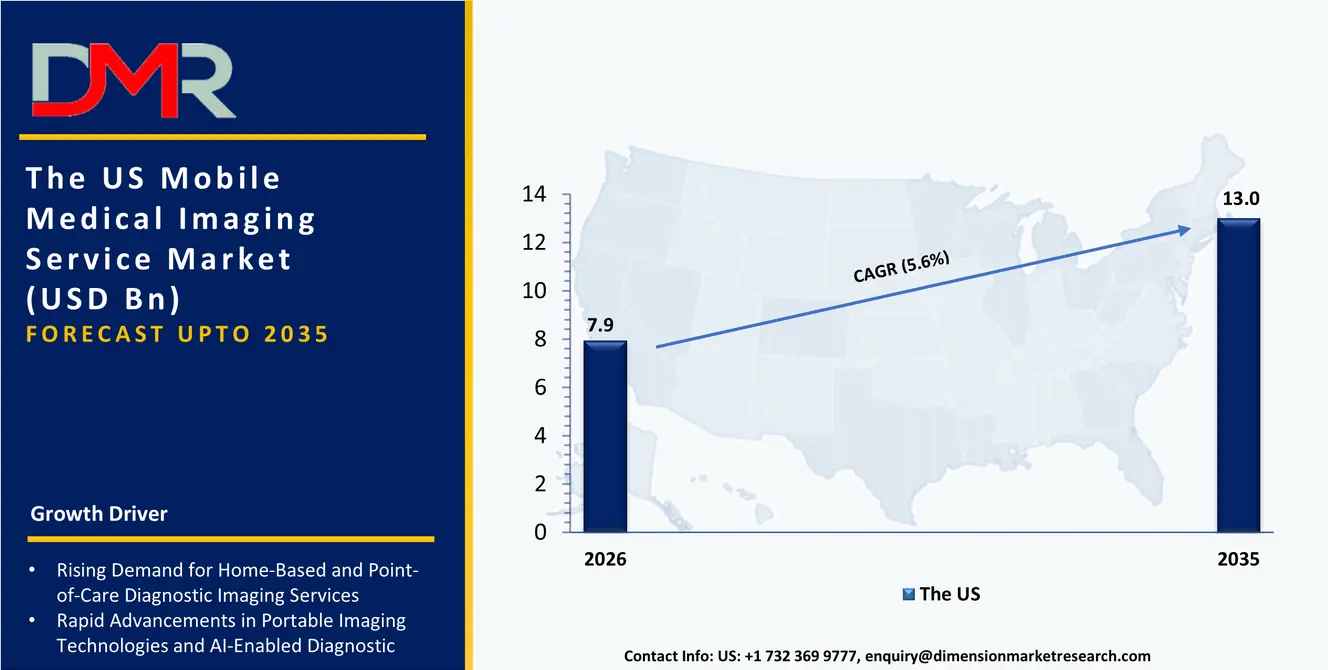
The United States Mobile Medical Imaging Service Market is projected to be valued at USD 7.9 billion in 2026 and is expected to reach USD 13.0 billion by 2035, registering a CAGR of 5.6% from 2026 to 2035. This robust trajectory reflects the U.S.'s position as the highest-value single-country mobile imaging services market globally, underpinned by an extensive network of hospital-affiliated mobile fleets and a rapidly expanding home healthcare imaging sector. Growth is fueled by the transformative impact of hospital-at-home reimbursement expansion, which has restructured payment incentives to favor home-based and portable diagnostic delivery, and by the rapid contracting growth of mobile MRI and mobile mammography service providers.
ℹ
To learn more about this report –
Download Your Free Sample Report Here
Japan Mobile Medical Imaging Service Market
Japan possesses one of the world's most sophisticated mobile diagnostic imaging infrastructures, a consequence of its super-aged society and high demand for accessible geriatric and homebound patient imaging, sustained by a well-developed portable ultrasound and mobile X-ray service network. The market is distinguished by advanced point-of-care imaging technology adoption, high utilization of mobile bone densitometry for osteoporosis screening relative to other Asian nations, and early regulatory approval of novel portable imaging devices. The Japanese Society of Radiological Technology's influential clinical practice guidelines and the national geriatric health screening program support sustained mobile imaging utilization.
Saudi Arabia Mobile Medical Imaging Service Market
Market expansion is directly tied to the Kingdom's substantial government investment in expanding diagnostic access across geographically dispersed regions, which together drive rising adoption of mobile CT, mobile mammography, and portable ultrasound services. The Saudi Ministry of Health oversees a growing mobile screening program supported by national community health initiatives, while public-private partnerships fund extensive mobile fleet deployments. Vision 2030's healthcare transformation agenda, which emphasizes equitable access and digital health, is opening significant opportunities for international mobile imaging fleet operators, portable equipment vendors, and tele-imaging platform developers.
Regulatory Landscape
The regulatory landscape for mobile medical imaging services is shaped by agencies that balance expanding diagnostic access with rigorous safety and quality assurance requirements for portable and vehicle-mounted imaging equipment. In the United States, the FDA's Center for Devices and Radiological Health, together with state radiation control programs, has established accreditation and mobile unit inspection frameworks that govern the operation of trailer-based mobile MRI, CT, and mammography units, ensuring image quality and radiation safety standards comparable to fixed installations.
Market Landscape & White Space Analysis
The Mobile Medical Imaging Service Market Adoption section assesses historical and forecast service penetration across the diagnostic imaging delivery models covered in the study. It evaluates deployed mobile fleet units, portable equipment utilization rates, and tele-imaging reporting volumes, including mobile on-site, portable, and remote diagnostic delivery. The United States hospital network operates one of the largest fleets of mobile MRI and mobile mammography units globally, with home healthcare-based portable imaging utilization continuing to expand across rural and suburban markets. China and India are scaling mobile imaging fleet deployment at a pace that positions Asia Pacific as the largest addressable growth region for mobile diagnostic service expansion over the forecast period. Globally, a substantial and growing share of diagnostic imaging encounters in underserved and homebound populations are now delivered through mobile on-site units, portable equipment services, or tele-imaging platforms rather than fixed hospital-based radiology suites.
By Region
North America
Europe
- Germany
- France
- The U.K.
- Italy
- Spain
- Rest of Europe
Asia-Pacific
- China
- Japan
- India
- Australia
- South Korea
- Rest of APAC
Latin America
- Mexico
- Brazil
- Rest of LATAM
Middle East & Africa
- Saudi Arabia
- The UAE
- South Africa
- Rest of MEA
Competitive Landscape
The Global Mobile Medical Imaging Service Market features a diverse competitive landscape spanning multinational imaging equipment manufacturers, dedicated mobile fleet service operators, portable device innovators, and emerging tele-imaging platform providers. Alliance HealthCare Services and Shared Imaging dominate the mobile on-site imaging services market through extensive networks of mobile MRI and CT trailers contracted to hospital systems nationwide. Siemens Healthineers and GE Healthcare are leading manufacturers of mobile-configured imaging equipment, competing on trailer-mounted system reliability, portable device miniaturization, and fleet connectivity platforms.
Some of the prominent players in the Global Mobile Medical Imaging Service Market are:
- Akumin Inc.
- Alliance HealthCare Services
- DMS Health Technologies
- TridentCare
- Shared Medical Services
- RadNet, Inc.
- RAYUS Radiology
- InHealth Group
- Cobalt Health
- Accurate Imaging Diagnostics
- Atlantic Medical Imaging
- Front Range Mobile Imaging
- Interim Diagnostic Imaging
- MobilexUSA
- Digirad Corporation
- Alliance Medical Limited
- Nuffield Health
- Premier Diagnostic Services
- Axiom Mobile Imaging
- Imaging On Site
- Jacksonville Mobile Imaging Services
- Mediscan Diagnostic Services
- Mobile Imaging Diagnostics
- Medica Reporting
- OnSite Imaging
- Quality Medical Imaging
- Alpha One Imaging
- Ultra-X Imaging
- Mantro Mobile Imaging
- The HCS Group
- Consulting Radiologists Ltd.
- MedQuest Associates
- MedRay Imaging
- CDL Nuclear Technologies
- SimonMed Imaging
- DispatchHealth Imaging
- Carestream Health
- Siemens Healthineers
- GE HealthCare
- Fujifilm Healthcare
- Other Key Players
Recent Developments
- May 2026: Shared Imaging expanded its mobile MRI fleet with a new generation of trailer-mounted wide-bore MRI units designed to reduce hospital deployment turnaround time for short-term and emergency imaging capacity contracts.
- February 2026: Hologic announced a partnership with a national home healthcare network to expand mobile mammography screening access to homebound and mobility-limited patients across underserved rural counties.
- December 2025: GE Healthcare launched a compact, trailer-configured PET CT system aimed at extending oncology screening access to community hospitals lacking permanent nuclear imaging infrastructure.
- October 2025: Butterfly Network expanded distribution of its handheld point-of-care ultrasound platform to home healthcare and rehabilitation providers, integrating AI-guided image acquisition for non-specialist operators.
Report Details
| Report Characteristics |
| Market Size (2026) |
USD 23.3 Bn |
| Forecast Value (2035) |
USD 39.4 Bn |
| CAGR (2026–2035) |
6.0% |
| The US Market Size (2026) |
USD 7.9 Bn |
| Historical Data |
2021 – 2025 |
| Forecast Data |
2027 – 2035 |
| Base Year |
2025 |
| Estimate Year |
2026 |
| Segments Covered |
By Service Type, By Service Delivery Model, By Clinical Application, By End User |
| Regional Coverage |
North America – The US and Canada; Europe – Germany, France, The UK, Italy, Spain, Rest of Europe; Asia-Pacific – China, Japan, India, Australia, South Korea, Rest of APAC; Latin America – Mexico, Brazil, Colombia, Argentina, Rest of LATAM; Middle East & Africa – Saudi Arabia, The UAE, South Africa, Rest of MEA |
Frequently Asked Questions
How big is the Global Mobile Medical Imaging Service Market?
▾ The Global Mobile Medical Imaging Service Market is projected to reach USD 39.4 billion by 2035, reflecting strong global demand for decentralized diagnostic imaging, home-based care, and community screening outreach.
What is the CAGR of the Global Mobile Medical Imaging Service Market from 2026 to 2035?
▾ The market is projected to expand at a compound annual growth rate (CAGR) of 6.0% between 2026 and 2035, supported by sustained investment in mobile fleet expansion, tele-imaging infrastructure, and rising home healthcare imaging demand.
What factors are driving the growth of the Global Mobile Medical Imaging Service Market?
▾ Growth is driven by the escalating demand for decentralized and home-based diagnostic imaging, advances in portable imaging hardware, expanding reimbursement for mobile and tele-imaging services, aging populations, and the integration of AI-enabled point-of-care image quality assurance tools.
What are the major trends in the Global Mobile Medical Imaging Service Market?
▾ Major trends include the convergence of hospital-at-home and community-based care platforms, the shift toward tele-imaging and remote diagnostic reporting, AI-enabled portable image acquisition guidance, precision screening program design by modality, and the expansion of mobile mammography and PET CT screening initiatives.
Which region held the largest share of the Global Mobile Medical Imaging Service Market in 2026?
▾ North America is expected to lead the global market with a 40.5% share in 2026, supported by extensive mobile fleet infrastructure, early adoption of home-based imaging reimbursement, a well-funded teleradiology ecosystem, and strong hospital outreach contracting.
Which region is expected to grow the fastest in the Global Mobile Medical Imaging Service Market?
▾ Asia Pacific is expected to record the fastest growth at an 8.3% CAGR through 2035, driven by its vast underserved rural population, rapid mobile fleet expansion, and government-led community screening programs.
Who are the key players in the Global Mobile Medical Imaging Service Market?
▾ Key market participants include Alliance HealthCare Services, Shared Imaging, Siemens Healthineers, GE Healthcare, Koninklijke Philips, Canon Medical Systems, Hologic, Carestream Health, Butterfly Network, and RadNet, among other mobile imaging equipment, fleet operation, and portable diagnostic technology firms.
How is the Global Mobile Medical Imaging Service Market segmented?
▾ The market is segmented by service type, service delivery model, clinical application, and end user, with regional analysis covering North America, Europe, Asia Pacific, Latin America, and the Middle East and Africa.