Market Overview
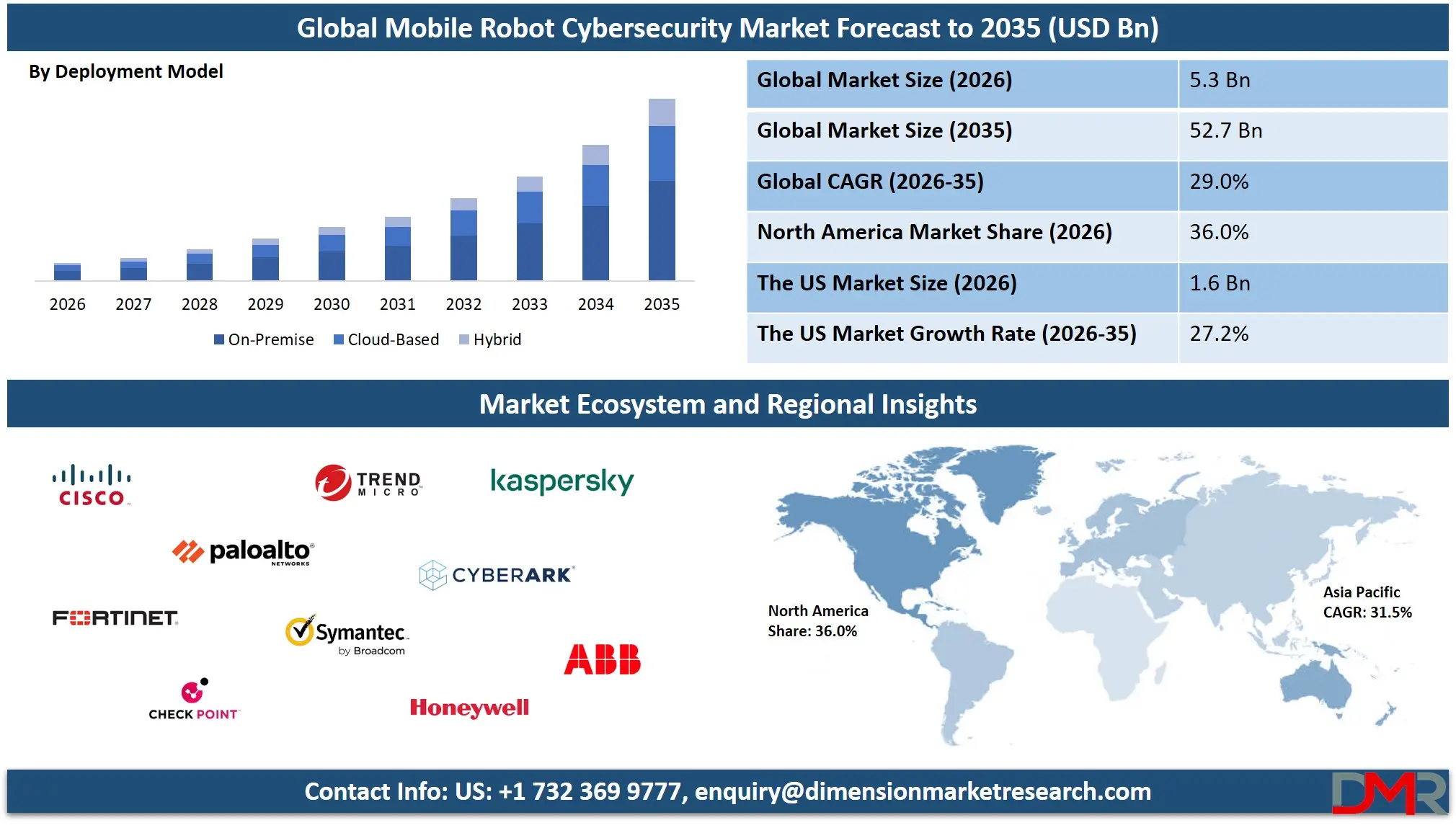
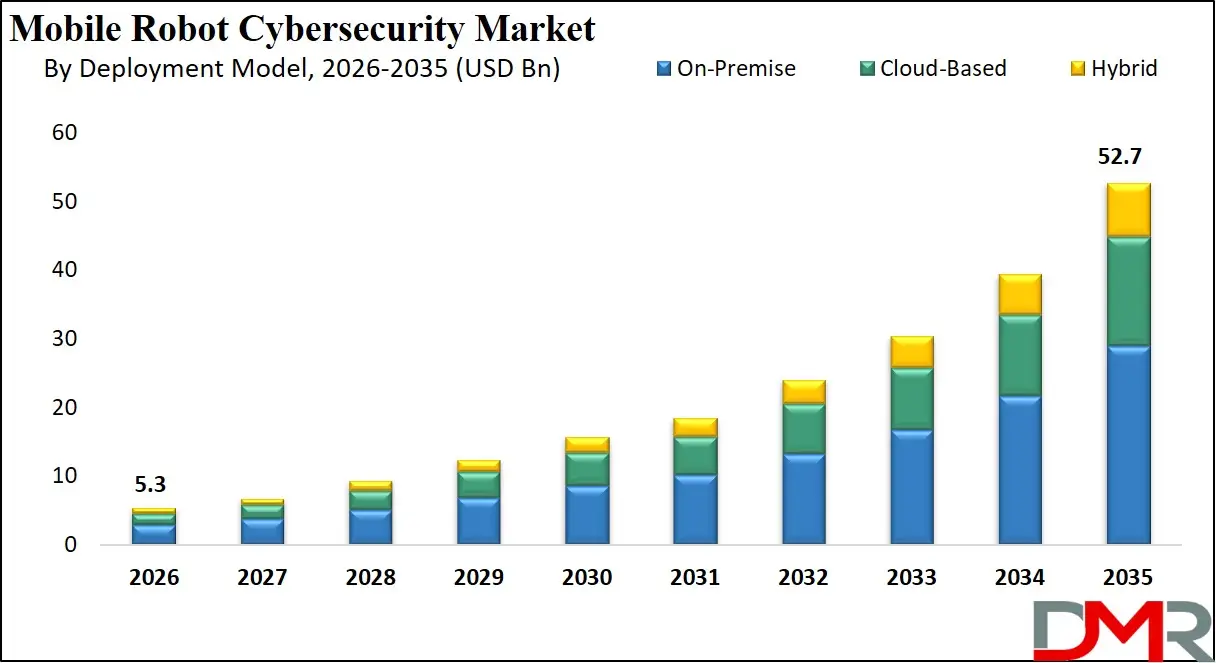
The Global Mobile Robot Cybersecurity Market is estimated to reach USD 5.3 billion in 2026 and is expected to grow at a CAGR of 29.0% from 2026 to 2035, reaching USD 52.7 billion by 2035, driven by increasing adoption of autonomous mobile robots, rising cyber threats in industrial robotics, and growing demand for robotic network security, endpoint protection, and secure communication systems across connected robotic ecosystems.
ℹ
To learn more about this report –
Download Your Free Sample Report Here
Mobile robot cybersecurity refers to the set of technologies, protocols, and security frameworks designed to protect mobile robotic systems from cyber threats, unauthorized access, data breaches, and operational disruptions. Mobile robots including autonomous mobile robots, automated guided vehicles, unmanned aerial vehicles, and service robots rely heavily on network connectivity, cloud platforms, sensors, and artificial intelligence for navigation, communication, and decision making. This connectivity exposes robotic platforms to vulnerabilities such as malware attacks, system hijacking, communication interception, and manipulation of control commands. Cybersecurity solutions for mobile robots focus on securing firmware, communication networks, device identities, data transmission, and robotic operating systems to ensure safe and reliable operation. As robotics becomes integrated with industrial automation, Internet of Things infrastructure, and smart manufacturing environments, cybersecurity plays a crucial role in protecting robotic fleets, maintaining operational continuity, and safeguarding sensitive industrial data.
The global mobile robot cybersecurity market represents the industry focused on providing security technologies and services that protect connected robotic systems used across manufacturing, logistics, healthcare, defense, agriculture, and service sectors. As organizations deploy increasing numbers of autonomous mobile robots and drone based systems, the need for advanced security solutions such as threat detection platforms, endpoint protection, secure communication protocols, and identity access management has grown rapidly. The market includes cybersecurity software providers, hardware security manufacturers, and managed security service providers that develop solutions specifically designed for robotic networks and intelligent machines operating in connected industrial ecosystems.
ℹ
To learn more about this report –
Download Your Free Sample Report Here
Growth in the global mobile robot cybersecurity market is driven by the expansion of Industry 4.0 infrastructure, rising adoption of collaborative robots, and the integration of robotics with cloud computing and artificial intelligence technologies. Enterprises are prioritizing robotic system protection to prevent operational downtime, intellectual property theft, and safety risks caused by cyber intrusions. Increasing regulatory focus on operational technology security, along with rising investments in autonomous logistics, smart factories, and robotic healthcare systems, is accelerating demand for advanced cybersecurity platforms that safeguard robotic devices, fleet management systems, and data communication networks worldwide.
The US Mobile Robot Cybersecurity Market
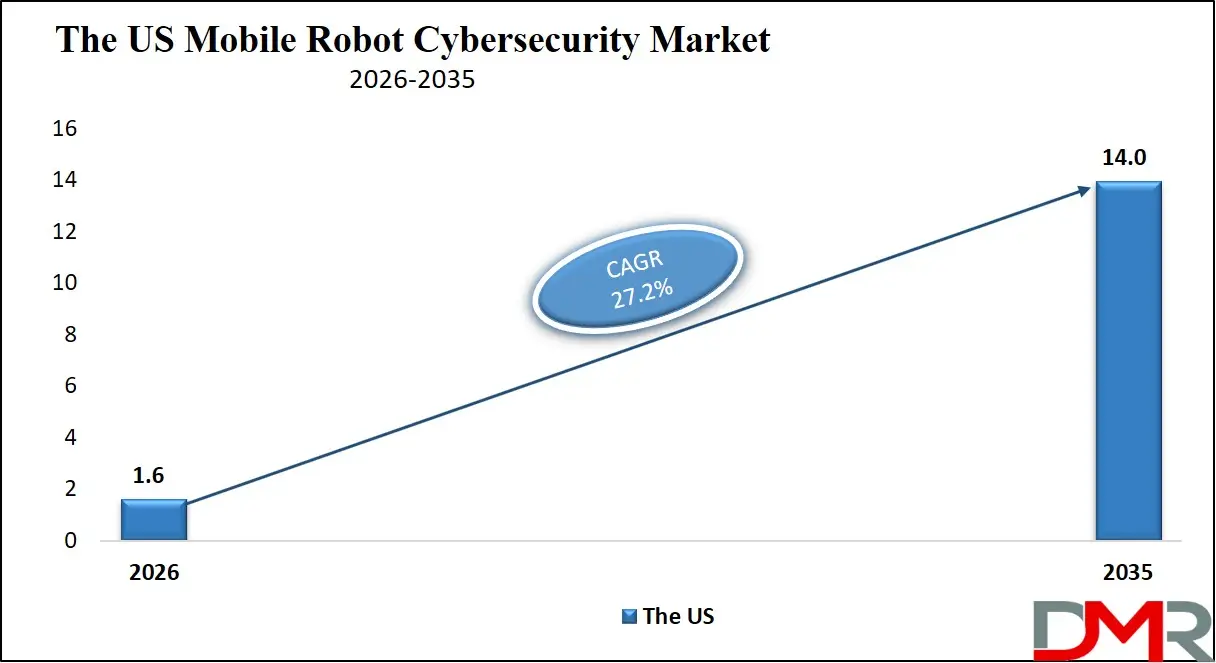
The U.S. Mobile Robot Cybersecurity Market size is expected to reach at USD 1.6 billion in 2026. It is further expected to witness subsequent growth in the upcoming period, holding USD 14.0 billion in 2035 at a CAGR of 27.2%.
ℹ
To learn more about this report –
Download Your Free Sample Report Here
The United States mobile robot cybersecurity market is expanding rapidly as organizations increase the deployment of autonomous mobile robots, drones, and automated guided vehicles across manufacturing, logistics, defense, and healthcare sectors. Advanced robotics systems rely on continuous connectivity with cloud platforms, industrial networks, and fleet management software, which increases the risk of cyber threats targeting robotic infrastructure. As a result, enterprises are investing heavily in endpoint protection, secure communication protocols, identity management, and threat detection platforms designed specifically for robotic operating environments. Strong adoption of industrial automation and smart manufacturing initiatives is further accelerating demand for advanced robotic cybersecurity solutions.
The presence of leading cybersecurity providers and robotics technology developers in the United States is also supporting market growth through continuous innovation in robotic security architecture and operational technology protection. Government agencies and defense organizations are increasingly prioritizing cybersecurity for unmanned ground vehicles, surveillance drones, and autonomous defense platforms to prevent system compromise and operational disruption. In addition, large scale warehouse automation and e commerce fulfillment operations are deploying fleets of connected mobile robots that require robust data protection and network monitoring. These trends are strengthening the adoption of integrated cybersecurity platforms that safeguard robotic fleets, control systems, and industrial networks.
The Europe Mobile Robot Cybersecurity Market
The Europe mobile robot cybersecurity market is projected to reach approximately USD 1.4 billion in 2026, expanding at a CAGR of 27.0%. Growth in the region is strongly supported by the rapid adoption of industrial automation, smart manufacturing systems, and connected robotic technologies across major economies such as Germany, France, and United Kingdom. Manufacturing companies are increasingly deploying autonomous mobile robots and automated guided vehicles within production facilities and logistics environments. As these robotic systems become integrated with industrial networks and cloud based platforms, the need for advanced cybersecurity solutions such as network protection, secure communication protocols, and robotic endpoint security is rising significantly.
In addition, the strong presence of robotics manufacturers, industrial automation providers, and cybersecurity technology companies across Europe is contributing to market expansion. Governments and regulatory bodies in the region are emphasizing stricter cybersecurity frameworks to protect operational technology systems and connected industrial infrastructure. Growing investments in Industry 4.0 initiatives and smart factory development are encouraging organizations to adopt robust security architectures for robotic fleets and automation systems. As a result, enterprises across sectors including manufacturing, logistics, and defense are increasingly implementing advanced threat detection platforms, encrypted robotic communication networks, and secure firmware management to safeguard connected robotic ecosystems.
The Japan Mobile Robot Cybersecurity Market
The Japan mobile robot cybersecurity market is projected to reach approximately USD 318 million in 2026, growing at a CAGR of 30.2%. Growth in the country is driven by the strong adoption of robotics across manufacturing, electronics production, automotive assembly, and logistics automation. Japan has long been a global leader in industrial robotics, with companies increasingly deploying autonomous mobile robots and automated guided vehicles within smart factories and warehouse environments. As robotic systems become more connected through industrial networks, cloud platforms, and artificial intelligence applications, demand for advanced cybersecurity solutions that protect robotic communication systems and operational data is rising rapidly.
In addition, the expansion of Industry 4.0 infrastructure and the integration of robotics with digital manufacturing technologies are further strengthening the need for robust robotic cybersecurity frameworks in Japan. Companies are prioritizing network security, endpoint protection, and secure firmware management to safeguard robotic fleets operating within highly automated production facilities. The growing use of service robots, inspection robots, and logistics automation systems is also increasing cybersecurity requirements across multiple industries. As enterprises continue to modernize factory operations and supply chain networks, investments in advanced robotic security platforms are expected to accelerate across the Japanese market.
Global Mobile Robot Cybersecurity Market: Key Takeaways
- Rising cybersecurity risks in connected robots: Growing use of autonomous mobile robots and automated guided vehicles across industries is increasing exposure to cyber threats. Organizations are adopting robotic network security, endpoint protection, and encrypted communication systems to safeguard connected robotic fleets.
- Industry 4.0 driving security adoption: Expansion of smart factories and industrial automation is increasing demand for cybersecurity solutions that protect robotic networks, operational data, and automated production environments.
- Hardware security gaining importance: Secure processors, security chips, and trusted modules are increasingly used to protect robotic devices from tampering, unauthorized access, and firmware manipulation.
- Artificial intelligence improving threat detection: AI driven cybersecurity platforms help detect abnormal robot behavior, monitor robotic networks, and automatically respond to emerging cyber threats.
- Growth of robotic logistics automation: Increasing deployment of robots in warehouses and e commerce fulfillment centers is driving demand for secure fleet management and robotic communication protection.
Global Mobile Robot Cybersecurity Market: Use Cases
- Smart Manufacturing Security: Autonomous mobile robots and automated guided vehicles are widely used in smart factories for material movement and inspection. Mobile robot cybersecurity solutions protect industrial networks, robotic operating systems, and control commands. Secure firmware, encrypted communication, and endpoint protection help prevent unauthorized access and cyber-attacks that could disrupt production processes and connected factory systems.
- Warehouse Automation Protection: Logistics and e commerce warehouses deploy robotic fleets for order fulfillment and inventory handling. Cybersecurity solutions secure wireless communication, fleet management platforms, and data transmission between robots and warehouse systems. Network monitoring and identity access control help prevent hacking attempts and ensure safe robotic operations.
- Defense Robotics Security: Military and surveillance robots such as unmanned ground vehicles and drones require strong cybersecurity to prevent system hijacking and signal interference. Security frameworks protect command networks, navigation software, and communication links used in defense robotics operations.
- Healthcare Service Robots Security: Hospitals use mobile robots for medicine delivery, disinfection, and patient assistance. Cybersecurity platforms protect healthcare data, robotic control systems, and hospital networks while ensuring safe and uninterrupted robotic services within connected healthcare environments.
Global Mobile Robot Cybersecurity Market: Stats & Facts
- U.S. Cybersecurity and Infrastructure Security Agency (CISA)
- In 2025, CISA reported that over 42% of critical infrastructure organizations in the U.S. deployed autonomous or robotic systems in operational environments, increasing the need for cybersecurity protections for connected robotic platforms.
- In 2024, CISA identified over 250 publicly disclosed vulnerabilities in industrial control and robotic automation systems, many affecting mobile and autonomous robots used in logistics and manufacturing.
- In 2024, CISA warned that network-connected robotic systems accounted for nearly 18% of newly reported OT security incidents in U.S. industrial environments.
- In 2023, CISA reported that 60% of organizations using robotics platforms rely on cloud connectivity, expanding cybersecurity risk exposure.
- In 2025, CISA guidance highlighted that robotic fleet management platforms are increasingly targeted by ransomware groups due to centralized control architecture.
- European Union Agency for Cybersecurity (ENISA)
- In 2025, ENISA noted that autonomous robotic systems were among the top emerging technologies requiring cybersecurity standards in the EU digital resilience framework.
- In 2024, ENISA reported that over 37% of European manufacturing facilities used robotic automation systems connected to enterprise networks.
- In 2023, ENISA documented more than 120 vulnerabilities related to robotic software frameworks and middleware platforms used in autonomous systems.
- In 2024, ENISA highlighted that robotic platforms integrated with AI navigation systems increased attack surfaces due to sensor and software dependencies.
- In 2025, ENISA identified robot fleet management software as a growing cybersecurity risk area in smart factories and warehouses.
- National Institute of Standards and Technology (NIST)
- In 2024, NIST reported that over 70% of industrial robots in operational environments are connected to enterprise IT networks or cloud systems.
- In 2023, NIST documented that robot operating system (ROS) deployments were used in thousands of robotics research and commercial platforms globally, raising cybersecurity considerations.
- In 2025, NIST cybersecurity frameworks highlighted autonomous robots as a critical component of cyber-physical systems requiring secure software architecture.
- In 2024, NIST found that authentication weaknesses were present in more than 30% of tested robotic communication interfaces.
- In 2023, NIST studies indicated that sensor spoofing and command injection remain key vulnerabilities in autonomous robotic navigation systems.
- European Commission
- In 2025, the European Commission reported that over 3 million industrial robots were operating globally within manufacturing environments.
- In 2024, EU digital strategy initiatives identified robotics and autonomous machines as key technologies requiring cybersecurity compliance under the EU Cyber Resilience Act.
- In 2023, the Commission estimated that more than 75% of new robotic deployments in European factories include internet connectivity for remote monitoring.
- In 2024, EU research programs funded over 40 cybersecurity and robotics integration projects under Horizon Europe initiatives.
- In 2025, EU industrial policy emphasized secure robotics integration as part of Industry 4.0 infrastructure modernization.
- U.S. Department of Defense
- In 2025, the Department of Defense reported that autonomous and robotic systems are increasingly integrated across logistics, surveillance, and operational platforms.
- In 2024, DoD cybersecurity assessments identified robotic and autonomous vehicles as cyber-physical systems requiring hardened communication networks.
- In 2023, DoD research programs supported more than 60 projects focused on secure autonomy and robotic system resilience.
- In 2025, defense technology strategies emphasized cybersecurity protections for unmanned ground vehicles and robotic support systems.
- In 2024, DoD guidance highlighted secure firmware and encrypted communication as essential safeguards for military robotic platforms.
- National Cyber Security Centre (NCSC)
- In 2024, the NCSC reported that robotic automation systems used in UK logistics facilities are increasingly connected to enterprise IT infrastructure, raising cyber risk concerns.
- In 2023, the NCSC warned that supply-chain vulnerabilities in robotic software components can expose industrial systems to cyber intrusion.
- In 2025, the NCSC emphasized that autonomous systems and robotics are key sectors requiring stronger cyber resilience standards in the UK industrial ecosystem.
Global Mobile Robot Cybersecurity Market: Market Dynamic
Driving Factors in the Global Mobile Robot Cybersecurity Market
Rising Adoption of Autonomous Mobile Robots
The increasing deployment of autonomous mobile robots and automated guided vehicles in manufacturing, logistics, and warehouse automation is a major driver of the mobile robot cybersecurity market. These robots operate through wireless networks, cloud platforms, and robotic operating systems, which creates exposure to cyber threats. As industrial automation expands, companies are adopting endpoint protection, secure communication protocols, and robotic network security solutions to protect connected robotic fleets and maintain operational safety.
Growing Cyber Threats in Connected Robotics
Connected robotic ecosystems are becoming attractive targets for cyber-attacks due to their integration with industrial networks and IoT infrastructure. Vulnerabilities in communication channels, robot control software, and fleet management systems can lead to system manipulation or data breaches. As a result, organizations are implementing advanced threat detection, identity access management, and encryption technologies to strengthen cybersecurity across robotic platforms.
Restraints in the Global Mobile Robot Cybersecurity Market
High Deployment and Integration Costs
Implementing cybersecurity solutions for mobile robots requires investments in hardware security modules, encryption systems, and monitoring platforms. Integration with existing industrial control systems and robotic infrastructure can increase deployment complexity and cost, which may limit adoption among smaller organizations.
Limited Cybersecurity Awareness in Robotics Operations
Many companies deploying mobile robots focus primarily on automation efficiency rather than cybersecurity preparedness. Limited awareness of robotic vulnerabilities and lack of specialized cybersecurity expertise can slow the adoption of dedicated robotic security platforms in several industries.
Opportunities in the Global Mobile Robot Cybersecurity Market
Expansion of Smart Factories and Industry 4.0
The growth of Industry 4.0 and smart manufacturing is creating strong opportunities for mobile robot cybersecurity solutions. As factories deploy connected robotic fleets, demand is rising for network security, secure firmware, and robotic endpoint protection to safeguard automated production environments.
Increasing Investments in Autonomous Logistics
E commerce and logistics companies are expanding the use of robotic warehouse systems and delivery robots. This growth creates opportunities for cybersecurity providers offering secure communication, fleet monitoring, and cloud security solutions for robotic logistics operations.
Trends in the Global Mobile Robot Cybersecurity Market
Integration of Artificial Intelligence in Cybersecurity
Artificial intelligence and machine learning are increasingly used in cybersecurity platforms to detect abnormal robot behavior and network threats in real time. AI driven monitoring systems improve threat detection capabilities for robotic fleets and connected automation systems.
Rising Focus on Operational Technology Security
Organizations are prioritizing operational technology security to protect industrial robots, automated vehicles, and smart factory networks. Security frameworks designed for OT environments are becoming essential to safeguard robotic communication networks, data systems, and industrial automation infrastructure.
Global Mobile Robot Cybersecurity Market: Research Scope and Analysis
By Component Analysis
Hardware security is anticipated to dominate the component segment of the mobile robot cybersecurity market, capturing about 41.0% of the total market share in 2026. This dominance is largely driven by the increasing need to secure robotic hardware components such as processors, control units, sensors, and communication modules that form the core infrastructure of autonomous mobile robots and automated guided vehicles. Hardware based security mechanisms such as secure chips, trusted platform modules, and secure boot systems provide foundational protection against physical tampering, firmware manipulation, and unauthorized device access. As robots operate in industrial automation, logistics warehouses, and defense environments, hardware level protection becomes essential for safeguarding robotic operating systems and maintaining secure communication across connected robotic networks.
Software security also plays a critical role in this component segment by providing advanced protection for robotic applications, communication protocols, and cloud connected robotic management platforms. Software based cybersecurity solutions include threat detection platforms, data encryption systems, network firewalls, and identity access management tools designed to secure robotic operating environments. These solutions help monitor robotic fleets, detect anomalies in robot behavior, and protect sensitive operational data transmitted between robots, industrial control systems, and cloud infrastructure. As robotic systems increasingly rely on artificial intelligence, edge computing, and remote fleet management software, demand for flexible and scalable software security platforms continues to expand within the mobile robot cybersecurity market.
By Security Layer Analysis
Network security is anticipated to dominate the security layer segment of the mobile robot cybersecurity market, capturing about 34.0% of the total market share in 2026. This leadership is driven by the extensive reliance of mobile robots on wireless communication, cloud connectivity, and industrial networks to perform navigation, coordination, and data exchange tasks. Autonomous mobile robots, drones, and automated guided vehicles constantly communicate with fleet management platforms, warehouse systems, and industrial control networks. As a result, protecting these communication channels becomes critical. Network security solutions such as firewalls, encrypted communication protocols, virtual private networks, and network monitoring platforms help prevent unauthorized access, cyber intrusions, and data interception within connected robotic ecosystems.
Endpoint security also plays an important role in this segment by focusing on protecting the individual robotic devices operating within a network. Each mobile robot acts as a connected endpoint that can be targeted through firmware vulnerabilities, malware attacks, or unauthorized device access. Endpoint security solutions secure robotic hardware, operating systems, and embedded software through mechanisms such as secure boot, firmware validation, device authentication, and continuous threat monitoring. These technologies help ensure that robotic devices operate safely while preventing malicious manipulation of robot commands, navigation systems, and operational data across industrial automation and logistics environments.
By Robot Type Analysis
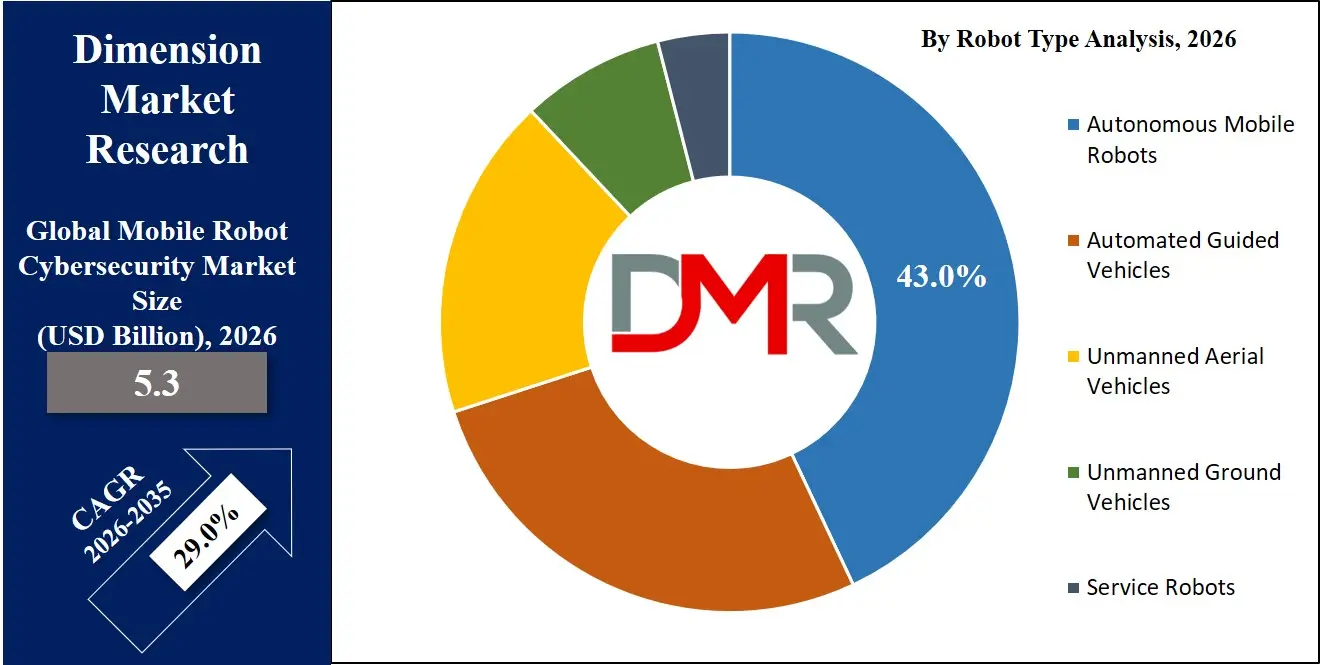
Autonomous mobile robots are anticipated to dominate the robot type segment of the mobile robot cybersecurity market, capturing about 43.0% of the total market share in 2026. These robots are widely deployed across manufacturing facilities, smart warehouses, logistics centers, and healthcare environments to perform tasks such as material transportation, inventory movement, and automated inspection. Autonomous mobile robots rely heavily on sensors, artificial intelligence, cloud connectivity, and wireless communication networks to operate efficiently. This high level of connectivity increases exposure to cyber threats targeting robotic navigation systems, fleet management platforms, and data communication channels. As a result, organizations are investing in cybersecurity solutions such as secure communication protocols, threat detection systems, and endpoint protection to safeguard autonomous robotic operations and maintain reliable automation infrastructure.
ℹ
To learn more about this report –
Download Your Free Sample Report Here
Automated guided vehicles also represent a significant segment within the mobile robot cybersecurity market due to their extensive use in industrial automation and warehouse material handling. These vehicles operate along predefined routes within factories and logistics facilities and are connected to centralized control systems and warehouse management software. Because AGVs depend on continuous network communication and integrated control platforms, they can be vulnerable to cyber intrusions, unauthorized command manipulation, and operational disruptions. Cybersecurity solutions such as network monitoring, secure firmware updates, and device authentication systems are increasingly implemented to protect AGV fleets and ensure safe and uninterrupted movement of goods within automated industrial environments.
By Deployment Model Analysis
On premise deployment is anticipated to dominate the deployment model segment of the mobile robot cybersecurity market, capturing about 55.0% of the total market share in 2026. This dominance is largely driven by industries such as manufacturing, defense, and logistics that require strict control over operational data, network infrastructure, and robotic systems. On premise cybersecurity solutions allow organizations to manage security frameworks directly within their internal IT and operational technology environments. This approach provides greater control over robotic networks, secure firmware management, and real time monitoring of autonomous mobile robots and automated guided vehicles. Many enterprises prefer on premise deployment to reduce external security risks, maintain regulatory compliance, and protect sensitive industrial data generated by robotic operations.
Cloud based deployment is also gaining significant traction as organizations adopt connected robotic fleets and centralized robotic management platforms. Cloud based cybersecurity solutions enable remote monitoring, scalable threat detection, and automated security updates for large fleets of mobile robots operating across multiple facilities. These platforms help secure communication between robots, cloud infrastructure, and enterprise systems through advanced encryption, identity access management, and network security tools. As robotics systems increasingly integrate with artificial intelligence, data analytics, and Internet of Things ecosystems, cloud based security platforms are becoming essential for managing cybersecurity across distributed robotic environments.
By Authentication Method Analysis
Password authentication is anticipated to dominate the authentication method segment of the mobile robot cybersecurity market, capturing about 30.0% of the total market share in 2026. This method remains widely used due to its simplicity, cost effectiveness, and compatibility with existing robotic management platforms and industrial control systems. Password based authentication is commonly implemented in robotic fleet management software, control dashboards, and network access systems that manage autonomous mobile robots and automated guided vehicles. Organizations continue to rely on password security combined with encryption and access control mechanisms to protect robotic communication networks, prevent unauthorized system access, and secure operational data within connected robotics environments.
Biometric authentication is also gaining traction in this market as organizations seek more advanced and secure identity verification methods for robotic systems and industrial automation platforms. Biometric technologies such as fingerprint recognition, facial recognition, and iris scanning provide stronger identity validation by linking system access to unique physical characteristics of authorized personnel. This approach helps reduce the risks associated with password theft or credential sharing while enhancing security across robotic control systems, industrial networks, and cloud connected robotics platforms. As robotics adoption expands in high security sectors such as defense, healthcare, and critical infrastructure, biometric authentication is becoming an important component of advanced cybersecurity frameworks.
By End-Use Industry Analysis
The manufacturing industry is anticipated to dominate the end use industry segment of the mobile robot cybersecurity market, capturing about 37.0% of the total market share in 2026. Manufacturing facilities increasingly deploy autonomous mobile robots, automated guided vehicles, and collaborative robots to support material handling, production support, and inspection tasks within smart factory environments. These robotic systems are integrated with industrial networks, production management platforms, and industrial Internet of Things infrastructure, which creates potential cybersecurity vulnerabilities. As a result, manufacturers are investing in robotic network security, endpoint protection, encrypted communication protocols, and secure firmware management to protect connected robotic systems, prevent operational disruptions, and safeguard sensitive production data within advanced industrial automation environments.
Logistics and warehousing also represent a significant segment in the mobile robot cybersecurity market as companies expand warehouse automation and robotic fleet operations to improve supply chain efficiency. Autonomous robots are widely used for order picking, inventory transportation, and automated fulfillment within large distribution centers. These robotic systems rely on wireless communication, cloud based fleet management platforms, and warehouse management software to coordinate operations. Because of this connectivity, logistics companies are increasingly implementing cybersecurity solutions such as network monitoring, identity access management, and secure communication systems to protect robotic fleets, maintain safe warehouse operations, and prevent cyber threats that could disrupt automated logistics processes.
The Global Mobile Robot Cybersecurity Market Report is segmented on the basis of the following:
By Component
- Hardware Security
- Secure Processors
- Security Modules
- Security Chips
- Secure Gateways
- Software Security
- Security Platforms
- Data Encryption
- Network Firewalls
- Threat Detection
- Identity Authentication
- Security Services
- Security Consulting
- System Integration
- Security Monitoring
- Penetrating Testing
- Incident Response
By Security Layer
- Network Security
- Endpoint Security
- Application Security
- Cloud Security
- Data Security
By Robot Type
- Autonomous Mobile Robots
- Logistics Robots
- Manufacturing Robots
- Inspection Robots
- Automated Guided Vehicles
- Warehouse Vehicles
- Production Vehicles
- Material Handling Vehicles
- Unmanned Aerial Vehicles
- Surveillance Drones
- Delivery Drones
- Mapping Drones
- Unmanned Ground Vehicles
- Military Vehicles
- Mining Vehicles
- Exploration Vehicles
- Service Robots
- Hospitality Robots
- Cleaning Robots
- Delivery Robots
By Deployment Model
- On-Premise
- Cloud-Based
- Hybrid
By Authentication Method
- Password Authentication
- Biometric Authentication
- Digital Certificates
- Security Tokens
- Multi-Factor Authentication
By End-Use Industry
- Manufacturing Industry
- Logistics and Warehousing
- Healthcare Sector
- Retail Industry
- Agriculture Industry
- Other Industries
Impact of Artificial Intelligence in the Global Mobile Robot Cybersecurity Market
Artificial intelligence is playing a transformative role in the global mobile robot cybersecurity market by improving the ability to detect, analyze, and respond to cyber threats targeting connected robotic systems. Mobile robots operating in manufacturing, logistics, healthcare, and defense environments generate large volumes of operational and network data through sensors, control systems, and communication networks. Artificial intelligence powered cybersecurity platforms can analyze this data in real time to identify unusual robot behavior, abnormal network traffic, or unauthorized access attempts. By using machine learning algorithms, these systems can continuously learn from new threat patterns and strengthen the protection of robotic operating systems, fleet management platforms, and wireless communication networks.
Artificial intelligence also enhances predictive security capabilities for robotic ecosystems by enabling proactive threat detection and automated response mechanisms. AI driven security tools can monitor robotic fleets, detect vulnerabilities in firmware or software applications, and automatically isolate compromised devices before cyber-attacks spread across connected networks. This capability is especially important for autonomous mobile robots and automated guided vehicles operating in smart factories and automated warehouses where system disruptions can impact large scale operations. As robotics systems increasingly integrate with cloud computing, industrial Internet of Things infrastructure, and edge computing platforms, artificial intelligence is becoming a critical component for strengthening cybersecurity frameworks and ensuring safe and reliable robotic operations across global industries.
Global Mobile Robot Cybersecurity Market: Regional Analysis
Region with the Largest Revenue Share
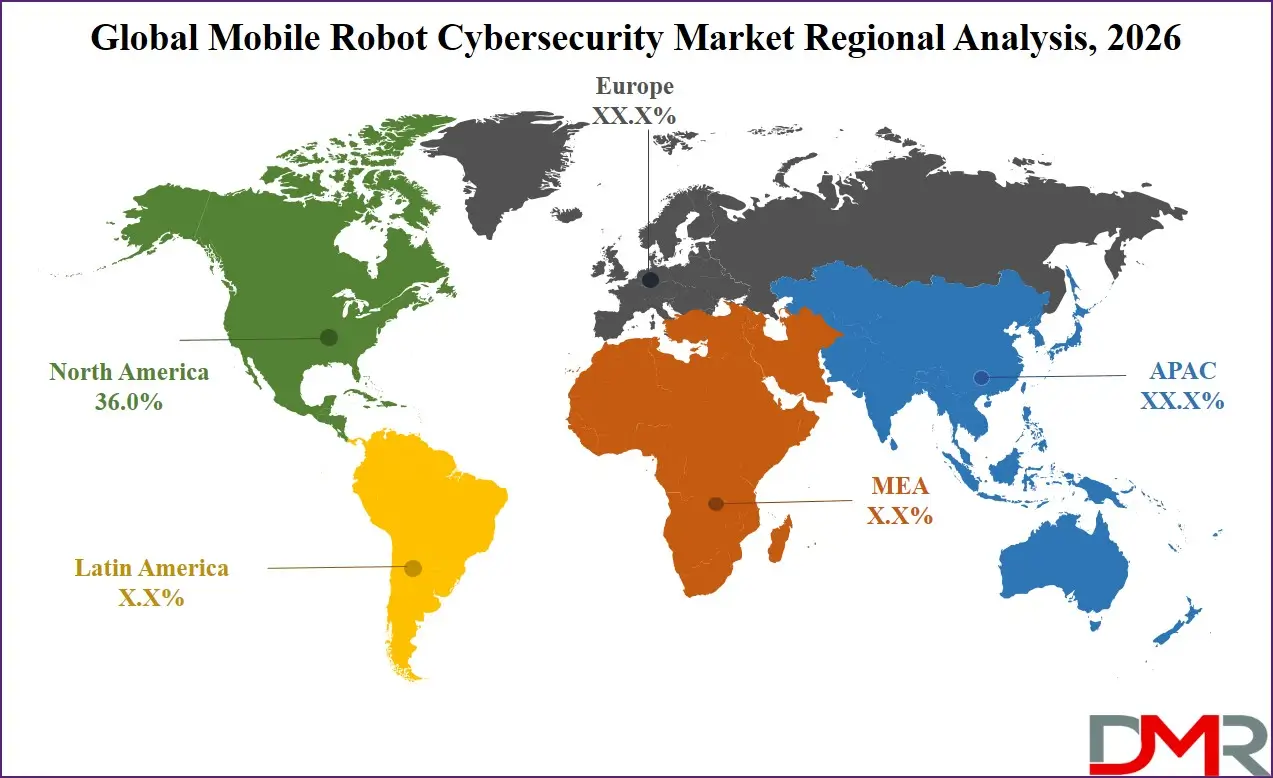
North America is anticipated to lead the global mobile robot cybersecurity market, accounting for about 36.0% of the total global market revenue in 2026. This leadership is driven by the rapid adoption of autonomous mobile robots, automated guided vehicles, and industrial robotics across manufacturing, logistics, defense, and healthcare sectors. The region benefits from advanced industrial automation infrastructure and strong investments in cybersecurity technologies to protect connected robotic systems. The presence of major cybersecurity providers and robotics technology companies in the United States and Canada further accelerates innovation in robotic network security, endpoint protection, and secure communication platforms designed for connected robotic ecosystems.
ℹ
To learn more about this report –
Download Your Free Sample Report Here
Region with the Highest CAGR
Asia Pacific is expected to register the highest CAGR in the global mobile robot cybersecurity market during the forecast period. The region is experiencing rapid growth in industrial automation, smart manufacturing, and warehouse robotics across countries such as China, Japan, South Korea, and India. Increasing deployment of autonomous mobile robots and automated guided vehicles in manufacturing plants and logistics centers is creating greater demand for advanced robotic cybersecurity solutions. Additionally, growing investments in Industry 4.0 infrastructure, artificial intelligence integration, and connected industrial networks are accelerating the adoption of network security, endpoint protection, and secure communication technologies for robotic systems across the region.
By Region
North America
Europe
- Germany
- The U.K.
- France
- Italy
- Russia
- Spain
- Benelux
- Nordic
- Rest of Europe
Asia-Pacific
- China
- Japan
- South Korea
- India
- ANZ
- ASEAN
- Rest of Asia-Pacific
Latin America
- Brazil
- Mexico
- Argentina
- Colombia
- Rest of Latin America
Middle East & Africa
- Saudi Arabia
- UAE
- South Africa
- Israel
- Egypt
- Rest of MEA
Global Mobile Robot Cybersecurity Market: Competitive Landscape
The global mobile robot cybersecurity market features a highly competitive landscape characterized by the presence of cybersecurity vendors, industrial automation providers, robotics manufacturers, and specialized security startups. Market participants are focusing on developing integrated cybersecurity platforms that combine network security, endpoint protection, data encryption, and threat detection capabilities specifically designed for robotic ecosystems. Increasing deployment of autonomous mobile robots and connected robotic fleets across manufacturing, logistics, and healthcare sectors is encouraging companies to invest heavily in research and development to strengthen robotic security architectures. Strategic collaborations between robotics developers and cybersecurity solution providers are also becoming common to deliver platform integrated protection for robotic operating systems, communication networks, and cloud connected robotic management platforms. The market is witnessing continuous innovation as vendors introduce artificial intelligence driven threat detection, secure firmware management, and advanced robotic network monitoring solutions to address evolving cyber threats targeting connected robotic infrastructure.
Some of the prominent players in the Global Mobile Robot Cybersecurity Market are:
- Cisco Systems
- Palo Alto Networks
- Fortinet
- Check Point Software Technologies
- Trend Micro
- Broadcom (Symantec)
- Kaspersky
- CyberArk
- Honeywell
- ABB
- Siemens
- KUKA
- FANUC
- Yaskawa Electric
- Omron
- Forescout Technologies
- Darktrace
- Rapid7
- Alias Robotics
- IBM
- Other Key Players
Recent Developments in the Global Mobile Robot Cybersecurity Market
- October 2025: Alias Robotics introduced CAI (Cybersecurity AI), an advanced artificial intelligence platform designed to detect vulnerabilities and automate security testing across robotic systems, strengthening protection for industrial robots, autonomous mobile robots, and connected robotic infrastructures.
- October 2025: SoftBank Group announced the acquisition of the robotics division of ABB in a deal valued at approximately USD 5.4 billion to strengthen its robotics and artificial intelligence strategy and expand secure robotic automation capabilities.
- September 2025: Alias Robotics secured strategic support through participation in the SynerLeap innovation ecosystem backed by ABB to accelerate the development of cybersecurity solutions for industrial robots and autonomous mobile robots.
- June 2024: Cobalt Robotics was acquired by technology entrepreneur Dean Drako and later restructured to expand artificial intelligence driven robotic security solutions.
Report Details
| Report Characteristics |
| Market Size (2026) |
USD 5.3 Bn |
| Forecast Value (2035) |
USD 52.7 Bn |
| CAGR (2026–2035) |
29.0% |
| The US Market Size (2026) |
USD 1.6 Bn |
| Historical Data |
2021 – 2025 |
| Forecast Data |
2027 – 2035 |
| Base Year |
2025 |
| Estimate Year |
2026 |
| Report Coverage |
Market Revenue Estimation, Market Dynamics, Competitive Landscape, Growth Factors and etc. |
| Segments Covered |
By Component (Hardware Security, Software Security, Security Services), By Security Layer (Network Security, Endpoint Security, Application Security, Cloud Security, Data Security), By Robot Type (Autonomous Mobile Robots, Automated Guided Vehicles, Unmanned Aerial Vehicles, Unmanned Ground Vehicles, Service Robots), By Deployment Model (On-Premise, Cloud-Based, Hybrid), By Authentication Method (Password Authentication, Biometric Authentication, Digital Certificates, Security Tokens, Multi-Factor Authentication), and By End-Use Industry (Manufacturing Industry, Logistics and Warehousing, Defense and Security, Healthcare Sector, Retail Industry, Agriculture Industry, Other Industries). |
| Regional Coverage |
North America – The US and Canada; Europe – Germany, The UK, France, Russia, Spain, Italy, Benelux, Nordic, & Rest of Europe; Asia-Pacific – China, Japan, South Korea, India, ANZ, ASEAN, Rest of APAC; Latin America – Brazil, Mexico, Argentina, Colombia, Rest of Latin America; Middle East & Africa – Saudi Arabia, UAE, South Africa, Turkey, Egypt, Israel, & Rest of MEA |
| Prominent Players |
Cisco Systems, Palo Alto Networks, Fortinet, Check Point Software Technologies, Trend Micro, Broadcom, Kaspersky, CyberArk, Honeywell, ABB, Siemens, and many others. |
| Purchase Options |
We have three licenses to opt for: Single User License (Limited to 1 user), Multi-User License (Up to 5 Users) and Corporate Use License (Unlimited User) along with free report customization equivalent to 0 analyst working days, 3 analysts working days and 5 analysts working days respectively. |
Frequently Asked Questions
How big is the Global Mobile Robot Cybersecurity Market?
▾ The Global Mobile Robot Cybersecurity Market size is estimated to have a value of USD 5.3 billion in 2026 and is expected to reach USD 52.7 billion by the end of 2035.
What is the growth rate in the Global Mobile Robot Cybersecurity Market in 2026?
▾ The market is growing at a CAGR of 29.0% over the forecasted period of 2026.
What is the size of the US Mobile Robot Cybersecurity Market?
▾ The US Mobile Robot Cybersecurity market is projected to be valued at USD 1.6 billion in 2026. It is expected to witness subsequent growth in the upcoming period as it holds USD 14.0 billion in 2035 at a CAGR of 27.2%.
Which region accounted for the largest Global Mobile Robot Cybersecurity Market?
▾ North America is expected to have the largest market share in the Global Mobile Robot Cybersecurity Market with a share of about 36.0% in 2026.
Who are the key players in the Global Mobile Robot Cybersecurity Market?
▾ Some of the major key players in the Global Mobile Robot Cybersecurity Market are Cisco Systems, Palo Alto Networks, Fortinet, Check Point Software Technologies, Trend Micro, Broadcom, Kaspersky, CyberArk, Honeywell, ABB, Siemens, and many others.