Global Network Bandwidth Management Software Market Snapshot
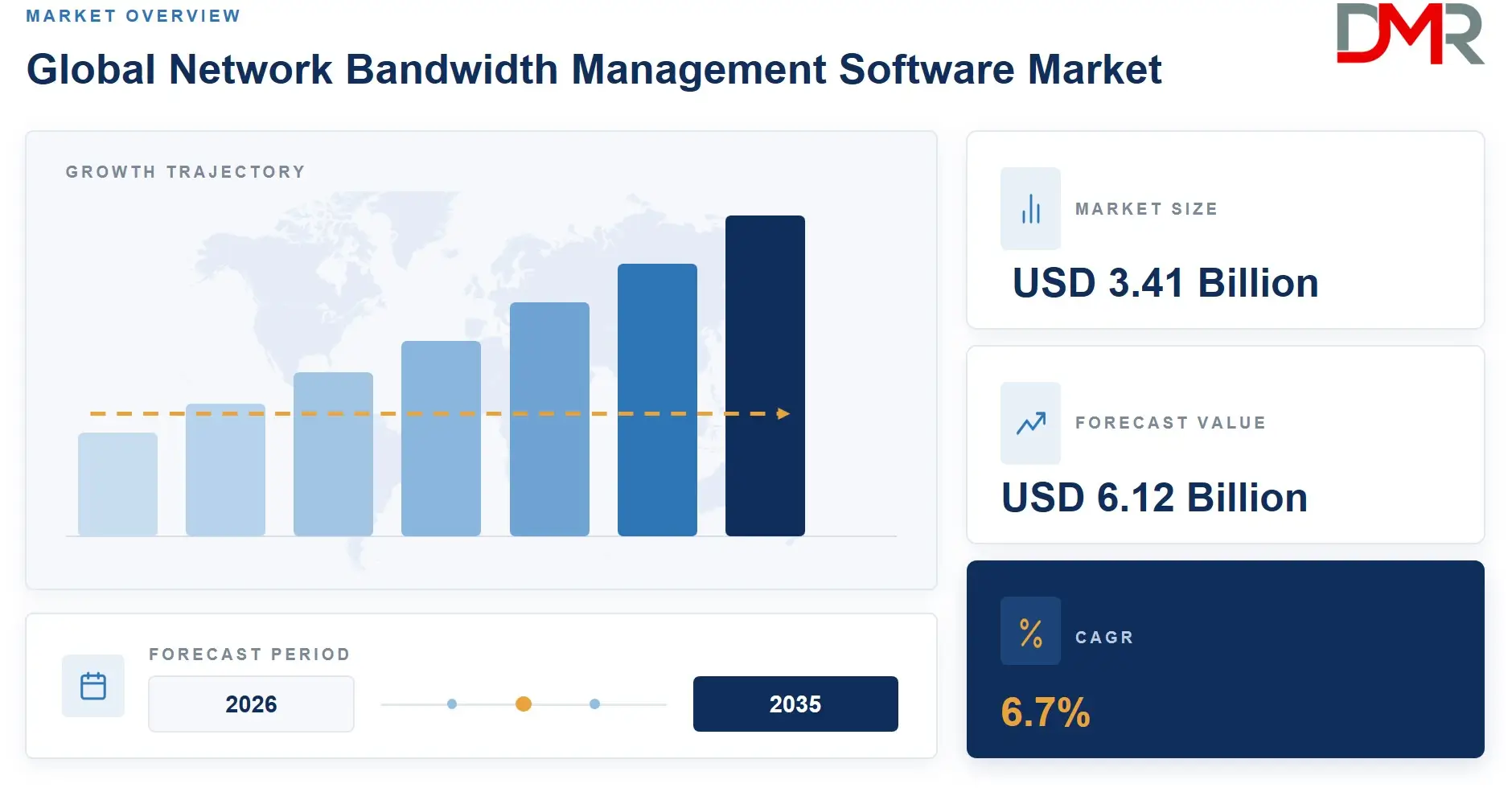
- Global Market Size, 2026: USD 3.41 billion
- Global Market Size, 2035: USD 6.12 billion
- Global CAGR, 2026–2035: 6.7%
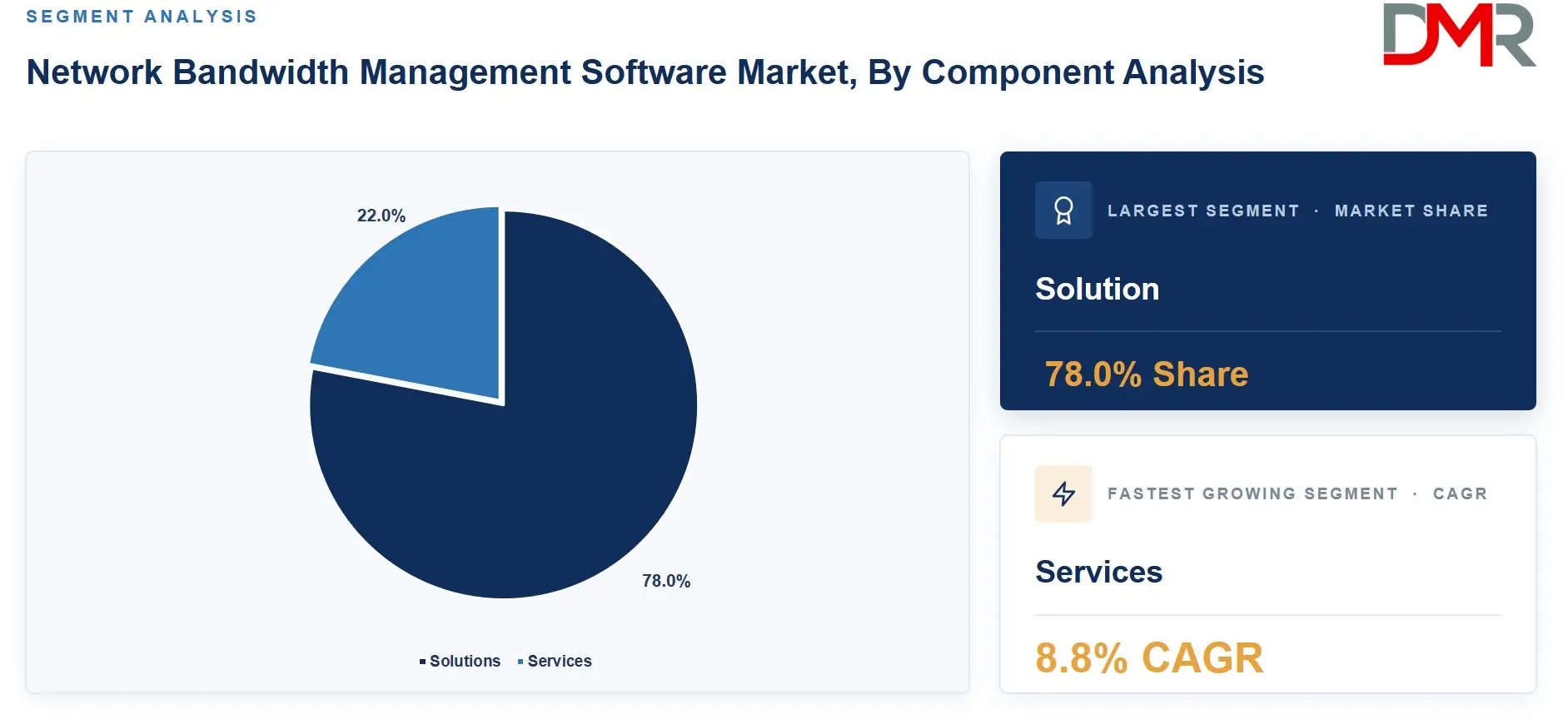
- Leading Component Segment: Solutions, 78% share
- Leading Deployment Segment: Cloud-based, 53% share
- Leading Organization Size: Large enterprises, 62% share
- Fastest-Growing Segment: Wireless networks, 8.1% CAGR
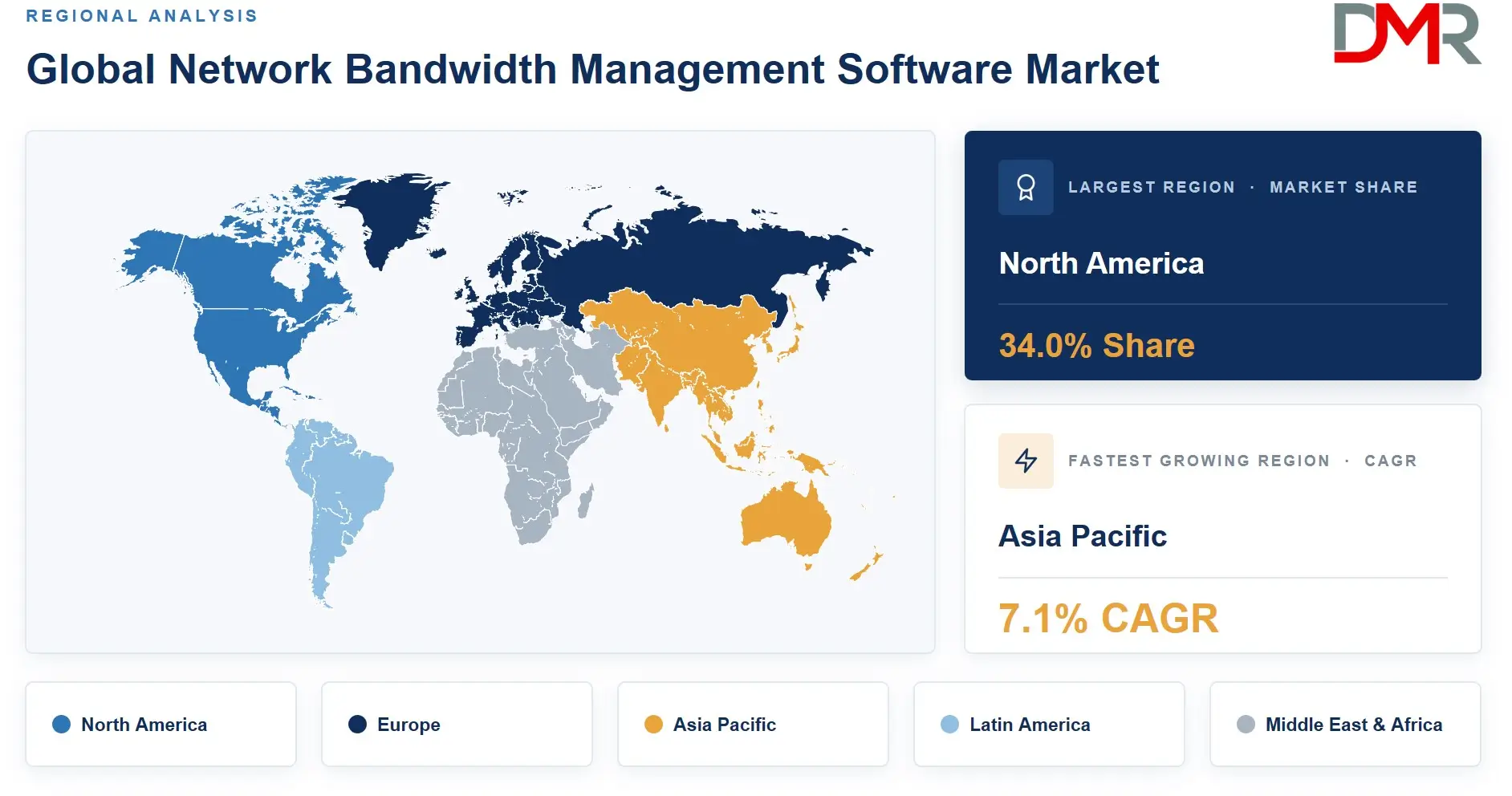
- Leading Region, 2026: North America, 34% share
- Fastest-Growing Region: Asia-Pacific, approximately 7.1% CAGR
What is the Global Network Bandwidth Management Software and its Market Size?
The global Network Bandwidth Management Software and its Market is estimated at USD 3.41 billion in 2026 and is projected to reach approximately USD 6.12 billion by 2035, representing a 6.7% CAGR. The estimate reflects the midpoint of current published market benchmarks, which generally place the sector in the low-to-mid single-digit growth range.
ℹ
To learn more about this report –
Download Your Free Sample Report Here
Growth is being driven by rapidly increasing traffic volumes, hybrid and multi-cloud adoption, distributed workforces, SaaS dependence, IoT deployments, SD-WAN expansion, higher-resolution media, AI workloads, and the need to extract more value from existing connectivity. Vendors are also shifting from passive monitoring toward predictive analytics and AI-assisted network operations. loud deployment, SD-WAN, AI-enabled orchestration, private 5G, Wi-Fi 7, and AI infrastructure as important forces shaping demand.
Use Cases
- Network Monitoring: Provides real-time visibility into traffic volumes, utilization, bottlenecks, applications, devices, users, and network interfaces.
- Traffic Prioritization: Assigns higher priority to latency-sensitive applications such as voice, video conferencing, ERP, and business-critical SaaS.
- Bandwidth Allocation: Dynamically distributes available capacity among applications, departments, locations, users, and services.
- Capacity Planning: Uses historical and real-time utilization information to forecast network expansion requirements.
- Application Performance Optimization: Identifies bandwidth-intensive applications and reallocates network resources to improve application responsiveness.
- SD-WAN Optimization: Uses application-aware policies and link-performance data to select appropriate paths across multiple WAN connections.
Key Takeaways
- Market growth: The global market is estimated at USD 3.41 billion in 2026 and is expected to reach USD 6.12 billion by 2035.
- Growth drivers: Hybrid-cloud complexity, traffic growth, distributed work, AI workloads, IoT, SD-WAN, and increasing network-performance expectations are expanding demand.
- Segment dominance: Software solutions remain the largest component category, while cloud-based deployment is becoming the preferred delivery model.
- Fastest growth: Wireless-network bandwidth management is forecast to expand at approximately 8.1% annually as Wi-Fi 6E/7, private 5G, mobility, and high-density devices increase capacity requirements.
- Regional leadership: North America remains the largest market because of its mature enterprise IT ecosystem, while Asia-Pacific is expected to grow fastest through digitalization, cloud adoption, telecom investment, and expanding enterprise networks.
How AI/Gen AI is Transforming the Network Bandwidth Management Software Market?
Artificial intelligence is moving bandwidth management from rule-based monitoring toward predictive and increasingly autonomous network operations. AI models can correlate traffic flows, application behavior, device telemetry, historical utilization, latency, packet loss, and topology data to identify abnormal patterns and forecast congestion. Vendors are embedding AI assistants and agents into network-management platforms to recommend or execute remediation actions. Cisco describes AI networking as combining high-performance infrastructure with autonomous, reasoning-based operations, while NETSCOUT is developing AI-ready network data foundations for observability and AIOps.
The primary benefits include faster troubleshooting, better utilization of existing capacity, reduced manual configuration, improved application performance, and earlier detection of anomalies. AI can also distinguish normal traffic spikes from emerging incidents, reducing alert fatigue and enabling IT teams to focus on higher-value activities.
Key Drivers in the Global Network Bandwidth Management Software Market
Explosive Growth in Network Traffic and Application Complexity
The fundamental driver is the continuing increase in the volume, diversity, and business importance of network traffic. Enterprises increasingly operate hybrid environments in which SaaS applications, cloud infrastructure, private data centers, remote users, IoT devices, branch offices, video collaboration, and AI workloads coexist. This makes bandwidth a business-performance resource rather than merely an infrastructure metric.
Hybrid Cloud, SD-WAN and Distributed Enterprise Adoption
The transition from centralized corporate networks to distributed hybrid environments is creating a much more complicated traffic-management problem. Enterprises now connect branch offices, remote employees, cloud applications, data centers, and multiple service providers through combinations of broadband, fiber, MPLS, cellular and other transports.
Restraints in the Global Network Bandwidth Management Software Market
Integration Complexity and Legacy Infrastructure
Many enterprises operate heterogeneous networks containing equipment from multiple generations and vendors. Bandwidth-management software must collect telemetry through protocols and interfaces that may differ substantially between devices. Legacy infrastructure can lack modern streaming telemetry and detailed application visibility, forcing organizations to rely on polling, flow records, packet inspection, or proprietary APIs.
Growth Opportunities in the Global Network Bandwidth Management Software Market
AI-Powered Autonomous Bandwidth Optimization
The most significant product opportunity is the development of AI-native bandwidth-management systems capable of moving from visibility and recommendations toward closed-loop optimization. Instead of requiring administrators to identify congestion and manually change QoS rules, future platforms can predict demand, assess business priorities, and recommend or automatically implement policy changes.
SME-Focused Cloud Bandwidth Management
Large enterprises currently account for the majority of spending, but SMEs represent an attractive growth opportunity because they increasingly depend on cloud applications without possessing large network-operations teams.
Trends in the Global Network Bandwidth Management Software Market
Shift from Bandwidth Monitoring to Full Network Observability
The market is expanding beyond standalone bandwidth dashboards toward broader observability platforms that correlate network, application, infrastructure, security, and user-experience telemetry. This reflects the reality that bandwidth congestion is often only one component of an application-performance problem.
Cloud, Wireless and AI-Optimized Networking
Cloud management is becoming the default operating model while wireless networks are becoming increasingly bandwidth-intensive. Wi-Fi 7, private 5G, edge computing, high-density devices, and AI applications require more predictable capacity and lower latency.
Research Scope and Analysis
The market is segmented by Component, Deployment Mode, Organization Size, Network Type, Application, and End-Use Industry. The primary four segmentation dimensions used for the quantitative market model are Component, Deployment Mode, Organization Size, and Network Type, with Application and End-Use Industry providing additional demand-side analysis.
ℹ
To learn more about this report –
Download Your Free Sample Report Here
By Component Analysis
Solutions dominated the market in 2026 with an estimated 78% share, while services accounted for approximately 22%. Solutions lead because organizations increasingly require continuous visibility, traffic control, bandwidth optimization, QoS management and performance analytics as integrated software capabilities rather than isolated professional services. Within solutions, Bandwidth Monitoring & Management represents the largest functional category, followed by traffic management and shaping and network performance management. Services are expected to grow steadily as organizations require implementation, integration, consulting, customization, support and managed operations. The fastest-growing component-related opportunity is expected to be Bandwidth Optimization and automated QoS, supported by AI-assisted recommendations and policy automation. Vendors increasingly package these functions into cloud observability and AIOps suites rather than selling bandwidth control as a standalone point product. The broad competitive set includes Cisco, IBM, NETSCOUT, SolarWinds, Broadcom, HPE, ManageEngine, Riverbed, Paessler and others.
By Deployment Analysis
Cloud-based deployment is estimated to hold approximately 53% of the 2026 market, ahead of on-premises deployment at 47%. Cloud leads because centralized management simplifies administration across distributed branches, remote users, hybrid-cloud infrastructure and multi-site networks. Subscription pricing also lowers upfront capital requirements and supports rapid deployment. Cloud-based bandwidth management is forecast to grow at approximately 8.1% CAGR, according to published market analysis. The fastest-growing use cases involve organizations managing geographically distributed infrastructure without maintaining separate management servers. On-premises software remains important in government, defense, financial services, healthcare, telecom and other environments where data sovereignty, security controls or operational policies favor local deployment. The second-largest deployment opportunity is therefore hybrid architectures in which cloud analytics are combined with local collectors or enforcement mechanisms.
By Organization Size Analysis
Large enterprises are estimated to account for approximately 62% of the market in 2026, reflecting their larger network footprints, higher traffic volumes, multi-site operations, greater application diversity and more formal network-management requirements. Large organizations are also more likely to operate multiple data centers, cloud environments, SD-WAN deployments and high-density wireless infrastructure. However, SMEs are the fastest-growing organization-size segment, with published analysis estimating approximately 6.48% CAGR through 2031. SME demand is being accelerated by cloud-first IT architectures and managed service providers that package sophisticated bandwidth-management functions into affordable subscriptions. The second-largest opportunity is the upper-midmarket, where organizations often have enterprise-level network complexity but smaller IT teams. Vendors that simplify implementation through automatic discovery, SaaS delivery, templates and AI-assisted troubleshooting can capture significant incremental SME demand..
By Network Type Analysis
Wired networks remain the largest network-type category, estimated at approximately 65% of 2026 market demand, consistent with published estimates placing wired networks at 64.85% in 2025. Wired enterprise, data-center and WAN infrastructure continues to carry a substantial proportion of mission-critical traffic. However, wireless networks are forecast to be the fastest-growing category at approximately 8.1% CAGR, driven by Wi-Fi 6E, Wi-Fi 7, private 5G, mobile devices, IoT endpoints and bandwidth-intensive applications. SD-WAN is also an important growth area because it requires continuous measurement of latency, loss, jitter and link utilization to select optimal traffic paths. Data-center networks represent another strategic opportunity as AI infrastructure generates high-volume east-west traffic and large data transfers. The market is therefore moving toward unified management across wired, wireless, WAN, SD-WAN and data-center environments rather than isolated network domains.
By Application Analysis
Network Monitoring is estimated to remain the largest application segment of the Network Bandwidth Management Software Market in 2026, accounting for approximately 31% of market revenue. Its leadership reflects the fundamental requirement of enterprises to continuously identify bandwidth utilization, traffic patterns, congestion, application consumption, network bottlenecks and abnormal usage across increasingly distributed infrastructure. Network monitoring provides the visibility layer required before organizations can implement traffic prioritization, bandwidth allocation or capacity optimization. Traffic Prioritization & Control represents the second-largest application, with an estimated 23% share, supported by increasing use of QoS policies for voice, video conferencing, SaaS, ERP and other latency-sensitive applications. Application Performance Optimization is projected to be the fastest-growing application, with an estimated 7.8% CAGR, as organizations increasingly connect network performance directly with user and application experience. Bandwidth Allocation and Network Capacity Planning are also gaining importance as hybrid-cloud environments, AI workloads, IoT and distributed offices create more variable traffic patterns.
By End Use Industry Analysis
IT & Telecommunications is estimated to remain the largest end-use industry in the Network Bandwidth Management Software Market, accounting for approximately 25% of 2026 revenue. Telecommunications operators and IT organizations manage large-scale, highly distributed networks where bandwidth monitoring, capacity planning, traffic engineering and QoS management are core operational requirements. Published market research also identifies Telecom and IT as the leading end-user vertical, with a 25.08% share in 2025. BFSI represents another major adoption center because financial institutions require reliable, low-latency connectivity for transaction processing, digital banking, trading, branch connectivity and cloud applications. Healthcare is projected to be the fastest-growing major end-use industry, with an estimated 7.0% CAGR, driven by telemedicine, electronic health records, cloud-based healthcare platforms, medical imaging, connected medical devices and remote patient monitoring. Mordor Intelligence estimates healthcare growth at approximately 6.85% CAGR. Retail & E-Commerce is also expanding as omnichannel platforms, digital payments, inventory systems and customer-facing applications become increasingly network dependent. Government & Defense, Manufacturing, Education, Energy & Utilities, and Transportation & Logistics provide additional opportunities, particularly where operational continuity, IoT connectivity, remote sites and mission-critical applications require controlled network performance.
The Global Network Bandwidth Management Software Market Report is segmented on the basis of the following:
By Component
- Solutions
- Bandwidth Monitoring & Management
- Traffic Management & Shaping
- Bandwidth Optimization
- Network Performance Management
- Quality of Service (QoS) Management
- Services
- Implementation & Integration
- Support & Maintenance
- Consulting
By Deployment Mode
By Organization Size
- Large Enterprises
- Small & Medium-Sized Enterprises (SMEs)
By Network Type
- Enterprise Networks
- Data Center Networks
- Wide Area Networks (WAN)
- Software-Defined Wide Area Networks (SD-WAN)
- Wireless Networks
By Application
- Network Monitoring
- Traffic Prioritization & Control
- Bandwidth Allocation
- Network Capacity Planning
- Application Performance Optimization
By End-Use Industry
- IT & Telecommunications
- BFSI
- Healthcare
- Government & Defense
- Media & Entertainment
- Retail & E-Commerce
- Manufacturing
- Education
- Energy & Utilities
- Transportation & Logistics
- Other Industries
Regional Analysis
North America is the Leading Region in the Global Network Bandwidth Management Software Market
North America is expected to remain the leading regional market, representing approximately 34% of global revenue in 2026, or roughly USD 1.16 billion. Published market analysis similarly places North America's share at 34.05% in 2025. The region benefits from high enterprise cloud penetration, extensive data-center capacity, sophisticated IT operations, early SD-WAN adoption, large technology vendors and substantial cybersecurity spending. The United States represents the overwhelming majority of regional demand. Financial services, technology, healthcare, government, telecom, retail and hyperscale cloud operators are important consumers. AI infrastructure investment is also creating new requirements for high-performance network monitoring and traffic optimization.
ℹ
To learn more about this report –
Download Your Free Sample Report Here
Asia Pacific is the Fastest-Growing Region in the Global Network Bandwidth Management Software Market
Asia-Pacific is projected to be the fastest-growing regional market, with an estimated 7.1% CAGR through 2035. Published estimates similarly forecast approximately 7.05% growth. China, Japan, India, South Korea, Singapore and Australia are leading demand centers. Growth is supported by enterprise digitalization, data-center construction, cloud migration, telecom investment, 5G expansion, smart manufacturing, e-commerce and the rapid adoption of SaaS. India and Southeast Asia provide particularly attractive expansion opportunities as organizations modernize networks while maintaining strong cost sensitivity.
The Europe Network Bandwidth Management Software Market
The European market is estimated at approximately USD 0.91 billion in 2026 and is projected to reach around USD 1.53 billion by 2035, representing an estimated 5.9% CAGR. Demand is supported by cloud adoption, industrial digitalization, cybersecurity requirements and the need for operational resilience. NIS2 has increased attention on cybersecurity risk management and reporting among covered organizations, while the Cyber Resilience Act introduces cybersecurity requirements affecting software and other products with digital elements. Germany, the U.K., France, Italy and the Nordic markets are particularly important.
Latin America Network Bandwidth Management Software Market
Latin America is estimated at approximately USD 0.23 billion in 2026, rising to roughly USD 0.42 billion by 2035, at an estimated 6.9% CAGR. Brazil and Mexico account for the largest demand pools. Cloud migration, telecommunications modernization, digital banking, e-commerce and distributed enterprise operations are key growth drivers. Adoption remains constrained by IT-budget limitations and uneven infrastructure quality, increasing the attractiveness of SaaS and managed-service models.
MEA Network Bandwidth Management Software Market
The Middle East & Africa market is estimated at approximately USD 0.20 billion in 2026 and is expected to reach around USD 0.36 billion by 2035, representing approximately 6.8% CAGR. The Gulf states are leading demand through smart-city programs, cloud investment, government digitalization and hyperscale data-center development. Saudi Arabia and the UAE are especially important, while South Africa provides a major African enterprise and telecom market.
Major Countries Analysis
United States Network Bandwidth Management Software Market
The United States market is estimated at approximately USD 0.93 billion in 2026 and is projected to reach approximately USD 1.54 billion by 2035, at around 5.8% CAGR. Demand is driven by hyperscale cloud, AI infrastructure, cybersecurity, SD-WAN, enterprise observability and large distributed corporate networks. AI-related network requirements are increasing the importance of high-speed traffic analysis and congestion management. Cisco's AI-networking strategy reflects the broader industry movement toward combining AI infrastructure with autonomous network operations.
Japan Network Bandwidth Management Software Market
Japan is estimated at approximately USD 0.19 billion in 2026, reaching around USD 0.32 billion by 2035, representing approximately 6.0% CAGR. Key drivers include enterprise modernization, manufacturing automation, data-center investment, 5G, cloud adoption and the country's emphasis on highly reliable network infrastructure. Demand is particularly relevant in manufacturing, telecommunications, financial services and government.
Saudi Arabia Network Bandwidth Management Software Market
Saudi Arabia's market is estimated at approximately USD 0.06 billion in 2026, increasing to around USD 0.11 billion by 2035, at approximately 6.7% CAGR. Vision-driven digital transformation, cloud adoption, smart-city projects, government modernization, telecom investment and data-center development are major demand drivers. Large enterprises and government organizations are likely to remain the primary adopters.
Regulatory Landscape
Network bandwidth-management software is influenced less by a single dedicated bandwidth regulation than by broader cybersecurity, privacy, software-security and critical-infrastructure requirements. In the United States, NIST Cybersecurity Framework 2.0 provides a widely used framework for managing cybersecurity risk and increasingly informs enterprise requirements for visibility, governance and monitoring.
NIST published additional CSF 2.0 implementation guidance in March 2026. In Europe, NIS2 establishes cybersecurity risk-management and reporting requirements across 18 critical sectors, while the EU Cyber Resilience Act introduces cybersecurity obligations for hardware and software products with digital elements, with major provisions becoming applicable from December 2027. In India, the Digital Personal Data Protection Rules 2025 and associated enforcement framework increase the importance of appropriate personal-data governance where network telemetry contains identifiable or sensitive information.
Investment and White Space Analysis or Epidermatology based on the network
The strongest investment opportunities lie in AI-native bandwidth optimization, cloud-managed platforms, SME solutions, wireless network management, SD-WAN analytics and integrated network-security/observability platforms. Investors and new entrants can target underserved midmarket organizations that need enterprise-grade visibility without enterprise-grade complexity.
Asia-Pacific, particularly India and Southeast Asia, offers attractive growth because cloud adoption, data-center expansion, telecom modernization and digital services are expanding rapidly. Another white space is the integration of bandwidth management with FinOps and cloud-cost optimization, allowing organizations to connect network-performance decisions with cloud egress and infrastructure expenditure. AI agents that can safely recommend or execute network changes represent another high-value opportunity.
By Region
North America
Europe
- Germany
- France
- The U.K.
- Italy
- Spain
- Rest of Europe
Asia-Pacific
- China
- Japan
- India
- Australia
- South Korea
- Rest of APAC
Latin America
- Mexico
- Brazil
- Rest of LATAM
Middle East & Africa
- Saudi Arabia
- The UAE
- South Africa
- Rest of MEA
Competitive Landscape
The Network Bandwidth Management Software market is moderately fragmented but increasingly consolidating around broader observability, AIOps, SD-WAN and network-management platforms. Major vendors compete through functionality breadth, telemetry coverage, AI capabilities, scalability, integrations, deployment flexibility and total cost of ownership. Published competitive landscapes identify Cisco, IBM, NETSCOUT, SolarWinds, Broadcom, HPE, Juniper, InfoVista, BMC, ManageEngine, Riverbed, Paessler, Auvik, Fortinet, Huawei and Extreme Networks among relevant vendors.
Competition is shifting away from standalone bandwidth monitoring toward integrated platforms capable of correlating network, application, infrastructure, security and user-experience data. Strategic priorities include cloud delivery, AI-assisted troubleshooting, automated remediation, SD-WAN integration, network observability, cybersecurity convergence and expansion into SMEs.
Some of the prominent players in the Global Network Bandwidth Management Software Market are:
- Cisco Systems
- Broadcom
- SolarWinds
- ManageEngine
- Paessler
- Progress Software
- NETSCOUT Systems
- Kentik
- Catchpoint
- ThousandEyes
- Riverbed Technology
- Auvik
- LogicMonitor
- Datadog
- Dynatrace
- New Relic
- Zabbix
- Nagios Enterprises
- PRTG Network Monitor
- WhatsUp Gold
- NetFlow Analyzer
- ExtraHop
- Gigamon
- NetBrain Technologies
- ScienceLogic
- Splunk
- IBM
- Broadcom Software
- BMC Software
- Micro Focus
- HPE
- Nokia
- Juniper Networks
- Arista Networks
- Huawei
- Fortinet
- Palo Alto Networks
- F5 Networks
- A10 Networks
- Versa Networks
- Other Key Players
Recent Developments
- May 2026: ManageEngine introduced native OpenConfig and gNMI streaming telemetry support in OpManager Nexus, enabling real-time, vendor-neutral network observability across major networking infrastructure.
- April 2026: Auvik launched Auvik Aurora, an AI-powered agentic platform designed to proactively manage, troubleshoot and optimize networks using real-time network-management data.
- February 2026: NETSCOUT expanded Omnis AI Insights for communications service providers, delivering AI-ready network data for predictive maintenance, customer-experience improvement and increasingly automated network operations.
- February 2026: Cisco announced the Silicon One G300 networking platform for AI data centers, addressing rapidly increasing bandwidth requirements and traffic demands from large-scale AI infrastructure.
- February 2026: Broadcom released DX NetOps 25.4.5, introducing the Network Observability Deployment Engine to simplify deployment and lifecycle management of cloud-native network-observability capabilities.
- November 2025: Broadcom published its State of Network Operations 2026 research, highlighting the gap between enterprise AI adoption and network readiness and emphasizing the need for real-time network visibility and observability.
- October 2025: IBM published its analysis of AI network monitoring, highlighting the use of artificial intelligence, machine learning and real-time network data to automate monitoring, detect anomalies and optimize network operations.
Report Details
| Report Characteristics |
| Market Size (2026) |
USD 3.41 Bn |
| Forecast Value (2035) |
USD 6.12 Bn |
| CAGR (2026–2035) |
6.7% |
| The US Market Size (2026) |
USD 0.93 Bn |
| Historical Data |
2021 – 2025 |
| Forecast Data |
2026 – 2035 |
| Base Year |
2025 |
| Segments Covered |
By Component, By Deployment Mode, By Organization Size, By Network Type, By Application, By End-Use Industry |
| Regional Coverage |
North America – The US and Canada; Europe – Germany, France, The UK, Italy, Spain, Rest of Europe; Asia-Pacific – China, Japan, India, Australia, South Korea, Rest of APAC; Latin America – Mexico, Brazil, Colombia, Argentina, Rest of LATAM; Middle East & Africa – Saudi Arabia, The UAE, South Africa, Rest of MEA |
Frequently Asked Questions
What is the current size of the Network Bandwidth Management Software Market?
▾ The Network Bandwidth Management Software Market is estimated at approximately USD 3.41 billion in 2026, based on current published market estimates.
What will the Network Bandwidth Management Software Market be worth by 2035?
▾ The Network Bandwidth Management Software Market is estimated to reach approximately USD 6.12 billion by 2035 under the long-term forecast model used in this report.
What is the expected CAGR of the Network Bandwidth Management Software Market?
▾ The Network Bandwidth Management Software Market is modeled to expand at approximately 6.7% CAGR from 2026 to 2035, broadly consistent with current published growth benchmarks.
What are the key growth drivers of the Network Bandwidth Management Software Market?
▾ The Network Bandwidth Management Software Market is driven by cloud migration, SD-WAN adoption, AI workloads, IoT, increasing traffic volumes, distributed workforces and application-performance requirements.
What are the major trends in the Network Bandwidth Management Software Market?
▾ Major Network Bandwidth Management Software Market trends include AI-enabled optimization, cloud-native deployment, network observability, automated remediation, SD-WAN integration and wireless bandwidth management.
Which region leads the Network Bandwidth Management Software Market?
▾ North America leads the Network Bandwidth Management Software Market, accounting for approximately 34% of global revenue, while Asia-Pacific is projected to grow fastest.
Which companies are major players in the Network Bandwidth Management Software Market?
▾ Major participants in the Network Bandwidth Management Software Market include Cisco, IBM, NETSCOUT, SolarWinds, Broadcom, HPE, ManageEngine, Riverbed, Auvik, Paessler, Fortinet and Huawei.
What are the major segments of the Network Bandwidth Management Software Market?
▾ The Network Bandwidth Management Software Market is segmented by component, deployment mode, organization size, network type, application and end-use industry.