Global Observability Platform Market Snapshot
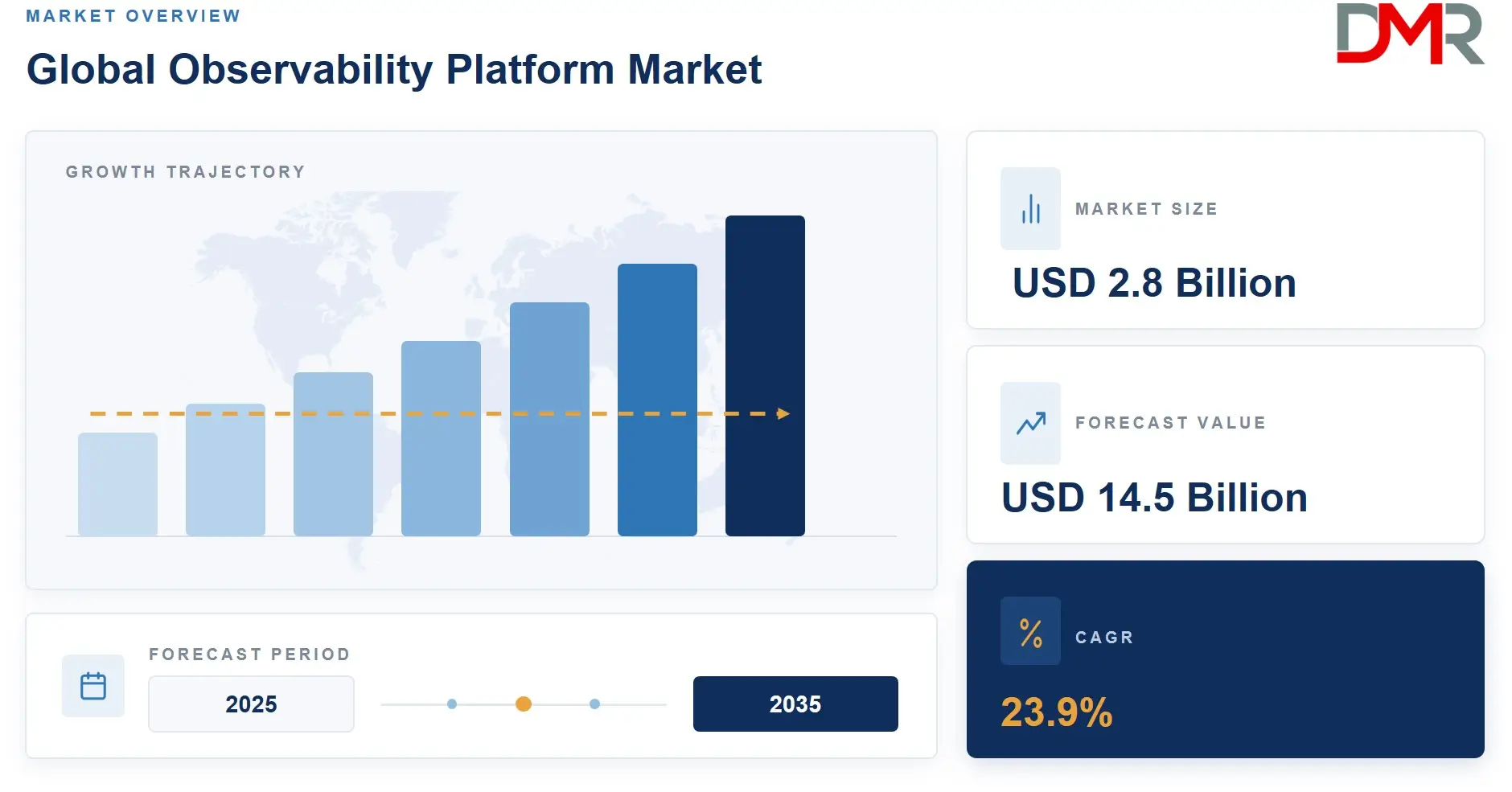
- Global Observability Platform Market Size in 2026: USD 2.8 Billion
- Global Observability Platform Market Size in 2035: USD 14.5 Billion
- Global CAGR from 2026 to 2035: 23.9%
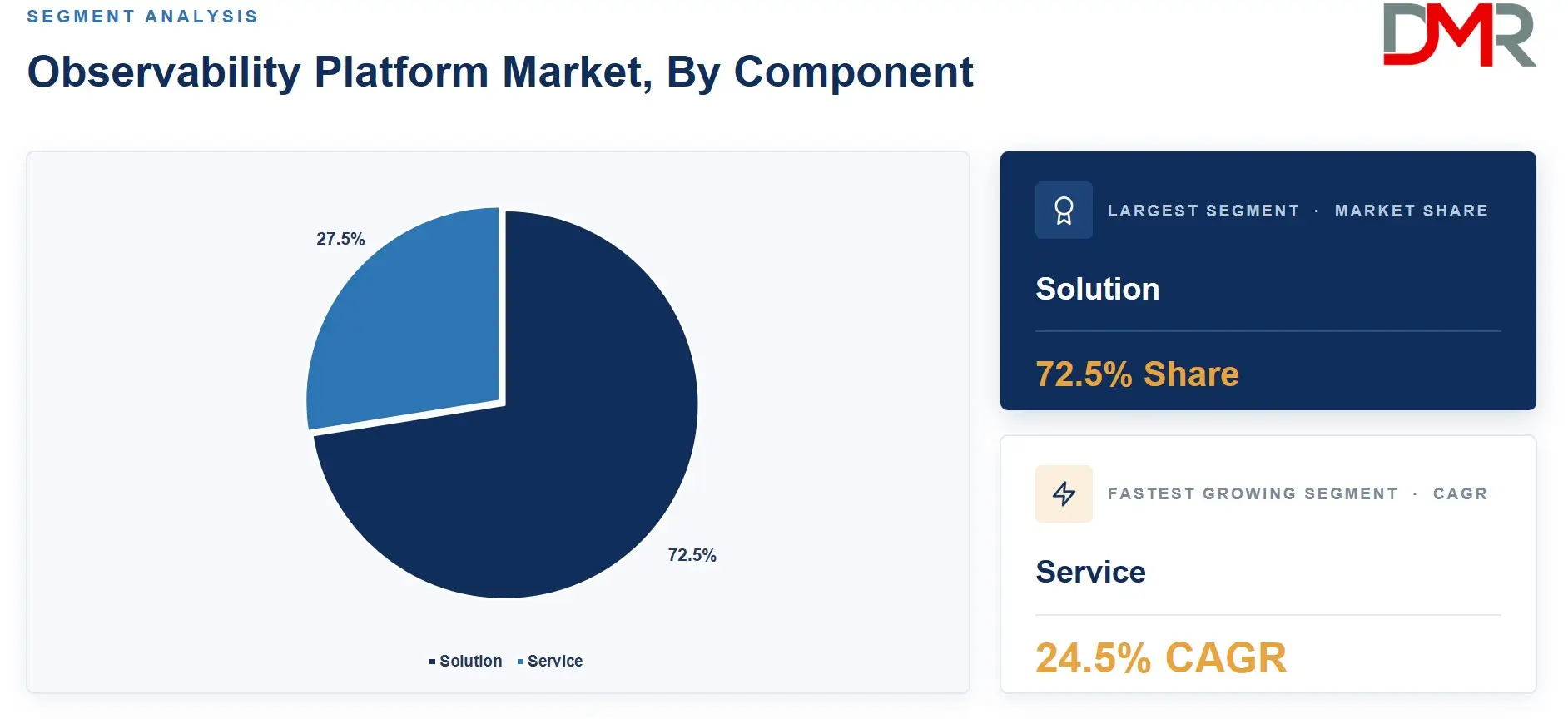
- Solution is the leading component segment in 2026: 72.5%
- Cloud is the leading deployment mode segment in 2026: 70.2%
- Large Enterprises is the leading organization size segment in 2026: 63.3%
- Application Performance Monitoring is the leading application segment in 2026: 31.8%
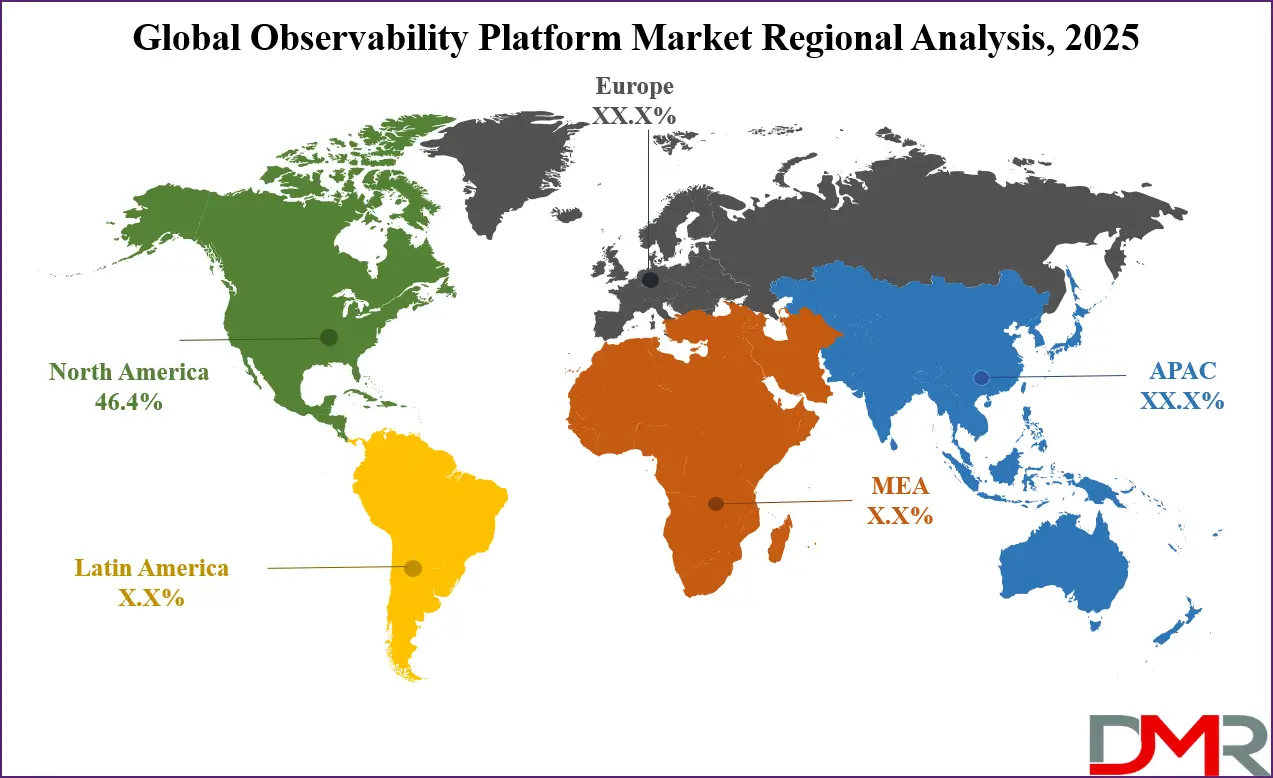
- North America is the leading region in 2026: 46.9%
What is the Global Observability Platform and its Market Size?
The Observability Platform market refers to a suite of tools and services that help organizations collect, correlate, analyze, and visualize telemetry data metrics, logs, and traces from their IT infrastructure, applications, and distributed systems. These platforms enable real-time visibility, root-cause analysis, and proactive monitoring, which are critical as enterprises increasingly operate complex digital environments with cloud, microservices, containers, and hybrid infrastructures. Traditional monitoring methods are no longer sufficient to manage these dynamic and distributed systems.
ℹ
To learn more about this report –
Download Your Free Sample Report Here
The Global Observability Platform Market is projected to be valued at USD 2.8 billion in 2026 and is projected to reach USD 14.5 billion by 2035, expanding at a CAGR of 23.9% during the forecast period. Growth is being driven by increasing cloud complexity, rapid adoption of microservices and containerized applications, and rising demand for real-time infrastructure monitoring. Enterprises are increasingly deploying observability platforms to improve application performance, identify system failures, strengthen security, reduce downtime, and optimize IT operations. Growing cloud-native architectures, DevOps adoption, and digital transformation initiatives are further accelerating demand across industries worldwide.
Use Cases
- Application Performance Monitoring (APM): Real-time tracking of application health, response times, service dependencies, and user-experience metrics using observability platforms.
- Infrastructure Monitoring: Monitoring of servers, containers, network, storage, and virtualization layers with metrics, logs, and traces for proactive issue detection.
- Security & Compliance Monitoring: Using observability platforms to detect anomalous behavior, correlate diverse telemetry (logs + metrics + traces) and support regulatory audits and incident investigation.
- Root-Cause Analysis & Troubleshooting: Employing unified telemetry and contextual correlation to accelerate root cause identification in distributed microservices, cloud and hybrid environments.
Key Takeaways
- Market Size: The Global Observability Platform Market is anticipated to be valued at USD 2.8 billion in 2026 and is forecast to reach USD 14.5 billion by 2035, expanding at a CAGR of 23.9%.
- Growth Outlook: Market expansion is supported by accelerating cloud migration, adoption of cloud-native architectures, DevOps and Site Reliability Engineering practices, microservices deployment, artificial intelligence-driven monitoring, real-time analytics, digital transformation initiatives, and growing enterprise demand for unified visibility across applications, infrastructure, networks, logs, metrics, and distributed IT environments.
- Primary Growth Drivers: Increasing IT infrastructure complexity, rapid cloud migration, expanding microservices and containerized environments, growing DevOps adoption, rising application performance requirements, distributed workloads, cybersecurity concerns, and the need for real-time visibility across logs, metrics, traces, applications, networks, and infrastructure are accelerating enterprise investment in observability platforms.
- By Component Analysis: Solution is projected to lead the offering segment with a 72.5% share in 2026, supported by growing enterprise demand for unified monitoring, application performance management, infrastructure visibility, log analytics, and distributed tracing. Rising cloud-native deployments, complex microservices architectures, and the need for real-time insights are further strengthening adoption of comprehensive observability solutions.
- By Deployment Mode Analysis: Cloud is expected to lead deployment with a 70.2% share in 2026. Hybrid cloud is projected to record strong growth as enterprises increasingly combine public cloud scalability with private infrastructure control. Rising multi-cloud adoption, security requirements, workload flexibility, regulatory compliance, and demand for unified monitoring across distributed environments are accelerating hybrid deployment.
- By Organization Size Analysis: Large Enterprises is anticipated to dominate with a 63.3% share in 2026. SMEs is expected to record the fastest growth as affordable cloud-based observability solutions, increasing digitalization, scalable subscription models, and growing requirements for application performance and infrastructure visibility accelerate adoption.
- By Application: Application Performance Monitoring is projected to lead with a 31.8% share in 2026 due to rising demand for real-time application visibility, faster issue resolution, reduced downtime, and improved digital experiences.
- Regional Leadership: North America is expected to account for 46.9% of global revenue in 2026, supported by advanced cloud infrastructure, widespread DevOps adoption, strong presence of observability vendors, increasing cloud-native applications, and growing enterprise investment in real-time monitoring, cybersecurity, and digital transformation initiatives.
How AI/Gen AI is Transforming the Observability Platform Market?
AI and Generative AI are transforming the observability platform market by automating anomaly detection, root cause analysis, incident prioritization, and performance optimization across complex IT environments. AI-driven platforms analyze massive volumes of logs, metrics, and traces to identify issues proactively and reduce resolution time. Gen AI enables natural-language querying, automated incident summaries, intelligent troubleshooting recommendations, and predictive insights. Growing adoption of AIOps and autonomous operations is further improving system reliability, developer productivity, operational efficiency, and enterprise observability capabilities.
Key Drivers in the Global Observability Platform Market
Rising Complexity of Cloud-Native and Distributed IT Environments
Rapid adoption of cloud computing, microservices, containers, Kubernetes, serverless architectures, and distributed applications is increasing the complexity of enterprise IT environments. Traditional monitoring tools often struggle to provide complete visibility across interconnected systems. Observability platforms address this challenge by integrating logs, metrics, traces, and application data into unified environments. Growing requirements for real-time performance insights, faster troubleshooting, reduced downtime, and improved application reliability are therefore accelerating observability platform adoption across enterprises worldwide.
Growing Adoption of DevOps, SRE, and Digital Transformation Initiatives
Enterprises are increasingly adopting DevOps and Site Reliability Engineering practices to accelerate software delivery while maintaining application performance and reliability. Observability platforms enable development and operations teams to continuously monitor applications, identify performance bottlenecks, investigate incidents, and improve system resilience. Increasing digital transformation investments, frequent software releases, expanding customer-facing digital services, and growing dependence on mission-critical applications are strengthening demand for advanced observability capabilities that support faster development cycles and efficient IT operations.
Restraints in the Global Observability Platform Market
High Implementation Complexity and Growing Data Management Costs
Implementing comprehensive observability platforms can involve substantial costs related to software subscriptions, data ingestion, storage, integration, and skilled personnel. Enterprises generating large volumes of telemetry data may experience rapidly increasing expenses as applications and infrastructure scale. Integrating observability solutions with legacy systems, multiple cloud environments, and existing monitoring tools can also create technical complexity. These challenges particularly affect smaller organizations with limited IT budgets and expertise, potentially restricting widespread adoption of advanced observability platforms.
Growth Opportunities in the Global Observability Platform Market
Expansion of AI and Generative AI-Powered Observability
Integration of artificial intelligence and Generative AI creates significant opportunities for observability platform providers. AI-powered capabilities can automate anomaly detection, incident correlation, root cause analysis, and predictive performance management across complex environments. Generative AI further enables natural-language queries, automated incident summaries, intelligent troubleshooting recommendations, and conversational interfaces. Vendors incorporating advanced AI capabilities can help enterprises reduce manual investigation, improve operational efficiency, shorten mean time to resolution, and progress toward increasingly autonomous IT operations.
Growing Adoption Among SMEs and Emerging Digital Businesses
Small and medium-sized enterprises represent a significant growth opportunity as cloud adoption, SaaS applications, e-commerce platforms, and digital services expand across this segment. Cloud-based observability solutions with flexible subscription models can provide SMEs with enterprise-grade monitoring capabilities without substantial infrastructure investment. Increasing availability of automated deployment, simplified dashboards, and scalable pricing is lowering adoption barriers. Vendors offering cost-effective, easy-to-use platforms can capture growing demand from digitally expanding SMEs and technology-driven businesses.
Trends in the Global Observability Platform Market
Shift Toward Unified and Full-Stack Observability Platforms
Enterprises are increasingly moving away from fragmented monitoring tools toward unified observability platforms capable of integrating application, infrastructure, network, database, log, metric, and trace data. Full-stack observability provides broader visibility into dependencies across increasingly distributed technology environments and helps teams correlate performance issues more effectively. This consolidation trend is encouraging vendors to expand platform capabilities through integrated analytics, application performance monitoring, infrastructure monitoring, digital experience monitoring, and security observability within unified enterprise environments.
Growing Convergence of Observability, AIOps, and Security
Observability platforms are increasingly converging with AIOps and cybersecurity capabilities as enterprises seek integrated visibility across performance, reliability, and security operations. Advanced analytics and machine learning are being used to correlate telemetry data, detect abnormal behavior, prioritize incidents, and identify potential security threats. This convergence is supporting more proactive IT operations while reducing tool fragmentation. Organizations are increasingly favoring platforms that combine operational intelligence, automated remediation, security insights, and performance monitoring within unified workflows.
Research Scope and Analysis
The Global Observability Platform Market is segmented by component into solutions and services; deployment into cloud, on-premises, and hybrid; organization size into SMEs and large enterprises; and applications including performance, infrastructure, security, and troubleshooting. Key end users include IT and telecom, BFSI, healthcare, retail, manufacturing, and government sectors worldwide. Regional assessment covers North America, Europe, Asia Pacific, Latin America, and the Middle East and Africa.
ℹ
To learn more about this report –
Download Your Free Sample Report Here
By Component Analysis
Solution is projected to lead the offering segment with a 72.5% share in 2026, driven by demand for unified metrics, logs, traces, and full-stack visibility across cloud-native environments. Services is projected to grow fastest as enterprises increasingly adopted consulting, integration, and managed services to address deployment complexity, skill shortages, cost optimization, and continuous monitoring.
By Deployment Mode Analysis
Cloud dominated the Observability Platform Market with a 70.2% share in 2026, supported by SaaS adoption, scalability, rapid deployment, and integration with DevOps workflows. Hybrid deployment recorded the fastest growth as enterprises sought unified visibility across cloud and on-premises environments while maintaining flexibility, regulatory compliance, data governance, and sovereignty requirements.
By Organization Size Analysis
Large enterprises dominated the Observability Platform Market with a 63.3% share in 2026, driven by complex IT environments and strong requirements for reliability and performance. SMEs recorded the fastest growth, supported by affordable SaaS platforms, open-source tools, simplified pricing, and managed services that reduce implementation costs and improve operational visibility.
By Application Analysis
Application Performance Monitoring dominated the Observability Platform Market with a 31.8% share in 2026, driven by demand for improved user experience, reliability, and faster troubleshooting. Security and Compliance Monitoring recorded the fastest growth as organizations increasingly adopted real-time anomaly detection, incident response, compliance auditing, and integrated security observability capabilities.
By End User Analysis
IT and Telecom led the Observability Platform Market with a 30.3% share in 2026, supported by demand for network visibility, application uptime, and reliable digital services. Manufacturing recorded the fastest growth, driven by Industry 4.0, IoT, smart factories, predictive monitoring, downtime reduction, and integration of IT and operational technology systems.
The Global Observability Platform Market Report is segmented on the basis of the following:
By Component
- Solutions
- Metrics Monitoring
- Log Management & Analytics
- Tracing & Visualization
- Services
- Consulting & Integration
- Managed Services
By Deployment Mode
By Organization Size
- Small and Medium Sized Enterprises (SMEs)
- Large Enterprises
By Application
- Application Performance Monitoring
- Infrastructure Monitoring
- Security & Compliance Monitoring
- Root Cause Analysis & Troubleshooting
By End User
- IT & Telecom
- BFSI
- Healthcare & Life Sciences
- Retail & E-commerce
- Manufacturing
- Government & Public Sector
Regional Analysis
North America is the Leading Region in the Global Observability Platform Market
North America is expected to dominate this market as it is poised to account for 46.9% of the global market in 2026. This leadership is supported by widespread cloud adoption, advanced digital infrastructure, strong penetration of DevOps and cloud-native technologies, and significant enterprise spending on IT monitoring. Growing deployment of microservices, containers, AI-driven operations, and cybersecurity solutions, alongside the strong presence of major observability platform providers, continues to strengthen regional market growth.
ℹ
To learn more about this report –
Download Your Free Sample Report Here
Asia Pacific is the Fastest Growing Region in the Global Observability Platform Market
Asia Pacific is expected to record the fastest growth, with a CAGR of approximately 25.0% during the forecast period. Growth is supported by rapid cloud adoption, expanding digital transformation initiatives, increasing deployment of microservices, and rising investments in IT infrastructure. Growing adoption of DevOps practices, AI-driven monitoring, e-commerce platforms, and cloud-native applications across China, India, Japan, and Southeast Asia is further accelerating demand for advanced observability platforms.
Europe Observability Platform Market
The Europe Observability Platform Market is experiencing strong growth, supported by accelerating cloud migration, enterprise digital transformation, and increasing adoption of microservices and containerized applications. Organizations are deploying observability platforms to improve application reliability, infrastructure visibility, cybersecurity, and operational efficiency. Stringent data protection requirements are also encouraging secure monitoring practices. Expanding DevOps adoption, hybrid cloud environments, artificial intelligence-driven analytics, and growing demand for real-time performance insights across BFSI, telecom, healthcare, retail, and manufacturing are strengthening regional market development.
Latin America Observability Platform Market
The Latin America Observability Platform Market is expanding as enterprises accelerate cloud migration, digital transformation, and modernization of legacy IT infrastructure. Growing adoption of e-commerce, fintech, telecommunications, and digital banking services is increasing demand for real-time application and infrastructure visibility. Organizations are adopting observability platforms to improve system reliability, reduce downtime, and optimize performance. Expanding DevOps practices, hybrid cloud deployments, managed services, and AI-driven monitoring are further supporting adoption across Brazil, Mexico, Argentina, and other regional markets.
Middle East and Africa Observability Platform Market
The Middle East and Africa Observability Platform Market is expanding with accelerating cloud adoption, digital transformation programs, and modernization of enterprise IT infrastructure. Growing investments in data centers, smart cities, fintech, telecommunications, and digital government services are increasing demand for real-time system visibility. Enterprises are adopting observability platforms to improve application performance, infrastructure reliability, and cybersecurity. Rising DevOps adoption, hybrid cloud environments, AI-driven monitoring, and expanding managed services are further strengthening market development across the region.
Major Countries Analysis
United States Observability Platform Market
The U.S. Observability Platform Market is experiencing strong growth, supported by extensive cloud adoption, advanced digital infrastructure, and widespread deployment of microservices and containerized applications. Enterprises increasingly use observability platforms to enhance application performance, system reliability, cybersecurity, and customer experience. Strong adoption of DevOps, Site Reliability Engineering, AIOps, and generative AI is encouraging automated monitoring and incident management. Expanding multi-cloud environments and growing demand for real-time operational intelligence continue to strengthen market development.
Japan Observability Platform Market
The Japan Observability Platform Market is expanding as enterprises modernize legacy IT environments and accelerate cloud transformation. Growing adoption of hybrid cloud, IoT, automation, and digitally connected business applications is increasing requirements for unified infrastructure visibility. Organizations across manufacturing, financial services, telecommunications, and retail are implementing observability platforms to reduce downtime and improve operational efficiency. Increasing DevOps adoption, AI-powered analytics, cybersecurity requirements, and digital transformation initiatives are further supporting observability deployment across Japanese enterprises.
Saudi Arabia Observability Platform Market
The Saudi Arabia Observability Platform Market is gaining momentum as government and private enterprises accelerate cloud adoption and digital transformation. Expanding investments in smart cities, fintech, telecommunications, data centers, and digital government services are creating demand for advanced monitoring capabilities. Organizations are adopting observability platforms to strengthen application reliability, infrastructure performance, cybersecurity, and service availability. Growing deployment of cloud-native applications, AI-driven operations, DevOps practices, and large-scale digital initiatives is expected to support continued market expansion.
Technology Analysis
Technology Analysis is highly relevant to the Observability Platform Market as rapid advances in artificial intelligence, generative AI, machine learning, OpenTelemetry, cloud-native architectures, and automated incident management reshape platform capabilities. Vendors are increasingly integrating logs, metrics, traces, application data, and infrastructure telemetry within unified platforms. AI-driven anomaly detection, predictive analytics, automated root cause analysis, and natural-language querying are improving operational efficiency and reducing resolution times. Opportunities are emerging around autonomous observability, security convergence, and monitoring of AI workloads. However, telemetry complexity, data quality issues, integration challenges, and AI accuracy risks remain concerns. Continued technological innovation will intensify competition while encouraging enterprises to consolidate fragmented monitoring tools into comprehensive observability platforms.
Investment and White Space Analysis
Investment and White Space Analysis is particularly important for the Observability Platform Market as enterprises increase spending on cloud operations, application reliability, cybersecurity, and AI-enabled IT management. Significant opportunities exist among SMEs, hybrid and multi-cloud environments, managed observability services, security observability, and industry-specific platforms for financial services, healthcare, manufacturing, and telecommunications. Emerging markets also provide considerable white space as cloud adoption and digital infrastructure investment accelerate. Vendors can differentiate through flexible pricing, automated telemetry management, open-source integration, and AI-powered troubleshooting. Risks include intense competition, platform consolidation, high customer acquisition costs, and pricing pressure from open-source alternatives. Continued investment is expected to encourage innovation, partnerships, acquisitions, and broader enterprise adoption globally.
By Region
North America
Europe
- Germany
- The U.K.
- France
- Italy
- Spain
- Rest of Europe
Asia-Pacific
- China
- Japan
- South Korea
- India
- ANZ
- ASEAN
- Rest of Asia-Pacific
Latin America
- Brazil
- Mexico
- Argentina
- Colombia
- Rest of Latin America
Middle East & Africa
- Saudi Arabia
- UAE
- South Africa
- Israel
- Egypt
- Rest of MEA
Competitive Landscape
The Global Observability Platform Market is moderately consolidated, with vendors competing through full-stack visibility, AI-driven analytics, cloud-native monitoring, OpenTelemetry integration, automation, security observability, and scalable deployment. Major participants include Datadog, Dynatrace, New Relic, Cisco, Elastic, Microsoft, Google, Amazon Web Services, ScienceLogic, and LogicMonitor. Competitive differentiation increasingly centers on unified telemetry, automated root cause analysis, generative AI capabilities, flexible pricing, multi-cloud support, integrations, and managed services that improve enterprise application reliability and operational efficiency.
Some of the prominent players in the Global Observability Platform Market are:
- Datadog, Inc.
- Dynatrace, Inc.
- New Relic, Inc.
- Cisco Systems, Inc.
- Elastic N.V.
- Grafana Labs
- Amazon Web Services, Inc.
- Microsoft Corporation
- Google LLC
- IBM Corporation
- Oracle Corporation
- BMC Software, Inc.
- LogicMonitor, Inc.
- ScienceLogic, Inc.
- SolarWinds Corporation
- Sumo Logic, Inc.
- Honeycomb.io
- Coralogix Ltd.
- Apica
- ITRS Group
- Other Key Players
Recent Developments
- In August 2026, Grafana Labs announced general availability of Adaptive Profiles, completing its Adaptive Telemetry suite and providing an intelligent optimization layer across observability signals. This development strengthens its position in cost-efficient, AI-driven telemetry management.
- In July 2026, Dynatrace announced that it was positioned as a Leader in the 2026 Gartner Magic Quadrant for Observability Platforms. The company continues expanding AI observability capabilities designed for increasingly complex AI and cloud environments.
- In June 2026, Datadog acquired Adaptive ML to strengthen its AI research capabilities, particularly around world models and agentic LLM post-training for observability. The acquisition is expected to advance AI-powered monitoring and intelligent operational capabilities.
Report Details
| Report Characteristics |
| Market Size (2026) |
USD 2.8 Bn |
| Forecast Value (2035) |
USD 14.5 Bn |
| CAGR (2026–2035) |
23.9% |
| The US Market Size (2026) |
USD 1.1 Bn |
| Historical Data |
2021 – 2025 |
| Forecast Data |
2026 – 2035 |
| Base Year |
2025 |
| Segments Covered |
By Component, By Deployment Mode, By Organization Size, By Application, By End User |
| Regional Coverage |
North America – The US and Canada; Europe – Germany, France, The UK, Italy, Spain, Rest of Europe; Asia-Pacific – China, Japan, India, Australia, South Korea, Rest of APAC; Latin America – Mexico, Brazil, Colombia, Argentina, Rest of LATAM; Middle East & Africa – Saudi Arabia, The UAE, South Africa, Rest of MEA |
Frequently Asked Questions
How big is the Global Observability Platform Market?
▾ The Global Observability Platform Market is valued at USD 2.8 billion in 2026 and is projected to reach USD 14.5 billion by 2035, supported by increasing enterprise demand for real-time monitoring and operational visibility.
What is the CAGR of the Global Observability Platform Market from 2026 to 2035?
▾ The market is projected to expand at a CAGR of 23.9% from 2026 to 2035, supported by cloud migration, microservices adoption, DevOps practices, digital transformation, and growing demand for advanced monitoring capabilities.
What factors are driving the growth of the Global Observability Platform Market?
▾ Growth is driven by increasing cloud complexity, microservices and container adoption, distributed IT environments, DevOps and SRE practices, cybersecurity requirements, real-time monitoring needs, AI-driven analytics, and growing demand for improved application reliability.
What are the major trends in the Global Observability Platform Market?
▾ Major trends include full-stack observability, AI and generative AI integration, OpenTelemetry adoption, AIOps convergence, security observability, automated root-cause analysis, predictive monitoring, unified telemetry management, and increasing adoption of hybrid and multi-cloud observability platforms.
Which component segment leads the Global Observability Platform Market?
▾ Solutions are projected to lead the component segment with a 72.5% market share in 2026, supported by strong demand for metrics monitoring, log management and analytics, tracing, visualization, and unified full-stack observability capabilities.
Which deployment mode leads the Global Observability Platform Market?
▾ Cloud is projected to lead the deployment mode segment with a 70.2% share in 2026, driven by SaaS adoption, scalability, rapid deployment, cloud-native applications, DevOps integration, and increasing migration toward distributed cloud environments.
Which organization size segment leads the Global Observability Platform Market?
▾ Large Enterprises are projected to dominate with a 63.3% share in 2026, supported by complex IT infrastructures, distributed workloads, substantial technology investments, and strong requirements for application reliability, cybersecurity, and operational resilience.
Which application segment leads the Global Observability Platform Market?
▾ Application Performance Monitoring is projected to lead the application segment with a 31.8% share in 2026, supported by growing demand for application visibility, performance optimization, improved digital experiences, reduced downtime, and faster troubleshooting.
Which end-user industry leads the Global Observability Platform Market?
▾ IT and Telecom is projected to lead the end-user segment with a 30.3% share in 2026, driven by extensive cloud infrastructure, distributed networks, digital services, application uptime requirements, and growing demand for real-time monitoring.
Which region holds the largest share of the Global Observability Platform Market?
▾ North America is expected to lead the Global Observability Platform Market with a 46.9% share in 2026, supported by advanced cloud infrastructure, widespread DevOps adoption, cloud-native applications, strong technology investment, and leading observability vendors.
Which region is expected to grow the fastest in Observability Platform Market ?
▾ Asia Pacific is expected to record the fastest growth at approximately 25.0% CAGR through 2035, driven by cloud adoption, digital transformation, expanding IT infrastructure, DevOps implementation, e-commerce growth, and cloud-native application deployment.
Who are the key players in the Global Observability Platform Market?
▾ Key players include Datadog, Dynatrace, New Relic, Cisco Systems, Elastic, Grafana Labs, Amazon Web Services, Microsoft, Google, IBM, Oracle, BMC Software, LogicMonitor, ScienceLogic, SolarWinds, Sumo Logic, Honeycomb, and Coralogix.
How is the Global Observability Platform Market segmented?
▾ The market is segmented by component, deployment mode, organization size, application, and end user, with regional analysis covering North America, Europe, Asia Pacific, Latin America, and the Middle East and Africa.