Nigeria Medical Device Market Snapshot
- Market Size, 2026: USD 450 million
- Market Size, 2035: USD 930 million
- CAGR, 2026–2035: 8.4%
- Leading Product Segment: Diagnostic Imaging, 22%
- Leading Device Type: Active Devices, 31%
- Leading Application: General Diagnostics, 24%
- Leading End User: Hospitals, 51%
- Leading Distribution Channel: Specialist Distributors, 39%
- Fastest-Growing Segment: Software-Enabled Devices, 11.8% CAGR
What is the Nigeria Medical Device and its Market Size?
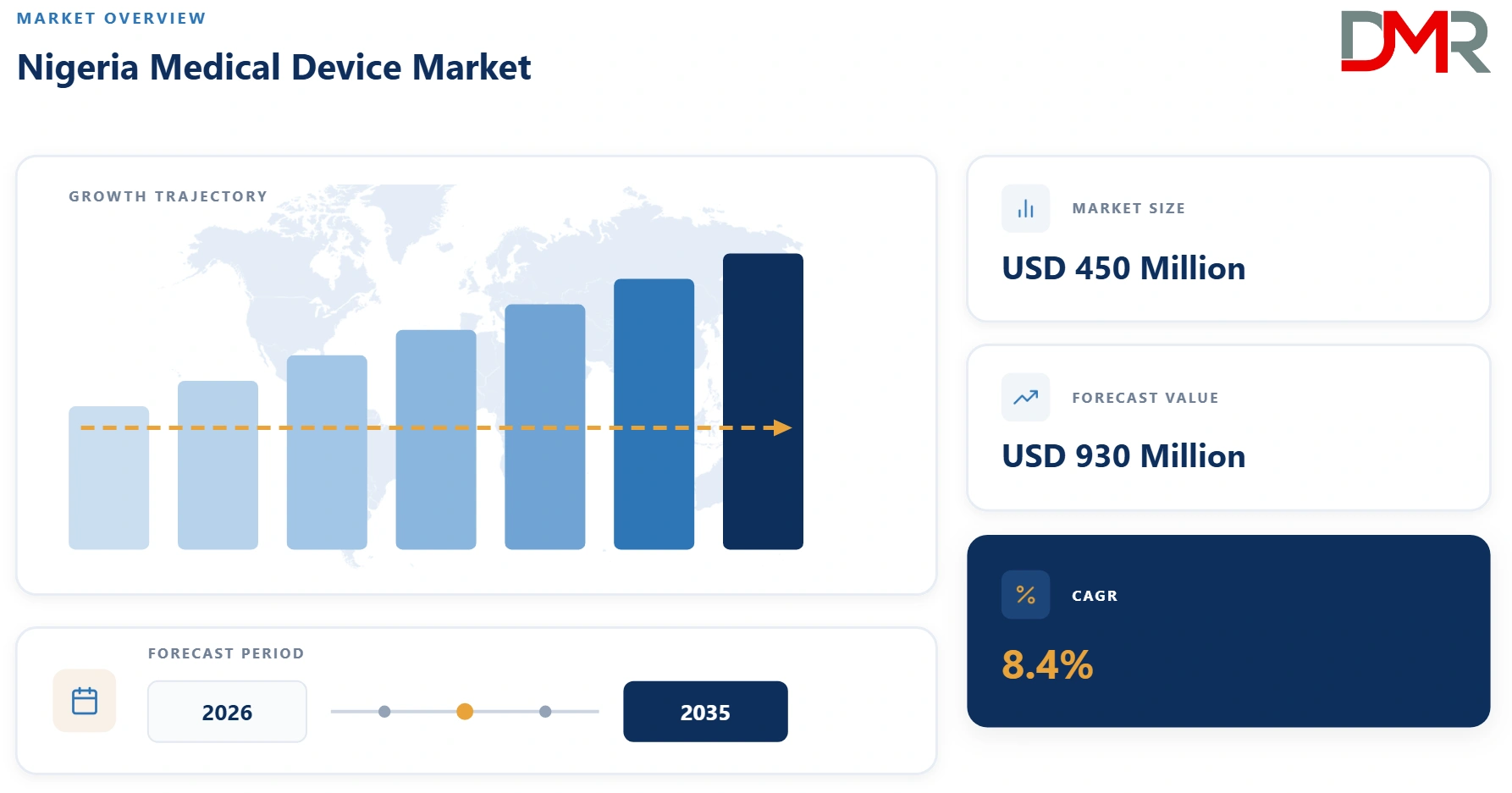
The Nigerian medical device market is estimated at USD 450 million in 2026 and is projected to reach approximately USD 930 million by 2035, representing an 8.4% CAGR.
ℹ
To learn more about this report –
Download Your Free Sample Report Here
The Nigeria medical device market comprises products, equipment, instruments, software-enabled systems, and consumables used to diagnose, monitor, prevent, treat, or manage diseases and medical conditions. It includes diagnostic imaging equipment, surgical instruments, therapeutic devices, patient-monitoring systems, IVD products, implants, diabetes-care devices, and medical consumables. The market operates through a combination of international manufacturers, Nigerian distributors, healthcare procurement organizations, public-sector tenders, private hospitals, clinics, diagnostic centers, and increasingly digital channels. Its core value proposition is to improve diagnostic accuracy, treatment effectiveness, patient monitoring, clinical productivity, and access to specialized healthcare.
Use Cases
- Diagnostic imaging: CT, MRI, ultrasound, X-ray, and mammography systems for disease detection and treatment planning.
- Patient monitoring: Multiparameter monitors, ECG, pulse oximetry, and remote-monitoring systems for acute and chronic-care patients.
- Laboratory diagnostics: IVD analyzers and rapid tests supporting infectious-disease, metabolic, oncology, and routine testing.
- Surgical intervention: Surgical instruments, electrosurgical systems, minimally invasive devices, and operating-room equipment.
- Chronic disease management: Glucose meters, insulin-delivery equipment, cardiac devices, and home-monitoring technologies.
- Cancer treatment: Radiotherapy systems, oncology imaging, treatment-planning software, and associated patient-monitoring technologies.
Key Takeaways
- Market size: Nigeria's medical-device market is estimated at USD 450 million in 2026, reaching about USD 930 million by 2035.
- Growth: The market is forecast to expand at approximately 8.4% CAGR during 2026–2035.
- Growth drivers: Healthcare infrastructure investment, chronic-disease burden, diagnostic capacity expansion, private-sector healthcare investment, and localization policies.
- Segment dominance: Diagnostic imaging is the largest product category, while hospitals remain the largest end-user group.
- Fastest growth: Software-enabled devices are expected to grow fastest as connected monitoring, AI-assisted diagnostics, digital workflows, and remote care expand.
- Structural characteristic: Import dependence remains high, creating opportunities for international suppliers, local assembly, technology transfer, and domestic manufacturing.
How AI/Gen AI is Transforming the Nigeria Medical Device Market?
AI, IoT, cloud connectivity, and software-defined medical technology are gradually shifting Nigerian healthcare from equipment-centric procurement toward connected clinical platforms. AI-assisted imaging can help radiologists prioritize abnormalities, IoT-enabled monitors can transmit patient data remotely, and cloud platforms can centralize diagnostic information across facilities. NAFDAC has already established dedicated guidance for Software as a Medical Device (SaMD), indicating that software-enabled medical technologies are becoming a recognized component of Nigeria's regulated device ecosystem.
The primary benefits include improved equipment utilization, earlier identification of deterioration, reduced manual workload, better remote support, and more efficient clinical decision-making. Connected systems can also improve preventive maintenance and reduce downtime—an important consideration in Nigeria, where imported equipment, spare-parts availability, technical expertise, electricity reliability, and foreign-exchange exposure can constrain utilization.
Key Drivers in the Nigeria Medical Device Market
Healthcare Infrastructure Modernization and Public Investment
Nigeria has a substantial deficit in modern diagnostic and specialized-care infrastructure, creating a significant replacement and greenfield opportunity for medical-device suppliers. Government-backed programs are increasingly moving beyond basic healthcare access toward advanced diagnostics, oncology, interventional cardiology, and tertiary-care modernization. The NSIA's MedServe program is a major catalyst, with plans involving diagnostic centers, oncology centers, and catheterization laboratories distributed across Nigeria's geopolitical zones. In February 2026, IFC and NSIA announced financing to expand diagnostic, cancer-care, and cardiac infrastructure, including CT, MRI, digital pathology, linear accelerators, and cardiac catheterization equipment.
Growing Chronic-Disease and Diagnostic Demand
Nigeria's large and growing population is increasing demand for diagnostic and therapeutic technologies. Cardiovascular disease, diabetes, cancer, kidney disease, and other chronic conditions require continuing monitoring and increasingly sophisticated diagnosis. Diabetes-related demand alone is substantial: one industry assessment estimates Nigeria's broader diabetes market at approximately USD 573.9 million in 2025, with continued expansion through 2029.
Restraints in the Nigeria Medical Device Market
Foreign-Exchange Exposure and Import Dependence
The most significant structural constraint is Nigeria's heavy reliance on imported medical technology. The U.S. Commercial Service reports that more than 98% of medical-equipment requirements are imported, leaving the market highly exposed to currency movements, shipping costs, tariffs, import procedures, and international supply-chain disruptions.
Infrastructure, Skills and Maintenance Constraints
Medical-device adoption is constrained by inconsistent electricity supply, limited biomedical-engineering capacity, uneven technical support, and shortages of specialized clinical personnel. Sophisticated CT, MRI, radiotherapy, laboratory, and surgical systems require stable infrastructure, trained operators, preventive maintenance, calibration, software updates, and reliable spare-parts availability.
Growth Opportunities in the Nigeria Medical Device Market
Local Manufacturing and Technology Transfer
Nigeria's import dependence creates considerable white space for domestic production of relatively standardized devices and consumables. Government policy is increasingly supportive of localization. The October 2024 Executive Order on increasing local production introduced fiscal incentives, regulatory harmonization, and mechanisms such as framework contracts and volume guarantees intended to stimulate healthcare manufacturing.
Decentralized Diagnostics and Connected Home Care
The geographic scale of Nigeria creates an attractive opportunity for portable, point-of-care, remote-monitoring, and home-healthcare technologies. Rather than relying exclusively on large tertiary hospitals, providers can deploy compact ultrasound systems, portable ECGs, rapid diagnostic tests, connected glucose monitors, digital pathology workflows, and remote patient-monitoring systems. The opportunity is strengthened by the growth of diagnostic centers outside traditional healthcare hubs. MedServe's nationwide expansion illustrates the market potential for decentralized diagnostic infrastructure, while digital connectivity creates the possibility of linking peripheral facilities to specialists in Lagos, Abuja, and other major medical centers.
Trends in the Nigeria Medical Device Market
Shift from Equipment Sales to Lifecycle-Service Models
Nigeria is moving toward procurement models emphasizing equipment uptime, maintenance, training, financing, and lifecycle support rather than one-time hardware purchases. Long-term partnerships between MedServe and major imaging suppliers demonstrate this transition. Suppliers capable of guaranteeing maintenance, local technical support, clinical education, and predictable operating costs should gain an advantage over purely transactional vendors.
Localization of Basic Medical Products
The combination of import dependence, currency pressures, supply-chain risk, and government policy is accelerating interest in Nigerian manufacturing. The strongest near-term localization potential is in syringes, PPE, consumables, rapid diagnostic tests, packaging, and other relatively standardized products. More sophisticated products are likely to follow a local assembly + imported components + technology-transfer model rather than complete domestic manufacturing in the short term.
Research Scope and Analysis
The Nigeria medical-device market is segmented by Product, Device Type, Application, End User, and Distribution Channel. The analysis distinguishes capital-intensive equipment from recurring consumables, hospital-based procurement from decentralized care, and conventional hardware from software-enabled and connected technologies.
ℹ
To learn more about this report –
Download Your Free Sample Report Here
By Product Analysis
Diagnostic Imaging is estimated to be the dominant product category in 2026, accounting for approximately 22% of market value. Its leadership reflects Nigeria's diagnostic-capacity deficit, increasing cancer and cardiovascular screening, private hospital investment, and large public infrastructure projects involving CT, MRI, X-ray, ultrasound, and related systems. Medical Consumables represent the second-largest category at approximately 19%, supported by high procedure volumes and recurring replacement demand for syringes, PPE, dressings, and related products. Surgical Devices account for roughly 16%, while therapeutic devices and patient monitoring contribute approximately 14% and 13%, respectively. In Vitro Diagnostics represent about 11%, with others comprising the balance. The fastest-growing product category is estimated to be In Vitro Diagnostics at approximately 10.5% CAGR, driven by decentralized testing, infectious-disease screening, chronic-disease diagnostics, and localization initiatives. Rapid diagnostic-test manufacturing is receiving increasing policy attention, while new diagnostic centers are creating demand for laboratory analyzers and pathology infrastructure.
By Device Type Analysis
Active Devices lead the device-type segmentation with approximately 31% share in 2026, reflecting the importance of imaging equipment, monitoring systems, laboratory analyzers, therapeutic systems, and powered clinical equipment. These products command high average selling prices and represent a significant portion of hospital capital expenditure. Single-use Devices constitute the second-largest category at approximately 23%, supported by high procedural volumes and infection-control requirements, followed by non-active devices at around 20%. Implantable Devices account for approximately 12%, while software-enabled devices represent roughly 9%. The fastest-growing category is Software-Enabled Devices, estimated at 11.8% CAGR, as hospitals increasingly adopt connected monitoring, AI-assisted diagnostics, digital workflows, and cloud-based clinical applications. NAFDAC's dedicated SaMD registration guidance creates an increasingly defined regulatory pathway for this segment.
By Application Analysis
General Diagnostics is estimated to lead applications with approximately 24% share in 2026, reflecting the broad requirement for laboratory tests, imaging, screening, pathology, and routine diagnostic procedures across Nigeria's healthcare system. Cardiology is the second-largest application at approximately 20%, supported by rising cardiovascular-disease burden and new catheterization laboratories. Oncology represents approximately 17%, orthopedics 14%, diabetes care 13%, and other applications approximately 12%. Oncology is forecast to be the fastest-growing application at approximately 10.9% CAGR, reflecting both unmet clinical demand and substantial infrastructure investment. NSIA's oncology expansion includes radiotherapy-enabled facilities and advanced diagnostic capabilities, while three upgraded oncology centers were commissioned in 2025.
By End User Analysis
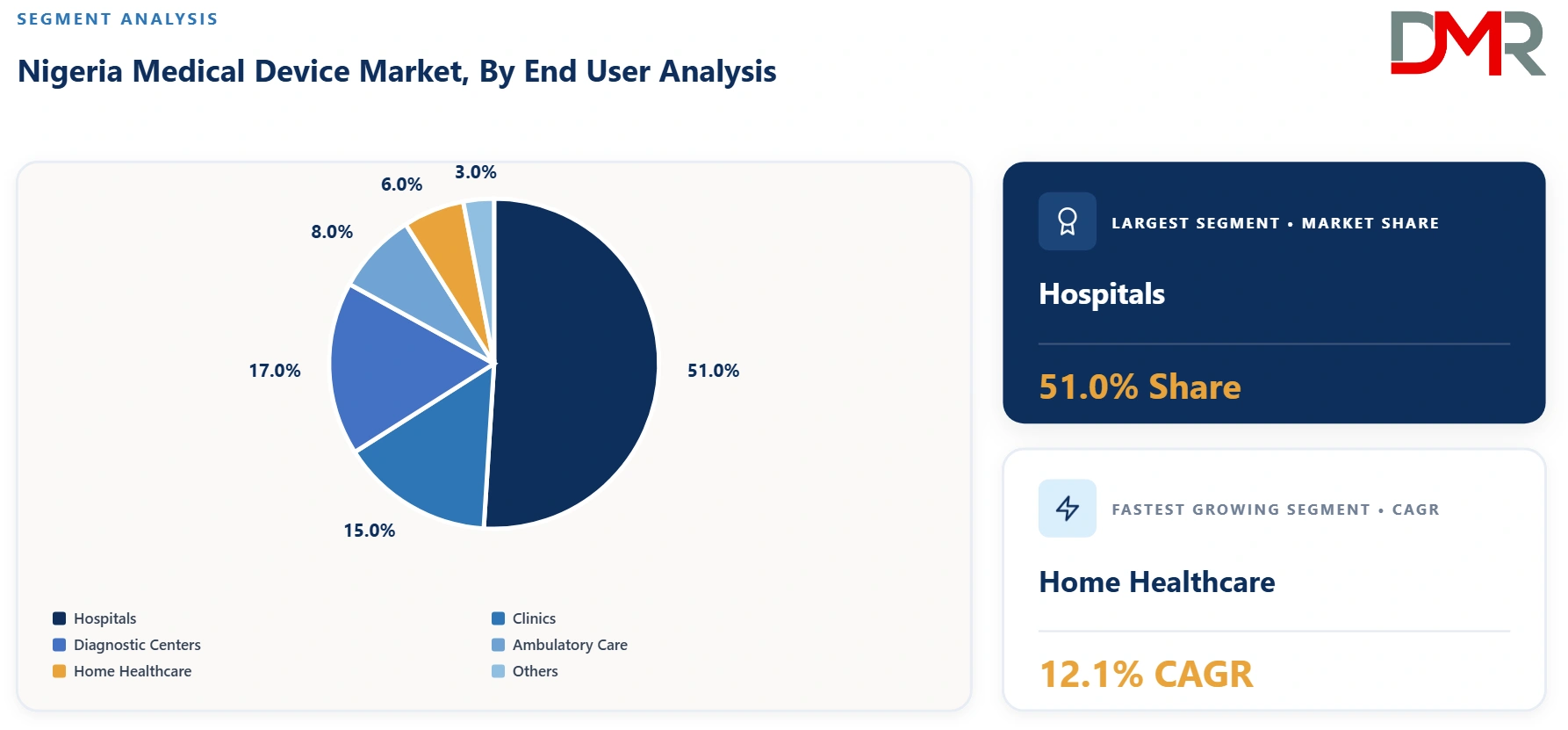
Hospitals dominate the Nigerian medical-device market with approximately 51% share in 2026, because they purchase the widest range of high-value equipment, including imaging, surgical systems, monitors, laboratory equipment, and therapeutic devices. Diagnostic Centers are the second-largest end-user category at approximately 17%, benefiting from rising demand for specialized testing and the expansion of standalone diagnostic infrastructure. Clinics represent around 15%, ambulatory care 8%, home healthcare 6%, and other users approximately 3%. Home Healthcare is the fastest-growing end-user category at approximately 12.1% CAGR, driven by chronic-disease management, connected monitoring, portable diagnostics, and the need to reduce hospital utilization. Its relatively small current base provides substantial room for expansion, particularly for glucose monitoring, pulse oximetry, ECG, blood-pressure monitoring, and wearable technologies.
By Distribution Channel Analysis
Specialist Distributors represent the leading channel, with approximately 39% share in 2026, because most international manufacturers require Nigerian partners for market access, regulatory support, logistics, installation, training, and after-sales service. Direct Manufacturer Sales account for approximately 27%, particularly for large capital equipment and government or tertiary-hospital projects. Medical equipment dealers represent approximately 16%, public-sector procurement approximately 11%, online/digital channels 4%, and other channels 3%. Online and Digital Channels are forecast to grow fastest at approximately 14.0% CAGR, albeit from a small base, as procurement platforms, digital catalogs, remote sales support, and direct-to-consumer monitoring products expand. The U.S. Commercial Service specifically advises international suppliers entering Nigeria to work with vetted local distributors because of their market knowledge, networks, and relationships.
The Nigeria Medical Device Market Report is segmented on the basis of the following:
By Product
- Diagnostic Imaging
- Surgical Devices
- Therapeutic Devices
- Patient Monitoring
- In Vitro Diagnostics
- Medical Consumables
- Others
By Device Type
- Active Devices
- Non Active Devices
- Implantable Devices
- Single Use Devices
- Software Enabled Devices
- Others
By Application
- Cardiology
- Orthopedics
- Oncology
- Diabetes Care
- General Diagnostics
- Other Applications
By End User
- Hospitals
- Clinics
- Diagnostic Centers
- Ambulatory Care
- Home Healthcare
- Others
By Distribution Channel
- Direct Manufacturer Sales
- NHS Procurement and Frameworks
- Specialist Distributors
- Medical Equipment Dealers
- Online and Digital Channels
- Others
Regulatory Landscape
Nigeria's medical-device regulatory environment is centered on the National Agency for Food and Drug Administration and Control (NAFDAC). Medical devices, IVDs, and related products must be registered before being manufactured, imported, exported, advertised, sold, distributed, or used in Nigeria. NAFDAC's 2025 medical-device framework addresses classification, registration, labeling, post-registration changes, establishment registration, refurbishment, and post-market risk management.
The regulatory environment is becoming more structured, but compliance remains a market-entry consideration because overseas manufacturers generally need an authorized Nigerian representative and documentation such as powers of attorney, manufacturing/free-sale certificates, and product dossiers. NAFDAC's GMP guidance also aligns manufacturing expectations with quality-management principles including risk management and ISO 13485-related requirements.
Investment and White Space Analysis
Nigeria offers significant medical-device investment white space because demand for modern equipment substantially exceeds domestic manufacturing capacity. The most attractive near-term opportunities are diagnostic imaging, IVDs, oncology equipment, cardiac intervention, patient monitoring, medical consumables, and refurbishment/service businesses. The USD 24.3 million IFC-supported MedServe financing and associated infrastructure expansion demonstrate growing institutional willingness to deploy capital into advanced healthcare assets. Investment risk remains elevated because of foreign-exchange volatility, procurement delays, power reliability, workforce shortages, and reimbursement constraints. However, these risks also create opportunities for equipment leasing, local assembly, pay-per-use models, maintenance-as-a-service, distributor financing, and technology-transfer partnerships. Investors with strong local operating partners and lifecycle-service capabilities are likely to outperform purely import-oriented models. The strongest long-term white space is the localization of standardized devices and consumables combined with imported high-end technology.
Competitive Landscape
The Nigerian medical-device market is moderately fragmented, with multinational manufacturers competing alongside regional suppliers, local distributors, specialist healthcare companies, and a small but growing domestic manufacturing base. Major international participants include Siemens Healthineers, GE HealthCare, Philips, Medtronic, Abbott, Roche, Johnson & Johnson, BD, Stryker, Boston Scientific, Mindray and other specialist manufacturers. Industry sources identify these companies among important participants in Nigeria's medical-device and diagnostics ecosystem.
Competitive differentiation increasingly depends on technology quality, total cost of ownership, distributor strength, regulatory execution, financing, training, maintenance, uptime, spare-parts availability, and clinical support. Large public projects favor companies able to provide long-term service commitments, while private hospitals tend to balance performance with acquisition cost and financing flexibility.
Some of the prominent players in the Nigeria Medical Device Market are:
- Philips Healthcare
- Siemens Healthineers
- GE HealthCare
- Medtronic
- Abbott Laboratories
- Johnson & Johnson
- Roche Diagnostics
- Becton, Dickinson and Company (BD)
- Stryker
- Boston Scientific
- 3M Health Care
- Cardinal Health
- Thermo Fisher Scientific
- Hologic
- Olympus
- Mindray
- Fresenius Medical Care
- Baxter
- B. Braun
- Terumo
- Edwards Lifesciences
- Zimmer Biomet
- Smith+Nephew
- Bio-Rad Laboratories
- Canon Medical Systems
- Fujifilm Healthcare
- Draeger
- Getinge
- ResMed
- Masimo
- Nipro
- Nihon Kohden
- Karl Storz
- Carestream Health
- bioMérieux
- Danaher
- Abbott Medical Devices
- Siemens Diagnostics
- Vantage Diagnostics Nigeria
- MedicaleX
- Other Key Players
Recent Developments
- February 2026: IFC and NSIA announced a naira-denominated financing partnership for MedServe's expansion, supporting diagnostic centers, radiotherapy-enabled cancer facilities, and cardiac catheterization laboratories using advanced CT, MRI, digital pathology, linear-accelerator, and cardiac technologies.
- December 2025: Siemens Healthineers and NSIA announced a 10-year strategic partnership to equip 10 new MedServe centers, combining advanced imaging technology with capacity building and long-term infrastructure support.
- December 2025: MedServe announced 10-year partnerships with both GE HealthCare and Siemens Healthineers covering state-of-the-art radiology equipment and comprehensive maintenance for centers scheduled for commissioning in 2026.
- May 2025: NAFDAC announced that Afrimedical Manufacturing and Supplies' 0.5 ml auto-disable syringe had achieved WHO prequalification, marking a major milestone for indigenous Nigerian medical-device manufacturing.
Report Details
| Report Characteristics |
| Market Size (2026) |
USD 450 Mn |
| Forecast Value (2035) |
USD 930 Mn |
| CAGR (2026–2035) |
8.4% |
| Historical Data |
2021 – 2025 |
| Forecast Data |
2026 – 2035 |
| Base Year |
2025 |
| Segments Covered |
By Product, By Device Type, By Application, By End User, By Distribution Channel |
| Country Coverage |
Nigeria |
Frequently Asked Questions
What is the size of the Nigeria Medical Device Market in 2026?
▾ The Nigeria Medical Device Market is estimated at approximately USD 450 million in 2026, supported by healthcare infrastructure investment, diagnostic expansion, and rising medical-technology demand.
What will be the size of the Nigeria Medical Device Market by 2035?
▾ The Nigeria Medical Device Market is projected to reach approximately USD 930 million by 2035, reflecting sustained investment in diagnostics, hospitals, specialized care, and connected medical technologies.
What is the CAGR of the Nigeria Medical Device Market from 2026 to 2035?
▾ The Nigeria Medical Device Market is projected to expand at approximately 8.4% CAGR from 2026 to 2035, driven by healthcare modernization and increasing technology adoption.
What are the key growth drivers of the Nigeria Medical Device Market?
▾ The Nigeria Medical Device Market is driven by healthcare infrastructure development, chronic-disease prevalence, diagnostic capacity expansion, private healthcare investment, and government localization initiatives.
What are the major trends in the Nigeria Medical Device Market?
▾ Major Nigeria Medical Device Market trends include connected healthcare, AI-assisted diagnostics, decentralized testing, software-enabled devices, lifecycle service models, and increasing local manufacturing.
Which segment dominates the Nigeria Medical Device Market?
▾ Diagnostic Imaging is the leading product segment in the Nigeria Medical Device Market, accounting for an estimated 22% share in 2026, supported by strong unmet diagnostic demand.
Which is the fastest-growing segment in the Nigeria Medical Device Market?
▾ Software-Enabled Devices are expected to be the fastest-growing segment of the Nigeria Medical Device Market, with an estimated 11.8% CAGR, supported by connected and AI-enabled healthcare.
Who are the key players in the Nigeria Medical Device Market?
▾ Key participants in the Nigeria Medical Device Market include Siemens Healthineers, GE HealthCare, Philips, Medtronic, Abbott, Roche, Johnson & Johnson, BD, Stryker, Boston Scientific, and Mindray.