Nuclear Fuel Fabrication Market Snapshot
- Market Value: The global Nuclear Fuel Fabrication market is expected to reach USD 10.8 billion by 2035 from USD 6.4 billion in 2026, at a CAGR of 5.4%.
- By Fuel Type Segment Analysis: Uranium Dioxide (UO₂) Fuel segment dominated with 52% share in 2026.
- By Reactor Type Segment Analysis: Pressurized Water Reactor (PWR) led reactor types with 41% share in 2026.
- By Application Segment Analysis: Commercial Nuclear Power Plants held 67% share in 2026.
- By Fabrication Process Segment Analysis: Fuel Assembly Fabrication accounted for 58% share in 2026.
- By Enrichment Type Segment Analysis: Low-Enriched Uranium (LEU) held 64% share in 2026.
- Regional Analysis: Asia Pacific led global Nuclear Fuel Fabrication market with 38% revenue share in 2026.
- Major Players: BWX Technologies (BWXT), Cameco Corporation, X-energy, Orano, General Atomics, Westinghouse Electric Company and Others.
What is the Global Nuclear Fuel Fabrication Market and its Market Size?
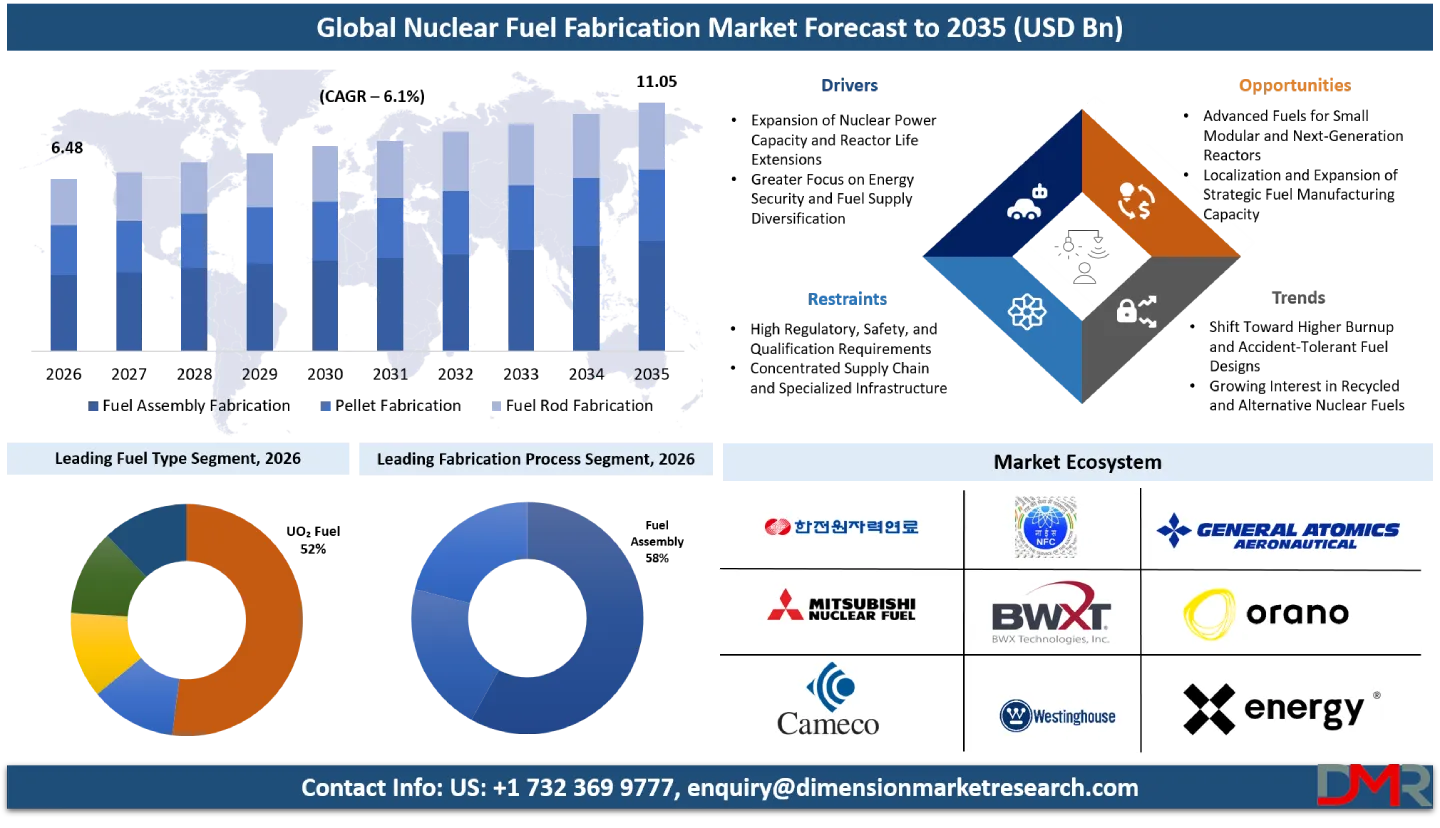
The Global Nuclear Fuel Fabrication Market size is projected to be valued at USD 6.48 billion in 2026 and is projected to reach USD 11.05 billion by 2035, expanding at a steady CAGR of 6.1% during the forecast period. Nuclear fuel fabrication represents the final manufacturing stage that converts prepared nuclear material into engineered fuel suitable for reactor operation. Uranium dioxide powder is commonly pressed into ceramic pellets, loaded into metal fuel rods, and arranged into precisely designed assemblies for specific reactor systems.
ℹ
To learn more about this report –
Download Your Free Sample Report Here
The growth of the nuclear fuel fabrication industry is supported by reactor life extensions, new nuclear construction, energy security programs, fuel supply diversification, and development of advanced reactors. The IAEA reported 417 operational nuclear reactors with 377 GW(e) of capacity at the end of 2024 and projects global nuclear capacity could reach between 561 GW(e) and 992 GW(e) by 2050. This expanding reactor base creates long-term demand for uranium fuel, fuel assemblies, enrichment services, advanced fuel designs, and secure nuclear fuel supply chains.
Use Cases
- Commercial Power Generation: Fabricated uranium fuel supports continuous electricity production in commercial nuclear reactors. Utilities require scheduled fuel reloads, qualified assemblies, and reliable supply agreements to maintain high reactor availability and long operating cycles.
- Reactor Refueling: Nuclear plants periodically replace part of their reactor core with newly fabricated fuel assemblies. This creates recurring market demand because fuel must meet exact reactor design, enrichment, geometry, safety, and performance requirements.
- Advanced Nuclear Reactors: Small modular reactors and advanced reactor concepts are creating demand for new fuel forms, including higher-assay fuels. HALEU contains more than 5% but less than 20% uranium-235 and is expected to support numerous advanced reactor designs.
- Research and Specialized Reactors: Nuclear fuel fabrication also serves research reactors, isotope production systems, demonstration reactors, and other specialized applications where fuel geometry, enrichment, cladding, and performance specifications differ from conventional commercial power reactors.
- Fuel Supply Diversification: Utilities and governments increasingly seek alternative qualified suppliers to strengthen energy security. Recent fuel diversification programs, including alternative VVER fuel deliveries in Europe, demonstrate growing strategic interest in reducing dependence on single-source nuclear fuel supply chains.
How AI/Gen AI is Transforming the Global Nuclear Fuel Fabrication Market?
Artificial intelligence is increasingly supporting quality control, process monitoring, predictive maintenance, engineering analysis, and manufacturing optimization across highly controlled nuclear production environments. Fuel fabrication involves powder processing, pellet pressing, sintering, dimensional inspection, rod loading, welding, assembly, and extensive quality assurance. Data-driven systems can help manufacturers identify process deviations earlier, analyze inspection results, optimize equipment utilization, and improve production consistency. Digital models can also support engineering teams when evaluating complex fuel geometry, thermal behavior, material performance, and manufacturing tolerances.
Generative AI can further improve document-intensive activities such as technical knowledge retrieval, maintenance planning, operating procedure management, supplier documentation, and engineering workflow support. In regulated nuclear operations, adoption is likely to remain controlled because safety decisions require validated methods, human oversight, cybersecurity controls, traceability, and regulatory compliance. The strongest commercial opportunity therefore lies in using AI as a decision-support layer rather than an autonomous control system. This can improve workforce productivity while preserving the rigorous verification standards required in nuclear fuel manufacturing.
Key Drivers in the Nuclear Fuel Fabrication Market
Expansion of Nuclear Power Capacity and Reactor Life Extensions
Rising nuclear generation targets are strengthening long-term nuclear fuel fabrication market demand. Governments are supporting new reactors while utilities extend the operating lives of existing plants to provide firm, low-carbon electricity. Nuclear energy currently supplies around 9% of global electricity, while IAEA projections indicate global nuclear capacity could rise significantly through 2050. Every operating reactor requires recurring refueling, creating predictable demand for fabricated uranium pellets, rods, assemblies, engineering services, and quality assurance.
Greater Focus on Energy Security and Fuel Supply Diversification
Energy security is becoming a major nuclear fuel fabrication market growth driver as governments and utilities reassess dependence on concentrated conversion, enrichment, and fabrication supply chains. Buyers increasingly value geographic diversification, long-term supply agreements, qualified backup suppliers, and domestic manufacturing capabilities. Westinghouse, for example, operates fuel fabrication facilities in the United States, Sweden, and the United Kingdom, while fuel diversification initiatives are expanding opportunities for suppliers capable of qualifying fuel for multiple reactor designs.
Restraints in the Nuclear Fuel Fabrication Market
High Regulatory, Safety, and Qualification Requirements
Nuclear fuel manufacturing operates under demanding regulatory and quality requirements because small deviations in enrichment, pellet characteristics, cladding integrity, geometry, or assembly performance can affect reactor safety. Fuel assemblies are engineered specifically for reactor designs and manufactured to exact tolerances. New suppliers and fuel technologies therefore face extensive testing, licensing, qualification, safeguards, transportation, and documentation requirements. These conditions increase capital needs and lengthen commercialization cycles, limiting rapid entry into the nuclear fuel fabrication market.
Concentrated Supply Chain and Specialized Infrastructure
The global nuclear fuel cycle relies on specialized facilities for uranium conversion, enrichment, deconversion, pellet production, cladding, and final assembly fabrication. Building these facilities requires large investments, nuclear-grade manufacturing expertise, safeguards systems, trained personnel, and regulatory approvals. Uranium mining itself is geographically concentrated, with Kazakhstan, Canada, and Namibia accounting for about three-quarters of global mine production. Such concentration can expose fuel buyers to geopolitical, logistics, contracting, and capacity risks that influence procurement strategies and fabrication economics.
Growth Opportunities in the Nuclear Fuel Fabrication Market
Advanced Fuels for Small Modular and Next-Generation Reactors
The transition toward small modular reactors and advanced nuclear systems creates a significant growth opportunity for specialized fuel manufacturers. Many proposed advanced reactors require fuel with different enrichment levels, shapes, materials, and performance characteristics from conventional light-water reactor fuel. HALEU, defined as uranium enriched above 5% and below 20% uranium-235, is expected to be required by many advanced reactor concepts. The development of commercial HALEU and advanced fuel production infrastructure could establish valuable new fabrication markets through 2035 and beyond.
Localization and Expansion of Strategic Fuel Manufacturing Capacity
Governments seeking more resilient nuclear supply chains are creating opportunities for domestic conversion, enrichment, deconversion, and fuel fabrication investment. The U.S. HALEU Availability Program, for example, aims to encourage private investment and establish a reliable domestic supply of material needed for advanced reactors. Similar localization strategies can support new fabrication capacity, technology partnerships, licensing agreements, and long-term utility contracts. Suppliers able to combine proven manufacturing quality with secure regional production are positioned to capture growing strategic procurement demand.
Trends in the Global Nuclear Fuel Fabrication Market
Shift Toward Higher Burnup and Accident-Tolerant Fuel Designs
Nuclear utilities and fuel vendors are advancing fuel technologies designed to improve operating efficiency, safety margins, and fuel utilization. Development programs increasingly focus on accident-tolerant fuel, increased enrichment, enhanced cladding materials, and higher burnup. Framatome's portfolio includes enhanced accident-tolerant fuel concepts, higher uranium enrichment, and higher burnup capabilities, while U.S. regulatory work has addressed increased enrichment for conventional and accident-tolerant fuel. These developments can reshape fabrication equipment, licensing, inspection, and material requirements.
Growing Interest in Recycled and Alternative Nuclear Fuels
Fuel recycling and alternative fuel compositions are gaining attention as countries seek improved uranium utilization and more circular nuclear fuel cycles. Mixed oxide fuel combines uranium and recovered plutonium and is already manufactured commercially for selected light-water reactors. Orano's Melox facility reports more than 3,100 tonnes of heavy metal in cumulative production, illustrating established industrial experience in recycled fuel fabrication. Continued interest in MOX, advanced uranium fuels, and specialized reactor fuels expands technology opportunities beyond conventional uranium dioxide assemblies.
Research Scope and Analysis
The Nuclear Fuel Fabrication Market is segmented based on Fuel Type, Reactor Type, Application, Fabrication Process, Enrichment Type, and other relevant categories. The study provides an in-depth analysis of key segments and sub-segments, covering their applications, industry adoption, demand patterns, and contribution to overall market growth.
ℹ
To learn more about this report –
Download Your Free Sample Report Here
By Fuel Type;
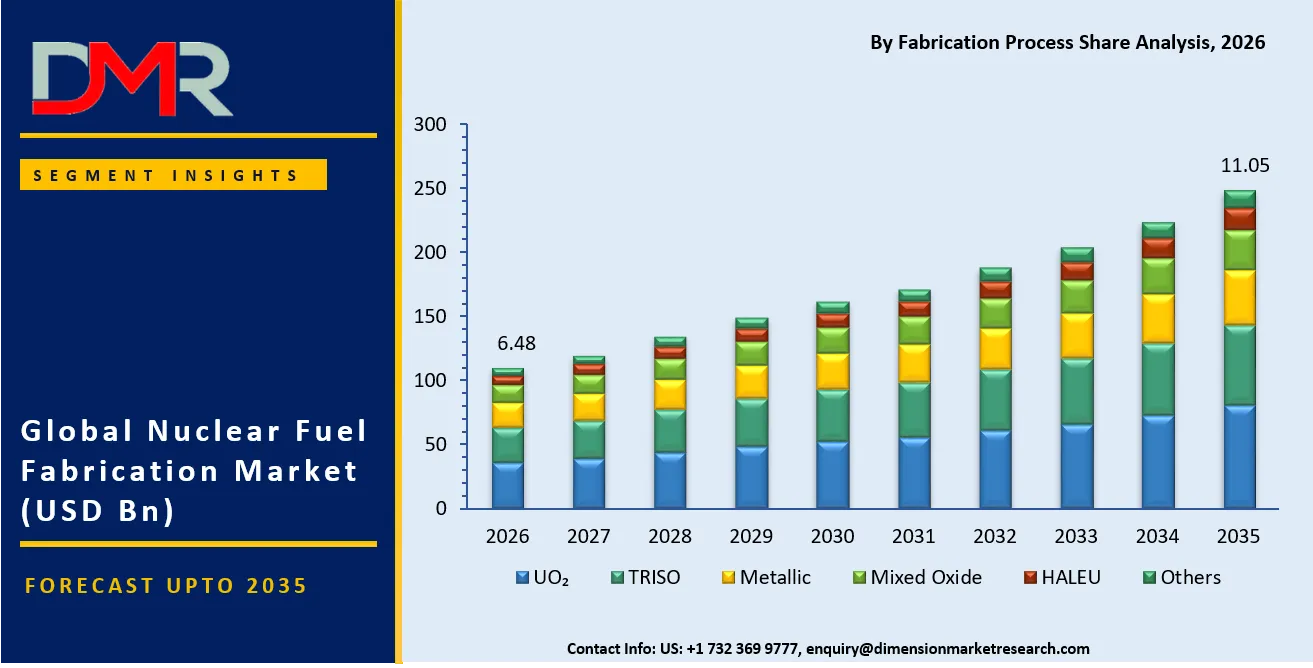
Uranium Dioxide (UO₂) Fuel dominated the fuel type segment with 52% share in 2026. Its leadership is linked to the extensive installed base of light-water reactors and a mature global manufacturing ecosystem for uranium oxide fuel. UO₂ powder is pressed and sintered into ceramic pellets, inserted into cladding tubes to create fuel rods, and assembled into reactor-specific configurations. UOX fuel is widely used in PWR and BWR systems, supporting recurring demand from commercial reactor refueling programs. Established specifications, qualified suppliers, predictable performance, and extensive operating experience reinforce the segment's market share. Advanced pellet chemistry, higher burnup strategies, and improved cladding can further extend opportunities for UO₂-based fuel platforms.
By Reactor Type;
Pressurized Water Reactor (PWR) led the reactor type segment with 41% share in 2026. PWRs represent the largest class of commercial nuclear reactors globally, creating a substantial installed base that requires recurring fuel reloads and replacement assemblies. Fuel suppliers manufacture reactor-specific PWR assemblies with carefully controlled uranium enrichment, pellet properties, rod geometry, cladding, structural components, and quality standards. Framatome markets fuel for light-water reactors including its GAIA PWR fuel platform, while global suppliers maintain dedicated PWR manufacturing capabilities. Continued PWR construction, plant life extensions, uprates, higher burnup programs, and fuel diversification initiatives support the segment's long-term contribution to nuclear fuel fabrication market demand.
By Application;
Commercial Nuclear Power Plants accounted for 67% of the Nuclear Fuel Fabrication Market in 2026. The segment benefits from the recurring refueling needs of the global operating reactor fleet and continued investment in new nuclear capacity. Commercial utilities purchase fuel through long-term contracts that can include engineering support, core design services, fabrication, delivery, and performance monitoring. IAEA PRIS data currently lists more than 400 reactors in operation globally, confirming the large installed base supporting recurring fuel requirements. Rising electricity demand, energy security policies, reactor life extensions, and plans for additional nuclear capacity are expected to maintain commercial power generation as the central application for fabricated nuclear fuel.
ℹ
To learn more about this report –
Download Your Free Sample Report Here
By Fabrication Process;
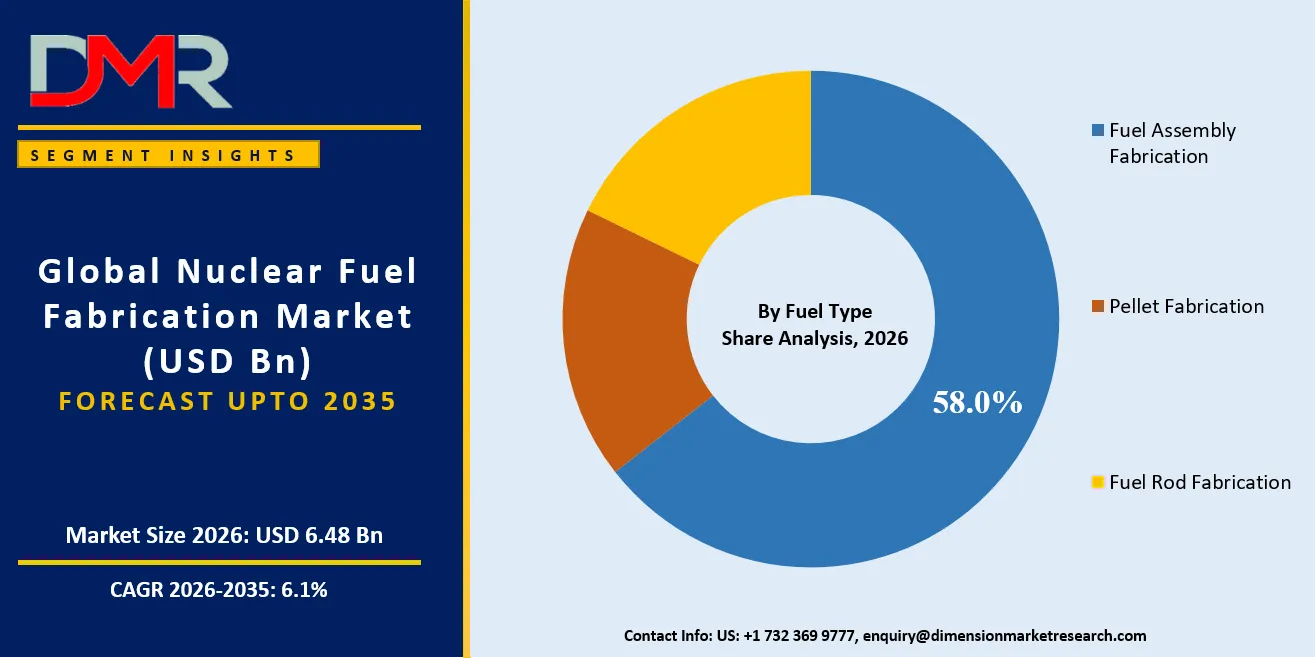
Fuel Assembly Fabrication accounted for 58% share in 2026, reflecting the high engineering value and technical complexity involved in transforming individual fuel rods and structural components into reactor-ready assemblies. Fuel assemblies must satisfy precise dimensional, mechanical, neutronic, thermal, and safety requirements because their configuration depends on reactor design. Fabricators combine fuel rods with grids, guide structures, end fittings, and related components under rigorous quality controls. The process therefore captures substantial value through specialized equipment, skilled labor, material science, inspection, traceability, and reactor-specific engineering. Demand is expected to rise with new reactor commissioning, replacement fuel cycles, and adoption of advanced assembly designs.
By Enrichment Type;
Low-Enriched Uranium (LEU) held 64% share in 2026 and remains the main enrichment category supporting the existing commercial light-water reactor fleet. Conventional reactors generally use uranium enriched to relatively low concentrations of uranium-235, creating a large recurring requirement for LEU conversion into uranium dioxide powder, pellets, rods, and complete assemblies. The installed fleet ensures continued LEU fabrication demand, while higher enrichment pathways are developing for advanced fuels. HALEU is enriched above 5% and below 20% uranium-235 and is expected to become increasingly important for advanced reactors, but conventional LEU remains the dominant commercial foundation of the market during the current period.
The Nuclear Fuel Fabrication Market Report is segmented on the basis of the following:
By Fuel Type
-
TRISO Fuel
- Metallic Nuclear Fuel
- Mixed Oxide (MOX) Fuel
- Uranium Dioxide (UO₂) Fuel
- High-Assay Low-Enriched Uranium (HALEU) Fuel
- Other Fuel Types
By Reactor Type
By Fabrication Process
By Enrichment Type
-
Mixed Oxide (MOX)
- High-Assay Low-Enriched Uranium (HALEU)
- Low-Enriched Uranium (LEU)
- Other Enrichment Types
By Application
Regional Analysis
Asia Pacific is the Leading Region in the Nuclear Fuel Fabrication Market
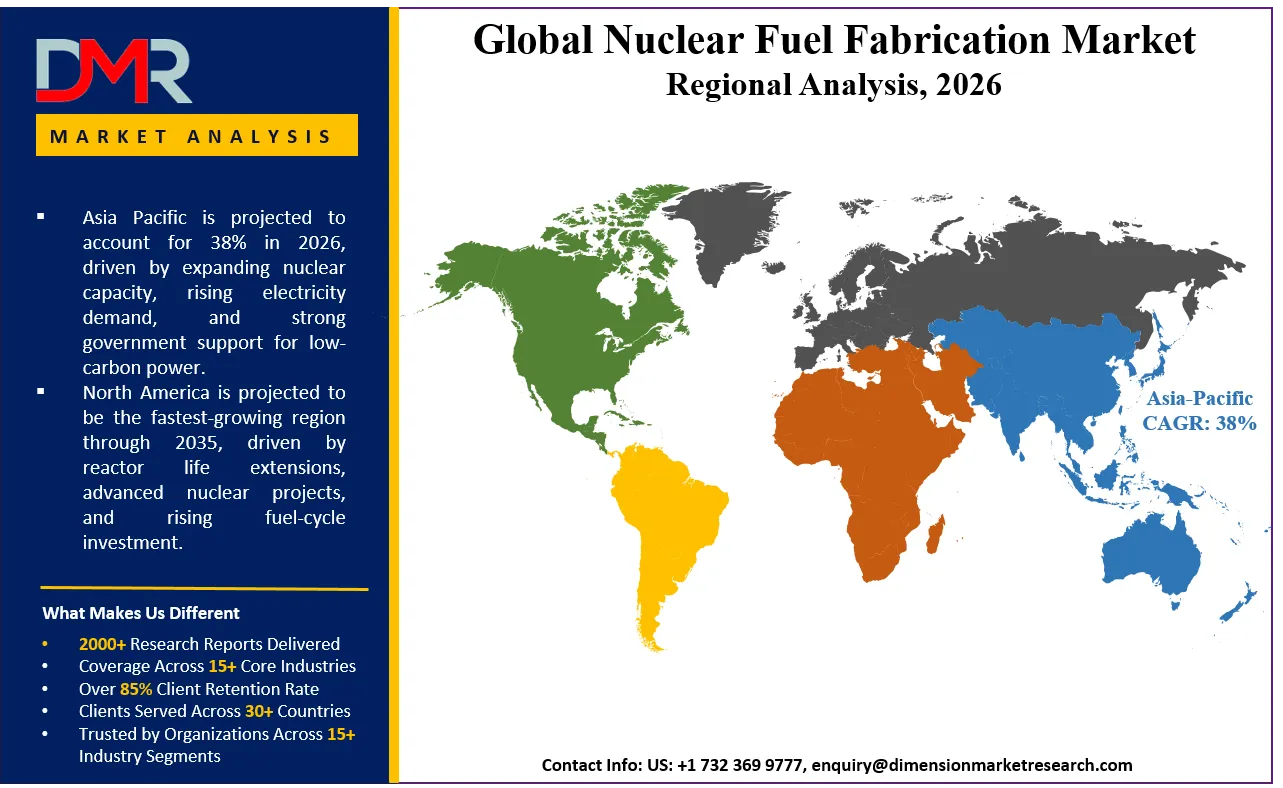
Asia Pacific led the Global Nuclear Fuel Fabrication Market with 38% revenue share in 2026. Regional growth is supported by expanding nuclear power capacity, ongoing reactor construction, rising electricity demand, and strong government support for low-carbon baseload generation. China, India, South Korea, and Japan maintain significant nuclear programs, while localization of fuel-cycle capabilities is strengthening regional supply security. Continued investment in reactor deployment, uranium fuel production, and domestic fabrication infrastructure supports Asia Pacific's leading market position.
ℹ
To learn more about this report –
Download Your Free Sample Report Here
North America is the Fastest-Growing Region in the Nuclear Fuel Fabrication Market
North America is expected to record the fastest growth in the Global Nuclear Fuel Fabrication Market through 2035, supported by reactor life extensions, advanced nuclear projects, and renewed investment in domestic fuel-cycle infrastructure. The United States is expanding support for HALEU availability, advanced reactor fuels, and secure enrichment and fabrication capacity. Strong participation from Westinghouse, BWXT, X-energy, Cameco, and General Atomics, combined with growing demand for accident-tolerant and next-generation fuels, is creating new commercial opportunities across the regional market.
By Region
North America
Europe
- Germany
- France
- The UK
- Spain
- Italy
- Rest of Europe
Asia Pacific
-
China
- Japan
- South Korea
- India
- Australia
- Rest of APAC
Latin America
-
Brazil
- Mexico
- Rest of Latin America
Middle East & Africa
-
GCC
- South Africa
- Rest of MEA
Major Countries Analysis
China Nuclear Fuel Fabrication Market
China is a central growth market for nuclear fuel fabrication due to its expanding reactor fleet, large nuclear construction pipeline, domestic fuel-cycle capabilities, and long-term energy security objectives. New reactor additions create requirements for initial cores as well as recurring reload fuel, increasing demand for pellets, rods, assemblies, engineering, enrichment, and quality control. Domestic manufacturing capabilities and continued investment in advanced reactor technologies strengthen China's position within the Asia Pacific nuclear fuel supply chain. Opportunities are expected across conventional PWR fuel, advanced materials, specialized fuel types, and next-generation reactor systems.
US Nuclear Fuel Fabrication Market
The United States represents a major country market based on its large commercial nuclear fleet, established fabrication infrastructure, reactor life-extension activity, and emerging advanced reactor sector. Federal efforts to strengthen domestic enrichment and HALEU availability are encouraging investment across the nuclear fuel supply chain. The DOE states that HALEU will be needed for many advanced reactor concepts, while established facilities already manufacture fuel for conventional commercial plants. Growth opportunities include accident-tolerant fuels, higher enrichment, advanced reactor fuels, fuel supply diversification, and expansion of secure domestic production capacity.
Competitive Landscape
The Global Nuclear Fuel Fabrication Market has a highly specialized competitive landscape characterized by strict qualification requirements, long customer relationships, reactor-specific intellectual property, large capital investments, and extensive quality assurance capabilities.
Some of the prominent players in the Nuclear Fuel Fabrication Industry are:
- BWX Technologies (BWXT)
- Cameco Corporation
- X-energy
- Orano
- General Atomics
- Westinghouse Electric Company
- Korea Nuclear Fuel Co., Ltd. (KNF)
- Framatome*
- Mitsubishi Nuclear Fuel Co., Ltd. (MNF)
- Nuclear Fuel Complex (NFC)
- Others
Competition centers on fuel performance, supply reliability, regulatory qualification, reactor compatibility, manufacturing capacity, engineering expertise, geographic reach, and ability to support utilities throughout the fuel lifecycle.
Technology development is becoming an increasingly important competitive differentiator. Framatome is developing advanced light-water reactor fuels, including accident-tolerant concepts and higher enrichment options, while Westinghouse maintains multiple global fabrication facilities and continues to broaden reactor fuel supply capabilities. Orano combines upstream fuel-cycle expertise with recycled MOX fuel capabilities, and U.S. initiatives are encouraging new HALEU and advanced fuel supply capacity. As utilities focus more strongly on energy security and supplier diversification, companies that combine proven conventional fuel manufacturing with advanced fuel technology, regional capacity, regulatory expertise, and resilient supply networks are expected to strengthen their Global Nuclear Fuel Fabrication Market share through 2035.
Recent Developments:
Report Details
| Report Characteristics |
| Market Value (2025) |
USD 6.1 Billion |
| Market Value (2026) |
USD 6.4 Billion |
| Forecast Revenue (2035) |
USD 10.8 Billion |
| CAGR (2026–2035) |
5.4% |
| Historical Data |
2020 - 2024 |
| Forecast Data |
2026 - 2035 |
| Base Year |
2025 |
| Estimate Year |
2026 |
| Report Coverage |
Revenue Forecast, Market Dynamics, Competitive Landscape, Recent Developments |
| Segments Covered |
By Fuel Type (TRISO Fuel, Metallic Nuclear Fuel, Mixed Oxide (MOX) Fuel, Uranium Dioxide (UO₂) Fuel, High-Assay Low-Enriched Uranium (HALEU) Fuel, Other Fuel Types); By Reactor Type (Small Modular Reactor (SMR), Fast Neutron Reactor (FNR), Gas-Cooled Reactor (AGR/HTGR), CANDU Reactor, Pressurized Heavy Water Reactor (PHWR), Boiling Water Reactor (BWR), Pressurized Water Reactor (PWR), Other Reactor Types); By Fabrication Process (Fuel Assembly Fabrication, Pellet Fabrication, Fuel Rod Fabrication); By Enrichment Type (Mixed Oxide (MOX), High-Assay Low-Enriched Uranium (HALEU), Low-Enriched Uranium (LEU), Other Enrichment Types); By Application (Medical Isotope Production Reactors, Naval Nuclear Propulsion, Advanced Nuclear Reactors, Research Reactors, Government & National Nuclear Laboratories, Commercial Nuclear Power Plants, Other Applications) |
| Regional Coverage |
North America – US, Canada; Europe – Germany, France, UK, Spain, Italy, Rest of Europe; Asia-Pacific – China, Japan, South Korea, India, Australia, Rest of APAC; Latin America – Brazil, Mexico, Rest of Latin America; Middle East & Africa – GCC, South Africa, Rest of MEA |
| Prominent Players |
BWX Technologies (BWXT), Cameco Corporation, X-energy, Orano, General Atomics, Westinghouse Electric Company, Korea Nuclear Fuel Co., Ltd. (KNF), Framatome, Mitsubishi Nuclear Fuel Co., Ltd. (MNF), Nuclear Fuel Complex (NFC), and Other Key Players |
| Purchase Options |
We have three licenses to opt for: Single User License (Limited to 1 User), Multi-User License (Up to 5 Users), and Corporate Use License (Unlimited Users & Printable PDF) along with customization based on project requirements. |
Frequently Asked Questions
What is the current size of the Nuclear Fuel Fabrication Market?
▾ The Nuclear Fuel Fabrication Market is valued at USD 6.48 billion in 2026 and may reach USD 11.05 billion by 2035.
What is the growth rate of the Nuclear Fuel Fabrication Market during the forecast period?
▾ The Nuclear Fuel Fabrication Market is expected to grow at a CAGR of 6.1% during the forecast period 2026-2035.
Which region dominates the Global Nuclear Fuel Fabrication Market?
▾ Asia Pacific leads the Global Nuclear Fuel Fabrication Market with a 38% revenue share in 2026, driven by nuclear expansion.
What factors are driving the growth of the Nuclear Fuel Fabrication Market?
▾ Nuclear capacity expansion, fuel security, and reactor life extensions are driving Nuclear Fuel Fabrication Market growth.
What are the major challenges restraining the Nuclear Fuel Fabrication Market?
▾ High capital costs, strict regulations, long fuel qualification cycles, and supply risks restrain the Nuclear Fuel Fabrication Market.
Which segment holds the largest share of the Nuclear Fuel Fabrication Market?
▾ Uranium Dioxide (UO2) Fuel leads the Nuclear Fuel Fabrication Market by fuel type, accounting for a 52% share in 2026.
Who are the leading companies in the Nuclear Fuel Fabrication Market?
▾ BWX Technologies (BWXT), Cameco Corporation, X-energy, Orano, General Atomics, Westinghouse Electric Company, Korea Nuclear Fuel Co., Ltd. (KNF), Framatome, Mitsubishi Nuclear Fuel Co., Ltd. (MNF), and Nuclear Fuel Complex (NFC) are leading companies in the Nuclear Fuel Fabrication Market.
How is AI influencing the Nuclear Fuel Fabrication Market?
▾ AI supports quality inspection, predictive maintenance, process optimization, and engineering in the Nuclear Fuel Fabrication Market.
What are the future opportunities and trends in the Nuclear Fuel Fabrication Market?
▾ HALEU, advanced reactor fuels, SMRs, supply localization, and accident-tolerant fuels offer Nuclear Fuel Fabrication Market opportunities.