Market Overview
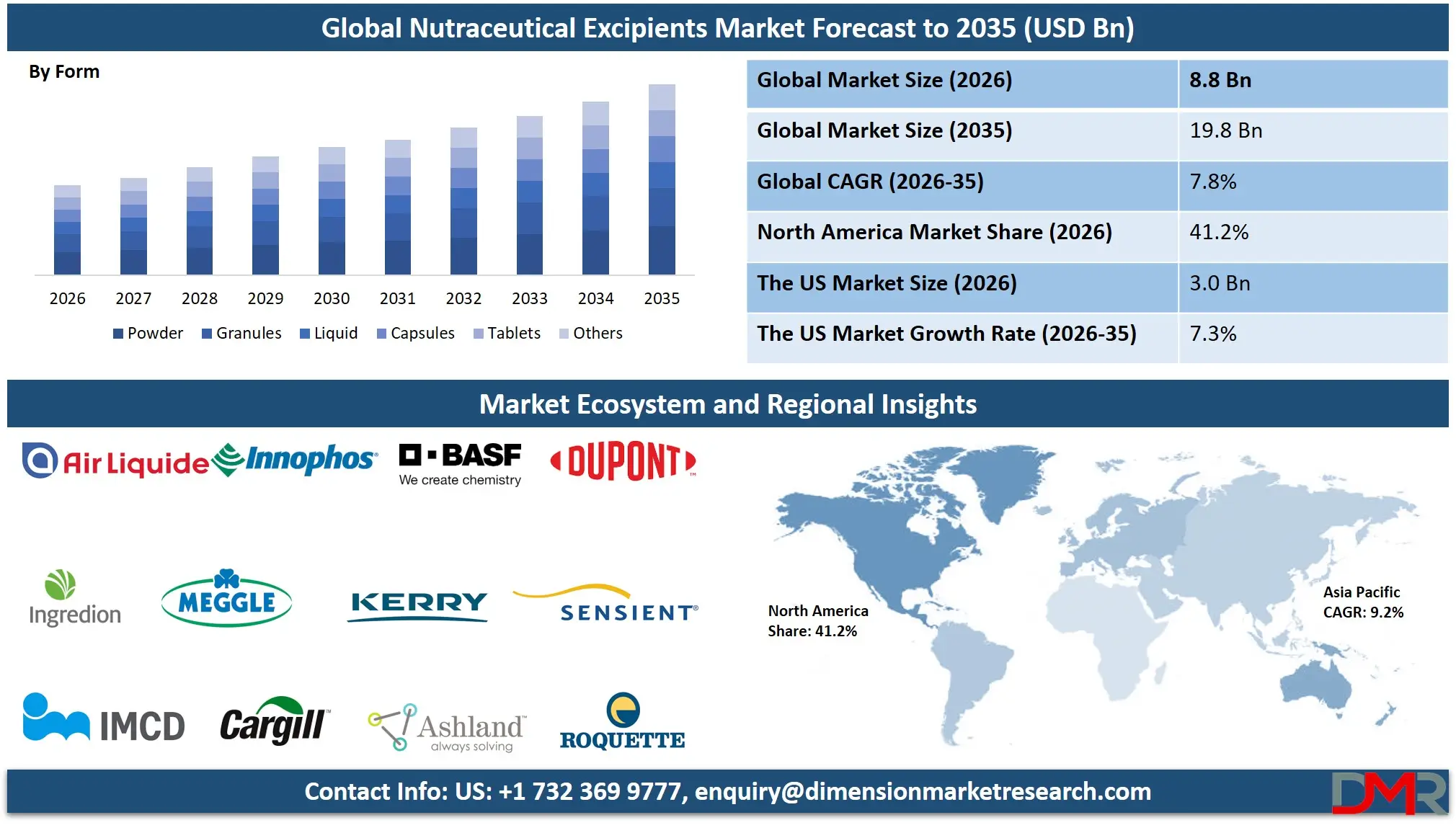
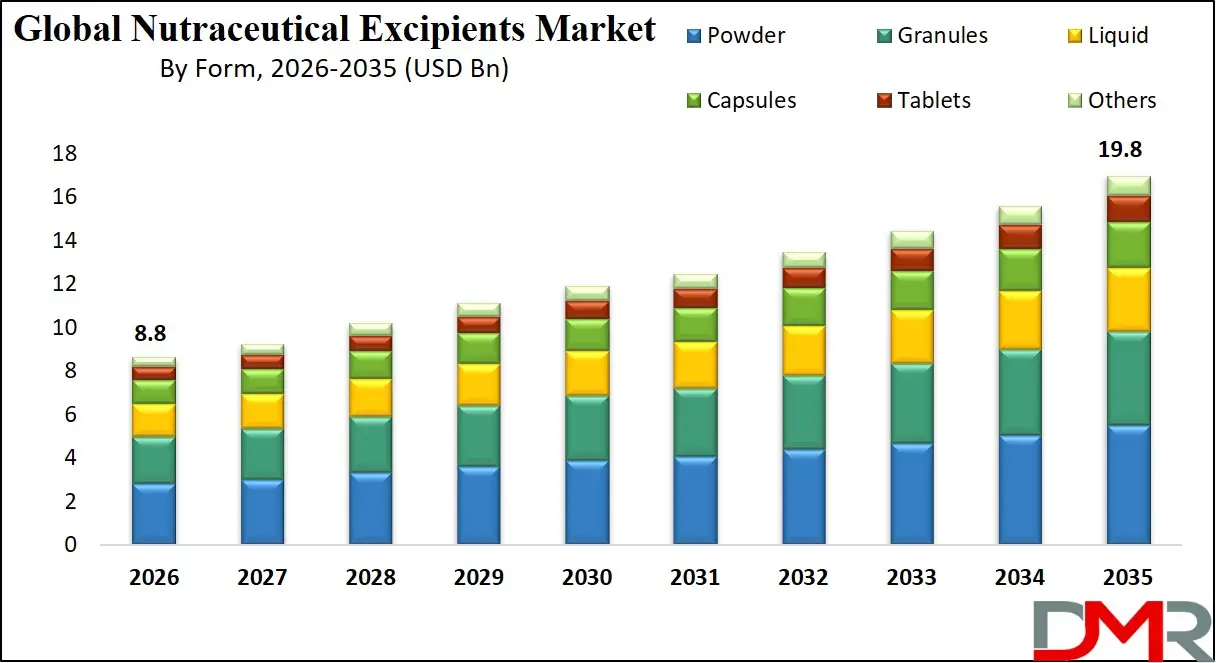
The Global Nutraceutical Excipients Market is set for substantial expansion, reaching an estimated USD 8.8 billion in 2026 and projected to grow at a strong CAGR of 7.8% from 2026 to 2035, to the market value of USD 19.8 billion by 2035. This robust growth trajectory is fueled by the accelerating adoption of functional foods and dietary supplements, rising consumer awareness regarding preventive healthcare, and increasing demand for clean-label and plant-based formulations across industries.
ℹ
To learn more about this report –
Download Your Free Sample Report Here
Rising incidences of lifestyle disorders, digestive health issues, and micronutrient deficiencies are compelling manufacturers to develop advanced nutraceutical delivery systems with enhanced bioavailability and stability. The rapid expansion of personalized nutrition, sports nutrition products, medical foods, and natural ingredient-based supplements is significantly increasing demand for high-quality excipient solutions.
Additionally, growing regulatory compliance requirements related to food safety standards, GRAS (Generally Recognized as Safe) designations, and international pharmacopeia guidelines are further accelerating market adoption. Manufacturers are increasingly integrating multifunctional excipients, natural binding agents, controlled-release polymers, and taste-masking technologies to improve product efficacy, shelf-life, and consumer compliance.
Natural and organic sourcing strategies, coupled with technological advancements in co-processing and particle engineering, are enabling nutraceutical companies to develop clean-label products without compromising functional performance. As preventive health trends dominate consumer behavior and aging populations expand globally, the Nutraceutical Excipients Market is expected to witness sustained growth through 2035, driven by formulation innovation and shifting dietary supplement consumption patterns.
ℹ
To learn more about this report –
Download Your Free Sample Report Here
Growing government initiatives promoting nutritional security, food fortification programs, and public health awareness campaigns further accelerate global adoption. However, barriers such as varying regulatory standards across regions (FDA, EFSA, FSSAI), high cost of natural excipient sourcing, raw material supply chain volatility, and challenges in maintaining excipient stability in novel delivery formats remain. Despite these limitations, the convergence of material science, green chemistry, and functional ingredient technologies positions nutraceutical excipients as essential components in the global preventive healthcare landscape through 2035.
The US Nutraceutical Excipients Market
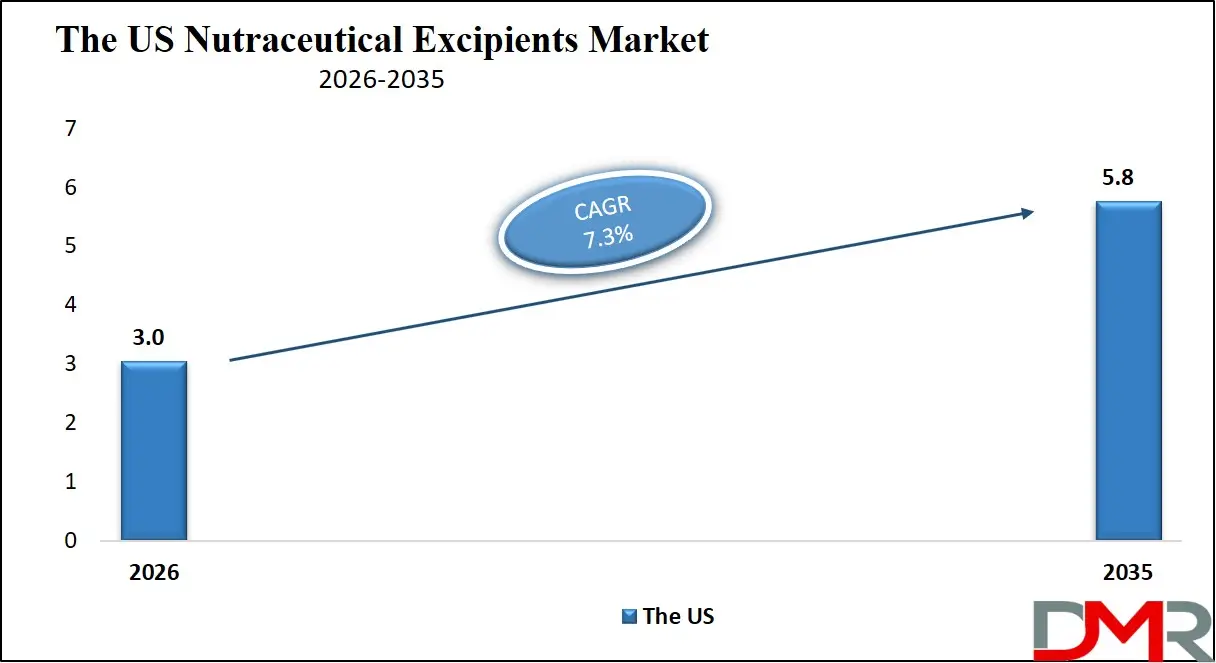
The U.S. Nutraceutical Excipients Market is projected to reach USD 3.0 billion in 2026 and grow at a CAGR of 7.3%, reaching USD 5.8 billion by 2035. The U.S. leads global adoption due to its mature dietary supplement industry, high consumer spending on preventive healthcare, and strong regulatory framework from the FDA and FTC ensuring product safety and quality standards.
ℹ
To learn more about this report –
Download Your Free Sample Report Here
The proliferation of personalized nutrition services, plant-based supplements, and functional food innovations, coupled with consumer demand for transparent labeling and natural ingredients, fuels demand for advanced excipient systems. Major nutraceutical brands, contract manufacturers, and food conglomerates such as Nestlé Health Science, Herbalife, and Pharmavite are integrating specialized excipients to enhance bioavailability, stability, and sensory characteristics of their formulations.
U.S. regulatory support for structure/function claims, alongside frameworks like the Dietary Supplement Health and Education Act (DSHEA), encourages investment in novel excipient technologies. The market is witnessing a shift toward multifunctional co-processed excipients and natural alternatives to synthetic binders and fillers, reducing reliance on traditional ingredients while improving manufacturing efficiency. The rise of gummy supplements, ready-to-drink functional beverages, and plant-based protein products has further intensified the focus on excipients offering superior texture, stability, and taste-masking capabilities, positioning the U.S. as a critical innovator in this space.
The Europe Nutraceutical Excipients Market
The Europe Nutraceutical Excipients Market is projected to be valued at approximately USD 2.6 billion in 2026 and is projected to reach around USD 4.9 billion by 2035, growing at a CAGR of about 7.2% from 2026 to 2035. Europe's leadership is anchored by its stringent regulatory environment, particularly the European Food Safety Authority (EFSA) guidelines and the Novel Food Regulation, which mandate rigorous safety assessments for new excipient ingredients.
Countries such as Germany, the U.K., France, and Italy are widely adopting advanced excipient solutions, driven by a high emphasis on clean-label products, organic certifications, and sustainable sourcing practices. The U.K.'s emphasis on public health nutrition and the EU's Farm to Fork Strategy further necessitate sustainable ingredient sourcing and transparency in nutraceutical supply chains.
Europe's strong tradition in herbal supplements, high consumer awareness of ingredient safety, and a mature functional food market drive the demand for natural excipients derived from plant sources. Funding and support for circular economy initiatives encourage upcycling of food industry by-products for excipient development and standardization of quality parameters across member states. With a sophisticated consumer base and a regulatory landscape that prioritizes safety and sustainability, Europe remains a highly advanced and essential region for nutraceutical excipient services.
The Japan Nutraceutical Excipients Market
The Japan Nutraceutical Excipients Market is anticipated to be valued at approximately USD 704.0 million in 2026 and is expected to attain nearly USD 1,240.0 million by 2035, expanding at a CAGR of about 6.5% during the forecast period. Japan's aging population and government push for "Healthy Life Expectancy" initiatives are driving the adoption of functional foods and FOSHU (Foods for Specified Health Uses) products, making advanced excipient technologies a cornerstone of nutritional innovation.
The Ministry of Health, Labour and Welfare (MHLW) actively supports the development of functional food ingredients, promoting the use of novel excipients that improve bioavailability and stability of bioactive compounds. Japan's leadership in fermentation technology and marine-derived ingredients provides a robust foundation for specialized excipient development, including controlled-release systems and moisture-protective coatings.
Japan's concept of "Food with Function Claims" driven by major pharmaceutical and food corporations integrates advanced excipient technologies into everything from bone health supplements to cognitive function products. Companies are deploying multifunctional excipients to combat challenges in formulating with sensitive bioactive ingredients and ensure the stability of innovative delivery formats in Tokyo's sophisticated nutraceutical market and regional health food channels. Japan's cultural emphasis on quality and precision positions it as a high-growth, technology-focused market for excipient solutions.
Key Takeaways
- Strong Global Market Growth Outlook: The Global Nutraceutical Excipients Market is expected to be valued at USD 8.8 billion in 2026 and is projected to reach USD 19.8 billion by 2035, showcasing rapid expansion supported by rising demand for functional foods and preventive health solutions.
- Steady CAGR Driven by Formulation Innovation: The market is expected to grow at a CAGR of 7.8% from 2026 to 2035, fueled by accelerating new product development, natural ingredient preferences, and increasing complexity of nutraceutical delivery systems worldwide.
- Steady Growth Trajectory in the United States: The U.S. Nutraceutical Excipients Market stands at USD 3.0 billion in 2026 and is projected to reach USD 5.8 billion by 2035, expanding at a CAGR of 7.3% due to high supplement consumption rates and strong manufacturing infrastructure.
- Regional Dominance: North America is expected to capture approximately 41.2% of the global market share in 2026, supported by a mature dietary supplement industry, robust R&D investments, and high consumer health awareness.
- Rapid Advancement in Excipient Technologies: Innovations including co-processed multifunctional excipients, plant-based binding systems, controlled-release coatings, and fermentation-derived natural ingredients are significantly enhancing formulation performance and clean-label profiles.
- Growing Health & Wellness Trends Boost Adoption: Rising global consumer focus on immunity, gut health, and healthy aging, coupled with demand for sugar-free and non-GMO products, is driving sustained demand for specialized, functional excipient solutions.
Global Nutraceutical Excipients Market: Use Cases
- Probiotic Formulation Stability: Nutraceutical manufacturers utilize moisture-protective coatings and desiccant excipients to maintain probiotic viability throughout shelf life, ensuring colony-forming unit counts meet label claims.
- Taste-Masking in Pediatric Supplements: Children's vitamin manufacturers employ flavoring agents, sweeteners, and coating technologies to mask bitter active ingredients, improving palatability and compliance in chewable tablets and gummies.
- Controlled-Release Sports Nutrition: Sports nutrition brands leverage polymer-based excipients to create sustained-release amino acid and creatine formulations, providing extended muscle support during training and recovery periods.
- Clean-Label Functional Foods: Food and beverage companies utilize natural binders and plant-based stabilizers to develop clean-label protein bars and fortified beverages without synthetic additives, meeting consumer demand for recognizable ingredients.
- Bioavailability Enhancement of Curcumin: Manufacturers of botanical supplements use solubilizers and absorption-enhancing excipients to improve the bioavailability of poorly soluble Nutraceutical like curcumin, maximizing therapeutic efficacy.
Global Nutraceutical Excipients Market: Stats & Facts
International Food Information Council (IFIC)
- 73% of global consumers report actively trying to eat healthier.
- 63% of consumers find it challenging to identify healthier food options.
- 56% of consumers are interested in learning more about functional foods.
Nutrition Business Journal (NBJ)
- The U.S. dietary supplement market grew by approximately 5-6% annually post-pandemic.
- Vitamins and minerals account for the largest share of supplement sales.
- Sports nutrition and weight management are among the fastest-growing supplement categories.
World Health Organization (WHO)
- 1 in 3 adults globally suffers from hypertension.
- Over 2 billion people worldwide suffer from micronutrient deficiencies.
Food and Agriculture Organization (FAO)
- Global demand for nutritious and safe food is projected to increase by 50% by 2050.
- Food fortification programs reach over 1 billion people in more than 140 countries.
International Probiotics Association (IPA)
- The global probiotics market is projected to reach USD 90 billion by 2030.
- Digestive health remains the primary reason for probiotic consumption.
National Institutes of Health (NIH)
- Over 50% of U.S. adults use at least one dietary supplement.
- Calcium, vitamin D, and omega-3 fatty acids are among the most commonly used supplements in aging populations.
Global Nutraceutical Excipients Market: Market Dynamic
Trends in the Global Nutraceutical Excipients Market
Increasing Demand for Plant-Based Excipients
Presently, there is a rapidly increasing demand for nutraceutical excipients of natural origin in the global market. The increasing concerns of consumers towards natural and soy products are the major factors for the growth of this market. Multinational companies in the nutraceutical and pharmaceutical industries are focusing on plant-based excipients to meet this trend, thus improving their competitiveness and product offerings in line with consumers' healthy lifestyle trends.
Rise of Multifunctional Excipients
Another trend that emerges in the Nutraceutical Excipients Market is that the function of excipients is gradually shifting from single to multiple functions. These emergent excipients increase the utility of Nutraceutical because they improve the stability, solubility, and particle size of the products. This trend is expected to foster market growth because the Nutraceutical Excipients Market would want to provide better excipients that will help in compounding difficult formulations.
Driving Factors in the Global Nutraceutical Excipients Market
Rising Demand for Nutraceutical Products
Some of the factors that are helping propel this market include the rising demand for nutraceutical products in the global market. Global customers are acting smarter by investing more in their health and this will lead to increased demand for dietary supplements and nutraceutical products. This trend is expected to follow the same trend during the forecast period hence leading to increased market growth of nutraceutical excipients due to the increasing demand for high-quality and effective products from the manufacturers.
Technological Advancements in Excipients
The emerging technologies associated with the creation of new nutraceutical excipients are also driving the growth of the Nutraceutical Excipients Market. Due to the advanced development of excipients, there are enhanced quality and safety of the Nutraceutical in the market hence making them more attractive. Prominent industry participants such as Ashland Global Holdings are working on research and development to bring newer generations of excipients into the market that is driving the growth of the market.
Opportunities in the Global Nutraceutical Excipients Market
Expansion in Emerging Markets
The nutraceutical excipients industry reflects the fact that the extant and expected growth opportunities will largely occur in developing markets around the globe. The Asian-Pacific and Latin American regions are economically progressing and are expanding their healthcare expenditure, which will in turn increase the consumption of nutritive products. This can be achieved through increased market penetration and opening up production facilities to support the local demand in Nutraceutical Excipients Markets.
Integration with Advanced Technologies
The advancement in technology concerning artificial intelligence and machine learning in the designing and manufacturing of excipients presents strong growth prospects. The subsequent technologies in making the excipients render are expected to increase the precision, efficiency, and control of the quality of the excipients as well as the innovation. These technologies are useful and market participants that incorporate them will be in a better position to secure competitive advantage and therefore spur growth of the Nutraceutical Excipients Market.
Restraints in the Global Nutraceutical Excipients Market
High Initial Investment Costs
New plant construction and the high costs of initial investment constraints are also issues that remain as restraints to the advanced excipients market growth. Smaller to mid-scale nutraceutical excipient suppliers might not be able to fund such investments thereby inhibiting the market's growth. Overall, complexity escalates costs because specialized tools, equipment, and trained professionals underpin the processes, altering the market's landscape.
Regulatory and Consumer Skepticism
There are some challenges to the market such as regulatory issues that affect the nutraceutical products due to the poor knowledge of the rural and underdeveloped society. Such regulatory measures and lengthy approval procedures for new excipients may slow product development and innovation, and raise costs. Also, people have some doubts about the efficiency and safety of nutraceutical products, which can influence the consumers' confidence and sluggish the speed of the new excipients appearing within the market.
Research Scope and Analysis
By Product Type Analysis
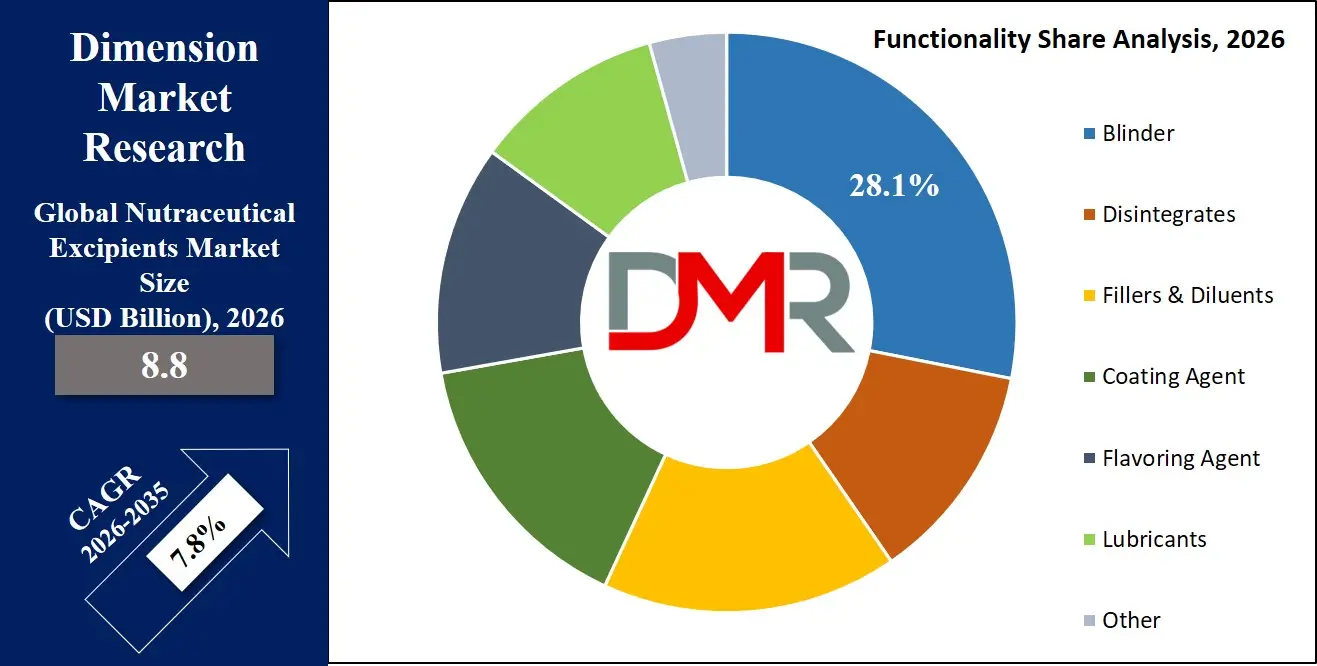
The binders are projected to dominate the Global Nutraceutical Excipients Market, accounting for the largest revenue share compared to other product categories. This dominance is primarily driven by the fundamental role these excipients play in tablet and capsule manufacturing, where they provide the necessary cohesion, bulk, and structural integrity for solid dosage forms. Nutraceutical manufacturers across vitamin, mineral, and botanical supplement categories require high-performance binding systems capable of maintaining tablet hardness while ensuring rapid disintegration for optimal nutrient release.
Modern binder systems provide advanced capabilities such as moisture resistance, improved compressibility, and compatibility with high-dose active ingredients. These features significantly reduce production challenges associated with poorly flowing powders and sensitive bioactives. Manufacturers prefer customizable excipient platforms offering consistent particle size distribution, low impurity profiles, and compatibility with both wet granulation and direct compression processes.
Additionally, the shift toward high-potency supplements and combination products has increased reliance on advanced filler systems capable of uniform blending at low active-to-excipient ratios. While functional categories like coatings, disintegrants, and flavoring agents are important for specialized applications, binders and fillers maintain segment dominance due to their universal requirement across the majority of solid oral dosage forms manufactured globally. As nutraceutical production volumes increase and manufacturing efficiency becomes paramount, this segment is expected to maintain its leadership position through continuous innovation in co-processed and multifunctional excipient technologies.
By Source Analysis
Natural excipients are expected to dominate the source segment due to accelerating consumer preference for clean-label products and regulatory support for plant-based ingredient systems. Manufacturers increasingly prioritize natural sourcing to align with consumer expectations regarding ingredient transparency, environmental sustainability, and avoidance of synthetic chemicals. Excipients derived from plant sources such as cellulose, starches, gums, and pectins offer functional performance comparable to synthetic alternatives while supporting marketing claims around natural formulation.
Natural excipients benefit from broad regulatory acceptance across major markets, established safety profiles based on historical food use, and compatibility with organic certification requirements. Their biodegradability and renewable sourcing align with corporate sustainability initiatives, while technological advances in processing enable consistent quality and functionality previously associated only with synthetic materials.
Although synthetic excipients remain relevant for specialized applications requiring precise functionality not achievable with natural alternatives, their adoption is comparatively limited in consumer-facing nutraceutical categories where natural positioning drives purchasing decisions. As regulatory frameworks increasingly favor recognizable ingredients and sustainability concerns influence formulation choices, natural excipients continue to lead the market and are projected to maintain dominance over the forecast period.
By Form Analysis
Powder is anticipated to dominate the form segment due to their extensive use in both direct manufacturing processes and as intermediate materials for further processing. These forms offer advantages in handling, blending uniformity, and compatibility with high-speed tableting and encapsulation equipment common in commercial nutraceutical production. Powdered excipients provide flexibility in formulation adjustment, while granulated forms improve flow properties and reduce dust generation during manufacturing.
The dominance of dry forms reflects the continued prevalence of tablets and capsules as preferred supplement delivery formats, accounting for the majority of nutraceutical products globally. Powder forms enable precise dosing in blend formulations, while granulated excipients support efficient direct compression approaches increasingly favored for cost reduction and process simplification.
Although liquid excipients are essential for specific applications such as softgels, liquid fills, and beverage formulations, their market share remains constrained by specialized handling requirements and stability considerations. The continued growth of gummy supplements and functional beverages is gradually expanding liquid excipient applications, but powder and granules maintain leadership due to their versatility, cost-effectiveness, and established position in mainstream supplement manufacturing.
By Function Analysis
Taste masking and solubility enhancement are projected to dominate the function segment due to the increasing formulation complexity of modern Nutraceutical incorporating bitter bioactive compounds and poorly soluble nutrients. As manufacturers incorporate higher concentrations of plant extracts, minerals, and amino acids into appealing delivery formats, technologies that address palatability and bioavailability challenges become essential to commercial success.
ℹ
To learn more about this report –
Download Your Free Sample Report Here
Taste-masking technologies enable formulation of palatable chewable tablets, gummies, and oral suspensions containing inherently bitter ingredients like green tea extract, curcumin, and certain vitamins. These functional excipients expand formulation possibilities while improving consumer compliance, particularly in pediatric and geriatric populations where taste sensitivity influences product acceptance.
Solubility enhancement addresses the fundamental challenge of delivering hydrophobic nutrients such as CoQ10, vitamin D, and omega-3 fatty acids in formats achieving meaningful absorption. Advanced solubilization technologies including self-emulsifying systems, cyclodextrin complexes, and nanoparticle-stabilizing excipients enable bioavailability improvements essential for demonstrating product efficacy. As scientific understanding of nutrient absorption drives formulation standards, these functional categories continue to dominate the excipient market through their direct impact on product performance.
By Application Analysis
Dietary supplements is forecasted to dominate the application segment, driven by the massive global consumption of vitamins, minerals, botanicals, and specialty nutrients in routine health maintenance. This segment accounts for the highest volume of excipient consumption due to the sheer number of dietary supplement products manufactured annually and the essential role excipients play in their production.
Within dietary supplements, multivitamins represent the largest category, requiring consistent excipient systems for high-volume, long-production-run manufacturing. Specialty supplements targeting joint health, cognitive function, sleep support, and beauty-from-within applications continue to expand formulation diversity, requiring specialized excipient portfolios to address unique stability and bioavailability challenges.
Although functional foods and beverages represent a rapidly growing application with substantial excipient requirements, the dietary supplements segment maintains dominance due to its established manufacturing infrastructure, regulatory framework supporting structure/function claims, and deep consumer acceptance of supplements as health management tools. As global populations age and preventive health behaviors strengthen, this segment will continue driving primary demand for excipient systems.
By End-User Analysis
Nutraceutical manufacturers is expected to dominate the end-user segment as the primary producers of finished dietary supplement and functional food products. These organizations operate the formulation development and commercial manufacturing facilities where excipient purchasing decisions are made, and excipient volumes are consumed. Their technical requirements, quality standards, and supply chain practices shape excipient market dynamics.
Large nutraceutical manufacturers operate sophisticated R&D functions driving innovation in delivery formats, bioactive combinations, and stability optimization. Their relationships with excipient suppliers influence new product development trajectories and adoption of novel excipient technologies. Manufacturing scale enables these organizations to establish specifications that become de facto industry standards for excipient quality and functionality.
While contract manufacturing organizations (CMOs) represent a growing channel through which excipients reach finished products, nutraceutical brand owners typically retain specification authority and supplier approval rights, maintaining their dominant influence over excipient selection. As the industry consolidates and major players expand portfolios through acquisition and organic growth, this segment continues to generate the majority of excipient demand and shape market evolution.
The Nutraceutical Excipients Market Report is segmented on the basis of the following:
By Product Type
- Binders
- Disintegrants
- Fillers & Diluents
- Coatings Agents
- Flavoring Agents
- Lubricants
- Others
By Source
- Natural Excipients
- Synthetic Excipients
By Form
- Powder
- Granules
- Liquid
- Capsules
- Tablets
- Others
By Application
- Dietary Supplements
- Functional Food & Beverages
- Sports Nutrition
- Medical Nutrition
- Pharmaceutical Formulations
- Cosmeceuticals
- Infant Nutrition
- Others
By End-User
- Nutraceutical Manufacturers
- Healthcare & Clinical Nutrition Providers
- Pharmaceutical Companies
- Food & Beverage Companies
- Contract Manufacturing Organizations (CMOs)
- Research & Academic Institutes
- Others
Impact of Artificial Intelligence in the Global Nutraceutical Excipients Market
- AI for Formulation Optimization: AI algorithms analyze vast datasets of excipient properties and active ingredient characteristics to predict optimal formulation combinations, reducing experimental iterations and accelerating new product development timelines by identifying compatible excipient systems for challenging bioactives.
- AI-Driven Predictive Stability Modeling: Machine learning models trained on accelerated stability study data predict long-term degradation patterns of nutraceutical formulations, enabling proactive selection of stabilizing excipients and antioxidants that maintain potency throughout product shelf life.
- Intelligent Taste-Masking Formulation Design: AI systems analyze molecular structures of bitter compounds and predict effective taste-masking approaches including polymer coatings, complexation agents, and sweetener combinations, streamlining development of palatable pediatric and geriatric formulations.
- Supply Chain Optimization and Sourcing Intelligence: AI-powered platforms monitor global agricultural conditions, weather patterns, and geopolitical factors affecting raw material availability for natural excipients, enabling predictive sourcing decisions that mitigate supply disruption risks.
- Learning from Manufacturing Process Data: AI systems analyze real-time manufacturing parameters and quality control data to identify correlations between excipient properties, processing conditions, and final product quality, enabling continuous process optimization and reduced batch variability.
Global Nutraceutical Excipients Market: Regional Analysis
Region with the Largest Revenue Share
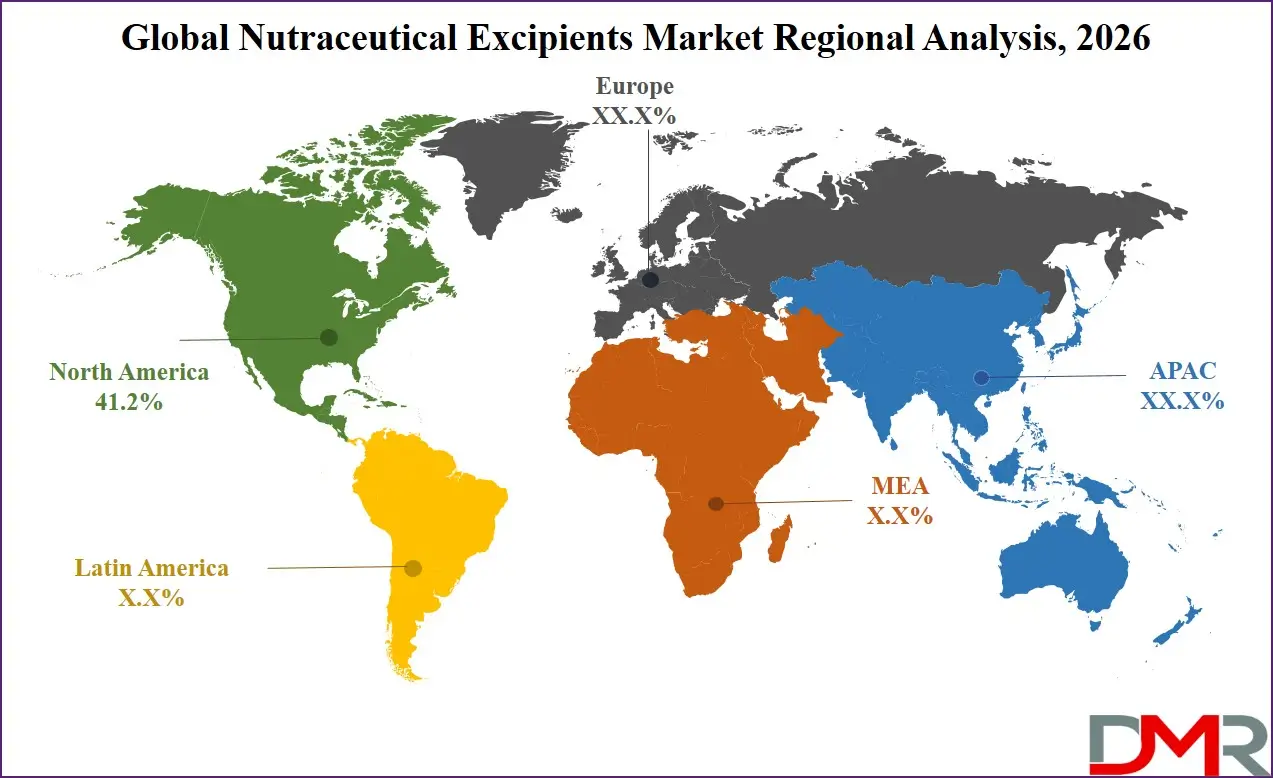
North America is projected to dominate the regional segment with the highest market share as it is anticipated to hold 41.2% of the total market revenue by the end of 2026, due to mature dietary supplement consumption patterns, advanced manufacturing infrastructure, and concentrated presence of leading nutraceutical brands. The region is home to innovative formulation companies and ingredient suppliers, driving technological advancements in excipient applications. Strong regulatory frameworks regarding GMP compliance and label claims compel manufacturers to adopt high-quality excipient standards. High consumer awareness regarding preventive health and supplement efficacy further strengthens demand.
ℹ
To learn more about this report –
Download Your Free Sample Report Here
The United States, in particular, accounts for the largest share within North America due to its large supplement market and high per capita consumption rates. Although Asia Pacific is the fastest-growing region, North America continues to hold the largest revenue share due to established manufacturing capabilities and sustained R&D investments in novel delivery technologies.
Region with the Highest CAGR
Asia-Pacific holds the highest CAGR and is poised to achieve rapid market share growth due to its massive population base, rising disposable incomes, and growing middle-class focus on preventive health management. Countries like China, India, Japan, and South Korea are investing heavily in domestic nutraceutical manufacturing capabilities. India's "Ayushman Bharat" health initiatives and China's "Healthy China 2030" strategy are creating fertile ground for nutritional product adoption. The region's price sensitivity is being addressed through local excipient production, cost-effective formulation approaches, and partnerships between global excipient suppliers and regional nutraceutical manufacturers. This, combined with immense population scale and accelerating health awareness, positions APAC as the fastest-growing market for nutraceutical excipient systems.
By Region
North America
Europe
- Germany
- The U.K.
- France
- Italy
- Russia
- Spain
- Benelux
- Nordic
- Rest of Europe
Asia-Pacific
- China
- Japan
- South Korea
- India
- ANZ
- ASEAN
- Rest of Asia-Pacific
Latin America
- Brazil
- Mexico
- Argentina
- Colombia
- Rest of Latin America
Middle East & Africa
- Saudi Arabia
- UAE
- South Africa
- Israel
- Egypt
- Rest of MEA
Competitive Landscape
The Global Nutraceutical Excipients Market is moderately fragmented, featuring a mix of global specialty chemical companies, food ingredient conglomerates, and specialized excipient manufacturers. Leading players like DuPont (International Flavors & Fragrances), Roquette Frères, and Cargill, Incorporated leverage their extensive ingredient portfolios, global manufacturing footprints, and food science expertise to serve nutraceutical manufacturers across multiple categories. Pure-play excipient innovators such as BASF SE, Evonik Industries, and JRS Pharma are driving market dynamics with specialized, high-performance materials and technical formulation support.
Food and beverage ingredient groups like Tate & Lyle, Ingredion Incorporated, and Kerry Group play a crucial role as suppliers of natural texturants, sweeteners, and flavor systems, while pharmaceutical excipient specialists like Shin-Etsu Chemical Co. and Ashland Global Holdings bring rigorous quality standards and regulatory expertise to nutraceutical applications. Regional players and distribution partners are also active, providing localized supply and technical support to manufacturers across emerging markets.
Some of the prominent players in the Global Nutraceutical Excipients Market are:
- Roquette Frères
- Ingredion Incorporated
- Kerry Group plc
- BASF SE
- DuPont de Nemours, Inc.
- Ashland Global Holdings Inc.
- MEGGLE GmbH & Co. KG
- JRS Pharma GmbH & Co. KG
- Cargill, Incorporated
- Sensient Technologies Corporation
- Innophos
- IMCD Group
- International Flavors & Fragrances Inc.
- Air Liquide
- Azelis Group
- Biogrund GmbH
- DFE Pharma GmbH & Co. KG
- SPI Pharma Inc.
- Colorcon, Inc.
- Shin-Etsu Chemical Co., Ltd
- Other Key Players
Recent Developments
- November 2025: Roquette launched a new range of plant-based binding excipients derived from pea starch, offering clean-label functionality for nutraceutical tablets with improved compressibility and rapid disintegration properties.
- October 2025: IFF demonstrated its enhanced taste-masking platform at SupplySide West 2026, highlighting microencapsulation technology capable of masking bitterness in high-load botanical formulations while maintaining bioavailability.
- September 2025: Cargill announced a multi-year agreement with a top-3 global supplement manufacturer to supply specialty excipients for its new line of gummy vitamins, signaling the critical role of texture and stability in format innovation.
- August 2025: BASF completed the acquisition of a specialist biotechnology firm to enhance its solubilization technology portfolio for poorly soluble nutraceutical actives including CoQ10 and curcumin.
- July 2025: A Horizon Europe grant was awarded to a consortium developing fermentation-derived excipient platforms from upcycled food industry side streams, linking circular economy principles with sustainable ingredient production.
- June 2025: Ingredion partnered with a major Brazilian functional food company to provide its natural stabilizer systems for plant-based protein beverages, aiming to set new standards for texture and suspension stability in the region.
Report Details
| Report Characteristics |
| Market Size (2026) |
USD 8.8 Bn |
| Forecast Value (2035) |
USD 19.8 Bn |
| CAGR (2026–2035) |
7.8% |
| The US Market Size (2026) |
USD 3.0 Bn |
| Historical Data |
2021 – 2025 |
| Forecast Data |
2027 – 2035 |
| Base Year |
2025 |
| Estimate Year |
2026 |
| Report Coverage |
Market Revenue Estimation, Market Dynamics, Competitive Landscape, Growth Factors and etc. |
| Segments Covered |
By Product Type (Binders, Disintegrants, Fillers & Diluents, Coating Agents, Flavoring Agents, Lubricants, Others); By Source (Natural Excipients, Synthetic Excipients); By Form (Powder, Granules, Liquid, Capsules, Tablets, Others); By Application (Dietary Supplements, Functional Food & Beverages, Sports Nutrition, Medical Nutrition, Pharmaceutical Formulations, Cosmeceuticals, Infant Nutrition, Others); By End-User (Nutraceutical Manufacturers, Healthcare & Clinical Nutrition Providers, Pharmaceutical Companies, Food & Beverage Companies, Contract Manufacturing Organizations (CMOs), Research & Academic Institutes, Others) |
| Regional Coverage |
North America – The US and Canada; Europe – Germany, The UK, France, Russia, Spain, Italy, Benelux, Nordic, & Rest of Europe; Asia-Pacific – China, Japan, South Korea, India, ANZ, ASEAN, Rest of APAC; Latin America – Brazil, Mexico, Argentina, Colombia, Rest of Latin America; Middle East & Africa – Saudi Arabia, UAE, South Africa, Turkey, Egypt, Israel, & Rest of MEA |
| Prominent Players |
Roquette Frères, Ingredion Incorporated, Kerry Group plc, BASF SE, DuPont de Nemours Inc., Ashland Global Holdings Inc., MEGGLE GmbH & Co. KG, JRS Pharma GmbH & Co. KG, Cargill Incorporated, Sensient Technologies Corporation, Innophos, IMCD Group, International Flavors & Fragrances Inc., Air Liquide, Azelis Group, Biogrund GmbH, DFE Pharma GmbH & Co. KG, SPI Pharma Inc., Colorcon Inc., Shin-Etsu Chemical Co. Ltd., and Other Key Players |
| Purchase Options |
We have three licenses to opt for: Single User License (Limited to 1 user), Multi-User License (Up to 5 Users) and Corporate Use License (Unlimited User) along with free report customization equivalent to 0 analyst working days, 3 analysts working days and 5 analysts working days respectively. |
Frequently Asked Questions
How big is the Global Nutraceuticals Excipients Market?
▾ The Global Nutraceuticals Excipients Market size is estimated to have a value of USD 5.2 billion in 2024 and is expected to reach USD 10.0 billion by the end of 2033.
Which region accounted for the largest Global Nutraceuticals Excipients Market?
▾ North America is projected to have the largest market share for the Global Nutraceuticals Excipients Market with a share of about 41.2% in 2024.
Who are the key players in the Global Nutraceuticals Excipients Market?
▾ Some of the major key players in the Global Nutraceuticals Excipients Market are BASF SE, Cargill Inc, Shin-Etsu Chemical Co Ltd, Associated British Foods, Roquette Freres, and many others.
What is the growth rate in the Global Nutraceuticals Excipients Market?
▾ The market is growing at a CAGR of 7.6 percent over the forecasted period.