What is the Online Examination System Market Size in 2026?
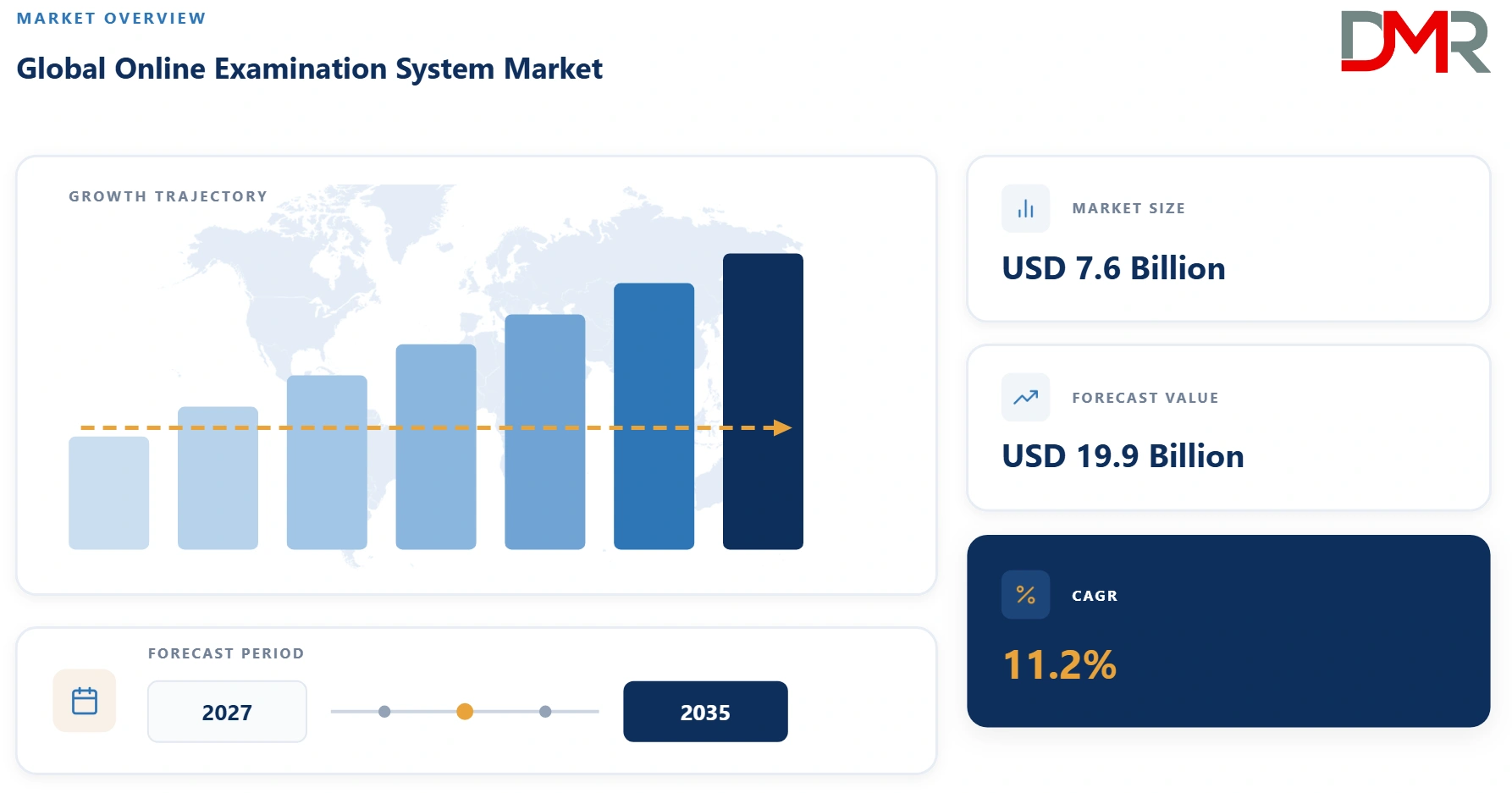
The global online examination system market is valued at USD 7.6 billion in 2026 and is projected to reach USD 19.9 billion by 2035, growing at a CAGR of 11.2% from 2027 to 2035. Growth is driven by the shift from paper-based to digital assessment, expanding professional certification demand, remote proctoring adoption, and AI-enabled assessment workflows across academic and corporate sectors.
ℹ
To learn more about this report –
Download Your Free Sample Report Here
The online examination system market encompasses software platforms, delivery infrastructure, and related services that enable the creation, administration, proctoring, scoring, and analysis of examinations conducted remotely or through computer-based testing. It includes assessment authoring tools, candidate authentication and proctoring solutions, automated grading engines, result analytics dashboards, and supporting implementation and consulting services. The market serves academic institutions, corporations, government agencies, certification bodies, and testing organizations seeking secure, scalable, and accessible digital assessment delivery.
The report covers the global online examination system landscape across five primary regions and key countries within each. It analyzes revenue generation from software licenses, subscription fees, and professional services. The scope encompasses platforms designed for formative and summative academic assessments, high-stakes certification and licensing examinations, corporate recruitment and training evaluations, and government-run competitive tests. Both cloud-hosted and on-premises deployment models are examined, alongside emerging hybrid architectures. The study tracks competitive dynamics, regulatory influences, technology adoption patterns, and procurement trends shaping market evolution across developed and emerging economies.
Online Examination System Market Snapshot
Online Examination System Market Snapshot, 2027-2035
| Metric |
Value |
| Market Size (2026) |
USD 7.6 Billion |
| Forecast Value (2035) |
USD 19.9 Billion |
| CAGR (2027-2035) |
11.2% |
| Largest Region (2026) |
North America, 34.8% share |
| Fastest-Growing Region (2027-2035) |
Asia Pacific, 14.6% CAGR |
| Leading Component (2026) |
Software, 68.5% share |
| Leading Deployment Mode (2026) |
Cloud-Based, 62.0% share |
| Key Players |
ExamSoft (Turnitin), Mercer Mettl, Questionmark, ProProfs, ClassMarker, Learnosity, Inspera, Pearson VUE |
Key Takeaways
- Market growth: The market expands from USD 7.6 billion in 2026 to USD 19.9 billion by 2035, registering an 11.2% CAGR, underpinned by digital transformation in education and workforce assessment.
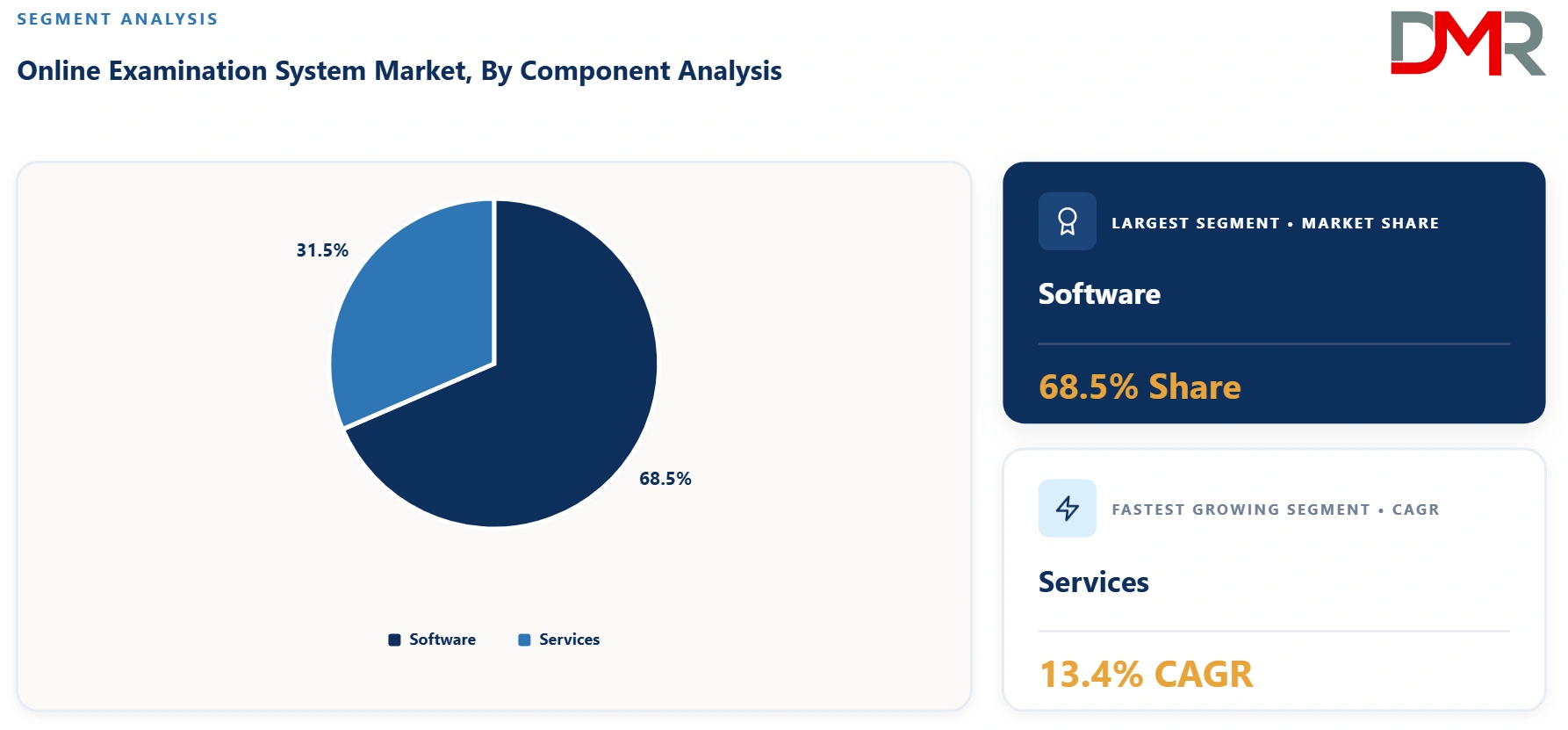
- Component leader: Software holds 68.5% share in 2026, led by growing demand for assessment authoring, proctoring integration, and analytics capabilities embedded within unified platforms.
- Fastest component: Services are set to grow at 13.4% CAGR through 2035, ahead of the overall market, as institutions require implementation support, training, and managed proctoring services.
- Deployment leader: Cloud-based systems account for 62.0% of 2026 demand, as subscription models reduce upfront costs and enable rapid scaling for institutions with fluctuating examination volumes.
- Fastest deployment: Hybrid deployments are projected to grow at 12.8% CAGR, supported by public-sector requirements for data sovereignty combined with the need for elastic capacity during peak examination periods.
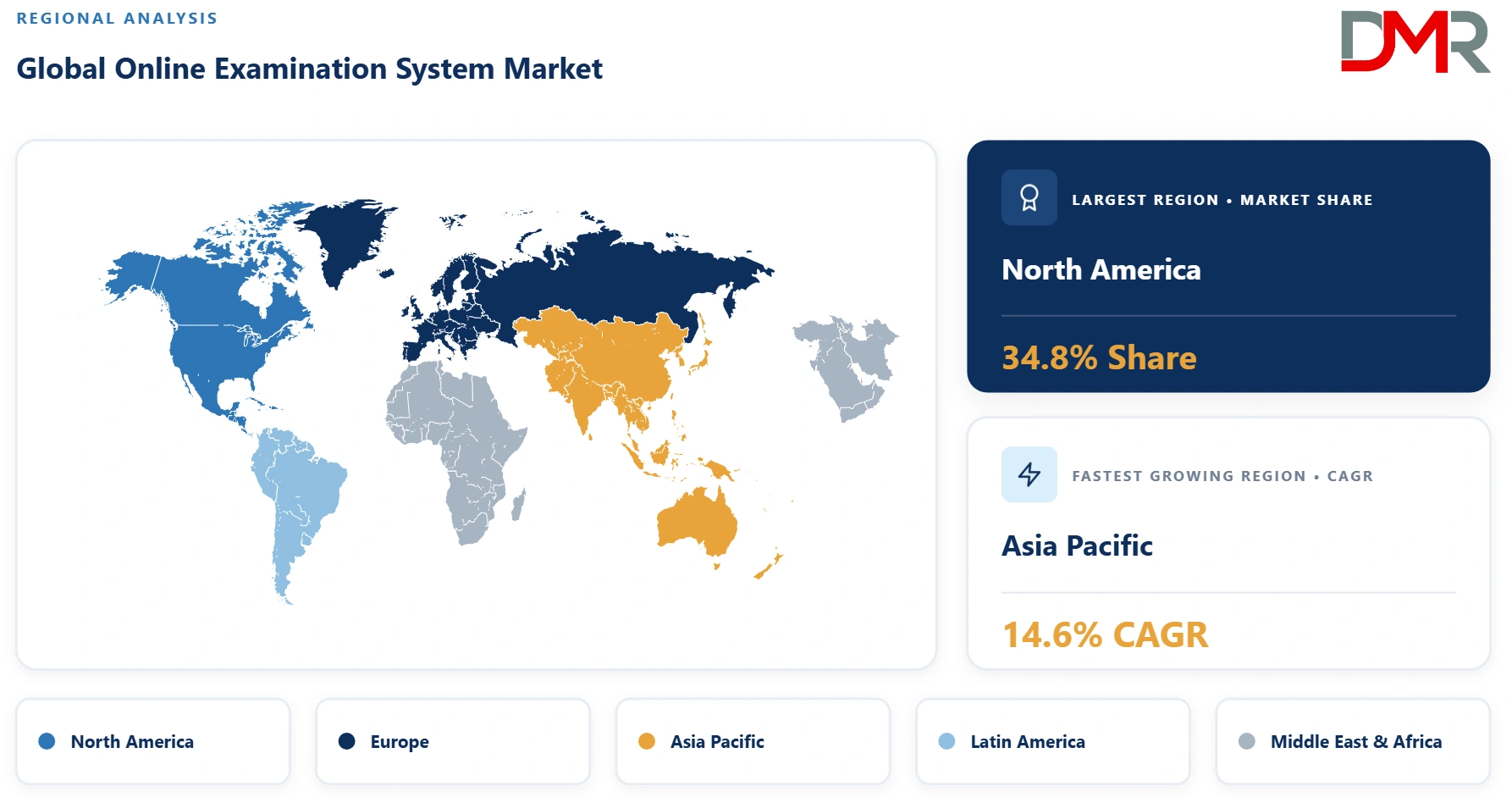
- Regional picture: North America leads with 34.8% share in 2026, while Asia Pacific is fastest-growing at 14.6% CAGR, driven by large-scale government testing digitization and expanding higher education enrollment.
What are the Key Use Cases of Online Examination System?
- High-stakes academic examinations: Universities deploy secure platforms for semester finals and entrance tests, requiring identity verification and proctoring integration.
- Professional certification and licensing: Certification bodies administer credentialing exams with automated scoring and detailed candidate performance analytics.
- Corporate recruitment screening: Enterprises use online assessments for pre-employment testing, reducing time-to-hire and standardizing candidate evaluation across geographies.
- Government competitive examinations: Public agencies conduct large-scale merit tests for civil service and public sector recruitment with multi-layer security controls.
How are Foundation Models and Generative AI Transforming the Online Examination System Market?
Foundation models and generative AI are reshaping assessment design, delivery, and integrity assurance. Automated item generation now enables institutions to produce large question banks with controlled difficulty and coverage parameters, reducing content development cycles from months to days. AI-powered proctoring systems analyze behavioral signals, keystroke patterns, and environmental audio to flag anomalies in real time, while large language models support adaptive testing pathways that adjust question difficulty based on candidate responses. These capabilities improve examination security and reduce human proctoring costs.
Adoption is accelerating across certification bodies and higher education institutions seeking to protect credential value against AI-assisted cheating. Vendors are embedding GenAI-resilient assessment designs that emphasize application, scenario analysis, and oral defense components over recall-based questions. Operational benefits include automated essay scoring with consistency auditing, natural language feedback generation for formative assessments, and predictive analytics identifying at-risk candidates before examinations. The market impact is visible in premium pricing for AI-enabled platforms and consolidation as vendors acquire specialized proctoring and analytics capabilities.
Online Examination System Market Dynamics at a Glance
Drivers, Restraints, Opportunities and Trends in the Online Examination System Market
| Type |
Factor |
Impact |
| Driver |
Shift from paper-based to digital assessment delivery |
High |
| Driver |
Expansion of professional certification and licensing requirements |
High |
| Restraint |
Data privacy and biometric regulation compliance costs |
Medium |
| Restraint |
Infrastructure and connectivity limitations in emerging markets |
High |
| Opportunity |
AI-driven adaptive testing and automated scoring integration |
Medium |
| Opportunity |
Government-led national examination digitization programs |
High |
| Trend |
Hybrid proctoring models combining AI and human review |
Medium |
| Trend |
GenAI-resilient assessment design adoption |
High |
What is Driving the Growth of the Online Examination System Market?
Shift from paper-based to digital assessment delivery
Institutions worldwide are replacing paper-based examination processes with digital platforms to reduce logistics costs, improve scoring turnaround, and expand access to remote candidates. The shift gained irreversible momentum following pandemic-era disruptions, with universities and certification bodies now treating online delivery as a permanent capability rather than contingency. Professional certification bodies report that digital delivery enables more frequent testing windows and broader geographic reach, directly expanding addressable candidate pools. Government education ministries in Asia Pacific and the Middle East are funding national assessment infrastructure, creating large-scale procurement opportunities. The operational evidence is compelling: automated scoring reduces result processing from weeks to hours, while digital delivery eliminates printing, shipping, and secure storage costs that consume significant portions of traditional examination budgets.
Rising Demand for Remote Proctoring and Assessment Integrity
The expansion of remote work and distributed learning has created sustained demand for proctoring solutions that can verify candidate identity and monitor examination sessions without requiring physical test centers. Employer adoption of online recruitment assessments and certification bodies maintaining credential integrity depend on robust proctoring capabilities. AI-powered proctoring systems now offer continuous identity authentication, behavioral anomaly detection, and automated flagging, reducing the human proctor-to-candidate ratio from 1:20 in live settings to 1:200 or better in automated modes. This cost efficiency enables certification organizations to expand testing access to candidates in regions without dedicated test centers, unlocking demand from underserved geographies and contributing directly to market growth.
What are the Key Restraints in the Online Examination System Market?
Data Privacy and Biometric Regulation Compliance
Online examination systems increasingly rely on biometric data including facial images, keystroke dynamics, and voice samples for identity verification and proctoring. Regulatory frameworks such as the GDPR in Europe, various state-level biometric privacy laws in the United States, and emerging data localization requirements in Asia Pacific impose significant compliance burdens on platform providers and institutional buyers. Vendors must implement consent management, data retention controls, cross-border transfer mechanisms, and audit trails, all of which increase development and operational costs. Public-sector procurement in some jurisdictions explicitly prohibits cloud hosting of examination data outside national borders, limiting the addressable market for standardized global platforms and requiring costly localized infrastructure. These regulatory constraints slow deployment cycles and disproportionately affect smaller vendors lacking legal and compliance resources.
Infrastructure and Connectivity Limitations in Emerging Markets
While the market’s fastest growth is projected in Asia Pacific, Latin America, and parts of Africa, these regions contain significant populations without reliable high-bandwidth internet access. Proctored online examinations typically require sustained video streaming, which consumes substantial bandwidth and is vulnerable to connectivity interruptions. Institutions serving rural or low-income candidate populations must either provide test-center alternatives, implement compressed media and local caching solutions, or accept higher rates of examination disruptions. The infrastructure gap also affects institutional buyers: schools and government agencies in emerging markets often lack the IT staff and hardware to deploy and maintain on-premises systems, while cloud-based solutions depend on connectivity that may be inconsistent. Addressing these constraints requires product localization and hybrid delivery models that add complexity and cost.
What are the Key Opportunities in the Online Examination System Market?
Government-Led National Examination Digitization Programs
Governments across Asia Pacific, the Middle East, and Latin America are investing in the digitization of high-volume public examinations for civil service, university admission, and professional licensing. These programs represent some of the largest single procurement opportunities in the market, often involving multi-year contracts and national-scale deployment. India’s expanding computer-based testing infrastructure for competitive examinations, China’s investment in standardized digital assessment for education and professional certification, and Gulf states’ modernization of public sector recruitment testing all signal substantial addressable demand. Vendors that can demonstrate security compliance, large-scale concurrency handling, and local partnership capacity are positioned to capture these contracts. Successful government deployments also create reference credibility for subsequent commercial and academic sector expansion within the same geographies.
AI-Enabled Adaptive Testing and Personalized Assessment
Adaptive testing platforms that adjust question difficulty in real time based on candidate ability estimates offer significant advantages over fixed-form examinations, including shorter test lengths, more precise measurement, and reduced candidate fatigue. While adaptive testing has existed in specialized contexts such as graduate admissions, generative AI and improved psychometric modeling are making it accessible to broader markets including K-12 formative assessment, corporate skills verification, and professional certification. Vendors integrating adaptive engines with learning management systems and corporate training platforms can differentiate on measurement precision and candidate experience. The opportunity extends to practice and mock test segments, where adaptive algorithms can personalize preparation pathways and identify knowledge gaps more efficiently than static question banks, creating recurring engagement models beyond high-stakes testing events.
What are the Latest Trends in the Online Examination System Market?
Hybrid Proctoring Models Combining AI and Human Review
The market is moving toward tiered proctoring architectures that balance cost and security. Fully automated AI proctoring handles volume examinations and low-stakes assessments, while human proctors review flagged sessions and supervise high-stakes certifications. This hybrid model addresses a critical limitation of pure AI proctoring: contextual judgment. Automated systems can detect anomalies but struggle to distinguish between suspicious behavior and innocent environmental factors. Human review of AI-flagged sessions provides a quality control layer that maintains examination integrity while keeping costs manageable. Vendors are investing in reviewer workflow tools, flag prioritization algorithms, and audit trails that document the human review process for appeals and regulatory compliance. The trend favors platforms that can offer flexible proctoring configurations rather than forcing institutions into a single model.
GenAI-Resilient Assessment Design
The proliferation of generative AI tools has forced examination designers to rethink assessment formats that rely on recall and standard essay responses. Certification bodies and higher education institutions are increasingly adopting assessment designs that are resistant to AI-assisted cheating: oral examinations delivered via video, scenario-based problem solving requiring applied reasoning, in-person or proctored coding environments, and mixed-format tests combining objective and constructed responses. Platforms are responding with features that support these formats, including secure browser environments for coding assessments, video response recording and evaluation workflows, and integration with plagiarism and AI-content detection tools. The trend elevates the importance of assessment design consulting services alongside software delivery, creating opportunities for vendors to differentiate through pedagogical expertise rather than feature checklists alone.
Research Scope and Analysis
The report segments the online examination system market by component, deployment mode, assessment type, application, end user, and region. Revenue scope includes software subscriptions, perpetual licenses, and professional services. Each segment is analyzed for 2026 market share and 2027–2035 growth trajectory, with regional breakdowns identifying demand drivers and competitive dynamics across North America, Europe, Asia Pacific, Latin America, and the Middle East and Africa.
ℹ
To learn more about this report –
Download Your Free Sample Report Here
By Component Analysis
Software dominates with 68.5% share in 2026, reflecting the centrality of assessment authoring, proctoring integration, and analytics engines to platform value propositions. Institutions prioritize unified platforms that consolidate question banking, delivery, and reporting rather than assembling point solutions. Services represent the fastest-growing component at 13.4% CAGR, driven by implementation complexity, proctoring managed services, and training requirements as institutions scale digital assessment programs beyond pilot deployments.
By Deployment Mode Analysis
Cloud-based deployment holds 62.0% share in 2026, favored for subscription economics, automatic updates, and elastic capacity during peak examination periods. The fastest growth is in hybrid deployments at 12.8% CAGR, as public-sector buyers and large institutions seek to retain sensitive data on-premises while leveraging cloud infrastructure for candidate-facing delivery and analytics. On-premises remains relevant in jurisdictions with strict data localization requirements and among institutions with existing data center investments.
By Assessment Type Analysis
Summative assessment leads with 41.2% share in 2026, driven by high-stakes academic finals, certification examinations, and licensing tests that require secure delivery and defensible scoring. Formative assessment is the fastest-growing type at 12.9% CAGR, as institutions adopt continuous evaluation models and practice-oriented learning approaches that generate recurring platform engagement rather than episodic high-stakes events. Adaptive assessment grows rapidly from a smaller base, supported by AI integration and demand for measurement efficiency.
By Application Analysis
Academic examinations account for 36.8% of 2026 demand, reflecting the scale of higher education and K-12 digital assessment adoption globally. Certification and licensing examinations represent the fastest-growing application at 13.1% CAGR, as professional bodies digitize credentialing and expand testing access. Corporate assessments and recruitment testing maintain steady growth tied to workforce digitization, while competitive and entrance examinations show concentration in Asia Pacific markets undergoing government-led testing modernization.
By End User Analysis
Colleges and universities lead with 32.4% share in 2026, as higher education institutions invest in secure examination platforms that integrate with learning management systems and support remote proctoring. Certification bodies are the fastest-growing end user segment at 13.6% CAGR, driven by the expansion of professional credentialing requirements and the need for secure, scalable delivery across geographically distributed candidate pools. Corporates and government organizations contribute significant volume but with different procurement cycles and customization requirements.
How is the Online Examination System Market Segmented?
By Component
- Software
- Services
- Implementation & Integration
- Consulting
- Training & Support
- Maintenance & Upgrades
By Deployment Mode
- Cloud-Based
- On-Premises
- Hybrid
By Assessment Type
- Formative Assessment
- Summative Assessment
- Diagnostic Assessment
- Adaptive Assessment
- Practice & Mock Tests
By Application
- Academic Examinations
- Corporate Assessments
- Certification & Licensing Examinations
- Recruitment & Pre-Employment Testing
- Competitive & Entrance Examinations
By End User
- Educational Institutions
- K-12 Schools
- Colleges & Universities
- Coaching Institutes
- Corporates & Enterprises
- Government Organizations
- Certification Bodies
- Examination & Testing Agencies
Which Region Leads the Online Examination System Market?
North America leads with 34.8% share in 2026, while Asia Pacific is projected to grow at 14.6% CAGR from 2027 to 2035.
ℹ
To learn more about this report –
Download Your Free Sample Report Here
Region with the Largest Revenue Share
North America commands 34.8% of global revenue in 2026, with the United States contributing over 80% of regional demand. The region benefits from mature digital education infrastructure, a concentrated base of major certification bodies and testing organizations, and widespread corporate adoption of online recruitment assessments. Key demand drivers include higher education’s shift to hybrid learning models, professional credentialing digitization across healthcare and IT sectors, and government agencies modernizing workforce testing. The outlook remains steady with mid-single-digit growth, though AI integration and replacement cycles for legacy platforms sustain vendor opportunity.
Region with the Highest CAGR
Asia Pacific is projected to grow at 14.6% CAGR through 2035, the fastest of any region. China, India, and Southeast Asian markets drive growth through government-led examination digitization, expanding higher education enrollment, and rising demand for professional certification in growing economies. India’s competitive examination ecosystem and China’s education technology investment represent particularly large-scale opportunities. Local vendors including examination platforms and cloud providers are gaining share alongside global players, with pricing sensitivity and localization requirements shaping competitive dynamics. Infrastructure constraints remain a limiting factor in some markets but are being addressed through hybrid delivery models.
Regional Analysis
Europe Online Examination System Market
The European market grows at a steady pace, with Germany, France, and the United Kingdom representing the largest national markets. GDPR compliance shapes platform requirements, favoring vendors with robust data protection features and EU-based hosting. Public sector procurement is significant, particularly in Nordic countries with advanced digital government initiatives. Corporate assessment demand is strong in financial services and professional services sectors.
Latin America Online Examination System Market
Growth in the region is led by Brazil and Mexico, where higher education expansion and corporate training digitization drive adoption. Government examination modernization programs in Brazil and Chile create large-volume opportunities. Connectivity limitations and pricing sensitivity favor cloud-based subscription models with offline capabilities and localized support.
Middle East & Africa Online Examination System Market
The region grows at a robust pace, with Saudi Arabia and the UAE investing in education technology and government workforce assessment modernization. South Africa leads Sub-Saharan adoption, while Gulf states' national transformation agendas create demand for secure certification and recruitment testing platforms aligned with localization and data sovereignty requirements.
By Region
North America
Europe
- Germany
- France
- The U.K.
- Italy
- Spain
- Rest of Europe
Asia-Pacific
- China
- Japan
- India
- Australia
- South Korea
- Rest of APAC
Latin America
- Mexico
- Brazil
- Rest of LATAM
Middle East & Africa
- Saudi Arabia
- The UAE
- South Africa
- Rest of MEA
Regulatory Landscape
Online examination platforms operate within an increasingly complex regulatory environment spanning data protection, biometric privacy, accessibility, and examination integrity standards. The GDPR in Europe imposes strict requirements on processing biometric data for proctoring, requiring explicit consent, data minimization, and retention limits. Similar frameworks are emerging across Asia Pacific and Latin America. Accessibility regulations including the ADA in the United States and the European Accessibility Act mandate that examination platforms support screen readers, keyboard navigation, and accommodation workflows. Government procurement rules in several countries require data localization or security certifications that favor domestic vendors. Compliance costs are rising, but vendors that invest in regulatory readiness gain competitive advantage in public-sector and enterprise procurement, while non-compliant platforms face exclusion from high-value contracts.
Investment and White Space
Investment activity in the online examination system market concentrates on AI proctoring, adaptive assessment engines, and assessment analytics. Private equity and strategic acquirers are targeting specialized proctoring vendors to integrate into broader assessment platforms, as evidenced by Turnitin’s acquisition of ExamSoft and ongoing consolidation among mid-tier providers. White space opportunities exist in three areas: assessment design consulting services that help institutions transition from recall-based to competency-based formats; hybrid proctoring workflow tools that improve human reviewer efficiency; and localized platforms for emerging market government examinations that address connectivity and language requirements. Early-stage funding is flowing toward startups applying generative AI to formative assessment feedback and oral examination delivery, though regulatory uncertainty around AI decision-making in high-stakes testing constrains adoption in regulated markets. Investors favor vendors with recurring revenue models, institutional customer concentration below 20%, and demonstrated compliance capabilities.
Who are the Leading Companies in the Online Examination System Market?
The online examination system market exhibits moderate concentration, with the top ten vendors accounting for approximately 35–40% of global revenue. The competitive landscape spans dedicated assessment platforms, learning management system integrated assessment modules, and proctoring-focused specialists. Differentiation increasingly depends on AI capability, proctoring integration depth, and compliance readiness rather than basic examination delivery features. Partnerships between platform vendors and certification bodies, and acquisitions of proctoring specialists by larger assessment companies, are reshaping competitive positioning.
- ExamSoft (Turnitin) (United States): Assessment platform focused on higher education and certification, known for secure exam delivery and analytics; acquired by Turnitin to integrate with plagiarism detection.
- Mercer Mettl (India): Full-stack assessment and proctoring platform serving corporate recruitment, certification, and academic markets with strong Asia Pacific presence.
- Questionmark (United Kingdom): Assessment management and delivery platform with emphasis on compliance, certification, and workforce assessment; known for psychometric rigor.
- ProProfs (United States): Cloud-based quiz and assessment platform serving SMB and education markets with broad feature set and freemium entry points.
- ClassMarker (Australia): Online testing platform with strong presence in education and corporate training, emphasizing ease of use and accessibility.
- Learnosity (Australia): Assessment infrastructure and item authoring platform powering third-party assessment products; strong developer ecosystem.
- Inspera (Norway): Digital assessment platform focused on higher education, with significant European public-sector deployments.
- Pearson VUE (United States): Global computer-based testing and certification delivery network with extensive test center infrastructure and high-stakes examination expertise.
Some of the prominent players in the Global Online Examination System Market are:
- Turnitin (ExamSoft)
- Mercer | Mettl
- Questionmark
- ProProfs
- ClassMarker
- Learnosity
- Inspera
- Pearson VUE
- TestInvite
- TestGorilla
- EduBrite
- WizIQ
- Edbase
- Ginger Webs (ThinkExam)
- RK Infotech (Conduct Exam)
- Eklavvya
- SpeedExam
- MeritTrac
- Go4Read
- Online Exam Builder
- Testportal
- Exam.net
- Easy LMS
- Synap
- Janison
- BetterExaminations
- Excelsoft Technologies
- Learning Spiral
- MaivenPoint
- Meazure Learning
- Qorrect
- RM Assessment
- Open Assessment Technologies
- TestReach
- DigiExam
- Televic Education
- Assessment Systems Corporation
- YouTestMe
- Talview
- TCS iON
- Other Key Players
Recent Developments
- In March 2026, Mercer Mettl released its global framework report on GenAI-resilient assessment design, guiding high-stakes testing toward continuous identity authentication and hybrid delivery infrastructure.
- In February 2026, Questionmark expanded localized enterprise procurement features with adaptive question pathways and cloud-hosted data privacy modules for EMEA compliance.
- In January 2026, Turnitin integrated ExamSoft deeper into its assessment integrity suite, combining proctoring and plagiarism detection for unified academic integrity workflows.
- In November 2025, Pearson VUE announced expansion of its global test center network in Southeast Asia to support certification demand growth.
- In September 2025, Inspera secured a multi-year contract with a Nordic higher education consortium for digital examination delivery across member institutions.
Report Scope and Research Methodology
Market definition: The online examination system market comprises software platforms and services enabling digital assessment creation, delivery, proctoring, scoring, and analytics for academic, corporate, government, and certification use cases.
Methodology: Dimension Market Research built the estimate bottom-up from company revenues, candidate session volumes, and average revenue per examination for each component and end-user segment, then checked it top-down against education technology and workforce assessment spending totals. Primary interviews with assessment directors, certification executives, and platform procurement officers validated adoption rates and pricing. Forecasts apply segment-level growth assumptions for 2027–2035 and are reviewed at each report update.
Report Details
| Report Characteristics |
Details |
| Market Size (2026) |
USD 7.6 Billion |
| Forecast Value (2035) |
USD 19.9 Billion |
| CAGR (2027-2035) |
11.2% |
| Historical Data |
2021–2026 |
| Forecast Data |
2027–2035 |
| Base Year |
2026 |
| Estimate Year |
2027 |
| Segments Covered |
By Component, By Deployment Mode, By Assessment Type, By Application, By End User |
| Regional Coverage |
North America (The US, Canada); Europe (Germany, France, The UK, Italy, Spain, Rest of Europe); Asia Pacific (China, Japan, India, Australia, South Korea, Rest of APAC); Latin America (Mexico, Brazil, Rest of LATAM); Middle East & Africa (Saudi Arabia, The UAE, South Africa, Rest of MEA) |
Frequently Asked Questions
How big is the Online Examination System Market in 2026?
▾ The global online examination system market is valued at USD 7.6 billion in 2026.
What is the growth rate of the Online Examination System Market?
▾ The online examination system market is projected to grow at a CAGR of 11.2% from 2027 to 2035.
Which region leads the Online Examination System Market?
▾ North America leads the online examination system market with 34.8% share in 2026.
Which product segment dominates the Online Examination System Market?
▾ Software dominates the online examination system market with 68.5% share in 2026.
Which end user is growing fastest in the Online Examination System Market?
▾ Certification bodies are the fastest-growing end user segment in the online examination system market at 13.6% CAGR.
Who are the key players in the Online Examination System Market?
▾ Key players include ExamSoft (Turnitin), Mercer Mettl, Questionmark, ProProfs, ClassMarker, Learnosity, Inspera, and Pearson VUE.
What are the main challenges facing the Online Examination System Market?
▾ Main challenges include data privacy and biometric regulation compliance costs, and infrastructure and connectivity limitations in emerging markets.