Global Operations Service Consulting Market Snapshot
- Market Size in 2026: USD 38.66 billion
- Market Size in 2035: USD 57.66 billion
- Global CAGR, 2026–2035: 4.5%
- Leading Service Type: Strategy & Operations Consulting, 31% share
- Leading Engagement Model: Project-Based Consulting, 54% share
- Leading Organization Size: Large Enterprises, 72% share
- Fastest-Growing Service Segment: Technology & Digital Operations Consulting, 8.2% CAGR
- Leading Region: North America, 34% share
- Fastest-Growing Region: Asia-Pacific, 6.1% CAGR
What is the Global Operations Service Consulting and its Market Size?
Operations Service Consulting comprises advisory and transformation services that help organizations improve the efficiency, resilience, cost structure and performance of core operating activities. Engagements typically cover operating-model design, process optimization, supply-chain and procurement transformation, finance and accounting operations, HR/workforce operations, technology-enabled operations, risk and compliance, performance management and continuous improvement.
ℹ
To learn more about this report –
Download Your Free Sample Report Here
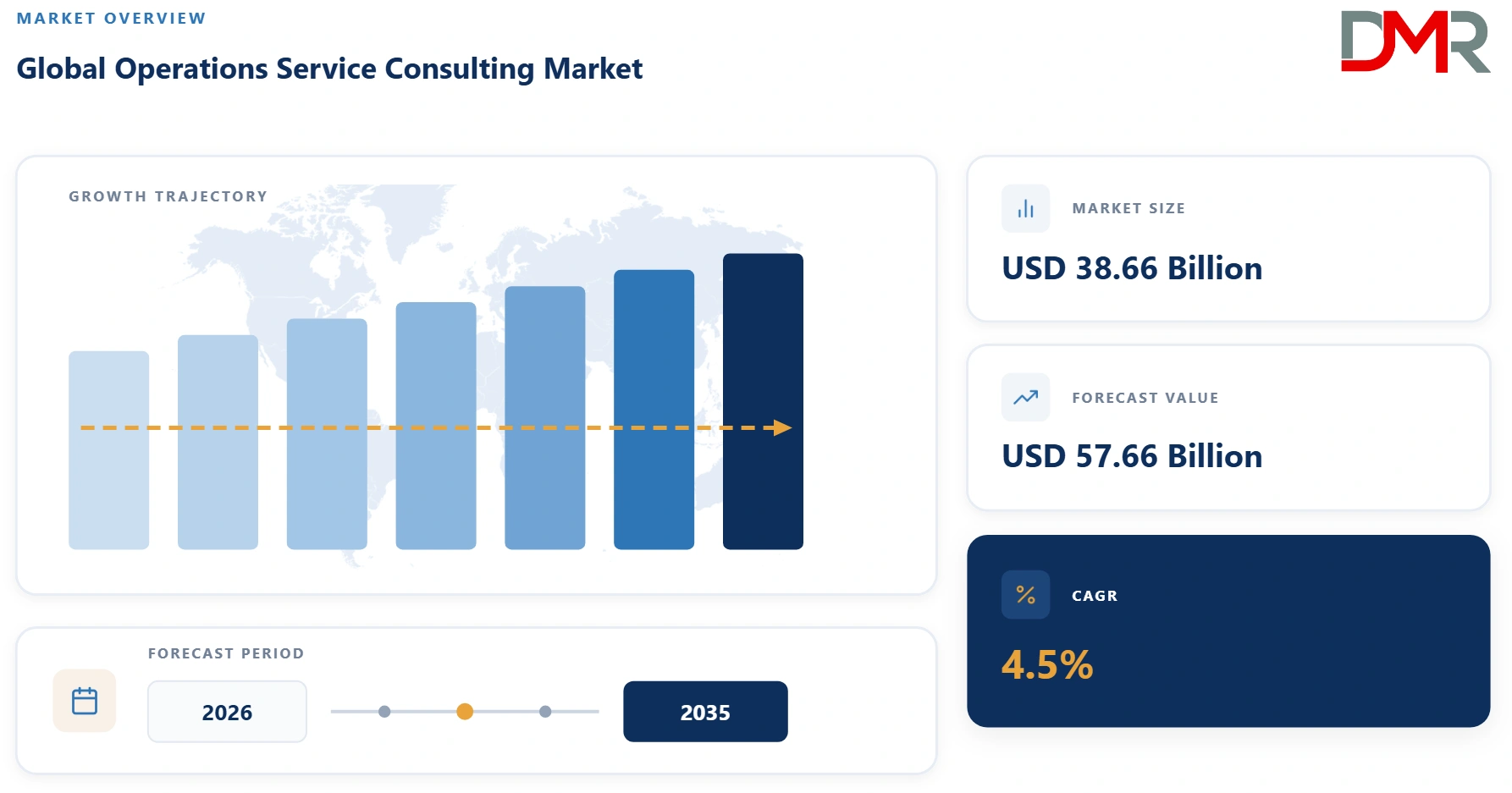
The global Operations Service Consulting market is estimated at USD 38.66 billion in 2026 and is projected to reach USD 57.66 billion by 2035, representing a 4.5% CAGR. The outlook is supported by continued enterprise cost pressure, digital transformation, supply-chain volatility, regulatory complexity and growing demand to convert artificial intelligence from experimentation into measurable operational outcomes. Recent industry research identifies digital transformation, automation, AI-enabled decision-making, data-driven operating models and cost optimization as major growth forces.
The market is also changing qualitatively. Consulting providers are increasingly expected to combine strategy with implementation, proprietary analytics, technology platforms, AI agents and managed capabilities. Gartner's 2026 assessment of supply-chain strategy and operations consulting, for example, identifies digital twins, control towers, multiechelon inventory optimization, scenario engines and AI/GenAI as increasingly standard elements of provider propositions.
Use Cases
- Supply Chain Optimization: Redesign networks, inventory policies, procurement processes and logistics to improve resilience and reduce total operating cost.
- Process Transformation: Map, redesign and automate workflows to eliminate bottlenecks, manual activities, duplication and unnecessary process complexity.
- Finance Operations: Improve order-to-cash, procure-to-pay, record-to-report, working-capital management and management reporting.
- Workforce Optimization: Redesign workforce models, skills, productivity processes and organizational structures around changing operating requirements.
- Digital Operations: Integrate cloud, analytics, AI, automation and enterprise platforms into operating processes and decision-making.
- Risk & Compliance: Strengthen controls, governance, operational resilience, third-party risk and regulatory compliance.
Key Takeaways
- Market Size: The global market is estimated at USD 38.66 billion in 2026, reaching USD 57.66 billion by 2035.
- Growth: A 4.5% CAGR reflects steady enterprise demand for measurable efficiency, resilience and transformation outcomes.
- Key Drivers: Digital transformation, AI adoption, supply-chain disruption, cost optimization and regulatory complexity are the primary growth catalysts.
- Segment Leadership: Strategy & Operations Consulting leads by service type, project-based engagements dominate delivery economics, and large enterprises remain the largest buyers.
- Fastest Growth: Technology & Digital Operations Consulting is expected to expand at approximately 8.2% CAGR, substantially above the overall market.
- Regional Leadership: North America holds the largest 2026 share at approximately 34%, while Asia-Pacific is forecast to grow fastest at 6.1% CAGR.
How AI/Gen AI is Transforming the Operations Service Consulting Market?
Artificial intelligence is shifting operations consulting from periodic diagnostic work toward continuous, data-driven operational management. Consultants increasingly deploy generative AI, predictive analytics, process mining, intelligent automation and agentic AI across procurement, finance, supply chain, manufacturing, customer operations and HR. IBM, for example, now positions its business-operations practice around AI-powered finance, HR, procurement and supply-chain capabilities, while McKinsey describes agentic AI as particularly relevant to operations because agents can execute tasks rather than merely generate recommendations.
The principal benefits are faster analysis, lower manual effort, improved forecasting, automated decision support, better process compliance and more continuous performance monitoring. AI also allows consultants to shift from labor-intensive data collection toward higher-value operating-model redesign.
Key Drivers in the Global Operations Service Consulting Market
Enterprise Cost Optimization and Operational Resilience
Persistent pressure on margins is sustaining demand for operations consulting. Enterprises face wage inflation, changing trade policies, supply-chain disruption, elevated financing costs and increasing expectations for productivity. As a result, organizations are moving beyond conventional cost-cutting toward structural redesign of operating models, procurement, shared services, supply networks and workforce deployment. Operations consultants are increasingly engaged to identify savings while protecting service quality and growth capacity.
Digital Transformation and AI Adoption
Digital transformation is the second major structural growth engine. Organizations are replacing fragmented legacy processes with cloud ERP, analytics, automation, digital twins and AI-enabled decision systems. However, technology investments frequently require operating-model redesign, process standardization, change management and workforce transformation, creating a direct role for operations consultants. Published market research identifies digital transformation as a principal driver of operations-consulting demand.
Restraints in the Global Operations Service Consulting Market
High Implementation Complexity and Change Resistance
Operations transformation frequently crosses multiple functions, geographies and technology systems. Legacy ERP environments, inconsistent master data, fragmented ownership and organizational resistance can delay projects and reduce expected ROI. Consultants may therefore face longer sales cycles and greater pressure to demonstrate measurable benefits before clients approve large transformation programs.
Growth Opportunities in the Global Operations Service Consulting Market
AI-Enabled and Agentic Operations Transformation
The strongest opportunity lies in helping organizations redesign processes around AI agents rather than simply adding AI tools to existing workflows. Procurement, customer operations, finance, supply chain and HR are particularly suitable because they contain large volumes of structured decisions and repetitive activities.
Mid-Market Digital Operations Transformation
Large enterprises currently account for most consulting revenue, leaving substantial whitespace among SMEs and mid-market companies. Smaller organizations increasingly need help implementing cloud ERP, analytics, automation and standardized operating processes but often cannot justify large strategy engagements.
Trends in the Global Operations Service Consulting Market
Shift From Advice to Outcome-Based Transformation
Operations consulting is moving from recommendations toward implementation and measurable business outcomes. Buyers increasingly expect consultants to redesign processes, deploy technology, enable employees and remain involved until operational KPIs improve.
Convergence of Consulting, Technology and Managed Operations
The boundaries between consulting, systems integration, technology implementation and managed services are becoming less distinct. Firms such as IBM increasingly position consulting around AI, automation and global delivery, while strategy firms are building stronger technology partnerships and digital assets.
Research Scope and Analysis
The market is segmented By Service Type, By Engagement Model, By Organization Size and By Industry. The estimates emphasize consulting revenue directly attributable to operational improvement, transformation, implementation support and operational excellence rather than general management consulting or standalone software/BPO revenue.
ℹ
To learn more about this report –
Download Your Free Sample Report Here
By Service Type Analysis
Strategy & Operations Consulting is estimated to be the dominant service category in 2026, with approximately 31% market share, supported by demand for operating-model redesign, capacity strategy, network design, organizational effectiveness and enterprise-wide transformation. Its leadership reflects the fact that large transformation programs generally begin with strategic operating-model decisions before implementation. Business Process Optimization is estimated at approximately 18%, making it the second-largest category because process redesign remains relevant across finance, HR, customer operations and shared services. Technology & Digital Operations Consulting is the fastest-growing category, forecast at approximately 8.2% CAGR, as organizations integrate cloud ERP, AI, automation, process mining and analytics into core operations. Supply Chain & Procurement Consulting accounts for roughly 17% and remains highly resilient because geopolitical volatility and supplier risk are keeping network redesign and procurement transformation high on executive agendas. Finance & Accounting Operations Consulting, HR & Workforce Operations Consulting, and Risk & Compliance Operations Consulting represent smaller but structurally important niches.
By Engagement Model Analysis
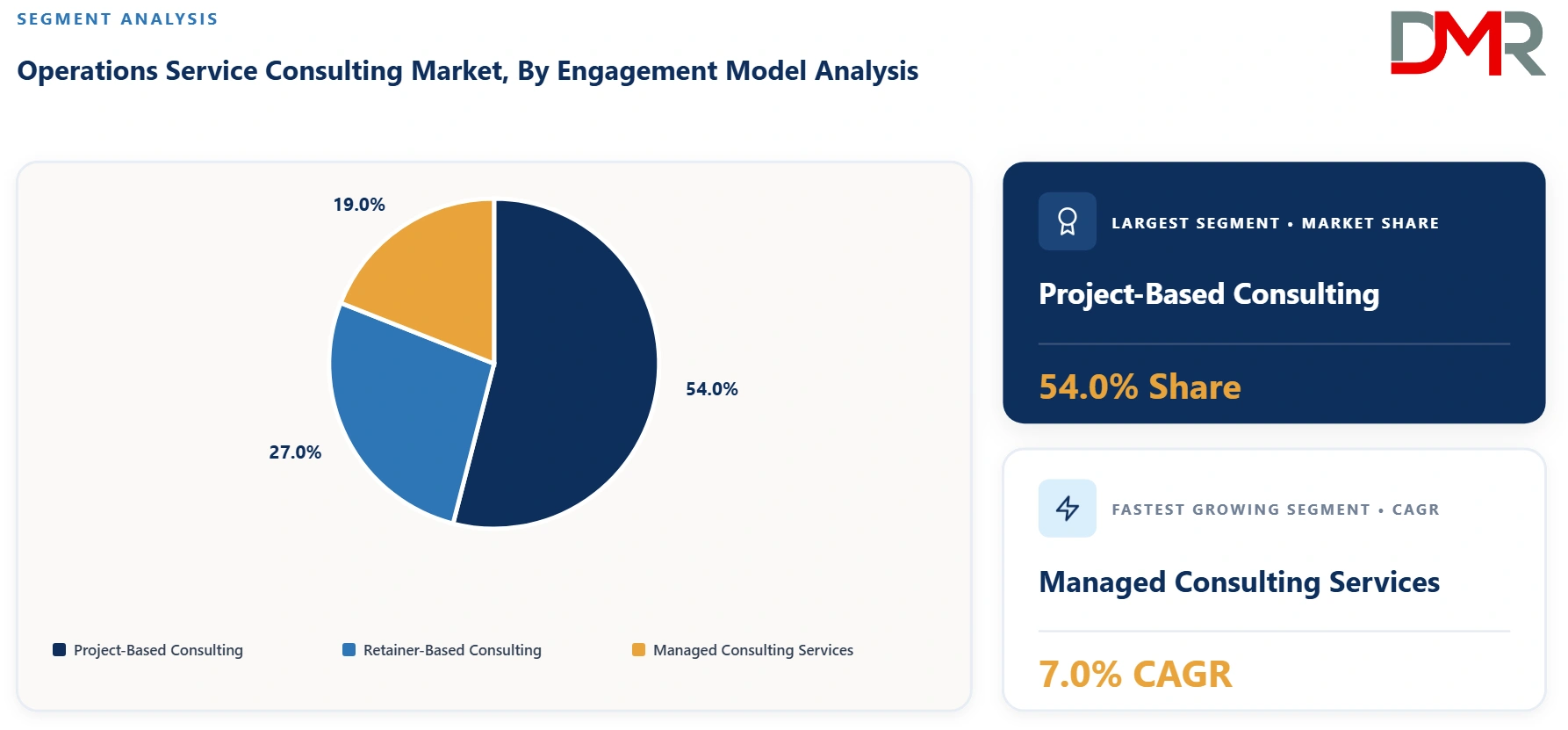
Project-Based Consulting dominates with an estimated 54% share in 2026, reflecting the prevalence of defined transformation, operating-model redesign, cost-reduction and process-improvement mandates. Large enterprises commonly approve consulting around specific business cases, transformation programs or regulatory requirements, supporting high project penetration. Retainer-Based Consulting represents approximately 27% and is increasingly attractive where clients require recurring analytics, performance management, regulatory support or continuous operational improvement. Managed Consulting Services account for approximately 19% but are expected to be the fastest-growing engagement model, at roughly 7.0% CAGR, because enterprises increasingly want external providers to operate analytics, transformation offices and technology-enabled improvement capabilities on a recurring basis. The movement toward managed models also aligns with the broader convergence between consulting and implementation services.
By Organization Size Analysis
Large Enterprises represent approximately 72% of 2026 market revenue, making them the dominant customer group. Their leadership is driven by complex multinational operating structures, larger transformation budgets, multiple ERP environments, extensive supply chains and regulatory exposure. Large enterprises also have greater ability to fund multi-year transformation programs. Small & Medium Enterprises account for approximately 28% but represent the faster-growing customer category, with an estimated 6.8% CAGR through 2035. Cloud software, remote consulting, standardized methodologies and AI-enabled delivery are reducing the cost of serving smaller clients. The strongest SME opportunity is expected in digital process optimization, finance operations, procurement, workforce productivity and cloud-enabled operating-model transformation. The market should gradually become less concentrated as consulting firms productize previously bespoke services.
By Industry Analysis
BFSI is estimated to be the largest individual industry vertical in 2026 at approximately 19% share, reflecting complex regulatory requirements, high transaction volumes, strong demand for cost optimization and extensive use of digital operating models. Manufacturing follows at approximately 17%, driven by factory modernization, supply-chain resilience, procurement, quality and industrial automation. IT & Telecommunications account for around 15%, supported by cloud transformation, workforce optimization and technology-cost management. Healthcare & Life Sciences is the fastest-growing industry category, estimated at roughly 7.0% CAGR, as providers face productivity pressures, workforce shortages, regulatory complexity and demand for digital transformation. Retail & E-Commerce, Energy & Utilities, Government & Public Sector, Transportation & Logistics and other industries provide substantial additional demand, with logistics and energy particularly benefiting from network optimization, resilience and sustainability-related transformation.
The Global Operations Service Consulting Market Report is segmented on the basis of the following:
By Service Type
- Strategy & Operations Consulting
- Business Process Optimization
- Supply Chain & Procurement Consulting
- Finance & Accounting Operations Consulting
- Human Resources & Workforce Operations Consulting
- Technology & Digital Operations Consulting
- Risk & Compliance Operations Consulting
By Engagement Model
- Project-Based Consulting
- Retainer-Based Consulting
- Managed Consulting Services
By Organization Size
- Large Enterprises
- Small & Medium Enterprises
By Industry
- BFSI
- Healthcare & Life Sciences
- IT & Telecommunications
- Manufacturing
- Retail & E-Commerce
- Energy & Utilities
- Government & Public Sector
- Transportation & Logistics
- Others
Regional Analysis
North America is the Leading Region in the Global Operations Service Consulting Market
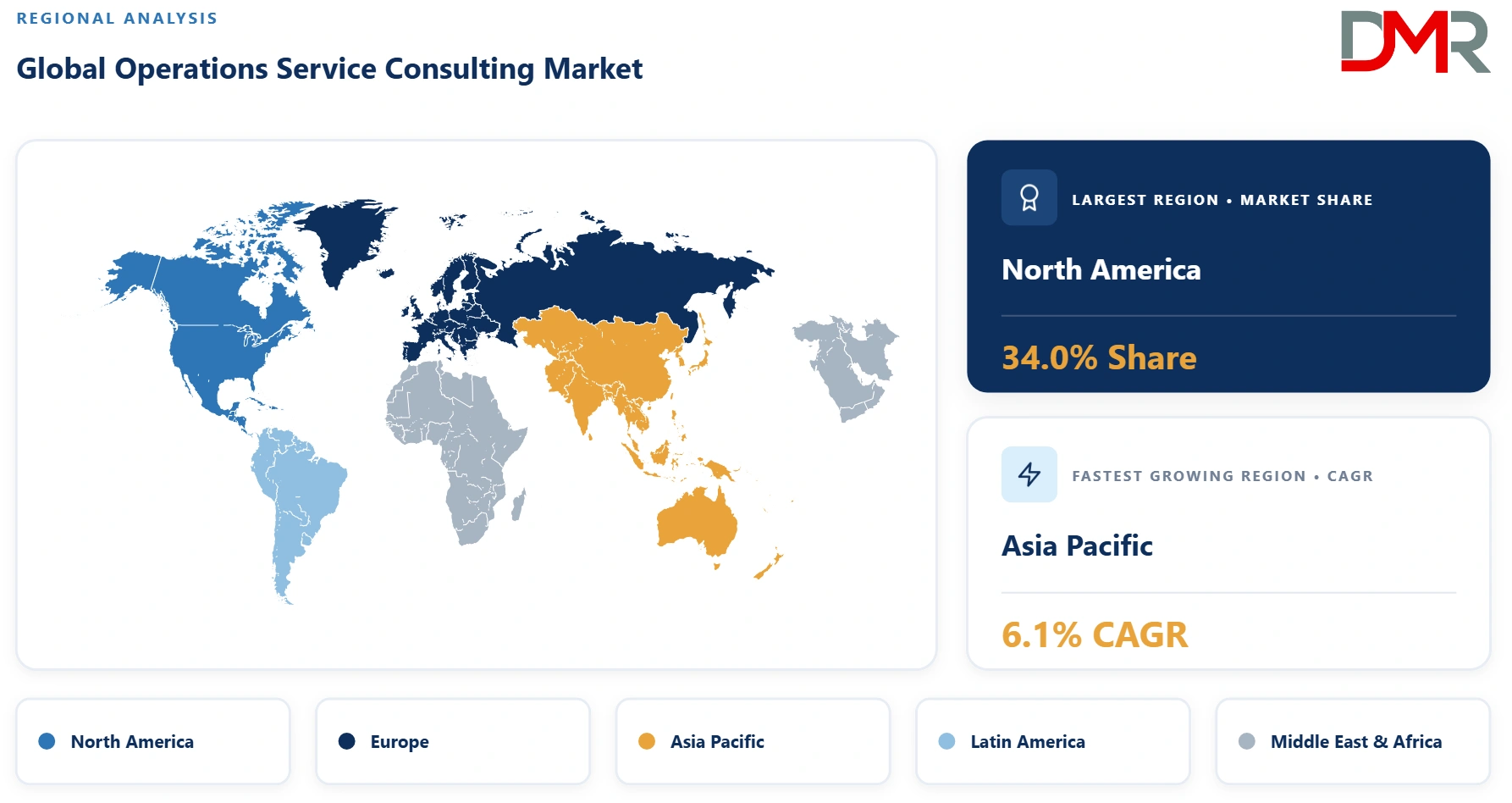
North America is expected to maintain its leading position, representing approximately 34% of global market revenue in 2026, or about USD 13.14 billion. The region benefits from high consulting penetration, large multinational enterprises, advanced cloud and AI adoption, mature professional-services ecosystems and significant technology investment. The United States remains the principal national market. Demand is especially strong in financial services, healthcare, manufacturing, technology, retail and logistics, where enterprises are redesigning operations around AI, automation and resilience. The region also has a highly developed ecosystem of strategy firms, Big Four firms, technology consultancies and specialized operations boutiques, intensifying competition while expanding the addressable market.
ℹ
To learn more about this report –
Download Your Free Sample Report Here
Asia Pacific is the Fastest-Growing Region in the Global Operations Service Consulting Market
Asia-Pacific is projected to be the fastest-growing regional market, with an estimated 6.1% CAGR through 2035. Its growth is supported by industrial expansion, supply-chain diversification, manufacturing investment, digital transformation and rising adoption of cloud and AI. China, India, Japan, South Korea and ASEAN economies represent the largest opportunities. India is particularly important as enterprises expand global capability centers and digital delivery operations, while manufacturers are diversifying production and supply networks across Asia. Deloitte India's 2026 launch of an AI-led SAP delivery centre in Bengaluru, with more than 1,000 professionals and plans for additional AI specialists, illustrates the region's expanding role in enterprise transformation delivery.
The Europe Operations Service Consulting Market
The European market is estimated at USD 10.82 billion in 2026 and is projected to reach approximately USD 15.92 billion by 2035, implying a 4.4% CAGR. Demand is being shaped by industrial competitiveness, supply-chain resilience, digital transformation, sustainability reporting, AI governance and financial-sector operational resilience. Manufacturing, automotive, financial services, healthcare and energy are major contributors. EU regulation is also creating consulting demand around AI governance, operational resilience, sustainability reporting and data management. The EU AI Act's major implementation milestone arrives in August 2026, while DORA has applied to financial entities since January 2025.
Latin America Operations Service Consulting Market
Latin America is estimated at USD 2.32 billion in 2026, rising to approximately USD 3.47 billion in 2035, representing a modeled 4.6% CAGR. Brazil and Mexico dominate regional demand. Growth is supported by manufacturing nearshoring, financial-services modernization, supply-chain redesign, retail digitization, shared-service expansion and enterprise automation. Consulting demand is strongest where organizations need to improve productivity without large capital expenditure, making process optimization, procurement, finance operations and cloud transformation particularly attractive.
MEA Operations Service Consulting Market
The Middle East & Africa market is estimated at USD 3.09 billion in 2026 and approximately USD 4.62 billion in 2035, representing a 4.6% CAGR. Saudi Arabia and the UAE are the major growth centers, supported by economic diversification, government digitization, infrastructure investment, smart-city programs, financial-sector transformation and energy-transition initiatives. Saudi Arabia is particularly important because national transformation programs are creating demand for operating-model redesign, digital government, procurement modernization, workforce transformation and data-driven performance management.
Major Countries Analysis
United States Operations Service Consulting Market
The U.S. market is estimated at USD 11.80 billion in 2026 and projected to reach approximately USD 17.30 billion by 2035, reflecting a 4.4% CAGR. Demand is supported by large enterprise transformation budgets, AI adoption, healthcare restructuring, manufacturing reshoring, supply-chain redesign and financial-services modernization. AI-enabled operations, cloud ERP, process automation and workforce productivity are key technology themes.
Japan Operations Service Consulting Market
Japan is estimated at USD 1.70 billion in 2026, reaching approximately USD 2.59 billion by 2035, equivalent to a 4.8% CAGR. Demand is being driven by labor shortages, aging demographics, manufacturing modernization, robotics, supply-chain resilience and enterprise digitalization. Consulting opportunities increasingly center on automation, workforce productivity, factory transformation, procurement and AI-supported decision-making.
Saudi Arabia Operations Service Consulting Market
Saudi Arabia is estimated at USD 0.55 billion in 2026 and approximately USD 0.95 billion by 2035, implying a 6.3% CAGR. Vision-led economic diversification, public-sector digitization, infrastructure development, tourism, logistics and energy transformation are expanding demand. Government digital-transformation progress and increasing technology adoption create particularly strong opportunities for operating-model, process, technology and workforce consulting.
Regulatory Landscape
Operations consulting is increasingly influenced by regulations governing data, AI, cybersecurity, sustainability, financial resilience and sector-specific controls. In Europe, the EU AI Act is particularly important: transparency provisions and enforcement begin applying from August 2026, with additional high-risk obligations following in 2027–2028. DORA, applicable since January 2025, creates requirements around ICT risk, operational resilience and third-party technology exposure for financial entities. The EU's CSRD/ESRS framework also creates demand for sustainability-data processes, controls and reporting transformation, although the regulatory framework is being simplified and amended during 2026. In India, the Digital Personal Data Protection Act and 2025 Rules establish a new framework for digital-data governance, with phased implementation extending into 2026–2027.
Investment and White Space Analysis
The strongest investment opportunities are concentrated in AI-enabled operations, mid-market transformation, supply-chain resilience, procurement analytics, operational-risk management and industry-specific digital operating models. White space exists between high-cost strategy consulting and low-value outsourcing, particularly for standardized transformation packages aimed at SMEs and regional enterprises. Asia-Pacific offers the greatest geographic whitespace because industrial growth and digital transformation are expanding faster than mature-market consulting demand. Additional opportunities include AI governance, agentic-process redesign, data operating models, workforce transformation and continuous-improvement subscriptions. Providers that combine consulting with proprietary AI assets and recurring managed services should have stronger long-term economics than firms dependent entirely on billable consulting hours.
By Region
North America
Europe
- Germany
- France
- The U.K.
- Italy
- Spain
- Rest of Europe
Asia-Pacific
- China
- Japan
- India
- Australia
- South Korea
- Rest of APAC
Latin America
- Mexico
- Brazil
- Rest of LATAM
Middle East & Africa
- Saudi Arabia
- The UAE
- South Africa
- Rest of MEA
Competitive Landscape
The market is moderately fragmented but increasingly concentrated around global professional-services networks and large technology-enabled consulting firms. Major participants include Deloitte, Accenture, IBM Consulting, EY, KPMG, PwC, McKinsey, BCG, Bain, Capgemini, Cognizant, TCS, Infosys, Wipro, HCLTech, Genpact, Kearney, Roland Berger, Oliver Wyman and AlixPartners. Competition is increasingly based on the ability to combine strategic expertise, industry knowledge, proprietary benchmarks, AI platforms, implementation capabilities and measurable outcomes. M&A and strategic partnerships are important because consulting firms are using acquisitions and technology alliances to strengthen AI, supply-chain, ERP and automation capabilities. Accenture's 2026 acquisition of Industries eXcellence Group, for example, is explicitly aimed at strengthening software, data and AI-enabled manufacturing and supply-chain capabilities.
Some of the prominent players in the Global Operations Service Consulting Market are:
- Accenture
- Deloitte
- McKinsey & Company
- Boston Consulting Group (BCG)
- Bain & Company
- PwC
- EY
- KPMG
- Capgemini
- IBM Consulting
- Kearney
- Oliver Wyman
- Roland Berger
- Alvarez & Marsal
- Cognizant
- Infosys Consulting
- Tata Consultancy Services (TCS)
- NTT DATA
- CGI
- Protiviti
- Grant Thornton
- L.E.K. Consulting
- AlixPartners
- Mercer
- Willis Towers Watson
- ZS Associates
- BearingPoint
- Booz Allen Hamilton
- PA Consulting
- FTI Consulting
- Huron Consulting Group
- Slalom
- North Highland
- West Monroe
- Arthur D. Little
- Simon-Kucher
- The Hackett Group
- Riveron Consulting
- RSM International
- BDO
- Other Key Players
Recent Developments
- June 2026: Accenture agreed to acquire Industries eXcellence Group, strengthening capabilities around Siemens Digital Industries, software, data and AI-enabled product development, production and supply-chain operations.
- June 2026: Deloitte India and SAP launched an AI-led Bengaluru delivery centre focused on Business AI, cloud modernization and intelligent automation, initially supporting more than 1,000 professionals and planned expansion of AI talent.
- June 2026: IBM and OpenAI expanded enterprise AI capabilities through IBM's participation in the OpenAI Daybreak Cyber Partner Program, embedding frontier AI into controlled enterprise workflows through IBM Consulting Advantage.
- April 2026: BCG and Google Cloud expanded their strategic partnership to accelerate enterprise-wide Gemini and agentic-AI adoption, combining transformation expertise with cloud technology and AI-enabled delivery.
- March 2026: EY and 8090 launched EY.ai PDLC, an AI-native software-development approach designed to accelerate enterprise delivery and automate traditionally slow and costly software-development processes.
Report Details
| Report Characteristics |
| Market Size (2026) |
USD 38.66 Bn |
| Forecast Value (2035) |
USD 57.66 Bn |
| CAGR (2026–2035) |
4.5% |
| The US Market Size (2026) |
USD 11.80 Bn |
| Historical Data |
2021 – 2025 |
| Forecast Data |
2026 – 2035 |
| Base Year |
2025 |
| Segments Covered |
By Service Type, By Engagement Model, By Organization Size, By Industry |
| Regional Coverage |
North America – The US and Canada; Europe – Germany, France, The UK, Italy, Spain, Rest of Europe; Asia-Pacific – China, Japan, India, Australia, South Korea, Rest of APAC; Latin America – Mexico, Brazil, Colombia, Argentina, Rest of LATAM; Middle East & Africa – Saudi Arabia, The UAE, South Africa, Rest of MEA |
Frequently Asked Questions
What is the market size of the Operations Service Consulting Market in 2026?
▾ The global Operations Service Consulting Market is estimated at USD 38.66 billion in 2026, covering operational transformation, process, supply-chain, finance, HR, technology and risk consulting services.
What will the Operations Service Consulting Market be worth in 2035?
▾ The global Operations Service Consulting Market is projected to reach approximately USD 57.66 billion by 2035, driven by continued demand for efficiency, resilience and digital transformation.
What is the CAGR of the Operations Service Consulting Market from 2026 to 2035?
▾ The Operations Service Consulting Market is forecast to expand at approximately 4.5% CAGR between 2026 and 2035, supported by enterprise transformation and technology adoption.
What are the major growth drivers of the Operations Service Consulting Market?
▾ Key drivers of the Operations Service Consulting Market include AI adoption, digital transformation, cost optimization, supply-chain resilience, workforce productivity and regulatory complexity.
Which region leads the Operations Service Consulting Market?
▾ North America leads the Operations Service Consulting Market, accounting for approximately 34% of global market revenue in 2026, supported by mature consulting demand and high technology investment.
Which region is the fastest-growing in the Operations Service Consulting Market?
▾ Asia-Pacific is expected to be the fastest-growing regional market, with an estimated 6.1% CAGR, driven by industrialization, digital transformation and supply-chain diversification.
Who are the key players in the Operations Service Consulting Market?
▾ Major players in the Operations Service Consulting Market include Deloitte, Accenture, IBM Consulting, EY, KPMG, PwC, McKinsey, BCG, Bain, Capgemini, Cognizant, TCS, Infosys, Wipro and HCLTech.
What are the major segments of the Operations Service Consulting Market?
▾ The Operations Service Consulting Market is segmented by Service Type, Engagement Model, Organization Size and Industry, with further analysis covering major regions and individual countries.