Global Optical Interconnect Market Snapshot
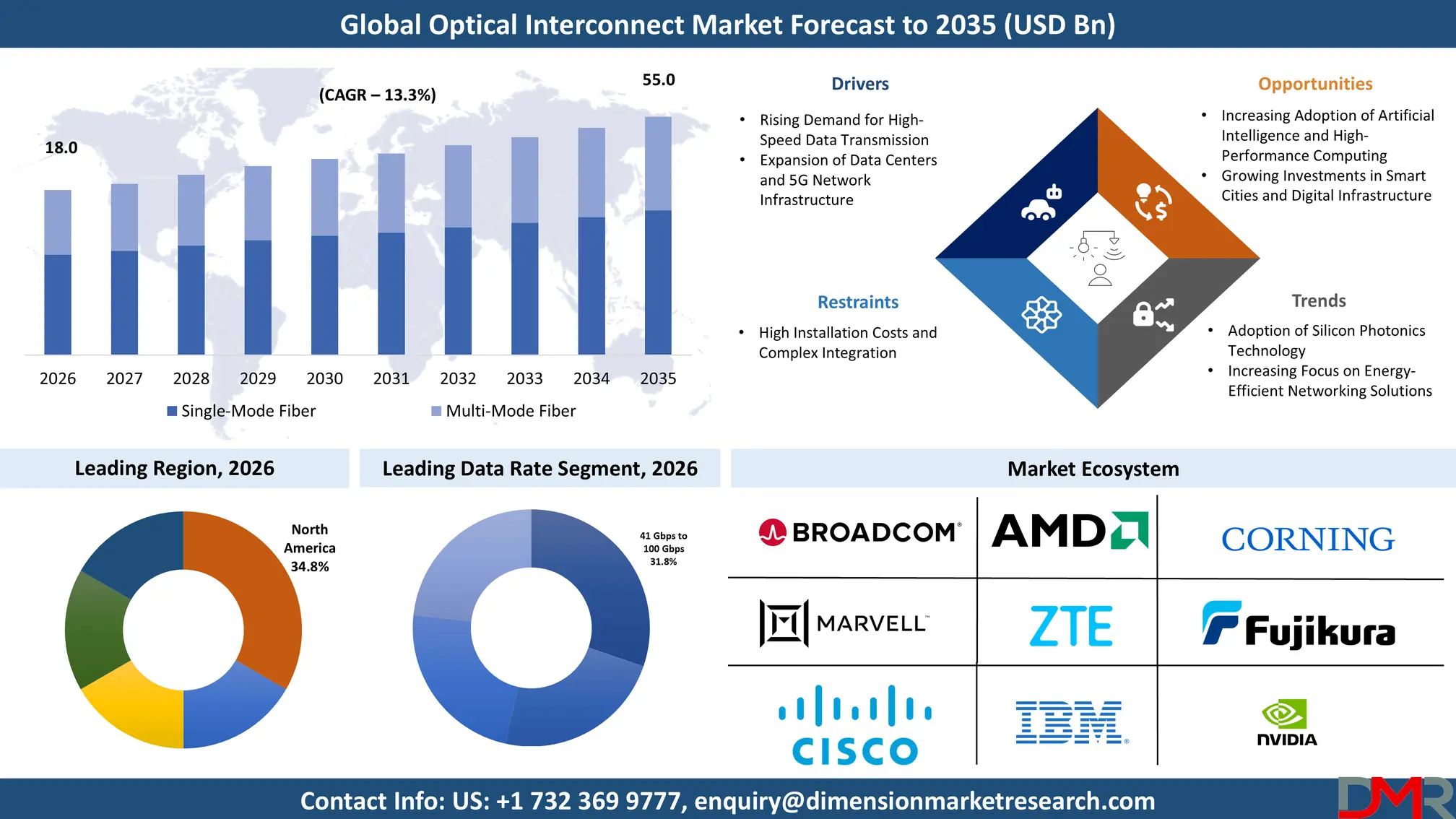
- Global Optical Interconnect Market Size in 2026: USD 18.0 Billion
- Global Optical Interconnect Market Size in 2035: USD 55.0 Billion
- Global CAGR from 2026 to 2035: 13.3%
- Cable Assemblies is the leading Product Type segment in 2026: 37.8%
- Data Communication is the leading Application segment in 2026: 46.7%
- Data Centers is the leading End Use segment in 2026: 31.8%
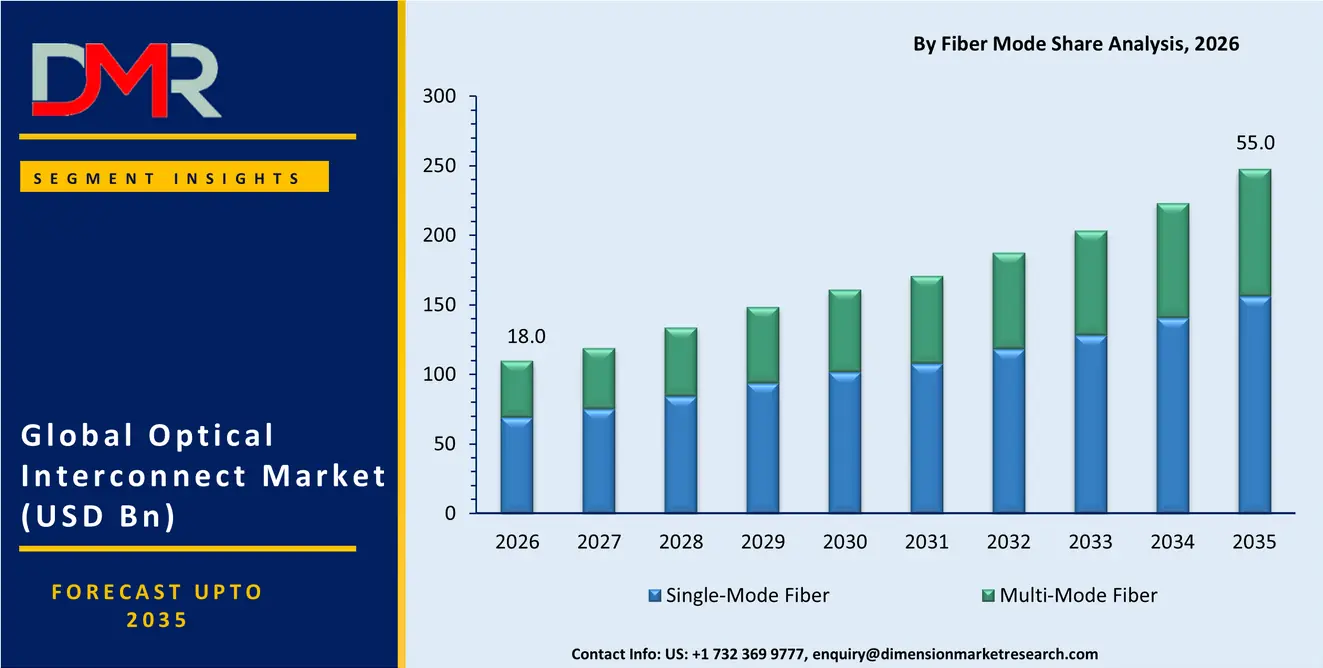
- Single-Mode Fiber is the leading Fiber Mode segment in 2026: 62.6%
- North America is the leading Region in 2026: 34.8%
What is the Global Optical Interconnect and its Market Size?
The Global Optical Interconnect Market is projected to reach USD 18.0 billion in 2026 and grow at a compound annual growth rate of 13.2% from there until 2035 to reach a value of USD 55.0 billion.
ℹ
To learn more about this report –
Download Your Free Sample Report Here
The Global Optical Interconnect Market comprises a diverse ecosystem of component manufacturers, technology providers, and solution developers focused on enabling high-speed optical connectivity. The market structure includes optical transceivers, cable assemblies, connectors, silicon photonics, and fiber-based solutions serving data centers, telecommunications, automotive, and high-performance computing applications. Key players compete through technological innovation, product development, strategic partnerships, and expansion of manufacturing capabilities. The market is influenced by increasing AI workloads, cloud infrastructure growth, and demand for energy-efficient, high-bandwidth communication networks. Continuous advancements in photonic technologies and optical integration are shaping the competitive landscape and future market growth.
Use Cases
- AI & Machine Learning Clusters: It helps in connecting number of GPUs or AI accelerators inside a large training pod using Co-packed Optics (CPO) to remove copper bottlenecks
- Data Center Interconnect (DCI): It synchronizes data & distributes workloads at speeds exceeding 100 Tb/s across campus or metro-scale facilities using Nokia Optical DCI frameworks
- Optical Circuit Switching (OCS): It supports in bypassing heavy electronic packet routing for static, high-volume persistent data flows in a high performance computing
- Chiplet & Intra-Chip Links: It allows high speed parallel data paths directly on or between silicon substrates to expand processor memory bandwidth.
Key Takeaways
- Market Size: The Global Optical Interconnect Market is projected to reach USD 18.0 billion in 2026 and expand to USD 55.0 billion by 2035, driven by increasing demand for high-speed connectivity.
- Growth Rate and Outlook: The market is expected to grow at a CAGR of 13.3% from 2026 to 2035, supported by AI adoption, cloud computing, data center expansion, and 5G infrastructure development.
- Primary Growth Drivers: Rising bandwidth requirements, hyperscale data center growth, artificial intelligence workloads, and demand for energy-efficient networking solutions are key market growth drivers.
- By Product Type Analysis: Cable Assemblies lead the market with a 37.8% share in 2026, while silicon photonics is gaining momentum due to its high-speed and low-power capabilities.
- By Application Analysis: Data Communication dominates with a 46.7% share in 2026, driven by increasing data traffic from cloud platforms and enterprise networks.
- By Fiber Mode Analysis: Single-Mode Fiber holds the leading position with a 62.6% share in 2026, supported by its high bandwidth and long-distance transmission advantages.
- Regional Leadership: North America leads the market with a 34.8% share in 2026, while Asia Pacific is the fastest-growing region due to rapid digitalization and infrastructure investments.
How AI/Gen AI is Transforming the Optical Interconnect Market?
Optical interconnects use light instead of electrical signals to transfer massive volumes of data at ultra-low latencies. In generative AI infrastructure, they eliminate copper wire distance bottlenecks, allowing thousands of accelerators to function as a single massive, unified computing engine. In this Electrical signals over traditional copper degrade past 1.5 meters, restricting high-speed GPU clusters to single racks. Optics extend high-bandwidth links across multi-rack pods. Also, synchronous AI operations like matrix multiplication require real-time data summing across nodes, minimizing tail latency.In addition, co-packaged optics reduce energy consumption per bit (targeting <4–6 pJ/bit), saving power that can be redirected to core AI processing.
Key Drivers in the Global Optical Interconnect Market
Rising Demand for High-Speed Data Transmission
The rapid growth of cloud computing, artificial intelligence, big data analytics, and video streaming has significantly increased the demand for faster and more reliable data transmission. Optical interconnects provide superior bandwidth, low latency, and energy-efficient communication in comparison to traditional copper-based connections, making them vital in modern networking infrastructure. Enterprises and hyperscale data centers are mainly adopting optical interconnect solutions to handle growing workloads while ensuring seamless connectivity. This expanding demand for high-performance computing and networking continues to be a major driver supporting the global optical interconnect market.
Expansion of Data Centers and 5G Network Infrastructure
The constant expansion of hyperscale data centers and the global rollout of 5G networks are driving the adoption of optical interconnect technologies. Data centers require high-capacity, low-loss communication between servers, switches, and storage systems, while 5G infrastructure demands high-speed fiber connectivity for efficient data transfer. Optical interconnects meet these performance requirements by allowing scalable, energy-efficient, and reliable communication networks. Increase in investments in digital infrastructure by governments and private organizations is further accelerating the deployment of optical interconnect solutions across various communication and networking applications.
Restraints in the Global Optical Interconnect Market
High Installation Costs and Complex Integration
Despite offering superior performance, optical interconnect solutions include a high initial investment in fiber optic components, transceivers, connectors, and installation. Integrating optical technologies into existing copper-based infrastructure often needs specialized expertise and additional equipment, increasing deployment complexity and costs. Small and medium-sized enterprises may find these expenses challenging, limiting adoption in cost-sensitive environments. Furthermore, maintenance and testing of optical systems require skilled professionals, adding operational costs. These financial and technical barriers can slow market penetration, particularly in developing regions with limited infrastructure investment.
Growth Opportunities in the Global Optical Interconnect Market
Increasing Adoption of Artificial Intelligence and High-Performance Computing
The growing deployment of artificial intelligence (AI), machine learning, and high-performance computing (HPC) systems presents significant opportunities for the optical interconnect market. These advanced computing applications require ultra-fast, low-latency communication between processors, memory, and storage devices. Optical interconnect technologies provide the bandwidth and efficiency needed to support intensive computational workloads while minimizing energy consumption. As enterprises, research institutions, and cloud service providers continue investing in AI-driven infrastructure, demand for advanced optical interconnect solutions is expected to increase substantially across multiple industry sectors.
Growing Investments in Smart Cities and Digital Infrastructure
Governments worldwide are investing heavily in smart city initiatives, broadband expansion, and digital transformation projects, creating favorable opportunities for optical interconnect providers. Smart transportation, intelligent utilities, connected healthcare, and public safety systems require robust, high-speed communication networks capable of handling large volumes of real-time data. Optical interconnect technologies support these requirements through reliable, scalable, and energy-efficient connectivity. Rising investments in fiber-optic infrastructure, combined with increasing adoption of Internet of Things (IoT) applications, are expected to create sustained growth opportunities for market participants.
Trends in the Global Optical Interconnect Market
Adoption of Silicon Photonics Technology
Silicon photonics is emerging as a major trend in the optical interconnect market due to its ability to deliver higher bandwidth, reduced power consumption, and compact device designs. The technology integrates optical and electronic components onto a single silicon chip, improving manufacturing efficiency and lowering production costs. Data centers, telecommunications providers, and high-performance computing systems are increasingly adopting silicon photonics to address growing bandwidth demands. Constant advancements in chip integration and optical module performance are expected to accelerate the commercialization of silicon photonics solutions.
Increasing Focus on Energy-Efficient Networking Solutions
Energy efficiency has become a critical priority as data centers and communication networks expand around the world. Optical interconnect solutions consume less power than traditional copper-based technologies while delivering higher transmission speeds and lower signal loss. Organizations are mainly deploying energy-efficient networking infrastructure to reduce operational costs and meet sustainability objectives. Manufacturers are also developing advanced low-power optical transceivers and innovative fiber technologies to improve overall network performance. This growing emphasis on environmentally sustainable, high-performance communication infrastructure continues to shape the evolution of the global optical interconnect market.
Research Scope and Analysis
The Optical Interconnect Market research analyzes products, technologies, applications, and deployment trends across data centers, telecommunications, high-performance computing, and enterprise networks. It evaluates market dynamics, competitive landscape, innovation, supply chain developments, regional demand, regulatory factors, and growth opportunities driven by rising bandwidth requirements and AI-enabled infrastructure expansion.
ℹ
To learn more about this report –
Download Your Free Sample Report Here
By Product Type Analysis
The Cable Assemblies segment is expected to account for 37.8% of the global optical interconnect market share in 2026, maintaining its leading position owing to widespread adoption in data centers, telecommunications, and high-performance computing applications. These assemblies offer reliable, high-bandwidth connectivity, easy installation, and superior signal integrity, making them a preferred choice for high-speed network infrastructure. Meanwhile, the Silicon Photonics segment is projected to register the fastest CAGR of 19.8% during the forecast period. Growth is driven by the growing demand for energy-efficient, compact, and high-speed optical communication solutions, particularly in AI workloads, hyperscale data centers, cloud computing, and next-generation networking technologies.
By Data Rate Analysis
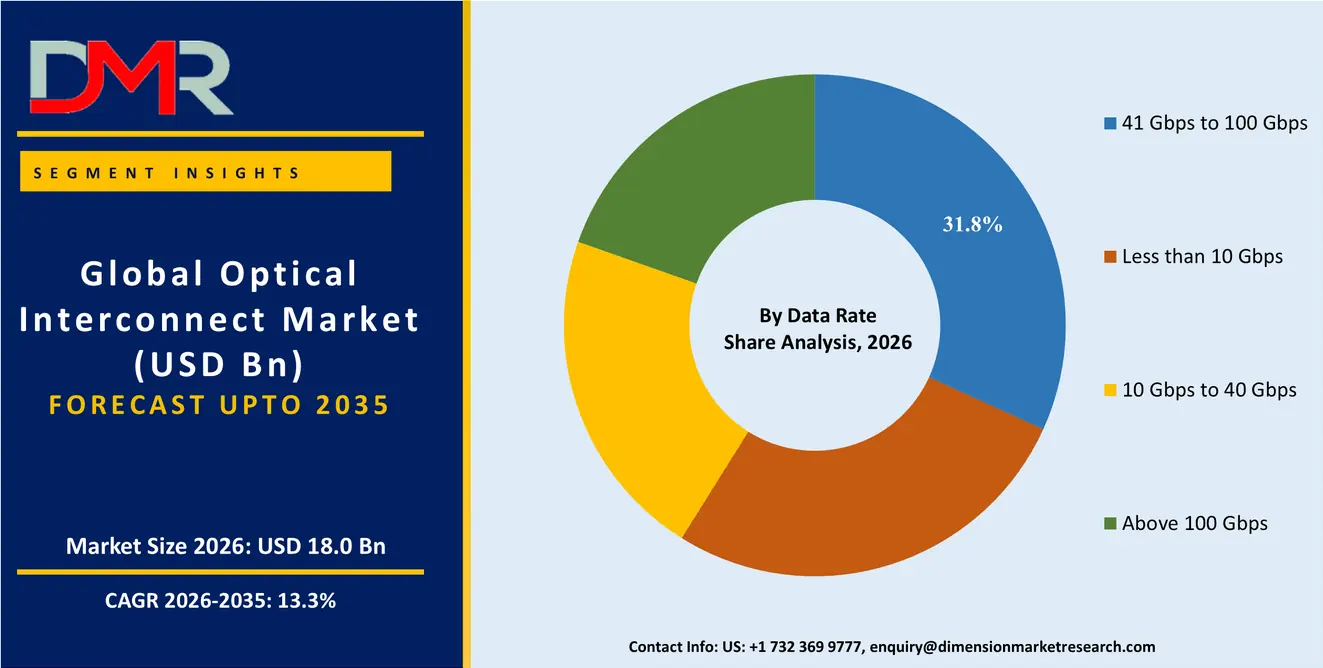
The 41 Gbps to 100 Gbps segment is projected to hold the largest share of 31.8% of the global optical interconnect market in 2026, owing to its widespread deployment across enterprise networks, cloud data centers, and telecommunications infrastructure. This data rate range provides an optimal balance between performance, scalability, and cost, making it suitable for high-bandwidth applications. Meanwhile, the Above 100 Gbps segment is expected to register the fastest CAGR of 18.1% during the forecast period, fueled by rising demand for AI computing, hyperscale data centers, 5G networks, and next-generation cloud services requiring ultra-high-speed, low-latency optical communication.
By Fiber Mode Analysis
The Single-Mode Fiber segment is expected to dominate the global optical interconnect market, accounting for 62.6% of the market share in 2026. Its dominance is attributed to superior long-distance transmission capabilities, higher bandwidth, and lower signal attenuation, making it the preferred choice for telecommunications networks, hyperscale data centers, and metro fiber infrastructure.
ℹ
To learn more about this report –
Download Your Free Sample Report Here
Meanwhile, the Multi-Mode Fiber segment is projected to grow at a CAGR of 9.7% during the forecast period, supported by increasing adoption in enterprise networks, campus environments, and short-range data center applications where cost-effective deployment, simplified installation, and reliable high-speed connectivity are key operational requirements.
By Application Analysis
The Data Communication segment is projected to account for the largest share of 46.7% of the global optical interconnect market in 2026, driven by the increasing need for high-speed, low-latency data transmission across cloud computing platforms, hyperscale data centers, enterprise networks, and telecommunications infrastructure. Optical interconnects are essential for supporting growing bandwidth requirements and reliable network performance. Meanwhile, the Automotive segment is expected to expand at a CAGR of 16.3% during the forecast period, fueled by rising adoption of advanced driver-assistance systems (ADAS), autonomous driving technologies, connected vehicles, and in-vehicle high-speed communication networks requiring reliable optical connectivity.
The Global Optical Interconnect Market Report is segmented on the basis of the following:
By Product Type
- Cable Assemblies
- Indoor Cable Assemblies
- Outdoor Cable Assemblies
- Active Optical Cables (AOC)
- Passive Optical Cables (POC)
- Connectors
- Optical Transceivers
- Free Space Optics
- Silicon Photonics
By Data Rate
- Less than 10 Gbps
- 10 Gbps to 40 Gbps
- 41 Gbps to 100 Gbps
- Above 100 Gbps
By Fiber Mode
- Single-Mode Fiber
- Multi-Mode Fiber
By Application
- Data Communication
- Data Centers
- High-Performance Computing (HPC)
- Telecommunication
- Long Haul
- Metro
- Access Networks
- Military & Aerospace
- Automotive
- Medical
- Consumer Electronics
Regional Analysis
North America is the Leading Region in the Global Optical Interconnect Market
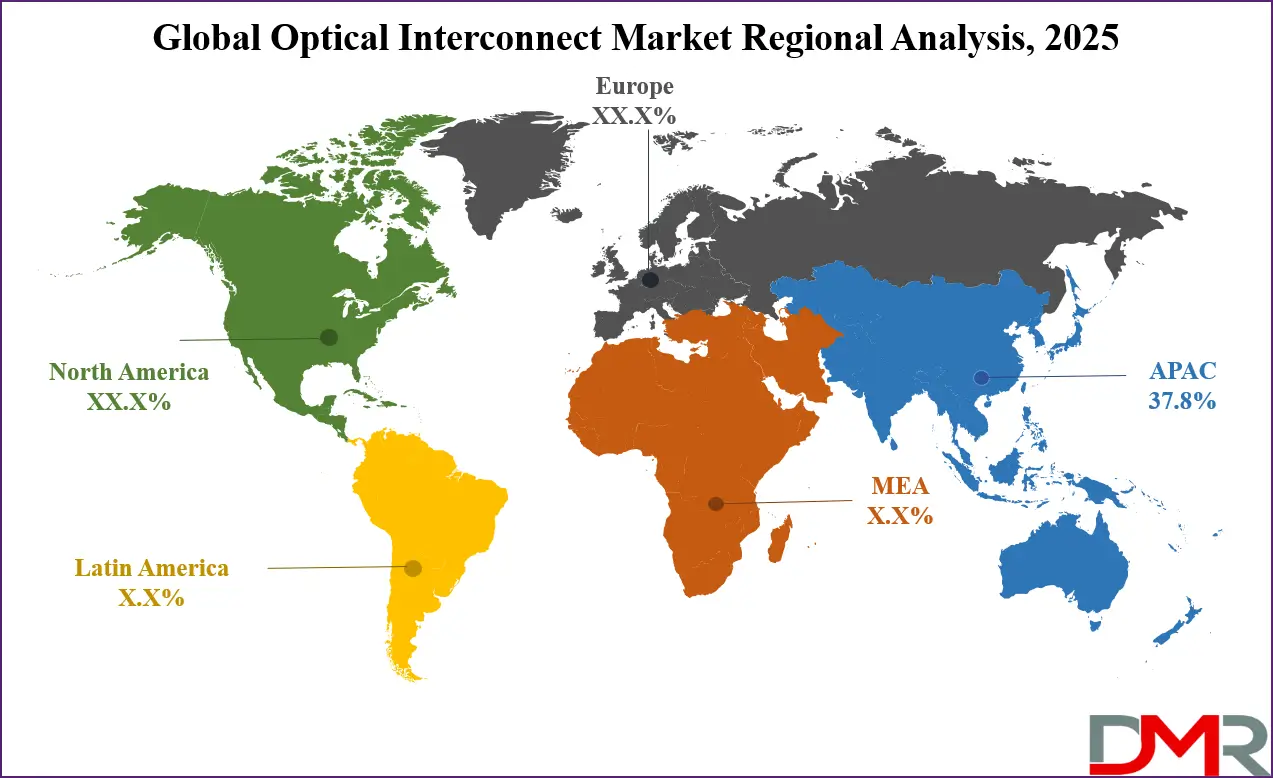
North America is projected to account for 34.8% of the global optical interconnect market in 2026, maintaining its leadership owing to the strong presence of hyperscale data centers, leading cloud service providers, and advanced telecommunications infrastructure. The region benefits from substantial investments in artificial intelligence, high-performance computing, and 5G network deployment, driving demand for high-speed optical connectivity. In addition, the presence of major technology companies, continuous innovation in networking solutions, and increasing enterprise digital transformation initiatives further strengthen North America's dominant position in the market.
ℹ
To learn more about this report –
Download Your Free Sample Report Here
Asia Pacific is the Fastest-Growing Region in the Global Optical Interconnect Market
Asia Pacific is anticipated to register a CAGR of 15.8% during the forecast period, driven by rapid digitalization, expanding data center capacity, and increasing investments in 5G and fiber-optic infrastructure. The growth in internet penetration, growing cloud computing adoption, and the expansion of AI-enabled applications are accelerating the need for optical interconnect solutions across the region. Countries such as China, Japan, South Korea, and India are investing heavily in advanced communication networks, while the growth of electronics manufacturing and smart city projects further supports sustained market expansion.
The Europe Optical Interconnect Market
The Europe Optical Interconnect Market is estimated to be valued at USD 4.16 billion in 2026 and is further anticipated to reach USD 10.45 billion by 2035 at a CAGR of 10.7%.
The European market is driven by rising investments in digital infrastructure, expanding hyperscale and colocation data centers, and increasing deployment of fiber-optic communication networks across the region. Growing adoption of cloud computing, artificial intelligence, industrial automation, and high-performance computing is accelerating demand for high-bandwidth optical interconnect solutions. The ongoing rollout of 5G networks, supported by government initiatives promoting digital connectivity, is further strengthening market growth. In addition, the region's emphasis on energy-efficient networking technologies and advanced semiconductor innovation is expected to sustain demand across telecommunications, enterprise networking, healthcare, automotive, and industrial applications.
Latin America Optical Interconnect Market
The Latin America Optical Interconnect Market is experiencing steady growth, supported by growth in investments in broadband infrastructure, cloud computing, and data center development across key economies like Brazil and Mexico. Rising internet penetration, digital transformation initiatives, and expanding telecommunications networks are driving the adoption of optical interconnect solutions. The growth in demand for high-speed connectivity from enterprises and government organizations, coupled with ongoing fiber-optic network expansion and 5G deployment, is expected to create favorable opportunities for market growth throughout the forecast period.
MEA Optical Interconnect Market
The Middle East & Africa (MEA) Optical Interconnect Market is set to experience gradual growth, driven by a rise in investments in digital infrastructure, smart city projects, and telecommunications modernization. Countries such as the UAE, Saudi Arabia, and South Africa are expanding fiber-optic networks and data center facilities to support growing cloud adoption and digital services. The growth in demand for high-speed internet connectivity, government-led digital transformation programs, and rise in adoption of advanced networking technologies are expected to accelerate the deployment of optical interconnect solutions across the region during the forecast period.
Major Countries Analysis
United States Optical Interconnect Market
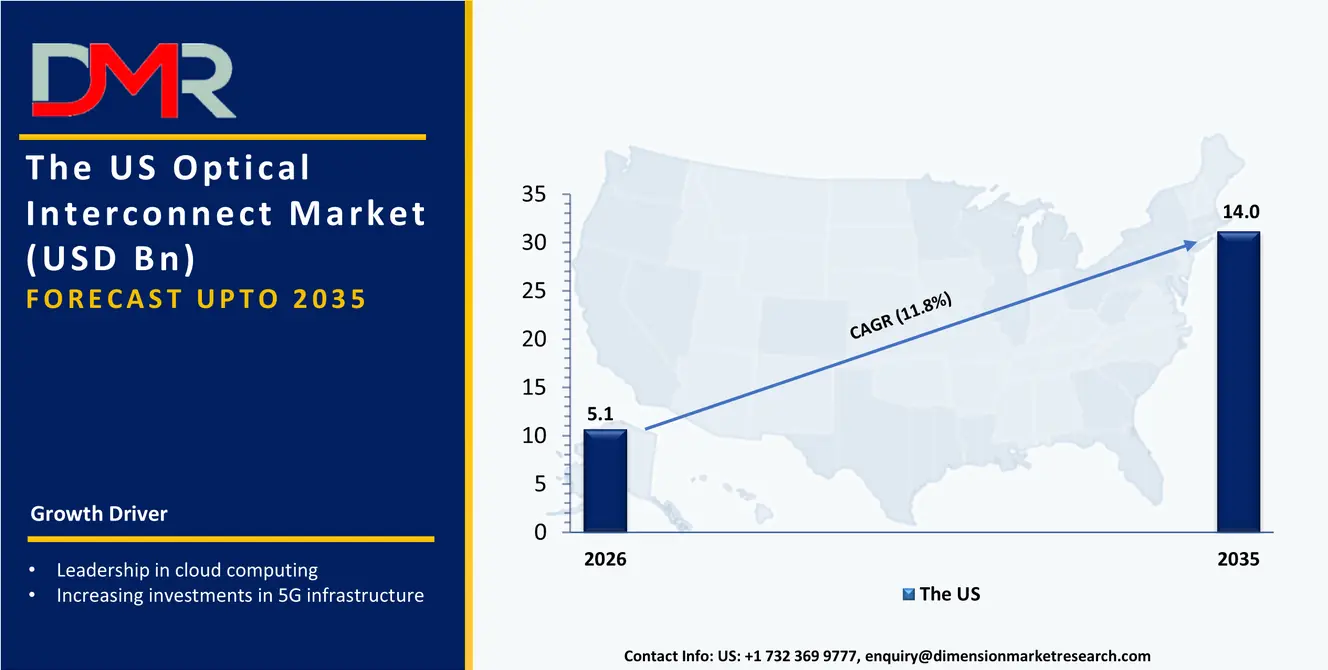
The United States Optical Interconnect Market is valued at USD 5.1 billion in 2026 and is expected to reach USD 14.0 billion by 2035, registering a CAGR of approximately 11.8% from 2026 to 2035. The growth in the US market is supported by the country's leadership in cloud computing, artificial intelligence, high-performance computing, and hyperscale data center deployment. Increasing investments in 5G infrastructure, fiber-optic communication networks, and next-generation networking technologies continue to drive demand for high-speed optical interconnect solutions.
ℹ
To learn more about this report –
Download Your Free Sample Report Here
The presence of major cloud service providers, semiconductor manufacturers, and networking equipment companies further strengthens market expansion. Additionally, rising enterprise digital transformation initiatives, growing bandwidth requirements, and continuous technological advancements in silicon photonics and optical modules are expected to support sustained growth across telecommunications, healthcare, defense, and enterprise networking applications.
Japan Optical Interconnect Market
The Japan Optical Interconnect Market is valued at USD 1.1 billion in 2026 and is forecast to reach USD 2.5 billion by 2035, expanding at a CAGR of approximately 9.6% between 2026 and 2035. In Japan, the growth in the market is supported by Japan's strong semiconductor industry, advanced telecommunications infrastructure, and rise in investments in data centers, artificial intelligence, and 5G networks. Growing demand for high-speed data transmission, cloud computing, and high-performance computing applications is driving the adoption of optical interconnect technologies across enterprise, industrial, and telecommunications sectors.
Saudi Arabia Optical Interconnect Market
The Saudi Arabia Optical Interconnect Market is valued at USD 180.0 million in 2026 and is forecast to reach USD 590.0 million by 2035, expanding at a CAGR of approximately 14.1% between 2026 and 2035. In Saudi Arabia, growth is driven by increasing investments in digital infrastructure, hyperscale data centers, and nationwide fiber-optic network expansion under Vision 2030 initiatives. Growing adoption of cloud computing, 5G deployment, smart city projects, and enterprise digital transformation is accelerating demand for high-speed optical interconnect solutions across telecommunications, government, and commercial sectors.
Technology Analysis
Technology advancement is the primary growth driver in the Optical Interconnect market, with increasing adoption of silicon photonics, co-packaged optics, wavelength division multiplexing, high-speed optical transceivers, and pluggable modules supporting faster and more energy-efficient data transmission.
Rapid expansion of hyperscale data centers, artificial intelligence workloads, high-performance computing, and 5G infrastructure is accelerating demand for low-latency, high-bandwidth connectivity. Continuous innovation in photonic integration and optical packaging is improving scalability while reducing power consumption. However, design complexity, interoperability challenges, thermal management, and high development costs remain significant risks.
Overall, technological progress is enhancing network performance, enabling next-generation computing infrastructure, and driving sustained market expansion across communication ecosystems.
Patent Analysis
Patent activity in the Optical Interconnect market is expanding rapidly as semiconductor, networking, and photonics companies compete to develop advanced optical communication technologies. Innovation is concentrated in silicon photonics, optical engines, photonic integrated circuits, co-packaged optics, fiber coupling, laser integration, and high-speed transceiver architectures.
Strong intellectual property portfolios provide competitive differentiation, licensing opportunities, and barriers to market entry while supporting commercialization of next-generation optical solutions. However, complex patent landscapes, cross-licensing requirements, intellectual property disputes, and high research and development investments present challenges for emerging participants
Robust patent development is accelerating technological innovation, strengthening competitive positioning, and supporting long-term growth across data communication and networking markets.
By Region
North America
Europe
- Germany
- France
- The U.K.
- Italy
- Spain
- Rest of Europe
Asia-Pacific
- China
- Japan
- India
- Australia
- South Korea
- Rest of APAC
Latin America
- Mexico
- Brazil
- Rest of LATAM
Middle East & Africa
- Saudi Arabia
- The UAE
- South Africa
- Rest of MEA
Competitive Landscape
The global optical interconnect market is highly competitive, with key players looking for technological innovation, strategic partnerships, and product advancements to strengthen their market position. Companies are investing in high-speed optical modules, silicon photonics, advanced fiber technologies, and energy-efficient connectivity solutions to address growing data transmission demands. Leading market participants are expanding their product portfolios and enhancing manufacturing capabilities to serve data centers, telecommunications, automotive, and high-performance computing applications. Continuous research and development activities remain central to maintaining competitiveness in this rapidly evolving market.
Some of the prominent players in the Global Optical Interconnect Market are:
- Broadcom
- NVIDIA
- Cisco
- Marvell Technology
- Coherent Corp.
- Lumentum Holdings
- Corning
- Amphenol
- Molex
- TE Connectivity
- Sumitomo Electric Industries
- Fujikura
- Furukawa Electric
- CommScope
- VIAVI Solutions
- Ciena
- Infinera
- Juniper Networks
- Intel
- AMD
- IBM
- Ayar Labs
- POET Technologies
- Lightmatter
- Celestial AI
- Ranovus
- DustPhotonics
- Hisense Broadband
- Source Photonics
- NeoPhotonics
- AOI
- MaxLinear
- Semtech
- MACOM
- Applied Optoelectronics
- ADVA
- Ribbon Communications
- Nokia
- Huawei
- ZTE
- Other Key Players
Recent Developments
- In April 2026, Kopin Corporation announced a strategic collaboration with Fabric.AI to design MicroLED-based optical interconnect technology that will be made to replace traditional copper wiring between GPUs and high-performance processors for smart data centers. In addition, Fabric.AI has placed a USD 15M purchase order with Kopin to fund the demonstration chipset. Further, as artificial intelligence continues to scale, traditional data-center architectures are approaching their operational limits and are being criticized for their energy consumption and environmental impact. D
- In April 2026, Marvell Technology, Inc. acquired Polariton Technologies, a developer of high-speed, low-power plasmonics-based silicon photonics devices. The acquisition strengthens Marvell’s optical technology portfolio by adding advanced modulation capabilities that allow continued scaling in bandwidth, power efficiency, and integration for next-generation coherent and optical interconnect platforms. As artificial intelligence workloads drive exponential increases in bandwidth demand, data center architectures are evolving to require ever-higher performance optical interconnects, particularly for scale-across and data center interconnect (DCI) applications.
- In March 2026, Nokia introduced a suite of new optical networking innovations created to address the unprecedented scale and application diversity demands driven by the AI supercycle. AI traffic and data center interconnect (DCI) requirements are continuing to accelerate, exceeding the practical limits of approaches based solely on incremental improvements over previous generations. Further, it represents a fundamental shift in how optical transport products are designed and developed, delivering application-optimized connectivity that maximizes performance while significantly reducing cost, space, and power and simplifying network operations.
- In March 2026, Avicena unveiled the LightBundle™ eKit, the industry’s first evaluation platform for microLED optical connectivity using ASIC-based transceivers with integrated LED, photodetector (PD) and micro-lens arrays connected via a multi-core fiber bundle. The kit allows hyperscaler, AI accelerator, high-bandwidth memory (HBM), networking, and AI infrastructure architects to evaluate next-generation optical links created to overcome the bandwidth, reach, routing and energy limitations of copper interconnects in AI systems.
Report Details
| Report Characteristics |
| Market Size (2026) |
USD 18.0 Bn |
| Forecast Value (2035) |
USD 55.0 Bn |
| CAGR (2026–2035) |
13.3% |
| Historical Period |
2021 – 2025 |
| Forecast Period |
2027 – 2035 |
| Base Year |
2025 |
| Estimate Year |
2026 |
| Segments Covered |
By Product Type, By Data Rate, By Fiber Mode, By Application |
| Regional Coverage |
North America – The US and Canada; Europe – Germany, The UK, France, Spain, Italy, & Rest of Europe; Asia-Pacific – China, Japan, South Korea, India, Australia, Rest of APAC; Latin America – Brazil, Mexico, Argentina, Colombia, Rest of Latin America; Middle East & Africa – Saudi Arabia, The UAE, South Africa, & Rest of MEA |
Frequently Asked Questions
How big is the Optical Interconnect Market?
▾ The global Optical Interconnect Market is projected to reach USD 18.0 billion in 2026 and grow significantly by 2035 due to rising demand for high-speed connectivity and data center expansion.
What is the CAGR of the Optical Interconnect Market from 2026 to 2035?
▾ The Optical Interconnect Market is expected to grow at a CAGR of approximately 13.2% from 2026 to 2035.
What factors are driving the growth of the Optical Interconnect Market?
▾ Growth is driven by increasing data center deployments, AI adoption, cloud computing, 5G networks, and rising demand for high-bandwidth communication solutions.
What are the major trends in the Optical Interconnect Market?
▾ Key trends include silicon photonics adoption, higher-speed optical solutions, energy-efficient networking, and integration of optical technologies in AI and HPC systems.
Which region held the largest share of the Optical Interconnect Market in 2026?
▾ North America held the largest market share in 2026, accounting for 34.8%, supported by strong data center and technology infrastructure.
Which region is expected to grow the fastest in the Optical Interconnect Market?
▾ Asia Pacific is the fastest-growing region, with a CAGR of 15.8%, driven by digitalization, 5G expansion, and data center investments.
Who are the key players in the Optical Interconnect Market?
▾ Key players include Cisco Systems, Intel Corporation, Broadcom, Lumentum, Coherent, Molex, and TE Connectivity.
How is the Optical Interconnect Market segmented?
▾ The market is segmented by Product Type, Data Rate, Fiber Mode, Application, and End Use.