What is the Parks and Recreation Software Market Size in 2026?
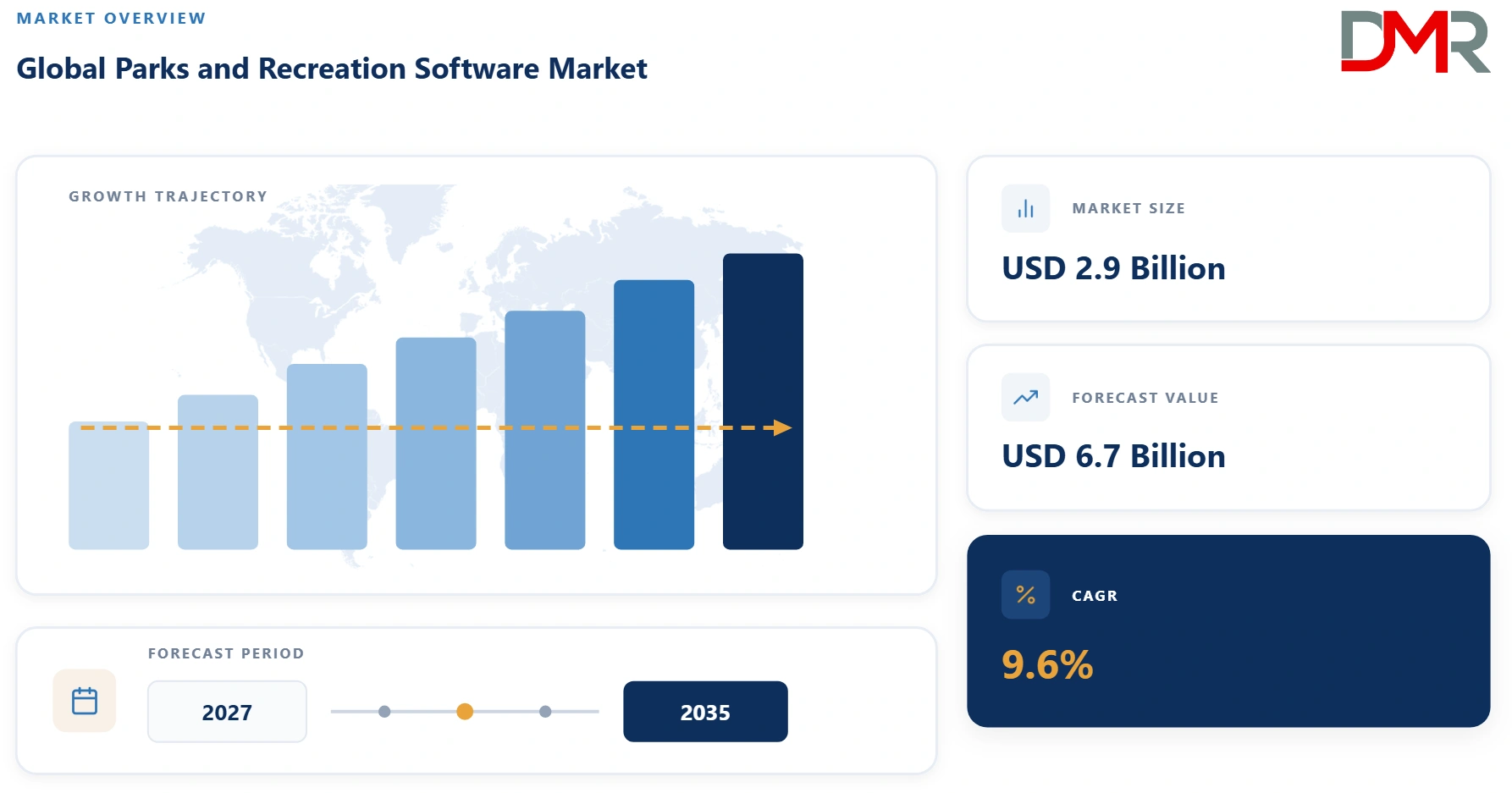
The Global Parks and Recreation Software Market is valued at USD 2.9 billion in 2026 and is projected to reach USD 6.7 billion by 2035, growing at a CAGR of 9.6% from 2027 to 2035. Growth is driven by rising park and recreation use, the shift from paper and phone bookings to online self-service, public funding for the modernization of municipal systems, and growing use of integrated payments, mobile apps, and artificial intelligence to run parks, programs, and facilities.
ℹ
To learn more about this report –
Download Your Free Sample Report Here
The Parks and Recreation Software Market comprises software that parks, recreation and leisure organizations use to take bookings and registrations, manage facilities and assets, run memberships and programs, sell tickets, collect payments and report on visitor use. It spans municipal recreation management suites, state and federal reservation and permit systems, campground and facility booking tools, and the implementation, training and support services sold with them. Revenue includes subscription licenses, perpetual licenses, maintenance and support, and implementation services.
The Parks and Recreation Software Market in this report measures the value of the software and related services, rather than the kiosks, gates, sensors and point-of-sale hardware around it, the payment processing fees collected on transactions, or the general government websites, finance and permitting systems that connect to it. Demand comes from city and county recreation departments, state and federal park agencies, private operators of campgrounds, golf courses, aquatic and fitness centers, and nonprofits such as community centers and youth sports leagues. The report covers five segments across five regions, including major national markets in each.
Parks and Recreation Software Market Snapshot
Parks and Recreation Software Market Snapshot, 2027-2035
| Metric |
Value |
| Market Size (2026) |
USD 2.9 Billion |
| Forecast Value (2035) |
USD 6.7 Billion |
| CAGR (2027-2035) |
9.6% |
| Largest Region (2026) |
North America, 47.0% share |
| Fastest-Growing Region (2027-2035) |
Asia Pacific, 12.5% CAGR |
| Leading Component (2026) |
Software, 74.0% share |
| Leading Application (2026) |
Registration and Reservation Management, 31.0% share |
| Key Players |
Xplor, CivicPlus, Tyler Technologies, ACTIVE Network, Daxko, Aspira, Jonas Leisure, DaySmart |
Parks and Recreation Software Market: Key Takeaways
- Market growth: The market is valued at USD 2.9 billion in 2026 and is expected to reach USD 6.7 billion by 2035, expanding at a 9.6% CAGR from 2027 to 2035.
- Component leader: Software holds a 74.0% share of the market in 2026, as agencies buy subscription platforms for bookings, registrations and facility management, while Services is the fastest-growing component at a 10.6% CAGR through 2035 on implementation, data migration and managed support demand.
- Fastest deployment: Cloud Based deployment is set to grow at an 11.2% CAGR through 2035, ahead of the overall market, and already holds 68.0% of 2026 revenue as departments retire on-premises servers and desktop clients.
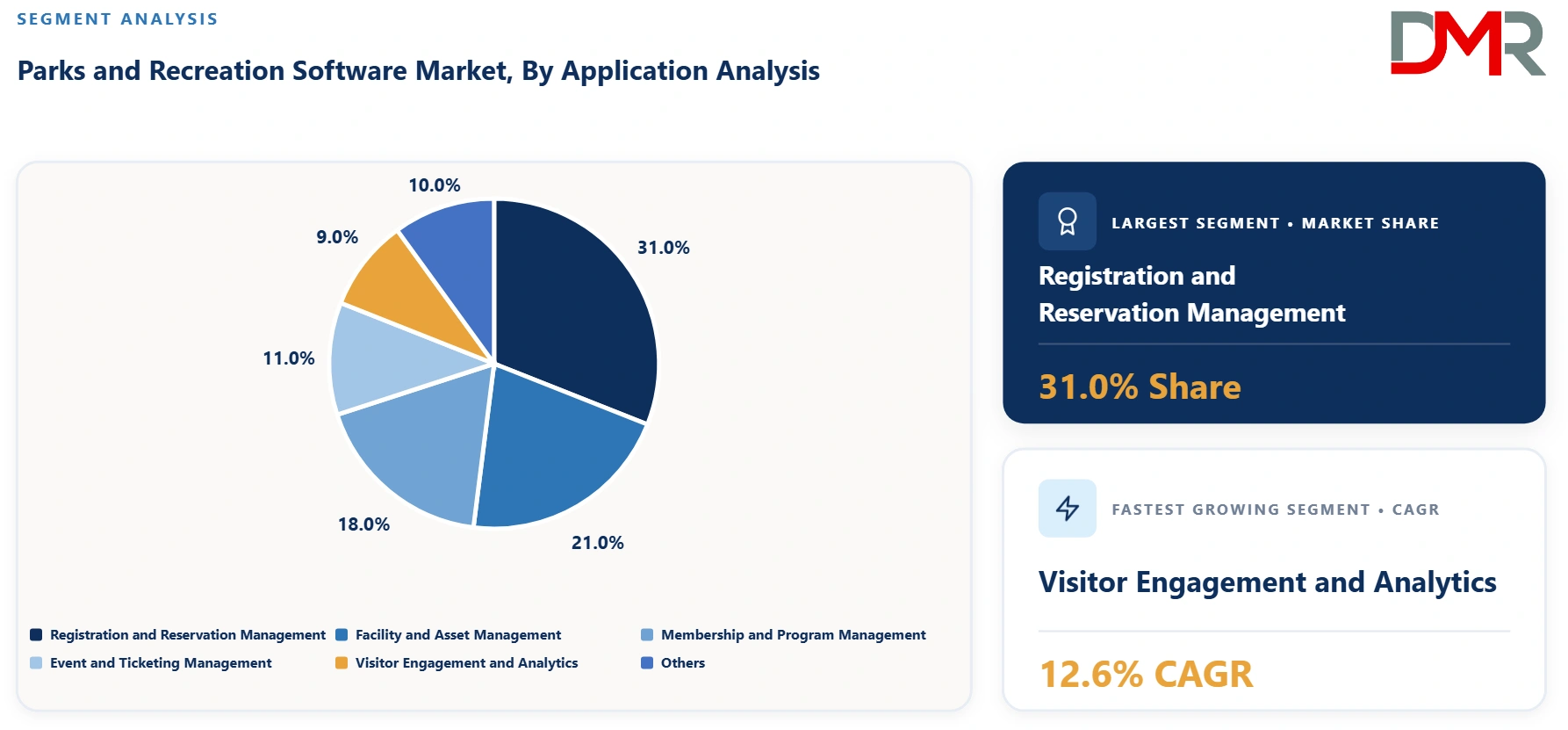
- Application leader: Registration and Reservation Management accounts for 31.0% of 2026 demand, as residents and visitors expect to book programs, shelters, courts, campsites and passes online.
- Fastest application: Visitor Engagement and Analytics is projected to grow at a 12.6% CAGR, supported by mobile apps, AI assistants and dashboards that show how parks and programs are used.
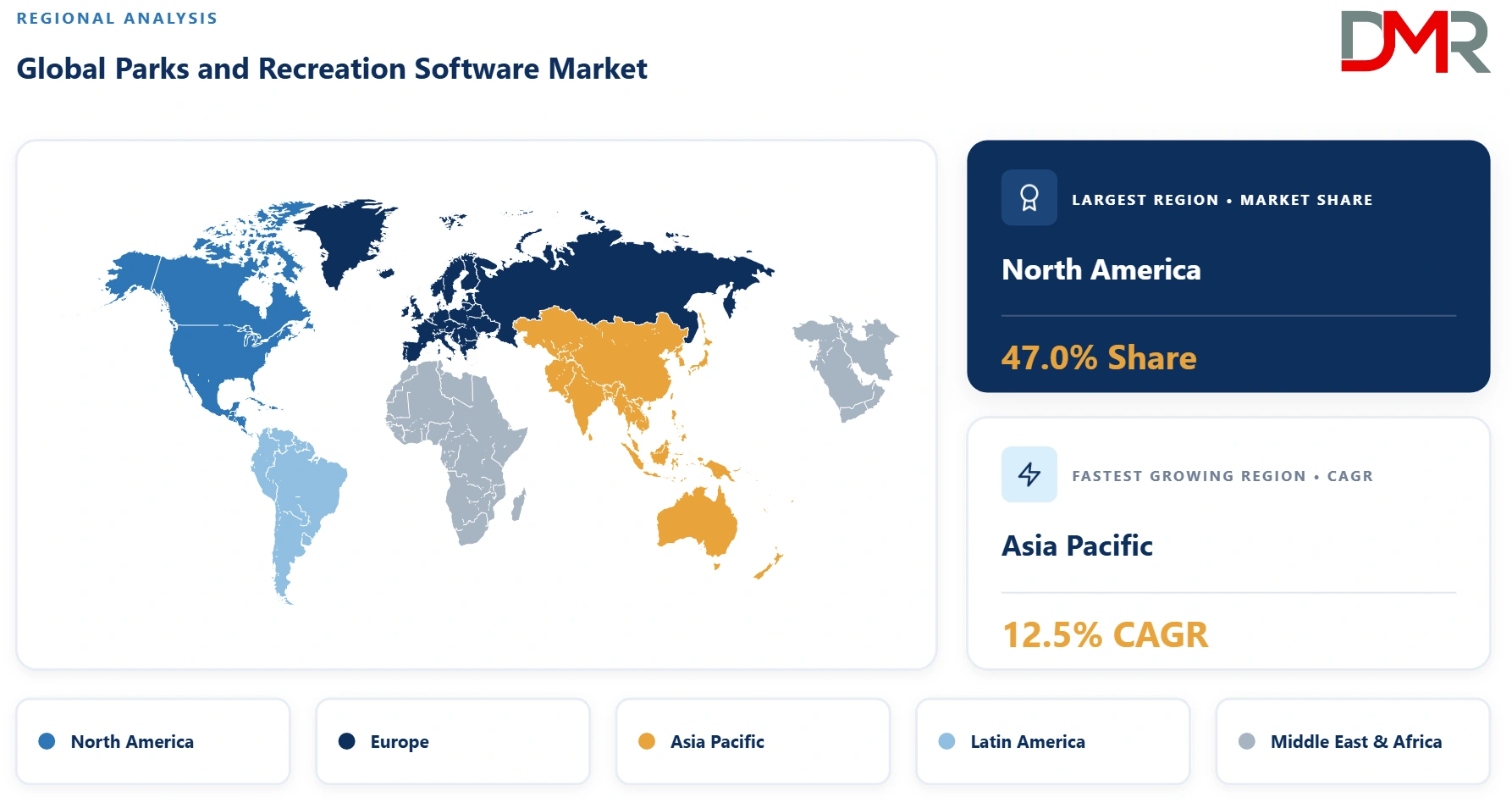
- Regional picture: North America leads with a 47.0% share in 2026, while Asia Pacific is the fastest-growing region at a 12.5% CAGR.
What are the Key Use Cases of Parks and Recreation Software?
- Online Registration, Booking and Ticketing: Residents and visitors register for classes and camps, reserve picnic shelters, courts and campsites, buy passes and tickets, and pay online, which reduces counter work and phone calls for staff and fills programs more reliably.
- Facility, Asset and Maintenance Management: Departments track playgrounds, fields, trails, pools and fleets, schedule work orders and inspections, and plan capital replacement, helping small teams keep aging assets safe and available.
- Membership and Program Management: Recreation centers, aquatic facilities and leagues manage households, memberships, rosters, waivers, financial assistance and recurring billing in one system, giving staff a single view of each participant.
- Visitor Insights and Resident Communication: Dashboards, mobile apps and messaging show attendance, revenue and demand by site, and help agencies justify budgets, reduce crowding with timed entry, and keep residents informed.
How are AI and Cloud Computing Transforming the Parks and Recreation Software Market?
Artificial intelligence and cloud platforms are changing how small public teams serve residents. In January 2026 CivicPlus launched six AI releases under CivicPlus Intelligence, including CivicPlus Agent, which answers resident questions, and CivicPlus Athena, an assistant for staff, and by September 2026 it reported that the Agent supported more than 240 customers. In March 2026 Xplor closed its merger with Clubessential and announced an eight-figure investment in AI across its portfolio. At the same time, cloud platforms combine registration, payments, mobile apps and reporting in one system that the vendor keeps updated, so departments no longer maintain servers or desktop software. Vendors increasingly package AI assistants, embedded payments and analytics into higher subscription tiers, which raises revenue per customer and moves competition toward ease of use, integration with civic systems and trust in how resident data is handled.
Parks and Recreation Software Market Dynamics at a Glance
Drivers, Restraints, Opportunities and Trends in the Parks and Recreation Software Market
| Type |
Factor |
Impact |
| Driver |
Rising Park Use and Demand for Online Self-Service |
High |
| Driver |
Public Funding and Modernization of Municipal Systems |
High |
| Restraint |
Tight Budgets and Legacy System Inertia |
High |
| Restraint |
Accessibility, Privacy and Payment Compliance Burden |
Medium |
| Opportunity |
Cloud Migration and Mobile First Visitor Experience |
High |
| Opportunity |
AI Enabled Operations and Visitor Insights |
High |
| Trend |
Platform Consolidation and Embedded Payments |
High |
| Trend |
Smart Parks and Timed Entry Management |
Medium |
What is Driving the Growth of the Parks and Recreation Software Market?
Rising Park Use and Demand for Online Self-Service
Parks remain heavily used, and visitors now expect to book, pay and check availability on a phone. The National Park Service recorded more than 323 million recreation visits in 2025, including over 13 million overnight stays, and 26 parks set visitation records, even though the total was about 3% below the record set in 2024. City parks show the same pattern: Trust for Public Land reported in May 2026 that residents across the United States use parks regularly and value them highly. Crowded sites push agencies toward reservations, timed entry and permits, and busy municipal departments use online registration to fill classes, camps and rentals with fewer staff hours. Each of these workflows needs software for booking, payment and reporting, which supports steady spending across all regions.
Public Funding and Modernization of Municipal Systems
Governments increasingly treat parks as infrastructure with measurable returns. Departments are replacing aging on-premises recreation systems with cloud platforms that connect to payment, accounting and resident service tools, and state agencies are re-tendering reservation systems like in January 2026, for example, the State of Alaska issued a request for proposals for an online reservation system for its state parks. Accessibility rules add urgency, because websites and apps used to register for programs must meet web accessibility standards. These forces keep municipal and state software contracts flowing even when general budgets are tight.
What are the Key Restraints in the Parks and Recreation Software Market?
Tight Budgets and Legacy System Inertia
Most parks and recreation departments are small, depend on annual budgets and have little technology staff. Many still run older recreation systems that staff know well, and replacing them means data migration, retraining, new payment arrangements and public procurement, which can take a year or more and is easy to postpone. Multi-year contracts with incumbent vendors, and the cost of moving participant, household and financial records, keep many departments in place even when they are dissatisfied. Smaller towns often choose low-cost or free tools, or rely on spreadsheets and forms, which limits revenue growth at the lower end of the market even where online booking use is rising.
Accessibility, Privacy and Payment Compliance Burden
Recreation software handles card payments and personal data on households and children, and public agencies must also meet accessibility rules. Vendors must keep platforms compliant with card payment standards, privacy laws and web accessibility requirements, and must document security practices for public buyers. Compliance adds engineering and testing cost, favors vendors with security and accessibility teams, and can slow product releases for smaller specialists.
What are the Key Opportunities in the Parks and Recreation Software Market?
Cloud Migration and Mobile First Visitor Experience
A large base of departments still runs on-premises or older web systems, and each replacement is a multi-year subscription opportunity. Cloud platforms let a department offer online registration, mobile passes, digital waivers and contactless check-in without running servers, and let vendors ship improvements continuously. Mobile apps and resident portals raise participation by making it easy to find and book activities, while embedded payments give vendors a share of transaction value in addition to software fees. Small and mid-size municipalities, state park systems and campgrounds that still take bookings by phone or paper remain the largest white space for suppliers with simple pricing and quick setup.
AI Enabled Operations and Visitor Insights
Agencies want to understand demand, reduce no-shows, set fair prices and answer residents quickly with small teams. AI assistants can answer common questions, draft communications and help staff find records, while analytics can forecast attendance, flag underused facilities and support grant applications and budget requests. Vendors that combine these tools with secure, well-governed data can sell them as premium modules and expand from booking software into broader operating platforms. Emerging markets in Asia Pacific, Latin America and the Gulf, where public parks and leisure facilities are expanding, add further room for growth.
What are the Latest Trends in the Parks and Recreation Software Market?
Platform Consolidation and Embedded Payments
Vendors are combining registration, memberships, facility booking, payments and mobile apps in single platforms, and ownership is consolidating around a few large groups. Xplor completed its merger with Clubessential Holdings on 30 March 2026, creating a larger global software and payments company whose parks and recreation portfolio includes RecTrac, RecDesk and PerfectMind, which is now sold as Xplor Recreation. CivicPlus ties its recreation software to municipal websites, agendas and 311 services, and Tyler Technologies links recreation to finance and permitting. Buyers gain fewer integrations and one vendor to call, but vendors compete on payment economics, AI features and the strength of their civic and financial integrations.
Smart Parks and Timed Entry Management
Agencies are adding sensors, counters and mobile apps to measure visitor flow and manage crowding, and they link that data to reservation, permit and timed-entry systems. Federal lands, state parks and popular local sites use lotteries, timed entry and permits to protect resources and spread demand, and the national Recreation.gov system, operated by Booz Allen Hamilton under a contract awarded in 2016, sets expectations for real-time availability and simple booking. Software that connects visitor counts, capacity limits, pricing and maintenance planning helps managers act on the data. Vendors that offer open interfaces to GIS, asset and payment tools gain an advantage as agencies build connected park systems.
Research Scope and Analysis
The report segments the Parks and Recreation Software Market by component, deployment mode, end user, application, and facility type across five regions and key countries.
ℹ
To learn more about this report –
Download Your Free Sample Report Here
By Component Analysis
Software leads the component segment with a 74.0% share in 2026 as departments and park agencies buy subscription platforms for registration, reservations, facility and asset management and payments. Services, covering implementation, data migration, training and managed support, hold the remaining 26.0% and are the fastest-growing component at a 10.6% CAGR from 2027 to 2035, because migrations from legacy systems and integration with payment, accounting and GIS tools need hands-on work and ongoing administration.
By Deployment Mode Analysis
Cloud-based deployment accounts for 68.0% of 2026 revenue and is also the fastest-growing mode at an 11.2% CAGR through 2035, because departments want online booking, mobile access and vendor-managed updates without running servers. On-premises deployment holds 20.0% of 2026 revenue, mainly in older installations at agencies with local hosting or data residency requirements, and declines as contracts renew. Hybrid deployment holds 12.0%, combining local databases or devices at gates and kiosks with cloud booking and payments.
By Facility Type Analysis
Municipal Parks and Community Centers hold the largest share of demand at 36.0% in 2026, driven by city and county programs, rentals and registrations. National and State Parks and Campgrounds follow with 17.0% and are the fastest-growing facility type at an 11.4% CAGR from 2027 to 2035, as agencies expand reservations, permits and timed entry and replace aging booking systems. Sports Complexes and Athletic Leagues, Aquatic and Fitness Centers, Golf Courses and Resorts, and Zoos, Museums and Attractions add steady demand.
By Application Analysis
Registration and Reservation Management leads the application segment with a 31.0% share in 2026 because online booking of programs, rentals, campsites and passes is the first workflow most agencies digitize and the one residents use most. Facility and Asset Management follows as departments schedule maintenance, inspections and capital replacement, and Membership and Program Management supports households, leagues and recurring billing. Visitor Engagement and Analytics is the fastest-growing application, expanding at a 12.6% CAGR from 2027 to 2035 as agencies adopt mobile apps, AI assistants and dashboards. Event and Ticketing Management adds steady demand.
By End User Analysis
Local Government and Municipal Agencies lead the end user segment with a 44.0% share in 2026, because city and county recreation departments run the largest number of programs, facilities and registrations. Private Recreation Operators, such as campgrounds, golf courses, aquatic and fitness centers and attractions, follow with 24.0% and are the fastest-growing group at an 11.6% CAGR between 2027 and 2035, as they adopt online booking, memberships and dynamic pricing. State and Federal Park Agencies hold 22.0%, driven by reservation, permit and timed-entry systems, and Nonprofit and Community Organizations, including community centers and youth leagues, hold 10.0%.
How is the Parks and Recreation Software Market Segmented?
By Component
By Deployment Mode
- Cloud-based
- On-premises
- Hybrid
By Facility Type
- Municipal Parks and Community Centers
- National and State Parks and Campgrounds
- Sports Complexes and Athletic Leagues
- Aquatic and Fitness Centers
- Golf Courses and Resorts
- Zoos, Museums and Attractions
- Others
By Application
- Registration and Reservation Management
- Facility and Asset Management
- Membership and Program Management
- Event and Ticketing Management
- Visitor Engagement and Analytics
- Others
By End User
- Local Government and Municipal Agencies
- State and Federal Park Agencies
- Private Recreation Operators
- Nonprofit and Community Organizations
Which Region Leads the Parks and Recreation Software Market?
North America leads the Parks and Recreation Software Market with a 47.0% share in 2026, while Asia Pacific is projected to grow at a 12.5% CAGR from 2027 to 2035.
ℹ
To learn more about this report –
Download Your Free Sample Report Here
Region with the Largest Revenue Share
North America accounted for 47.0% of global revenue in 2026, supported by thousands of municipal recreation departments, a large state and federal park system, and the home markets of leading vendors such as Xplor, CivicPlus, Tyler Technologies and ACTIVE Network. The United States dominates regional sales, while Canada adds steady demand from municipal recreation departments and provincial parks. Accessibility rules, public funding for parks and the replacement of older on-premises systems sustain upgrade demand. The region should keep the largest share despite slower growth than Asia Pacific.
Region with the Highest CAGR
Asia Pacific is projected to grow at a 12.5% CAGR from 2027 to 2035, the fastest of any region. China leads regional demand through large investment in urban parks, scenic areas and smart tourism, while Japan and South Korea add demand from municipal facilities, sports centers and leisure operators. India and Australia are expanding quickly as cities build parks and sports facilities and as councils replace older booking systems. Rising urbanization, government investment in public space and the spread of mobile payments support adoption through 2035.
Regional Analysis
Europe Parks and Recreation Software Market
Europe is a mature, standards-driven market led by Germany, France, the United Kingdom, Italy and Spain. Municipal leisure centers, national and regional parks, and private operators all adopt cloud booking and membership tools, and the United Kingdom has an established base of leisure management suppliers. Data protection under the GDPR, the European Accessibility Act and public procurement rules shape vendor selection and favor suppliers with local hosting and support. Growth is steady, driven by the replacement of older systems, mobile ticketing and the growth of outdoor and wellness tourism.
Latin America Parks and Recreation Software Market
Latin America is an emerging market where cities, national parks and private leisure operators are digitizing bookings and entry. Brazil and Mexico generate most regional revenue, with Chile, Colombia and Argentina contributing smaller volumes. Municipal budgets, currency volatility and limited technology staff slow upgrades, and many parks still sell tickets at the gate or through general ticketing apps. Tourism growth, mobile payments and the appeal of low-cost cloud tools support healthy growth from a small base.
Middle East & Africa Parks and Recreation Software Market
Middle East and Africa is a smaller but steadily developing market led by Saudi Arabia, the UAE and South Africa. Gulf governments are building large parks, sports and leisure destinations as part of national diversification and tourism programs, creating demand for ticketing, booking and visitor management software. South Africa has an established base of national and provincial parks and private game reserves that use online reservation tools. Sales run mainly through international suppliers and local integrators, and limited local technology capacity shapes deployments.
By Region
North America
Europe
- Germany
- France
- The U.K.
- Italy
- Spain
- Rest of Europe
Asia-Pacific
- China
- Japan
- India
- Australia
- South Korea
- Rest of APAC
Latin America
- Mexico
- Brazil
- Rest of LATAM
Middle East & Africa
- Saudi Arabia
- The UAE
- South Africa
- Rest of MEA
Regulatory Landscape
Regulation shapes how recreation software is built, secured and sold. Federal agencies buying cloud services follow FedRAMP, and vendors that take card payments must meet PCI DSS. Registration of children for camps and youth programs brings privacy duties under laws such as COPPA and state privacy statutes, and in Europe the GDPR and the European Accessibility Act apply to booking and ticketing services. Public buyers also use competitive procurement, as the State of Alaska did in January 2026 for its state parks reservation system. Vendors that document accessibility conformance, secure development and data handling can turn compliance into a sales advantage.
Investment and White Space Analysis
Capital is moving toward vertical software and payments businesses that serve parks, recreation and membership organizations, because their revenue is recurring and tied to transaction volume. White space remains in small and rural departments still on paper or spreadsheets, state and federal reservation and permit modernization, AI assistants for resident service, accessibility remediation, integration with GIS and asset systems, and fast-growing public park programs in Asia Pacific, Latin America and the Gulf. Risks include long public procurement cycles, tight municipal budgets, incumbent contracts, pricing pressure from free or low-cost tools, scrutiny of booking and payment fees, and the integration of acquired products. Investors should favor assets with recurring subscription revenue, integrated payments and a large base of public sector customers.
Who are the Leading Companies in the Parks and Recreation Software Market?
The Parks and Recreation Software Market is moderately fragmented, with recreation management specialists, public sector software groups, membership and wellness platforms, reservation and ticketing providers, and GIS and asset vendors all competing. Xplor, CivicPlus, Tyler Technologies, ACTIVE Network and Daxko lead municipal and community recreation, while Aspira and Booz Allen Hamilton serve state and federal reservation systems. Specialists such as Jonas Leisure, DaySmart, Amilia, CommunityPass, Cogran and MyRec.com compete on price and fit with smaller departments, and Brightly, Accela and Esri supply asset, permitting and mapping tools that connect to recreation systems.
- Xplor Technologies, Inc. (Atlanta, US): Software and embedded payments provider whose Xplor Recreation portfolio includes RecTrac, RecDesk and PerfectMind, majority-owned by Advent International and unified with Clubessential Holdings in a merger that closed on 30 March 2026.
- CivicPlus, LLC (Manhattan, US): Public sector SaaS provider whose CivicRec recreation management software links programs, bookings and payments to municipal websites and resident services, and which launched its CivicPlus Intelligence AI releases in January 2026.
- Tyler Technologies, Inc. (Plano, US): Government software provider whose parks and recreation software connects with its finance, permitting and civic systems, giving municipal departments one vendor across back-office and resident-facing services.
- ACTIVE Network, LLC (Dallas, US): Global Payments subsidiary whose ACTIVE Net platform handles registration, reservations and payments for parks and recreation departments and YMCAs, with a large installed base among larger agencies.
- Daxko, LLC (Birmingham, US): Software provider for YMCAs, community recreation centers and health and wellness operators, offering membership, program and billing tools alongside engagement and reporting products.
Some of the prominent players in the Global Parks and Recreation Software Market are:
- Xplor Technologies, Inc.
- CivicPlus, LLC
- Tyler Technologies, Inc.
- ACTIVE Network, LLC
- Daxko, LLC
- Aspira
- Booz Allen Hamilton Inc. (Recreation.gov)
- Jonas Software (Jonas Leisure)
- DaySmart Software
- Amilia Inc. (SmartRec)
- CommunityPass
- Cogran Systems
- MyRec.com
- eTrak
- EZFacility Inc.
- Legend Recreation Software
- Omnify Inc.
- Traction Rec
- Aluvii
- Accela, Inc.
- GovPilot
- FMX
- Brightly Software (Siemens)
- Esri, Inc.
- Univerus Software
- Dash Platform
- Centaman
- EMS Software, LLC
- InnoSoft Canada Inc.
- Other Key Players
Recent Developments
- In January 2026, CivicPlus launched six AI releases under CivicPlus Intelligence across its Civic Impact Platform, including CivicPlus Agent for resident questions and CivicPlus Athena, an assistant for municipal staff.
- In January 2026, the State of Alaska Department of Natural Resources issued a request for proposals for an online reservation system for Alaska state parks, an example of state agencies re-tendering park booking platforms.
- In March 2026, Xplor Technologies closed its merger with Clubessential Holdings, launching a unified company under the Xplor brand led by CEO Randy Eckels, with an eight-figure investment in AI across its portfolio.
- In April 2026, the US Department of Justice extended the compliance dates for its ADA Title II web and mobile app accessibility rule to April 26, 2027 for governments serving 50,000 or more people and April 26, 2028 for smaller ones.
Report Scope and Research Methodology
Market definition: Parks and recreation software covers software used by parks, recreation and leisure organizations for registration and reservation, facility and asset management, membership and program management, ticketing, payments and visitor analytics, together with related implementation and support services. It excludes hardware such as kiosks, gates and sensors, payment processing and transaction fee revenue, and general government websites, finance or permitting systems that are not specific to recreation.
Methodology: Dimension Market Research estimates the Parks and Recreation Software Market through a combination of top-down and bottom-up research approaches, supported by published industry research, vendor portfolios, public sector technology spending, park visitation data, and technology adoption patterns. Market estimates and segment-level assessments consider component, deployment mode, end user, application, facility type, and regional demand. The findings are cross-validated against broader public sector software, recreation management software, and park visitation and funding trends.
Report Details
| Report Characteristics |
Details |
| Market Size (2026) |
USD 2.9 Billion |
| Forecast Value (2035) |
USD 6.7 Billion |
| CAGR (2027-2035) |
9.6% |
| Historical Data |
2021–2026 |
| Forecast Data |
2027–2035 |
| Base Year |
2026 |
| Estimate Year |
2027 |
| Segments Covered |
By Component, By Deployment Mode, By End User, By Application, By Facility Type |
| Regional Coverage |
North America (The US, Canada); Europe (Germany, France, The UK, Italy, Spain, Rest of Europe); Asia Pacific (China, Japan, India, Australia, South Korea, Rest of APAC); Latin America (Mexico, Brazil, Rest of LATAM); Middle East & Africa (Saudi Arabia, The UAE, South Africa, Rest of MEA) |
Frequently Asked Questions
How big is the Parks and Recreation Software Market in 2026?
▾ The global Parks and Recreation Software Market is valued at about USD 2.9 billion in 2026 and is projected to reach USD 6.7 billion by 2035.
What is the growth rate of the Parks and Recreation Software Market?
▾ The market is expected to grow at a CAGR of 9.6% from 2027 to 2035, driven by online self-service, public funding for municipal modernization, cloud migration and AI-enabled operations.
Which region leads the Parks and Recreation Software Market?
▾ North America leads with a 47.0% share in 2026, while Asia Pacific is the fastest-growing region at a 12.5% CAGR over 2027 to 2035.
Which deployment mode dominates the Parks and Recreation Software Market?
▾ Cloud Based deployment dominates with a 68.0% share in 2026 and is also the fastest-growing mode at an 11.2% CAGR through 2035.
Which application is growing fastest in the Parks and Recreation Software Market?
▾ Visitor Engagement and Analytics is the fastest-growing application at a 12.6% CAGR from 2027 to 2035, as agencies adopt mobile apps, AI assistants and usage dashboards.
Who are the key players in the Parks and Recreation Software Market?
▾ Key players include Xplor, CivicPlus, Tyler Technologies, ACTIVE Network, Daxko, Aspira, Jonas Leisure, DaySmart, Amilia and CommunityPass.
What are the main challenges facing the Parks and Recreation Software Market?
▾ Main challenges include tight municipal budgets, long procurement cycles, migration from legacy systems, accessibility, privacy and payment compliance, and price pressure from free or low-cost tools.