Market Snapshot
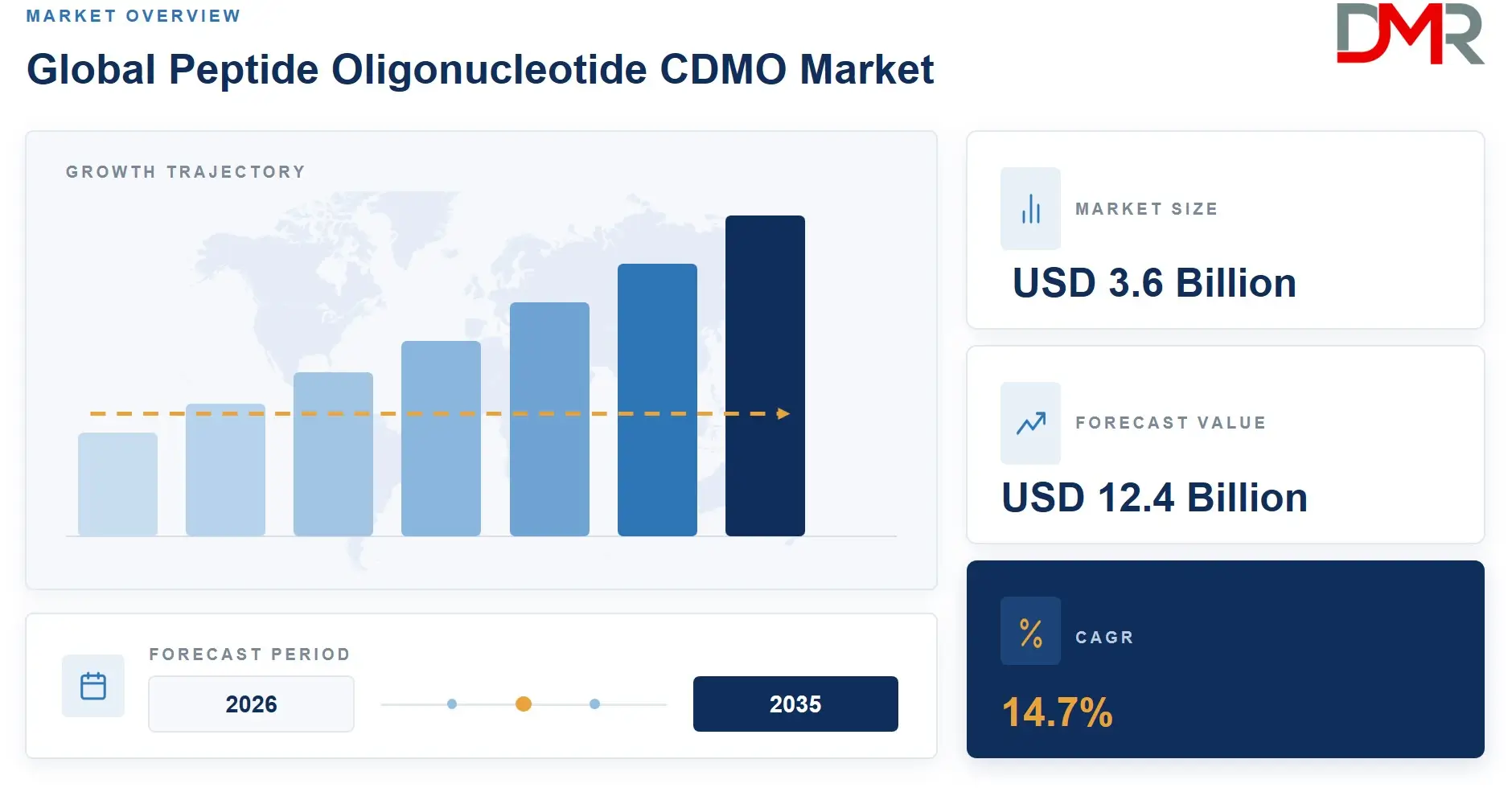
- Market Size (2026): USD 3.6 Bn
- Forecast Value (2035): USD 12.4 Bn
- CAGR (2026-2035): 14.7%
- Largest Region (2026): North America, approximately 43%
- Fastest-Growing Region: Asia-Pacific
- Leading Molecule Type (2026): Peptides, around 57%
- Leading Service Type (2026): API Manufacturing, close to 44%
- Key Players: Bachem, CordenPharma, PolyPeptide Group and others
What is Peptide Oligonucleotide CDMO Market and its Market Size?
Global Peptide Oligonucleotide CDMO Market size is estimated to reach USD 3.6 Bn in 2026 and is further anticipated to reach USD 12.4 Bn by 2035, at a CAGR of 14.7%.
ℹ
To learn more about this report –
Download Your Free Sample Report Here
This industry covers outsourced development and manufacturing services for therapeutic peptides, oligonucleotides and related conjugates, from route design and process optimization through active pharmaceutical ingredient production, analytical control and selected drug product support. Buyers use CDMOs when internal synthesis capacity, specialized chemistry, containment or quality systems would be slower or more expensive to build.
Demand is shaped by a widening clinical pipeline of RNA-targeted medicines, peptide therapeutics and conjugated modalities. Manufacturing economics depend on synthesis yield, purification efficiency, solvent consumption, raw material quality, scale-up reproducibility and the ability to meet stringent impurity profiles under GMP conditions.
Commercial differentiation is moving beyond reactor capacity. Sponsors increasingly value integrated development, analytical method transfer, regulatory documentation, secure raw material sourcing and the ability to move a molecule from early clinical batches to commercial volumes without changing manufacturing partners.
Use Cases
- Clinical Pipeline Scale-Up: Emerging biotechnology companies outsource route optimization and GMP batch production when a peptide or oligonucleotide candidate moves from discovery into human studies, reducing the need to build specialized synthesis suites before clinical proof is established.
- Commercial API Supply: Pharmaceutical companies use qualified CDMOs for recurring production of peptide and oligonucleotide APIs where validated purification, impurity control, batch traceability and dependable scheduling are required to support commercial medicine supply.
- Conjugated Therapeutics: Drug developers engage specialist partners for peptide-oligonucleotide conjugates and other complex constructs that require controlled coupling, orthogonal purification and analytical characterization across multiple molecular components.
- Lifecycle and Second-Source Manufacturing: Mature product owners add external manufacturing sites to diversify supply, manage demand peaks and reduce dependence on a single plant while preserving validated quality specifications and regulatory change control.
Key Takeaways
- Market Size & Share: North America is expected to account for roughly 43% of 2026 revenue.
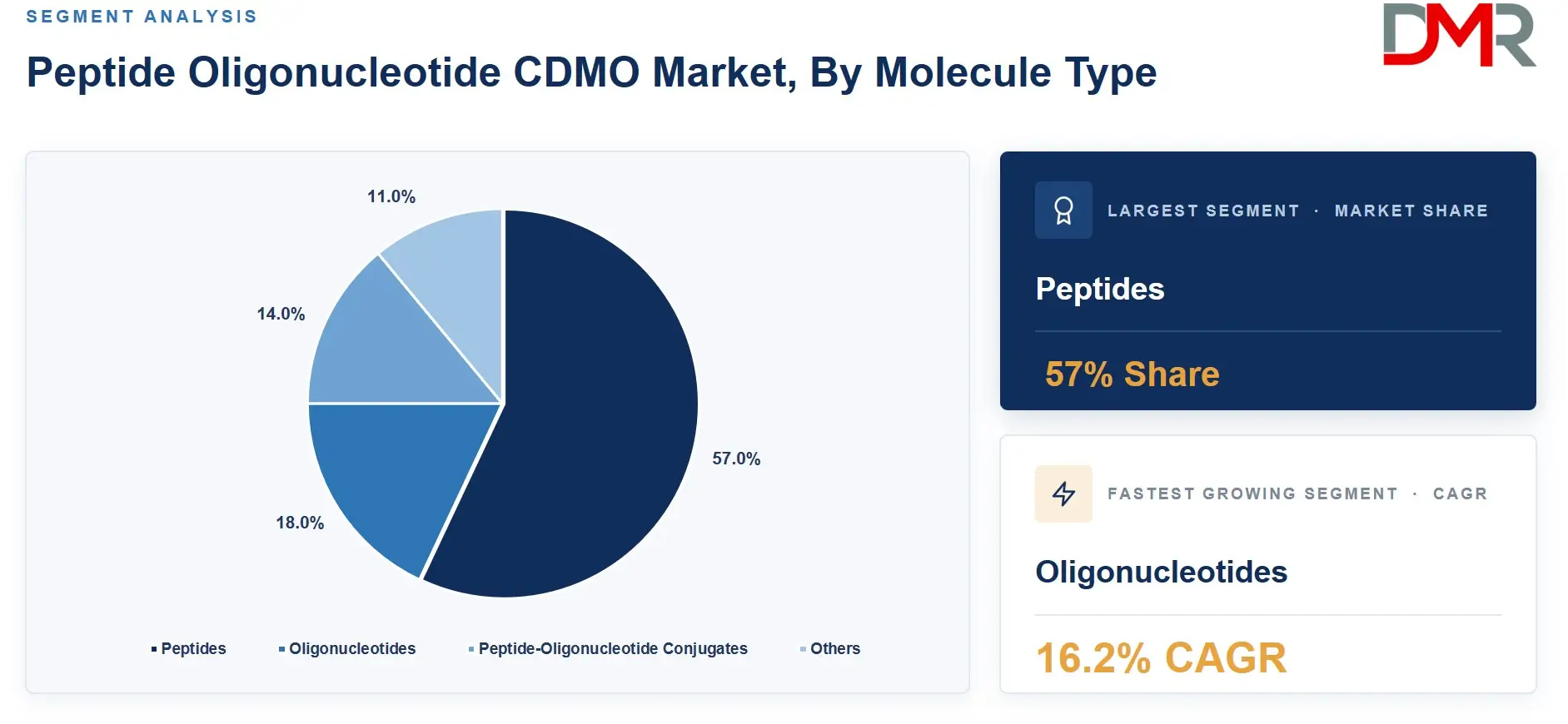
- Molecule Type Analysis: Peptides are projected to represent approximately 57% of 2026 demand.
- Regional Analysis: Asia-Pacific is the fastest-growing regional manufacturing and outsourcing base through 2035.
- Service Analysis: API manufacturing is set to hold around 44% of 2026 revenue.
- Technology Shift: Hybrid and enzymatic synthesis is forecast to expand at a CAGR of 18.1% through 2035.
How AI/Gen AI is Transforming the Peptide Oligonucleotide CDMO Market?
AI is being applied mainly to development efficiency rather than replacing chemistry expertise. Statistical learning can connect sequence characteristics, coupling conditions, impurity patterns and purification outcomes, helping development teams prioritize experiments and identify process windows with fewer physical iterations.
Generative models and language systems also support knowledge retrieval, batch record review and regulatory documentation, while predictive models can flag deviations before they become batch failures. Adoption remains bounded by data quality, validated workflows and the need for human review in GMP environments.
- Process Optimization: Machine learning screens multivariable synthesis and purification conditions.
- Quality Analytics: Models support impurity trend detection and deviation investigation.
- Documentation: LLM-based tools assist controlled retrieval and drafting from approved technical records.
- Capacity Planning: Forecasting models improve campaign scheduling across shared manufacturing assets.
Key Drivers in the Global Peptide Oligonucleotide CDMO Market
Pipeline expansion and outsourcing intensity are reinforcing each other as modality complexity rises.
- Expansion of Peptide and Oligonucleotide Pipelines: Peptides account for approximately 57% of 2026 molecule-type revenue, reflecting a broad installed base of development and commercial programs. New targets and delivery approaches increase the number of candidates requiring specialized synthesis, purification and analytical methods, which directs more sponsor spending toward experienced external manufacturers.
- Preference for Flexible External Capacity: Commercial-scale work represents around 61% of 2026 activity by scale. Building dedicated GMP synthesis and purification assets requires capital, specialist staff and long qualification cycles, so sponsors increasingly use CDMOs to add capacity, create second sources and match spending to program milestones.
Restraints in the Global Peptide Oligonucleotide CDMO Market
Growth is constrained by manufacturing complexity and by the economics of high-purity synthesis at scale.
- Yield and Purification Constraints: Solid-phase synthesis holds close to 66% of 2026 technology revenue, but longer or chemically difficult sequences can create deletion impurities and heavy solvent use. Purification losses can materially affect batch economics, forcing CDMOs to invest in process intensification and analytical control before scale-up is commercially attractive.
- Specialized Raw Material and Quality Requirements: Biopharmaceutical companies represent nearly 69% of 2026 end-user demand. These customers require tight change control, traceable reagents and reproducible impurity profiles, making supplier qualification lengthy and limiting rapid switching when protected amino acids, phosphoramidites, resins or specialized enzymes face constraints.
Growth Opportunities in the Global Peptide Oligonucleotide CDMO Market
White space is strongest where new modalities require capabilities that are not yet widely installed.
- Integrated Development for Emerging Biotech: Emerging biotechnology companies are forecast to expand at a CAGR of 17.4% through 2035. Providers that combine process development, analytics, GMP manufacturing and regulatory support can capture programs earlier and retain them as they move through clinical stages.
- Next-Generation Synthesis Platforms: Hybrid and enzymatic synthesis is projected to grow at 18.1% through 2035. Lower reagent intensity, improved selectivity and potential advantages for difficult sequences create openings for CDMOs that can industrialize these methods while preserving regulatory comparability.
Trends in the Global Peptide Oligonucleotide CDMO Market
Supplier strategies are shifting toward integrated platforms and more efficient chemistry.
- From Capacity Selling to Platform Partnerships: Development and analytical services are projected to grow at 17.0% through 2035. Sponsors increasingly prefer partners that can solve route, impurity and scale-up problems before manufacturing, making technical depth a stronger differentiator than reactor availability alone.
- Broader Modality Coverage: Oligonucleotides are expected to grow at a CAGR of 16.2% through 2035, faster than the overall industry. CDMOs are adding complementary synthesis, conjugation, purification and analytical capabilities so a single network can support multiple nucleic-acid and peptide formats.
Research Scope and Analysis
Segment performance is assessed across molecule type, service type, scale of operation, synthesis technology and end user. Each axis identifies where 2026 revenue is concentrated and which sub-segment is expected to expand fastest through 2035, together with the commercial mechanism behind each position.
ℹ
To learn more about this report –
Download Your Free Sample Report Here
By Molecule Type
Peptides are projected to hold the largest molecule share in 2026 at approximately 57%, supported by established therapeutic use, a broad development pipeline and mature solid-phase manufacturing know-how. Growth, however, is concentrated in oligonucleotides, expanding at a CAGR of 16.2% between 2026 and 2035 as RNA-targeted drug development increases demand for phosphoramidite chemistry, high-resolution purification and specialized analytical methods.
By Service Type
API manufacturing is expected to lead service revenue in 2026 with around 44%, because clinical and commercial programs require repeat GMP campaigns, validated release testing and reliable scale-up. The steeper trajectory sits with development and analytical services, forecast at a CAGR of 17.0% through 2035 as sponsors outsource route optimization, impurity characterization and method development earlier in the program lifecycle.
By Scale of Operation
Commercial scale is set to represent close to 61% of 2026 revenue, reflecting larger batch values, recurring supply agreements and extensive quality oversight. Growth is faster in clinical scale, at a CAGR of 16.8% through 2035, as a larger pipeline of novel peptide, oligonucleotide and conjugated candidates creates demand for flexible small-batch GMP capacity before commercial volumes are known.
By Synthesis Technology
Solid-phase synthesis is projected to account for roughly 66% of 2026 technology revenue due to established workflows, automation and broad sequence applicability. Growth, however, is concentrated in hybrid and enzymatic synthesis, advancing at a CAGR of 18.1% through 2035 as manufacturers pursue lower solvent consumption, improved selectivity and process routes that can address sequences where conventional chemistry becomes inefficient.
By End User
Biopharmaceutical companies are expected to generate nearly 69% of 2026 end-user demand because they maintain the largest portfolios of outsourced clinical and commercial programs. Emerging biotechnology companies are the fastest-growing group, with a CAGR of 17.4% through 2035, driven by asset-light development models and the need to access GMP infrastructure, analytical expertise and regulatory support without constructing internal plants.
The Global Peptide Oligonucleotide CDMO Market Report is Segmented Based on the Following
By Molecule Type
- Peptides
- Oligonucleotides
- Peptide-Oligonucleotide Conjugates
- Others
By Service Type
- Process Development
- Analytical & Formulation Services
- API Manufacturing
- Fill-Finish & Packaging
- Others
By Scale of Operation
- Preclinical & Discovery
- Clinical Scale
- Commercial Scale
- Others
By Synthesis Technology
- Solid-Phase Synthesis
- Liquid-Phase Synthesis
- Hybrid & Enzymatic Synthesis
- Others
By End User
- Large Pharmaceutical Companies
- Biopharmaceutical Companies
- Emerging Biotech Companies
- Academic & Research Institutes
- Others
Regional Analysis
Region with the Largest Revenue Share
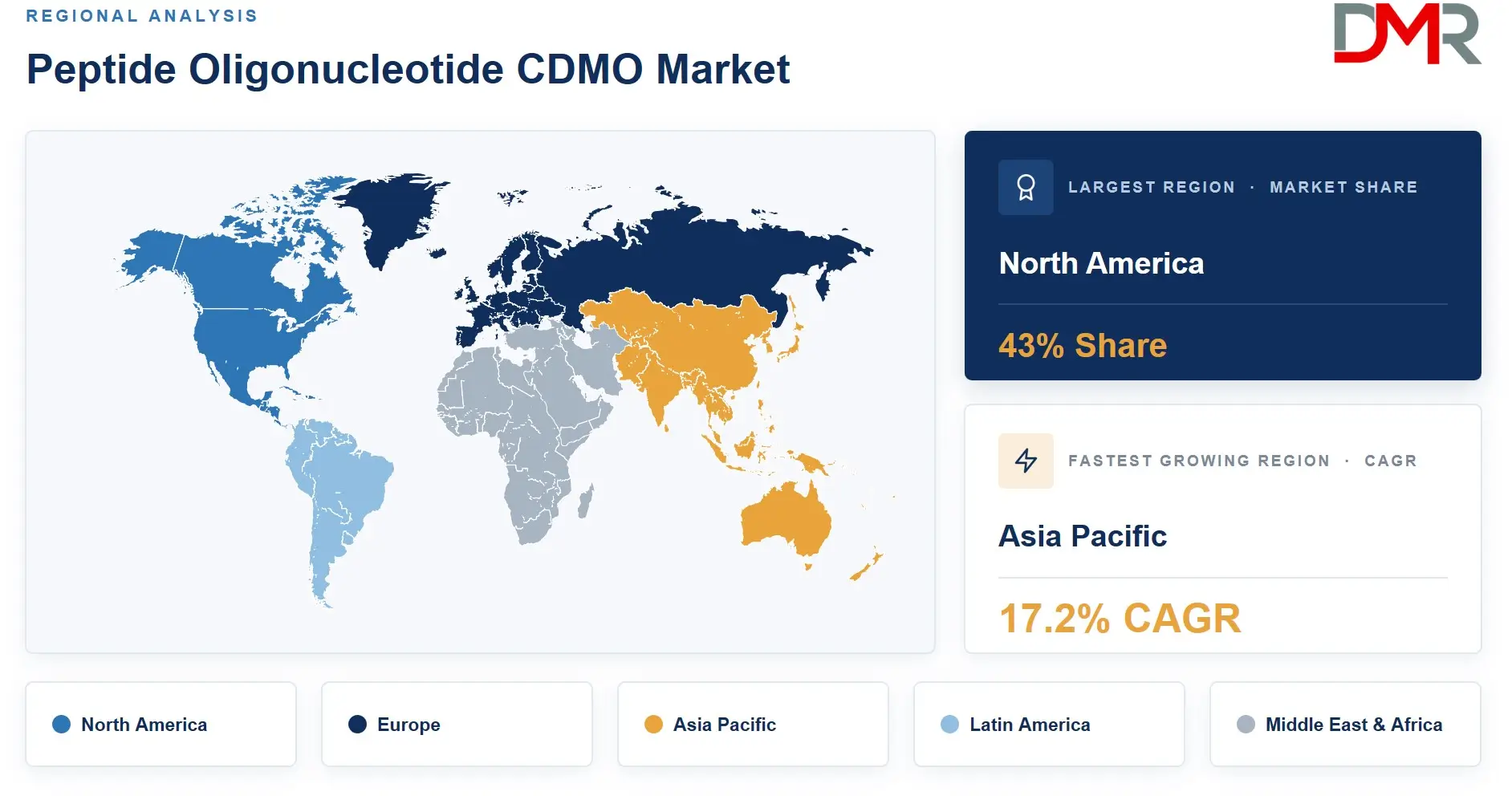
North America is expected to remain the largest region, accounting for approximately 43% of global revenue in 2026. The concentration reflects a deep biotechnology funding ecosystem, large clinical pipelines, established pharmaceutical procurement and substantial demand for outsourced GMP development. The US anchors regional spending through sponsor density and commercial medicine portfolios, while specialized CDMO networks support both domestic and international programs.
ℹ
To learn more about this report –
Download Your Free Sample Report Here
Region with the Highest CAGR
Asia-Pacific is forecast to record the highest regional CAGR at 17.2% between 2026 and 2035. Capacity additions in China and India, growing biotechnology pipelines, improving quality systems and competitive manufacturing economics are widening the region's role beyond early-stage chemistry. Japan, South Korea and Australia add demand from innovative therapeutics and clinical development, supporting a more diversified outsourcing base.
By Region
North America
Europe
- Germany
- France
- The UK
- Italy
- Spain
- Rest of Europe
Asia-Pacific
- China
- Japan
- India
- Australia
- South Korea
- Rest of APAC
Latin America
- Mexico
- Brazil
- Colombia
- Argentina
- Rest of LATAM
Middle East & Africa
- Saudi Arabia
- The UAE
- South Africa
- Rest of MEA
Regulatory Landscape
Peptide and oligonucleotide CDMOs operate within stringent GMP expectations covering starting materials, process validation, impurity characterization, analytical methods and data integrity. Requirements are becoming more demanding as conjugated and novel nucleic-acid modalities introduce complex impurity profiles and control strategies. Commercial openings favor manufacturers that can translate development knowledge into regulator-ready CMC packages and maintain consistent change control across sites. The main brake is qualification time, because new facilities, raw materials and process changes can require extensive comparability work. Strong regulatory execution therefore influences sponsor retention, technology transfer risk and the speed at which new capacity becomes revenue generating.
Patent Analysis
Intellectual property in this sector extends beyond therapeutic sequences into synthesis routes, protecting groups, conjugation chemistry, purification methods and enabling manufacturing technologies. The landscape is shifting as developers seek more efficient ways to produce longer, modified and conjugated molecules at scale. Commercial openings sit with CDMOs that can develop non-infringing process routes and contribute manufacturing know-how without compromising sponsor ownership of product IP. Risk rises when process choices intersect with protected chemistry or when technology transfer exposes confidential methods across multiple partners. Patent awareness therefore affects route selection, partnership structures and the competitive value of proprietary manufacturing platforms.
Competitive Landscape
Competition combines large integrated outsourcing groups with specialist peptide and oligonucleotide manufacturers. Scale matters for commercial supply, but sponsors also compare sequence complexity, purification capability, analytical depth, regulatory history, raw material sourcing and technology transfer performance. Leading providers are expanding synthesis and downstream capacity while adding development services that secure programs earlier. Specialists compete through technical expertise in difficult sequences, conjugation and flexible clinical manufacturing. Asian providers are increasing their share of development and manufacturing work as quality systems mature and customers diversify supply. Long-term positioning will depend on converting capacity additions into validated, high-utilization assets rather than simply adding nominal reactor volume.
Some of the Prominent Players in the Global Peptide Oligonucleotide CDMO Market Are
- Bachem
- CordenPharma
- PolyPeptide Group
- Lonza
- Thermo Fisher Scientific
- WuXi STA
- Ajinomoto Bio-Pharma Services
- Cambrex
- Piramal Pharma Solutions
- Evonik
- AmbioPharm
- CSBio
- CPC Scientific
- Almac Group
- Sterling Pharma Solutions
- Senn Chemicals
- JPT Peptide Technologies
- GenScript
- SynPeptide
- BCN Peptides
- Eurogentec
- Bio-Synthesis
- Creative Peptides
- Pepscan
- AnaSpec
- RiboBio
- Hongene Biotech
- STA Pharmaceutical
- Asymchem
- Porton Pharma Solutions
- Pharmaron
- Sai Life Sciences
- Neuland Laboratories
- Syngene International
- Dishman Carbogen Amcis
- Aragen Life Sciences
- Aurigene Pharmaceutical Services
- Nitto Avecia
- Agilent Technologies
- Kaneka Eurogentec
- Other Key Players
Recent Developments
- In March 2026, several leading peptide and oligonucleotide outsourcing groups continued multi-year capacity programs focused on larger synthesis trains, purification and analytical support, reflecting persistent sponsor demand for integrated clinical-to-commercial manufacturing.
- In October 2025, CDMO investment remained concentrated on peptide and oligonucleotide capacity, with providers emphasizing higher-throughput synthesis and downstream processing to address growing late-stage pipelines.
- In June 2025, manufacturers broadened development offerings around complex sequences and conjugates, aiming to retain sponsor programs from process design through GMP production.
- In November 2024, industry capacity expansion accelerated across North America, Europe and Asia-Pacific as suppliers prepared for a larger wave of peptide and nucleic-acid therapeutics entering clinical and commercial manufacturing.
Report Details
| Report Characteristics |
| Market Size (2026) |
USD 3.6 Bn |
| Forecast Value (2035) |
USD 12.4 Bn |
| CAGR (2026-2035) |
14.7% |
| The US Market Size (2026) |
USD 1.2 Bn |
| Historical Data |
2021 - 2025 |
| Forecast Data |
2026 - 2035 |
| Base Year |
2025 |
| Segments Covered |
By Molecule Type, By Service Type, By Scale of Operation, By Synthesis Technology and By End User |
| Regional Coverage |
North America - The US and Canada; Europe - Germany, France, The UK, Italy, Spain, Rest of Europe; Asia-Pacific - China, Japan, India, Australia, South Korea, Rest of APAC; Latin America - Mexico, Brazil, Colombia, Argentina, Rest of LATAM; Middle East & Africa - Saudi Arabia, The UAE, South Africa, Rest of MEA |
Frequently Asked Questions
How big is the Global Peptide Oligonucleotide CDMO Market?
▾ Global demand is estimated at USD 3.6 Bn in 2026. Outsourcing covers process development, analytical support, GMP API production and related services for peptide and oligonucleotide programs, with spending increasingly tied to complex sequences, conjugates and commercial supply requirements.
What is the growth rate of the Global Peptide Oligonucleotide CDMO Market?
▾ The industry is forecast to expand at a CAGR of 14.7% from 2026 to 2035, supported by expanding therapeutic pipelines, greater outsourcing intensity, new synthesis technologies and the need for flexible clinical and commercial manufacturing capacity.
Which region holds the largest share in the Global Peptide Oligonucleotide CDMO Market?
▾ North America is expected to lead with approximately 43% of 2026 revenue. Its position reflects dense biotechnology and pharmaceutical activity, significant clinical development spending, established outsourcing relationships and strong demand for GMP manufacturing and CMC support.
Which molecule type leads the market?
▾ Peptides are projected to hold around 57% of 2026 molecule-type revenue. Their lead is supported by established therapeutic applications, mature manufacturing workflows and a broad pipeline, while oligonucleotides are expanding faster as RNA-targeted programs scale.
Which service area is growing fastest?
▾ Development and analytical services are forecast to grow at a CAGR of 17.0% through 2035. Sponsors are moving outsourcing decisions earlier so process design, impurity control, analytical methods and scale-up planning can be integrated before GMP manufacturing begins.
Who are the key players in the Global Peptide Oligonucleotide CDMO Market?
▾ Prominent participants include Bachem, CordenPharma, PolyPeptide Group, Lonza, Thermo Fisher Scientific, WuXi STA and Ajinomoto Bio-Pharma Services. Competition centers on technical capability, validated capacity, regulatory execution, delivery reliability and the ability to support programs across development stages.
What defines the Peptide Oligonucleotide CDMO Market outlook?
▾ The Peptide Oligonucleotide CDMO Market outlook is defined by rising modality complexity, sponsor preference for asset-light development, capacity investment and tighter integration of process development with commercial manufacturing. Providers able to manage difficult chemistry, purification and regulatory documentation are positioned to capture a larger share of outsourced programs.